





























In today’s high-speed networking environments, flexibility, scalability, and reliability are essential for enterprise, data center, and carrier networks. At the core of many modern network architectures lies a compact but critical component: the SFP (Small Form-factor Pluggable) transceiver. Often called a mini-GBIC, an SFP enables network devices—such as switches, routers, and servers—to connect to a variety of media types, including copper Ethernet cables and fiber-optic links, while supporting a wide range of distances and speeds.
SFP modules provide modular flexibility, allowing network administrators to adapt existing hardware to evolving connectivity requirements without replacing the entire device. They also facilitate media conversion, transforming electrical signals from the host device into optical signals for fiber networks, or into alternate electrical formats for copper links. With multimode SFPs supporting distances up to 550 meters and single-mode variants reaching from 10 km to over 160 km depending on the standard (LX, EX, ZX), SFPs are crucial for both short-range intra-building connections and long-haul backbone deployments.
Beyond distance and speed, SFPs play a key role in high-speed uplinks, data center aggregation, and campus backbone design. Fiber-based SFPs are also inherently immune to electromagnetic interference (EMI), making them ideal for industrial environments or locations with significant electrical noise. By combining hot-swappability, standardized form factors, and multi-vendor compatibility under industry Multi-Source Agreements (MSAs), SFP modules simplify upgrades, spare management, and flexible deployment across diverse network topologies.
This article provides a comprehensive guide to understanding SFP modules, including their primary uses, common applications, technical operation, types, and selection criteria. It is intended for network engineers, IT decision-makers, and procurement teams seeking authoritative, accurate, and actionable insights into deploying SFP modules effectively in modern networks.
➡️ What Is an SFP Used For (Quick Overview)
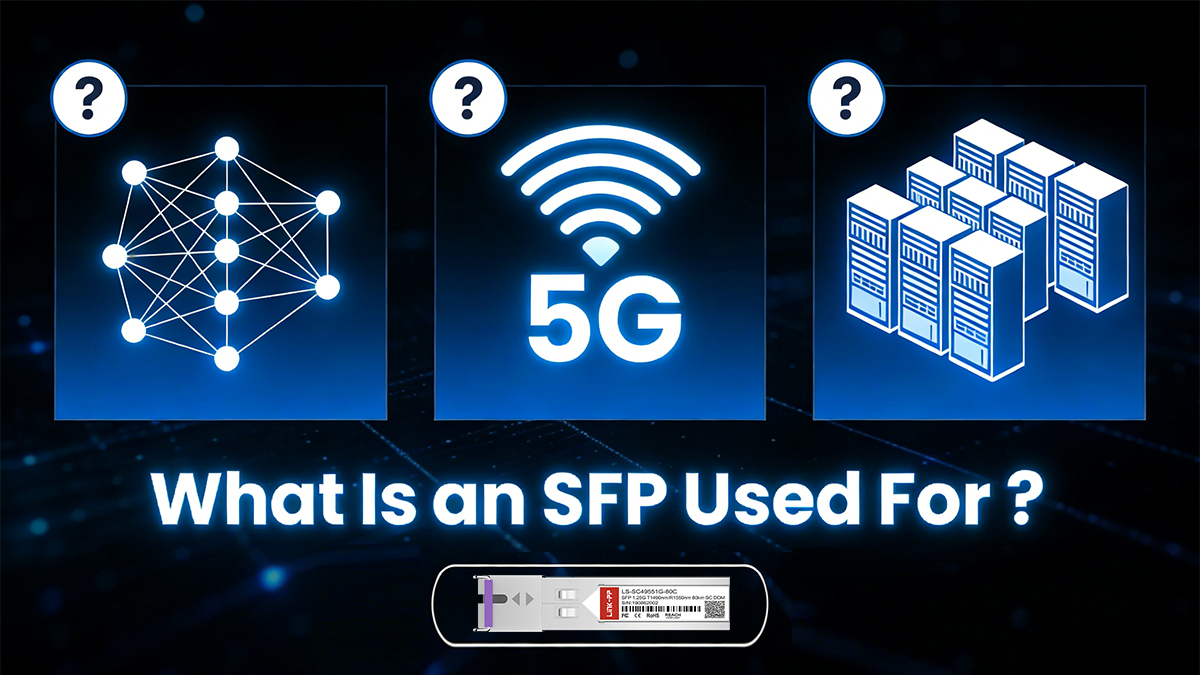
An Small Form-factor Pluggable module is a compact, hot-swappable transceiver designed to connect network devices—such as switches, routers, and servers—to different types of physical media, including fiber-optic cables and copper Ethernet cables. Its primary purpose is to provide modular flexibility, allowing a single network device to adapt to varying media types, link distances, and data rates by simply swapping the module, without replacing the entire chassis.
SFP modules also perform media conversion, translating electrical signals from the host device into optical signals for fiber or alternate electrical formats for copper links. This capability is essential for extending network reach: multimode fiber SFP Transcrivers typically support distances up to 550 meters, while single-mode fiber SFP Modules can span from 10 km to over 160 km depending on the optical standard (LX, EX, ZX).
Beyond distance, SFP modules enable high-speed uplinks and backbone connections, particularly in data centers, campus networks, and enterprise backbones. Fiber-based SFPs offer electromagnetic interference (EMI) immunity, making them ideal for industrial and electrically noisy environments. By combining hot-swappability, standardized form factors, and multi-vendor interoperability under industry Multi-Source Agreements (MSAs), SFP modules simplify network upgrades, spare management, and flexible deployment across diverse network topologies.
In summary, SFP modules serve as a versatile, scalable, and reliable solution for modern networking, bridging copper and fiber infrastructures, supporting varying distances and speeds, and enabling future-ready network designs.
➡️ Primary Uses of an SFP Module
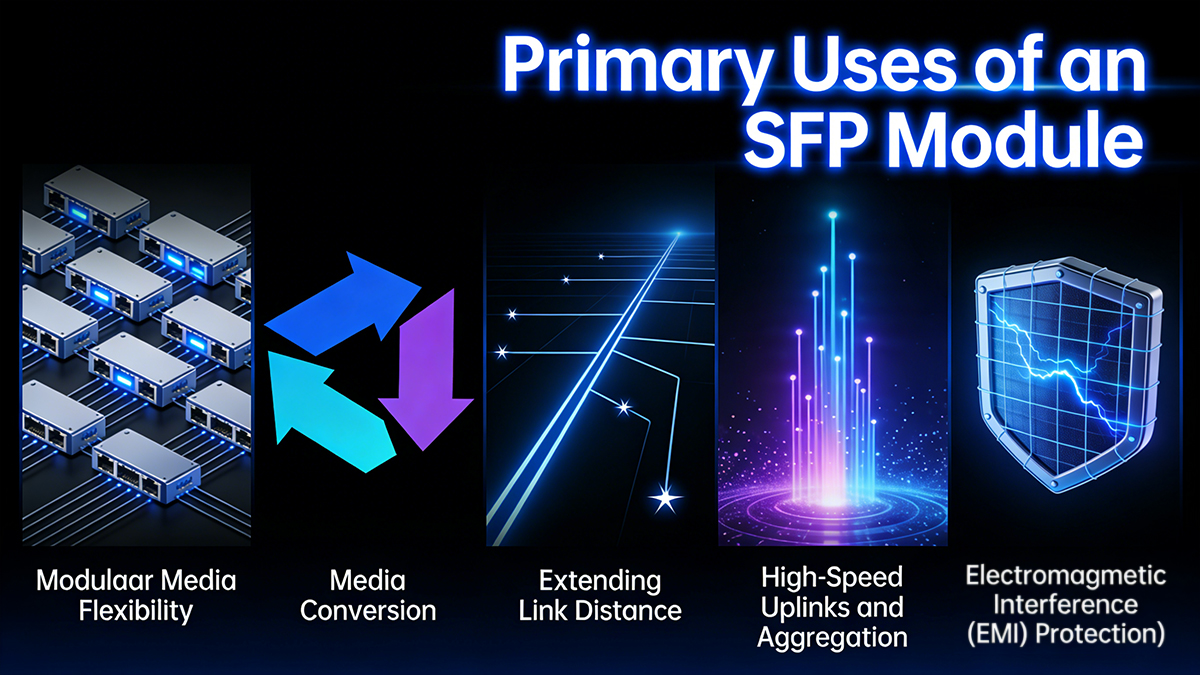
SFP Transceivers are widely used in modern networking environments due to their flexibility, scalability, and high performance. They allow network devices to accommodate changing requirements without replacing hardware, making them essential components in enterprise networks, data centers, telecommunications infrastructure, and industrial applications. The primary uses of an SFP module include:
1. Modular Media Flexibility
One of the core advantages of SFP modules is their ability to support multiple media types. A device with SFP slots can switch between fiber-optic or copper connections as needed, simply by installing the appropriate transceiver. This modularity enables network engineers to adapt to new standards, extend existing networks, or reconfigure infrastructure without purchasing new switches or routers.
2. Media Conversion
SFP modules perform electrical-to-optical conversion (for fiber links) or electrical-to-electrical conversion (for copper links), making them critical for integrating heterogeneous network segments. This function is particularly important in hybrid networks where both copper and fiber are deployed to balance cost, distance, and performance.
3. Extending Link Distance
Standard copper Ethernet cables are limited to 100 meters, but SFP modules allow for longer reach using fiber-optic transceivers:
-
Multimode SFP (SX): Typically support distances up to 550 meters.
-
Single-mode SFP (LX/EX/ZX): Support distances from 10 km to over 160 km, depending on the optical standard.
This makes SFPs indispensable for campus interconnections, metropolitan networks, and long-haul deployments.
4. High-Speed Uplinks and Aggregation
SFP modules support a range of speeds, from 1 Gbps (SFP) to 10 Gbps (SFP+), and even 25 Gbps (SFP28), making them ideal for uplinks between switches, server connections, and backbone links. Their use ensures that network traffic is aggregated efficiently, reduces congestion, and maintains high reliability in both data center and enterprise networks.
5. Electromagnetic Interference (EMI) Protection
Fiber-based SFP modules are immune to EMI, which can disrupt traditional copper connections. This makes them particularly suitable for industrial environments, manufacturing plants, and other electrically noisy settings, ensuring stable data transmission over long distances.
Summary Table: SFP Primary Uses
| Primary Use | Description | Typical Scenario |
|---|---|---|
| Modular Media Flexibility | Swap modules for fiber or copper | Mixed network deployments |
| Media Conversion | Electrical ↔ Optical / Electrical | Hybrid copper-fiber networks |
| Extending Link Distance | Multimode up to 550m, Single-mode up to 160km+ | Campus, MAN, WAN |
| High-Speed Uplinks | 1G / 10G / 25G | Data center aggregation, backbone |
| EMI Protection | Optical immunity to interference | Industrial & harsh environments |
➡️ Common Applications of SFP Modules
SFPs are a critical component in diverse networking environments, enabling high-speed, flexible, and reliable connections across a variety of industries. Their compact design and hot-swappable capability make them ideal for both enterprise-scale networks and high-performance data center architectures. The following are the most common applications of SFP modules:
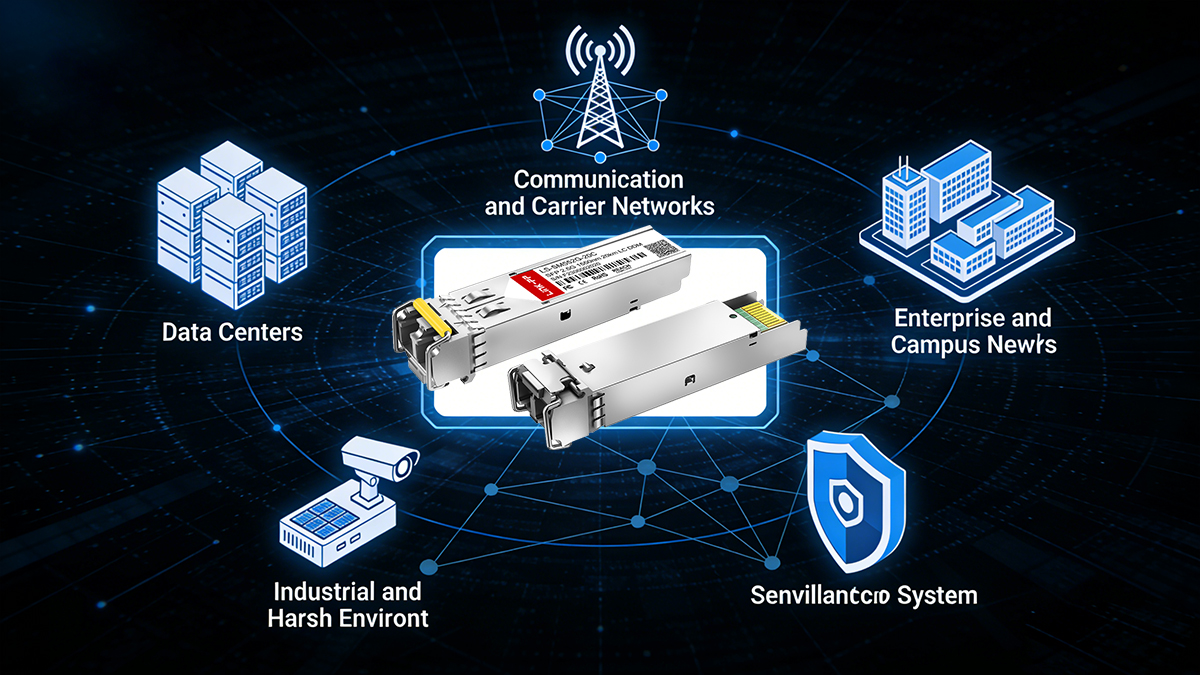
1. Data Centers
In modern data centers, SFP modules are widely deployed for high-speed uplinks, server-to-switch connections, and switch-to-switch aggregation links. Typical use cases include:
-
Top-of-Rack (ToR) connections: SFP+ modules provide 10 Gbps uplinks between racks.
-
Core switch interconnects: QSFP modules (40/100 Gbps) aggregate multiple lanes for backbone traffic.
-
Storage networking: Fiber SFPs support SAN connectivity, ensuring low-latency and high-throughput for storage arrays.
Benefits: Hot-swappability reduces downtime, and modularity allows quick upgrades as traffic demands grow.
2. Telecommunications and Carrier Networks
Telecom operators rely on SFP modules to build long-distance and high-capacity MAN/WAN links. Key points include:
-
Single-mode fiber SFPs enable distances from 10 km to over 160 km.
-
Dense Wavelength Division Multiplexing (DWDM) compatibility allows multiple SFPs to transmit different wavelengths on a single fiber for cost-efficient scaling.
-
SFP28 modules support up to 25 Gbps per channel for high-throughput backbone links.
Advantages: Reliability over long distances, flexibility to mix multimode and single-mode connections, and compliance with industry MSAs for multi-vendor interoperability.
3. Enterprise and Campus Networks
SFP modules provide the flexibility needed for inter-building and inter-floor connectivity, often bridging network segments that exceed copper cable limits. Examples include:
-
University campuses: Fiber SFPs link academic buildings and dormitories for gigabit networking.
-
Corporate campuses: Modular SFPs allow offices to scale bandwidth without replacing switches.
-
Branch offices: Copper RJ45 SFPs connect nearby floors or buildings over short distances up to 100 meters.
Key Benefit: Supports hybrid networks with both copper and fiber, enabling cost-effective upgrades and future scalability.
4. Industrial and Harsh Environments
Fiber-based SFP modules are preferred in electrically noisy or high-interference environments. Key technical points:
-
EMI and RFI immunity ensures stable communication in power plants, manufacturing floors, and transportation hubs.
-
Temperature-tolerant modules can operate in extended ranges (typically -40°C to +85°C) for industrial SFP optical modules.
-
Redundant network design: Hot-swappable SFPs allow quick replacement without network downtime.
Impact: Reliable network operation in environments where standard copper Ethernet could fail due to interference or extreme conditions.
5. Surveillance and Security Systems
High-definition video surveillance demands high-bandwidth and low-latency connections. SFP modules support:
-
Multimode fiber (SX) for short-range campus deployments up to 550 meters.
-
Single-mode fiber (LX/EX/ZX) for city-wide or remote monitoring up to 160 km.
-
Multiple camera aggregation: One switch port with SFP uplink can carry multiple high-definition video streams.
Advantages: Minimizes signal degradation over distance, supports real-time video streaming, and enables flexible network topology for security systems.
Summary Table: Common SFP Applications
| Application Area | Typical Use Case | Common SFP Type | Speed / Bandwidth | Transmission Distance | Key Advantages |
|---|---|---|---|---|---|
| Data Centers | Server-to-switch, switch aggregation, SAN storage | SFP+, QSFP, SFP28 | 1 Gbps – 100 Gbps | Up to 100 m (copper), 550 m (multimode fiber), 10–160 km (single-mode fiber) | Hot-swappable, modular, supports high-speed uplinks, reduces downtime |
| Telecom & Carrier Networks | MAN/WAN links, long-haul fiber connections, DWDM aggregation | Single-mode fiber SFP, SFP28 | 1 Gbps – 25 Gbps | 10 km – 160+ km | High reliability, long distance, multi-vendor interoperability |
| Enterprise & Campus Networks | Building-to-building, floor-to-floor backbone, branch office connections | Multimode fiber SFP, Copper RJ45 SFP | 1 Gbps – 10 Gbps | 100 m (copper), 550 m (multimode fiber), 10 km+ (single-mode fiber) | Flexible hybrid networks, cost-effective upgrades, scalable |
| Industrial Networks | Manufacturing, power plants, transportation systems | Fiber SFP (industrial grade) | 1 Gbps – 10 Gbps | 550 m (multimode), 10–160 km (single-mode) | EMI/RFI immunity, extended temperature tolerance (-40°C to +85°C), reliable in harsh environments |
| Surveillance & Security | HD video transmission, city-wide surveillance, campus security | Multimode fiber (SX), Single-mode fiber (LX/EX/ZX) | 1 Gbps – 10 Gbps | 550 m (multimode), 10–160 km (single-mode) | Minimal signal degradation, low latency, supports multiple camera streams |
➡️ How SFP Works (Technical Explanation)
An SFP (Small Form-factor Pluggable) module operates as a media transceiver, converting electrical signals from a network device into optical signals for fiber connections, or into alternate electrical formats for copper connections. The module plugs into a standardized SFP port on switches, routers, or servers, providing a flexible interface that can be hot-swapped without interrupting network operations.
Electrical-to-Optical Conversion
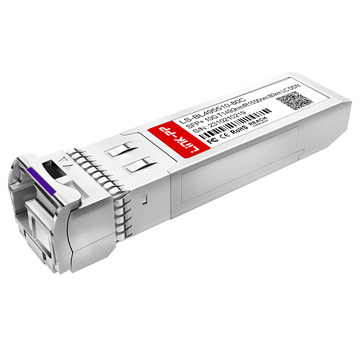
Fiber SFP modules contain a laser diode or vertical-cavity surface-emitting laser (VCSEL) to transmit data over optical fiber. Incoming optical signals are received by a photodiode and converted back into electrical signals for the host device. This process enables high-speed, long-distance data transmission while minimizing signal degradation and eliminating electromagnetic interference (EMI).
Electrical-to-Electrical Conversion
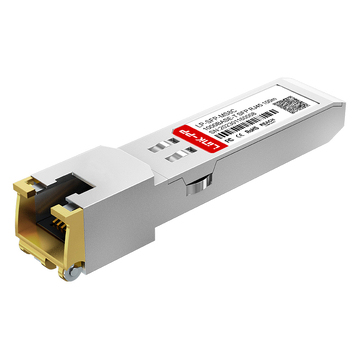
Copper SFP modules (commonly RJ45-based) perform signal retiming and conditioning to interface with twisted-pair Ethernet cables (Cat5e, Cat6, or Cat6a). These modules support standard 1000Base-T or 10GBase-T protocols, providing reliable short-range connectivity (up to 100 meters) while maintaining compatibility with existing Ethernet infrastructure.
Hot-Swappable Design
SFP modules adhere to industry Multi-Source Agreements (MSAs), ensuring that modules from different vendors can be inserted or removed without powering down the host device. This feature enables rapid network upgrades, easy replacement of faulty modules, and minimal downtime for critical infrastructure.
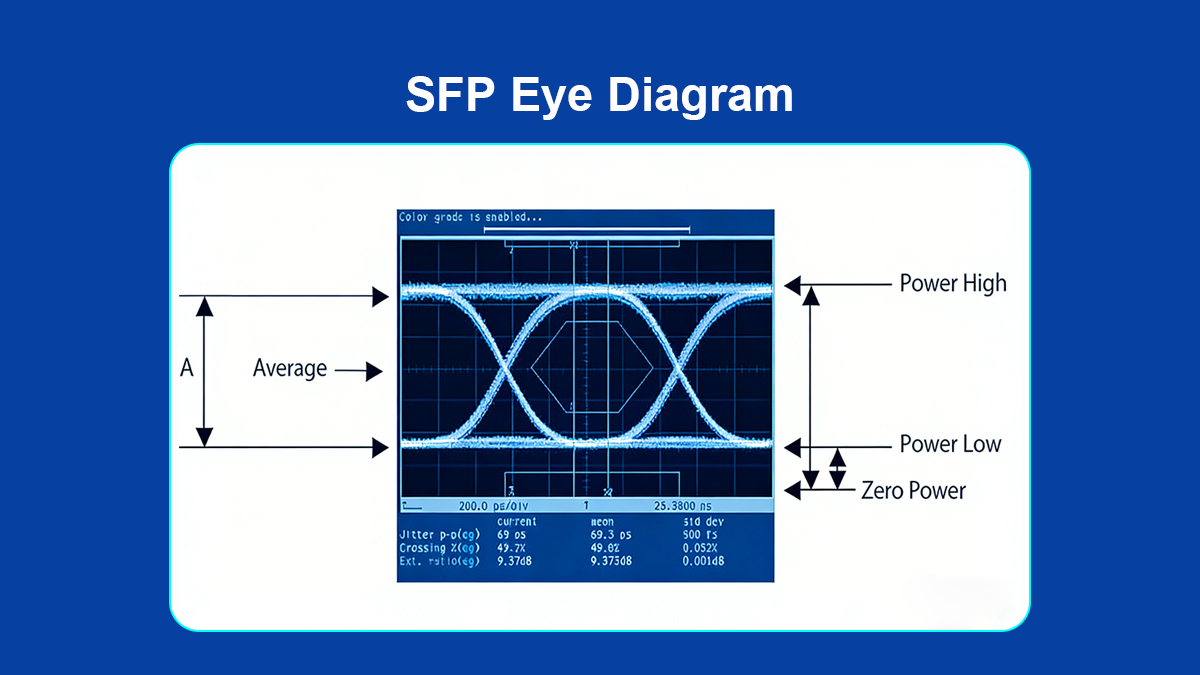
Digital Diagnostics and Monitoring (DDM/DOM)
Modern SFP modules often include Digital Diagnostic Monitoring (DDM) or Digital Optical Monitoring (DOM) functionality. These features allow network administrators to monitor:
-
Transmit and receive optical power (dBm)
-
Laser bias current and voltage
-
Module temperature
-
Signal integrity metrics
DDM/DOM provides real-time visibility into the health and performance of the network link, reducing troubleshooting time and improving operational reliability.
Speed and Compatibility
SFP modules are available in multiple data rates and variants:
They are compatible with multimode (SX) and single-mode (LX/EX/ZX) fiber, as well as copper RJ45 connections, providing the flexibility to design networks that meet both distance and bandwidth requirements.
SFP Functions
| Function | Description | Typical Parameters |
|---|---|---|
| Optical Transmission | Converts electrical signals to light for fiber | Laser type: VCSEL/DFB, Wavelength: 850/1310/1550 nm |
| Optical Reception | Converts light back to electrical signals | Photodiode sensitivity: -24 to -3 dBm |
| Copper Interface | Electrical signal conditioning for RJ45 | Standards: 1000Base-T, 10GBase-T, max 100 m |
| Hot-Swap | Insert/remove without powering down | MSA compliant |
| Monitoring | DDM/DOM for real-time diagnostics | Voltage, current, temperature, Tx/Rx power |
➡️ SFP Types, Wavelengths, and Transmission Distance
SFPs are available in a variety of types and standards, optimized for different data rates, fiber media, and transmission distances. Understanding these distinctions is essential for network planning, device compatibility, and performance optimization.
| SFP Type | Media | Wavelength | Typical Reach | Data Rate | Common Applications |
|---|---|---|---|---|---|
| SFP (MMF) | Multimode Fiber (SX) | 850 nm | Up to 550 m | 1 Gbps | Campus, intra-building, short-range uplinks |
| SFP (SMF) LX | Single-Mode Fiber | 1310 nm | 10 km | 1 Gbps | Inter-building, metropolitan area networks |
| SFP (SMF) EX | Single-Mode Fiber | 1310 nm | 40 km | 1 Gbps | Long-distance campus or carrier links |
| SFP (SMF) ZX | Single-Mode Fiber | 1550 nm | 80–160 km | 1 Gbps | WAN, long-haul backbone connections |
| SFP+ | Fiber (MMF/SMF) | 850/1310/1550 nm | 10 km (SMF) | 10 Gbps | Data center uplinks, switch aggregation |
| SFP28 | Fiber (SMF) | 1310/1550 nm | 10–40 km | 25 Gbps | High-speed enterprise or data center networks |
| QSFP/QSFP28 | Fiber (SMF) | 850/1310 nm | 10–40 km | 40–100 Gbps | Backbone aggregation, high-throughput links |
| RJ45 Copper SFP | Twisted-Pair (Cat5e/Cat6) | N/A | Up to 100 m | 1–10 Gbps | Short-range server/switch connectivity |
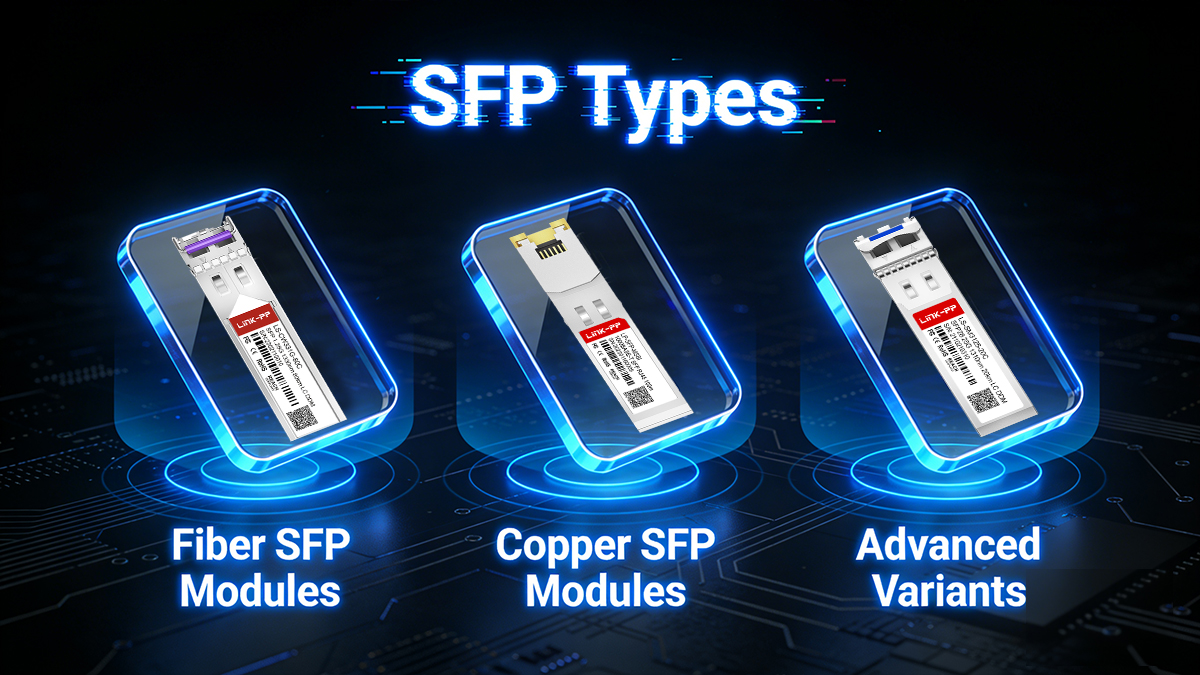
● Fiber SFP Modules
Fiber SFPs are classified by fiber type, wavelength, and reach:
-
Multimode Fiber (MMF SX): Designed for short-distance connections, typically up to 550 meters. Operates at 850 nm wavelength, commonly used for intra-building links, top-of-rack switch connections, and campus networks.
-
Single-Mode Fiber (SMF, LX/EX/ZX): Supports long-distance connections from 10 km to over 160 km, depending on the module class. Operates at 1310nm (LX/EX) or 1550nm (ZX) wavelength. Ideal for MAN/WAN links, inter-data center connectivity, and metropolitan networks.
-
DWDM SFP: Enable multiple optical wavelengths on a single fiber for long-haul, high-capacity networks. DWDM modules allow dense wavelength division multiplexing, increasing fiber utilization and network scalability.
● Copper SFP Modules
Copper SFPs provide RJ45 Ethernet connectivity for short-range links:
-
Typically support 1000Base-T (1 Gbps) or 10GBase-T (10 Gbps) standards.
-
Maximum reach is 100 meters over Cat5e, Cat6, or Cat6a twisted-pair cables.
-
Ideal for connecting servers, switches, or network segments within a building where fiber is not required.
● Advanced Variants
-
SFP+: Enhanced SFP supporting up to 10 Gbps, commonly used for data center uplinks and backbone aggregation.
-
SFP28: Supports 25 Gbps for next-generation high-speed networks.
-
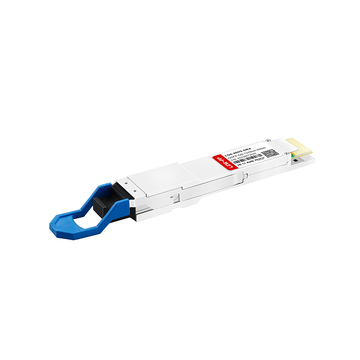
QSFP/QSFP28: “Quad” modules combining four channels for 40–100 Gbps, ideal for switch-to-switch high-throughput links.
➡️ How to Choose the Right SFPs for Your Network
Selecting the right SFP module requires balancing network requirements, physical infrastructure, performance targets, and long-term scalability. Rather than choosing by price alone, engineers and network planners should evaluate the following key factors.
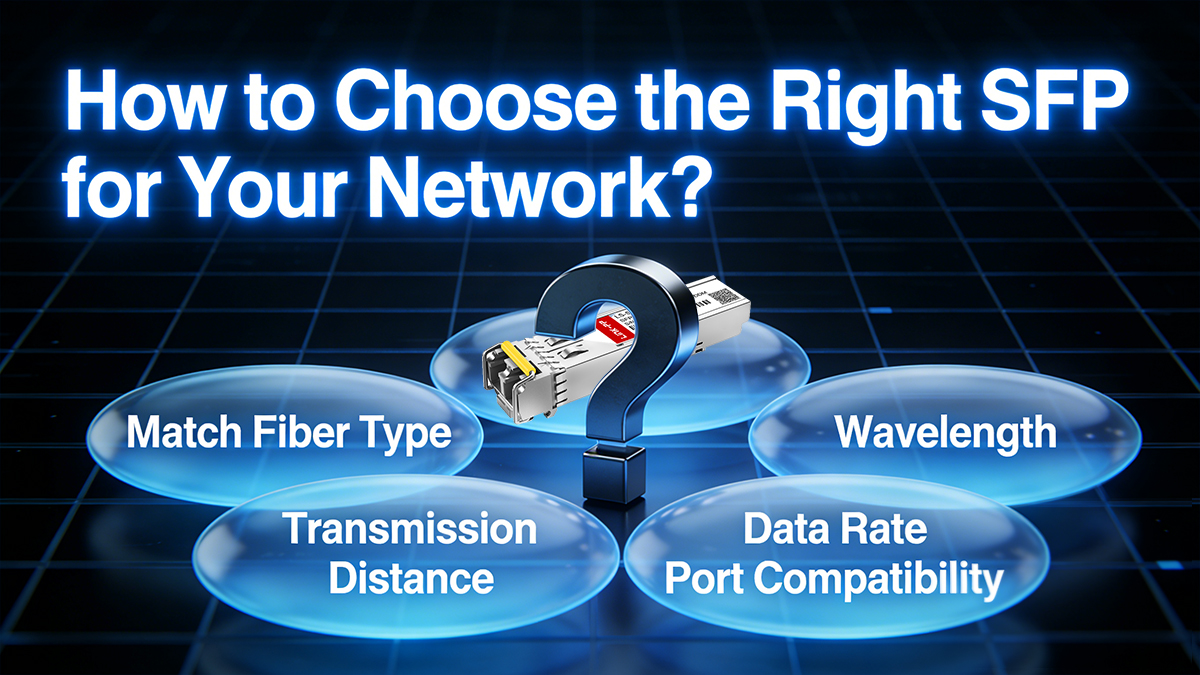
☆ Determine Required Data Rate and Port Compatibility
Start by identifying the maximum supported speed of the host device’s SFP port:
-
SFP ports support 1 Gbps
-
SFP+ ports support 10 Gbps
-
SFP28 ports support 25 Gbps
Using a lower-speed module in a higher-speed port is often supported, but inserting a higher-speed module into an unsupported port will not function. Always confirm switch or router specifications before deployment.
☆ Match Fiber Type and Transmission Distance
The choice between multimode and single-mode fiber is driven primarily by distance and cabling availability:
-
Multimode fiber (MMF, SX, 850 nm): Up to 550 m, cost-effective for short-range links within buildings or data centers.
-
Single-mode fiber (SMF, LX/EX/ZX): 10 km to 160+ km, ideal for campus, metro, or long-haul connections.
Selecting an SFP with excessive reach can increase cost unnecessarily, while insufficient reach may cause link instability.
☆ Select the Appropriate Wavelength
SFP modules operate at standardized wavelengths, which must match the fiber plant and peer device:
-
850 nm – Multimode fiber (short-range)
-
1310 nm – Single-mode fiber (medium-range)
-
1550 nm – Single-mode fiber (long-range)
For DWDM applications, each SFP uses a specific ITU wavelength channel, enabling multiple links over a single fiber pair.
☆ Consider Environmental and Reliability Requirements
For deployments in challenging conditions, consider industrial SFP modules:
-
Operating temperature ranges typically from -40°C to +85°C
-
Enhanced resistance to vibration, humidity, and EMI
These modules are commonly used in industrial automation, transportation, and outdoor telecom enclosures.
☆ Evaluate Monitoring and Diagnostic Features
Modern networks benefit from Digital Diagnostic Monitoring (DDM/DOM), which allows administrators to track:
-
Optical transmit and receive power
-
Module temperature and voltage
-
Laser bias current
DDM helps with preventive maintenance, faster troubleshooting, and long-term network reliability.
☆ Verify Interoperability and Vendor Compatibility
Although SFP modules follow MSA (Multi-Source Agreement) standards, some network vendors enforce compatibility checks. When selecting an SFP module:
-
Confirm whether the device supports third-party or compatible SFPs
-
Ensure EEPROM coding matches vendor requirements if necessary
-
Test interoperability in critical deployments before full rollout
Choosing the right SFP module ensures stable performance, cost efficiency, and future scalability. A well-matched SFP reduces troubleshooting time, improves uptime, and extends the usable life of your network infrastructure.
➡️ SFP Standards, Interoperability, and Compatibility Notes
SFP modules are designed to be vendor-agnostic and interoperable, but real-world deployments often involve standards compliance, MSA definitions, and vendor-specific enforcement. Understanding these factors helps avoid compatibility issues and ensures reliable network operation.
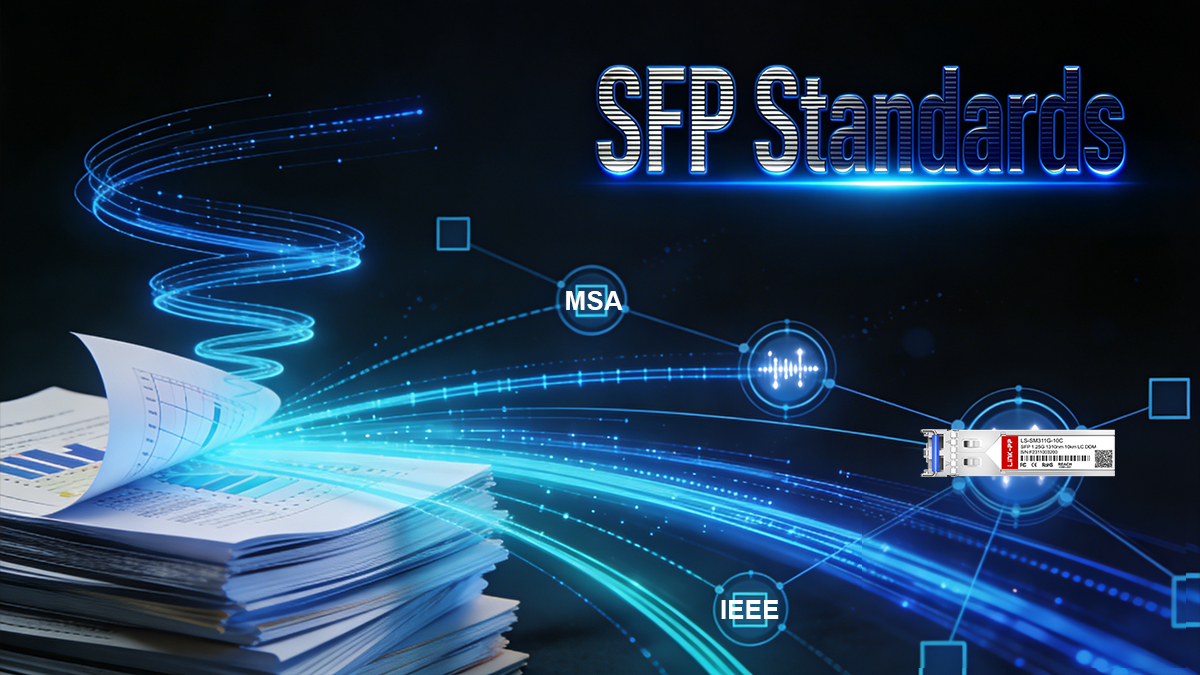
1. Multi-Source Agreement (MSA) Compliance
Most SFP modules are built according to industry MSAs, which define:
-
Mechanical form factor and electrical interface
-
Optical characteristics (wavelength, power levels)
-
EEPROM memory structure and diagnostics support
MSA compliance allows SFP modules from different manufacturers to work in the same SFP port, enabling multi-vendor sourcing and supply chain flexibility.
2. IEEE Ethernet Standards
SFP modules implement Ethernet physical layer standards defined by the IEEE 802.3 family, including:
-
1000BASE-SX / LX for 1 Gbps fiber
-
10GBASE-SR / LR for 10 Gbps SFP+
-
25GBASE-SR / LR for SFP28
Adherence to IEEE standards ensures link stability, predictable performance, and cross-vendor interoperability when both ends of the link follow the same specification.
3. Vendor Compatibility and Port Locking
Despite MSA and IEEE standards, some network equipment vendors implement vendor-specific compatibility checks:
-
The switch or router may verify the SFP’s EEPROM data
-
Unsupported or unrecognized modules may trigger warnings or be disabled
-
Advanced features such as DOM/DDM may be restricted
In these cases, vendor-coded or certified compatible SFP modules are often required to ensure full functionality.
4. Third-Party and Compatible SFP Modules
High-quality third-party SFP modules are widely used and offer:
-
Cost savings compared to OEM modules
-
MSA-compliant hardware and optics
-
EEPROM programming matched to specific vendor platforms
When selecting third-party SFPs, it is critical to verify:
-
Compatibility with the exact device model and firmware version
-
Support for required diagnostics (DOM/DDM)
-
Proven deployment history in similar network environments
5. Cross-Vendor Link Interoperability
In most cases, SFP modules from different vendors can interoperate if:
-
Data rate, wavelength, and fiber type are identical
-
Optical power budgets are compatible
-
Both modules comply with the same IEEE standard
For long-distance or DWDM links, additional validation is recommended to ensure optical power balance and wavelength accuracy.
Key takeaway:
While SFP modules are built on open standards, compatibility depends on both standards compliance and vendor implementation. Verifying interoperability in advance reduces deployment risk, improves uptime, and protects long-term network reliability.
➡️ SFP Modules Installation and Troubleshooting Tips
Proper installation and systematic troubleshooting are essential to ensure stable performance and long-term reliability of SFP modules. Although SFPs are designed to be plug-and-play, many link issues result from handling errors, mismatched specifications, or environmental factors.
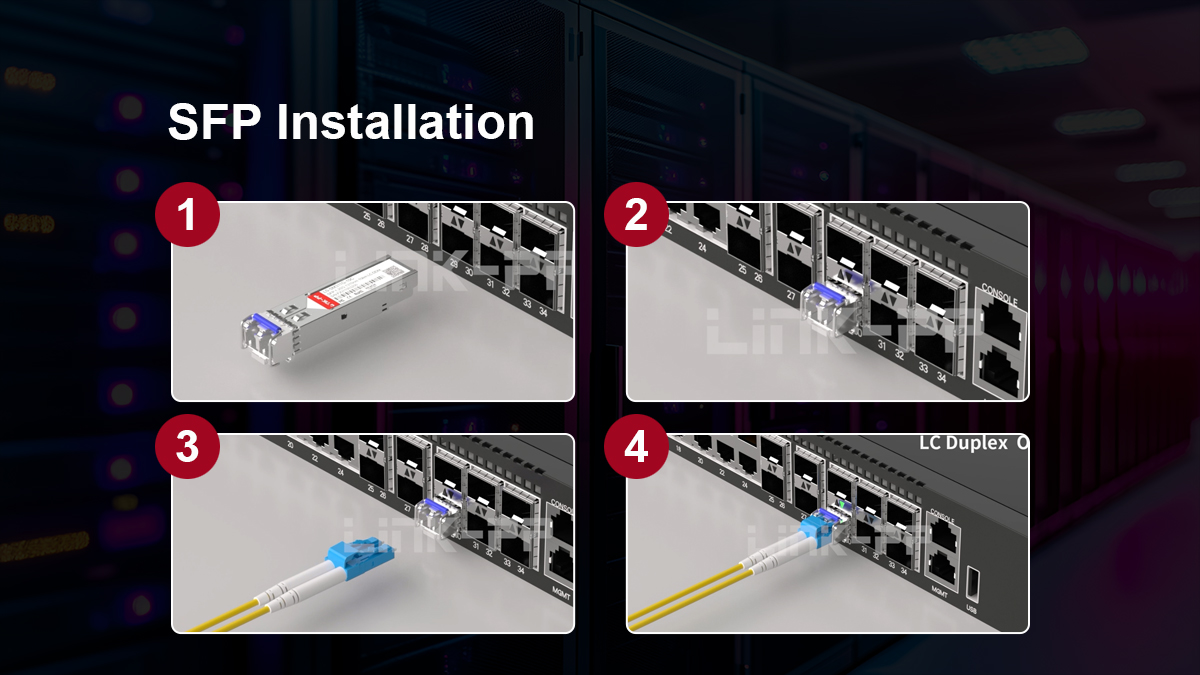
▷ Best Practices for SFP Installation
Before inserting an SFP module, verify that the module type, speed, and wavelength match the host device and the remote endpoint.
Installation steps:
-
Insert the SFP module gently into the SFP port until it clicks into place.
-
Ensure the latch or bail clasp is fully engaged.
-
Clean fiber connectors before connecting patch cords.
-
Match Tx to Rx when connecting fiber links.
-
Secure fiber cables to avoid excessive bending or tension.
Handling notes:
-
Avoid touching optical interfaces to prevent contamination.
-
Keep protective dust caps on unused ports.
-
Follow ESD precautions during installation.
▷ Common Installation Mistakes
Many SFP-related issues can be traced to simple configuration or handling errors:
-
Installing an unsupported speed module in the SFP port
-
Using multimode fiber with single-mode SFPs, or vice versa
-
Connecting fibers with incorrect polarity (Tx/Rx reversed)
-
Exceeding the minimum or maximum supported transmission distance
-
Ignoring vendor compatibility requirements
▷ Troubleshooting Link and Signal Issues
When a link does not come up or experiences instability, use a structured troubleshooting approach:
Basic checks:
-
Confirm the SFP is recognized by the switch or router
-
Verify both ends of the link use the same standard and wavelength
-
Check fiber cleanliness and connector condition
Advanced diagnostics:
-
Use DDM/DOM to inspect Tx/Rx optical power levels
-
Compare measured power against the module’s specified operating range
-
Look for abnormal temperature or voltage readings
▷ Optical Power Budget Considerations
Incorrect optical power levels can cause intermittent or failed links:
-
Underpowered signals may indicate excessive fiber loss or dirty connectors
-
Overpowered signals can occur on very short links with long-reach SFPs
In short-distance deployments, optical attenuators may be required to bring power levels within the acceptable range.
▷ Environmental and Reliability Checks
For industrial or outdoor installations:
-
Confirm the SFP’s operating temperature range meets site conditions
-
Ensure proper airflow and cooling around high-density switch ports
-
Avoid excessive vibration or mechanical stress on fiber connections
Most SFP issues can be resolved through correct specification matching, clean fiber handling, and DDM-based diagnostics. Following structured installation and troubleshooting practices significantly reduces downtime and maintenance effort.
➡️ FAQ About SFP Transceivers

Q1: What Is an SFP Used For?
An SFP (Small Form-factor Pluggable) module is used to connect network devices such as switches and routers to fiber or copper cables, enabling flexible, hot-swappable network connectivity.
Q2: What Devices Use SFP Modules?
SFP modules are commonly used in:
-
Ethernet switches
-
Routers
-
Network interface cards (NICs)
-
Firewalls and load balancers
Q3: What Is the Difference Between SFP and SFP+?
-
SFP: Supports data rates up to 1 Gbps
-
SFP+: Supports data rates up to 10 Gbps and is commonly used for data center uplinks
Q4: How Far Can an SFP Module Transmit Data?
Transmission distance depends on the SFP type:
-
Copper SFP (RJ45): Up to 100 m
-
Multimode fiber (SX): Up to 550 m
-
Single-mode fiber (LX/EX/ZX): 10 km to 160+ km
Q5: Can I Mix Different SFP Brands?
Yes, as long as the modules are MSA-compliant and supported by the host device. Some vendors require vendor-coded compatible SFPs.
Q6: Are SFP Modules Hot-Swappable?
Yes. SFP modules are designed to be inserted and removed without powering down the host device.
Q7: Do All SFP Modules Support DDM/DOM?
Not all. Many modern SFPs support Digital Diagnostic Monitoring (DDM/DOM), but support depends on the module and platform.
➡️ SFP in Network Conclusion
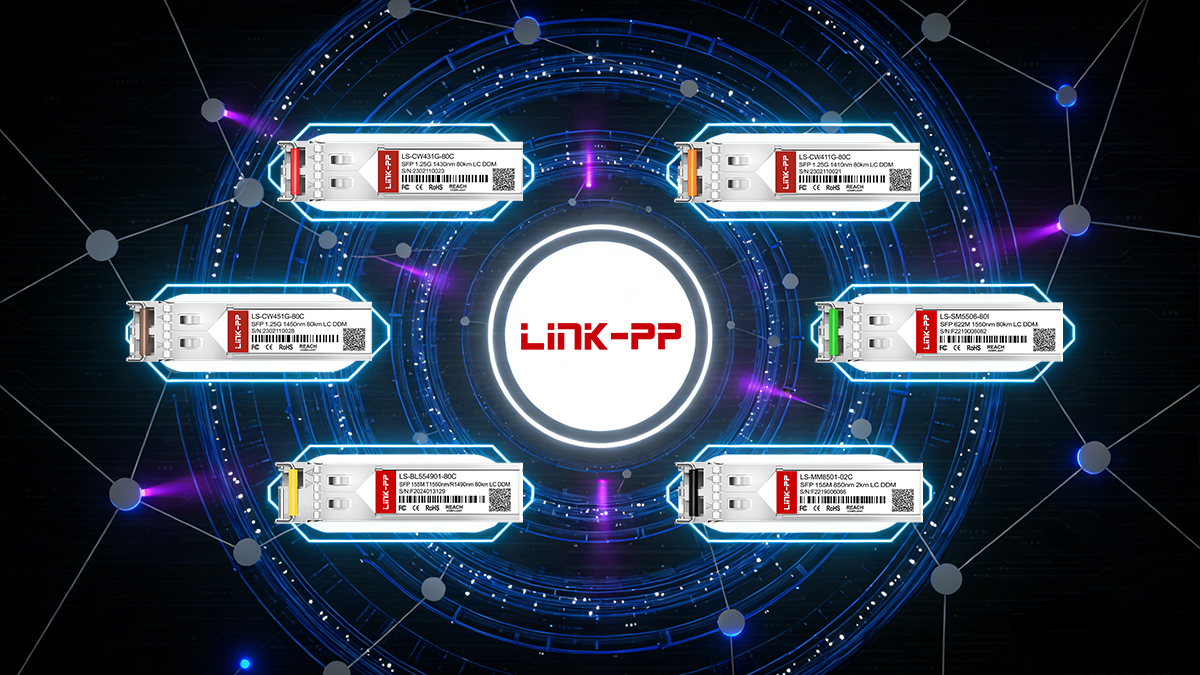
SFP modules play a critical role in modern network design, offering unmatched flexibility, scalability, and performance across data centers, enterprise networks, telecom infrastructure, and industrial environments. By selecting the right SFP type, wavelength, and transmission distance, network engineers can build reliable and future-ready networks without unnecessary hardware replacement.
Understanding how SFP modules work, how they comply with industry standards, and how to install and troubleshoot them effectively helps reduce downtime and optimize long-term network performance.
? For engineers and network designers looking for reliable, standards-compliant SFP solutions, explore compatible optical modules, technical documentation, and application support at the LINK-PP Official Store, where products are engineered for real-world deployment and long-term reliability.