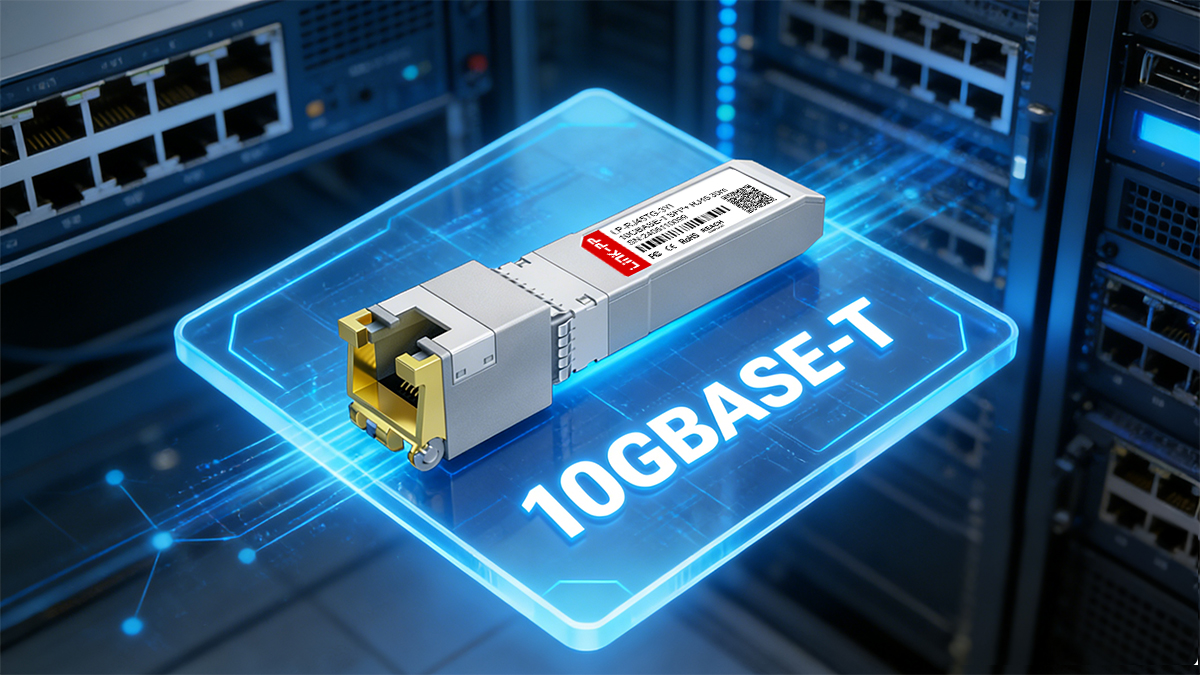
10GBASE-T is the IEEE-standard 10-Gigabit Ethernet technology that delivers 10 Gbps over twisted-pair copper cabling, enabling high-speed networking using familiar RJ45 infrastructure. It is widely used in enterprise networks, data centers, and campus environments where fiber deployment is costly or operationally complex. With proper cabling (Cat6a), certification, and thermal planning, 10G SFP+ copper module provides a scalable and standards-based upgrade path from 1G networks while maintaining backward compatibility and operational simplicity.
As enterprise networks, data centers, and cloud infrastructures continue to scale, 10-gigabit Ethernet (10GbE) has become a foundational requirement rather than a premium upgrade. Among the various 10G physical layer options, 10GBASE-T Module stands out as the most widely adopted copper-based Ethernet standard, enabling high-speed connectivity over familiar RJ45 cabling.
Standardized under IEEE 802.3an, 10GBASE-T allows organizations to deploy 10 Gbps Ethernet using twisted-pair copper cables (Cat6a, Cat7, and above), preserving existing cabling investments while delivering a tenfold bandwidth increase over Gigabit Ethernet. This combination of performance, compatibility, and operational simplicity makes 10G copper module a dominant choice for server access, enterprise switching, campus backbones, and edge network upgrades.
However, 10GBASE-T is not without trade-offs. Compared with optical 10G solutions such as SFP+ fiber modules and DAC cables, copper-based 10G links introduce higher power consumption, increased latency, and more demanding thermal requirements. These factors directly affect network design, switch selection, rack density, and long-term operational costs.
A clear technical understanding of how 10GBASE-T works, its cabling constraints, performance boundaries, and deployment best practices is essential for engineers, system architects, and procurement professionals aiming to build scalable, stable, and cost-efficient 10G networks.
What You Will Learn in This Guide
By the end of this technical guide, you will clearly understand:
-
What 10GBASE-T is, how it works, and how it differs from fiber-based 10G standards
-
Key technical specifications, including speed, latency, power consumption, and cabling limits
-
Cat6 vs Cat6a vs Cat7 performance differences and real-world deployment distances
-
Engineering best practices for designing reliable 10G copper links
-
Common pitfalls and compatibility risks in enterprise and data center deployments
-
How to select and validate 10GBASE-T transceivers and network equipment for production environments
This guide is designed for network engineers, data center architects, IT managers, system integrators, and procurement specialists seeking accurate, practical, and deployment-ready knowledge of 10G SFP+ RJ45 Transceiver.
⭐ What Is 10GBASE-T?
10GBASE-T is an IEEE-defined Ethernet standard that enables 10-gigabit-per-second (10 Gbps) data transmission over twisted-pair copper cabling, using standard RJ45 connectors. It belongs to the 10-Gigabit Ethernet (10GbE) family and is formally standardized as IEEE 802.3an.
Unlike optical 10GbE variants such as 10GBASE-SR or 10GBASE-LR, which rely on multimode or single-mode fiber, 10GBASE Copper Module runs over familiar copper cabling (Cat6a / Cat7 / Cat8), making it the most backward-compatible and operationally flexible 10GbE interface for enterprise networks, data centers, and industrial environments.
1. Formal Definition & IEEE Standardization
10GBASE-T is defined under IEEE 802.3an-2006, specifying:
-
Data rate: 10 Gbps (full duplex)
-
Medium: Balanced twisted-pair copper cable
-
Connector: 8P8C modular connector (RJ45)
-
Maximum distance:
-
100 m on Cat6a / Cat7
-
55 m on Cat6 (high-quality installations only)
-
-
Signaling: PAM-16 (16-level Pulse Amplitude Modulation)
IEEE designation breakdown:
| Component | Meaning |
|---|---|
| 10G | 10 Gigabits per second |
| BASE | Baseband signaling |
| T | Twisted-pair copper cabling |
The standard was ratified in 2006, addressing enterprise demand for high-speed Ethernet without fiber migration, while maintaining compatibility with structured copper cabling systems.
2. Why 10GBASE-T Exists
Before 10GBASE-T, upgrading to 10GbE typically required fiber infrastructure, which introduced:
-
Higher deployment cost
-
Fiber handling complexity
-
Specialized installation requirements
-
Increased maintenance overhead
10GBASE-T was designed to extend 10GbE to existing copper environments, enabling:
-
Reuse of structured copper cabling
-
Simple RJ45-based connectivity
-
Lower operational complexity
-
Easier incremental upgrades
This made 10GBASE-T the natural upgrade path from 1GBASE-T and 1000BASE-T, preserving familiar network architecture and troubleshooting practices.
3. Core Specifications (At a Glance)
| Parameter | Specification |
|---|---|
| Standard | IEEE 802.3an |
| Line rate | 10.3125 Gbps |
| Net data rate | 10 Gbps |
| Duplex mode | Full duplex |
| Encoding | PAM-16 |
| Cable types | Cat6a, Cat7, Cat8 |
| Max distance | 100 m (Cat6a+) |
| Connector | RJ45 |
| Auto-negotiation | Supported |
| Backward compatibility | 1000BASE-T / 100BASE-TX / 10BASE-T |
4. What Problem Did 10GBASE-T Solve? (Engineering Motivation)
Before 10GBASE-T, achieving 10G speeds required optical fiber or expensive CX4 copper assemblies, creating high deployment barriers for:
-
Enterprise LAN upgrades
-
Campus backbone networks
-
Top-of-rack (ToR) server connectivity
Key Engineering Goals of 10GBASE-T
| Design Objective | Engineering Value |
|---|---|
| RJ45 backward compatibility | Reuse structured cabling |
| 100 m reach | Match traditional Ethernet distances |
| EMI robustness | Office & industrial environments |
| Auto-negotiation | Seamless speed fallback |
Industry impact:
10GBASE-T made 10G Ethernet economically viable for large enterprise adoption, not just data centers.
5. Common Physical Implementations
10GBASE-T is delivered in two major hardware forms:
1) 10GBASE-T Switch Ports (Native RJ45)
-
Found on enterprise switches and NICs
-
Integrated PHY
-
Higher power but lower overall system cost
2) 10GBASE-T SFP+ Modules
-
Copper transceivers inserted into SFP+ ports
-
Enable RJ45 connectivity on fiber-oriented switches
-
Typical power: 2.3–2.8 W
-
Used for:
-
Switch interconnect bridging
-
Gradual copper → fiber migration
-
Mixed-media environments
-
6. Key Advantages and Limitations
♦ Advantages
-
Uses existing copper cabling
-
RJ45 interface — universal familiarity
-
Excellent backward compatibility
-
Simplified troubleshooting
-
Lower cabling cost
Backward Compatibility
One of 10G copper Module’s greatest advantages is automatic backward compatibility:
| Speed | Supported |
|---|---|
| 10GBASE-T | ✅ |
| 5GBASE-T | ✅ |
| 2.5GBASE-T | ✅ |
| 1000BASE-T | ✅ |
| 100BASE-TX | ✅ |
This allows auto-negotiation across multiple speeds, making it ideal for mixed-speed enterprise environments.
♦ Limitations
-
Higher power consumption than fiber
-
Increased heat output
-
Higher port latency (~2–3 µs vs ~0.3 µs fiber)
-
Shorter reach than optical standards
In high-density switch deployments, 10GBASE-T thermal density becomes a major design factor. Engineers often limit copper port density per line card or rely on active airflow optimization, especially when using SFP+ copper transceivers. This is why many hyperscale data centers prefer fiber-based 10GbE for scale deployments, while enterprises continue favoring 10GBASE-T for operational simplicity.
⭐ Key Technical Specifications of 10GBASE-T
10GBASE-T is standardized under IEEE 802.3an, defining the physical layer (PHY) for 10 Gigabit Ethernet transmission over twisted-pair copper cabling. Compared with fiber-based 10GbE standards, 10Gb RJ45 SFP+ introduces more complex signal processing, higher power consumption, and stricter cabling requirements, making correct parameter understanding essential for network design, equipment selection, and deployment planning.
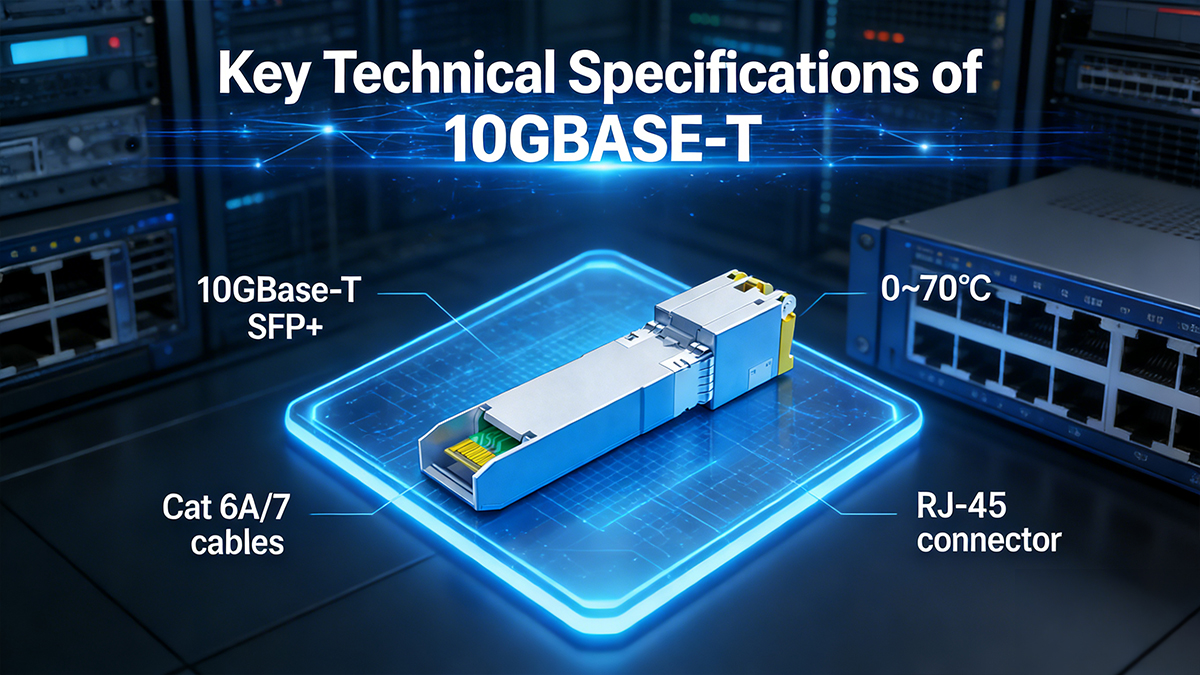
Core Electrical & Performance Parameters
The following table summarizes the most critical electrical and performance characteristics of 10G Copper links, verified against IEEE 802.3an and leading PHY vendor specifications.
| Parameter | Typical Value | Engineering Notes |
|---|---|---|
| Line rate | 10 Gbps | Full-duplex Ethernet |
| Encoding | PAM-16 | 16-level pulse amplitude modulation |
| Symbol rate | 800 Msymbol/s per pair | Across 4 twisted pairs |
| Cable type | Cat6a / Cat7 / Cat8 | Cat6a recommended baseline |
| Connector | RJ45 (8P8C) | Backward compatible |
| Max distance | 100 m | 90 m permanent + 10 m patch |
| Typical latency | 2–3 μs | PHY + FEC processing |
| Typical power | 3–6 W per port | PHY dependent |
Technical Explanation
To achieve 10 Gbps transmission within the bandwidth constraints of copper cabling, SFP+ 10GBASE-T employs PAM-16 modulation combined with advanced DSP and forward error correction (FEC). This enables high spectral efficiency but introduces:
-
Higher computational complexity
-
Increased power draw
-
Additional link latency
Insight:
Compared to optical PHYs using 64b/66b encoding, 10Gb Copper Module requires heavy real-time digital signal processing, including echo cancellation, crosstalk suppression, and LDPC-based FEC — directly impacting power and thermal budgets.
Cabling & Channel Requirements
Cable selection is the single most critical factor affecting 10GBASE-T performance and long-term stability.
| Cable Type | Max Distance @10G | Deployment Suitability |
|---|---|---|
| Cat6 | 55 m | Short links, controlled noise |
| Cat6a | 100 m | Recommended production baseline |
| Cat7 | 100 m | Shielded, industrial / enterprise |
| Cat8 | 30 m | High-density data center TOR |
Cat6a is widely recognized as the practical baseline for full-length copper SFP+ deployments.
Why Cat6a Matters
-
500 MHz channel bandwidth
-
Significantly reduced alien crosstalk (AXT)
-
Better impedance stability
-
Improved EMI suppression
Deployment Best Practice:
For enterprise networks and data centers targeting 100 m channel reach with long-term reliability, Cat6a should be considered the minimum standard, while Cat7 and Cat8 are preferred in high-noise or ultra-dense rack environments.
Power Consumption & Thermal Design Considerations
One of the defining engineering characteristics of 10GBASE-T is its high PHY power consumption, driven primarily by complex DSP workloads.
Typical Power Consumption Comparison
| Implementation | Typical Power |
|---|---|
| Early 10GBASE-T PHY | 6–8 W |
| Modern 10GBASE-T PHY | 3–5 W |
| SFP+ fiber module | 0.8–1.5 W |
| SFP+ DAC cable | <0.5 W |
Thermal Impact
Compared with fiber-based 10G solutions, 10GBASE-T generates 2–4× more heat per port, resulting in:
-
Higher switch inlet temperature
-
Increased fan speed and noise
-
Reduced maximum port density
Best Practice:
High-density 10GBASE-T deployments require active airflow management, front-to-back cooling alignment, and careful port spacing to avoid thermal throttling or premature hardware aging.
Latency Characteristics & Application Impact (Optional Section)
The heavy signal processing pipeline inside 10GBASE-T PHYs introduces measurably higher latency compared with optical links.
| Interface | Typical PHY Latency |
|---|---|
| 10GBASE-SR / LR (fiber) | ~300–500 ns |
| 10GBASE-T | ~2–3 μs |
Application Impact
-
Enterprise LAN: negligible
-
Storage networks: minor
-
HPC & HFT: significant
Deployment Guidance:
10GBASE-T is well suited for enterprise access, server connectivity, and TOR switching, but not optimal for ultra-low-latency workloads such as high-frequency trading or GPU cluster interconnects.
⭐ How 10GBASE-T Works — PHY Architecture & Signal Flow Explained
10GBASE-T achieves 10 Gbps full-duplex transmission over twisted-pair copper cabling by combining high-order modulation, advanced digital signal processing (DSP), and powerful forward error correction (FEC). This architecture is significantly more complex than fiber-based 10G PHYs and is the primary reason for its higher power consumption, thermal footprint, and latency.
Understanding the internal signal flow helps network engineers and system designers optimize cabling, select compatible switches, and avoid deployment pitfalls.
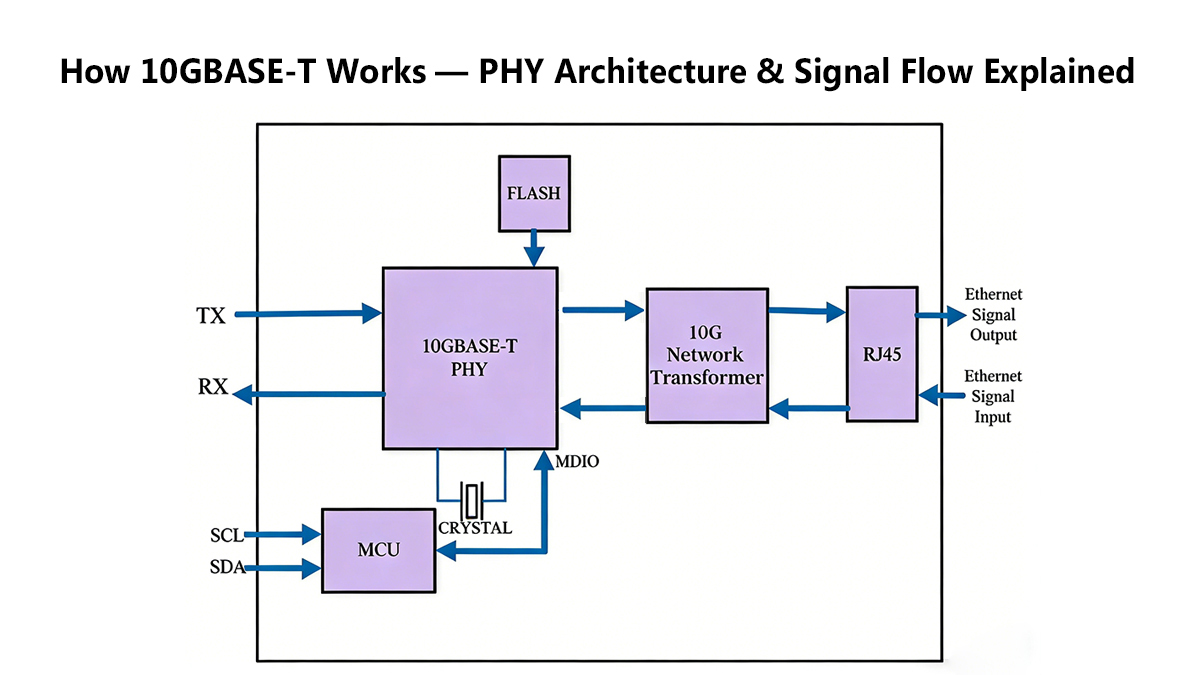
▶ End-to-End Signal Processing Pipeline
At the physical layer, 10G copper SFP+ implements a multi-stage DSP pipeline designed to mitigate the fundamental limitations of copper transmission, including attenuation, echo, crosstalk, and electromagnetic interference (EMI).
Simplified PHY Signal Flow
Key Functional Blocks
| Block | Function | Engineering Purpose |
|---|---|---|
| PCS | Line coding & framing | Maintain data integrity |
| FEC (LDPC) | Error correction | Compensate copper noise |
| PAM16 | High-density modulation | Increase spectral efficiency |
| DSP Engine | Echo & crosstalk cancellation | Enable 100 m reach |
| AFE | Analog signal conditioning | Drive copper channel |
▶ PAM-16 Modulation Explained (Why 16-Level Encoding Matters)
To fit 10 Gbps throughput into the limited bandwidth of twisted-pair copper, 10GBASE-T employs PAM-16 (Pulse Amplitude Modulation with 16 levels).
Why PAM16 Is Necessary
| Modulation | Bits per Symbol | Spectral Efficiency |
|---|---|---|
| NRZ | 1 | Low |
| PAM4 | 2 | Moderate |
| PAM16 | 4 | Very High |
By encoding 4 bits per symbol, PAM16 allows 10GBASE-T to:
-
Achieve 10 Gbps throughput
-
Operate within 500 MHz channel bandwidth
-
Maintain backward-compatible cabling infrastructure
▶ Forward Error Correction (LDPC) & Link Reliability
10G copper transceiver integrates Low-Density Parity-Check (LDPC) FEC, one of the most powerful error correction methods used in modern digital communications.
Role of FEC in 10GBASE-T
-
Corrects bit errors caused by:
-
Alien crosstalk (AXT)
-
Electromagnetic interference (EMI)
-
Impedance discontinuities
-
-
Extends usable reach to 100 meters
-
Enables BER ≤ 1 × 10⁻¹² target performance
Engineering Trade-off
| Benefit | Penalty |
|---|---|
| High link reliability | Added latency (~1–2 μs) |
| Extended cable reach | Increased silicon complexity |
| Improved noise immunity | Higher power consumption |
▶ Echo Cancellation & Crosstalk Suppression
Copper Ethernet channels suffer from two dominant impairments:
-
Echo: Reflections of transmitted signals returning to the receiver
-
Crosstalk: Interference from adjacent twisted pairs
SFP+ RJ45 Module PHYs incorporate multi-dimensional adaptive filtering algorithms to suppress both.
Echo Cancellation
-
Eliminates self-interference from full-duplex operation
-
Requires continuous adaptive coefficient updates
Crosstalk Cancellation
-
Suppresses:
-
Near-End Crosstalk (NEXT)
-
Far-End Crosstalk (FEXT)
-
Alien Crosstalk (AXT)
-
Note:
These adaptive DSP functions account for a significant portion of the PHY’s real-time computational workload, directly contributing to power draw and heat generation.
▶ Analog Front-End (AFE) & Channel Equalization
The AFE bridges digital processing and physical copper transmission, handling:
-
Line driving
-
Signal amplification
-
Equalization
-
Impedance matching
Key Design Goals
| Goal | Purpose |
|---|---|
| Impedance matching | Reduce reflections |
| Pre-emphasis | Compensate high-frequency loss |
| Adaptive equalization | Correct cable dispersion |
| EMI suppression | Improve regulatory compliance |
Poor PCB layout, improper magnetics selection, or low-quality RJ45 connectors can negate even the most advanced PHY algorithms, leading to unstable links and excessive packet errors.
▶ Why 10GBASE-T Has Higher Latency and Power Than Fiber
Latency Breakdown
| Component | Approx. Contribution |
|---|---|
| FEC decoding | 1–1.5 μs |
| DSP filtering | 0.5–1 μs |
| AFE processing | 0.3–0.5 μs |
| Total PHY latency | ~2–3 μs |
Power Drivers
-
PAM16 digital processing
-
Adaptive echo & crosstalk cancellation
-
Continuous LDPC decoding
This explains why:
10GBASE-T SFP+ consumes 2–4× more power and introduces 5–10× more PHY latency than fiber-based 10G solutions.
⭐ 10GBASE-T vs. SFP+ Fiber vs. DAC
When selecting a 10G physical layer, engineers must balance distance, power, latency, cabling cost, and scalability.
The three dominant options are 10GBASE-T, SFP+ fiber, and SFP+ DAC — each optimized for different deployment scenarios.
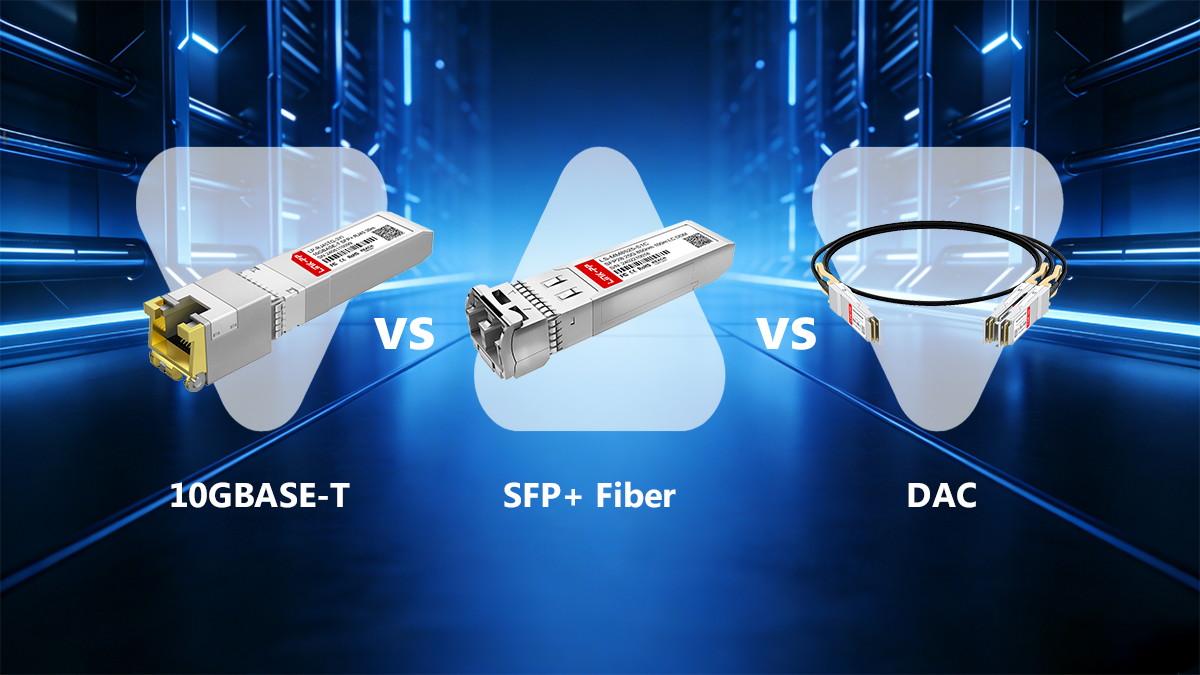
Comparison Table
| Feature | 10GBASE-T | SFP+ SR (Fiber) | DAC |
|---|---|---|---|
| Medium | Twisted-pair copper | Multimode fiber | Twinax copper |
| Connector | RJ45 | LC duplex | SFP+ twinax |
| Max Distance | 100 m | 300–400 m | ≤7 m |
| Typical Power | 3–6 W | 0.8–1.5 W | <0.5 W |
| Latency | Higher (~2–3 μs) | Low (<1 μs) | Lowest (<0.3 μs) |
| Cabling Cost | Medium | Higher | Low |
| Install Complexity | Low | Medium | Low |
| Scalability | Medium | High | Low |
- 10GBASE-T → Best for existing copper infrastructure, enterprise LAN, campus networks.
- SFP+ Fiber → Best for scalable data center fabrics, low power, long-term growth.
- DAC → Best for short-reach, ultra-low-latency in-rack links.
Total Cost of Ownership (TCO) Analysis
| Cost Factor | 10GBASE-T | SFP+ Fiber | DAC |
|---|---|---|---|
| PHY / Module Cost | Medium | Medium–High | Low |
| Cabling Cost | Low–Medium | High | Low |
| Switch Port Cost | Higher (PHY intensive) | Moderate | Moderate |
| Power & Cooling | High | Low | Very Low |
| Installation Labor | Low | Medium | Low |
| Upgrade Scalability | Medium | High | Low |
Selection Logic
-
Choose 10GBASE-T → structured copper cabling, enterprise networks, ≤100 m
-
Choose SFP+ Fiber → data centers, scalable architectures, low power
-
Choose DAC → ≤7 m, ultra-low latency, in-rack server interconnects
⭐ 10GBASE-T Typical Use Cases & Deployment Scenarios
10GBASE-T is optimized for short-to-medium reach Ethernet over structured copper cabling, making it ideal for environments where existing RJ45 infrastructure, flexibility, and ease of installation outweigh ultra-low latency and minimal power consumption.
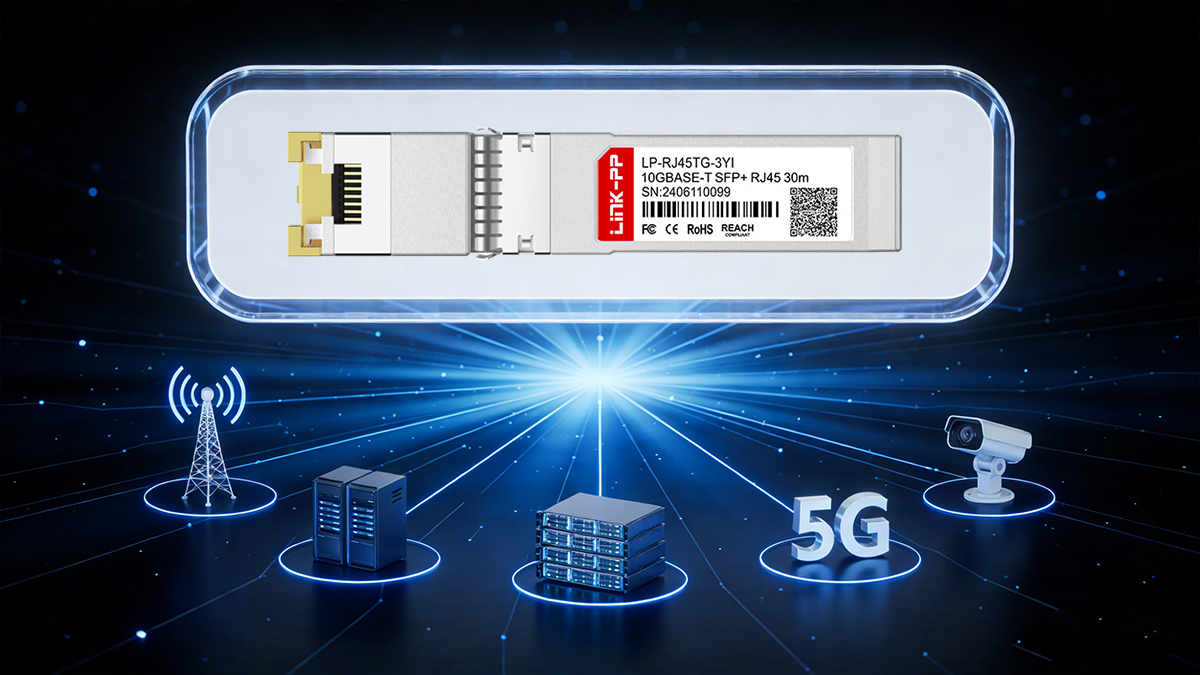
1. Enterprise Core & Access Networks
Primary scenario: Office buildings, enterprise campuses, corporate LAN backbones
Why 10GBASE-T works well:
-
Seamless upgrade path from 1G/2.5G/5G → 10G using existing Cat6a cabling
-
Native RJ45 compatibility — no fiber retraining or MPO deployment required
-
Simplified moves, adds, and changes (MAC operations)
Typical links:
-
Access switch → aggregation switch
-
Wiring closet → building core
-
Floor distribution → IDF/MDF backbone
In brownfield enterprise upgrades, 10G SFP+ copper transceiver often cuts cabling retrofit cost by 40–60% compared to fiber rebuilds.
2. Campus & Commercial Building Backbone
Primary scenario: Universities, hospitals, airports, shopping malls
Why copper still dominates:
-
Long horizontal runs already installed
-
Maintenance teams trained on RJ45-based testing & troubleshooting
-
Flexible endpoint connection (IP phones, cameras, WiFi APs, workstations)
Typical deployment:
-
Horizontal links: ≤100 m over Cat6a
-
Vertical risers: copper or fiber hybrid architecture
3. Server Access & Edge Data Center
Primary scenario: Enterprise data centers, edge computing rooms
Use cases:
-
10G NIC → Top-of-Rack (ToR) switch
-
Storage servers (iSCSI, NFS)
-
Virtualization clusters (VM traffic, backup links)
Why 10GBASE-T is chosen:
-
Plug-and-play RJ45
-
Lower upfront cost in low-to-mid density racks
4. Industrial Ethernet & Harsh Environments
Primary scenario: Manufacturing floors, transportation systems, energy facilities
Advantages:
-
Robust copper cabling
-
Easy field termination
-
Compatible with industrial-grade RJ45 connectors
Typical applications:
-
Machine controllers
-
Industrial cameras
-
PLC networks
-
SCADA systems
5. WiFi 6 / WiFi 7 High-Speed Access Networks
Primary scenario: High-density WiFi deployments
Why 10GBASE-T matters:
-
Supports multi-gig AP uplinks (5G/10G)
-
Works with existing structured cabling
-
Simplifies PoE++ power + data delivery
Typical links:
-
WiFi 6E / WiFi 7 AP → access switch
6. When 10GBASE-T Is Not the Best Choice
-
Large-scale hyperscale data centers
-
Ultra-low latency trading systems
-
Power-constrained high-density racks
? In these cases, SFP+ fiber or DAC usually deliver lower latency, lower power, and better scaling.
SFP+ copper transceiver is best suited for enterprise, campus, and edge networks where existing copper cabling, RJ45 flexibility, and low deployment cost are priorities. It is less optimal for hyperscale data centers due to higher power consumption and latency.
⭐ 10GBASE-T Procurement Checklist & Compatibility Pitfalls
Selecting 10GBASE-T equipment is not just a specification exercise. In real deployments, compatibility gaps, PHY power mismatches, and vendor lock-in are the leading causes of project delays, unstable links, and unexpected TCO increases.
This checklist is based on field deployments, interoperability testing, and post-failure analysis across enterprise and data center networks.
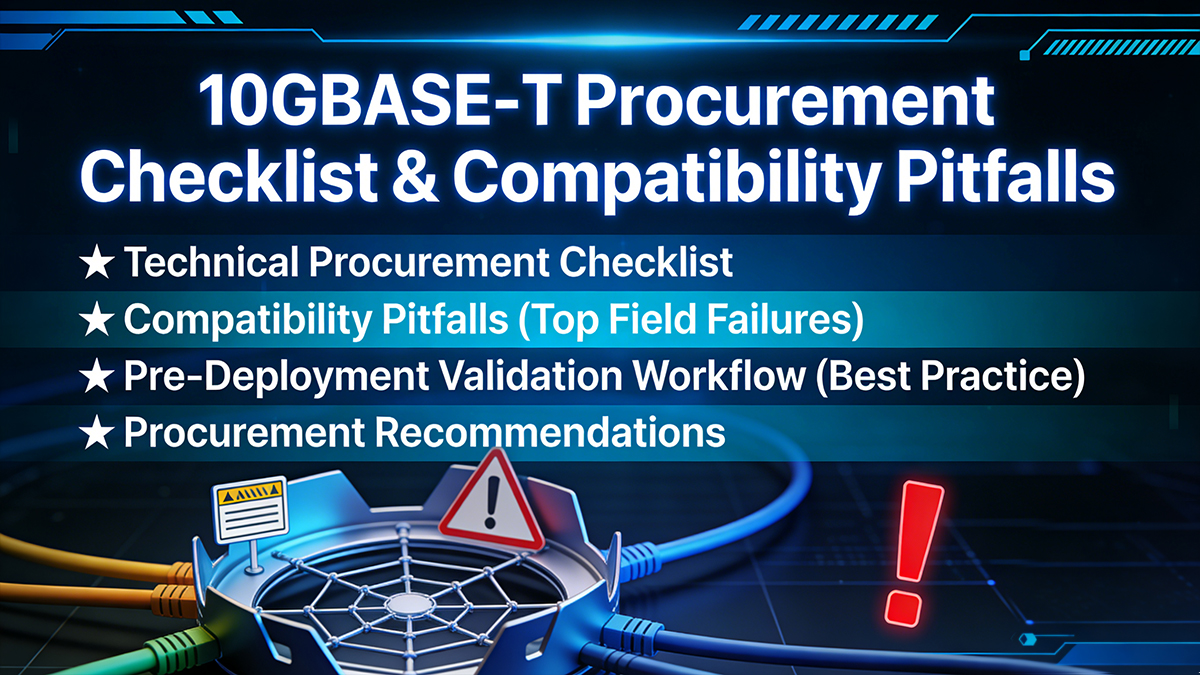
★ Technical Procurement Checklist
| Verification Item | Why It Matters |
|---|---|
| IEEE 802.3an compliance | Guarantees protocol-level interoperability |
| Cable support (Cat6 / Cat6a / Cat7 / Cat8) | Ensures full 100 m reach and low BER |
| PHY power consumption | Directly impacts rack thermal design |
| Latency performance | Critical for storage, virtualization & real-time apps |
| Operating temperature range | Determines reliability in dense racks |
| EMI immunity & shielding design | Avoids BER spikes in noisy environments |
| DOM/DDM support (if SFP+) | Enables proactive monitoring |
★ Compatibility Pitfalls (Top Field Failures)
Pitfall #1 — Switch Vendor EEPROM Lock
Some switch vendors enforce EEPROM authentication, rejecting third-party RJ45 SFP+ modules.
Avoidance strategy:
-
Validate platform compatibility list
-
Perform pre-deployment plug-in testing
-
Request custom EEPROM coding support if required
Pitfall #2 — Underestimated Thermal Load
10GBASE-T PHYs typically consume 3–6W per port, which is 3–5× higher than fiber-based SFP+.
Real-world impact:
-
Dense racks can exceed thermal envelope
-
Leads to port flapping, CRC errors, and auto-throttling
Avoidance strategy:
-
Validate airflow direction (front-to-back / reverse)
-
Model rack-level thermal budget
Pitfall #3 — Cat6 Cable Overconfidence
Cat6 is officially rated only up to 55m at 10G.
Observed failure modes:
-
Link instability at 60–90m
-
Random packet loss
-
Elevated BER under temperature fluctuation
Avoidance strategy:
-
Use Cat6a minimum for production
-
Validate channel certification reports
Pitfall #4 — Power Budget Oversight in ToR Switches
High-density RJ45 switch ports can exceed power and cooling budgets, triggering:
-
Port downshifts
-
Fan overdrive
-
Reduced switch lifespan
Avoidance strategy:
-
Evaluate per-port thermal design power (TDP)
-
Prefer fiber uplinks in high-density fabrics
★ Pre-Deployment Validation Workflow (Best Practice)
-
Sample testing on target switch model
-
Validate 100m link margin with Cat6a
-
Measure actual power draw & thermal behavior
-
Run 24–72 hour traffic soak testing
-
Record DOM / PHY diagnostics
★ Procurement Recommendations
-
Avoid grey-market transceivers
-
Prefer suppliers offering:
-
Platform compatibility reports
-
EEPROM customization
-
Full traceability & batch records
-
Engineering-level support
-
LINK-PP 10GBASE-T solutions meet all above requirements, offering full MSA compliance, platform interoperability testing, and high supply stability.
⭐ FAQ — 10GBASE-T Quick Answers
Q1: What is 10GBASE-T?
Answer:
10GBASE-T is a 10 Gigabit Ethernet standard defined by IEEE 802.3an, enabling 10 Gbps full-duplex transmission over twisted-pair copper cabling (RJ45) for distances up to 100 meters using Cat6a or higher cables.
Q2: Is 10GBASE-T the same as RJ45 SFP+?
Answer:
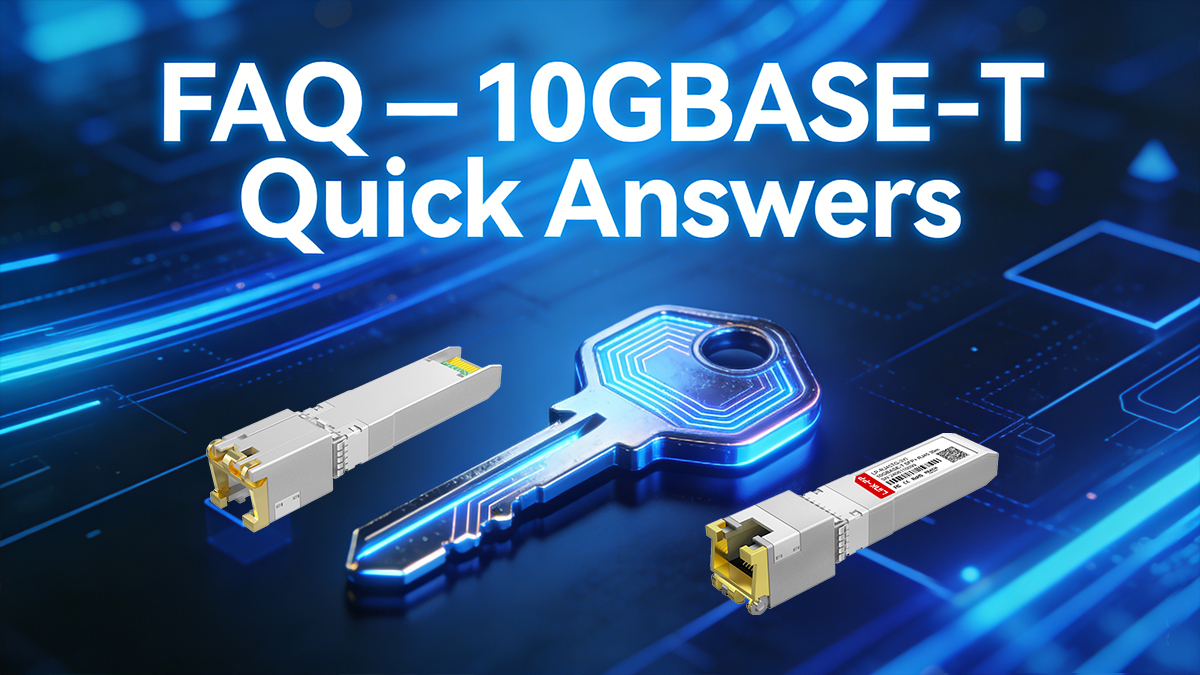
No. 10GBASE-T is a network standard, while RJ45 SFP+ is a transceiver form factor that implements the 10GBASE-T protocol.
In short:
-
10GBASE-T = protocol & electrical standard
-
RJ45 SFP+ = hardware module that supports 10GBASE-T
Q3: What cable is required for 10GBASE-T?
Answer:
The recommended cable is Cat6a or higher for reliable 100m transmission.
| Cable Type | Max Distance @10G |
|---|---|
| Cat6 | ~55m |
| Cat6a | 100m |
| Cat7 | 100m |
| Cat8 | 30m |
Q4: How much power does 10GBASE-T consume?
Answer:
10GBASE-T PHY typically consumes 3–6W per port, which is 3–5× higher than fiber-based SFP+ modules.
This makes thermal and airflow planning critical in dense switch environments.
Q5: Is 10GBASE-T suitable for data centers?
Answer:
It depends on the architecture.
-
Yes → For enterprise racks, structured cabling, and brownfield upgrades
-
No → For hyperscale, leaf-spine fabrics, or ultra-low latency networks, where SFP+ fiber or DAC is preferred.
Q6: What is the latency of 10GBASE-T?
Answer:
Typical PHY latency is 2–3 microseconds, higher than:
-
SFP+ fiber: <1 μs
-
DAC: <0.3 μs
This matters in HPC, financial trading, and AI clusters.
Q7: Can 10GBASE-T work with existing Cat5e cables?
Answer:
No. Cat5e does not support 10GBASE-T at meaningful distances.
Reliable deployment requires Cat6a minimum.
Q8: Why do some switches reject third-party RJ45 SFP+ modules?
Answer:
Some switch vendors use EEPROM authentication to restrict non-OEM modules.
This can cause port shutdown or error states unless compatibility coding is applied.
Q9: Is 10GBASE-T backward compatible with 1G and 100M Ethernet?
Answer:
Yes. 10GBASE-T supports auto-negotiation with 1000BASE-T and 100BASE-TX, enabling smooth network migration.
Q10: When should I choose 10GBASE-T instead of fiber?
Answer:
Choose 10GBASE-T if:
-
You already have structured copper cabling
-
You need simple RJ45-based installation
-
Power and latency are not critical constraints
Choose fiber SFP+ if:
-
You need high density, low power, or scalability
-
You operate data center or AI workloads
⭐ 10GBASE-T Final Recommendation
Use 10GBASE-T when:
-
Existing copper infrastructure must be preserved
-
Structured cabling is already deployed
-
Enterprise or campus upgrades are required
-
Fiber deployment is operationally complex
Avoid 10GBASE-T when:
-
Ultra-low latency is critical
-
Power efficiency is a priority
-
High-density data-center fabrics are planned
For reliable deployment, testing, and procurement guidance:
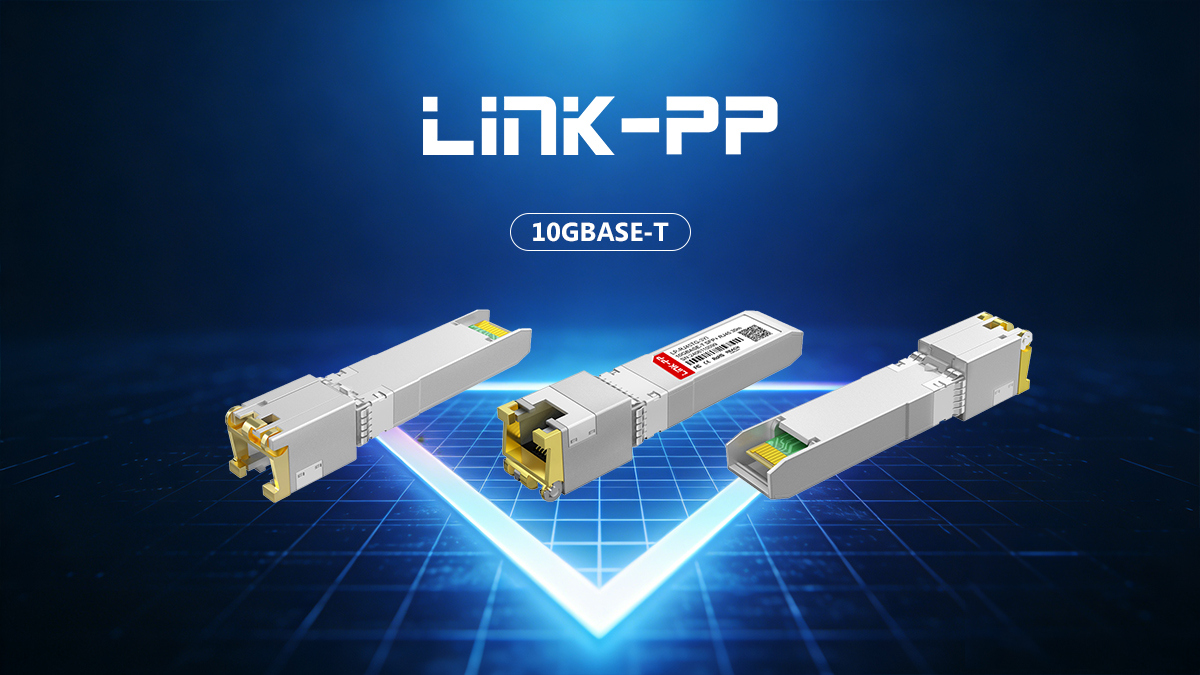
? Request LINK-PP Official Store sample testing, compatibility validation, and engineering support for enterprise-grade 10GBASE-T networks.
Appendix
Standards & References
-
IEEE 802.3an — 10GBASE-T
-
TIA/EIA-568 — Structured Cabling Standards
-
ISO/IEC 11801 — Cabling Infrastructure
Typical Datasheet Fields
-
PHY power consumption
-
Operating temperature
-
Cable length certification
-
EMI tolerance
-
Compatibility matrix