



































The rapid growth of cloud computing, artificial intelligence, and data-intensive applications has placed unprecedented demands on modern network infrastructure. Data centers and service provider networks are now required to handle massive data transmission, ultra-low latency workloads, and continuously increasing bandwidth requirements. As 100G networks approach their scalability limits, the industry has shifted its focus toward 400G Ethernet as the next mainstream upgrade path.
To support 400G speeds without drastically increasing footprint or power consumption, new optical transceiver form factors have emerged. Among them, the QSFP-DD transceiver has become one of the most widely adopted solutions. By doubling the electrical interface density of standard QSFP modules while maintaining backward compatibility, QSFP-DD offers a practical and cost-effective solution to scaling network capacity.
In this article, we will explore QSFP-DD technology by breaking down its technical specifications and comparing it with QSFP56. We will also explain how it delivers superior 400G network performance, highlighting its key benefits and practical use cases. By the end, you will have a clear understanding of the QSFP-DD transceiver and be able to determine whether it is the right choice for your 400G network deployment.
? Introduction to QSFP-DD Technology
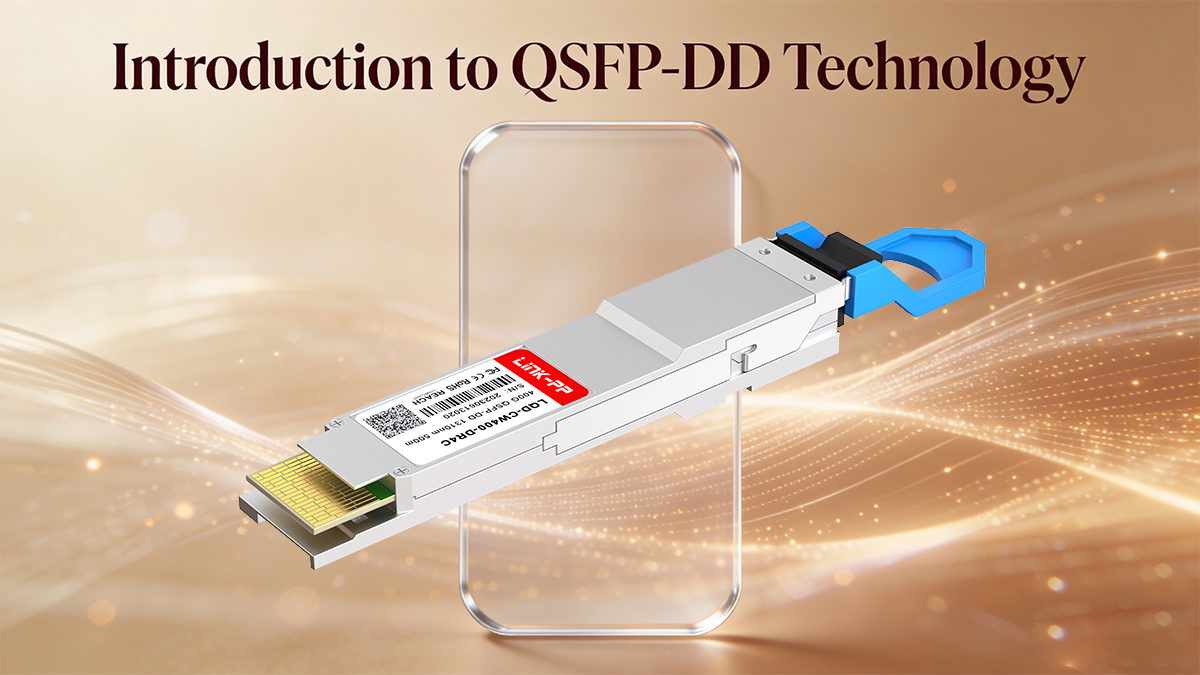
QSFP-DD technology was designed to handle growing data demands by offering higher bandwidth density, improved power efficiency, and easier network upgrades. The following content explains what QSFP-DD means and outlines the standards and MSA compliance.
Meaning of QSFP-DD
QSFP-DD stands for Quad Small Form-factor Pluggable Double Density. The term “Quad” refers to the original QSFP architecture, which was based on four high-speed electrical lanes. “Double Density” highlights the key innovation of QSFP-DD: the electrical interface is expanded from 4 lanes to 8 lanes within a similar physical footprint, effectively doubling the bandwidth capacity per port.
In practical terms, QSFP-DD enables a single pluggable module to support up to 400Gbps by operating eight electrical lanes at 50G PAM4 per lane. Despite the increased lane count, QSFP-DD maintains compatibility with existing QSFP modules. This design allows network operators to deploy QSFP-DD ports while still supporting lower-speed QSFP56, QSFP28, or QSFP+ modules during phased network upgrades.
QSFP-DD Standards & Protocols
QSFP-DD is defined and managed by the QSFP-DD Multi-Source Agreement (MSA), which sets the mechanical, electrical, and thermal specifications required for multi-vendor interoperability. Together, these standards ensure that QSFP-DD modules operate reliably across various platforms, switches, and routers while enabling flexible deployment in diverse network environments. The table below provides an overview of the standards and protocols related to QSFP-DD.
| Category | Standard / Protocol | Description |
| Electrical Interface | IEEE 802.3bs / 802.3cd | Defines 50G PAM4 electrical signaling per lane |
| Lane Architecture | 8×50G PAM4 | Enables 400G total data rate |
| Optical Interfaces | 400G DR4, FR4, LR4 | Covers short-reach and long-reach single-mode applications |
| Management Interface | CMIS (Common Management Interface Specification) | Advanced monitoring and control for 400G modules |
| Form Factor Standard | QSFP-DD MSA | Ensures mechanical and thermal interoperability |
MSA Compliance and Industry Adoption
The QSFP-DD form factor was first introduced under the QSFP-DD MSA Consortium, which includes major industry players such as Broadcom, Cisco, Finisar, and Intel. This consortium aimed to create an open, multi-vendor standard for 400G optical transceivers that could scale efficiently with evolving switch and router architectures.
Today, QSFP-DD has seen widespread adoption across hyperscale and large-scale data centers and service provider networks. Its compatibility with existing QSFP form factor cages and ports allows for easy deployment in mixed-speed environments, enabling a gradual and cost-effective migration to the 400G network.
? Key Technical Specifications of QSFP-DD Transceiver
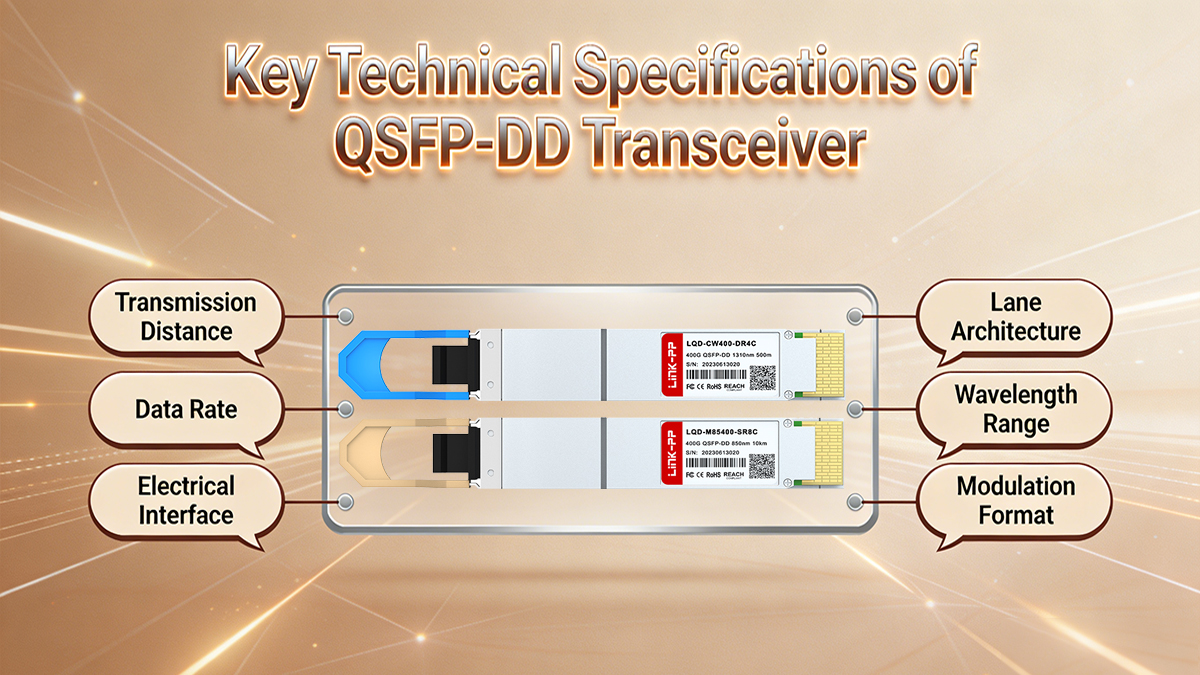
To understand how QSFP-DD transceivers deliver 400G performance, it’s essential to look at their technical underpinnings. These fiber optic transceivers combine advanced electrical interfaces, precise wavelength control, and high-speed modulation formats to achieve multi-terabit data transmission in a compact form factor. The following technical specifications define their performance and interoperability across diverse network environments.
Transmission Distance and Data Rate
QSFP-DD modules support a wide range of standardized data rates and transmission distances to cater to diverse link requirements. The primary data rate is 400Gb/s, achieved through an 8x50G electrical interface.
For optical transmission, specific multi-lane protocols define the reach: for instance, QSFP-DD DR4 supports up to 500m over parallel single mode fiber (SMF) using four lanes at 100G each via PAM4 modulation, while QSFP-DD FR4 utilizes Coarse Wavelength Division Multiplexing (CWDM) over four wavelengths to achieve 2km. For longer hauls, QSFP-DD LR4 modules can reach 10km.
Electrical Interface and Lane Architecture
The QSFP-DD uses a 76-pin electrical interface that extends the QSFP form factor by adding an extra row of contacts. This dual-density connector design allows eight electrical lanes per direction—four more than the QSFP56—while maintaining mechanical backward compatibility.
Each lane operates at 25Gbps NRZ or 50Gbps PAM4, depending on the encoding scheme, supporting higher bandwidth without increasing module size. This architecture enables seamless scaling of network capacity while retaining interoperability with existing QSFP ports when configured for lower data rates.
Wavelength Range and Modulation Format
For single-mode applications, wavelengths are defined by the MSA. QSFP-DD optical modules employ a variety of wavelength ranges and modulation formats depending on the specific application standard.
For example, QSFP-DD DR4 modules operate at 1310nm and use PSM4 (parallel single mode fiber) with PAM4 modulation, while QSFP-DD FR4 and QSFP-DD LR4 modules use four multiplexed wavelengths in the 1271nm - 1331nm range for single-mode duplex transmission. The adoption of PAM4 encoding doubles the data throughput per lane compared to NRZ, which is critical for achieving 400G speeds within the same bandwidth.
? QSFP-DD VS QSFP56: Choosing The Right Form Factor
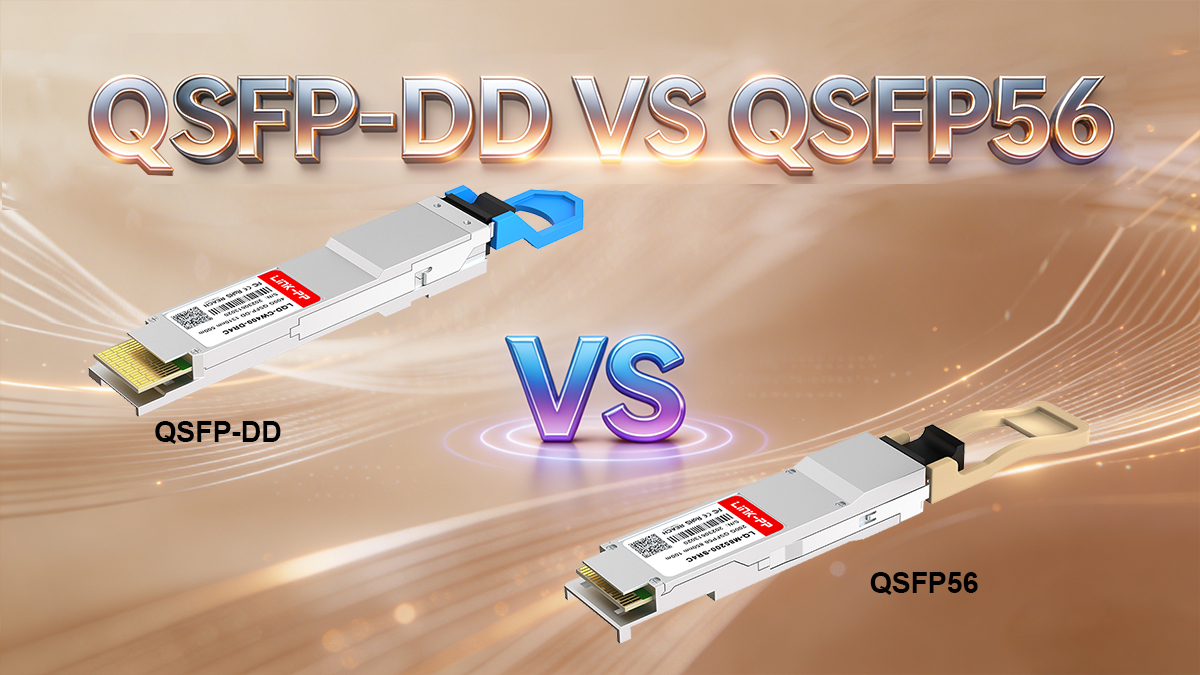
Selecting the proper transceiver form factor is a critical step when building a 400G network. While both QSFP-DD and QSFP56 support high-speed data transmission, they differ in physical design, electrical interface, and scalability. Understanding the distinctions between these two form factors helps you balance current performance needs with future expansion goals.
The table below shows some of the key feature differences between the QSFP-DD and QSFP56.
| Feature | QSFP-DD | QSFP56 |
| Maximum Data Rate | 400Gbps (8×50G PAM4 lanes) | 200Gbps (4×50G PAM4 lanes) |
| Electrical Lanes | 8 lanes (each at 50Gbps) | 4 lanes (each at 50Gbps) |
| Connector Type | 76-pin double-density connector | 38-pin standard QSFP-type connector |
| Backward Compatibility | Compatible with QSFP+, QSFP28, QSFP56 modules | Compatible with QSFP+, QSFP28 modules |
| Typical Applications | 400G data center core and aggregation layers | 200G TOR (Top of Rack) and aggregation links |
Differences in Port Speed and Port Density
The most fundamental difference between QSFP-DD and QSFP56 lies in their native port speed and resulting port density on switching platforms. QSFP-DD is architected with eight electrical lanes, each operating at 50Gbps PAM4, enabling a single module to deliver 400G throughput without breakout. This allows switch vendors to build line cards and top-of-rack switches that support dozens of native 400G ports, maximizing front-panel bandwidth within fixed rack space.
In contrast, QSFP56 maintains a four-lane electrical architecture, capping its native port speed at 200G. While QSFP56 can participate in 400G deployments via 2×200G breakout configurations, this approach consumes multiple ports and increases cabling complexity. As a result, QSFP56-based designs generally offer lower effective port density when targeting large-scale 400G fabrics, making them less efficient for hyperscale or core-layer deployments.
Differences in Connector Design and Scalability
QSFP-DD introduces a double-density connector interface, achieved by adding a second row of high-speed electrical contacts while maintaining the same front-panel footprint as standard QSFP modules. This enhanced cage and connector design is specifically engineered to handle higher signal integrity requirements associated with 8-lane PAM4 signaling, including tighter impedance control and improved EMI performance.
QSFP56, by comparison, uses the standard QSFP connector layout, which simplifies backward compatibility but limits electrical scalability. The four-lane constraint makes QSFP56 less adaptable for future speed increases beyond 200G without fundamental changes to the form factor. From a scalability standpoint, QSFP-DD provides a clearer upgrade path toward 800G and beyond.
When to Choose QSFP-DD Over QSFP56
Choosing QSFP-DD over QSFP56 is primarily driven by network scale, growth expectations, and architectural efficiency. QSFP-DD is the preferred option when building new 400G-native infrastructures, especially in environments where port density, power efficiency per bit, and simplified cabling are critical.
Key scenarios where QSFP-DD is the better choice include:
- Hyperscale and cloud data centers that require high-radix 400G switches to reduce network tiers.
- Core and spine layers where native 400G links minimize breakout complexity and fiber congestion.
- Future-oriented deployments planning a smooth transition toward 800G without replacing the physical port system.
QSFP56 remains relevant for incremental upgrades or 200G-focused networks, but for organizations aiming to standardize on 400G as a long-term baseline, QSFP-DD offers superior technical headroom and architectural consistency.
? How QSFP-DD Enables 400G Network Performance
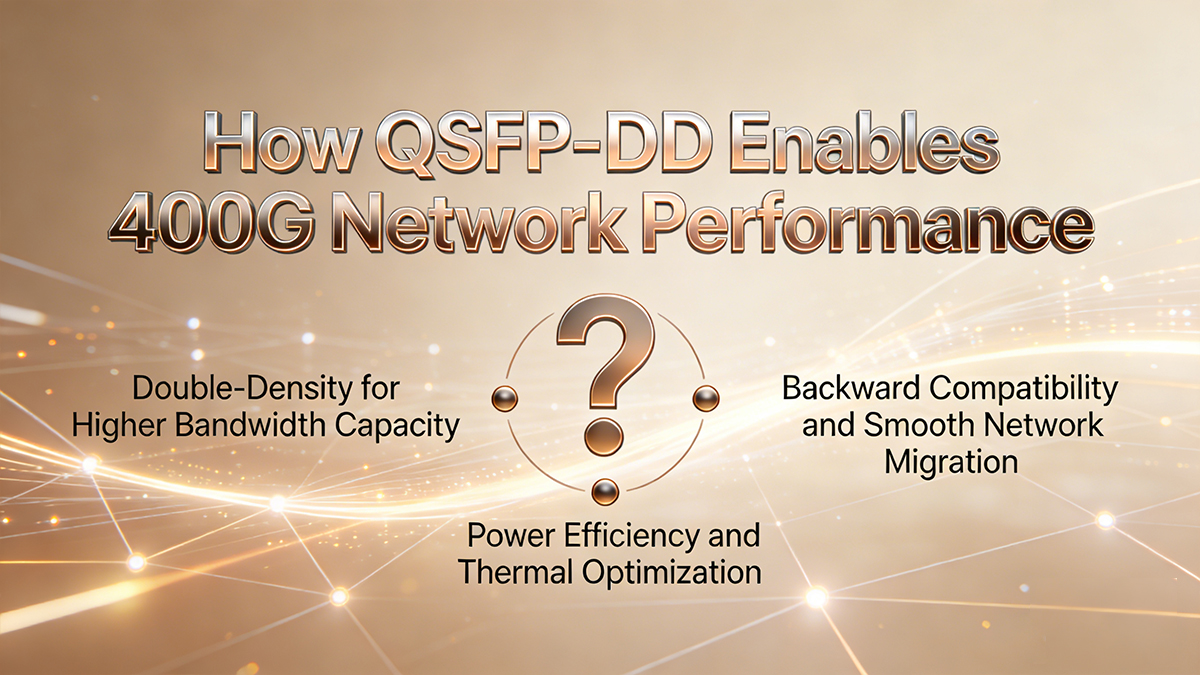
In 400G network infrastructure, the QSFP-DD is the cornerstone of achieving massive data throughput without compromising network flexibility. By integrating double-density architecture, backward compatibility, and optimized power design, QSFP-DD optical transceivers allow network operators to build scalable, high-performance environments that meet the demands of hyperscale computing and advanced cloud workloads.
Double-Density for Higher Bandwidth Capacity
QSFP-DD achieves 400G network performance by doubling the number of high-speed electrical lanes from 4 to 8, enabling an aggregate throughput of up to 400Gbps within the same physical footprint as previous QSFP form factors. Each lane typically operates at 50Gbps using PAM4 modulation, allowing the module to support multiple 400G interface types such as DR4, FR4, and LR4. This double-density lane architecture significantly increases port bandwidth capacity on switches and routers, allowing network devices to deliver higher total system throughput without increasing chassis size or port count.
Backward Compatibility and Smooth Network Migration
A key advantage of QSFP-DD in enabling 400G performance is its backward compatibility with QSFP+, QSFP28, and QSFP56 modules. The mechanical design includes a single-lane connector interface that allows legacy modules to operate within QSFP-DD ports, ensuring seamless integration into existing network environments. This backward compatibility enables gradual migration from 100G or 200G to 400G networks, reducing capital expenditure and minimizing operational risk while maintaining consistent performance during transition phases.
Power Efficiency and Thermal Optimization
QSFP-DD modules are engineered with advanced power and thermal management features to sustain stable 400G performance in high-density deployments. Optimized electrical signaling, low-power DSPs, and improved heat dissipation structures help maintain power consumption typically within 7–12W for most 400G optical modules. Additionally, enhanced cage and connector designs support better airflow and thermal monitoring, ensuring reliable operation even in densely populated switch platforms where thermal constraints are critical to overall network performance.
? Benefits of QSFP-DD Transceivers in 400G Networks
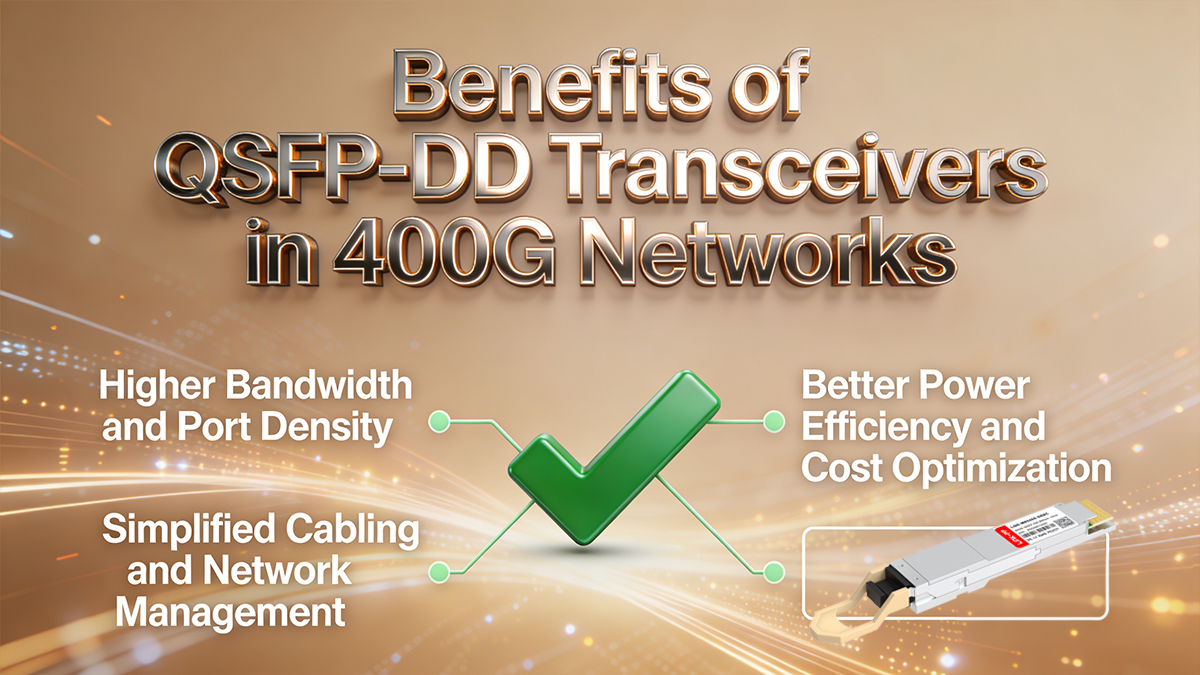
QSFP-DD transceivers deliver clear operational and architectural advantages for 400G network deployments. By combining higher electrical lane density with mature optical interfaces, they enable efficient bandwidth scaling while reducing complexity in large-scale data center and service provider environments.
Higher Bandwidth and Port Density
QSFP-DD transceivers support eight 50G electrical lanes, allowing a single port to deliver up to 400Gbps throughput. This double-density design significantly increases switch front-panel bandwidth, enabling network operators to scale capacity without expanding rack space or increasing the number of physical ports.
Simplified Cabling and Network Management
By consolidating higher data rates into fewer physical interfaces, QSFP-DD reduces the total number of fiber links and cables required. This simplification lowers cabling congestion, improves airflow, and makes network planning, troubleshooting, and port mapping more manageable in dense 400G deployments.
Better Power Efficiency and Cost Optimization
QSFP-DD modules are designed with optimized PAM4 modulation and improved thermal layouts, enabling lower power consumption per transmitted bit. Higher port density also reduces the cost per gigabit by minimizing switch hardware, cabling infrastructure, and operational overhead across large-scale networks.
? QSFP-DD Use Cases in Modern Network Infrastructure
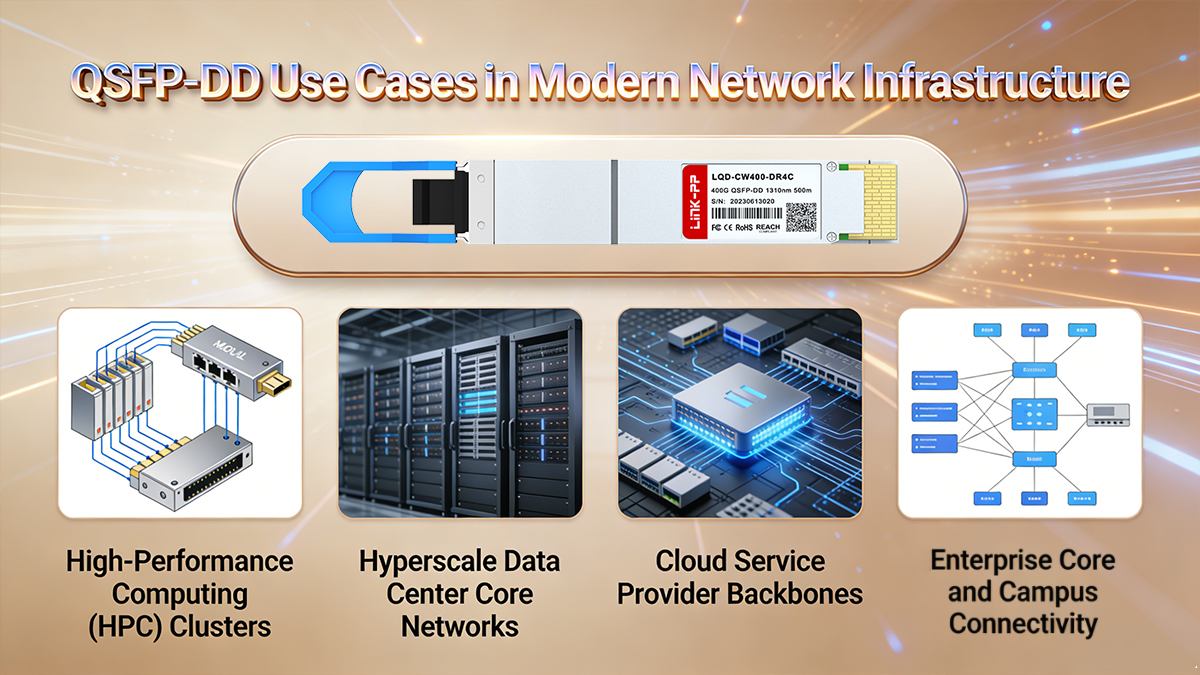
QSFP-DD transceivers are widely deployed in modern networks that require ultra-high bandwidth, low latency, and scalable architectures. Their double-density design and native 400G support make them especially suitable for environments where performance, port density, and future-proofing are critical.
High-Performance Computing (HPC) Clusters
In HPC clusters, QSFP-DD modules are commonly used to interconnect compute nodes and high-speed storage fabrics, where latency and throughput directly affect job completion times. 400G QSFP-DD links enable faster MPI communication and data exchange between GPUs and CPUs, while supporting InfiniBand HDR/EDR or Ethernet-based architectures with dense, short-reach optical connections.
Hyperscale Data Center Core Networks
Hyperscale data centers use QSFP-DD transceivers extensively in core layers to meet exponential traffic demands between leaf and spine switches. Their 400G capacity allows operators to consolidate multiple 100G ports into one high-bandwidth link, minimizing space and power usage. The modules support Ethernet, InfiniBand, and breakout configurations for flexible topology designs without sacrificing reliability or throughput.
Cloud Service Provider Backbones
In cloud operator backbones, QSFP-DD enables scalable interconnection between data centers across metro and regional networks. Modules such as 400G FR4 or 400G LR4 deliver high reach and signal integrity over single-mode fiber, supporting virtualized services and large-scale storage replication. Network operators benefit from lower cost-per-bit transmission while maintaining carrier-grade performance and seamless scalability.
Enterprise Core and Campus Connectivity
In large enterprise core and campus networks, QSFP-DD transceivers are increasingly adopted for data center interconnects and core switch uplinks. They provide sufficient bandwidth for virtualization, AI workloads, and high-volume data transfers. QSFP-DD also supports gradual upgrades, allowing enterprises to deploy 400G links selectively while maintaining compatibility with existing lower-speed infrastructure.
? LINK-PP QSFP-DD Transceiver Solutions for 400G Networks
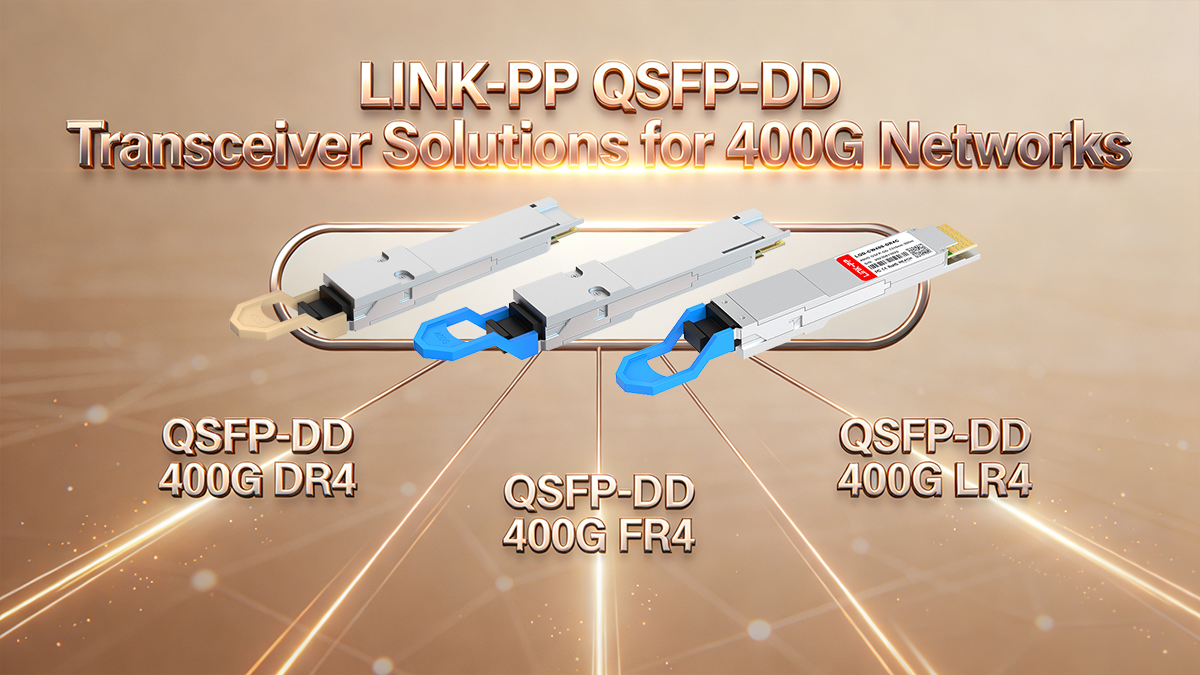
LINK-PP provides a comprehensive portfolio of 400G QSFP-DD transceiver modules designed to support high-density, high-speed optical interconnects in modern data center and carrier networks. These solutions cover short-, medium-, and long-reach scenarios, enabling flexible deployment of 400G QSFP-DD links across HPC clusters, hyperscale data center core networks, cloud service provider backbones, etc.
LQD-CW400-DR4C QSFP-DD 400G DR4 Module
The LQD-CW400-DR4C is a 400G DR4 QSFP-DD optical transceiver optimized for short-reach data center interconnections. It is designed for high-density environments where low latency, high bandwidth, and parallel single-mode fiber (SMF) connectivity are required.
Key Features and Capabilities:
- Supports 400GBASE-DR4 standard with 4 parallel optical lanes operating at 106.25Gbps per lane (PAM4 modulation).
- Employs a 1310nm wavelength together with an MTP/MPO-12 APC connector for four-lane parallel data transmission.
- Typical transmission distance of up to 500m over SMF, suitable for intra–data center spine–leaf connections.
- Electrical interface compliant with 8×50G PAM4 lanes, ensuring compatibility with QSFP-DD host systems.
- Optimized for low power consumption, typically ≤9.5W, helping reduce thermal load in high-port-density switches.
- Fully compliant with QSFP-DD MSA and IEEE 802.3bs, supporting hot-pluggable operation and real-time DOM monitoring.
LQD-CW400-FR4C QSFP-DD 400G FR4 Module
The LQD-CW400-FR4C 400G FR4 QSFP-DD module is designed for medium-reach 400G optical links, offering a balance between reach, fiber efficiency, and deployment flexibility. It is ideal for data center interconnect (DCI) and aggregation-layer applications.
Key Features and Capabilities:
- Supports 400GBASE-FR4 with 4 wavelength channels using CWDM technology over a duplex LC connector.
- Each optical lane operates at 106.25Gbps PAM4, enabling aggregate 400G transmission over 2km of SMF.
- Utilizes a wavelength range of approximately 1271nm to 1331nm, reducing fiber count compared to DR4 solutions.
- Duplex LC interface simplifies cabling and supports easy migration from 100G/200G CWDM architectures.
- Integrated digital diagnostics provide real-time monitoring of operating temperature, supply voltage, TX/RX power, and laser bias current.
- Designed for stable operation in high-performance switches with enhanced thermal design and power efficiency typically ≤9.5W.
LQD-CW400-LR4C QSFP-DD 400G LR4 Module
The LQD-CW400-LR4C is a long-reach 400G LR4 QSFP-DD transceiver tailored for metro, backbone, and inter–data center connectivity. It enables high-capacity optical transmission over extended distances in many scenarios.
Key Features and Capabilities:
- Complies with 400GBASE-LR4 specification, supporting 400G transmission up to 10km over single mode fiber.
- Employs CWDM wavelengths around 1271nm – 1331nm, ensuring precise channel spacing and low dispersion.
- Duplex LC connector enables efficient fiber utilization and seamless integration into existing long-reach optical infrastructures.
- High-performance optical components deliver stable output power and receiver sensitivity for reliable long-distance links.
- Supports advanced FEC (forward error correction) at the system level to maintain signal integrity over extended reach.
- Fully compliant with QSFP-DD MSA standards, offering interoperability with mainstream 400G switches and routers.
? FAQs about QSFP-DD 400G Network Deployment
QSFP-DD is widely adopted in 400G network rollouts, but practical deployment often raises questions around compatibility, interface selection, and thermal management. We will address common deployment FAQs to help network engineers plan QSFP-DD 400G infrastructures more effectively.
How does QSFP-DD differ from QSFP+?
QSFP-DD supports up to 400Gbps by using an 8-lane electrical interface, while QSFP+ is limited to 40Gbps with a 4-lane architecture. In addition, QSFP-DD introduces a double-density connector and higher power envelope to support advanced modulation formats such as PAM4, which are not supported by QSFP+.
Is QSFP-DD backward compatible with QSFP56, QSFP28, and QSFP+ ports?
QSFP-DD ports are designed to accept QSFP+, QSFP28, and QSFP56 modules, enabling reuse of existing optics during network upgrades. However, backward compatibility is mechanical and electrical only; the achievable data rate is limited by the inserted module and the host port configuration.
Can QSFP-DD ports support 200G or 100G connections?
Yes, QSFP-DD ports can be configured to support 200G or 100G operation through port breakout or native lower-speed optics. For example, a single QSFP-DD port can be split into 2×200G or 4×100G links using appropriate breakout cables and switch configuration.
What are the most common QSFP-DD 400G interface types?
The most common QSFP-DD 400G interfaces include DR4 for 500m single-mode links, FR4 for 2km reach, and LR4 for up to 10km transmission. These interfaces differ mainly in wavelength allocation and optical architecture, allowing operators to choose based on distance and fiber availability.
What are the typical power consumption ranges for QSFP-DD modules?
QSFP-DD 400G modules typically consume between 7W and 12W, depending on the interface type and reach. Short-reach DR4 modules usually operate at lower power levels, while longer-reach FR4 and LR4 modules require more power due to integrated wavelength multiplexing and amplification.
How should QSFP-DD modules be managed for optimal thermal performance?
Proper thermal management involves ensuring adequate front-to-back airflow and spacing between high-power modules. Using switch platforms with efficient heat sinks, fan speed control, and monitoring transceiver temperature via the Digital Diagnostics Monitoring (DDM) interface helps maintain longevity and prevent signal degradation.
? Summary: Is QSFP-DD The Right Choice for Your 400G Network Upgrade?
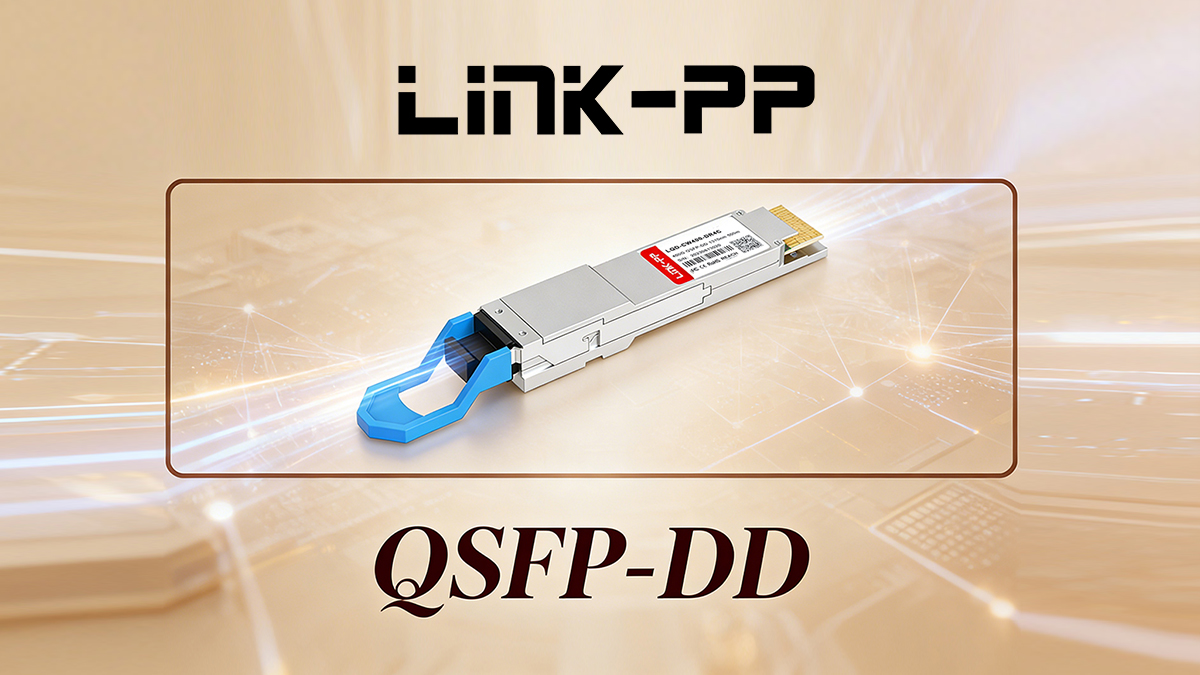
As 400G network becomes the new standard for cloud computing, AI workloads, and data-intensive applications, QSFP-DD has clearly emerged as one of the most practical and future-ready transceiver form factors. Throughout this article, we explored how QSFP-DD achieves 400G performance through its double-density 8-lane architecture, PAM4 modulation, and strong MSA-driven system support.
Compared with QSFP56, QSFP-DD delivers higher native port speeds, superior port density, and a more scalable upgrade path—while maintaining backward compatibility that enables smooth, cost-effective network migration. Whether deployed in hyperscale data centers, HPC clusters, service provider backbones, or enterprise core networks, QSFP-DD offers the performance, efficiency, and flexibility required to build high-bandwidth 400G infrastructures.
If you are planning a 400G network upgrade and looking for reliable, standards-compliant QSFP-DD transceiver solutions, explore the full range of LINK-PP products and technical resources at the LINK-PP Official Store to find the right solution for your network deployment.







