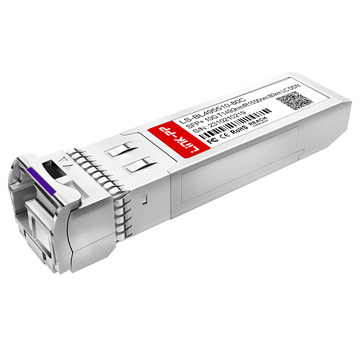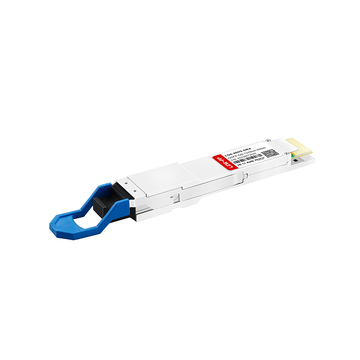
As network speeds continue to scale from 10G to 25G and 100G, choosing the right transceiver form factor has become a critical design decision. SFP28 and QSFP28 are two of the most commonly deployed interfaces for 25GbE and 100GbE networks, especially in modern data centers and high-performance enterprise environments.
The key difference is simple:
SFP28 supports 25Gbps per port using a single lane, while QSFP28 delivers up to 100Gbps by combining four 25Gbps lanes in a single module. This architectural difference directly impacts port density, cabling design, scalability, and overall network cost.
This article provides a clear, side-by-side comparison of SFP28 vs QSFP28, covering specifications, performance, cost considerations, and real-world use cases. By the end, you’ll know which transceiver type fits your network requirements today—and which one prepares you better for future upgrades.
What Is SFP28?
SFP28 is a single-lane 25Gbps optical transceiver form factor designed for 25 Gigabit Ethernet (25GbE) networks, widely used in server access, Top-of-Rack (ToR) switching, and short- to mid-range data center links.
It delivers significantly higher bandwidth than 10G SFP+ while retaining the same compact form factor. This makes SFP28 a practical upgrade option for networks that need higher throughput without increasing port density or power consumption.
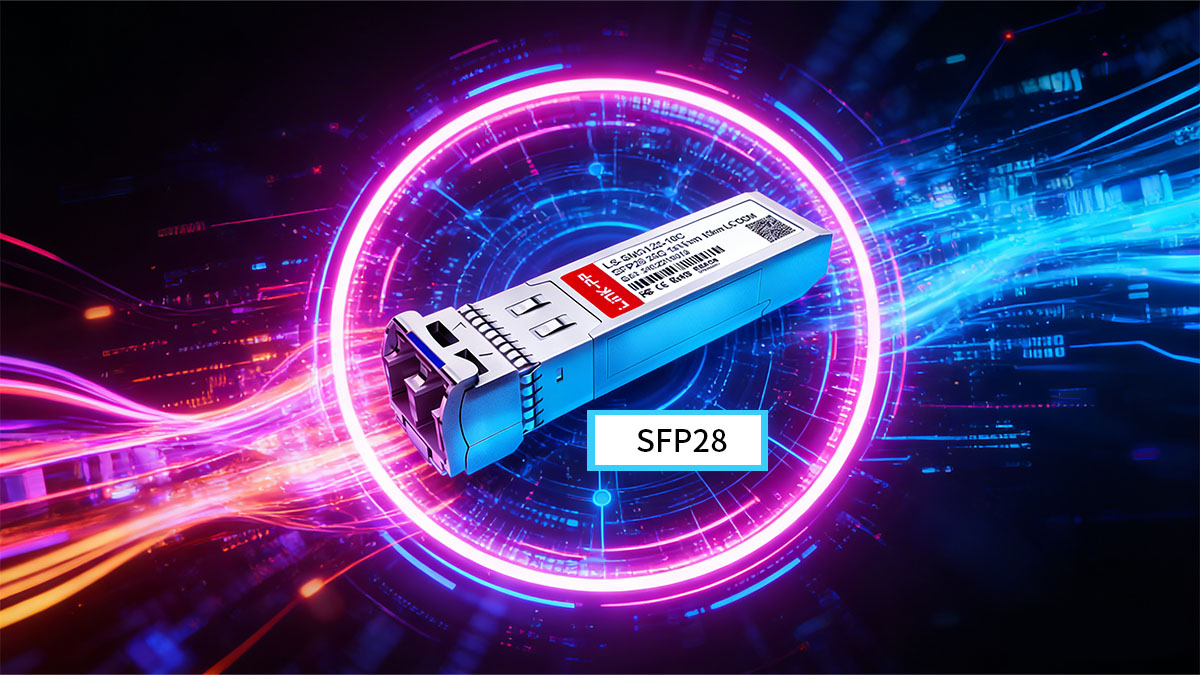
Core Characteristics of SFP28
| Parameter | Specification |
|---|---|
| Data Rate | 25Gbps (single lane) |
| Form Factor | SFP |
| Typical Power Consumption | ~1W or lower |
| Common Fiber Types | Multimode (MMF), Single-mode (SMF) |
Key takeaway: SFP28 achieves 25Gbps using a single electrical and optical lane, which simplifies signal design and helps reduce power usage compared with multi-lane transceivers.
Because only one lane is used, SFP28 minimizes lane alignment issues and thermal overhead. This characteristic makes it well suited for high-density switch environments where cooling and power budgets are constrained.
Common Types of SFP28 Transceivers
-
SFP28 SR – Short-reach connectivity over multimode fiber, typically up to 70–100 meters
-
SFP28 LR – Long-reach transmission over single-mode fiber, typically up to 10 km
-
SFP28 DAC – Direct Attach Copper for ultra-short, low-latency connections
-
SFP28 AOC – Active Optical Cable for flexible short-range deployments
These variants allow SFP28 to support a wide range of data center and enterprise cabling scenarios without changing the physical interface.
Typical Network Scenarios for SFP28
SFP28 is commonly selected when:
-
25GbE per port is sufficient for server or storage connectivity
-
High port density is required on access or ToR switches
-
Networks are upgrading incrementally from 10G SFP+ to 25G
-
Power efficiency and thermal control are critical design factors
In real-world deployments, SFP28 is most often used at the network edge, connecting individual servers to aggregation or spine layers.
What Is QSFP28?
QSFP28 is a high-density 100Gbps optical module form factor that uses four 25Gbps lanes to deliver 100 Gigabit Ethernet (100GbE). It is widely deployed in data center aggregation, spine-leaf architectures, and high-capacity switch-to-switch interconnections.
Compared with single-lane transceivers, QSFP28 is designed to maximize bandwidth per port. By integrating four parallel lanes into one module, it significantly reduces the number of physical ports required to achieve 100G throughput, improving rack efficiency and simplifying large-scale network design.
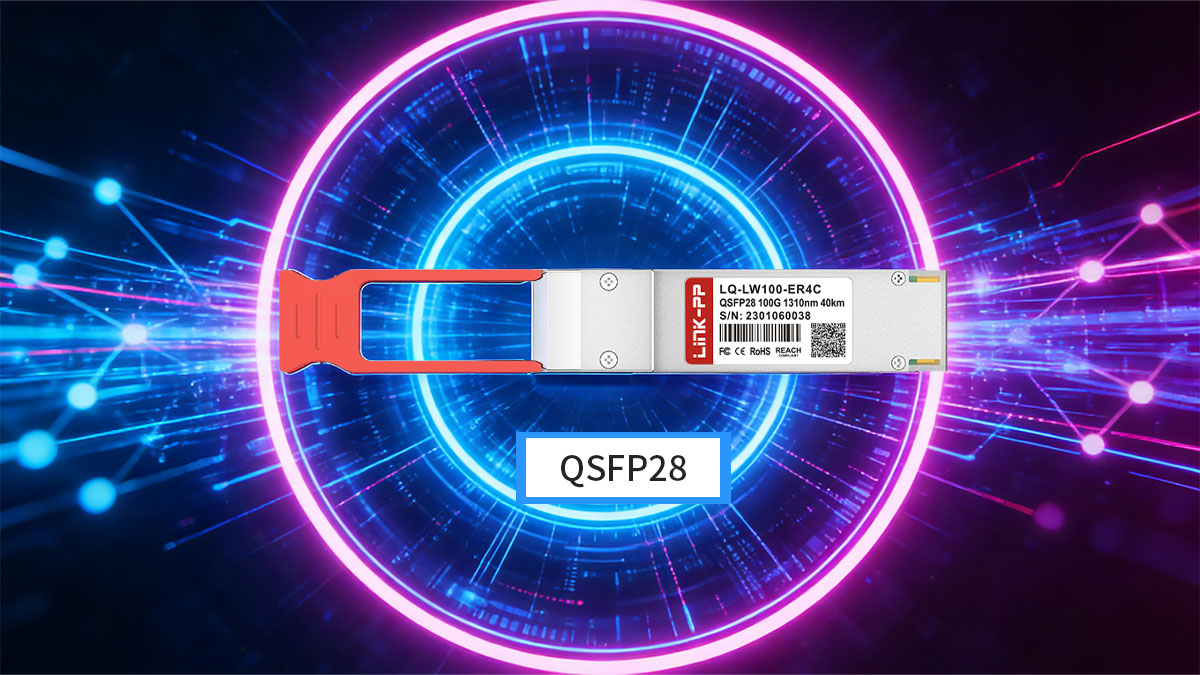
Core Characteristics of QSFP28
| Parameter | Specification |
|---|---|
| Total Data Rate | 100Gbps (4 × 25Gbps lanes) |
| Form Factor | QSFP |
| Typical Power Consumption | ~3–5W |
| Common Fiber Types | Multimode (MMF), Single-mode (SMF) |
Key takeaway: QSFP28 aggregates four 25Gbps lanes into a single 100Gbps interface, enabling much higher bandwidth per port than SFP28 while maintaining manageable power and thermal limits.
Because QSFP28 relies on parallel lanes, it introduces additional considerations such as lane alignment, fiber count, and thermal management. However, these trade-offs are generally outweighed by its efficiency in high-capacity network layers.
Common Types of QSFP28 Transceivers
-
QSFP28 SR4 – Short-reach transmission over multimode fiber using four parallel fibers
-
QSFP28 LR4 – Long-reach transmission over single-mode fiber with wavelength multiplexing
-
QSFP28 DAC – Direct Attach Copper for short, cost-effective switch-to-switch links
-
QSFP28 AOC – Active Optical Cable for flexible high-speed connections
These options allow QSFP28 to support both parallel-fiber and duplex-fiber architectures, depending on distance and cabling strategy.
Typical Network Scenarios for QSFP28
QSFP28 is typically chosen when:
-
100GbE bandwidth is required between switches or network layers
-
Spine-leaf or aggregation architectures are deployed
-
Reducing the total number of switch ports is a priority
-
Future scalability toward higher-speed Ethernet is planned
In most designs, QSFP28 operates in the aggregation or core layer, where high throughput and efficient port utilization are more important than per-port granularity.
SFP28 vs QSFP28: Key Technical Differences
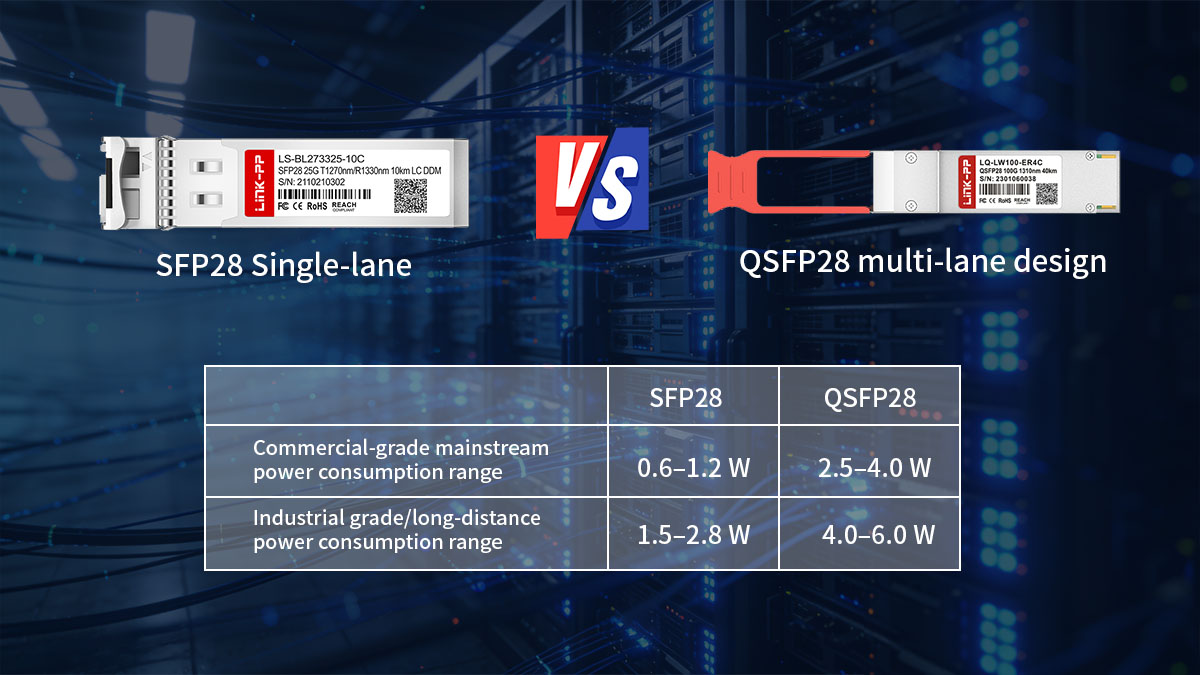
The fundamental difference between SFP28 module and QSFP28 module lies in lane architecture and total bandwidth.
SFP28 delivers 25Gbps using a single lane, while QSFP28 combines four 25Gbps lanes to achieve 100Gbps in one module. This distinction directly affects port density, cabling complexity, power consumption, and scalability.
Bandwidth and Lane Architecture
| Parameter | SFP28 | QSFP28 |
|---|---|---|
| Total Bandwidth | 25Gbps | 100Gbps |
| Lane Structure | 1 × 25G | 4 × 25G |
| Typical Ethernet | 25GbE | 100GbE |
| Bandwidth per Lane | 25Gbps | 25Gbps |
Conclusion: Both transceivers use the same 25Gbps lane speed, but QSFP28 multiplies capacity by aggregating four lanes into a single high-bandwidth interface.
This design allows QSFP28 to scale throughput efficiently at aggregation layers, while SFP28 maintains simplicity and predictability at the access layer.
Form Factor and Port Density
| Aspect | SFP28 | QSFP28 |
|---|---|---|
| Physical Size | Smaller | Larger |
| Typical Ports per RU | Higher | Lower |
| Best Use Layer | Access / ToR | Aggregation / Spine |
Conclusion: SFP28 enables higher port counts per switch, while QSFP28 maximizes bandwidth per port.
In environments where connecting many endpoints matters more than raw throughput, SFP28 is usually preferred. QSFP28 becomes advantageous when fewer, higher-capacity links are required.
Power Consumption and Thermal Impact
| Metric | SFP28 | QSFP28 |
|---|---|---|
| Typical Power Draw | ~1W | ~3–5W |
| Heat Density | Lower | Higher |
| Cooling Requirement | Minimal | Moderate |
Conclusion: QSFP28 consumes more power due to its multi-lane design, but delivers significantly higher bandwidth per watt at scale.
For dense access switches, lower per-port power makes SFP28 easier to cool. In core and aggregation switches, QSFP28’s efficiency per gigabit often offsets its higher absolute power draw.
Cabling and Fiber Requirements
| Factor | SFP28 | QSFP28 |
|---|---|---|
| Fiber Count (Typical) | 2 fibers | 2 or 8 fibers |
| Common Interfaces | SR, LR | SR4, LR4 |
| Cabling Complexity | Low | Medium |
Conclusion: SFP28 typically uses simple duplex fiber, while QSFP28 may require parallel fiber or wavelength multiplexing depending on the optic type.
This means QSFP28 deployments often need more careful planning around fiber infrastructure, especially for SR4 parallel optics.
Scalability and Flexibility
| Capability | SFP28 | QSFP28 |
|---|---|---|
| Breakout Support | No | Yes (100G → 4 × 25G) |
| Upgrade Path | 10G → 25G | 25G → 100G |
| Deployment Flexibility | High | Very High |
Conclusion: QSFP28 offers greater architectural flexibility through breakout configurations, while SFP28 excels in straightforward, point-to-point deployments.
Breakout support allows QSFP28 to function as both a 100G uplink and four independent 25G downlinks, which is a key reason it dominates modern spine–leaf designs.
SFP28 vs QSFP28: Performance Comparison
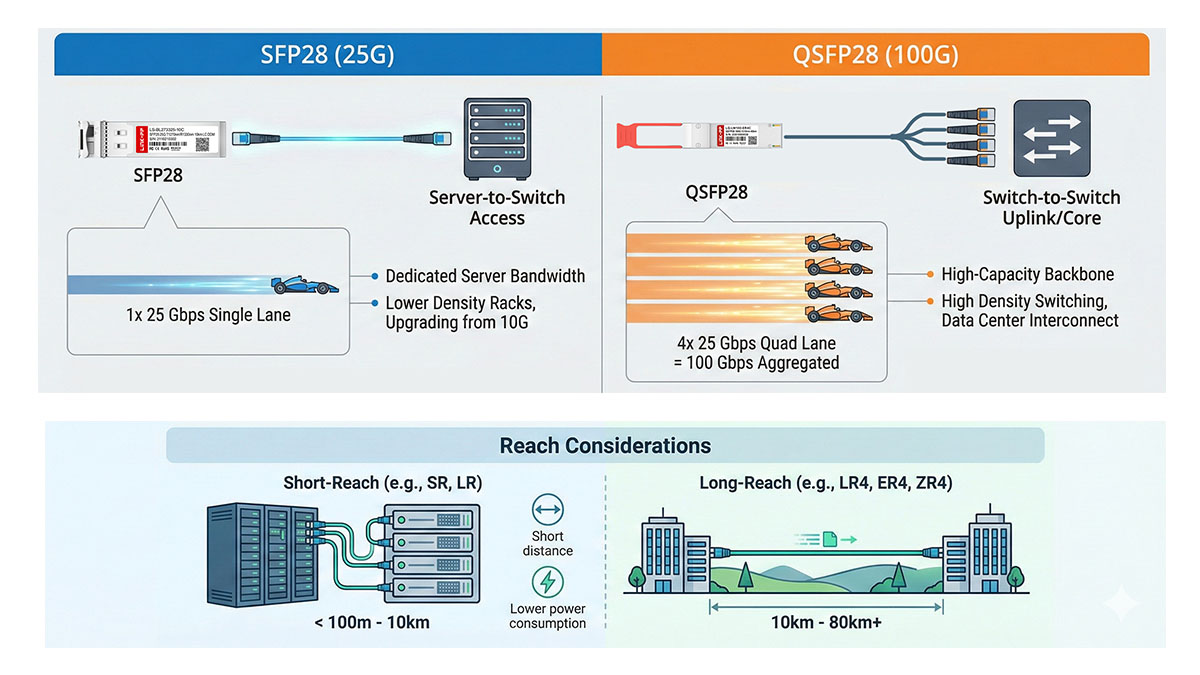
From a performance standpoint, SFP28 and QSFP28 do not differ in lane speed, but in how bandwidth is delivered and utilized across the network. Both rely on 25Gbps signaling per lane, yet their behavior under real traffic conditions is shaped by aggregation, topology, and deployment role.
Throughput Behavior in Real Networks
SFP28 is optimized for dedicated 25GbE links, where each port carries a single, predictable traffic flow. This makes performance easier to model and troubleshoot at the server and access layers.
QSFP28, by contrast, is designed for traffic aggregation. By combining four 25Gbps lanes, it supports multiple concurrent flows over a single 100GbE link, which is more efficient for inter-switch communication.
In practical terms:
-
SFP28 delivers consistent performance per endpoint
-
QSFP28 maximizes total throughput between network layers
Latency Considerations
In theory, SFP28 can achieve slightly lower latency because it avoids multi-lane alignment. In practice, however, the difference is usually negligible.
For most enterprise and cloud workloads:
-
Serialization and lane alignment in QSFP28 add minimal delay
-
Application-level latency remains unchanged
-
Network topology has a far greater impact than transceiver choice
As a result, latency is rarely the deciding factor between SFP28 and QSFP28.
Signal Stability and Reliability
SFP28’s single-lane architecture simplifies signal behavior. With fewer variables to manage, it tends to be more forgiving in environments with mixed cabling quality or less controlled fiber infrastructure.
QSFP28 requires tighter control over:
-
Lane synchronization
-
Fiber quality and connector cleanliness
-
Consistent cable lengths in parallel-fiber deployments
When deployed correctly, QSFP28 is just as stable, but it places higher demands on installation and validation.
Performance Efficiency at Scale
Although QSFP28 consumes more power per module, it often delivers higher bandwidth efficiency when evaluated across the entire network.
| Performance Metric | SFP28 | QSFP28 |
|---|---|---|
| Lane Speed | 25Gbps | 25Gbps × 4 |
| Max Link Throughput | 25Gbps | 100Gbps |
| Bandwidth Efficiency at Scale | Lower | Higher |
Replacing four separate 25G links with a single 100G QSFP28 connection typically improves throughput density and reduces overall port utilization.
Performance Summary
Rather than asking which transceiver is “faster,” the more accurate question is where each one performs best:
-
Choose SFP28 for predictable, per-port performance at the access layer
-
Choose QSFP28 for high-throughput, aggregated traffic in aggregation and core layers
Performance differences between SFP28 and QSFP28 are therefore architectural, not electrical.
Cost Comparison: SFP28 vs QSFP28
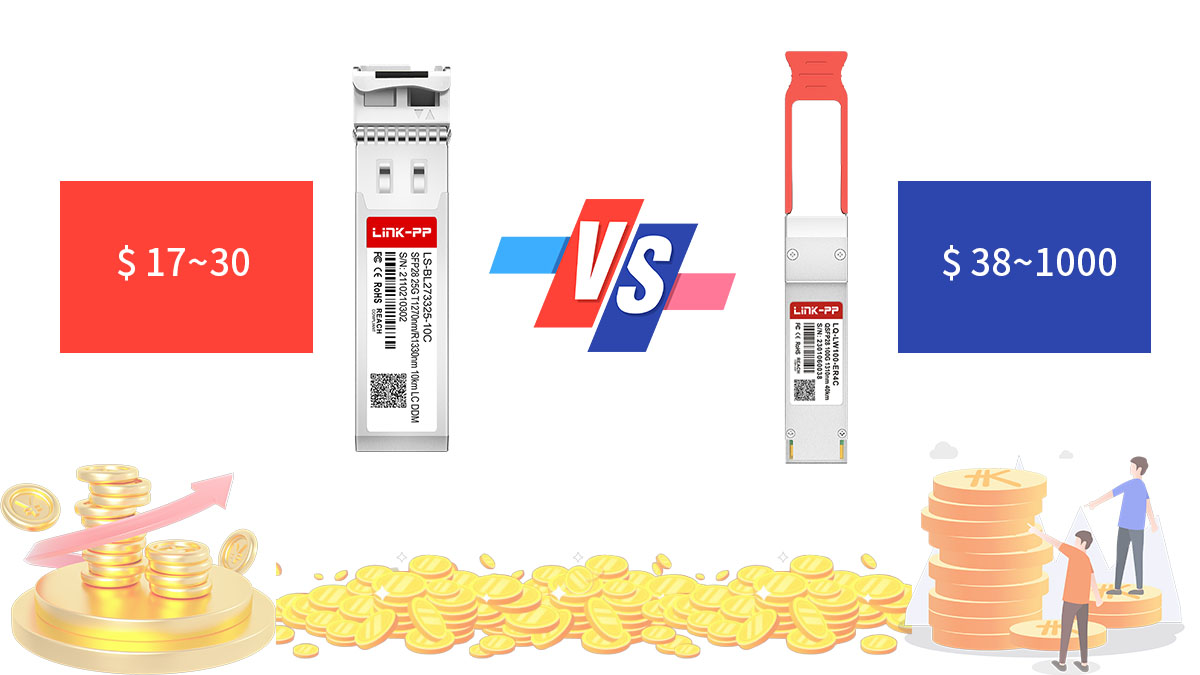
The cost difference between SFP28 and QSFP28 is not limited to the transceiver price itself.
In real deployments, total cost is shaped by port utilization, cabling architecture, power consumption, and long-term scalability.
Transceiver Module Cost
QSFP28 modules are more expensive per unit, but they deliver significantly higher bandwidth per port.
| Cost Factor | SFP28 | QSFP28 |
|---|---|---|
| Typical Unit Price | Lower | Higher |
| Bandwidth per Module | 25Gbps | 100Gbps |
| Cost per Gbps | Higher | Lower |
For single 25G links, SFP28 is clearly more economical. However, when evaluated on a cost-per-gigabit basis, QSFP28 often becomes more cost-efficient in aggregation layers.
Port Utilization and Switch Cost
| Aspect | SFP28 | QSFP28 |
|---|---|---|
| Ports Needed for 100G | 4 × SFP28 | 1 × QSFP28 |
| Switch Port Consumption | Higher | Lower |
| Backplane Efficiency | Lower | Higher |
Using four SFP28 ports to achieve 100G consumes more switch resources than a single QSFP28 port. In high-density switches, this can translate into higher capital cost and reduced scalability.
Cabling and Fiber Infrastructure Cost
| Infrastructure Element | SFP28 | QSFP28 |
|---|---|---|
| Typical Fiber Type | Duplex fiber | Duplex or parallel fiber |
| Fiber Count | Lower | Potentially higher |
| Cabling Complexity | Simple | Moderate |
SFP28 usually relies on standard duplex fiber, keeping cabling costs predictable. QSFP28 may require parallel fiber (SR4) or more advanced optics, which can increase upfront cabling costs if existing infrastructure is not optimized.
Power and Cooling Cost Over Time
| Metric | SFP28 | QSFP28 |
|---|---|---|
| Power per Module | Lower | Higher |
| Total Power per 100G | Higher | Lower |
| Cooling Overhead | Lower | Moderate |
Although QSFP28 consumes more power per module, it often replaces multiple 25G links. Over time, this can reduce power and cooling cost per unit of bandwidth, especially in large-scale data centers.
Long-Term Cost and Scalability
| Planning Factor | SFP28 | QSFP28 |
|---|---|---|
| Incremental Expansion | Easy | Moderate |
| Upgrade Flexibility | Limited | High (breakout support) |
| Long-Term TCO | Higher at scale | Lower at scale |
SFP28 works well for gradual, port-by-port expansion. QSFP28, on the other hand, provides better long-term value in networks that anticipate growth and higher bandwidth demand.
Typical Use Cases for SFP28
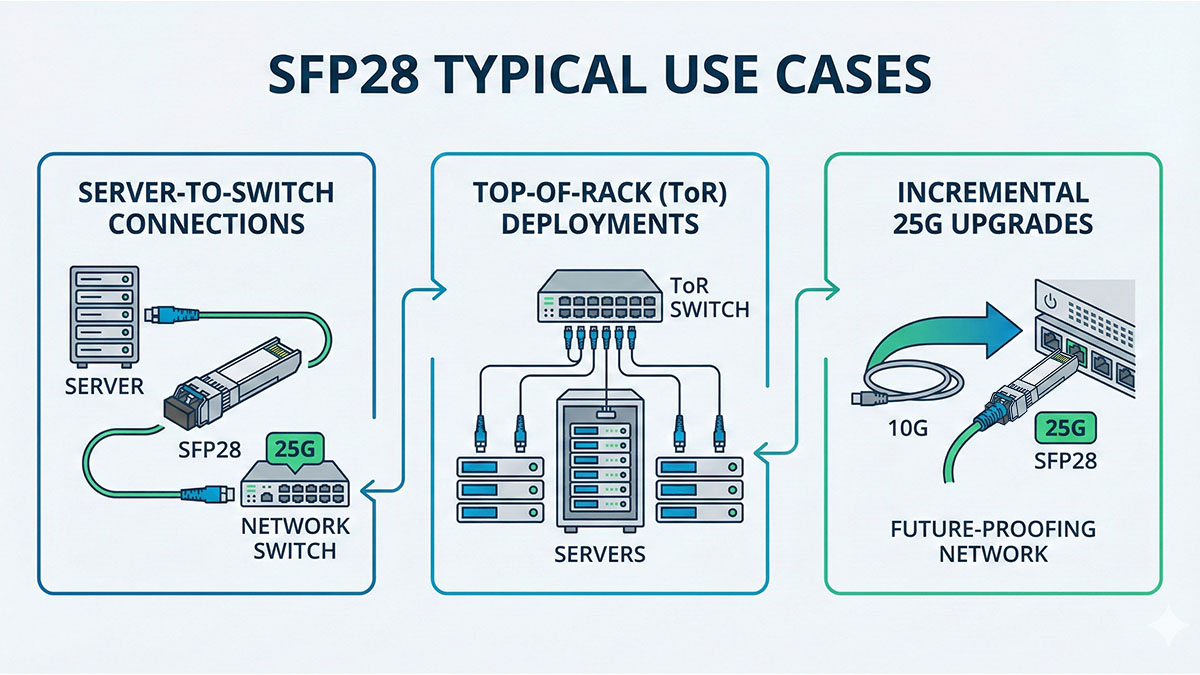
SFP28 transceiver is most commonly deployed in parts of the network where per-port bandwidth, simplicity, and density matter more than aggregated throughput. It is a natural fit for access-layer and server-facing connections in modern Ethernet networks.
Server-Facing Connectivity
SFP28 is widely used to connect servers equipped with 25GbE network interface cards (NICs) to Top-of-Rack switches. Because both ends operate natively at 25Gbps, the link remains simple, predictable, and easy to manage.
This makes SFP28 particularly suitable for:
-
Compute nodes with steady, per-server traffic patterns
-
Storage access links that benefit from consistent throughput
-
Latency-sensitive applications where deterministic behavior matters
Top-of-Rack (ToR) Switch Ports
At the ToR layer, SFP28 enables high port density without increasing power or cooling pressure. Its compact form factor allows switches to support dozens of server-facing ports while maintaining manageable thermal characteristics.
Operators often favor SFP28 in ToR deployments because:
-
Existing duplex fiber infrastructure can be reused
-
Per-port power consumption remains low
-
Troubleshooting is straightforward due to single-lane signaling
Incremental Network Upgrades
SFP28 plays a key role in networks transitioning from 10GbE to 25GbE. Since it shares the same physical form factor as SFP+, it allows for gradual upgrades without a complete redesign of the access layer.
This approach is common when:
-
Budget constraints require phased expansion
-
Mixed 10G and 25G environments must coexist
-
Immediate 100G aggregation is not yet necessary
Enterprise and Edge Deployments
In enterprise networks and edge data centers, operational simplicity often outweighs maximum throughput. SFP28’s lower power draw and straightforward cabling reduce both deployment risk and ongoing maintenance effort.
Typical examples include:
-
Enterprise access switches connecting departments or floors
-
Edge sites with limited cooling capacity
-
Regional data centers with moderate traffic growth
When SFP28 Makes the Most Sense
SFP28 is usually the right choice if:
-
25GbE per port meets current workload requirements
-
High port count is more important than link aggregation
-
The network relies on standard duplex fiber
-
Growth is expected to be gradual rather than exponential
In these scenarios, SFP28 offers the best balance of performance, cost control, and operational simplicity.
Typical Use Cases for QSFP28
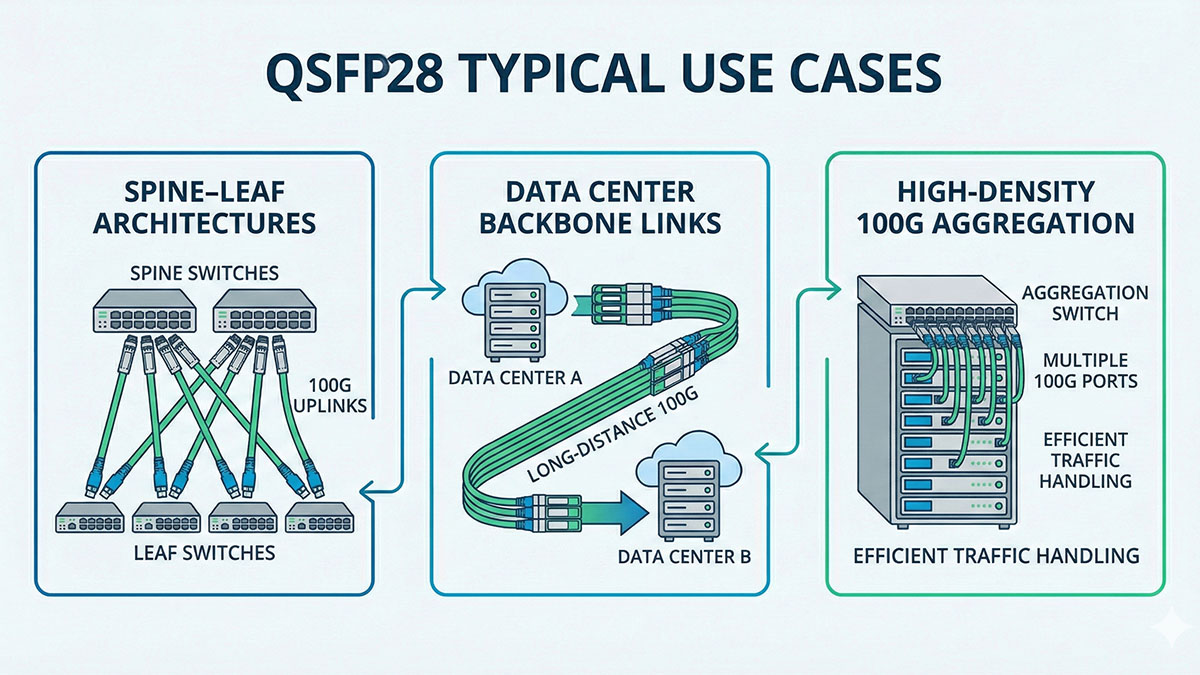
QSFP28 transceiver is designed for network segments where aggregate bandwidth, scalability, and future growth are more important than per-port simplicity. It is most commonly deployed in aggregation, spine, and high-capacity interconnect layers.
Switch-to-Switch Interconnects
QSFP28 is widely used to connect switches where large volumes of east–west traffic must be carried efficiently. At 100Gbps per port, it significantly reduces the number of physical links required between network devices.
This makes QSFP28 a natural choice when:
-
Multiple access switches aggregate into a single upstream device
-
High-throughput east–west traffic dominates workloads
-
Reducing fiber count and port usage is a priority
Spine–Leaf Architectures
In modern leaf–spine data center designs, QSFP28 typically serves as the primary uplink from leaf switches to spine switches. Its high bandwidth aligns well with traffic patterns generated by large clusters and distributed applications.
QSFP28 is favored in spine–leaf deployments because:
-
A single link can handle traffic from many downstream servers
-
Network oversubscription ratios are easier to control
-
Scaling the fabric requires fewer physical changes
High-Performance Computing and AI Clusters
QSFP28 is commonly found in environments with extreme bandwidth demands, such as high-performance computing (HPC) and AI training clusters. These workloads generate sustained, high-volume traffic that benefits from fewer, faster links.
Typical drivers include:
-
Large-scale GPU or accelerator clusters
-
Frequent data synchronization across nodes
-
Sensitivity to congestion rather than per-port latency
Data Center Backbone and Core Links
For core and backbone connections inside a data center, QSFP28 provides the capacity needed to support multiple access layers without constant link expansion. It simplifies topology design by concentrating bandwidth into fewer, higher-speed connections.
This is especially relevant when:
-
Traffic growth is expected to be rapid
-
Network redesigns must be minimized over time
-
Rack-to-rack or row-to-row links require long-term headroom
When QSFP28 Is the Better Choice
QSFP28 is usually the better option if:
-
Aggregate throughput is more important than per-port granularity
-
The network architecture is built around aggregation or spine layers
-
Future scalability is a key design requirement
-
Reducing cable complexity and port count is a strategic goal
In these scenarios, QSFP28 delivers the bandwidth concentration and scalability that modern data centers depend on.
Compatibility and Breakout Scenarios
Compatibility between SFP28 and QSFP28 is not based on form factor similarity, but on lane architecture and port design. Understanding how breakout works is essential to avoid incorrect deployments and wasted ports.
Understanding QSFP28 Breakout
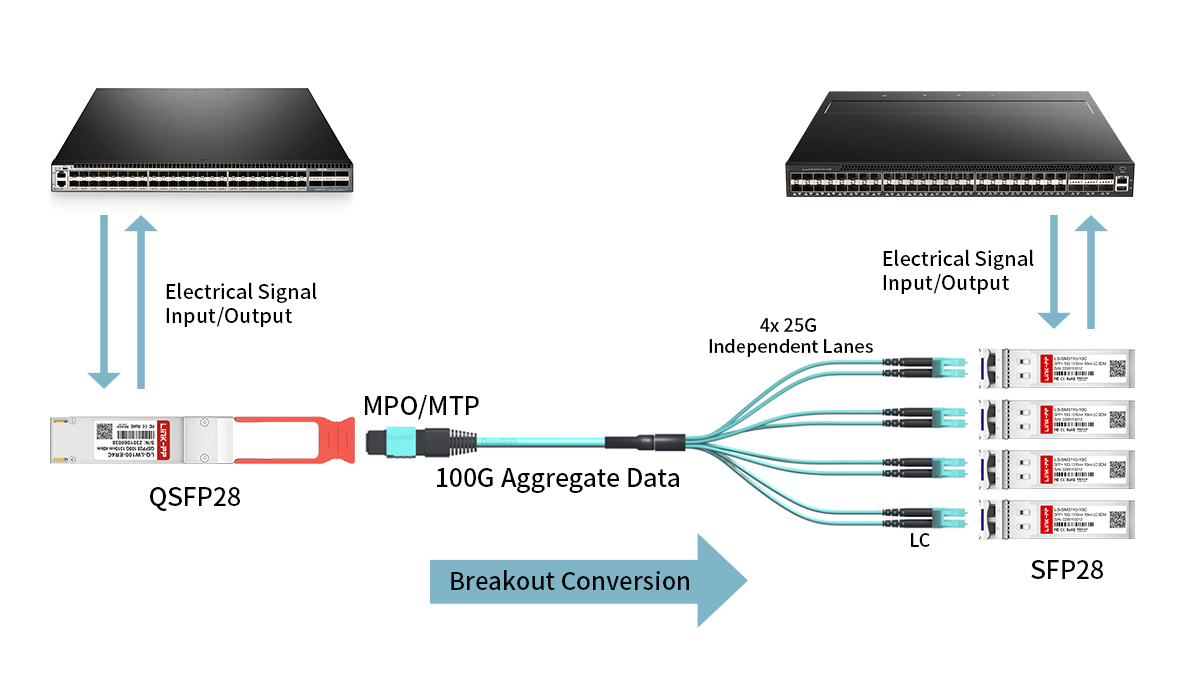
A QSFP28 port can be configured to operate as four independent 25Gbps lanes, allowing one 100GbE port to connect to multiple SFP28 endpoints.
This breakout model is commonly referred to as 100G to 4×25G.
Key requirements include:
-
A switch that explicitly supports QSFP28 breakout mode
-
Compatible breakout cables or optical modules
-
Proper port configuration at the switch OS level
Without these conditions, physical connectivity alone is not sufficient.
Common Breakout Configurations
The most widely deployed breakout scenario involves connecting one QSFP28 port to four SFP28 ports on another device.
| Configuration | Typical Application |
|---|---|
| 100G QSFP28 → 4×25G SFP28 | Leaf-to-server aggregation |
| QSFP28 breakout DAC | Short-reach, high-density racks |
| QSFP28 breakout AOC | Medium reach inside data centers |
This approach is often used to maximize port efficiency on high-capacity switches while maintaining 25GbE server links.
Compatibility Limitations to Be Aware Of
Breakout does not imply universal compatibility. There are several practical constraints that must be considered:
-
SFP28 cannot aggregate upward into a single QSFP28 port without breakout support
-
QSFP28 ports configured as 100G cannot accept a single SFP28 module
-
Mixed vendor environments may require firmware-level validation
Ignoring these constraints is a common cause of link failures during deployment.
When Breakout Makes Sense
Breakout is most effective when:
-
Server-facing ports remain at 25GbE
-
Uplink ports need to conserve space and power
-
Gradual migration toward 100GbE is planned
In these cases, breakout provides flexibility without forcing immediate architectural changes.
When Breakout Is Not the Right Choice
Breakout may introduce unnecessary complexity if:
-
All connected devices already support native 100GbE
-
Port configuration must remain static
-
Cable management simplicity is a priority
In such environments, direct QSFP28-to-QSFP28 links are usually more reliable.
Practical Takeaway
Compatibility between SFP28 and QSFP28 is conditional, not automatic.
Breakout is a powerful tool, but only when the hardware, software, and network design align.
Used correctly, it bridges 25G and 100G deployments. Used incorrectly, it creates avoidable operational risk.
How to Choose Between SFP28 and QSFP28
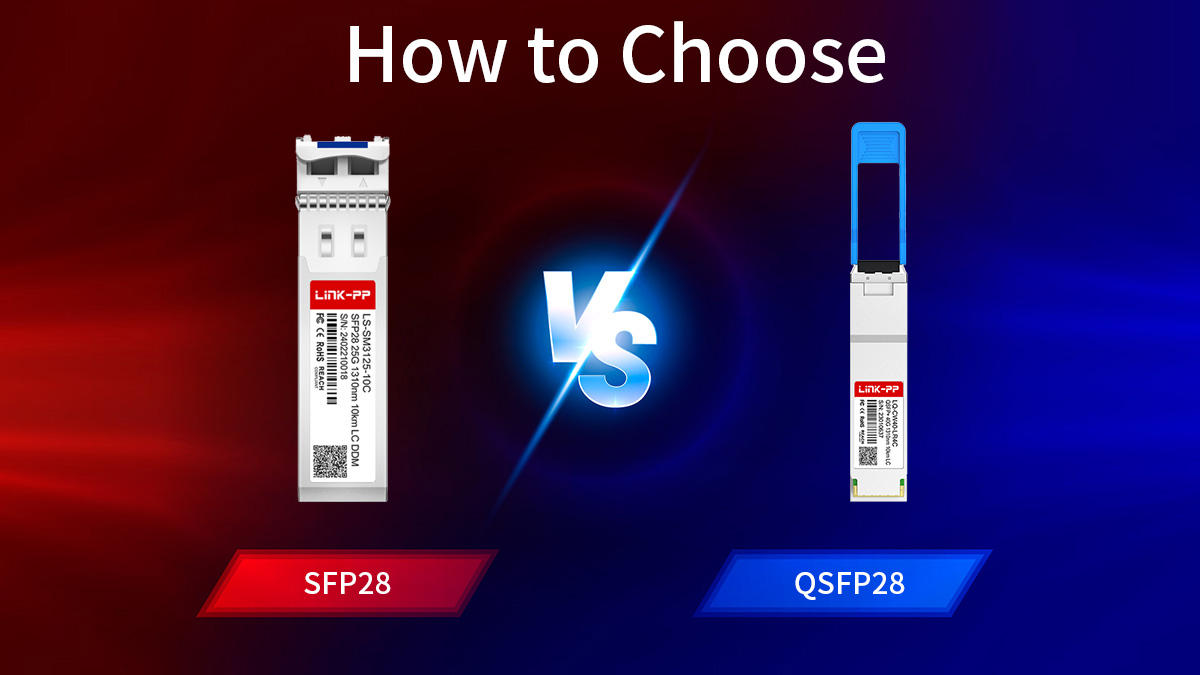
Choosing between SFP28 and QSFP28 is less about which technology is “better” and more about where the port sits in your network and how traffic is expected to grow. The decision should start from architecture, not from raw speed.
Start With Network Layer, Not Speed
The most reliable way to choose is to first identify the role of the port.
-
Server-facing and access-layer ports typically favor SFP28
-
Aggregation, spine, and backbone ports typically favor QSFP28
This distinction aligns bandwidth with traffic patterns and avoids overbuilding where it is not needed.
Compare Decision-Critical Factors
The following comparison focuses only on factors that directly influence deployment decisions.
| Decision Factor | SFP28 | QSFP28 |
|---|---|---|
| Typical port role | Access / server-facing | Aggregation / uplink |
| Bandwidth model | Per-port 25GbE | Aggregated 100GbE |
| Port density priority | High | Medium |
| Growth strategy | Incremental | Scalable |
Rather than choosing on speed alone, this view highlights functional fit within the network.
Consider Traffic Growth and Upgrade Path
If traffic growth is expected to be gradual and predictable, SFP28 allows capacity to be added port by port. This reduces upfront cost and simplifies operational planning.
If traffic growth is expected to be rapid or uneven, QSFP28 provides headroom that avoids frequent link upgrades and topology changes.
The upgrade path matters as much as the current requirement.
Evaluate Operational Complexity
Operational factors often become decisive at scale.
SFP28 tends to be easier to operate because:
-
Each port behaves independently
-
Cabling is simple and consistent
-
Troubleshooting is localized
QSFP28 introduces more flexibility, but also more variables:
-
Breakout configurations require careful planning
-
Misconfiguration impacts multiple downstream links
-
Cable management becomes more critical
A Simple Rule of Thumb
In practice, many networks follow a mixed approach:
-
SFP28 at the edge for server and access connectivity
-
QSFP28 upstream for aggregation and fabric links
This combination balances cost efficiency, performance, and scalability without forcing early overcommitment.
Final Takeaway
Choose SFP28 when clarity, density, and per-port control matter most.
Choose QSFP28 when consolidation, scalability, and long-term growth dominate the design.
When aligned with network role and traffic behavior, both technologies deliver optimal value—often within the same architecture.
Summary: SFP28 vs QSFP28 — Which One Should You Choose?
SFP28 and QSFP28 are not competing technologies—they serve different roles within the same network architecture.
SFP28 is best suited for environments where 25GbE per port, high density, and operational simplicity are the priority, especially at the server-facing and access layers. QSFP28, by contrast, excels where bandwidth aggregation, scalability, and long-term growth are critical, such as uplinks, spine–leaf fabrics, and data center backbones.
In practice, most modern networks benefit from a hybrid approach:
-
SFP28 at the edge for efficient, predictable connectivity
-
QSFP28 upstream for capacity consolidation and future expansion
The right choice depends less on speed alone and more on port role, traffic patterns, and upgrade strategy.
Looking for Compatible SFP28 and QSFP28 Modules?
If you are evaluating deployment or planning an upgrade, using vendor-compatible optical modules can help balance performance, reliability, and cost.
LINK-PP offers a full range of SFP28 and QSFP28 transceivers, designed for broad switch compatibility and real-world data center applications.
? Explore available options at the LINK-PP Official Store and find the right module for your network design.