





























? What Is a Pluggable Transceiver and How It Works
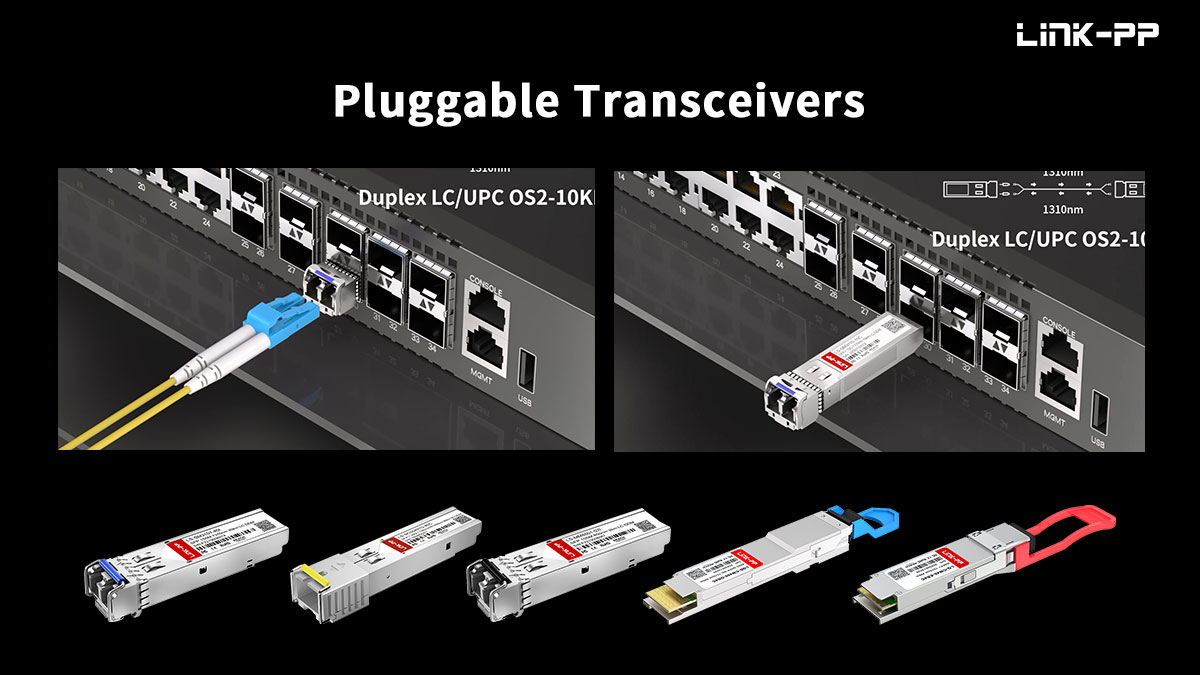
A pluggable transceiver is a modular interface that sits between a network device and the physical transmission medium, enabling data to be sent and received over optical fiber or copper cabling. Unlike fixed, on-board interfaces, pluggable transceivers can be inserted, removed, and replaced while the system is powered on (hot-swappable), allowing networks to adapt to changing speed, distance, and media requirements without replacing host hardware.
At a high level, the pluggable model separates signal processing from physical transmission, which is the core reason it has become the dominant architecture in modern Ethernet networks.
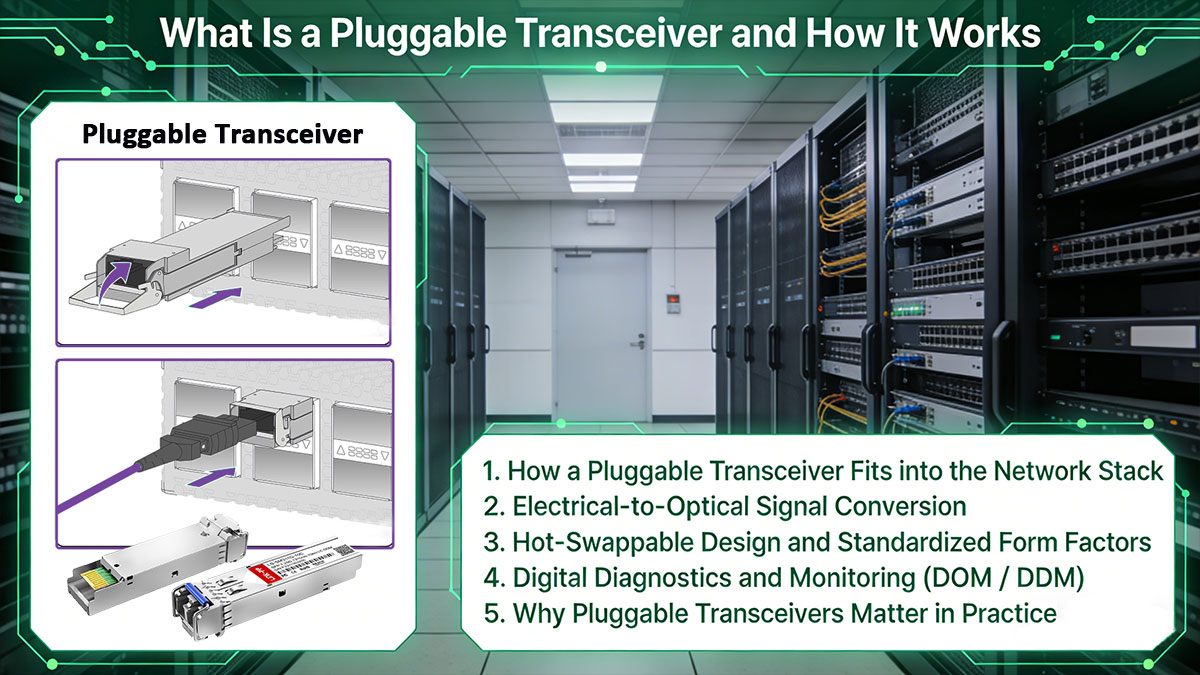
How a Pluggable Transceiver Fits into the Network Stack
In a typical Ethernet system, responsibilities are divided across three layers:
-
Host device (switch, router, NIC)
-
Handles MAC, PHY, and SerDes functions
-
Generates and receives high-speed electrical signals
-
Manages link negotiation, FEC, and protocol compliance
-
-
Pluggable transceiver module
-
Converts electrical signals to optical (or copper) signals for transmission
-
Performs the reverse conversion on receive
-
Implements optical modulation, wavelength control, and diagnostics
-
-
Transmission medium
-
Single-mode or multimode fiber
-
Copper cabling (DAC or RJ45)
-
This division allows the same switch port to support different link characteristics simply by changing the transceiver, rather than redesigning the hardware.
Electrical-to-Optical Signal Conversion
At the heart of every pluggable optical transceiver is a bidirectional conversion process:
-
Transmit (Tx):
High-speed electrical signals from the host SerDes are used to drive a laser (such as VCSELs for short reach or DFB lasers for long reach). The laser converts the electrical data into modulated light at a specific wavelength. -
Receive (Rx):
Incoming optical signals are captured by a photodiode, converted back into electrical signals, and then passed to the host PHY for decoding and error correction.
The specific implementation varies by module type:
-
SR modules typically use 850 nm lasers and multimode fiber
-
LR/ER modules use 1310 nm or 1550 nm wavelengths over single-mode fiber
-
WDM-based modules (e.g., LR4, CWDM4) multiplex multiple wavelengths onto a single fiber pair
Hot-Swappable Design and Standardized Form Factors
Pluggable transceivers are designed to be hot-pluggable, meaning they can be inserted or removed without powering down the system. This is enabled by standardized electrical interfaces and control protocols defined by MSA (Multi-Source Agreements) such as SFP, QSFP, and QSFP-DD.
Common characteristics include:
-
A standardized mechanical cage and connector
-
Defined pin assignments for power, data, and control signals
-
Low-speed management interfaces (I²C-based) for monitoring and configuration
This standardization ensures that optical transceivers from different vendors can physically fit the same ports, even though full interoperability still depends on firmware and platform support.
Digital Diagnostics and Monitoring (DOM / DDM)
Most modern pluggable transceivers support Digital Optical Monitoring (DOM or DDM), allowing real-time visibility into operating conditions such as:
-
Module temperature
-
Supply voltage
-
Laser bias current
-
Transmit optical power
-
Receive optical power
These parameters are critical for proactive network operations. Trending DOM data over time helps engineers detect thermal stress, optical degradation, or marginal link conditions before they cause outages.
Why Pluggable Transceivers Matter in Practice
The practical value of pluggable transceivers lies in their flexibility:
-
Scalability: Upgrade speeds (e.g., 10G to 25G or 100G) without replacing switches
-
Media flexibility: Choose fiber or copper based on distance and environment
-
Operational efficiency: Replace failed optics without service disruption
-
Supply chain resilience: Source compatible transceivers independently of hardware vendors
For these reasons, pluggable optical modules are not just components—they are a system-level design choice that directly impacts network reliability, cost control, and long-term scalability.
In the sections that follow, we will examine the different types of pluggable transceivers, how they are classified by form factor and speed, and what practical considerations should guide selection and deployment in real-world networks.
? Types of Pluggable Transceivers by Form Factor and Speed
Pluggable transceivers are most commonly classified by form factor and supported data rate, as these two attributes determine port compatibility, achievable bandwidth, power consumption, and typical deployment scenarios. While many modules share similar physical dimensions, their electrical signaling, lane architecture, and operational requirements differ significantly.
Understanding these distinctions is essential when designing scalable networks or planning speed upgrades without introducing compatibility or thermal risks.
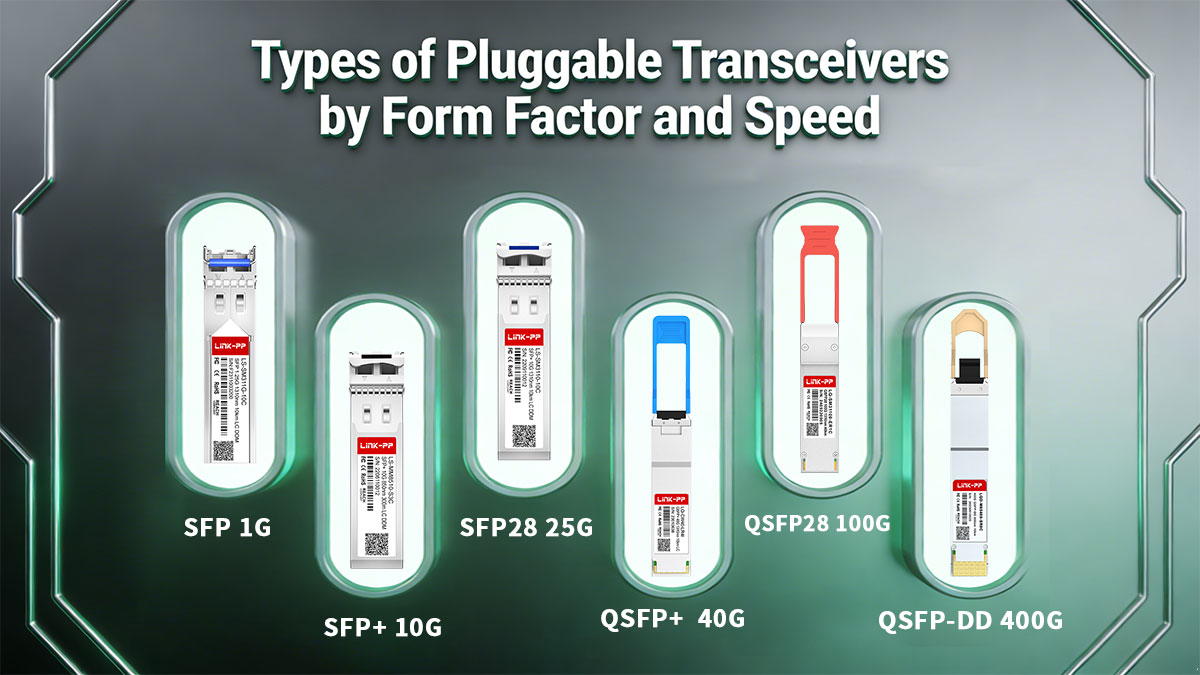
▶ SFP (Small Form-Factor Pluggable) — 1G
SFP transceivers were introduced to support data rates up to 1 Gbps and remain widely deployed in enterprise access and legacy networks.
Typical standards and use cases:
-
1000BASE-SX (multimode fiber, short reach)
-
1000BASE-LX (single-mode fiber, up to 10 km)
-
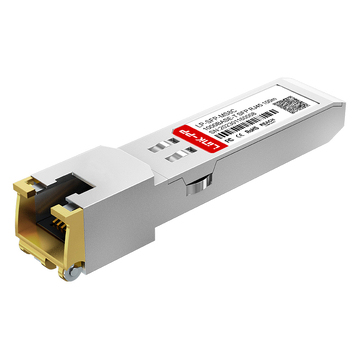
1000BASE-T (copper RJ45 SFP)
Key characteristics:
-
Single electrical lane
-
Low power consumption (typically < 1 W)
-
Broad platform compatibility
-
Long lifecycle and stable interoperability
Despite the shift toward higher speeds, 1G SFP modules continue to be used where bandwidth demands are modest and cost efficiency is a priority.
▶ SFP+ — 10G
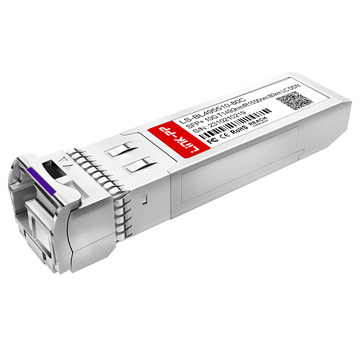
SFP+ transceivers extend the SFP form factor to support 10 Gbps operation while maintaining the same physical footprint.
Common standards:
-
10GBASE-SR (MMF, up to 300 m)
-
10GBASE-LR (SMF, up to 10 km)
-
10GBASE-ER (SMF, up to 40 km)
-
10GBASE-T (RJ45, limited adoption due to power)
Technical distinction from SFP:
-
Signal processing is largely handled by the host device
-
Reduced module complexity
-
Lower power consumption compared to earlier 10G solutions
SFP+ is widely used in data center access layers, enterprise aggregation, and storage networks, offering a strong balance between performance and port density.
▶ SFP28 — 25G
SFP28 transceivers support 25 Gbps Ethernet using a single 25G electrical lane, delivering significantly higher bandwidth without increasing port size.
Typical applications:
Why SFP28 matters:
-
Higher throughput per port than 10G
-
Comparable power consumption to SFP+
-
Ideal for server-facing links and top-of-rack switching
While SFP28 modules are mechanically compatible with SFP+ cages, full 25G operation requires SFP28-capable host hardware and firmware. In some platforms, SFP28 modules may fall back to 10G operation when inserted into SFP+ ports.
▶ QSFP+ — 40G
QSFP+ (Quad Small Form-Factor Pluggable Plus) supports 40 Gbps by combining four 10G electrical lanes within a single module.
Common standards:
-
40GBASE-SR4 (MMF, MPO connectors)
-
40GBASE-LR4 (SMF, WDM)
Notable features:
-
High bandwidth density
-
Breakout support (4 × 10G)
-
Typically higher power consumption than SFP+
QSFP+ played a critical role in early high-density data center designs but has largely been superseded by QSFP28 for new deployments.
▶ QSFP28 — 100G
QSFP28 transceivers deliver 100 Gbps using four 25G lanes (4 × 25G NRZ), making them the dominant interface for modern 100G Ethernet.
Widely deployed standards:
-
CWDM4
-
PSM4
Advantages of QSFP28:
-
Mature ecosystem and broad vendor support
-
Balanced power efficiency and thermal performance
-
Support for breakout configurations (4 × 25G)
QSFP28 is commonly used in spine–leaf data center architectures, core switching, and high-capacity enterprise backbones.
▶ QSFP-DD and Beyond — 400G+
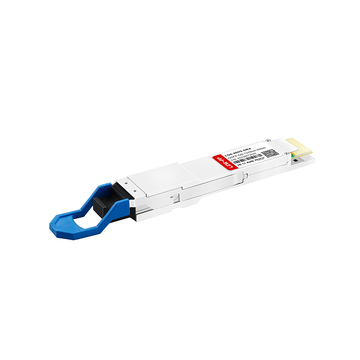
QSFP-DD (Double Density) extends the QSFP form factor to support eight high-speed electrical lanes, enabling 400 Gbps and beyond.
Key points:
-
Backward compatible with QSFP+/QSFP28 cages
-
Higher power and thermal design requirements
-
Primarily used in hyperscale and AI-driven networks
As networks continue to scale, QSFP-DD and similar high-density form factors represent the next phase of pluggable transceiver evolution.
▶ Summary: Choosing by Form Factor and Speed
| Form Factor | Typical Speed | Lane Architecture | Common Use Cases |
|---|---|---|---|
| SFP | 1G | 1 × 1G | Access, legacy |
| SFP+ | 10G | 1 × 10G | Enterprise, DC |
| SFP28 | 25G | 1 × 25G | Server-facing |
| QSFP+ | 40G | 4 × 10G | Aggregation |
| QSFP28 | 100G | 4 × 25G | Spine / Core |
| QSFP-DD | 400G+ | 8 × 50G+ | Hyperscale |
Selecting the correct pluggable transceiver form factor is not just about speed—it directly affects cabling architecture, power budgets, scalability, and long-term operational efficiency. In the next section, we will examine how transmission medium and fiber type further influence transceiver selection.
? Optical vs. Copper Pluggable Transceivers
Pluggable modules can be broadly classified into fiber transceivers and copper transceivers, depending on the transmission medium they use. Each type serves distinct deployment scenarios, with different trade-offs in distance, power consumption, latency, and cost.
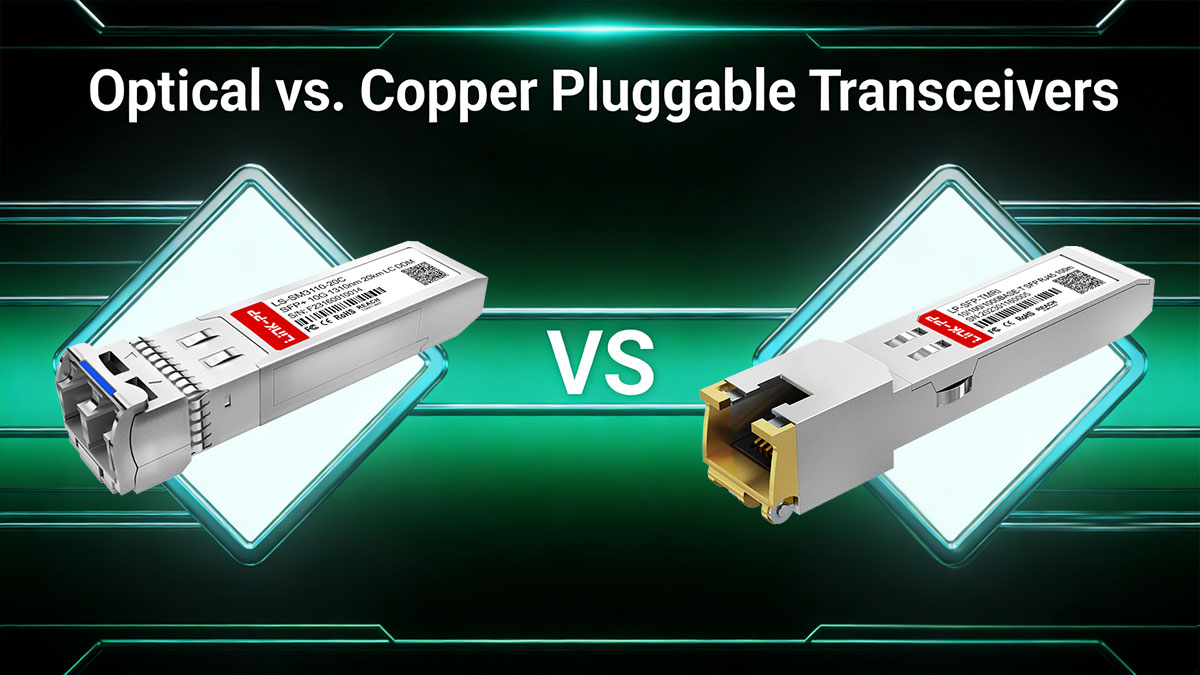
Optical Pluggable Transceivers
Optical pluggable transceivers convert electrical signals into optical signals and transmit data over fiber optic cables. They are the dominant choice in modern data centers, telecom networks, and high-performance computing environments.
Key characteristics:
-
Transmission medium: Single-mode fiber (SMF) or multimode fiber (MMF)
-
Typical distances: From 100 meters (SR) up to 80 km or more (ZR/ER)
-
Common examples: SFP, SFP+, SFP28, QSFP+, QSFP28, QSFP56
-
Standards: IEEE 802.3, MSA specifications (SR, LR, DR, FR, LR4, CWDM4, PSM4)
Advantages:
-
Long transmission distance
-
High bandwidth scalability (10G → 400G+)
-
Strong immunity to electromagnetic interference (EMI)
-
Lower latency over long links
Typical use cases:
-
Data center interconnects (DCI)
-
Spine–leaf architectures
-
Telecom access and aggregation networks
-
5G fronthaul / midhaul / backhaul
Copper Pluggable Transceivers
Copper pluggable transceivers transmit electrical signals directly over copper cables, without optical conversion. They are primarily used for short-reach connections.
This category includes Direct Attach Copper (DAC) and 10G/25G/40G/100GBASE-T copper modules.
Key characteristics:
-
Transmission medium: Twinax copper cable or twisted-pair Ethernet cable
-
Typical distances:
-
DAC: 0.5–7 m (passive), up to ~15 m (active)
-
BASE-T modules: up to 30 m (Cat6a)
-
-
Common examples: SFP+ DAC, QSFP28 DAC, 10GBASE-T SFP+
Advantages:
-
Lower upfront cost for short links
-
Simple deployment (plug-and-play)
-
No optical cleaning or fiber handling required
Limitations:
-
Limited distance compared to optical modules
-
Higher power consumption (especially BASE-T)
-
Bulkier cabling, reduced airflow in dense racks
Typical use cases:
-
Top-of-rack (ToR) to server connections
-
Short intra-rack or adjacent-rack links
-
Lab testing and temporary deployments
Optical vs. Copper: Quick Comparison
| Parameter | Optical Transceivers | Copper Transceivers |
|---|---|---|
| Transmission distance | Medium to ultra-long | Very short |
| Bandwidth scalability | Excellent | Limited |
| Power efficiency | Generally better | Higher (BASE-T) |
| EMI immunity | Strong | Weak |
| Cost (short reach) | Higher | Lower |
| Cabling complexity | Fiber management required | Simple plug-in |
Engineering Recommendation
-
Choose pluggable optical transceivers when distance, bandwidth growth, and signal integrity are critical.
-
Choose pluggable copper transceivers for short, cost-sensitive connections where simplicity matters more than scalability.
In modern high-speed networks (25G and above), pluggable fiber transceivers are increasingly favored due to lower total cost of ownership (TCO) and better future-proofing.