
In modern network infrastructure — from campus aggregation to hyperscale data centers — the demand for higher throughput, improved efficiency, and cost-effective scalability is continually reshaping optical transceiver selection. Small Form-Factor Pluggable SFP, SFP+, and SFP28 transceivers remain among the most widely deployed modular interfaces across Ethernet, Fibre Channel, and telecommunications environments. Although these form factors share a common physical footprint, they differ fundamentally in electrical specifications, supported data rates, application domains, and backward compatibility.
For IT architects, network engineers, and procurement professionals, understanding these differences is no longer optional — it directly influences network performance, upgrade paths, and total cost of ownership (TCO). Misjudging the technical boundaries or compatibility of these transceivers can lead to under-utilized interfaces, avoidable hardware refresh cycles, or unnecessary operational costs.
This guide provides a detailed, practical comparison of SFP, SFP+, and SFP28 transceiver technologies. We will:
-
Explain the core functional distinctions and standard-defined specifications for each transceiver type.
-
Clarify real-world compatibility rules and deployment scenarios.
-
Outline objective criteria for evaluating 1G, 10G, and 25G network upgrades.
-
Highlight key deployment considerations such as power consumption, port density, and thermal implications.
Whether you are planning a network upgrade, evaluating interconnect options for new equipment, or simply seeking an authoritative reference for transceiver technologies, this guide will equip you with the insights necessary to make informed decisions.
↪️ What Are SFP, SFP+, and SFP28?
In optical networking, SFP (Small Form-Factor Pluggable), SFP+ (Enhanced Small Form-Factor Pluggable), and SFP28 are standardized modular transceiver interfaces used to convert electrical signals to optical (or electrical) signals for transmission over fiber or copper media. While all three share a similar compact physical form factor, they differ substantially in supported data rates, protocol support, and application domains — differences that have significant implications for network design and upgrade planning.
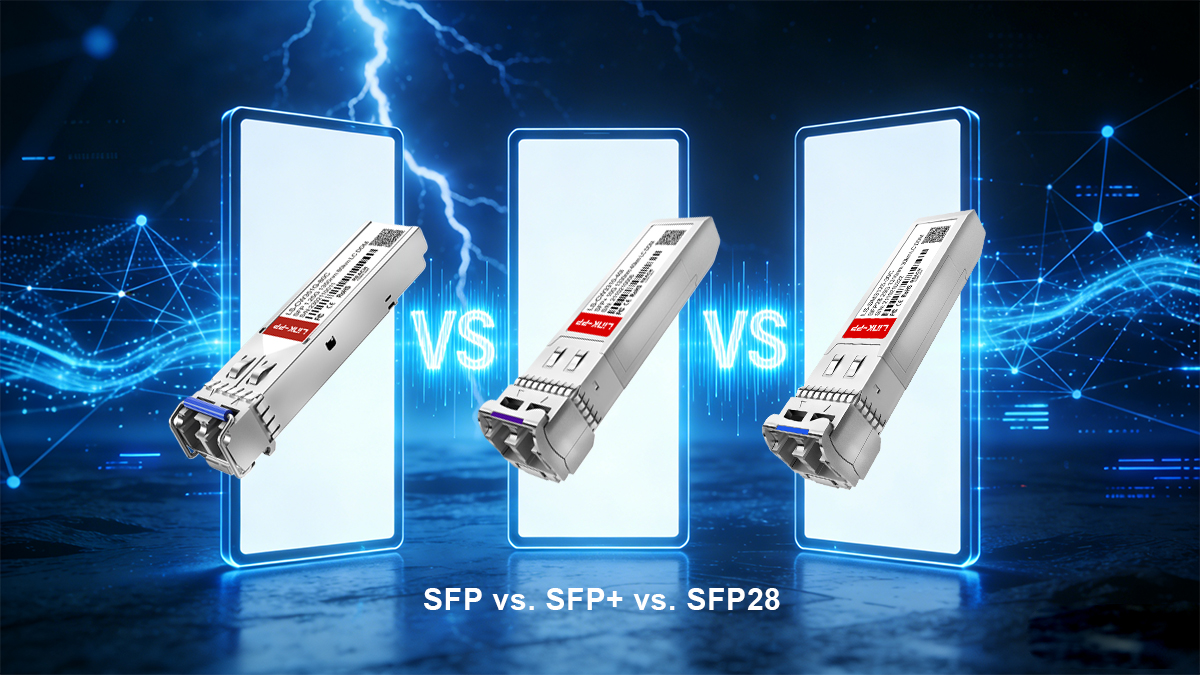
SFP, SFP+, and SFP28 are small form-factor pluggable optical transceivers used in Ethernet networks.
SFP supports 1Gbps, SFP+ supports 10Gbps, and SFP28 supports 25Gbps, while sharing the same physical form factor but requiring different host-side electrical interfaces.
SFP (Small Form-Factor Pluggable)
SFP is the original small form-factor transceiver standard developed to support lower-speed optical and copper links such as 1 Gbps Ethernet and early Fibre Channel. SFP modules comply with Multisource Agreements (MSA) and IEEE 802.3 standards (e.g., 1000BASE-SX/1000BASE-LX) and are widely used in access and aggregation layers of enterprise networks.
Key Characteristics of SFP:
-
Data Rate: Typically up to ~1 Gbps (some enhanced variants support 2.5G or 4.25G)
-
Applications: 1G Ethernet, legacy links, campus access points
-
Form Factor: Identical physical housing used by later generations
-
Compatibility: SFP ports generally do not accept higher-speed modules like SFP+ or SFP28 without hardware support
Because SFP modules predate higher-speed Ethernet standards, they remain common in existing infrastructure but are less suitable for modern high-performance networks requiring more throughput.
SFP+ (Enhanced SFP)
SFP+ is an evolution of the SFP standard designed specifically for higher-speed links, most notably 10 Gigabit Ethernet and multi-rate Fibre Channel. Despite maintaining the same physical form factor and pinout as SFP, SFP+ modules are engineered for significantly higher performance.
Key Characteristics of SFP+:
-
Data Rate: Standardized primarily for 10 Gbps Ethernet and related protocols, with some support for 8G/16G Fibre Channel
-
Standards: Commonly aligns with IEEE 802.3ae and SFF-8431 specifications
-
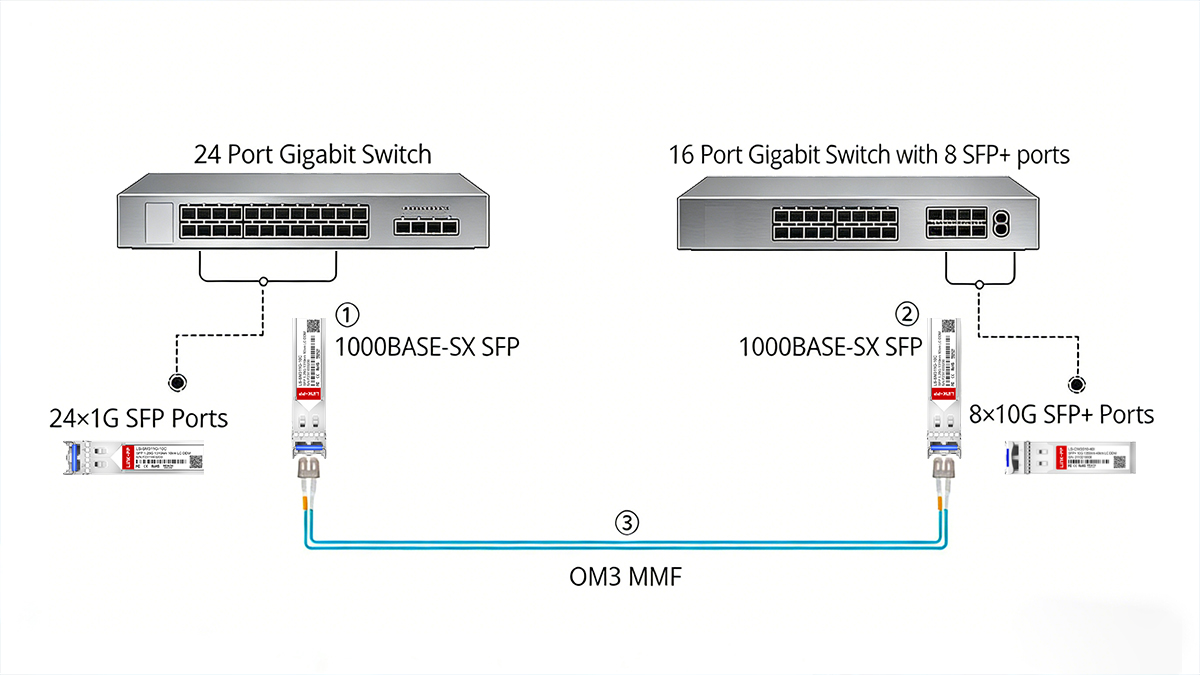
Compatibility: SFP+ ports can often accept SFP optics and operate at the lower SFP speeds, providing a smooth upgrade path from 1G to 10G
-
Use Cases: Top-of-Rack (ToR) and aggregation switches, SAN uplinks, enterprise cores
SFP+ remains one of the most widely deployed interfaces for 10 G networking due to its balance of performance, port density, and ecosystem maturity.
SFP28 (25 Gigabit SFP)
SFP28 represents the next step in the evolution of the SFP family. It retains the same form factor and mechanical housing as SFP and SFP+ but is optimized for much higher electrical lane speeds, typically supporting 25 Gbps links defined under IEEE 802.3by.
Key Characteristics of SFP28:
-
Data Rate: Standard support for 25 Gbps Ethernet, with some implementations supporting dual-rate 10/25 Gbps operations
-
Protocol Support: 25GBASE-SR/LR and similar 25 GbE standards
-
Compatibility: SFP28 modules can often operate in SFP+ ports at reduced speeds (e.g., 10 Gbps), but full 25 Gbps performance requires SFP28-rated host hardware
-
Use Cases: High-density data center access, server uplinks, 5G fronthaul, and aggregation layers
SFP28 has become the de facto standard for 25G networking because it delivers a step-function increase in bandwidth while preserving the compact form factor that enables high port densities — an essential characteristic in modern leaf-spine architectures.
Quick Comparison: SFP vs. SFP+ vs. SFP28
To synthesize these differences clearly:
| Parameter |
SFP |
SFP+ |
SFP28 |
| Max Data Rate |
1 Gbps |
10 Gbps |
25 Gbps |
| Host Electrical Interface |
1G SerDes |
10G SerDes |
25G SerDes |
| Backward Compatibility |
❌ |
⚠️ Limited |
⚠️ Limited |
| Typical Use Case |
Access Layer |
Aggregation |
Data Center |
| Common Ethernet Standard |
1000BASE-X |
10GBASE-SR/LR |
25GBASE-SR/LR |
This comparison highlights how each successive generation offers higher bandwidth and performance while preserving physical compatibility. However, network device support and port capability remain critical determinants of whether a module can operate at its full rated speed.
↪️ Speed and Technical Differences (1G vs. 10G vs. 25G)
Although SFP, SFP+, and SFP28 transceivers share the same compact mechanical form factor, they are designed around very different electrical signaling requirements and Ethernet standards. The most important distinction is not the housing itself, but the line rate, signal integrity tolerance, and host interface capability required to reliably operate at 1G, 10G, or 25G speeds.
Understanding these technical differences is essential when evaluating performance limits, compatibility, and upgrade feasibility.
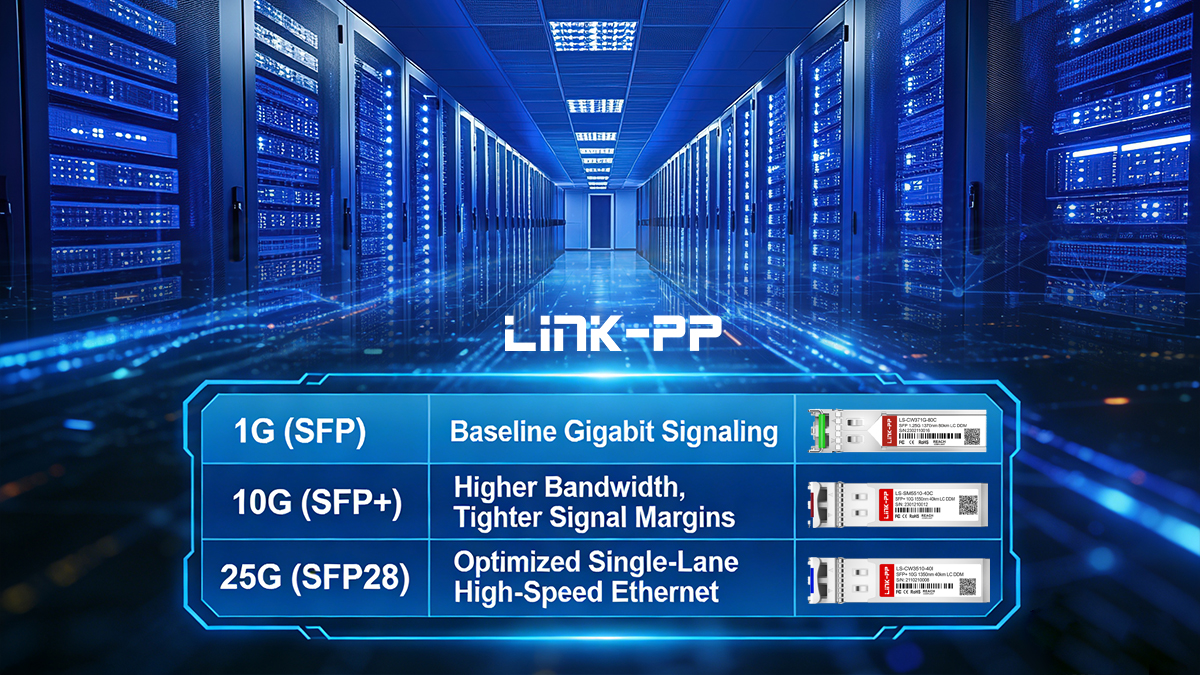
♦ 1G (SFP): Baseline Gigabit Signaling
Standard SFP modules are primarily designed for 1 Gbps Ethernet, most commonly defined by IEEE 802.3z and IEEE 802.3ab standards (e.g., 1000BASE-SX, 1000BASE-LX, 1000BASE-T).
From a technical perspective:
-
Line rate: ~1.25 Gbps (including encoding overhead)
-
Electrical interface: Relatively low signal bandwidth and relaxed jitter tolerance
-
Encoding: 8b/10b
-
Host requirements: Minimal equalization and simpler PCB trace design
Because of these characteristics, SFP ports are electrically simpler and more forgiving. This makes 1G SFP modules suitable for access networks, legacy systems, and environments where bandwidth demands are modest and predictable.
♦ 10G (SFP+): Higher Bandwidth, Tighter Signal Margins
SFP+ was introduced to support 10 Gigabit Ethernet under IEEE 802.3ae, while maintaining the same physical footprint as SFP. The key change lies in the electrical lane speed and signal quality requirements.
Technically, SFP+ differs from SFP in several important ways:
-
Line rate: ~10.3125 Gbps
-
Electrical interface: Significantly higher frequency signaling with stricter jitter and noise margins
-
Encoding: 64b/66b (more efficient than 8b/10b)
-
Host dependency: Greater reliance on the host system for clock recovery, equalization, and signal conditioning
Unlike earlier XFP modules, SFP+ intentionally shifts more complexity to the switch or NIC silicon. This design enables lower power consumption and higher port density, but it also means that SFP+ performance depends heavily on the quality of the host hardware.
♦ 25G (SFP28): Optimized Single-Lane High-Speed Ethernet
SFP28 extends the same design philosophy further to support 25 Gigabit Ethernet, standardized under IEEE 802.3by. While the external form factor remains unchanged, the internal electrical performance requirements are substantially more demanding.
Key technical characteristics include:
-
Line rate: ~25.78125 Gbps
-
Electrical interface: Very high-speed single-lane signaling with tight insertion loss and crosstalk budgets
-
Encoding: 64b/66b
-
Host dependency: Advanced SerDes, equalization, and signal integrity design are mandatory
From an architectural standpoint, 25G represents a major efficiency improvement: instead of bonding multiple lower-speed lanes, SFP28 Module delivers higher throughput over a single electrical lane. This is why 25G has become the preferred building block for modern leaf-spine data center designs and 5G transport networks.
♦ Technical Comparison at a Glance
| Parameter |
SFP (1G) |
SFP+ (10G) |
SFP28 (25G) |
| Nominal Ethernet Speed |
1 Gbps |
10 Gbps |
25 Gbps |
| Approx. Line Rate |
~1.25 Gbps |
~10.31 Gbps |
~25.78 Gbps |
| Encoding Scheme |
8b/10b |
64b/66b |
64b/66b |
| Electrical Complexity |
Low |
Medium |
High |
| Host Signal Conditioning |
Minimal |
Required |
Critical |
| Typical Deployment Era |
Legacy / Access |
Enterprise & DC |
Modern DC & 5G |
♦ Why Speed Differences Matter in Practice
The jump from 1G to 10G — and especially from 10G to 25G — is not simply a linear increase in bandwidth. Each step introduces stricter electrical tolerances, higher host dependency, and more demanding PCB and port design requirements.
As a result:
-
A higher-speed module cannot achieve its rated performance without a compatible host port.
-
Backward compatibility may exist mechanically, but electrical capability ultimately determines usable speed.
-
Network upgrades must account for both transceivers and switch/NIC architecture.
These technical realities form the foundation for understanding compatibility rules and real-world deployment scenarios, which we will explore in the next section.
In simple terms: SFP is designed for 1G access networks, SFP+ for 10G aggregation, and SFP28 for 25G data center and cloud-scale deployments.
↪️ SFP vs. SFP+ vs. SFP28: Use Cases and Compatibility Rules
While SFP 1G , SFP+ 10G , and SFP28 25G transceivers share the same physical form factor, their practical use cases and compatibility behavior are governed by host port capabilities, electrical design, and firmware support rather than by the module alone. Understanding where each transceiver type is typically deployed — and how backward compatibility works in real networks — is critical for avoiding performance mismatches and deployment issues.
When choosing between SFP, SFP+, and SFP28, the decision should be based on required bandwidth, switch port capability, and future upgrade planning rather than physical size, since all three share the same form factor.
1. Typical Use Cases by Transceiver Type
Each generation of the SFP family aligns naturally with specific network layers and traffic profiles.
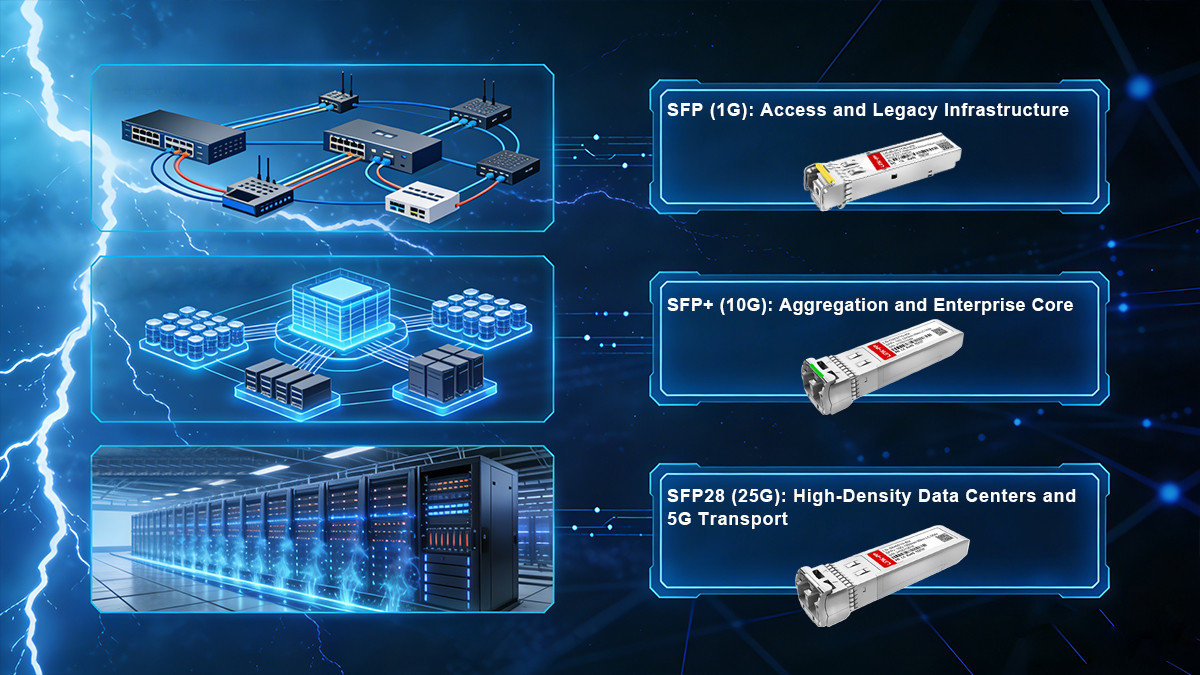
SFP (1G): Access and Legacy Infrastructure
1 Gbps SFP modules are most commonly used in environments where 1 Gbps bandwidth is sufficient and widely supported:
-
Enterprise access switches and edge ports
-
Campus networks and building distribution
-
Legacy server connections and management networks
-
Industrial Ethernet and long-lifecycle systems
In these scenarios, stability, wide interoperability, and long-term availability are often prioritized over raw throughput.
SFP+ (10G): Aggregation and Enterprise Core
10 Gbps SFP+ has become the standard interface for 10G Ethernet links across enterprise and data center networks:
-
Top-of-Rack (ToR) switch uplinks
-
Aggregation and core switch interconnects
-
Storage and SAN networks (e.g., 8G/16G Fibre Channel)
-
High-performance enterprise servers
SFP+ strikes a balance between performance, port density, and ecosystem maturity, making it suitable for both new deployments and incremental upgrades from 1G infrastructure.
SFP28 (25G): High-Density Data Centers and 5G Transport
25Gbps SFP28 is designed for high-bandwidth, high-density environments where efficiency and scalability are critical:
-
Data center leaf-spine architectures
-
Server access links in cloud and hyperscale networks
-
5G fronthaul, midhaul, and backhaul transport
-
High-performance computing (HPC) interconnects
By delivering 25 Gbps over a single electrical lane, SFP28 enables greater bandwidth per port without increasing physical footprint, which is essential in modern, space-constrained facilities.
2. Mechanical vs. Electrical Compatibility
A common source of confusion is the distinction between mechanical compatibility and electrical compatibility.
-
Mechanical compatibility:
SFP, SFP+, and SFP28 modules share the same physical dimensions and can typically be inserted into the same type of cage.
-
Electrical compatibility:
The actual operating speed and stability depend on whether the host port’s SerDes, PCB design, and firmware support the required signaling rate.
Mechanical fit does not guarantee functional compatibility or full-speed operation.
3. Backward Compatibility Rules in Practice
In real deployments, compatibility follows a host-centric model:
-
SFP module in SFP+ or SFP28 port:
Commonly supported. The port negotiates down to 1G operation if the switch firmware allows it.
-
SFP+ module in SFP28 port:
Often supported at 10G speed, provided the host port is designed for dual-rate (10G/25G) operation.
-
SFP28 module in SFP+ port:
May operate at 10G in some platforms, but 25G operation is not possible without SFP28-rated hardware.
-
Higher-speed module in lower-speed port:
Physical insertion may be possible, but electrical limitations usually prevent stable operation at the higher rate.
Because of these constraints, the host port ultimately determines the maximum usable speed, regardless of the transceiver’s nominal rating.
4. Firmware and Vendor Support Considerations
Beyond hardware design, firmware and vendor qualification policies also play a role:
-
Some switch vendors restrict supported transceiver types through EEPROM validation.
-
Certain platforms require explicit configuration to enable mixed-speed operation.
-
Compatibility matrices published by switch manufacturers or transceiver suppliers should always be consulted before deployment.
These factors explain why two switches with identical physical ports may behave differently when using the same SFP-family module.
Key Takeaway
SFP, SFP+, and SFP28 are best understood not as interchangeable upgrades, but as distinct solutions optimized for different network layers and performance targets. While physical compatibility simplifies inventory and cabling strategies, electrical design and host support define real-world usability.
This understanding sets the stage for evaluating when a network upgrade from 1G to 10G or 25G is technically justified — a topic explored in the next section.
↪️ How to Evaluate a 1G, 10G, and 25G Network Upgrade
Upgrading from 1G to 10G or 25G Ethernet is not simply a matter of replacing transceivers. It is a system-level decision that affects switching architecture, cabling infrastructure, power budgets, and long-term scalability. A structured evaluation helps ensure that higher link speeds deliver measurable benefits without introducing unnecessary cost or operational complexity.
The following criteria provide a practical, vendor-neutral framework for assessing whether — and when — a 1G, 10G, or 25G upgrade is technically and economically justified.
● Application Bandwidth Requirements
The starting point for any upgrade decision should be actual traffic demand, not theoretical peak speeds.
Consider:
-
Average and peak bandwidth per link
-
East-west traffic growth driven by virtualization, containerization, or distributed storage
-
Latency sensitivity of applications such as real-time analytics or storage replication
In many enterprise environments, 1G remains sufficient for edge access, while 10G or 25G becomes necessary at aggregation or server-facing layers where traffic is concentrated.
● Switch and NIC Port Capabilities
Transceiver speed is only usable if the host ports are designed to support it.
Key questions include:
-
Do existing switch or NIC ports support 10G or 25G at the electrical level?
-
Are ports single-rate or dual-rate (e.g., 10G/25G capable)?
-
Does the platform support mixed-speed operation on the same line card?
If new switches or network interface cards are required, their cost and deployment impact should be factored into the upgrade decision.
● Cabling and Fiber Infrastructure
Physical media often determines the feasibility of a speed upgrade.
Evaluate:
-
Fiber type in use (OM3/OM4/OM5 multimode or single-mode fiber)
-
Existing link distances and attenuation margins
-
Connector quality and overall link cleanliness
For example, while 1G and 10G links are tolerant of many legacy fiber installations, 25G deployments impose tighter link budget and signal integrity requirements, especially over multimode fiber.
● Port Density and Network Architecture
Higher speeds can reduce the number of required physical links, but they also change how ports are consumed.
From an architectural perspective:
-
10G often replaces multiple 1G links at aggregation points
-
25G enables higher bandwidth per port without increasing physical footprint
-
Fewer, faster links can simplify topology but may reduce redundancy if not carefully designed
Modern leaf-spine architectures often favor 25G at the access layer to balance performance and scalability.
● Power, Thermal, and Operational Impact
Higher data rates introduce incremental power and thermal considerations, even within the same form factor.
When evaluating an upgrade, assess:
-
Per-port power consumption and cumulative rack impact
-
Cooling capacity and airflow design
-
Operational complexity, including monitoring and troubleshooting
Although SFP28 Transceivers are more efficient per gigabit than earlier generations, total power consumption may still increase as overall bandwidth scales.
● Cost and Upgrade Timeline
A realistic upgrade strategy aligns technical needs with budget and deployment constraints.
Key factors include:
-
Cost of transceivers, switches, and NICs
-
Reuse potential of existing fiber and infrastructure
-
Phased upgrade options versus full replacement
In many cases, organizations adopt a staged approach: maintaining 1G at the edge, deploying 10G at aggregation, and selectively introducing 25G where traffic growth justifies it.
● Evaluation Summary
| Evaluation Factor |
1G (SFP) |
10G (SFP+) |
25G (SFP28) |
| Bandwidth Headroom |
Low |
Medium |
High |
| Hardware Requirements |
Minimal |
Moderate |
Advanced |
| Infrastructure Sensitivity |
Low |
Medium |
High |
| Typical Upgrade Trigger |
Legacy refresh |
Capacity growth |
Scale & density |
| Architectural Fit |
Access |
Aggregation |
Access & spine |
Key Takeaway
A successful network upgrade balances performance demand, infrastructure readiness, and long-term scalability. While 25G offers clear efficiency and density advantages, 10G remains a practical and widely supported choice for many enterprise networks, and 1G continues to serve effectively in low-bandwidth roles.
This evaluation framework helps ensure that speed upgrades are driven by measured needs and architectural goals, rather than by transceiver specifications alone.
↪️ Deployment Considerations for SFP, SFP+, and SFP28
When deploying SFP, SFP+, or SFP28 transceivers, performance specifications alone are not sufficient to ensure a stable and efficient network. Real-world deployment outcomes are strongly influenced by operational factors such as power consumption, port density, thermal management, and compatibility risk. These considerations become increasingly important as link speeds scale from 1G to 10G and 25G.
▷ Power Consumption
Although all three transceiver types share the same physical form factor, their power profiles differ due to signaling speed and internal electronics.
-
SFP (1G):
Typically consumes the least power per port, making it well suited for access layers and environments with strict power budgets.
-
SFP+ (10G):
Requires higher power than SFP due to increased electrical complexity, but remains efficient enough for high-density enterprise and data center deployments.
-
SFP28 (25G):
Operates at higher signaling rates and therefore draws more absolute power per module, though it often delivers better power efficiency per gigabit than 10G solutions.
At scale, even small differences in per-port power consumption can have a measurable impact on rack-level and facility-level energy usage.
▷ Port Density and Interface Efficiency
One of the primary advantages of the SFP family is the ability to maintain high port density while increasing bandwidth.
-
Upgrading from 1G to 10G or 25G allows significantly more throughput per rack unit without increasing physical port count.
-
SFP28, in particular, enables higher aggregate bandwidth using the same switch faceplate layout as SFP+.
However, higher density also means that each port becomes more critical, placing greater emphasis on reliability and consistent transceiver performance.
▷ Thermal Management and Cooling
As link speeds increase, thermal behavior becomes a key design constraint.
-
Higher-speed transceivers generate more heat, especially in densely populated switch line cards.
-
Inadequate airflow or cooling can lead to thermal throttling, link instability, or reduced component lifespan.
-
Data center switches are typically designed with specific airflow patterns; transceiver selection should align with these thermal designs.
Proactive thermal planning is especially important for SFP28 deployments in compact or high-density environments.
▷ Compatibility and Interoperability Risk
Compatibility issues are a common source of deployment delays and operational risk.
Key risk factors include:
-
Host port electrical limitations that prevent full-speed operation
-
Firmware or EEPROM validation restrictions imposed by switch vendors
-
Inconsistent behavior across platforms that share the same physical port type
Because SFP, SFP+, and SFP28 modules may physically fit into the same cages, compatibility assumptions are often made incorrectly. Verifying support through vendor documentation, interoperability testing, or qualified compatibility lists is essential before large-scale deployment.
▷ Operational Best Practices
To reduce deployment risk and ensure predictable performance:
-
Validate transceivers on target hardware prior to full rollout
-
Monitor power and temperature metrics after deployment
-
Standardize transceiver models where possible to simplify operations
-
Maintain clear documentation of supported speeds and port capabilities
These practices become increasingly important as networks transition to higher-speed interfaces.
Key Takeaway
Successful deployment of SFP, SFP+, and SFP28 transceivers depends on more than speed and form factor. Power efficiency, port density, thermal behavior, and compatibility assurance collectively determine network stability and scalability. Addressing these factors early helps organizations realize the benefits of higher-speed networking while minimizing operational risk.
↪️ FAQ About SFP vs. SFP+ vs. SFP28
This section addresses the most common technical questions engineers and buyers ask when comparing SFP, SFP+, and SFP28 transceivers.
Q1: Can SFP28 always run at 25G speed?
No. An SFP28 transceiver can only operate at 25 Gbps when it is installed in a host port that is electrically designed and configured for 25G operation.
If an SFP28 module is inserted into a 10G-only SFP+ port, it may either operate at 10G (if supported) or fail to establish a link. The transceiver itself does not determine the operating speed — the host port capability does.
Q2: Is SFP+ becoming obsolete?
SFP+ is not obsolete. While 25G deployments are increasing in modern data centers, 10G SFP+ remains widely used in enterprise networks, storage environments, and existing infrastructures. Many organizations continue to deploy SFP+ due to its mature ecosystem, broad compatibility, and lower overall upgrade cost compared to 25G.
Q3: Does using SFP28 increase power consumption?
In absolute terms, yes — SFP28 modules typically consume more power than SFP+ or SFP due to higher signaling speeds.
However, power efficiency per gigabit is often better with SFP28, meaning that more bandwidth is delivered for each watt consumed. At scale, overall power impact depends on total port count, traffic patterns, and switch design rather than transceiver choice alone.
Q4: Is SFP28 the same as SFP+?
No. SFP28 and SFP+ share the same physical form factor, but they are designed for different electrical signaling rates.
SFP+ Transceiver is optimized for 10G operation, while SFP28 supports 25G Ethernet. Full 25G performance requires SFP28-rated host hardware.
Q5: Is SFP28 backward compatible with SFP+?
In many cases, yes — at reduced speed.
An SFP28 transceiver may operate at 10G when installed in an SFP+ port if the platform supports dual-rate operation. However, backward compatibility is not guaranteed across all switches, and vendor documentation should always be verified.
6: Are SFP and SFP+ the same?
No. Although they look identical externally, SFP and SFP+ differ significantly in electrical performance and supported speeds.
SFP modules are typically limited to 1G operation, while SFP+ modules are designed for 10G Ethernet and higher-speed protocols.
Q7: What is an SFP28 transceiver?
An SFP28 transceiver is a small form-factor pluggable module designed to support 25 Gigabit Ethernet over optical fiber or direct-attach copper. It enables high-bandwidth connectivity using the same compact interface as SFP and SFP+, making it a common choice for modern data center and 5G network deployments.
FAQ Summary
Most confusion around SFP, SFP+, and SFP28 arises from their shared physical design. In practice, operating speed, electrical compatibility, and host support determine how each transceiver performs. Understanding these distinctions helps avoid deployment issues and ensures that network upgrades deliver the intended benefits.
↪️ Conclusion: When to Choose 1G (SFP), 10G (SFP+), or 25G (SFP28)
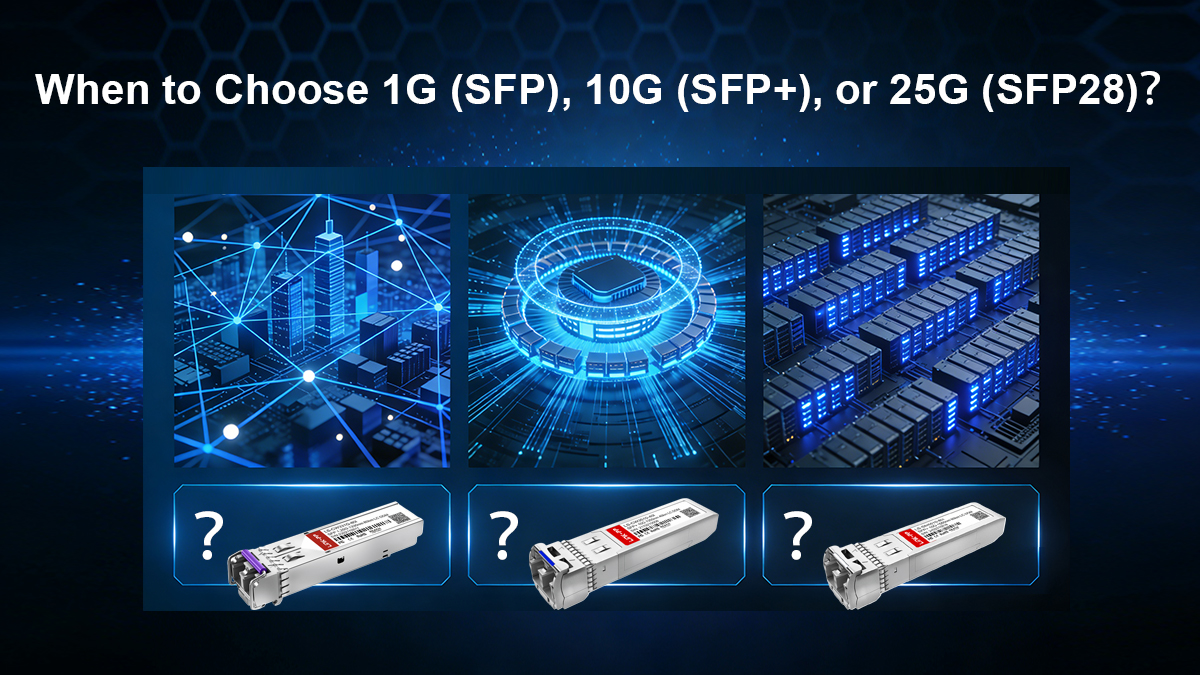
Choosing between SFP, SFP+, and SFP28 is ultimately a question of matching network requirements with realistic performance needs and infrastructure readiness. Although these transceivers share a common form factor, they serve very different roles in modern networks.
-
Choose 1G SFP when bandwidth demand is stable and modest, such as in access networks, management links, or legacy environments where cost efficiency and long-term compatibility are the primary concerns.
-
Choose 10G SFP+ when consolidating traffic, upgrading aggregation layers, or supporting enterprise workloads that require higher throughput without a full architectural overhaul. SFP+ remains a proven, widely supported option for many production networks.
-
Choose 25G SFP28 when scalability, port density, and bandwidth efficiency are critical — particularly in data centers, cloud infrastructure, and 5G transport networks. SFP28 enables significant performance gains while preserving the same physical interface, provided the host hardware is designed for 25G operation.
Rather than viewing these options as simple generational replacements, they should be considered complementary technologies that can coexist within a phased upgrade strategy. A balanced approach — deploying the right speed at the right network layer — delivers the best combination of performance, reliability, and total cost of ownership.
Quick Answers: SFP vs. SFP+ vs. SFP28
Is SFP compatible with SFP+ ports?
In most cases, SFP modules can operate in SFP+ ports at 1G speed, but compatibility depends on the switch firmware.
Can SFP+ work in SFP ports?
No. SFP+ modules require a 10G-capable host interface and cannot operate in 1G-only SFP ports.
Is SFP28 backward compatible?
Physically yes, electrically no. SFP28 ports may support lower speeds if explicitly enabled by the switch vendor.
If you are evaluating SFP, SFP+, or SFP28 transceivers for your network and need reliable, standards-compliant solutions with verified compatibility, explore the full range of optical modules available at the LINK-PP.
LINK-PP provides professionally engineered transceivers designed for enterprise, data center, and telecom applications, with clear specifications and compatibility guidance to support confident deployment decisions.
? Visit the LINK-PP Official Store to find the right SFP solution for your network.










































