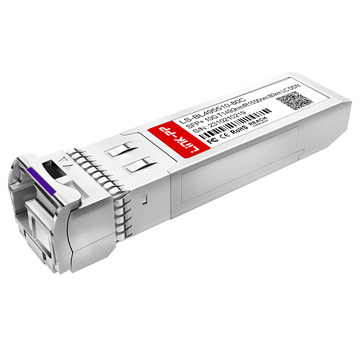
A 10GBASE-ER SFP module is a long-reach 10Gbps fiber optic transceiver designed to transmit data over single-mode fiber up to 40km, making it a key solution for extended Ethernet links beyond standard campus or data center distances.
Compared with short-reach and long-reach 10G SFP+ optics, 10GBASE-ER focuses on stable, high-speed transmission over metro-scale distances, where signal attenuation and link reliability become critical factors rather than port density or cost alone.
This article explains what a 10GBASE-ER SFP module is, how it differs from other 10G optical modules, and when choosing ER optics makes practical sense for enterprise, data center interconnection, and service provider networks—without diving into unnecessary technical complexity.
? What Is a 10GBASE-ER SFP Module?
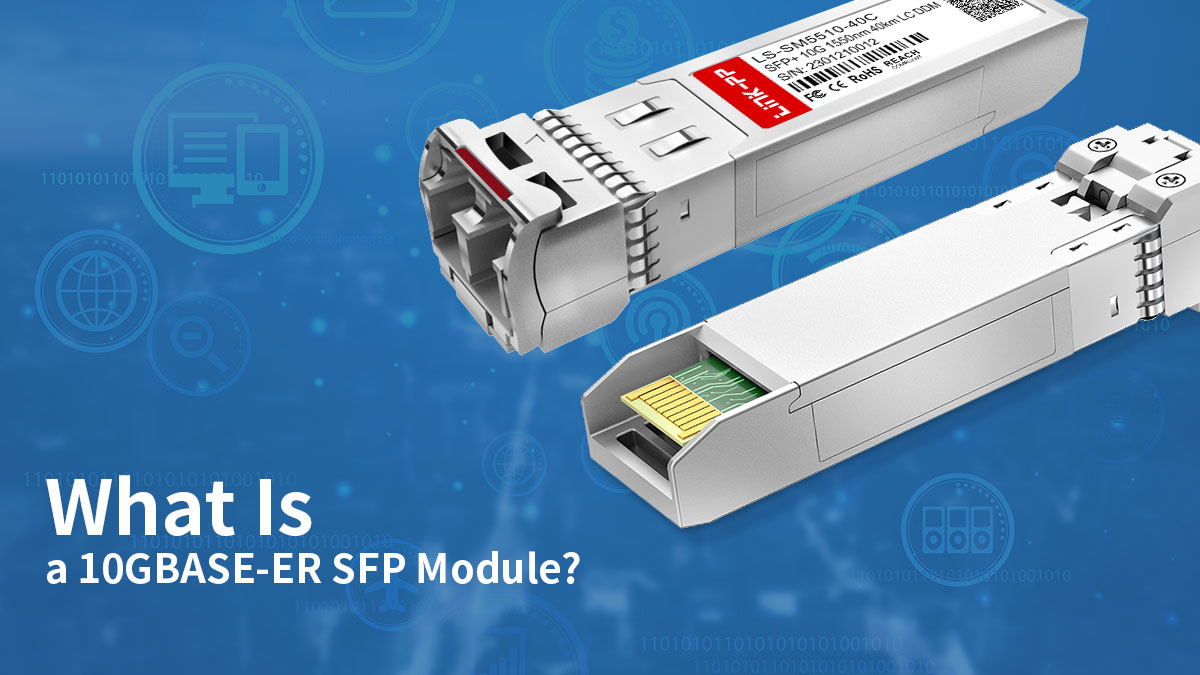
A 10GBASE-ER SFP module is a 10Gbps Ethernet optical transceiver designed for long-distance transmission over single-mode fiber, with a maximum reach of up to 40km under the IEEE 802.3ae standard.
Definition of 10GBASE-ER
10GBASE-ER refers to a 10 Gigabit Ethernet physical layer specification that operates at 1550nm and supports extended-reach fiber links beyond typical enterprise distances.
It is commonly implemented using SFP+ form-factor transceivers for compatibility with modern 10GbE network equipment.
What Does “ER” (Extended Reach) Mean?
“ER” stands for Extended Reach, indicating that this optical module is engineered to support significantly longer transmission distances than standard 10G optics such as SR or LR.
In practical network design, ER optics are chosen when:
-
Fiber links exceed 10km
-
Signal loss becomes a limiting factor
-
Stable long-distance connectivity is required without moving to DWDM solutions
How 10GBASE-ER Fits Within the 10G Ethernet Standard
Within the IEEE 802.3ae 10G Ethernet family, 10GBASE-ER sits between long-reach and ultra-long-reach optics in terms of distance and cost.
-
SR: short-distance, multimode fiber
-
LR: long-distance, single-mode fiber up to 10km
-
ER: extended-distance, single-mode fiber up to 40km
-
ZR: ultra-long-distance, typically 80km or more
This positioning makes 10GBASE-ER a balanced option for networks that require long-distance performance without the higher complexity and cost of ZR-class optics.
? Key Specifications of 10GBASE-ER SFP Modules
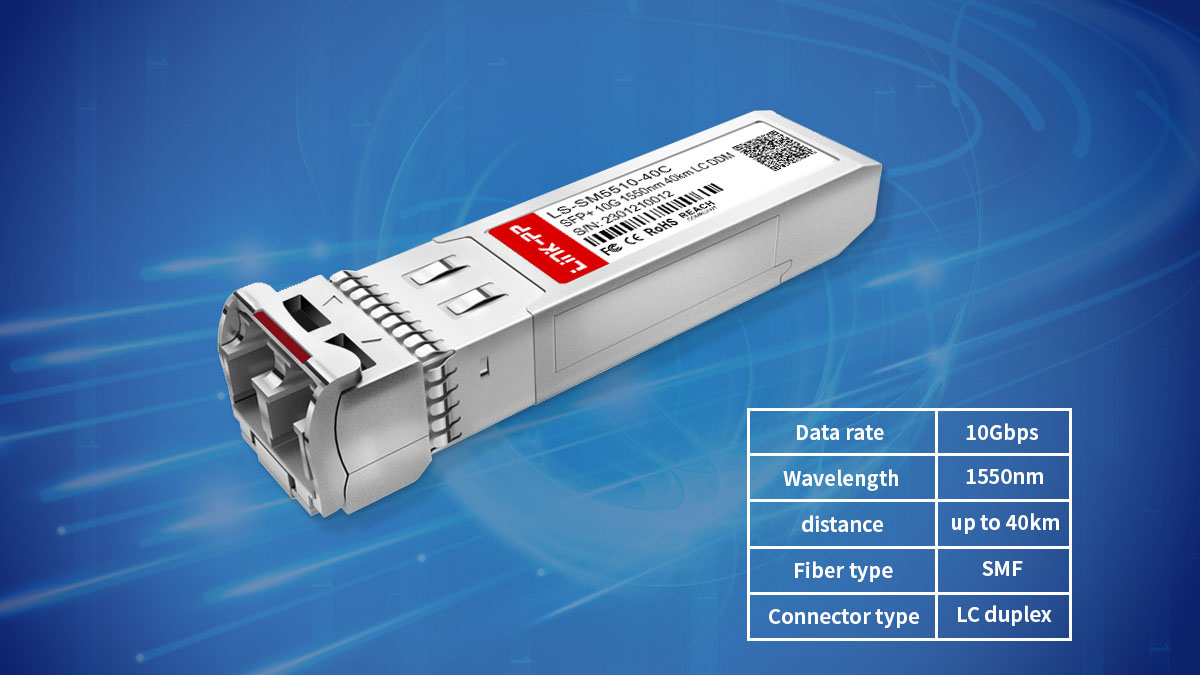
A 10GBASE-ER optical module is engineered around a specific set of optical specifications that collectively enable reliable 10Gbps Ethernet transmission over long-distance single-mode fiber, where attenuation, dispersion, and power margin become critical design factors.
Data Rate: 10Gbps
-
Supports 10Gbps line rate defined by the 10G Ethernet standard
-
Suitable for sustained high-throughput traffic rather than burst-based transmission
-
Commonly used in backbone links where bandwidth stability is more important than port density
Why it matters:
At long distances, maintaining a stable 10Gbps signal requires stricter control over signal quality than short-reach optics, making ER modules fundamentally different from SR in design complexity.
Wavelength: 1550nm
-
Operates at 1550nm, the lowest-attenuation window in single-mode fiber
-
Enables longer reach compared to 1310nm-based 10G optics
-
Compatible with existing long-haul and metro fiber infrastructure
Why it matters:
The choice of 1550nm is what allows ER modules to extend reach to 40km without optical amplification, making them a practical solution for metro-scale Ethernet links.
Maximum Transmission Distance: Up to 40km
-
Designed for up to 40km point-to-point transmission on standard SMF
-
Actual distance depends on fiber quality, connector loss, and link design
-
Provides a buffer between LR-class optics and ZR-class long-haul solutions
Why it matters:
This distance range covers most enterprise inter-campus and metro deployments, avoiding the cost and complexity of ultra-long-reach optics.
Fiber Type: Single-Mode Fiber (SMF)
-
Optimized exclusively for single-mode fiber, typically OS2
-
Minimizes modal dispersion over long distances
-
Required for maintaining signal integrity at 1550nm
Why it matters:
10GBASE-ER is not backward-compatible with multimode fiber, making fiber type verification a critical step before deployment.
Connector Type: LC Duplex
-
Uses LC duplex connectors with separate transmit and receive fibers
-
Standard interface for most SFP+ transceivers
-
Supports easy polarity management and troubleshooting
Why it matters:
LC duplex ensures broad compatibility with existing patch panels, transceivers, and structured cabling systems.
Optical Component Type (Transmitter & Receiver)
10GBASE-ER SFP modules typically use EML (Electro-Absorption Modulated Laser) transmitters combined with high-sensitivity PIN receivers to support stable long-distance 10Gbps transmission.
-
Transmitter:
-
EML lasers provide higher output power and better signal quality than VCSEL or standard DFB used in shorter-reach optics
-
Optimized for 1550nm long-distance transmission with lower chirp
-
-
Receiver:
-
APD or enhanced PIN receivers offer higher sensitivity
-
Better tolerance to signal attenuation over extended fiber spans
-
Why it matters:
The choice of optical components is the fundamental reason why 10GBASE-ER can reach 40km reliably. Compared to LR modules, ER optics are designed to handle weaker return signals while maintaining error-free 10Gbps performance.
Typical Optical Budget
-
Typical optical budget ranges from 23dB to 27dB
-
Accounts for:
-
Fiber attenuation
-
Connector and splice loss
-
System margin for aging and environmental factors
-
Why it matters:
Optical budget is the limiting factor that determines whether a 40km link will operate reliably, making ER modules suitable for links that exceed LR capabilities but do not justify DWDM deployment.
Transmit and Receive Power
10GBASE-ER SFP modules operate with higher transmit power and tighter receive sensitivity ranges than standard 10G optics to ensure sufficient optical margin over long distances.
-
Typical transmit power:
-
Approximately +1dBm to +5dBm, depending on the module design
-
-
Typical receiver sensitivity:
-
Around -15dBm to -17dBm
-
-
Power budget impact:
-
Enables total optical budgets of 23dB to 27dB
-
Supports long fiber runs with multiple connectors and splices
-
Why it matters:
Higher transmit power and sensitive receivers allow ER modules to tolerate real-world losses, but they also require proper link planning. In shorter links, excessive optical power may require attenuation to avoid receiver saturation.
? How 10GBASE-ER SFP Modules Work
A 10GBASE-ER SFP module operates by converting electrical 10Gbps Ethernet signals into high-power 1550nm optical signals, enabling stable transmission over long-distance single-mode fiber links.
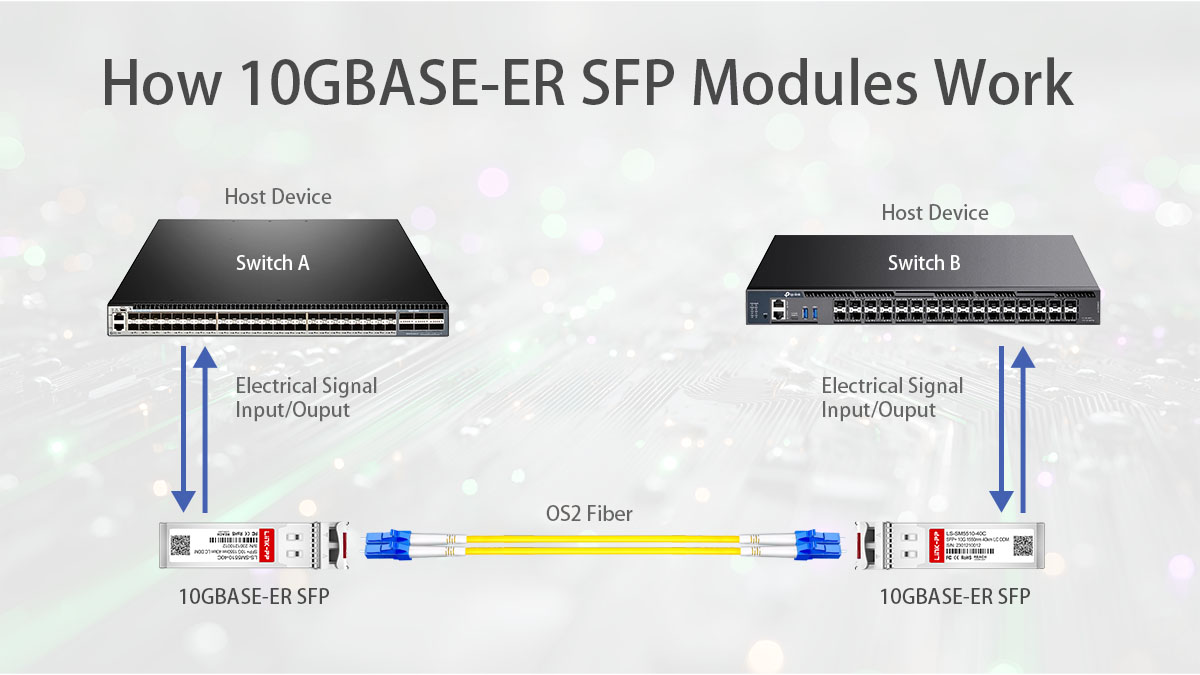
Optical Signal Transmission Over Long Distances
-
Electrical signals from the host device are converted into optical signals at the transmitter
-
The optical signal travels through single-mode fiber, where attenuation and dispersion accumulate over distance
-
The receiver restores the signal to electrical form while maintaining strict error-rate thresholds
This transmission process is optimized for links where distance, rather than port density, is the primary constraint, which is why ER optics are commonly used in backbone and inter-campus connections.
Role of Higher Optical Power at 1550nm
-
The 1550nm wavelength experiences lower fiber attenuation than shorter wavelengths
-
Higher launch power compensates for cumulative losses across long fiber spans
-
Extended reach is achieved without relying on optical amplification or regeneration
As a result, 10GBASE-ER modules can cover metro-scale distances using standard Ethernet infrastructure, reducing deployment complexity compared to carrier-grade solutions.
Comparison with Standard-Reach and Long-Reach Optics
-
Standard-reach (SR):
Optimized for short, in-rack or intra–data center links using low-power transmitters and multimode fiber -
Long-reach (LR):
Designed for single-mode fiber links up to 10km with moderate optical power at 1310nm -
Extended-reach (ER):
Uses higher optical power at 1550nm to bridge the gap between enterprise and metro distances, reaching up to 40km
This layered design clearly separates use cases, helping network planners avoid over-engineering short links or under-specifying long-distance connections.
? 10GBASE-ER vs Other 10G SFP+ Modules
10GBASE-ER occupies a distinct position within the 10G SFP+ ecosystem by balancing reach, optical complexity, and operational cost. Rather than being a simple distance upgrade, ER optics are purpose-built to address scenarios where standard enterprise modules reach their physical limits.
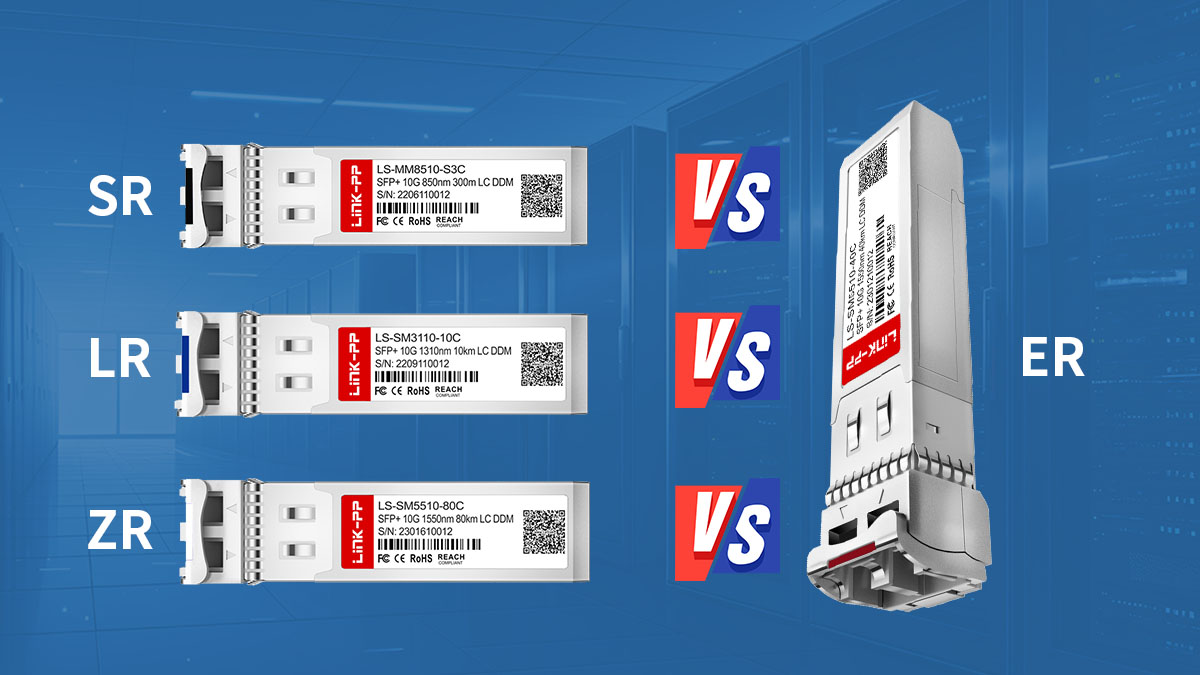
10GBASE-SR vs 10GBASE-ER
| Dimension | 10GBASE-SR | 10GBASE-ER |
|---|---|---|
| Fiber type | Multimode (OM3/OM4) | Single-mode (OS2) |
| Wavelength | 850nm | 1550nm |
| Practical reach | ≤300m | ≤40km |
| Optical design | Low-power VCSEL | High-power EML |
| Link tolerance | Low | High |
Deeper insight:
SR optics prioritize port density and power efficiency, making them ideal for short, predictable environments such as data halls. ER optics, in contrast, are engineered to overcome distance-induced signal degradation, which SR modules are fundamentally unable to address regardless of power adjustments.
10GBASE-LR vs 10GBASE-ER
| Dimension | 10GBASE-LR | 10GBASE-ER |
|---|---|---|
| Wavelength | 1310nm | 1550nm |
| Typical reach | ≤10km | ≤40km |
| Optical budget | ~6–10dB | ~23–27dB |
| Receiver sensitivity | Moderate | High |
| Deployment margin | Limited | Substantial |
Deeper insight:
LR modules operate close to their margin at longer distances, which is why links near 10km often show instability over time. ER modules introduce intentional optical headroom, allowing networks to tolerate aging fiber, additional connectors, and future rerouting without re-engineering the link.
10GBASE-ZR vs 10GBASE-ER
| Dimension | 10GBASE-ER | 10GBASE-ZR |
|---|---|---|
| Reach class | Extended | Ultra-long |
| Typical distance | ≤40km | ≥80km |
| Optical system | Direct-detect | Often requires amplification |
| Cost structure | Mid-range | High |
| Operational model | Ethernet-centric | Carrier-centric |
Deeper insight:
ZR optics are designed for distance-first deployments, where cost, power, and simplicity are secondary. ER modules deliberately stop short of this complexity, making them better suited for enterprises and metro networks that require long reach without adopting carrier-grade optical practices.
Distance, Cost, and Deployment Trade-Offs (Decision Lens)
Instead of viewing these modules as a linear scale of “short to long,” a more accurate model is use-case separation:
-
SR: Optimize for density and efficiency
-
LR: Optimize for standard enterprise reach
-
ER: Optimize for long-distance reliability with manageable complexity
-
ZR: Optimize for maximum distance regardless of cost
From a total cost of ownership perspective, 10GBASE-ER often represents the inflection point where extending reach no longer requires a shift to specialized optical systems.
? Common Use Cases for 10GBASE-ER SFP Modules
10GBASE-ER SFP modules are typically deployed in scenarios where link distance exceeds standard enterprise limits, but where networks still require simple, Ethernet-based deployment without carrier-grade complexity.

Metro Ethernet Networks
-
Connects network nodes across city-level fiber infrastructure
-
Supports stable 10Gbps transmission over distances up to 40km
-
Commonly used by enterprises extending private networks across multiple sites
In metro Ethernet environments, ER modules provide sufficient reach and optical margin while avoiding the cost and operational overhead of DWDM-based solutions.
Data Center Interconnection (DCI)
-
Links geographically separated data centers within a metropolitan area
-
Enables high-speed replication, backup, and workload mobility
-
Operates over existing single-mode fiber without signal regeneration
For short- to mid-range DCI scenarios, 10GBASE-ER offers a cost-effective way to extend data center connectivity without redesigning the network architecture.
Campus Backbone Links
-
Connects buildings across large enterprise or university campuses
-
Handles long fiber runs with multiple patch panels and splices
-
Ensures consistent performance for latency-sensitive applications
ER optics are well-suited for campus backbones where distances exceed LR capabilities and long-term link stability is a priority.
Telecom and Service Provider Environments
-
Used in access and aggregation layers of telecom networks
-
Supports long-distance Ethernet handoff and service delivery
-
Integrates easily with standard SFP+ ports on carrier equipment
In service provider environments, 10GBASE-ER serves as a practical bridge between enterprise Ethernet and more complex long-haul optical systems.
? Compatibility and Interoperability Considerations
10GBASE-ER SFP modules are widely interoperable across standard 10G SFP+ platforms, but proper compatibility planning is essential to ensure stable operation in real-world networks.
SFP+ Port Compatibility
-
Designed for standard SFP+ ports supporting 10Gbps Ethernet
-
Compatible with switches, routers, and network interface cards that support 10GBASE-ER
-
Does not require special line cards or proprietary interfaces
As long as the host device supports 10G SFP+ optics, ER modules can typically be deployed without hardware modification.
OEM vs Third-Party Compatible Modules
-
OEM modules:
-
Branded optics from equipment manufacturers
-
Higher cost, limited sourcing flexibility
-
-
Third-party compatible modules:
-
Programmed to match OEM specifications
-
Widely used in enterprise and service provider networks
-
Offer significant cost advantages
-
When sourced from reputable vendors, third-party (like LINK-PP) 10GBASE-ER SFP modules can deliver equivalent performance while reducing overall network cost.
Cisco, Juniper, Arista Compatibility Overview
-
Cisco:
-
ER modules supported on most Cisco 10G SFP+ platforms
-
Third-party compatibility depends on device configuration and software version
-
-
Juniper:
-
Broad support for standard-compliant ER optics
-
Less restrictive enforcement compared to some vendors
-
-
Arista:
-
Designed for open optics environments
-
Strong interoperability with third-party 10GBASE-ER modules
-
Understanding vendor-specific behavior helps avoid unnecessary compatibility issues during deployment.
Importance of Matching Optics on Both Ends
-
Both ends of the link should use the same optical standard (ER to ER)
-
Mismatched optics can result in unstable links or reduced performance
-
Power level differences may cause receiver saturation or link failure
For reliable long-distance operation, matching ER modules on both sides of the connection is a best practice rather than an optional recommendation.
? Power, Heat, and Network Design Considerations
Because 10GBASE-ER SFP modules are designed for long-distance transmission, they introduce higher power consumption and thermal output than short- and long-reach optics, which must be considered during network planning.
Power Consumption Compared to LR Modules
-
ER modules typically consume more power than 10GBASE-LR due to higher transmit power and more complex optical components
-
Increased power draw is expected in exchange for extended reach and larger optical budget
-
Most modern switches support ER power requirements, but high-density deployments should be evaluated carefully
In practice, ER optics are selected for distance-critical links rather than port-dense environments where power efficiency is the primary concern.
Heat Dissipation and Airflow Requirements
-
Higher power consumption leads to increased heat generation
-
Proper airflow within switch chassis is essential for stable long-term operation
-
Dense ER deployments may require improved cooling strategies or reduced port utilization
For network environments with limited cooling capacity, ER modules should be deployed selectively on links where their extended reach is truly required.
When Optical Attenuation or Dispersion Matters
-
Over long distances, fiber attenuation accumulates from fiber length, connectors, and splices
-
Chromatic dispersion becomes more noticeable at 10Gbps over extended fiber spans
-
ER modules are designed with sufficient optical margin to tolerate typical metro-scale losses
However, poor fiber quality or excessive connectors can still push links beyond design limits, making proper link budgeting an essential step before deployment.
? When Should You Choose a 10GBASE-ER SFP Module?
A 10GBASE-ER SFP module is the right choice when link distance, stability, and long-term scalability are more critical than upfront optical cost.
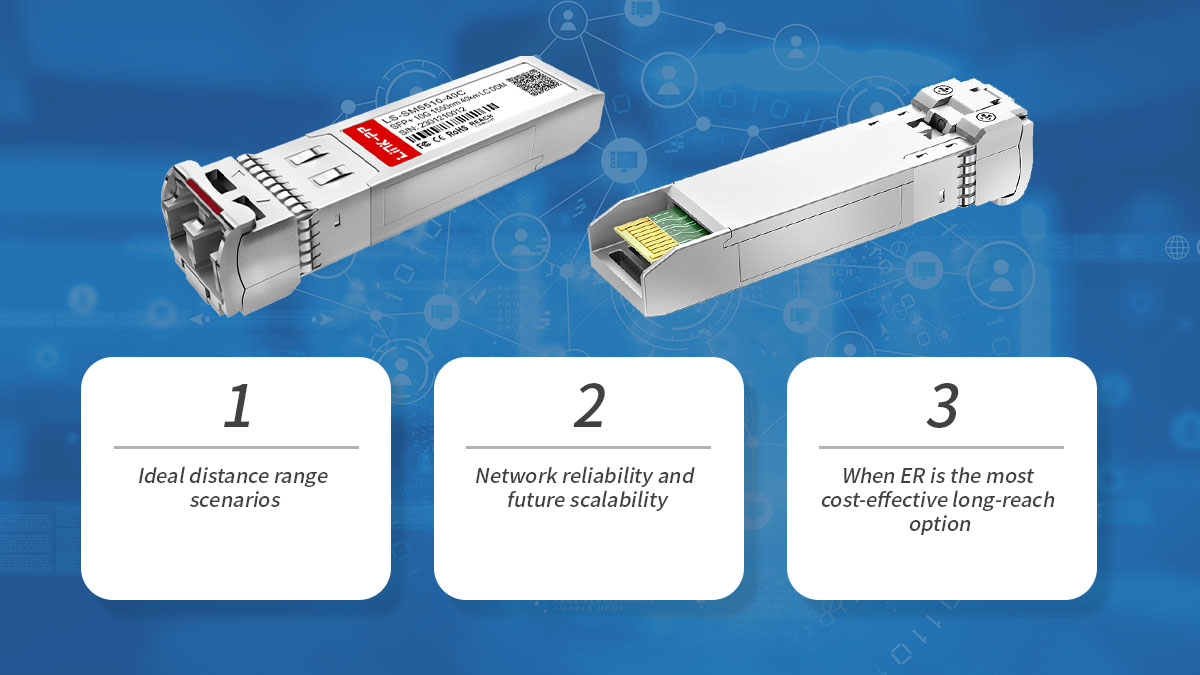
Ideal Distance Range Scenarios
-
Fiber link lengths beyond 10km where 10GBASE-LR becomes unreliable
-
Links approaching 20km to 40km with multiple connectors or splices
-
Inter-building or inter-campus connections that exceed standard enterprise reach
In these scenarios, ER modules provide the optical margin required to maintain consistent 10Gbps performance without additional equipment.
Network Reliability and Future Scalability
-
Higher optical budgets improve tolerance to aging fiber and environmental changes
-
Extended reach supports future network expansion without redesigning the physical layer
-
Reduces the likelihood of intermittent link issues caused by marginal signal levels
For networks expected to grow or remain in service for many years, ER optics offer greater long-term stability compared to shorter-reach alternatives.
When ER Is the Most Cost-Effective Long-Reach Option
-
When ER eliminates the need for:
-
Optical amplifiers
-
Signal regeneration
-
DWDM systems
-
-
When operational simplicity is valued over minimal module cost
-
When a single ER link replaces multiple shorter segments or intermediate devices
In these cases, the higher per-module cost of ER optics is offset by reduced network complexity and maintenance overhead.
? When a 10GBASE-ER SFP Module May Not Be the Best Choice
While 10GBASE-ER SFP modules excel in long-distance scenarios, they are not always the optimal solution for every 10Gbps fiber link.
Short-Distance Fiber Links
-
Fiber links within 10km rarely require ER-level optical power
-
10GBASE-LR or even SR optics can deliver stable performance at lower cost
-
Excessive optical power may introduce the need for attenuation
For short or moderate distances, ER modules often provide more capability than necessary.
Budget-Sensitive Deployments
-
ER modules are priced higher due to advanced optical components
-
Cost becomes significant when deploying large numbers of ports
-
Shorter-reach optics may meet performance requirements at a lower total cost
In environments where distance is not a limiting factor, choosing ER optics may reduce cost efficiency.
Ultra-Long-Distance Requirements
-
Links exceeding 40km approach the design limits of ER optics
-
Signal attenuation and dispersion may require:
-
ZR-class optics
-
Optical amplification
-
DWDM solutions
-
For true long-haul applications, ER is a stepping stone rather than a final solution.
High-Density, Power-Constrained Environments
-
Higher power consumption increases thermal load
-
Dense ER deployments may stress cooling capacity
-
Data center access layers often favor lower-power optics
In these cases, ER modules should be reserved only for links where extended reach is essential.
? FAQs About 10GBASE-ER SFP Modules
1. What is the maximum distance of a 10GBASE-ER SFP module?
A standard 10GBASE-ER SFP module supports transmission distances of up to 40km over single-mode fiber.
Actual reach depends on fiber quality, connector loss, and overall optical budget.
2. Can 10GBASE-ER work with 10GBASE-LR on the other end?
No. Both ends of the link should use the same optical standard, meaning ER modules must be paired with ER modules.
Mixing ER and LR optics can lead to power imbalance and unstable link performance.
3. Does 10GBASE-ER require dispersion compensation?
In most cases, dispersion compensation is not required for 10GBASE-ER links within the 40km design limit.
Standard single-mode fiber typically supports ER transmission without additional dispersion management.
4. Are third-party 10GBASE-ER SFP modules reliable?
Yes. High-quality third-party compatible ER modules can deliver performance comparable to OEM optics when sourced from reputable manufacturers.
Proper testing and compatibility programming are essential for reliable operation.
5. Does 10GBASE-ER consume more power than 10GBASE-LR?
Yes. 10GBASE-ER modules generally consume more power due to higher transmit power and more complex optical components.
This should be considered in high-density or thermally constrained environments.
6. When should I choose 10GBASE-ZR instead of 10GBASE-ER?
You should consider 10GBASE-ZR when link distances exceed 40km or when additional optical margin is required.
ZR optics are designed for ultra-long-distance transmission but come with higher cost and complexity.
? Summary: Is a 10GBASE-ER SFP Module Right for Your Network?
A 10GBASE-ER SFP module is an extended-reach 10Gbps optical solution designed for stable single-mode fiber links up to 40km, making it a practical choice for long-distance Ethernet deployments where reliability and simplicity matter.
Key Takeaways
-
10Gbps at 1550nm: Optimized for long-distance transmission with lower attenuation
-
Up to 40km reach: Covers most inter-campus and metro Ethernet scenarios
-
High optical budget: Better tolerance for fiber loss, connectors, and aging infrastructure
-
Standard SFP+ form factor: Broad compatibility with enterprise and carrier equipment
When to Choose — and When Not
Choose 10GBASE-ER when:
-
Fiber links exceed 10km and approach 40km
-
Network stability and long-term scalability are priorities
-
You want long-distance performance without DWDM complexity
Consider alternatives when:
-
Link distances are well below 10km
-
Cost or power efficiency is the primary constraint
-
Ultra-long-distance transmission beyond 40km is required
Final Recommendation
If your network requires reliable 10Gbps connectivity over extended distances without added optical complexity, a 10GBASE-ER SFP module delivers the right balance of performance, reach, and deployment simplicity.
For verified-compatible, enterprise-grade 10GBASE-ER optics, you can explore options available at the LINK-PP Official Store to support long-distance Ethernet deployments with confidence.