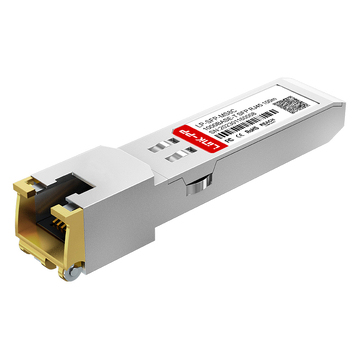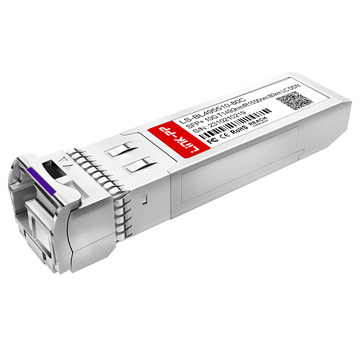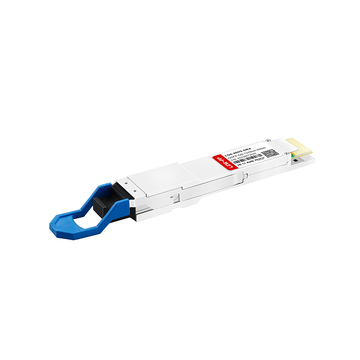






























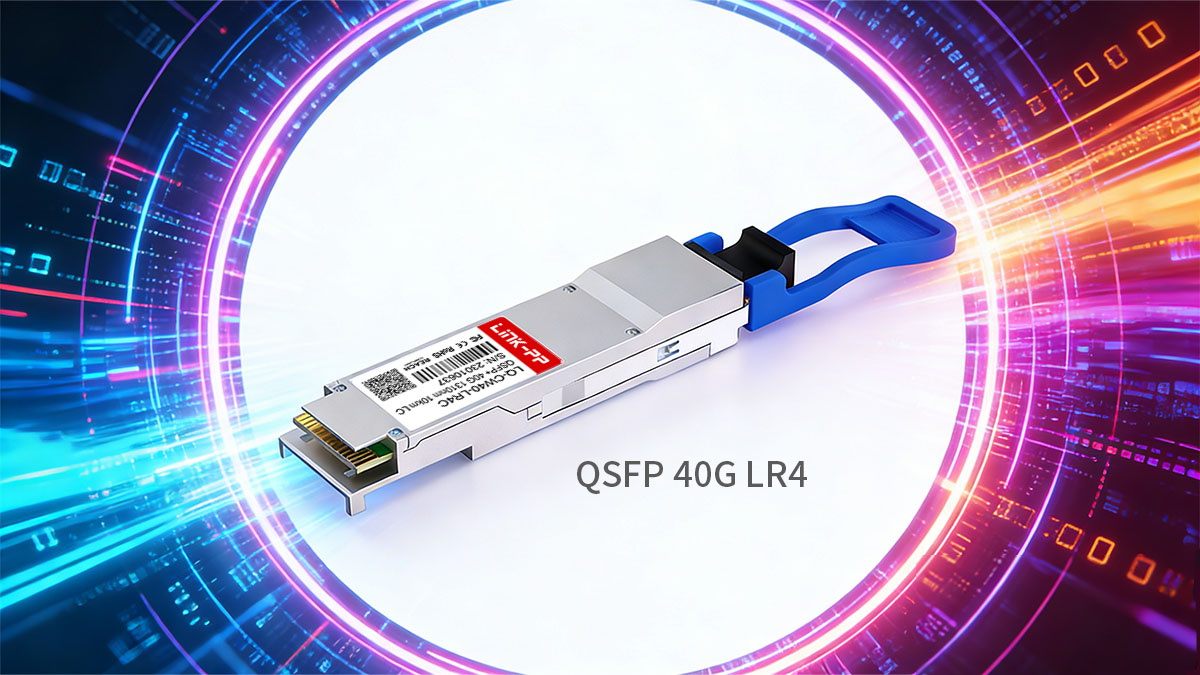
QSFP 40G LR4 is the preferred 40G optical transceiver for single-mode links up to 10km, offering a balanced solution between transmission distance, cost, and deployment flexibility. It is specifically designed for data center interconnects, enterprise backbone networks, and service provider aggregation layers where short-reach modules are insufficient but ultra-long-reach options are unnecessary.
Compared with 40G SR4 modules limited to multimode fiber and short distances, QSFP 40G LR4 enables long-distance transmission over standard single-mode fiber using CWDM technology at 1310nm. At the same time, it remains more cost-efficient and easier to deploy than 40G ER4 solutions, making it a practical choice for most 10km network scenarios.
This guide focuses on how QSFP 40G LR4 works, where it fits best, how it compares to other 40G QSFP options, and how to choose the right module for your network, with an emphasis on compatibility, specifications, and purchasing considerations rather than basic definitions.
✅ What Is a QSFP 40G LR4 Transceiver?
A QSFP 40G LR4 transceiver is a 40Gbps optical module designed for up to 10km transmission over single-mode fiber using four CWDM wavelengths around 1310nm.
It is standardized under 40GBASE-LR4 and widely used in backbone and aggregation networks where multimode solutions cannot meet distance requirements.
At a functional level, QSFP 40G LR4 balances reach, interoperability, and cost by combining multiple optical lanes into a single LC duplex interface, allowing long-distance deployment without complex fiber infrastructure.
How Does QSFP 40G LR4 Work?
QSFP 40G LR4 transmits data by splitting a 40Gbps signal into four 10Gbps lanes, each carried on a different wavelength over the same single-mode fiber pair.
These lanes are multiplexed and demultiplexed inside the module using CWDM technology.
-
Each electrical lane operates at 10Gbps
-
Optical wavelengths are centered around 1310nm
-
All four lanes share one LC duplex SMF link
-
The receiver recombines the lanes back into a 40Gbps signal
This architecture allows QSFP 40G LR4 to extend reach far beyond short-reach multimode modules without increasing fiber count.
Key Characteristics of QSFP 40G LR4
QSFP 40G LR4 is defined by long-reach capability, single-mode fiber compatibility, and standardized optical specifications.
These characteristics distinguish it from other 40G QSFP variants.
| Parameter | QSFP 40G LR4 |
|---|---|
| Data Rate | 40Gbps |
| Max Distance | Up to 10km |
| Fiber Type | Single-Mode Fiber (SMF) |
| Optical Wavelength | 1310nm (CWDM4) |
| Connector Type | LC Duplex |
Because it follows the MSA and IEEE standards, QSFP 40G LR4 modules are generally interoperable across compliant switches and platforms.
Where QSFP 40G LR4 Fits in 40G Networks
QSFP 40G LR4 is positioned as the default long-reach option for 40G networks that exceed SR4 distance limits but do not require ultra-long-reach optics. It is commonly selected when network design prioritizes reliability and fiber efficiency.
Typical positioning includes:
-
Aggregation and core layers in enterprise networks
-
Inter-building or campus backbone links
-
Data center interconnects within metro distances
-
Service provider aggregation networks
In these scenarios, QSFP 40G LR4 delivers sufficient reach without the higher cost and power requirements of extended-reach alternatives.
✅ Key Specifications of QSFP 40G LR4
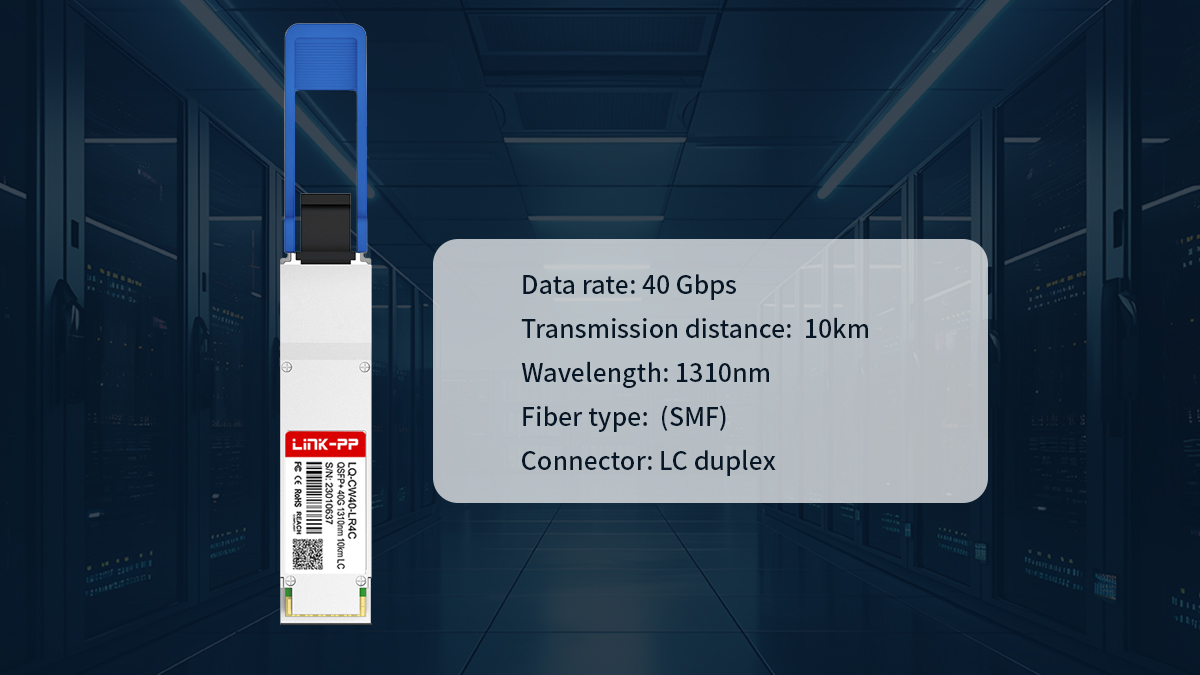
QSFP 40G LR4 is defined by a fixed set of optical and electrical specifications that directly determine its compatibility, reach, and deployment cost.
Understanding these specifications is essential for verifying whether the module fits your switch platform and network design.
Core Technical Specifications
QSFP 40G LR4 delivers 40Gbps transmission over single-mode fiber up to 10km using four CWDM4 wavelengths around 1310nm.
| Specification | QSFP 40G LR4 |
|---|---|
| Standard | 40GBASE-LR4 |
| Total Data Rate | 40Gbps |
| Transmission Distance | Up to 10km |
| Fiber Type | Single-Mode Fiber (SMF) |
| Optical Interface | LC Duplex |
These baseline specifications are fixed by the IEEE standard and apply across all compliant QSFP 40G LR4 modules, regardless of brand.
Optical and Wavelength Parameters
QSFP 40G LR4 uses four closely spaced wavelengths in the 1310nm window to carry parallel 10G optical lanes over a single fiber pair.
| Optical Parameter | Value |
|---|---|
| Wavelength Range | 1271–1331 nm (CWDM4) |
| Number of Lanes | 4 × 10G |
| Modulation | NRZ |
| Multiplexing Method | CWDM4 |
Because CWDM4 operates within the standard single-mode window, QSFP 40G LR4 can be deployed on existing SMF infrastructure without special fiber requirements.
Electrical and Power Characteristics
Power consumption and electrical signaling determine whether QSFP 40G LR4 can operate reliably in dense switch environments.
| Electrical Parameter | Typical Value |
|---|---|
| Host Interface | 4 × 10G Electrical |
| Max Power Consumption | ≤ 3.5W |
| Operating Temperature | 0°C to 70°C (Commercial) |
In most data center and enterprise switches, QSFP 40G LR4 power draw fits within standard thermal budgets, enabling high port density without additional cooling.
Mechanical and Form Factor Details
QSFP 40G LR4 follows the QSFP+ form factor, allowing hot-plug installation and high-density deployments.
| Mechanical Feature | Description |
|---|---|
| Form Factor | QSFP+ |
| Connector Type | LC Duplex |
| Hot-Pluggable | Yes |
| MSA Compliance | Yes |
MSA compliance ensures physical and electrical compatibility with a wide range of optical cages and switch platforms.
Why These Specifications Matter in Purchasing Decisions
Each QSFP 40G LR4 specification maps directly to a real deployment constraint.
-
Distance and fiber type determine whether existing cabling can be reused
-
Wavelength and standard compliance affect interoperability
-
Power consumption influences switch port density
-
Form factor ensures physical compatibility
Verifying these parameters before purchase reduces the risk of incompatibility, deployment delays, and unnecessary optical costs.
✅ QSFP 40G LR4 vs Other 40G QSFP Modules
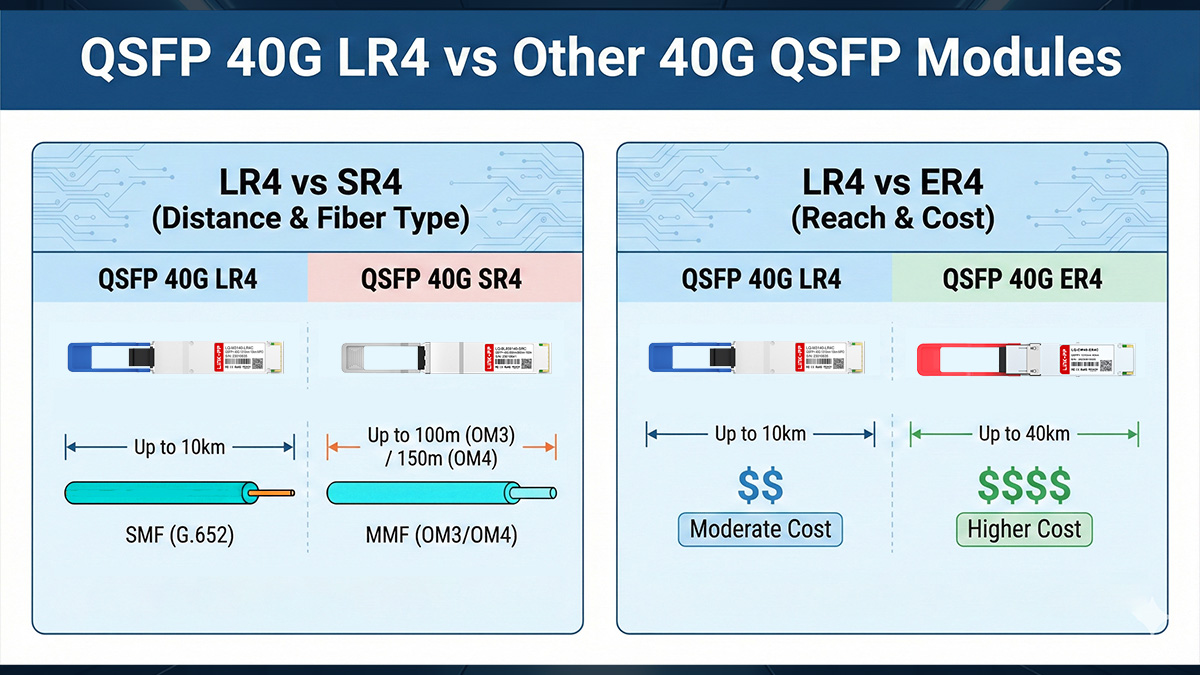
QSFP 40G LR4 is the most balanced choice for 40G single-mode links up to 10km, positioned between short-reach multimode modules and higher-cost extended-reach optics. To decide whether LR4 is the right option, it must be compared against the most common 40G QSFP alternatives.
QSFP 40G LR4 vs QSFP 40G SR4
The key difference between LR4 and SR4 is transmission distance and fiber type, which directly determines deployment scope and infrastructure requirements.
| Parameter | QSFP 40G LR4 | QSFP 40G SR4 |
|---|---|---|
| Max Distance | 10km | 100m–150m |
| Fiber Type | Single-Mode Fiber | Multimode Fiber |
| Wavelength | 1310nm | 850nm |
| Connector | LC Duplex | MPO/MTP |
Decision logic:
-
Choose LR4 when links exceed multimode limits or SMF is already deployed
-
Choose SR4 only for short intra-data-center connections where cost is the primary concern
SR4 is unsuitable for campus, inter-building, or backbone links due to its distance limitation and MPO cabling complexity.
QSFP 40G LR4 vs QSFP 40G ER4
LR4 and ER4 share the same single-mode architecture, but differ significantly in reach, cost, and power consumption.
| Parameter | QSFP 40G LR4 | QSFP 40G ER4 |
|---|---|---|
| Max Distance | 10km | Up to 40km |
| Wavelength | 1310nm (CWDM4) | 1310nm (CWDM4) |
| Typical Power | ≤3.5W | Higher than LR4 |
| Cost Level | Moderate | High |
Decision logic:
-
Choose LR4 for metro, campus, or aggregation links within 10km
-
Choose ER4 only when distance requirements exceed LR4 limits
For most enterprise and data center interconnect scenarios, ER4 provides unnecessary reach at a significantly higher cost.
QSFP 40G LR4 vs QSFP 40G PSM4
LR4 and PSM4 both operate over single-mode fiber, but differ in fiber count and cabling efficiency.
| Parameter | QSFP 40G LR4 | QSFP 40G PSM4 |
|---|---|---|
| Fiber Count | 2 fibers (LC) | 8 fibers (MPO) |
| Wavelength | CWDM4 1310nm | 1310nm |
| Cabling Complexity | Low | High |
| Typical Use Case | Backbone / DCI | Parallel SMF environments |
Decision logic:
-
Choose LR4 when fiber efficiency and simple cabling are priorities
-
Choose PSM4 only when parallel SMF infrastructure already exists
In most practical deployments, LR4 is favored due to its lower fiber consumption and simpler link management.
Summary: Which 40G QSFP Module Should You Choose?
QSFP 40G LR4 is the default long-reach 40G solution when distance, fiber efficiency, and cost must be balanced.
-
SR4 → short-reach, multimode, data center only
-
LR4 → up to 10km, single-mode, most versatile
-
ER4 → ultra-long-reach, higher cost
-
PSM4 → niche use, parallel SMF
For the majority of 40G networks operating beyond 150m and within 10km, QSFP 40G LR4 offers the most practical deployment profile.
✅ Typical Applications of QSFP 40G LR4
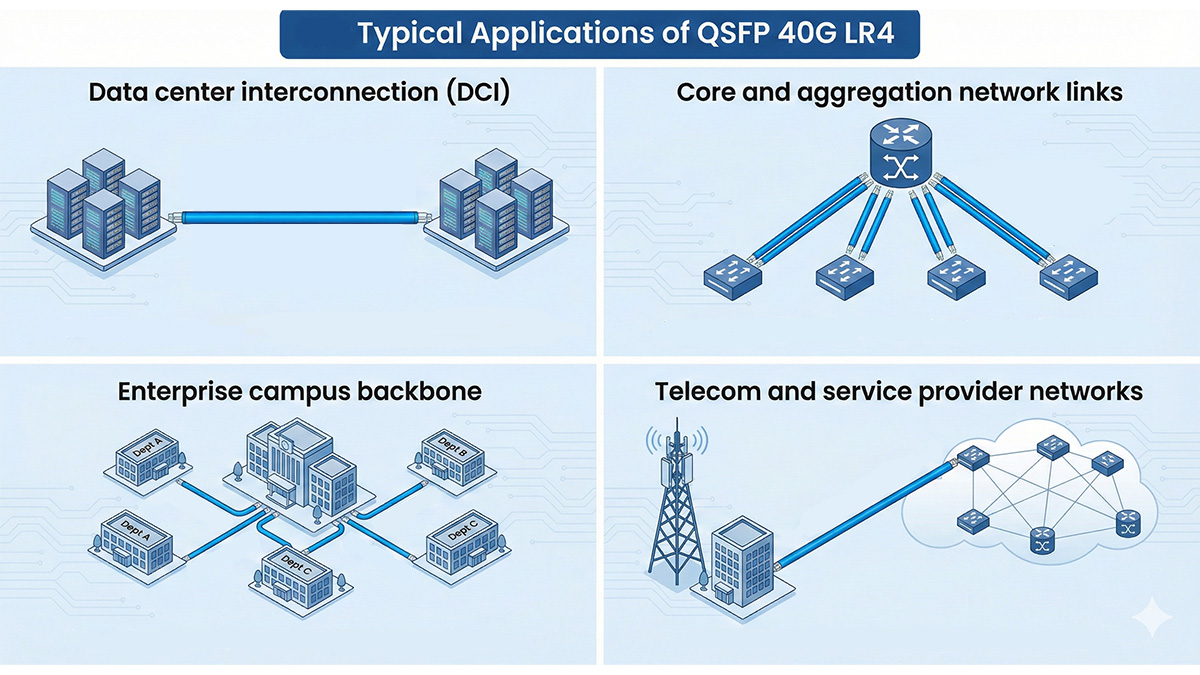
QSFP 40G LR4 is best suited for 40G network links that require single-mode transmission up to 10km with stable performance and efficient fiber usage. It is commonly deployed in scenarios where short-reach optics fail to meet distance requirements, while extended-reach modules would add unnecessary cost.
Data Center Interconnect (DCI)
QSFP 40G LR4 is widely used for short-to-medium distance data center interconnects where single-mode fiber is already available.
Typical DCI scenarios include:
-
Inter-building links within the same campus
-
Metro-edge data centers within 10km
-
Redundant 40G uplinks between core switches
In these environments, LR4 provides sufficient reach without the power and cost overhead of ER-class optics.
Enterprise Campus and Backbone Networks
For enterprise networks, QSFP 40G LR4 is a practical backbone solution connecting aggregation and core layers across large campuses.
Common enterprise use cases:
-
Core-to-aggregation switch uplinks
-
Cross-building backbone links
-
High-capacity links between data halls
Because LR4 operates over standard single-mode fiber with LC connectors, it integrates cleanly into existing enterprise cabling systems.
Service Provider Aggregation Networks
QSFP 40G LR4 fits well in service provider aggregation layers where predictable reach and interoperability are required.
Typical deployment scenarios:
-
Aggregation-to-core network links
-
Access network uplinks within metro areas
-
Transitional 40G infrastructure before migration to 100G
Its standardized optical specifications allow multi-vendor interoperability, which is critical in carrier environments.
High-Density Switch Environments
QSFP 40G LR4 is suitable for high-density switch deployments where power efficiency and thermal limits matter.
Key advantages in dense systems:
-
Moderate power consumption compared to ER4
-
LC duplex cabling reduces port congestion
-
Hot-pluggable QSFP+ form factor
These characteristics make LR4 a stable option for switches operating at high port utilization.
When QSFP 40G LR4 Is Not the Best Fit
QSFP 40G LR4 should not be used when network requirements fall clearly outside its optimal range.
-
Distances under 100m with multimode fiber → SR4 is more cost-effective
-
Distances beyond 10km → ER4 or higher-reach solutions are required
-
Environments with existing parallel SMF infrastructure → PSM4 may be considered
Understanding these boundaries helps avoid over- or under-engineering the optical layer.
✅ Compatibility and Interoperability Considerations
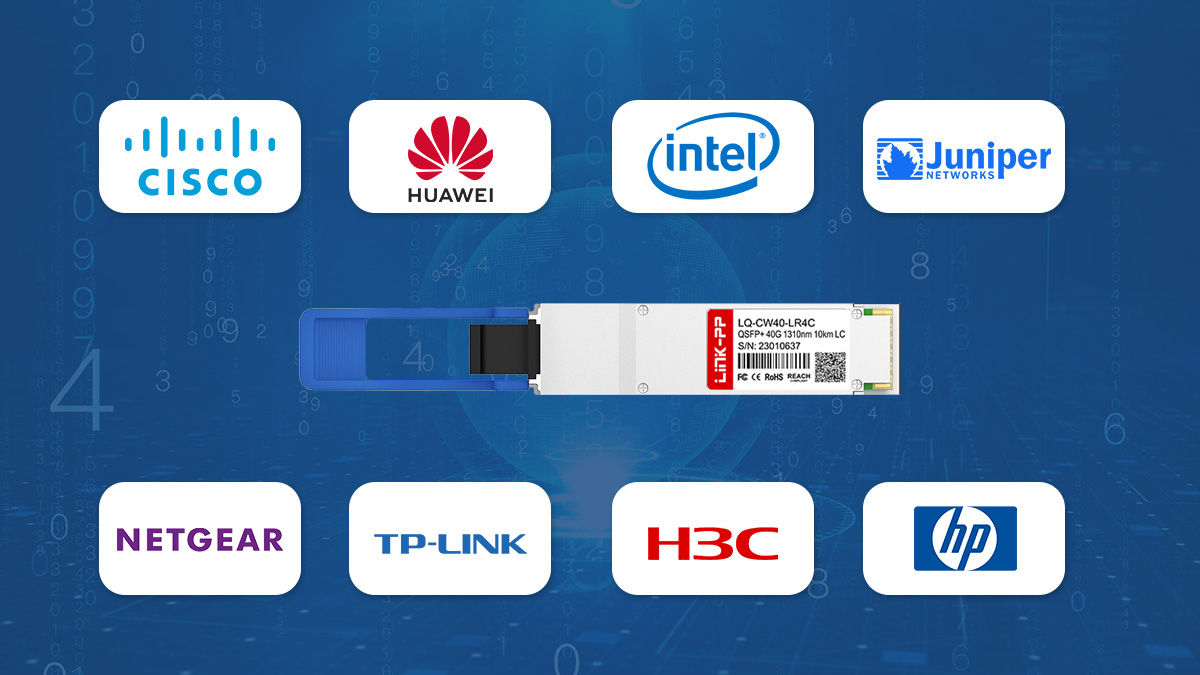
QSFP 40G LR4 modules are broadly interoperable across platforms when they comply with IEEE 40GBASE-LR4 and QSFP+ MSA standards, but real-world compatibility still depends on switch vendor policies and firmware behavior. Ignoring these factors is one of the most common causes of deployment issues.
Standards and MSA Compliance
Full compliance with IEEE and MSA specifications is the baseline requirement for cross-vendor interoperability.
| Compatibility Aspect | Requirement |
|---|---|
| IEEE Standard | 40GBASE-LR4 |
| Form Factor | QSFP+ MSA |
| Optical Interface | LC Duplex |
| Lane Architecture | 4×10Gbps CWDM4 |
Modules that follow these standards can physically and optically interoperate with compliant ports, regardless of brand.
Switch Vendor Compatibility
Even with standard compliance, switch vendors may enforce additional compatibility checks at the firmware level.
Common compatibility scenarios:
-
Some vendors whitelist certified transceivers only
-
Others allow third-party modules with warning messages
-
Firmware updates can change transceiver acceptance behavior
Before deployment, it is essential to confirm:
-
Supported QSFP 40G LR4 part numbers
-
Firmware version requirements
-
Whether unsupported optics trigger port shutdown or alarms
OEM vs Third-Party QSFP 40G LR4 Modules
Third-party QSFP 40G LR4 modules are widely used and technically equivalent when properly coded and tested, but OEM optics remain vendor-locked by design.
| Comparison Factor | OEM Modules | Third-Party Modules |
|---|---|---|
| Hardware Design | Vendor-specific | MSA-based |
| Compatibility Coding | Fixed | Reprogrammable |
| Cost | High | Lower |
| Interoperability | Vendor-restricted | Multi-vendor |
For multi-vendor networks or cost-sensitive deployments, third-party modules provide greater flexibility without sacrificing performance when sourced from reliable suppliers.
Interoperability Between Different LR4 Vendors
QSFP 40G LR4 modules from different vendors can interoperate on the same link as long as optical parameters remain within standard limits.
Key conditions for interoperability:
-
Matching LR4 standard on both ends
-
Similar optical power and sensitivity ranges
-
Compatible digital diagnostics (DOM)
In mixed-vendor environments, link testing during rollout is recommended to validate stability before large-scale deployment.
Practical Compatibility Checklist Before Purchase
A short compatibility check can prevent most deployment issues.
-
Confirm switch model and firmware version
-
Verify QSFP 40G LR4 support in vendor documentation
-
Check whether third-party optics are accepted
-
Validate fiber type and connector compatibility
-
Plan for link testing in mixed-vendor setups
This checklist is especially important when purchasing compatible or non-OEM QSFP 40G LR4 modules.
✅ Pricing Factors of QSFP 40G LR4 Transceivers
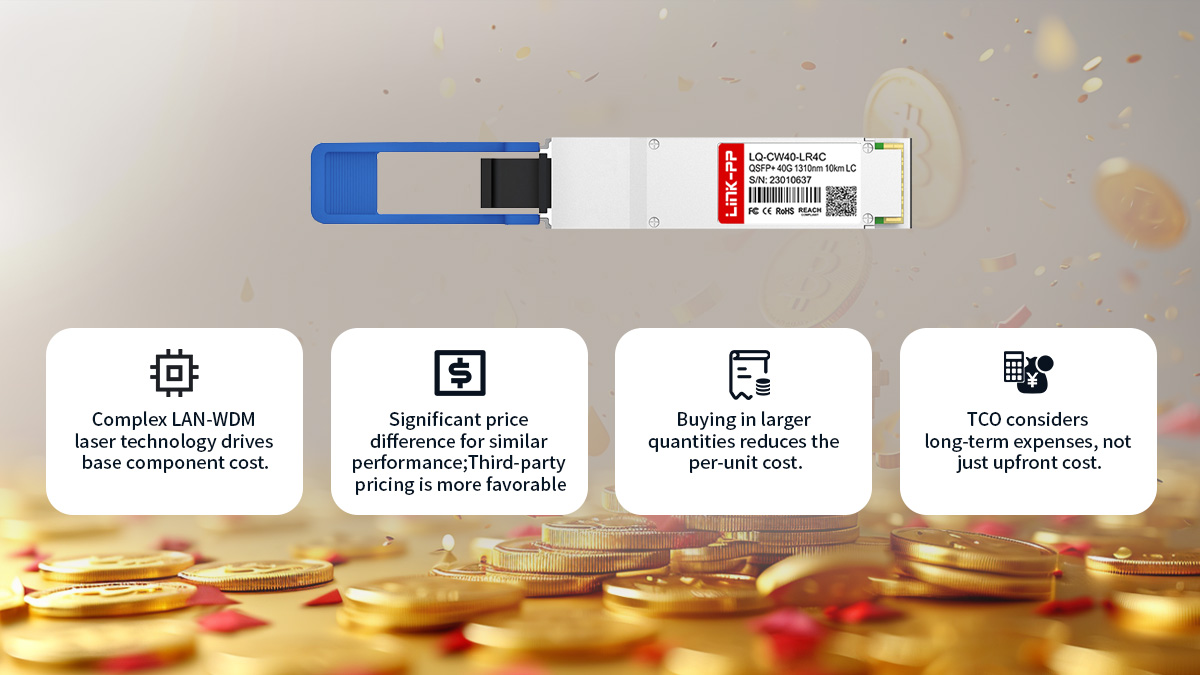
The price of a QSFP 40G LR4 transceiver is driven primarily by optical component cost, compatibility requirements, and supplier testing standards rather than the form factor itself. Understanding these factors helps buyers avoid overpaying while ensuring stable network performance.
Optical Components and Technology Cost
CWDM4 optical components are the main cost driver in QSFP 40G LR4 modules.
| Cost Factor | Impact on Price |
|---|---|
| CWDM4 Lasers | High |
| Optical Multiplexing | Medium |
| Receiver Sensitivity | Medium |
| Component Yield | Medium |
Compared to 40GBASE-SR4 modules using 850nm VCSELs, LR4 requires more complex laser sources and tighter wavelength control, which directly increases manufacturing cost.
OEM vs Third-Party Pricing Differences
Brand strategy and vendor lock-in have a larger impact on price than hardware performance differences.
| Pricing Aspect | OEM Modules | Third-Party Modules |
|---|---|---|
| Unit Price | High | Lower |
| Compatibility Coding | Fixed | Customizable |
| Warranty Flexibility | Vendor-specific | Supplier-based |
| Cost Efficiency | Low | High |
In most enterprise and data center environments, third-party QSFP 40G LR4 modules offer equivalent performance at a significantly lower cost when compatibility is confirmed.
Compatibility and Testing Requirements
More extensive compatibility testing increases module cost but reduces deployment risk.
Key pricing influences:
-
Multi-vendor switch testing coverage
-
Pre-configuration of EEPROM coding
-
Link-level optical performance testing
-
Burn-in and aging tests
Modules with broader compatibility matrices typically cost more than generic, untested alternatives but provide higher deployment confidence.
Volume, Lead Time, and Supply Stability
Order size and supply conditions directly affect unit pricing.
-
Bulk purchases reduce per-unit cost
-
Short lead times may increase price
-
Stable supply chains lower long-term procurement cost
For large-scale deployments, negotiating volume pricing and confirming long-term availability is often more important than minimizing initial unit price.
How to Evaluate Price vs Value
The lowest-priced QSFP 40G LR4 module is not always the most cost-effective option.
When evaluating value, consider:
-
Verified compatibility with your switch platform
-
Consistent optical performance at 10km
-
Warranty and replacement policy
-
Technical support responsiveness
A slightly higher upfront price can reduce operational risk and total cost of ownership over the lifecycle of the network.
✅ How to Choose the Right QSFP 40G LR4 Module
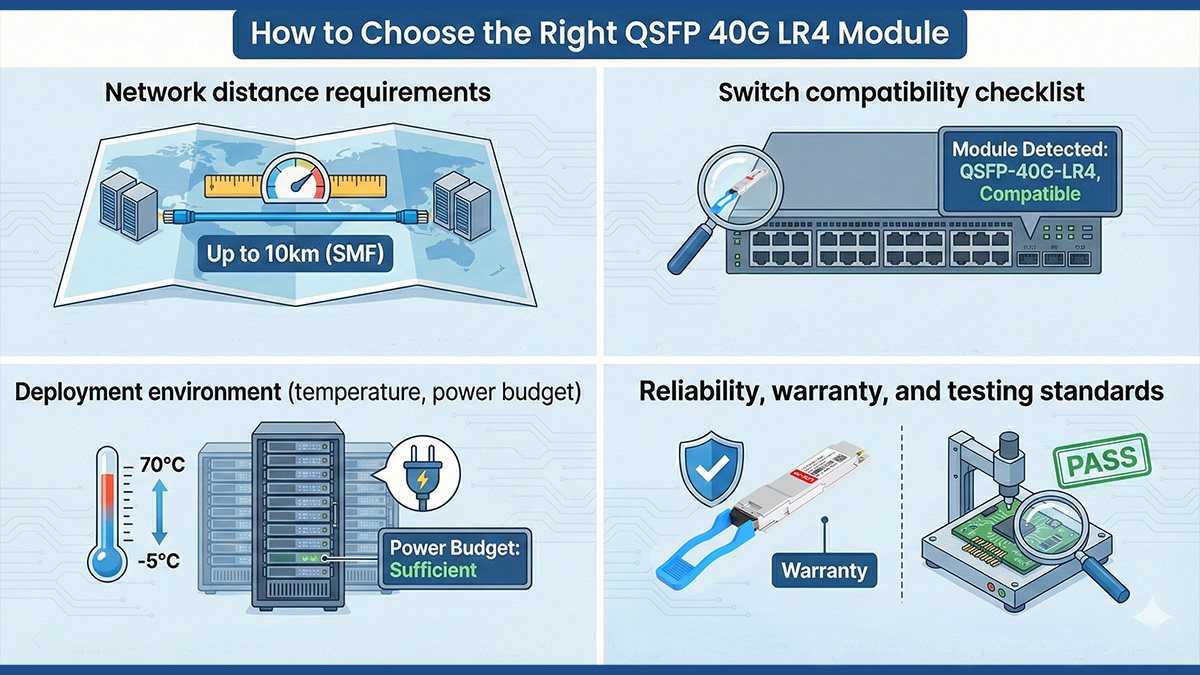
Choosing the right QSFP 40G LR4 module is less about raw specifications and more about matching the module to your actual network environment, compatibility constraints, and operational risk tolerance. A structured selection process can prevent costly compatibility issues and unnecessary over-specification.
Step 1: Confirm Distance and Fiber Infrastructure
QSFP 40G LR4 is the correct choice only when link distances exceed multimode limits and stay within 10km over single-mode fiber.
Before selection, verify:
-
Actual link distance, including patch panels
-
Availability of OS2 single-mode fiber
-
LC duplex connector compatibility
If the link is under 150m with multimode fiber, SR4 is more cost-effective. If it exceeds 10km, ER4-class optics are required.
Step 2: Validate Switch and Platform Compatibility
Compatibility with your switch model and firmware version is non-negotiable.
| Compatibility Check | Why It Matters |
|---|---|
| Switch Model | Determines supported optics |
| Firmware Version | Controls transceiver acceptance |
| Vendor Lock Policy | May block third-party modules |
| Port Power Budget | Ensures stable operation |
Always verify compatibility lists or confirm with your supplier before purchase, especially in multi-vendor environments.
Step 3: Decide Between OEM and Third-Party Modules
The choice between OEM and third-party QSFP 40G LR4 modules impacts cost, flexibility, and future scalability.
Decision factors:
-
OEM modules → vendor-certified, higher cost
-
Third-party modules → lower cost, multi-vendor support
-
Mixed environments → third-party often simplifies inventory
For most enterprise and data center networks, third-party modules provide the best balance of cost and flexibility when properly tested.
Step 4: Evaluate Power, Thermal, and Reliability Requirements
QSFP 40G LR4 modules must operate reliably within your switch’s thermal and power limits.
| Operational Factor | Typical Requirement |
|---|---|
| Max Power Consumption | ≤3.5W |
| Operating Temperature | 0°C to 70°C |
| Cooling Environment | Standard airflow |
In high-density deployments, power efficiency and thermal stability are critical for long-term reliability.
Step 5: Assess Supplier Quality and Support
Supplier capability directly affects deployment success and post-installation stability.
Key evaluation points:
-
Optical and electrical testing coverage
-
Compatibility programming accuracy
-
Warranty and replacement policy
-
Technical support response time
A reliable supplier reduces troubleshooting time and protects overall network uptime.
Final Selection Checklist
A QSFP 40G LR4 module is the right choice when all of the following conditions are met:
-
Link distance is within 10km over SMF
-
Switch compatibility is confirmed
-
Power and thermal limits are respected
-
Supplier testing and support meet operational needs
Following this checklist ensures the selected module aligns with both technical requirements and business constraints.
✅ Why Choose a Reliable QSFP 40G LR4 Supplier
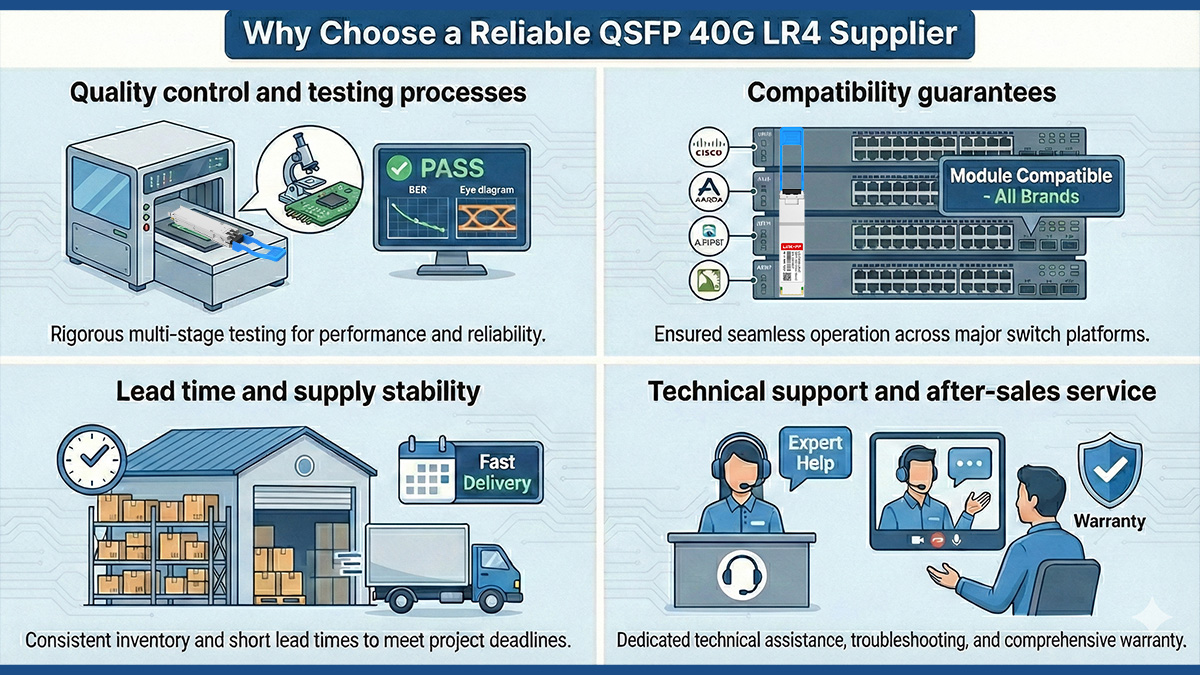
For QSFP 40G LR4 deployments, supplier reliability directly impacts compatibility success, network stability, and long-term operating cost. Even when two modules share identical specifications on paper, differences in testing, coding, and quality control can lead to very different real-world outcomes.
Consistent Optical and Electrical Testing
Reliable suppliers validate QSFP 40G LR4 modules beyond basic factory checks to ensure stable 10km performance.
| Testing Area | Purpose |
|---|---|
| Optical Power & Sensitivity | Ensure link stability at 10km |
| Wavelength Accuracy | Maintain CWDM4 compliance |
| Electrical Eye Diagram | Verify signal integrity |
| Burn-In Testing | Reduce early failure risk |
Without proper testing, modules may pass short-distance checks but fail under full reach or long-term operation.
Accurate Compatibility Coding and Validation
Correct EEPROM coding is essential for QSFP 40G LR4 interoperability with different switch platforms.
Key supplier capabilities include:
-
Accurate vendor-specific coding
-
Pre-validation on mainstream switch models
-
Firmware-aware compatibility adjustments
A reliable supplier minimizes the risk of port errors, alarms, or unexpected module rejection after firmware updates.
Proven Interoperability Across Vendors
Multi-vendor interoperability is not guaranteed by standards alone—it must be verified in practice.
| Interoperability Aspect | Reliable Supplier Practice |
|---|---|
| Cross-Vendor Testing | Tested with major switch brands |
| Mixed-End Links | Validated LR4-to-LR4 operation |
| DOM/DDM Accuracy | Consistent diagnostic reporting |
This is especially important in networks using switches from multiple vendors or planning future expansion.
Warranty, Replacement, and Lifecycle Support
Post-deployment support is a critical but often overlooked factor in QSFP 40G LR4 procurement.
A reliable supplier typically offers:
-
Clear warranty terms
-
Fast replacement or RMA handling
-
Stable product availability over time
-
Technical support during deployment and troubleshooting
These factors reduce downtime risk and simplify long-term maintenance.
Lower Total Cost of Ownership (TCO)
Choosing a reliable QSFP 40G LR4 supplier reduces total cost of ownership, even if the initial price is not the lowest.
TCO benefits come from:
-
Fewer compatibility-related failures
-
Reduced troubleshooting and replacement costs
-
Stable performance over the module lifecycle
In production networks, operational stability consistently outweighs marginal upfront savings.
✅ FAQs About QSFP 40G LR4 Transceivers
1. Is QSFP 40G LR4 single-mode only?
Yes. QSFP 40G LR4 is designed exclusively for single-mode fiber and does not support multimode fiber.
Its CWDM4 wavelengths around 1310nm require SMF to achieve up to 10km transmission.
2. What is the maximum transmission distance of QSFP 40G LR4?
QSFP 40G LR4 supports transmission distances of up to 10km over single-mode fiber.
Actual reach depends on link loss, fiber quality, and connector conditions.
3. Can QSFP 40G LR4 work with multimode fiber?
No. QSFP 40G LR4 cannot operate over multimode fiber due to wavelength and optical design differences.
For multimode environments, QSFP 40G SR4 is the appropriate alternative.
4. Is QSFP 40G LR4 compatible with all switches?
QSFP 40G LR4 is broadly compatible with QSFP+ ports that support 40GBASE-LR4, but switch vendor restrictions may apply.
Always verify switch model, firmware version, and transceiver acceptance policies before deployment.
5. Are third-party QSFP 40G LR4 modules safe to use?
Yes, third-party QSFP 40G LR4 modules are safe and reliable when properly tested and correctly coded for the target switch.
They are widely used in enterprise and data center networks to reduce optical costs.
6. Can QSFP 40G LR4 be used for breakout connections?
No. QSFP 40G LR4 is not designed for 40G-to-4×10G breakout applications.
Breakout requires SR4 or specific breakout-capable architectures, not LR4.
7. How does QSFP 40G LR4 differ from QSFP 40G ER4 in practice?
QSFP 40G LR4 is optimized for links up to 10km, while ER4 is designed for much longer distances at higher cost and power consumption.
LR4 is the more practical choice unless extended reach is required.
8. What connector type does QSFP 40G LR4 use?
QSFP 40G LR4 uses an LC duplex connector.
This simplifies cabling compared to MPO-based 40G modules and reduces fiber management complexity.
9. Is QSFP 40G LR4 still relevant with 100G networks?
Yes. QSFP 40G LR4 remains relevant in existing 40G infrastructures and as a transitional solution before 100G upgrades.
It is commonly used where 40G capacity is sufficient and cost efficiency is a priority.
✅ Conclusion: Is QSFP 40G LR4 the Right Choice for Your Network?
QSFP 40G LR4 is the right choice for networks that require reliable 40Gbps transmission over single-mode fiber up to 10km without the cost and complexity of extended-reach optics.
It fits naturally in data center interconnects, enterprise backbones, and service provider aggregation networks where SR4 distance limits are insufficient and ER4 would be over-engineered.
From specifications and applications to compatibility, pricing, and supplier selection, QSFP 40G LR4 stands out as a balanced and practical 40G optical solution. When properly matched to switch platforms and sourced from a reliable supplier, it delivers stable performance, strong interoperability, and lower total cost of ownership.
If you are planning a 40G deployment or upgrading existing single-mode links, exploring tested and compatible QSFP 40G LR4 transceivers from the LINK-PP Official Store can help streamline procurement while ensuring performance and compatibility across major switch platforms.