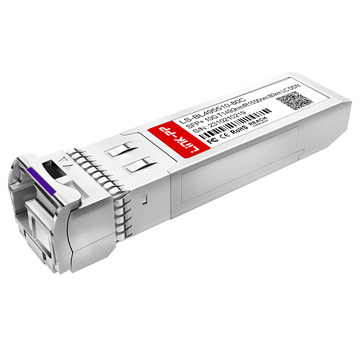
As enterprise networks, data centers, and service provider infrastructures continue to scale, the demand for reliable 10-Gigabit Ethernet (10GbE) connectivity over longer distances has become a standard requirement rather than an exception. Among the available 10G optical solutions, SFP 10G LR transceivers stand out as one of the most widely deployed and trusted options for long-reach fiber links. Designed to deliver stable 10Gbps performance over single-mode fiber up to 10 kilometers, SFP 10G LR modules form the backbone of many campus networks, inter-building connections, and data center interconnects.
This guide provides a comprehensive, engineering-focused explanation of what SFP 10G LR is, how it works, and where it is best applied. From the underlying 10GBASE-LR standard and optical transmission principles to key specifications, compatibility considerations, and comparisons with SR, ER, DAC, and AOC alternatives, the article is structured to support both network design engineers and technical procurement professionals. Whether you are planning a new 10GbE deployment or evaluating long-reach optical options for an existing fiber infrastructure, this article aims to deliver clear, accurate, and practical insight into SFP 10G LR Fiber Modules.
? What Is 10GBASE-LR SFP Module?
To understand SFP 10G LR, it is essential to first clarify what 10GBASE-LR means at the Ethernet standard level. Although these terms are often used interchangeably in practice, they refer to slightly different layers of the same technology stack.
Definition of 10GBASE-LR
SFP+ 10GBASE-LR is an optical Ethernet standard defined under IEEE 802.3ae for 10-Gigabit Ethernet transmission over single-mode fiber (SMF).
-
Data rate: 10 Gb/s
-
Maximum reach: Up to 10 km
-
Wavelength: 1310 nm
-
Fiber type: Single-mode fiber (typically G.652)
In this naming convention:
-
“10G” refers to 10 Gigabits per second
-
“BASE” indicates baseband signaling
-
“LR” stands for Long Reach
10GBASE-LR specifies the physical layer (PHY) characteristics—including wavelength, optical power budget, dispersion tolerance, and link distance—but does not mandate a specific form factor. This is where SFP+ comes into play.
What Does “LR” Mean in 10G Optical Modules?
In optical networking, LR (Long Reach) indicates a transmission class optimized for distances significantly longer than short-reach (SR) optics.
| Reach Class | Typical Distance | Wavelength | Fiber Type |
|---|---|---|---|
| SR (Short Reach) | 300–400 m | 850 nm | Multimode |
| LR (Long Reach) | Up to 10 km | 1310 nm | Single-mode |
| ER (Extended Reach) | 40 km | 1550 nm | Single-mode |
Compared to SR modules, LR optics:
-
Use single-mode fiber instead of multimode
-
Operate at 1310 nm, offering lower dispersion over distance
-
Support campus, metro-edge, and inter-building links
LR represents the most common “long-distance” option in enterprise and data-center networks, balancing reach, power consumption, and cost.
SFP 10G LR vs 10GBASE-LR — How Are They Related?
Although often used as synonyms, 10GBASE-LR and SFP+ 10G LR are not identical concepts.
-
10GBASE-LR
→ An IEEE Ethernet standard that defines optical transmission requirements -
SFP+ 10G LR
→ A physical transceiver module that implements the 10GBASE-LR standard in an SFP+ form factor
In other words:
10GBASE-LR defines how 10G optical transmission works;
SFP+ 10G LR defines how it is physically deployed.
SFP+ (Enhanced Small Form-factor Pluggable) modules:
-
Plug into standard SFP+ ports on switches, routers, and NICs
-
Are hot-pluggable, allowing live installation and replacement
-
Follow MSA (Multi-Source Agreement) mechanical and electrical specifications (e.g., SFF-8431, SFF-8432)
Key Characteristics of SFP+ 10GBASE-LR Modules
A typical 10GBASE LR SFP+ Transceiver includes the following characteristics:
-
Hot-pluggable SFP+ form factor
-
1310 nm DFB laser transmitter
-
Single-mode fiber support (up to 10 km)
-
LC duplex optical connector
-
Low power consumption (~1.5 W)
-
Digital Optical Monitoring (DOM) via SFF-8472
-
MSA compliance for multi-vendor interoperability
These features make SFP+ 10G LR modules a standard choice for scalable 10GbE deployments across enterprise, data-center, and service-provider environments.
? How Does an SFP 10G LR Transceiver Work?
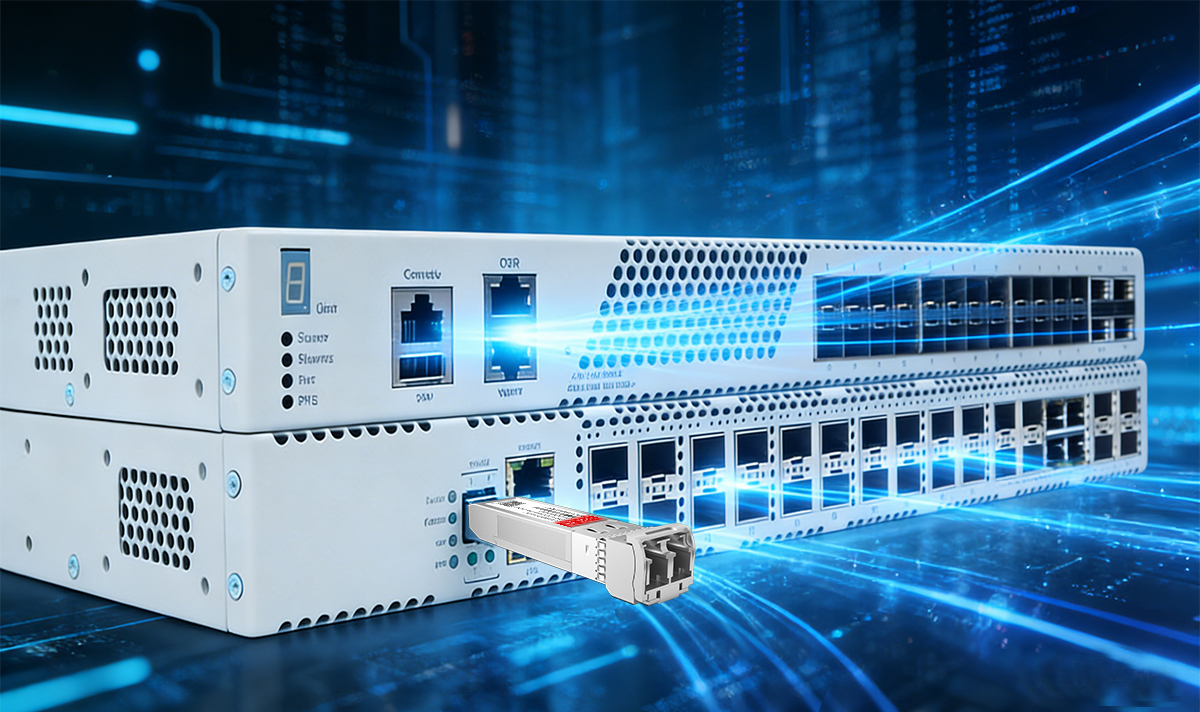
At its core, an SFP 10G LR transceiver (10GBASE-LR SFP+) operates by converting 10 Gb/s high-speed electrical signals into optical signals at a 1310nm wavelength, transmitting them over single-mode fiber, and then converting them back into electrical signals at the receiving end.
From an engineering and communications perspective, this process can be best understood by following the signal flow and examining the key functional modules inside the transceiver.
Optical Transmission Principle of 10G SFP+ Modules
End-to-End Signal Flow (Electrical → Optical → Electrical)
① Transmit Path (Electrical → Optical)
-
Host electrical input
A 10.3125 Gb/s NRZ electrical signal generated by the switch, router, or server PHY enters the SFP+ module via the SFI/XFI electrical interface, in accordance with IEEE 802.3ae. -
Clock and Data Recovery (CDR)
The CDR circuit extracts timing information and reshapes the data stream, reducing jitter and ensuring signal integrity. This step is critical for meeting the required bit error rate (BER ≤ 10⁻¹²) specified for 10GbE links. -
Laser driver and DFB laser
The recovered electrical signal drives a 1310 nm DFB (Distributed Feedback) laser, which directly modulates the optical output. Direct modulation is sufficient for 10 km links and keeps power consumption and complexity low. -
Optical power and waveform control
An APC (Automatic Power Control) loop stabilizes output power, within the IEEE-defined transmit power range of –8.2 to +0.5 dBm, compensating for temperature and aging effects. -
Launch into single-mode fiber
The optical signal exits the module through an LC duplex connector and propagates through G.652 single-mode fiber, supporting distances up to 10 km.
② Optical Fiber Transmission (Optical Channel)
-
Fiber type: Single-mode fiber (9/125 μm core/cladding)
-
Operating wavelength: 1310 nm
-
Primary loss factors:
-
Fiber attenuation (≈ 0.35 dB/km at 1310 nm)
-
Connector and splice losses
For 10GBASE-LR links, no optical amplification (e.g., EDFA) is required. The technology is optimized for short-to-medium backbone distances commonly found in enterprise and campus networks.
③ Receive Path (Optical → Electrical)
-
Optical input
The incoming optical signal enters the receiver through the LC connector. -
PIN photodiode (PD)
A PIN photodiode converts the optical signal into a proportional electrical current. For 10 km LR applications, PIN PDs offer an ideal balance of sensitivity, stability, and cost, without the complexity of APD receivers. -
Transimpedance amplifier (TIA)
The weak photocurrent is amplified into a usable voltage signal. -
Limiting amplifier and CDR
Signal amplitude is normalized, timing is recovered again, and a clean 10G electrical signal is delivered back to the host PHY—completing the optical-electrical-optical conversion loop.
Key Components and Technologies Inside an SFP 10G LR Module
| Component | Function | Engineering Notes |
|---|---|---|
| DFB laser | Optical signal generation | 1310 nm, low chirp, temperature-stable |
| PIN photodiode | Optical-to-electrical conversion | Cost-effective, reliable for 10 km |
| CDR | Jitter suppression | Ensures BER ≤ 10⁻¹² |
| APC | Output power control | Maintains stable optical budget |
| EEPROM | Module identification & monitoring | SFF-8472 / SFF-8431 compliant |
Why 1310nm Wavelength Is Used in 10G LR
The choice of 1310nm for 10GBASE-LR is driven by practical engineering trade-offs:
-
Lower chromatic dispersion than 1550 nm over short-to-medium distances
-
Lower system cost compared to ER/ZR solutions
-
No external modulator required, simplifying module design
-
Broad interoperability, as SFP+ 1310nm LR optics are universally supported by mainstream switches and routers
For distances around 10km, 1310nm provides the most efficient balance between performance, cost, and compatibility.
Single-Mode Fiber Requirements for 10GBASE-LR
SFP 10G LR modules are designed to operate over standard G.652 single-mode fiber, which is widely deployed in enterprise and carrier networks. Typical link characteristics include:
-
Transmit power: –8.2 to +0.5 dBm
-
Receiver sensitivity: ≤ –14.4 dBm
-
Optical link budget: ~6–8 dB
Example 10km link calculation:
-
Fiber attenuation: ~3.5 dB (10 km × 0.35 dB/km)
-
Connector/splice loss: ~1–2 dB
-
Remaining margin: sufficient for stable long-term operation
This margin ensures reliable performance without the need for optical amplification or advanced dispersion compensation.
Engineering Summary (One-Sentence View)
From an engineering standpoint, SFP 10G LR uses a 1310 nm DFB laser to modulate a 10Gb/s electrical signal, transmits it over single-mode fiber up to 10 km, and recovers it using a PIN photodiode, TIA, and CDR to deliver a clean 10G electrical interface—making it one of the most practical long-reach solutions for 10GbE networks.
? Key Specifications of SFP 10G LR
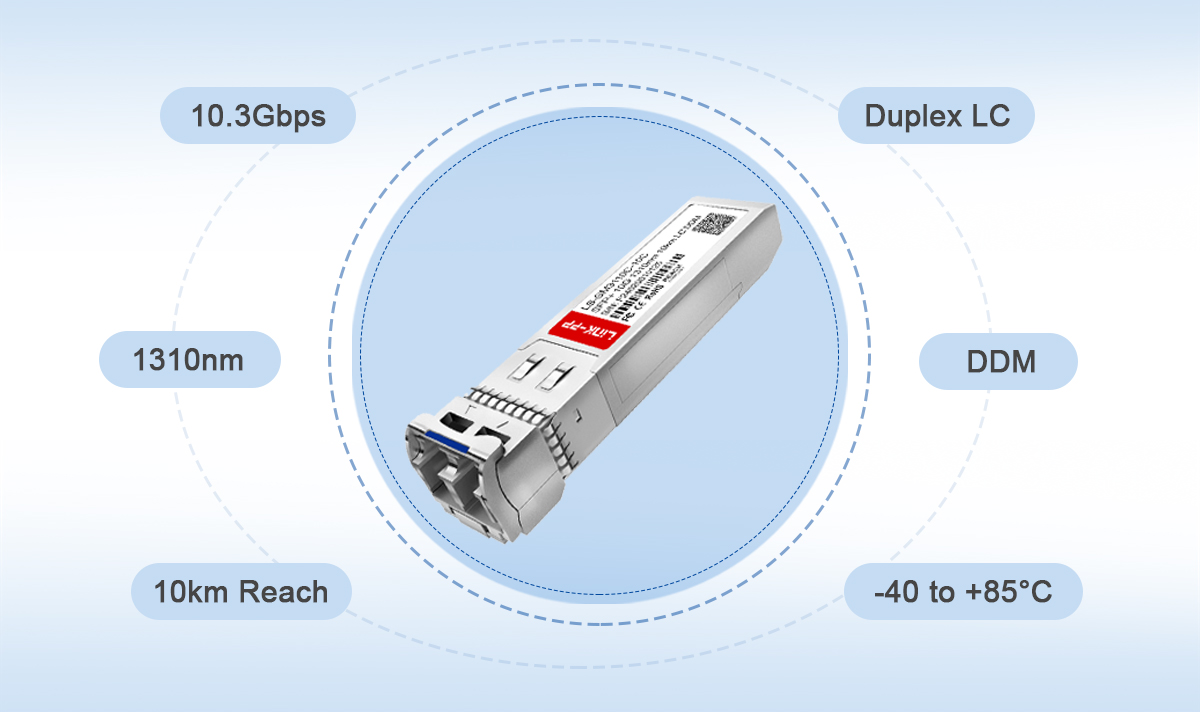
SFP 10G LR(10GBASE-LR SFP+)is defined by IEEE and MSA standards, with well-established electrical, optical, and environmental specifications. Understanding these parameters is essential for correct module selection, link design, and interoperability validation.
Data Rate and IEEE Standards
SFP 10G LR modules are designed for 10 Gigabit Ethernet (10GbE) applications and comply with IEEE 802.3ae 10GBASE-LR.
-
Nominal data rate: 10.3125 Gbps (Ethernet line rate)
-
Supported range: typically up to ~10.7 Gbps to accommodate protocol overhead and clock tolerance
-
Electrical interface: XFI / SFI-compliant serial interface
-
Form factor: SFP+ hot-pluggable module
-
MSA compliance: SFF-8431 / SFF-8432
These standards ensure interoperability across compliant switches, routers, and network interface cards.
Transmission Distance and Optical Budget
SFP 10G LR is optimized for medium-reach single-mode fiber links.
-
Maximum reach: up to 10 km on standard G.652 SMF
-
Typical fiber attenuation: ~0.35 dB/km at 1310 nm
-
End-to-end link budget: approximately 6–8 dB, depending on module class and connector loss
This budget comfortably supports campus backbones, inter-building links, and data-center interconnects where SR optics are insufficient but ER/ZR optics are unnecessary.
Wavelength, Connector Type, and Fiber Type
-
Wavelength: ~1310 nm, using a DFB (Distributed Feedback) laser
-
Fiber type: Single-Mode Fiber (SMF), typically ITU-T G.652
-
Connector: LC duplex, UPC polish
-
Transmission mode: Duplex (separate TX and RX fibers)
The 1310 nm window provides lower chromatic dispersion over 10 km compared with 850 nm multimode solutions, enabling stable 10 Gbps operation without optical amplification.
Power Consumption and DOM/DDM Support
SFP 10G LR modules are engineered for low power and operational visibility.
-
Typical power consumption: ≤ 1.5 W
-
Laser safety: Class 1 compliant
-
Digital Optical Monitoring (DOM/DDM):
-
Compliant with SFF-8472
-
Real-time monitoring of:
-
Transmit optical power
-
Receive optical power
-
Laser bias current
-
Module temperature
-
Supply voltage
DOM support allows network operators to proactively monitor link health, diagnose degradation, and plan maintenance.
Technical Specifications of 10GBASE-LR SFP+ Modules
| Specification | Typical SFP 10G LR Value |
|---|---|
| Data Rate | 10.3125 Gbps (10GbE), up to ~10.7 Gbps supported |
| IEEE Standard | IEEE 802.3ae 10GBASE-LR |
| Wavelength | 1310 nm (DFB laser) |
| Maximum Reach | 10 km on SMF |
| Transmit Power | –8.2 to +0.5 dBm (IEEE-defined range) |
| Receiver Sensitivity | ≤ –14.4 dBm |
| Fiber Type | Single-Mode Fiber (G.652 SMF) |
| Connector | LC duplex (UPC) |
| Power Consumption | ≤ 1.5 W |
| Temperature Range | 0 – 70 °C (commercial) or –40 – 85 °C (industrial/extended) |
| Diagnostics | SFF-8472 DOM/DDM supported |
| Compliance | IEEE 802.3ae, SFP+ MSA, RoHS, Class 1 laser |
Engineering Notes
From an engineering perspective, SFP 10G LR Module represents a balanced design point:
-
DFB laser + PIN photodiode provide sufficient optical margin for 10 km
-
Power consumption remains significantly lower than extended-reach optics
-
Wide industry adoption ensures strong interoperability and long-term availability
As a result, SFP 10G LR is often the default choice for 10 Gbps single-mode links where distance exceeds multimode limits but does not justify higher-cost long-haul optics.
? SFP 10G LR vs. Other 10G Modules
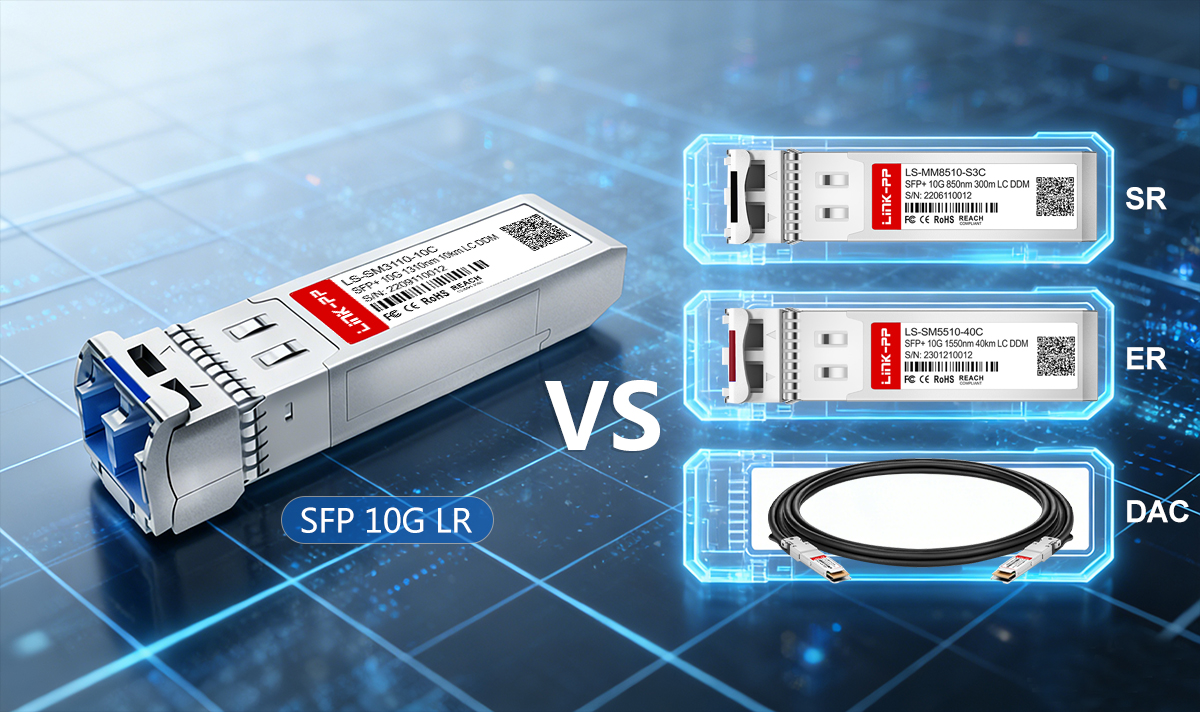
When designing a 10 GbE optical network, selecting the correct transceiver type is primarily a function of distance, fiber type, cost, and deployment environment. Among common 10G SFP+ options, SR, LR, and ER represent three standardized reach classes, while DAC and AOC offer alternatives for very short connections.
SFP 10G LR vs. SFP 10G SR
SFP 10G SR (10GBASE-SR) is optimized for short-distance transmission using 850 nm multimode optics.
| Parameter | SFP 10G SR | SFP 10G LR |
|---|---|---|
| IEEE Standard | 10GBASE-SR | 10GBASE-LR |
| Wavelength | 850 nm | 1310 nm |
| Fiber Type | MMF (OM3 / OM4) | SMF (G.652) |
| Max Distance | 300 m (OM3) / 400 m (OM4) | 10 km |
| Typical Use | Intra-rack, intra-building | Campus, inter-building |
Engineering considerations:
-
SR modules are lower cost but limited to short MMF runs.
-
LR modules support an order-of-magnitude longer reach using SMF, which is more future-proof and widely deployed in backbone infrastructure.
-
For distances beyond a few hundred meters, LR is mandatory—SR cannot be extended via patching or amplification.
Rule of thumb:
Use SR inside buildings or data halls; use LR once distances exceed MMF limits.
SFP 10G LR vs. SFP 10G ER
SFP 10G ER (10GBASE-ER) targets long-haul fiber links and operates at a higher optical wavelength.
Parameter SFP 10G LR SFP 10G ER
| IEEE Standard | 10GBASE-LR | 10GBASE-ER |
| Wavelength | 1310 nm | 1550 nm |
| Fiber Type | SMF | SMF |
| Max Distance | 10 km | 40 km |
| Optical Power | Moderate | High |
| Cost | Medium | High |
Key differences:
-
ER modules use 1550 nm optics, enabling much longer reach but at significantly higher cost.
-
Higher transmit power and tighter safety controls are required for ER.
-
ER modules are unnecessary for most enterprise or campus networks and can even cause receiver saturation on short links without attenuation.
Positioning:
LR fills the practical middle ground—far longer than SR, but far more economical and simpler to deploy than ER.
SFP 10G LR vs. DAC and AOC
Direct Attach Cable (DAC) and Active Optical Cable (AOC) solutions are alternatives to pluggable optics for short distances.
| Solution | Medium | Typical Reach | Use Case |
|---|---|---|---|
| DAC | Copper twinax | 1–7 m (passive), up to ~15 m (active) | In-rack / adjacent racks |
| AOC | Pre-terminated fiber | Up to ~100 m | Short data center links |
| SFP 10G LR | SMF | Up to 10 km | Campus / backbone links |
Trade-offs:
-
DAC and AOC offer low latency and simplicity but lack flexibility.
-
They cannot be patched, extended, or reused across infrastructure changes.
-
SFP 10G LR modules allow standardized fiber plant usage and long-term scalability.
Design guidance:
Use DAC/AOC for fixed, short connections; use SFP 10G LR when distance, modularity, or future expansion matters.
Summary: Choosing the Right 10G Optical Class
-
SR → Short, low-cost MMF links (hundreds of meters)
-
LR → Standard long-reach SMF links (up to 10 km)
-
ER/ZR → Metro and long-haul fiber (40 km+)
-
DAC/AOC → Very short, fixed connections
For most enterprise backbones, campus networks, and service provider access links, SFP 10G LR represents the optimal balance of reach, cost, and deployment flexibility.
? Typical Applications of SFP 10G LR
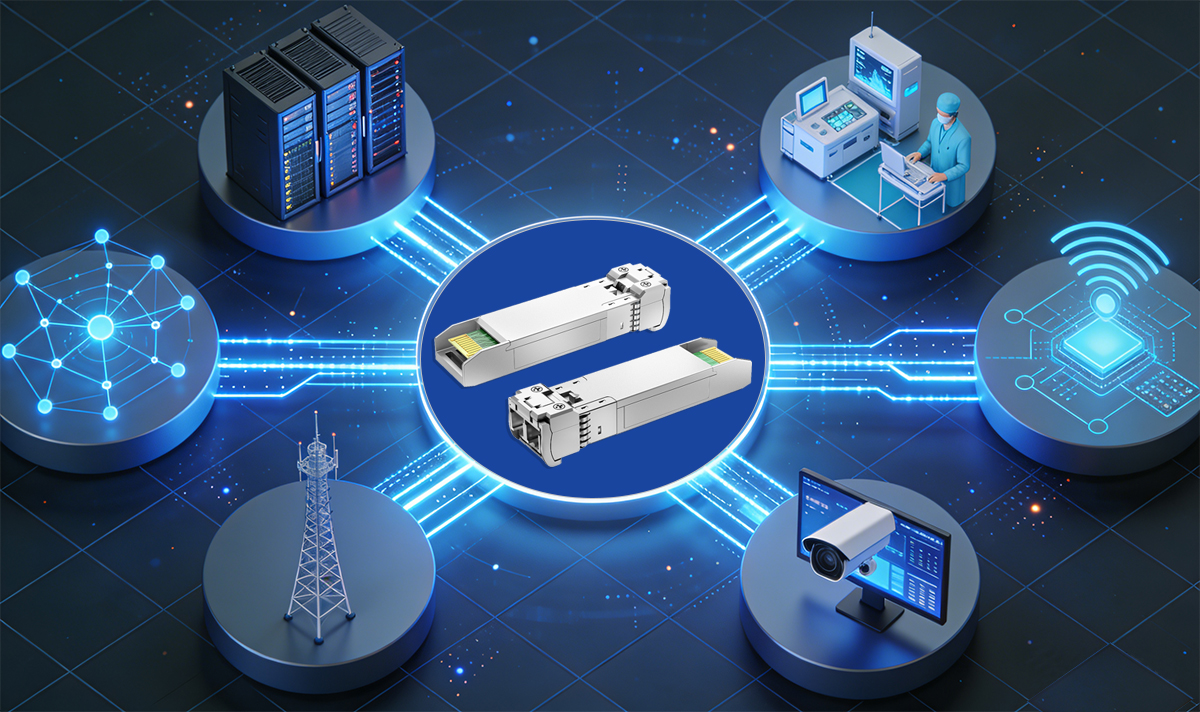
10GBASE-LR SFP Module are widely deployed in networks that require 10 Gbps bandwidth over single-mode fiber at distances up to 10 km. They are considered the default long-reach option for enterprise, campus, and service-provider infrastructures.
Data Center Interconnect (DCI)
In data center environments, 10G LR modules are commonly used for inter-room or inter-building connectivity, where distances exceed the limits of multimode fiber.
Typical use cases include:
-
Connecting spine or aggregation switches between data halls
-
Linking geographically separated data center buildings within a campus
-
Redundant fiber paths between primary and secondary sites (≤10 km)
Compared with DAC or SR optics, LR modules allow standard single-mode fiber plant usage, making them suitable for scalable and modular DCI designs.
Enterprise Backbone Networks
For enterprise networks, 10GBASE-LR is the most common backbone optic.
Common deployments include:
-
Core-to-distribution switch uplinks
-
Aggregation links between main equipment rooms
-
Redundant backbone rings across large facilities
Because many enterprise backbones are already built on G.652 single-mode fiber, LR optics enable straightforward upgrades from 1 GbE to 10 GbE without replacing cabling, significantly reducing upgrade cost and downtime.
Campus and Building-to-Building Fiber Links
Campus networks frequently span multiple buildings separated by hundreds of meters to several kilometers, which places them beyond multimode fiber limits.
SFP 10G LR is typically used for:
-
Building-to-building distribution links
-
Campus core ring architectures
-
Fiber runs across roads, tunnels, or outdoor ducts
The 10 km reach of LR modules provides ample margin for connector loss and future expansion, making them a long-term, low-risk choice for campus infrastructure.
Telecom and Service Provider Networks
In telecom and service provider environments, 10GBASE-LR modules are widely deployed for access and aggregation layers, where medium-distance fiber links are common.
Typical applications include:
-
Enterprise leased lines (10 GbE access)
-
Metro aggregation routers and gateways
-
Provider edge (PE) to customer edge (CE) connections
While longer-reach optics (ER/ZR) are used for metro or long-haul transport, LR optics strike a balance between reach, power consumption, and cost for many carrier-grade deployments.
Practical Selection Insight
Across all these scenarios, the choice of SFP 10G LR is driven primarily by:
-
Single-mode fiber availability
-
Link distances between 500 m and 10 km
-
Need for standardized, interoperable 10 GbE optics
When distances are short and multimode fiber is already installed, 10GBASE-SR may be more economical. However, for most backbone, campus, and inter-site links, SFP 10G LR remains the go-to 10 GbE optical standard.
? How to Choose the Right SFP 10G LR Module
Selecting the optimal 10GBASE-LR SFP+ transceiver involves both engineering evaluation and procurement strategy. Careful attention to compliance, network design, and environmental requirements ensures reliable, long-term operation.
Distance and Fiber Type Considerations
-
Fiber Type: 10GBASE-LR modules operate over single-mode fiber (SMF, G.652). LR optics are not compatible with multimode fiber—for short multimode runs, 10GBASE-SR is more suitable.
-
Link Distance: Verify the required distance against the module’s specifications. Standard LR optics reach up to 10 km on SMF. Always account for additional margin in your link budget to accommodate splices, connectors, and fiber aging.
-
Industrial or Harsh Environments: If deploying in outdoor cabinets, industrial facilities, or unconditioned data centers, choose modules rated for extended temperatures (–40 °C to +85 °C) like LINK-PP LS-SM3110-10I.
Power Budget and Network Design
-
Optical Budget: Ensure that Tx output power and Rx sensitivity meet your fiber span requirements. Example from LS-SM3110 series:
-
Tx: –6.5 to –0.5 dBm
-
Rx sensitivity: ~–14.4 dBm for 10 km
-
-
DOM Support: Digital Optical Monitoring (SFF-8472) allows real-time readout of power, temperature, voltage, and bias current, facilitating network maintenance and troubleshooting.
-
Network Design Considerations: Account for fiber attenuation (~0.35 dB/km for SMF at 1310 nm), connector and splice losses, and potential future upgrades. Ensure the transceiver’s link margin covers worst-case scenarios.
-
Compliance: Confirm MSA compliance, IEEE 802.3ae adherence, and vendor compatibility with your switches to avoid port lock-out issues.
Cost, Availability, and Long-Term Reliability
-
Cost Efficiency: Third-party 10GBASE-LR modules, such as LINK-PP LS-SM3110 series, provide a cost-effective alternative to OEM optics without sacrificing performance. Example pricing: ~$10–15 per module for small quantities.
-
Availability: For large-scale deployments, ensure that the vendor can supply modules consistently in the required volumes.
-
Reliability and Warranty: Modules should come with multi-year warranties and have passed factory testing for optical power, temperature cycling, and signal integrity. LINK-PP, for example, provides robust QA to ensure performance over the full 10 km link.
-
Long-Term Network Planning: Consider future expansion or technology upgrades. Choosing a vendor-agnostic, MSA-compliant 10G LR module maximizes flexibility and reduces dependency on a single OEM.
Selecting the right SFP 10G LR requires balancing distance requirements, fiber type, optical budget, environmental conditions, and cost. Modules like LINK-PP LS-SM3110-10C/10I demonstrate how commercial and industrial-grade LR optics can meet these criteria while remaining fully interoperable with major switch vendors.
? Summary: Key Takeaways on SFP 10G LR Transceivers
SFP 10G LR (10GBASE-LR SFP+) modules are high-speed, long-reach fiber optic transceivers designed for 10 Gbps Ethernet over single-mode fiber up to 10 kilometers. Operating at a 1310 nm wavelength with LC duplex connectors, these hot-pluggable modules deliver reliable performance across data centers, campus backbones, enterprise networks, and telecom environments.
Key specifications include 10 Gbps data rate, IEEE 802.3ae compliance, digital diagnostics (DOM/SFF-8472) support, and low power consumption (~1.5 W). Commercial and industrial versions, such as the LINK-PP LS-SM3110-10C/LS-SM3110-10I, accommodate standard and harsh operating conditions while maintaining interoperability with major OEM switches (Cisco, Juniper, Arista).
Compared to other 10G optical modules, LR fills the medium-to-long reach niche, bridging the gap between short-reach (SR, up to 400 m on MMF) and extended-reach (ER, up to 40 km on SMF) solutions. When selecting modules, engineers should evaluate MSA compliance, vendor compatibility, optical budget, distance, temperature range, and cost-effectiveness, ensuring optimal performance and network longevity.
Overall, SFP 10G LR modules provide a versatile, cost-efficient, and standardized solution for upgrading and maintaining 10G fiber networks, making them a preferred choice for enterprises, carriers, and industrial deployments seeking reliable long-reach connectivity.