



































10GBASE-SR SFP Module Enterprise Class delivers 10 Gbps short-reach connectivity over multimode fiber for enterprise networks, offering vendor-validated interoperability, consistent optical performance, simplified procurement, and 24/7 reliability—ideal for data-center ToR/EoR links requiring predictable, low-latency, short-distance connections and reduced operational risk.
As 10-Gigabit Ethernet continues to serve as the backbone for enterprise networks and data centers, selecting the right optical transceiver is critical for performance, compatibility, and long-term reliability. Among the most common short-reach solutions is the 10GBASE-SR SFP module enterprise class, a transceiver category designed for controlled enterprise environments that demand stable 24/7 operation.
This article explains what a 10GBASE-SR SFP Module Enterprise Class is, how it works, how it differs from commercial and carrier-class optics, and how to choose the right module for enterprise deployments.
Reading value — what you’ll learn:
-
Clear definition and engineering differences between commercial, enterprise, and carrier optics.
-
Key optical and interoperability specs to verify before purchase.
-
Practical selection and deployment checklist for enterprise-scale rollouts.
Internal resource: see our pillar guide on SFP Module Definition for foundational concepts referenced in this guide.
⏩ What Is a 10GBASE-SR SFP Module Enterprise Class?
As 10-Gigabit Ethernet remains a foundational technology in enterprise networks and data centers, understanding the role of short-reach optical transceivers is essential for reliable design and deployment. Among the available options, the 10GBASE-SR SFP module (enterprise class) is widely adopted for its balance of performance, interoperability, and operational stability in controlled environments. This section introduces what a 10GBASE-SR SFP module is, outlines its key technical characteristics, and explains how the “enterprise-class” designation differentiates it from commercial and carrier-grade optics.
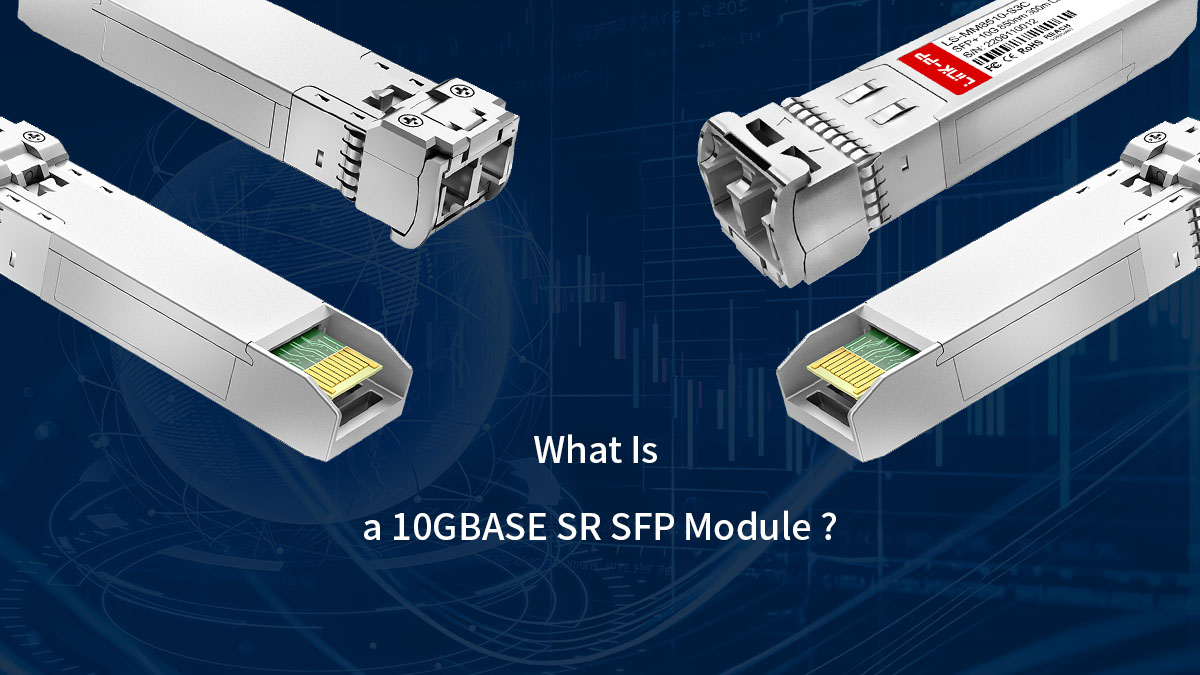
Definition of 10GBASE-SR SFP Module
A 10GBASE-SR SFP module is an optical transceiver that implements the 10GBASE-SR IEEE 802.3ae specification to deliver 10 Gbps Ethernet over multimode fiber (MMF) at an 850 nm wavelength. It is commonly provided in the SFP+ form factor (hot-pluggable), enabling easy insertion into SFP+/SFP-compatible switch, router, or server ports for short-reach links inside racks and data halls.
10GBASE-SR is optimized for short-distance connections and is the standard choice for switch-to-switch, switch-to-server, and other intra-data-center links where low latency and predictable performance are required.
| Parameter | Typical value / notes |
|---|---|
| Standard | IEEE 802.3ae (10GBASE-SR) |
| Form factor | SFP+ (hot-pluggable, SFP MSA compliant) |
| Wavelength | 850 nm (VCSEL) |
| Connector | Duplex LC |
| Supported fiber | Multimode fiber (OM3 / OM4 recommended) |
| Typical reach | OM3: up to ~300 m; OM4: up to ~400 m (vendor-dependent) |
| Tx optical power (typical range) | approx. -9.5 dBm to -3 dBm (check datasheet) |
| Receiver sensitivity (typical) | approx. ≤ -11 dBm (link-budget dependent) |
| Link budget | Calculated from Tx power minus Rx sensitivity and insertion losses — verify per vendor and channel design |
| Digital diagnostics (DDM/DOM) | Supported per SFF-8472 on most enterprise modules |
| Power consumption | Typically < 1.0 W (many modules ~0.6–0.8 W) |
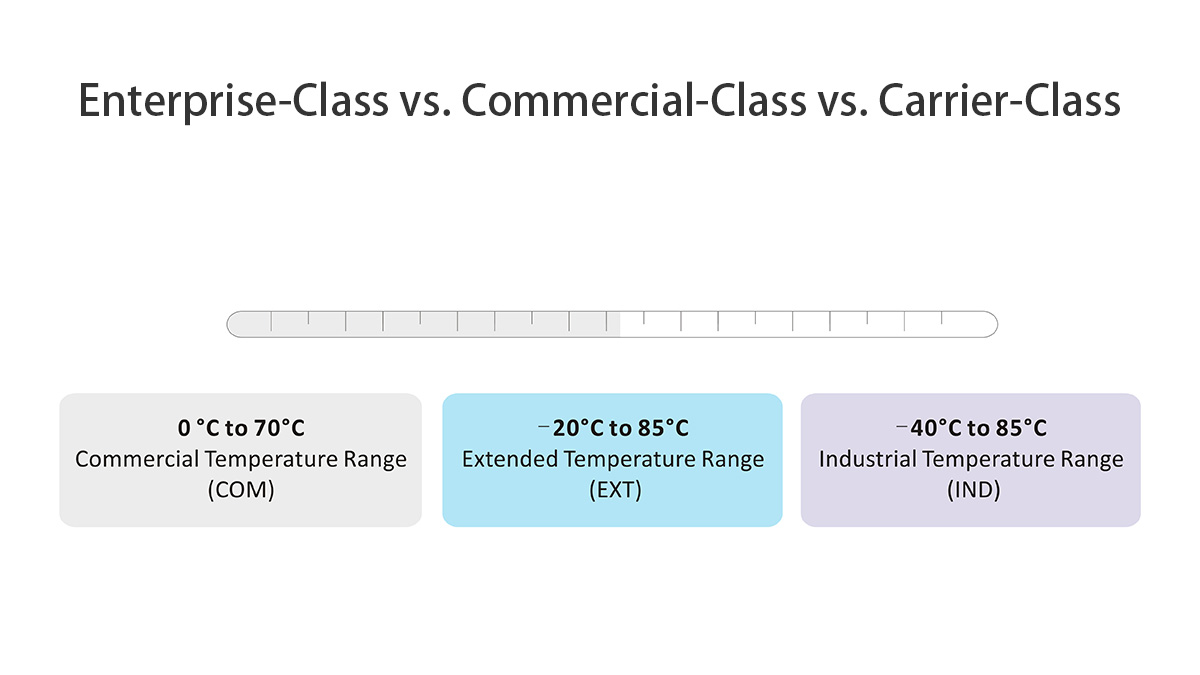
| Operating temperature (Enterprise class) | 0 °C to +70 °C (standard enterprise/commercial rating) |
| Extended / industrial temperature | -40 °C to +85 °C (available in industrial/carrier-grade SKUs only) |
| Mechanical / electrical compliance | SFP+ MSA, SFF electrical specs (e.g., SFF-8431), RoHS |
| Regulatory / test notes | Vendor burn-in, interoperability matrix with major switch vendors; Telcordia/NEBS applies only to carrier/telecom-grade SKUs |
| Typical use cases | ToR/EoR, leaf/spine short-reach links, server/storage interconnects in conditioned racks/rooms |
| Procurement notes | Prefer vendor-validated part numbers for your switch model; verify firmware/OS compatibility and RMA policy |
What “Enterprise-Class” Means in Optical Transceivers
“Enterprise-class” is a product positioning and validation level — not a separate IEEE standard. For 10GBASE-SR SFP modules, it commonly denotes a set of engineering and QA expectations tailored to enterprise IT environments:
-
Continuous 24×7 operation: designed and tested for long-term uptime in climate-controlled data centers.
-
Operating temperature: typically specified as 0 °C to +70 °C, matching standard enterprise ambient conditions.
-
Tighter optical tolerances: more consistent Tx/Rx power, extinction ratio and other key parameters across production batches.
-
Extended QA: burn-in/aging tests, temperature cycling, and interoperability testing to reduce early-life failures.
-
Vendor interoperability: validated or certified to interoperate with major enterprise switch platforms (Cisco, Juniper, Arista, HPE, etc.).
In short, enterprise-class modules prioritize predictability and low operational risk within controlled environments, rather than extreme environmental resilience (which is the domain of industrial or carrier-class optics).
Typical Enterprise Network Applications
Enterprise-class 10GBASE-SR SFP modules are widely used across common data-center and campus topologies:
-
Top-of-Rack (ToR) and End-of-Row (EoR) links connecting leaf/spine and rack switches.
-
Aggregation and core switches within enterprise campus networks.
-
Server and storage interconnects in private cloud and virtualization clusters.
-
High-density compute racks where predictable, short-reach links reduce latency and simplify troubleshooting.
These SFP+ modules are chosen where the physical environment is controlled (air-conditioned racks/rooms) and where consistent optical performance, vendor compatibility, and long service life are higher priorities than extreme temperature tolerance.
⏩ How Does a 10GBASE-SR SFP Module Work?
To understand why the 10GBASE-SR SFP module is so widely deployed in enterprise networks, it is important to look beyond the form factor and examine how the technology actually works. At its core, 10GBASE-SR defines the optical transmission method, fiber requirements, and performance limits that govern short-reach 10-Gigabit Ethernet links. This section explains the underlying transmission principle, the role of multimode fiber, and the practical factors—such as modal bandwidth and link budget—that determine real-world performance in enterprise environments.
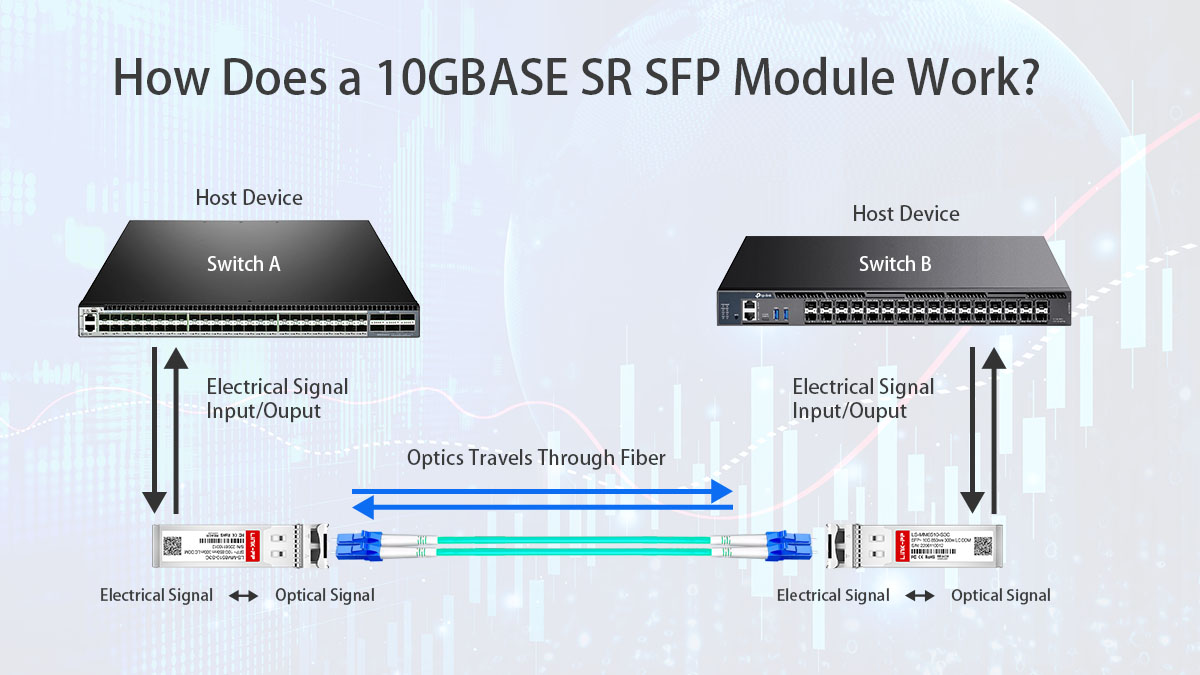
10GBASE-SR Standard and Transmission Principle
SFP 10G SR implements serial 10 Gbps Ethernet over multimode fiber according to IEEE 802.3ae. The transceiver converts host electrical signals into optical pulses using an ≈850nm VCSEL transmitter and a PIN photodiode receiver at the far end. Data is transmitted as intensity-modulated light; the receiver recovers the serial 10 Gbps stream and hands it back to the host PHY. The SFP+ form factor defines the mechanical, electrical and hot-plug behaviour so modules from different vendors can interoperate at the host interface when the optical parameters match the link budget requirements.
Key operational points:
-
VCSELs are chosen for cost, efficiency and suitability at 850 nm for short-reach MMF.
-
The optical channel is limited by modal dispersion and the modal bandwidth of the multimode fiber — not by the transceiver alone.
-
Digital Diagnostic Monitoring (DDM/SFF-8472) is commonly available on enterprise parts to report TX/RX power, temperature, voltage and bias current for operational visibility.
Supported Fiber Types: OM3 and OM4 Multimode Fiber
Modern enterprise deployments standardize on OM3 and OM4 multimode fiber for 10GBASE-SR because these fibers provide the modal bandwidth necessary for 10 Gbps at 850 nm and simplify cable management.
Practical notes:
-
OM3 (laser-optimized MMF) is the baseline for modern 10G short-reach links; it provides a minimum modal bandwidth around 2000 MHz·km at 850 nm.
-
OM4 offers higher modal bandwidth (commonly specified ≥4700 MHz·km at 850 nm) and therefore longer guaranteed reach and better margin for multi-connector channels.
-
Standard connector type: duplex LC. Use matched LC pairs and maintain good end-face cleanliness to avoid excess insertion loss.
-
Do not use 10GBASE-SR transceiver on single-mode fiber (SMF) — SR optics are multimode devices and will not function correctly on SMF without mode-conditioning or different transceiver types.
Maximum Transmission Distance in Enterprise Networks
Typical guaranteed reaches for 10GBASE-SR over common MMF grades are:
| Fiber grade | Typical guaranteed reach (practical) |
|---|---|
| OM3 | up to ~300 m |
| OM4 | up to ~400 m |
These figures are conservative, vendor-dependent, and assume standard channel designs. Actual achievable distance is affected by:
-
Fiber modal bandwidth (MHz·km) and age of the plant
-
Number of mated connectors and their insertion loss (typical LC mated pair ≈0.2–0.5 dB)
-
Splice losses, patch panel losses and connector cleanliness
-
Transceiver Tx power and receiver sensitivity (check datasheet for exact values)
-
Cable routing and bend radius violations that increase attenuation or modal dispersion
Link-budget reminder: calculate expected margin by subtracting total channel loss from the transceiver’s Tx power and comparing it against the receiver sensitivity. Always use the vendor datasheet values for Tx power, Rx sensitivity and any specified attenuation margins when verifying a planned channel.
Operational tip: for large enterprise links or when re-using older MMF, validate the actual modal bandwidth with an OTDR/OTDR-grade tester or perform a channel cert test — this prevents unexpected reach limitations after deployment.
⏩ How to Choose a 10GBASE-SR SFP Module
Selecting the right 10GBASE-SR SFP module for an enterprise network involves more than confirming standards compliance. In real deployments, factors such as switch compatibility, optical performance margin, qualification depth, and long-term support have a direct impact on network stability and operational cost. This section outlines a practical, engineering-focused approach to choosing a 10GBASE-SR SFP module, helping network teams evaluate compatibility risks, performance requirements, and lifecycle considerations before large-scale deployment.
Switch Compatibility (Cisco, Juniper, HPE, Arista)
Switch compatibility is the first selection checkpoint for any enterprise-class 10GBASE-SR SFP module. While 10GBASE-SR is standardized at the optical layer, enterprise switches often enforce vendor-specific EEPROM checks or firmware policies.
Best practices:
-
Verify platform compatibility against the switch vendor’s optics matrix or the transceiver supplier’s validated compatibility list (e.g., Cisco, Juniper, HPE, Arista).
-
EEPROM coding matters: enterprise-class third-party modules are typically pre-coded to match specific OEM identifiers, reducing “unsupported transceiver” warnings.
-
Firmware alignment: ensure the switch OS version supports the module SKU; firmware updates can introduce stricter checks.
-
Operational policy: confirm whether your organization permits third-party optics and whether alarms or log messages are acceptable in production.
For large rollouts, standardize on a single, validated SKU per platform to minimize operational variance.
Key Optical Specifications to Check
Beyond the “10GBASE-SR” label, several optical parameters determine real-world performance and margin. Always verify these values in the vendor SFP Module datasheet:
| Specification | What to verify | Why it matters in enterprise networks |
|---|---|---|
| Wavelength | ~850 nm (VCSEL-based) | Ensures compliance with 10GBASE-SR and correct operation over multimode fiber |
| Transmit optical power (Tx) | Within IEEE-specified range (check vendor datasheet) | Provides sufficient launch power and margin for connectors, patch panels, and aging |
| Receiver sensitivity (Rx) | More negative value = better sensitivity | Improves tolerance to insertion loss and reduces risk of link instability |
| Extinction ratio / optical modulation | Meets or exceeds IEEE limits | Directly affects signal integrity and bit error rate (BER) |
| Link budget | Tx power − Rx sensitivity − total channel loss | Determines whether the planned fiber channel will operate reliably |
| Channel loss assumptions | Fiber attenuation + connector/splice loss | Prevents overestimating achievable reach in real installations |
| DDM / DOM support | Temperature, voltage, bias current, Tx/Rx power | Enables real-time monitoring and proactive fault detection |
| Parameter consistency | Tight distributions across production batches | Simplifies large-scale deployment and reduces troubleshooting variance |
Enterprise-class modules typically offer tighter parameter distributions, which simplifies large-scale deployments and troubleshooting.
Reliability, Testing, and Quality Standards
Reliability is the defining attribute of enterprise-class optics. Evaluate how the module is qualified, not just its headline specs.
Key indicators:
-
Burn-in and aging tests: extended burn-in reduces early-life (infant mortality) failures.
-
Thermal and functional testing: operation verified across the full 0 °C to +70 °C enterprise temperature range.
-
Interoperability testing: validation on real enterprise switch platforms and OS versions, not only lab hosts.
-
Standards compliance: adherence to IEEE 802.3ae, SFP+/SFP MSAs, and RoHS requirements.
-
Field reliability data: MTBF or historical failure-rate metrics, when available, provide additional confidence.
SFP Modules that pass only minimal functional tests may meet the standard on paper but create long-term operational risk.
Lifecycle, Warranty, and RMA Considerations
Enterprise networks prioritize long-term availability and predictable support. When selecting a SFP 10GBASE-SR module, review commercial terms as carefully as technical ones:
-
Product lifecycle: confirm the expected availability window to avoid mid-project part changes.
-
Warranty coverage: enterprise-class optics commonly offer multi-year warranties aligned with switch refresh cycles.
-
RMA process: look for advance replacement options and clear turnaround times to minimize downtime.
-
Change control: ensure that component or firmware changes are controlled and backward-compatible within the same SKU.
-
Documentation: stable datasheets and revision tracking support compliance and audit requirements.
A slightly higher upfront cost for an enterprise-class module is often justified by lower operational overhead, fewer outages, and simpler lifecycle management.
⏩ Compatibility Issues With 10GBASE-SR SFP Module
When deploying 10GBASE-SR SFP modules in enterprise networks, compatibility can become a critical concern. Differences between OEM and third-party modules, vendor-specific firmware checks, and platform enforcement policies can affect module recognition, optical performance, and operational stability. Understanding these compatibility factors—and following best practices—helps network teams avoid unexpected downtime, reduce troubleshooting effort, and maintain reliable short-reach links across switches and servers.
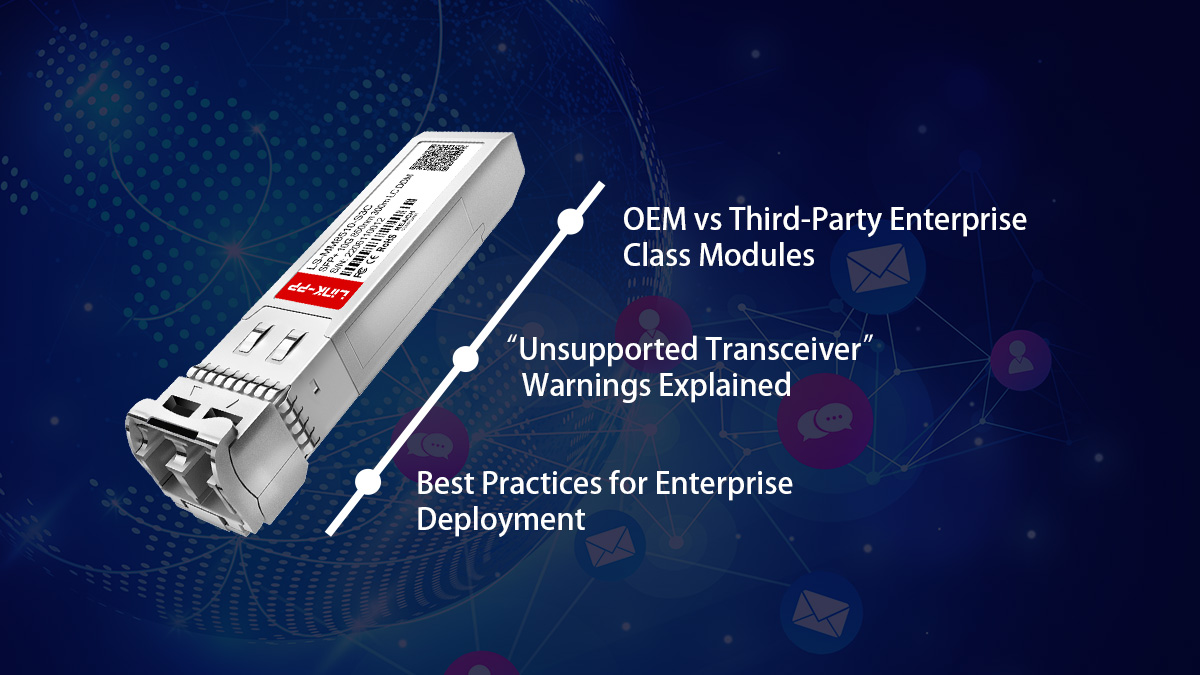
OEM vs Third-Party 10GBASE-SR SFP Modules
OEM 10GBASE-SR SFP+ modules are designed, branded, and sold by switch vendors such as Cisco, Juniper, HPE, or Arista. They offer official support, guaranteed interoperability, and clear accountability, but typically come at a significantly higher price.
Certified third-party SFP modules, when properly engineered and tested, can deliver equivalent optical performance and long-term reliability. Reputable suppliers validate their modules against specific switch models and software versions, ensuring EEPROM coding, power levels, and link behavior match OEM expectations. For many enterprises, this approach reduces capital expenditure while maintaining acceptable operational risk.
“Unsupported Transceiver” Warnings Explained
Some enterprise switches actively check the transceiver’s vendor ID and EEPROM data. When a non-OEM module is detected, the system may display messages such as “unsupported transceiver” or “third-party optic installed.”
In most cases, these warnings are policy-driven rather than technical failures. The optical link often operates normally, with full speed and error-free transmission. However, implications may include:
-
Limited or no vendor technical support while the module is installed
-
Log or alert noise in network management systems
-
Rare cases of port shutdown, depending on platform and configuration
Network teams should review vendor documentation to understand enforcement behavior and available override commands.
Best Practices for Enterprise Deployment
To minimize compatibility risk when deploying enterprise-class 10GBASE-SR SFP modules:
-
Standardize on validated module SKUs across the network
-
Match module firmware and switch OS versions used during qualification
-
Enable DDM/DOM monitoring and track Tx/Rx power and temperature trends
-
Document supported platforms and configurations for operations teams
Following these practices helps ensure predictable behavior, simplifies troubleshooting, and supports long-term stability in enterprise environments.
⏩ FAQs About 10GBASE-SR SFP Module Enterprise Class
1. What Is the Difference Between Enterprise Class and Commercial SFP Modules?
Enterprise-class 10GBASE-SR SFP modules focus on long-term reliability, tighter optical tolerances, and platform-level compatibility validation. They are typically subjected to extended burn-in testing, aging analysis, and interoperability checks with mainstream enterprise switches.
Commercial-grade modules, while often sharing the same IEEE standard and temperature range, prioritize lower cost and basic functionality, with less emphasis on consistency across large deployments.
2. Can a 10GBASE-SR SFP Module Enterprise Class Work in Cisco Switches?
Yes. A 10GBASE-SR SFP module enterprise class can operate in Cisco switches when it is specifically validated and coded for the target Cisco platform and software version.
Both Cisco OEM optics and qualified third-party enterprise-class modules can function correctly, provided EEPROM coding, optical parameters, and power levels meet Cisco interface requirements.
3. How Far Can a 10GBASE-SR SFP Module Reach?
In typical enterprise environments, supported distances are:
-
Up to 300 m on OM3 multimode fiber
-
Up to 400 m on OM4 multimode fiber
Actual reach depends on total channel loss, fiber quality, connector count, and installation practices.
4. What Type of Connector Is Used for 10GBASE-SR?
10GBASE-SR SFP+ modules use a duplex LC connector.
This connector supports separate transmit (Tx) and receive (Rx) fibers and is the standard interface for short-reach multimode optical links in enterprise networks.
5. What Is 10GBASE-SR in Networking?
10GBASE-SR is an IEEE-defined 10-Gigabit Ethernet standard designed for short-reach optical transmission. It operates at 850 nm over multimode fiber, making it ideal for data center, campus, and enterprise backbone connections where distances are relatively short but bandwidth demands are high.
6. What Is a 10GBASE-SR SFP Module?
A 10GBASE-SR SFP module is a hot-pluggable optical transceiver, usually in an SFP+ form factor, that enables 10 Gbps Ethernet links over multimode fiber. It converts electrical signals from a switch or server into optical signals and vice versa, supporting high-speed, low-latency communication within data centers.
7. Is 10GBASE-SR Single-Mode or Multimode?
10GBASE-SR is multimode only.
It is designed to operate over OM3 or OM4 multimode fiber and does not support single-mode fiber. For single-mode links, standards such as 10GBASE-LR or 10GBASE-ER are used instead.
⏩ Standards, Sources, and Compliance for 10GBASE-SR SFP Modules
IEEE Standards and Datasheet References
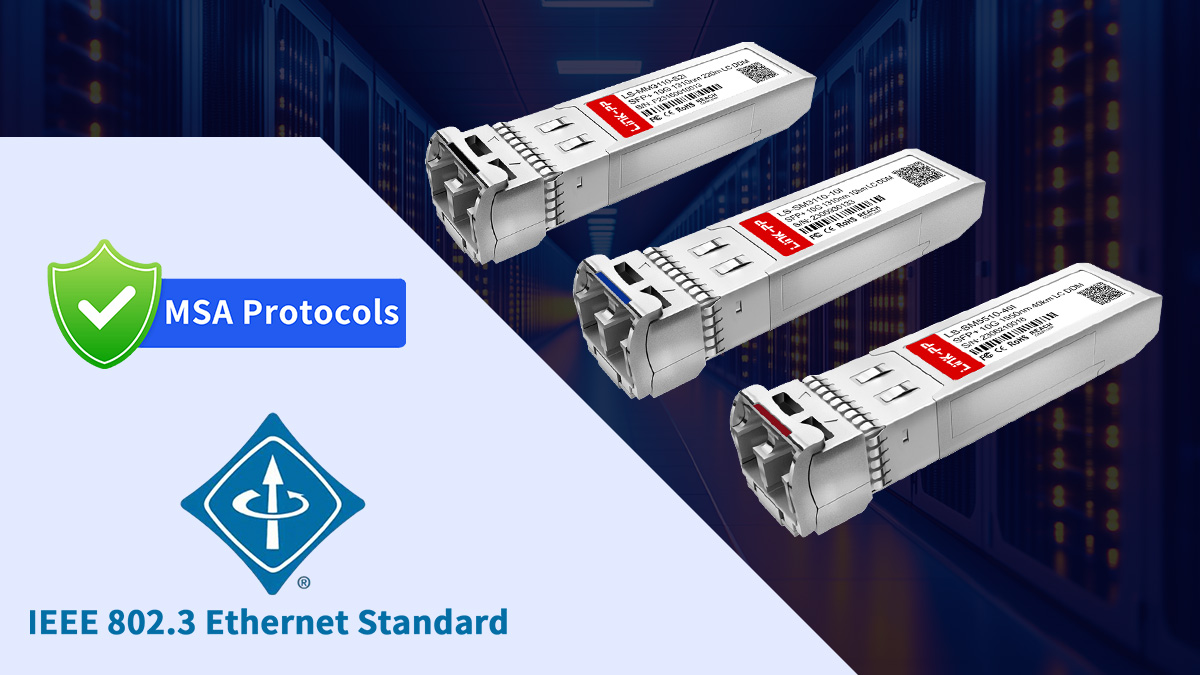
10GBASE-SR SFP+ modules are designed in compliance with IEEE 802.3ae for optical performance, while adhering to relevant SFP+ Multi-Source Agreements (MSAs), such as SFF-8431 and SFF-8472, to ensure mechanical compatibility, electrical interoperability, and standardized digital diagnostics.
A compliant enterprise-class module datasheet should clearly reference:
-
IEEE 802.3ae (Clause 52) for 10GBASE-SR optical specifications
-
SFF-8431 for SFP+ electrical and mechanical characteristics
-
SFF-8472 for Digital Diagnostic Monitoring (DDM/DOM) definitions
-
IEC 60825-1 / FDA 21 CFR 1040 for Class 1 laser safety compliance
-
RoHS and REACH environmental and material regulations
In addition to standards citations, authoritative datasheets typically include absolute maximum ratings, operating conditions, optical parameter limits, eye-diagram compliance, and interoperability notes. For enterprise deployments, the presence of complete, standards-referenced documentation is a strong indicator that the module has been engineered and validated for predictable, long-term operation rather than basic functional compatibility alone.
IEEE vs. MSA vs. Vendor Validation
| Category | Purpose | Example | Key Benefit |
|---|---|---|---|
| IEEE Standard | Defines 10G Ethernet optical performance | IEEE 802.3ae (10GBASE-SR) | Ensures correct speed, wavelength, and link budget |
| MSA (Multi-Source Agreement) | Defines SFP+ form factor, pinout, and diagnostics | SFF-8431, SFF-8472 | Ensures modules fit and communicate correctly across vendors |
| Vendor Validation | Verifies module works on specific switch platforms | Cisco, Juniper, HPE testing | Reduces warnings, ensures real-world interoperability |
⏩ Conclusion: Is a 10GBASE-SR SFP Module Enterprise Class Right for You?
Quick Buyer Checklist for Enterprise Networks
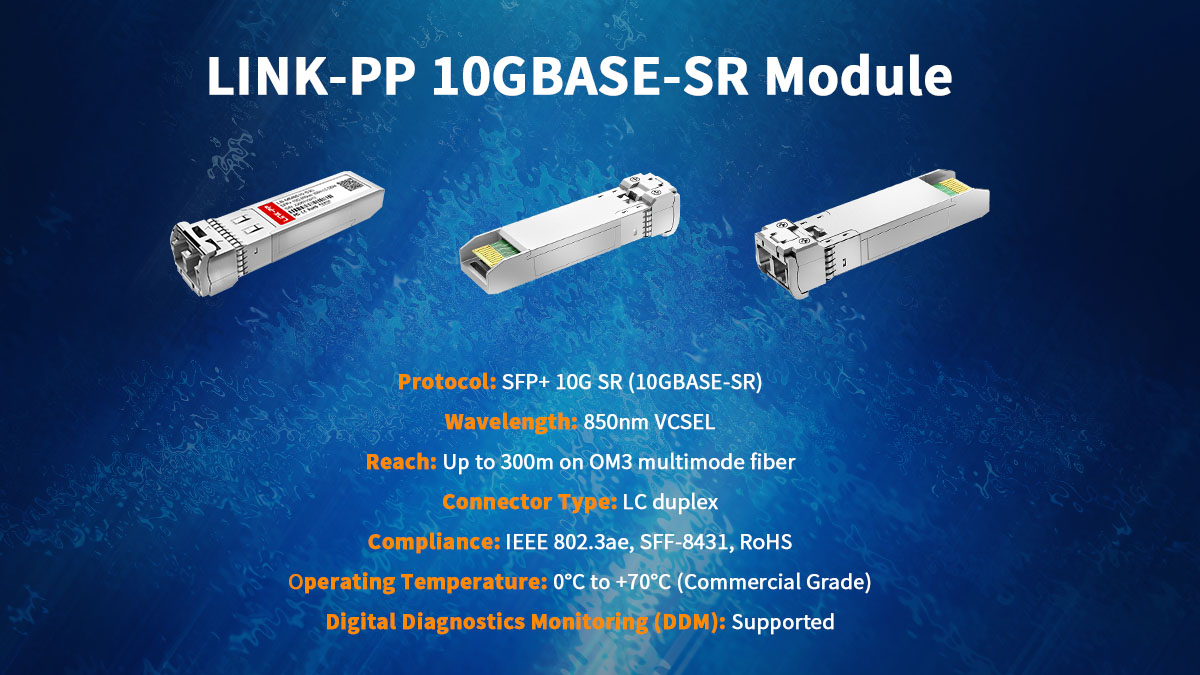
A 10GBASE-SR SFP module enterprise class is ideal for enterprise environments where predictable, high-performance short-reach connectivity is critical. Key selection criteria include:
-
Stable 10 Gbps short-reach links: Optimized for rack-to-rack, switch-to-server, and intra-data-center connections.
-
Proven compatibility: Verified interoperability with major enterprise switch vendors (Cisco, Juniper, HPE, Arista).
-
24/7 operational reliability: Designed for continuous operation in climate-controlled enterprise networks.
-
Tight optical tolerances: Ensures consistent performance across multiple modules and production batches.
-
Digital diagnostics support: DDM/DOM monitoring for proactive network maintenance.
Using this checklist helps IT teams minimize operational risks, maintain low latency, and avoid troubleshooting headaches in high-density environments.
Next Steps and Enterprise Optics Consultation
Choosing the correct SFP+10GBASE-SR module reduces network downtime, simplifies maintenance, and safeguards long-term IT investments. For large-scale deployments or situations with strict compatibility requirements, engaging with a trusted optics supplier or vendor-certified partner can provide:
-
Recommendations for validated module SKUs
-
Guidance on firmware alignment and configuration
-
Support for network rollout planning and ongoing monitoring
This ensures your enterprise network achieves predictable performance, long-term reliability, and operational efficiency while leveraging the full benefits of 10GBASE-SR short-reach optics.
Explore certified 10GBASE-SR SFP modules at the LINK-PP Official Store for reliable, tested, and compatible optics solutions.
About the Author
This article was written by the LINK-PP Optical Communications Engineering Team.
The team has long-term experience in the design, testing, and deployment of optical transceivers for enterprise networks and data center infrastructures, with over 10 years of hands-on engineering and volume-production experience across 10G, 25G, 40G, 100G, and 200G optical modules.
The content is based on IEEE 802.3 series standards, relevant SFP+/QSFP Multi-Source Agreements (including SFF-8431 and SFF-8472), and validated through real-world enterprise network deployments, interoperability testing, and long-term operational data.
Prior to publication, this article was technically reviewed by senior engineers with data center network implementation experience to ensure accuracy, completeness, and practical applicability.







