



































Small Form-Factor Pluggable modules are a critical component of modern Ethernet networks, providing flexible, hot-swappable connectivity between network devices such as switches, servers, and routers. Despite sharing the same physical form factor, SFP modules vary widely in data rate, fiber type, reach, wavelength, and transmission medium, making it essential for network engineers to choose the right module for each application.
Understanding the types of SFP modules is key to building high-performance, scalable, and reliable network infrastructures. For example:
-
1G SFP modules are widely deployed in enterprise access and campus networks, offering stable Gigabit Ethernet connectivity with low power consumption.
-
10G SFP+ modules maintain the same physical dimensions as 1G SFP but support 10 Gbps, enabling high-speed aggregation and server uplinks in data centers.
-
25G SFP28 modules provide next-generation bandwidth for hyperscale server connections and leaf-spine data center fabrics, while remaining mechanically compatible with SFP+ cages when dual-rate operation is required.
Beyond data rate, SFP modules can also be classified based on fiber type (multimode vs. single-mode), reach (short, long, extended), wavelength (BiDi, CWDM, DWDM), and transmission medium (fiber vs. copper). Each category has unique deployment considerations, from short in-rack connections to long-haul metro or carrier-grade networks.
This guide provides a comprehensive overview of SFP module types, including their performance characteristics, typical applications, and deployment best practices. By reading this article, network architects, engineers, and IT professionals will gain the knowledge needed to select the appropriate SFP module, optimize network design, and ensure reliable connectivity across modern 1G, 10G, and 25G Ethernet infrastructures.
✅ Classification by Data Rate: SFP, SFP+, and SFP28
One of the most fundamental ways to classify SFP modules is by their supported data rate, which directly impacts host compatibility, application scenarios, and performance characteristics. Understanding these distinctions helps network engineers select the right module for enterprise, data center, or carrier deployments.
The primary categories include:
-
SFP (1G) — Gigabit Ethernet modules
-
SFP+ (10G) — Enhanced modules for 10 Gbps
-
SFP28 (25G) — High-speed modules for modern 25 Gbps networks
Each type maintains the same small form-factor footprint, but the internal design and signal processing differ to support the target data rate.
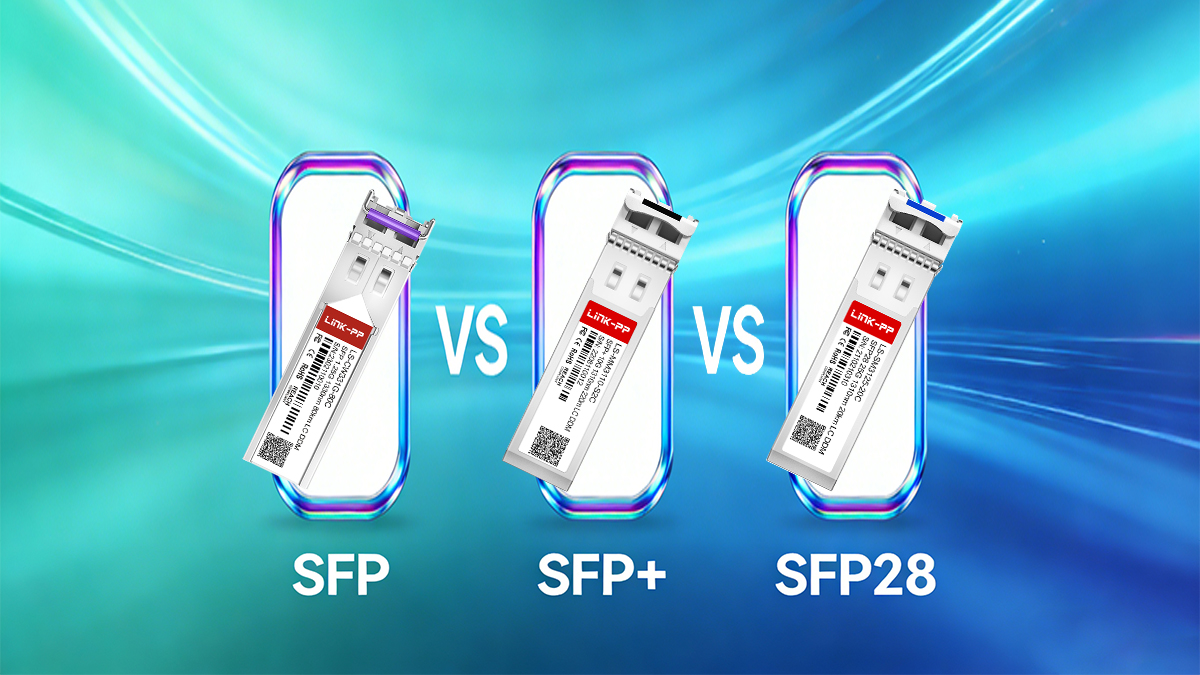
1. 1G SFP
Standard SFP modules are designed to support data rates up to 1 Gbps and are widely used for Gigabit Ethernet applications.
Common Standards:
-
1000BASE-SX — Multimode fiber, short-reach (up to 550 m with OM4)
-
1000BASE-LX — Single-mode fiber, long-reach (up to 10 km)
Typical Deployment:
-
Enterprise access switches
-
Campus networks
-
Legacy server uplinks
Key Advantages:
-
Broad compatibility with legacy network hardware
-
Low power consumption (~0.5–1 W per module)
-
Reliable and stable for extended operation
1G SFPs remain prevalent due to their cost-effectiveness and proven performance, particularly in environments where 10G or higher bandwidth is not required.
2. 10G SFP+
SFP+ modules maintain the same physical dimensions as SFP, but are engineered to handle 10 Gbps signaling.
Common Standards:
-
10GBASE-SR — Short-reach multimode fiber, typical reach 70–100 m (OM3)
-
10GBASE-LR — Long-reach single-mode fiber, up to 10 km
Key Features:
-
Reduced module complexity due to host-based signal processing
-
Many modules support SFF-8472 Digital Diagnostic Monitoring (DDM) for real-time visibility of temperature, optical power, and link status
-
Typical power consumption: ~1 W per module
Applications:
-
Data center server uplinks
-
Aggregation switches
-
High-speed enterprise backbones
SFP+ modules provide a balance between high-speed performance and energy efficiency, making them the standard for 10G Ethernet deployments.
3. 25G SFP28
SFP28 modules extend the SFP form factor to 25 Gbps, offering a single-lane high-speed solution for modern data centers and high-density access layers.
Common Standards:
-
25GBASE-SR — Multimode fiber, in-rack connections (up to 70 m for OM3, 100 m for OM4)
-
25GBASE-LR — Single-mode fiber, up to 10 km
Key Features:
-
Mechanically compatible with SFP+ cages, but full 25G operation requires SFP28-capable host hardware and firmware
-
Dual-rate modules can sometimes operate at 10 Gbps if legacy ports are used
-
Optimized for high-density, low-latency server uplinks
Applications:
-
Hyperscale data center leaf-spine fabrics
-
Storage clusters (NVMe-over-Fabrics or iSCSI)
-
Enterprise 25G Ethernet access deployments
SFP28 is the preferred module for next-generation 25G networks, providing higher bandwidth without increasing port density or footprint.
Comparison Table: SFP vs. SFP+ vs. SFP28
| Feature | SFP (1G) | SFP+ (10G) | SFP28 (25G) |
|---|---|---|---|
| Max Data Rate | 1 Gbps | 10 Gbps | 25 Gbps |
| Typical Fiber | MMF/SMF | MMF/SMF | MMF/SMF |
| Short-Reach SR | 550 m (OM4) | 70–100 m (OM3/OM4) | 70–100 m (OM3/OM4) |
| Long-Reach LR | 10 km | 10 km | 10 km |
| Power Consumption | 0.5–1 W | ~1 W | 1–2 W |
| Applications | Access layer, legacy uplinks | Data center uplinks, aggregation | Hyperscale server uplinks, 25G access |
✅ Classification by Fiber Type and Transmission Distance
In addition to data rate, SFP modules are commonly classified based on fiber type (multimode vs. single-mode) and supported transmission distance. These factors are critical for network design, as they determine reach, latency, and optical power requirements. Choosing the correct fiber type and module ensures stable connectivity, minimal signal loss, and optimal network performance.
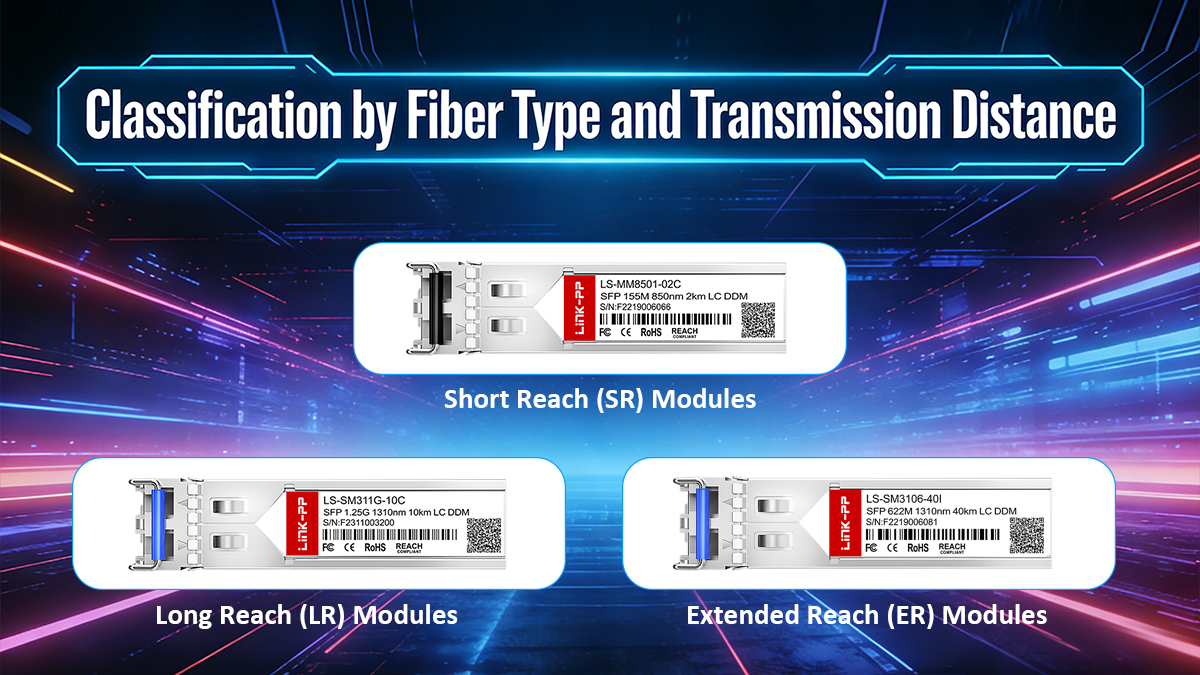
SFP modules are typically categorized into Short Reach (SR), Long Reach (LR), and Extended Reach (ER), each with distinct characteristics.
1. Short Reach (SR) Modules
SR SFP module is optimized for short-distance connections using multimode fiber (MMF).
Key Specifications:
-
Fiber type: OM3 or OM4 multimode fiber
-
Typical reach: 70–100 m (OM3), up to 300 m (OM4, depending on data rate)
-
Wavelength: 850 nm (multimode)
-
Maximum data rates: 1G (SFP), 10G (SFP+), 25G (SFP28)
Applications:
-
In-rack server connections
-
Data center top-of-rack (ToR) switches
-
Short links within equipment rooms
Advantages:
-
High port density in short-range environments
-
Low latency
-
Cost-effective for intra-rack and intra-building connections
2. Long Reach (LR) Modules
LR SFP module is designed for longer-distance links over single-mode fiber (SMF).
Key Specifications:
-
Fiber type: Single-mode fiber (SMF-28 or equivalent)
-
Typical reach: up to 10 km
-
Wavelength: 1310 nm
-
Maximum data rates: 1G, 10G, 25G
Applications:
-
Inter-building campus connections
-
Metro network links
-
Enterprise backbones
Advantages:
-
Supports moderate to long-distance connectivity
-
Maintains signal integrity over fiber spans
-
Widely compatible with standard SMF infrastructure
3. Extended Reach (ER) Modules
ER SFP module is used for long-haul, high-distance single-mode fiber links, often in metro or carrier networks.
Key Specifications:
-
Fiber type: Single-mode fiber
-
Typical reach: 40 km or more
-
Wavelength: 1550 nm
-
Maximum data rates: 10G (SFP+), 25G (SFP28)
Applications:
-
Metro Ethernet connections
-
Long-haul enterprise or carrier networks
-
Backbone optical networks requiring extended reach
Advantages:
-
Capable of bridging large distances without additional amplification
-
Supports high-capacity network links
-
Ideal for critical infrastructure requiring low-latency, high-reliability connections
Comparison Table: SR vs. LR vs. ER
| Module Type | Fiber Type | Wavelength | Typical Reach | Common Use Cases |
|---|---|---|---|---|
| SR (Short Reach) | Multimode (OM3/OM4) | 850 nm | 70–300 m | In-rack, ToR, intra-building |
| LR (Long Reach) | Single-mode | 1310 nm | Up to 10 km | Campus networks, inter-building links |
| ER (Extended Reach) | Single-mode | 1550 nm | 40 km+ | Metro, carrier, long-haul backbones |
This comparison helps network engineers match SFP modules to distance requirements and fiber infrastructure, ensuring proper signal quality and network reliability.
Key Considerations When Selecting Fiber Type
-
Distance Requirements: Always select SR, LR, or ER modules based on link distance to avoid signal degradation.
-
Fiber Infrastructure: Verify existing fiber type (MMF vs SMF) and grade (OM3, OM4, SMF-28).
-
Data Rate Compatibility: Higher data rates (10G, 25G) require higher-grade fibers to maintain link quality.
-
Budget vs Performance: SR modules are cost-effective for short distances; LR/ER modules are more expensive but necessary for long-haul connectivity.
-
Environmental Factors: Consider rack density, optical losses from connectors/splices, and any EMI-prone environments that may favor single-mode fiber.
✅ Wavelength-Specific and Special Function Modules
Beyond standard SR, LR, and ER modules, some SFP modules are designed to optimize fiber utilization or support wavelength-based network architectures. These include BiDi (Bidirectional) modules, CWDM (Coarse Wavelength Division Multiplexing), and DWDM (Dense Wavelength Division Multiplexing). Such modules are particularly important for carrier networks, metro networks, and high-capacity data centers where fiber availability is limited or maximizing throughput is critical.
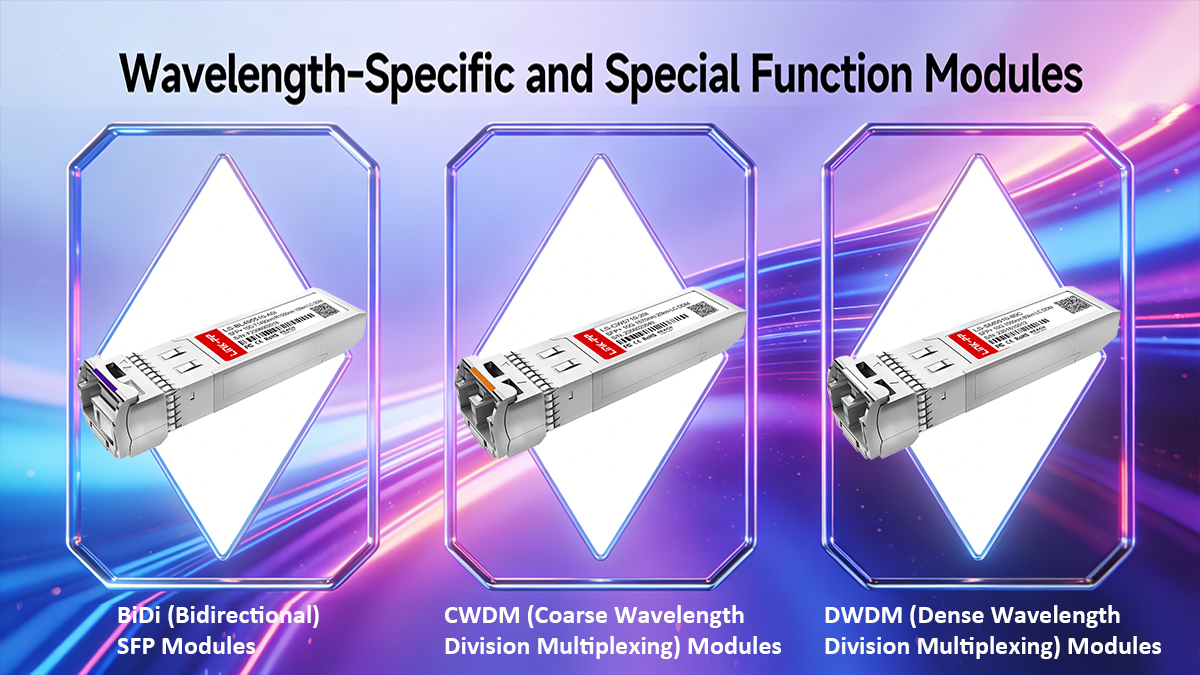
1. BiDi (Bidirectional) SFP Modules
Bidirectional SFP modules transmit and receive signals over a single fiber strand using different wavelengths for upstream and downstream traffic.
Key Features:
-
Reduces fiber usage by 50% in duplex links
-
Simplifies network upgrades where fiber is limited
-
Typically available for 1G, 10G, and 25G Ethernet applications
-
Must be deployed in matched pairs with complementary wavelengths (e.g., 1310 nm Tx / 1490 nm Rx)
Typical Applications:
-
Fiber-constrained environments
-
Data center interconnects
-
Enterprise campus upgrades without installing new fiber
BiDi modules are an efficient solution for fiber-limited networks, reducing infrastructure costs while maintaining high-speed connectivity.
2. CWDM (Coarse Wavelength Division Multiplexing) Modules
CWDM SFP modules allow multiple wavelengths to be transmitted on a single fiber, spaced at 20 nm intervals, for moderate-density optical networks.
Key Features:
-
Supports 8–18 channels typically
-
Wavelength range: 1270–1610 nm
-
Medium reach: 10–80 km depending on optical power and fiber quality
Applications:
-
Metro Ethernet networks
-
Enterprise inter-building links
-
Networks requiring moderate channel density without expensive DWDM equipment
Advantages:
-
Cost-effective way to multiply fiber capacity
-
Simplifies network expansion without new fiber installation
3. DWDM (Dense Wavelength Division Multiplexing) Modules
DWDM SFP modules enable high-density wavelength multiplexing, transmitting numerous channels over a single fiber with narrow wavelength spacing (typically 0.8–1.6 nm).
Key Features:
-
Supports dozens to hundreds of wavelengths on a single fiber
-
Operates in the C-band (1530–1565 nm) or L-band (1570–1610 nm)
-
Reach: 40–80 km for metro DWDM; longer with amplification
Applications:
-
Carrier networks and optical backbones
-
High-capacity enterprise and data center interconnects
-
Any scenario requiring maximized fiber utilization
Advantages:
-
Maximizes fiber capacity
-
Enables scalable, long-distance high-bandwidth networks
-
Compatible with optical transport networks (OTN)
Comparison Table: BiDi vs. CWDM vs. DWDM
| Module Type | Fiber Used | Wavelength / Channel | Reach | Typical Use |
|---|---|---|---|---|
| BiDi SFP | Single fiber (SMF) | Paired complementary wavelengths | 10 km typical | Fiber-limited data centers, campus |
| CWDM SFP | SMF | 1270–1610 nm, 20 nm spacing | 10–80 km | Metro networks, enterprise interconnects |
| DWDM SFP | SMF | 1530–1565 nm, 0.8–1.6 nm spacing | 40–80 km (longer with amplifiers) | Carrier networks, high-capacity backbones |
Choosing the right wavelength-specific SFP module depends on fiber availability, required channel density, and distance, enabling efficient, high-bandwidth optical networks.
Key Considerations for Special Function Modules
-
Fiber Availability: BiDi modules are ideal for networks with limited fibers, while CWDM and DWDM maximize single-fiber capacity.
-
Distance and Loss Budget: Ensure modules support the required reach and consider optical attenuation and connector losses.
-
Network Compatibility: Verify that switches, transceivers, and host devices support the required wavelengths and multiplexing standards.
-
Future Scalability: CWDM and DWDM allow network growth without new fiber installation, supporting long-term planning.
-
Deployment Cost vs Performance: BiDi modules reduce fiber count, CWDM provides cost-effective channel expansion, DWDM supports the highest density but may require additional equipment (amplifiers, multiplexers).
✅ Classification by Transmission Medium: Fiber vs. Copper
SFP Transceivers can also be classified based on the transmission medium they interface with. Understanding whether a module is fiber-based or copper-based is critical for network design, performance, and deployment planning. The choice affects reach, bandwidth, electromagnetic immunity, and physical cabling requirements.
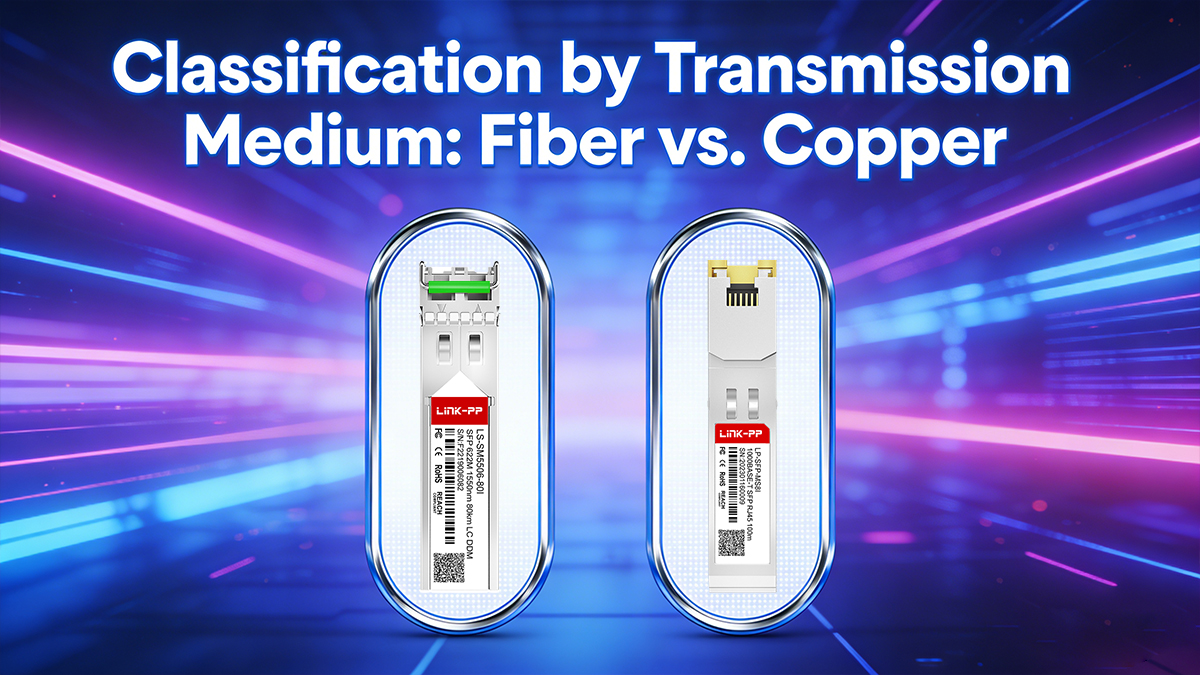
1. Fiber SFP Modules
Fiber SFP modules use optical fiber as the transmission medium, supporting a wide range of distances, wavelengths, and data rates. They are the most common type of SFP module in enterprise, data center, and telecom networks.
Key Characteristics:
-
Transmission media: Multimode fiber (MMF) or single-mode fiber (SMF)
-
Data rates: 1G (SFP), 10G (SFP+), 25G (SFP28)
-
Supports SR, LR, ER, BiDi, CWDM, DWDM modules
Advantages:
-
High-speed connectivity over long distances
-
Low latency
-
Immunity to electromagnetic interference (EMI)
-
High port density support in racks and equipment rooms
Typical Applications:
-
Data center interconnects
-
Enterprise campus networks
-
Carrier-grade optical backbones
Fiber SFP modules are preferred when distance, reliability, and port density are primary considerations.
2. Copper SFP Modules (RJ-45)
Copper SFP modules, commonly called RJ-45 SFP, terminate with a standard twisted-pair Ethernet port. They integrate an Ethernet PHY and magnetics within the SFP form factor, allowing SFP cages to connect directly to Cat5e, Cat6, or Cat6a cabling.
Key Characteristics:
-
Supported standards: 10/100/1000BASE-T; some modules support 2.5G/5G Ethernet
-
Maximum cable length: ~100 m, depending on speed and cable quality
-
Typically higher power consumption (~1.5–2 W) than fiber SFPs
-
Heat dissipation considerations in high-density deployments
Advantages:
-
Cost-effective for short-distance links
-
Simplifies integration with existing copper infrastructure
-
Useful for access-layer or management ports
Typical Applications:
-
Short-range connectivity in legacy networks
-
Gradual fiber migration scenarios
-
Small office or enterprise environments with copper cabling
Copper SFPs provide flexible deployment options, especially in mixed-media networks or where fiber installation is impractical.
Fiber vs. Copper SFP Comparison
| Feature | Fiber SFP | Copper SFP (RJ-45) |
|---|---|---|
| Max Data Rate | 1G, 10G, 25G | 10/100/1000 Mbps; some 2.5G/5G |
| Typical Reach | 70 m–40 km+ | Up to 100 m |
| Transmission Medium | Optical fiber (MMF/SMF) | Twisted-pair copper cabling |
| EMI Immunity | High | Low |
| Power Consumption | Low (~0.5–2 W) | Higher (~1.5–2 W) |
| Applications | Data centers, enterprise, carrier networks | Short-distance links, legacy copper infrastructure, access ports |
Key Considerations When Choosing Fiber vs Copper SFP
-
Distance Requirements: Fiber supports longer spans; copper is limited to ~100 m.
-
Existing Infrastructure: Use copper SFPs for legacy twisted-pair cabling, fiber SFPs for optical backbone.
-
Data Rate Needs: Fiber modules easily support 25G and beyond; copper SFPs are limited by cable quality and speed.
-
Environmental Factors: Fiber is immune to EMI and ideal in high-noise environments; copper may be affected by interference.
-
Port Density & Rack Space: Fiber SFPs allow higher density in racks compared to copper modules.
Selecting the appropriate transmission medium ensures reliable connectivity, optimal performance, and cost-efficient network design.
✅ Deployment Best Practices for SFP Modules
Proper deployment of SFPs is critical to ensure network reliability, optimal performance, and minimal downtime. While SFP modules are hot-swappable and standardized in form factor, careful planning, compatibility verification, and adherence to best practices are necessary to avoid operational issues, particularly in high-density data centers and carrier networks.
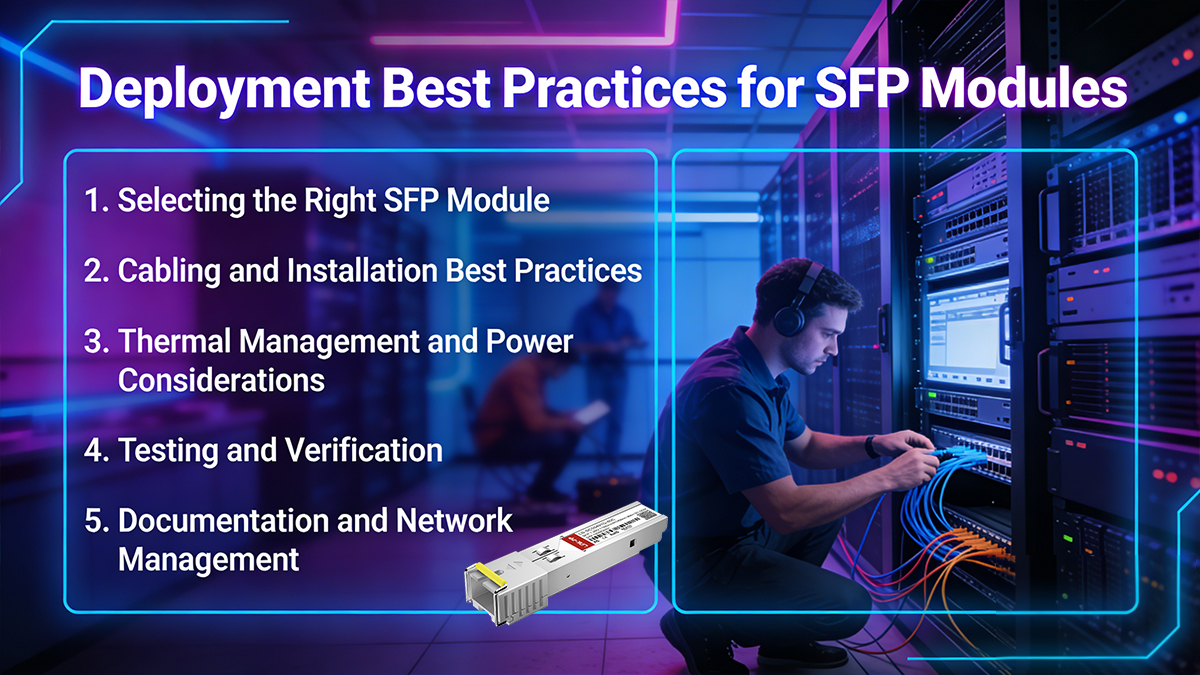
1. Selecting the Right SFP Module
-
Match Data Rate: Ensure the SFP module supports the required speed (1G, 10G, 25G) and is compatible with host hardware.
-
Check Fiber Type and Reach: Choose SR, LR, or ER modules based on fiber infrastructure and required link distance.
-
Consider Wavelength or Special Function: Use BiDi, CWDM, or DWDM modules when fiber count is limited or multiplexing is needed.
-
Verify Vendor Compatibility: Different SFP vendors may have subtle differences in coding and DDM support; verify interoperability with switches and NICs.
Proper module selection reduces link errors, signal degradation, and deployment delays.
2. Cabling and Installation Best Practices
-
Fiber Modules:
-
Follow minimum bend radius and avoid kinking cables.
-
Clean fiber connectors to prevent optical signal loss.
-
Use high-quality fiber patch cords (OM3/OM4 for SR, SMF for LR/ER).
-
-
Copper Modules:
-
Use shielded twisted-pair cables (Cat5e/6/6a) for higher speeds.
-
Avoid tight bundling near electrical interference sources.
-
-
General Tips:
-
Verify port alignment and insertion orientation.
-
Avoid touching optical interfaces to prevent contamination.
-
3. Thermal Management and Power Considerations
-
High-density SFP deployments may generate significant heat.
-
Ensure adequate airflow in racks and enclosures.
-
Monitor SFP temperature and optical power via DDM/SFF-8472 supported modules.
-
Keep ambient temperature within vendor-specified operating ranges (typically 0–70 °C for commercial modules).
Maintaining proper thermal conditions extends module life and network reliability.
4. Testing and Verification
-
Test all links before production deployment using optical power meters, OTDR, or diagnostic SFP tools.
-
Verify link speed, duplex settings, and latency.
-
Check for bit error rates (BER) to ensure optical or copper links operate within specifications.
-
Confirm DDM readings for real-time monitoring of voltage, temperature, and optical power.
Early testing prevents post-deployment connectivity issues and downtime.
5. Documentation and Network Management
-
Record module type, serial number, port assignment, and link type.
-
Maintain a fiber management plan with labeling for each patch panel and rack.
-
Use network management tools to monitor SFP module status, link utilization, and errors.
-
Keep track of firmware updates and compatibility notes from switch vendors.
Proper documentation ensures simpler troubleshooting, upgrades, and network audits.
Deployment Checklist Summary
| Step | Action | Purpose |
|---|---|---|
| Module Selection | Match speed, fiber type, and host compatibility | Ensure correct operation |
| Cabling & Installation | Follow bend radius, clean connectors | Reduce signal loss |
| Thermal Management | Ensure airflow, monitor DDM | Prevent overheating & failures |
| Testing & Verification | Validate link speed, BER, optical power | Confirm network readiness |
| Documentation | Record module type, port, link info | Facilitate future troubleshooting & upgrades |
Following these deployment best practices reduces risk of network outages, ensures optimal performance, and supports long-term scalability.
✅ FAQ About Types of SFP Modules
Q1. What is an SFP module?
A Small Form-Factor Pluggable (SFP) module is a hot-swappable transceiver that connects network devices like switches, routers, and servers to optical fiber or copper cabling. SFP modules support varying data rates, fiber types, and distances, providing flexible connectivity for enterprise, data center, and carrier networks.
Q2. What are the different types of SFP modules?
SFP modules can be classified by data rate, fiber type, wavelength, and transmission medium:
-
By Data Rate: SFP (1G), SFP+ (10G), SFP28 (25G)
-
By Fiber Type/Distance: SR (Short Reach), LR (Long Reach), ER (Extended Reach)
-
By Wavelength/Special Function: BiDi, CWDM, DWDM
-
By Medium: Fiber SFP vs Copper SFP (RJ-45)
Each type is designed for specific network applications, from short in-rack connections to long-haul metro or carrier links.
Q3. Can SFP modules be used interchangeably?
While SFP, SFP+, and SFP28 modules share the same mechanical form factor, they are not always interchangeable:
-
SFP28 modules may fit in SFP+ cages but require host support for 25G operation.
-
SFP+ modules cannot achieve 25G speeds.
-
Compatibility also depends on vendor firmware and device specifications.
Always check module-host compatibility lists before deployment.
Q4. What is the difference between fiber SFP and copper SFP?
Fiber SFP modules use optical fiber as the transmission medium, supporting longer distances, high bandwidth, and EMI immunity.
Copper SFP modules terminate with RJ-45 twisted-pair cabling, supporting short-distance links (up to 100 m) and are suitable for legacy networks or access ports.
| Feature | Fiber SFPs | |
|---|---|---|
| Max Data Rate | 1G / 10G / 25G | 10/100/1000 Mbps; some 2.5G/5G |
| Max Reach | 70 m – 40 km+ | Up to 100 m |
| EMI Immunity | High | Low |
| Applications | Data center, enterprise, carrier | Short-range, legacy copper networks |
Q5. What are BiDi, CWDM, and DWDM SFP modules?
-
BiDi SFP: Uses a single fiber strand for both transmit and receive by assigning different wavelengths for upstream and downstream.
-
CWDM SFP: Multiplexes multiple wavelengths over a single fiber with coarse spacing (~20 nm), supporting medium-density networks.
-
DWDM SFP: Multiplexes dozens of channels over a single fiber with dense wavelength spacing (~0.8–1.6 nm), ideal for high-capacity carrier or backbone networks.
These modules maximize fiber utilization and are used in fiber-constrained or high-density networks.
Q6. How do I choose the right SFP module?
Consider the following factors:
-
Data rate: Match SFP (1G), SFP+ (10G), or SFP28 (25G) to your network speed requirements.
-
Fiber type & distance: Use SR, LR, or ER depending on fiber and reach.
-
Transmission medium: Fiber for long distances or EMI-prone environments; copper for short-range or legacy infrastructure.
-
Special functions: BiDi, CWDM, or DWDM if multiplexing is needed or fiber is limited.
-
Host compatibility: Ensure the module is supported by the switch, NIC, or router firmware.
Q7. Can SFP modules support higher speeds than their specification?
No. Each SFP module is designed for a maximum data rate:
-
SFP — 1G
-
SFP+ — 10G
-
SFP28 — 25G
While a dual-rate SFP28 module may operate at 10G on compatible hardware, it cannot exceed its maximum specification.
Q8. How do I troubleshoot SFP module issues?
Common troubleshooting steps include:
-
Verify module-host compatibility and data rate
-
Inspect and clean fiber connectors
-
Check cable type and length
-
Monitor DDM readings for temperature, voltage, and optical power
-
Confirm port settings for duplex and speed
-
Replace suspected faulty modules and retest
Structured troubleshooting minimizes downtime and link instability.
✅ Final Insights on Types of SFP Modules
SFP modules are a cornerstone of modern networking, offering flexible, high-speed, and scalable connectivity for enterprise, data center, and carrier networks. Understanding the different types of SFP modules—including SFP (1G), SFP+ (10G), SFP28 (25G), fiber vs copper, and wavelength-specific modules like BiDi, CWDM, and DWDM—is essential for designing reliable, efficient, and future-proof networks.
Key points to remember:
-
Data Rate Matters: Choose the correct module for your network speed—SFP (1G), SFP+ (10G), or SFP28 (25G).
-
Distance and Fiber Type: SR, LR, and ER modules ensure proper reach; multimode vs. single-mode fiber must be matched.
-
Specialized Modules: BiDi, CWDM, and DWDM modules optimize fiber use and enable high-capacity links.
-
Transmission Medium: Fiber SFPs offer long-distance, low-latency connectivity, while copper SFPs are suitable for short-range or legacy infrastructure.
-
Deployment Best Practices: Verify compatibility, maintain proper cabling, monitor temperature and DDM readings, and test links before production.
-
Troubleshooting: Address common challenges such as compatibility issues, optical signal problems, and duplex/speed mismatches with structured diagnostics.
For network professionals and enterprise buyers seeking reliable, vendor-certified SFP modules, consider sourcing from reputable suppliers with proven interoperability testing, documentation, and support.
? Explore LINK-PP Official Store for a wide range of SFP, SFP+, and SFP28 modules, including fiber, copper, and wavelength-optimized options. Our modules are tested for IEEE standards compliance, high reliability, and long-term availability, ensuring your network deployment is robust and future-ready.
Implementing the right SFP module strategy is more than purchasing hardware—it’s a critical step in designing a high-performance, scalable, and reliable network infrastructure.
© 2026 LINK-PP. All rights reserved. This article provides professional guidance for network engineers and IT professionals seeking to understand the types and applications of SFP modules.







