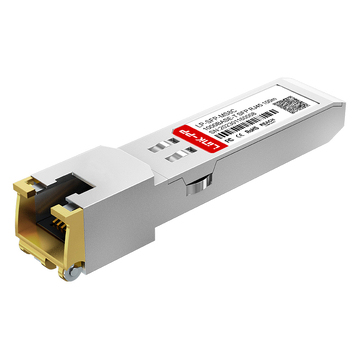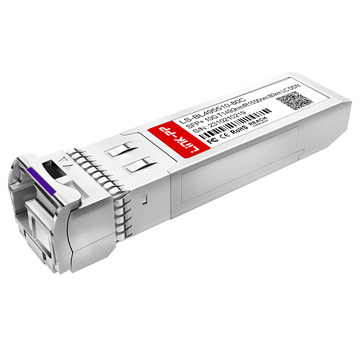


























The key difference between 10G SR and 10G LR transceivers is that SR is designed for short-distance transmission over multimode fiber, while LR supports long-distance links over single-mode fiber.
Although both deliver the same 10G data rate, they differ fundamentally in wavelength, transmission distance, fiber requirements, and deployment scenarios.
In practical terms, 10G SR typically operates at 850nm and supports distances up to 300m, making it suitable for data centers and short-range links. 10G LR operates at 1310nm and supports transmission up to 10km, which is why it is commonly used in campus networks, enterprise backbones, and building-to-building connections.
Understanding these differences is critical because SR and LR are not interchangeable, even though they share the same SFP+ form factor. Choosing the wrong transceiver can lead to fiber incompatibility, unstable links, or unnecessary cost.
This article breaks down the core technical differences, cost implications, compatibility considerations, and real-world use cases of 10G SR and 10G LR, helping you quickly determine which transceiver is the right fit for your network.
? What Are 10G SR and LR Transceivers?
10G SR and 10G LR are standardized 10-Gigabit Ethernet optical transceivers designed for short-range and long-range fiber links, respectively.
They follow different IEEE standards and are optimized for distinct wavelengths and fiber types, which defines how far they can transmit and where they are best deployed.
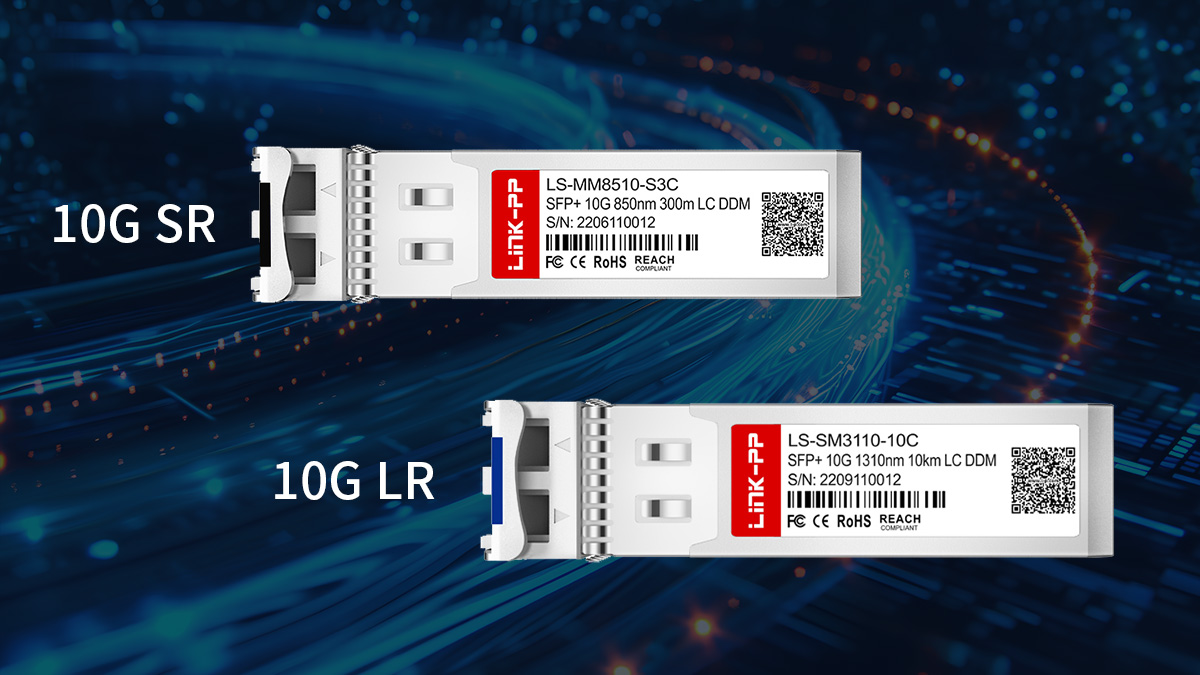
What Is a 10G SR Transceiver?
10G SR transceivers are designed for short-distance transmission over multimode fiber, typically within data centers and equipment rooms.
| Parameter | 10GBASE-SR |
|---|---|
| IEEE Standard | IEEE 802.3ae |
| Wavelength | 850nm |
| Fiber Type | Multimode (OM3 / OM4) |
| Max Distance | Up to 300m |
Explanation:
10G SR uses an 850nm VCSEL laser optimized for multimode fiber, making it cost-effective and power-efficient for short links. Its reach depends heavily on fiber grade, with OM4 enabling longer distances than OM3. Because of its limited link budget, SR is best suited for in-rack, inter-rack, and intra-data-center connections.
What Is a 10G LR Transceiver?
10G LR transceivers are built for long-distance transmission over single-mode fiber, supporting links up to 10 km.
| Parameter | 10GBASE-LR |
|---|---|
| IEEE Standard | 802.3ae |
| Wavelength | 1310nm |
| Fiber Type | Single-mode (OS2) |
| Max Distance | Up to 10km |
Explanation:
10G LR operates at 1310nm using a DFB laser, which provides a higher link budget and lower signal attenuation over long distances. This makes LR suitable for campus networks, building-to-building connections, and enterprise backbones where distance and signal stability are critical.
Why Are SR and LR Often Compared?
SR and LR are frequently compared because they both deliver 10G speeds but solve very different distance and infrastructure challenges.
-
Both are widely supported by switches, routers, and NICs
-
Both use LC connectors and similar SFP+ form factors
-
Both comply with the same 10G Ethernet framework
However, their optical design and fiber requirements are fundamentally different. Treating SR and LR as interchangeable options often leads to mismatched fiber usage or unnecessary costs.
? SR vs LR — Core Technical Differences
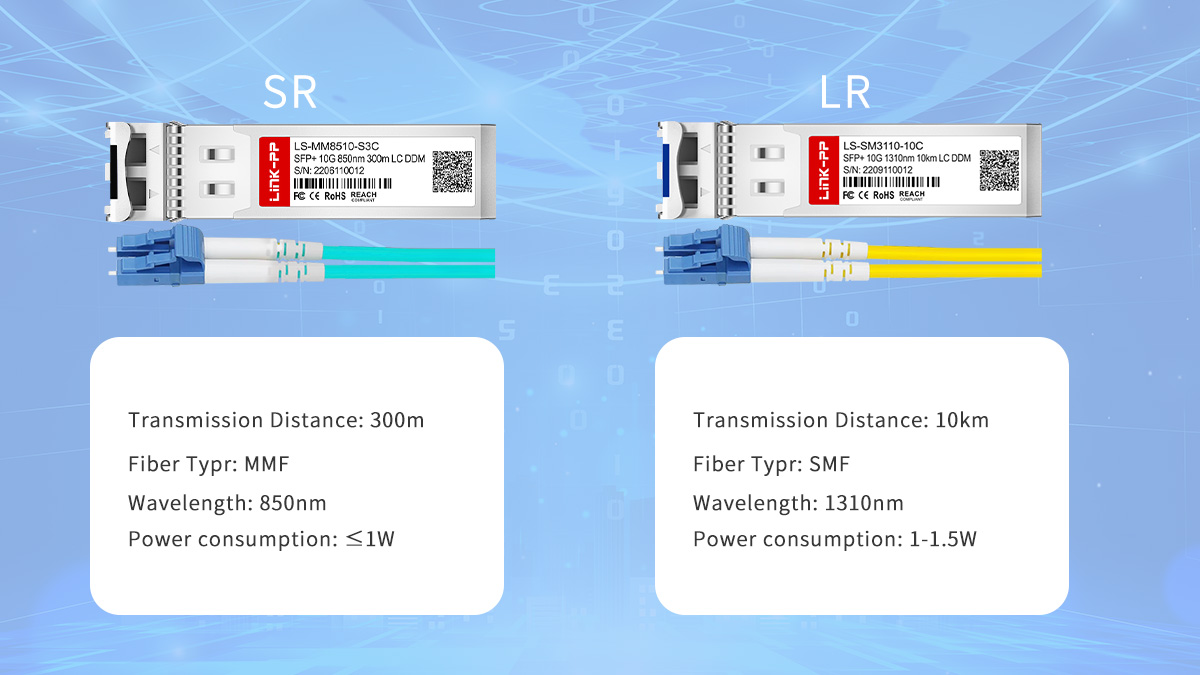
The core difference between 10G SR and 10G LR lies in transmission distance, wavelength, and fiber type, which together determine where each transceiver can be reliably deployed.
| Parameter | 10G SR | 10G LR |
|---|---|---|
| Wavelength | 850nm | 1310nm |
| Fiber Type | Multimode (OM3/OM4) | Single-mode (OS2) |
| Max Distance | Up to 300m | Up to 10km |
| Typical Use | Short-range links | Long-range links |
| Optical Budget | Lower | Higher |
Explanation:
Although both SR and LR deliver the same 10G data rate, their optical characteristics are fundamentally different. SR relies on an 850nm VCSEL laser optimized for multimode fiber, which offers low cost but limited reach due to higher modal dispersion. In contrast, LR uses a 1310nm DFB laser designed for single-mode fiber, enabling much longer transmission distances with lower signal attenuation.
Distance Capability: Why SR Is Short-Range and LR Is Long-Range
Transmission distance is the most visible difference between SR and LR, but it is a result of deeper optical design choices.
-
10G SR is limited by multimode fiber dispersion and a smaller link budget
-
10G LR benefits from single-mode fiber and higher optical power tolerance
-
Fiber quality directly affects achievable distance, especially for SR
Practical impact:
SR is ideal for rack-to-rack or row-level connections, while LR is designed for building-to-building or campus-scale links where distance consistency matters.
Wavelength and Signal Behavior
The wavelength used by SR and LR directly influences signal loss and transmission stability.
-
850nm signals attenuate faster over distance
-
1310nm signals experience lower attenuation in fiber
-
Longer wavelengths support higher link budgets
Why this matters:
Even if fiber length is within specification, wavelength mismatch can reduce reliability or increase error rates over time.
Fiber Infrastructure Requirements
SR and LR are not interchangeable when it comes to fiber infrastructure.
-
SR requires multimode fiber (OM3 or OM4)
-
LR requires single-mode fiber (OS2)
-
Using the wrong fiber type can result in link failure or unstable performance
Key takeaway:
Fiber availability is often the deciding factor when choosing between SR and LR, sometimes even more important than distance itself.
? Transmission Distance and Fiber Requirements Explained
Transmission distance and fiber type are tightly coupled, and neither 10G SR nor 10G LR can achieve its specified reach without the correct fiber infrastructure. In other words, distance capability is not an isolated specification—it is the result of wavelength choice, fiber design, and optical budget working together.
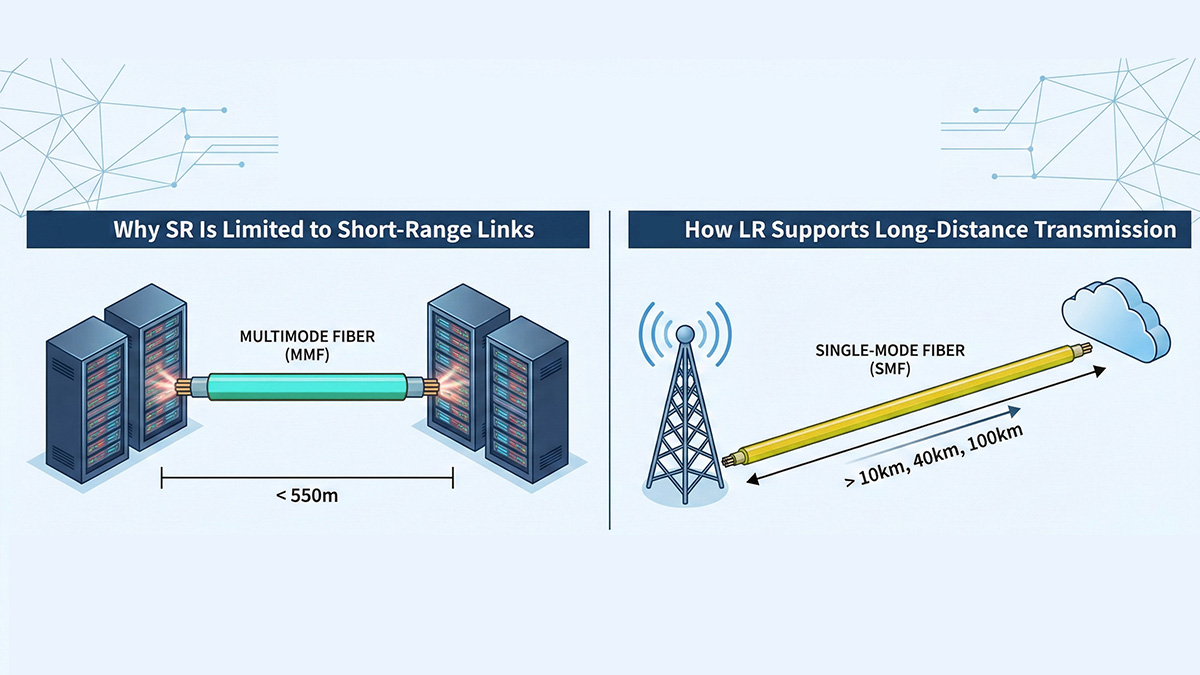
Why 10G SR Has Limited Transmission Distance
10GBASE-SR is inherently distance-limited because multimode fiber introduces modal dispersion that increases rapidly over longer links.
-
Multimode fiber supports multiple light paths simultaneously
-
Different paths arrive at slightly different times
-
Signal spreading increases as distance grows
Result:
Even with high-quality OM4 fiber, 10G SR is typically limited to short-range links where dispersion remains manageable.
How 10G LR Achieves Long-Distance Transmission
10GBASE-LR supports long-distance transmission by combining single-mode fiber with a higher link budget at 1310nm.
| Factor | SR (Multimode) | LR (Single-mode) |
|---|---|---|
| Light Path | Multiple modes | Single mode |
| Dispersion | Higher | Minimal |
| Attenuation | Higher | Lower |
| Distance Stability | Limited | High |
Explanation:
Single-mode fiber allows only one propagation path, which virtually eliminates modal dispersion. When paired with a 1310nm wavelength, signal loss is reduced significantly, enabling stable transmission over distances up to 10km.
Fiber Quality and Its Impact on Real-World Distance
Fiber grade and installation quality directly affect achievable distance, especially for 10G SR links.
-
OM3 vs OM4 can change maximum reach
-
Connector loss and splicing quality reduce effective link budget
-
Patch cord quality matters at 10G speeds
Practical guidance:
For SR deployments near distance limits, fiber quality is often the deciding factor between a stable link and intermittent errors.
Can Distance or Fiber Type Be Flexible?
Fiber type is non-negotiable, while distance has limited flexibility within specification margins.
-
SR cannot reliably operate on single-mode fiber without special attenuation
-
LR cannot be used on multimode fiber
-
Operating beyond rated distance increases error rates and instability
Key takeaway:
Always choose the transceiver based on fiber type first, then verify that the required distance falls comfortably within the supported range.
? Cost Comparison — Is SR Cheaper Than LR?
SFP+ 10G SR are generally cheaper than SFP+ 10G LR at the module level, but overall cost depends heavily on existing fiber infrastructure and deployment scale. Looking only at transceiver price can lead to misleading conclusions, especially in mixed or long-term network designs.
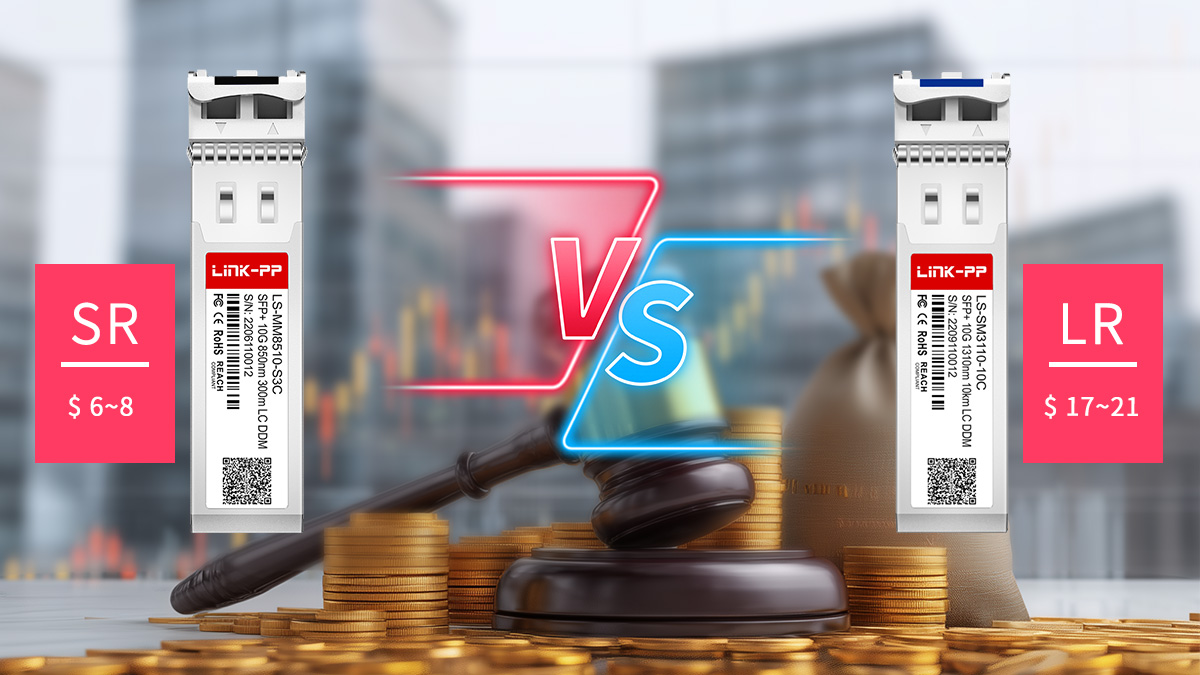
Transceiver Module Cost Differences
At equal 10G speeds, SR modules typically cost less than LR due to simpler optical components.
| Cost Factor | 10G SR | 10G LR |
|---|---|---|
| Laser Type | VCSEL | DFB |
| Optical Complexity | Lower | Higher |
| Typical Module Cost | Lower | Higher |
| Power Budget | Smaller | Larger |
Explanation:
SR uses an 850nm VCSEL laser, which is easier and cheaper to manufacture. LR relies on a 1310nm DFB laser with tighter tolerances, increasing component and testing costs.
Fiber Infrastructure Cost Considerations
Fiber infrastructure often outweighs transceiver price in total deployment cost.
-
Multimode fiber is usually cheaper per meter
-
Single-mode fiber scales better for long distances
-
Replacing existing fiber is often more expensive than upgrading transceivers
Implication:
If single-mode fiber is already installed, choosing LR may be more cost-effective despite higher module prices.
Total Cost of Ownership (TCO)
TCO depends on upgrade flexibility, distance requirements, and future scalability—not just initial spend.
-
SR may require re-cabling if distance grows
-
LR supports network expansion without fiber changes
-
Maintenance and troubleshooting costs increase near distance limits
Decision insight:
SR minimizes upfront cost in controlled environments, while LR reduces long-term risk in expanding networks.
When Is SR Actually the Cheaper Choice?
SR is the more economical option when distance and environment are strictly controlled.
-
In-rack or inter-rack connections
-
Data centers with OM3/OM4 fiber already deployed
-
Short links with no future distance expansion planned
When Does LR Make More Financial Sense?
LR becomes cost-efficient when distance, reliability, or future growth are priorities.
-
Campus or building-to-building links
-
Networks expected to scale beyond a few hundred meters
-
Deployments where re-cabling is costly or impractical
? Typical Use Cases for 10G SR vs LR
10G SR and 10G LR are optimized for different deployment environments, and choosing based on use case is often more effective than comparing specifications alone. Distance, fiber type, and operational flexibility collectively define which transceiver fits a given scenario.
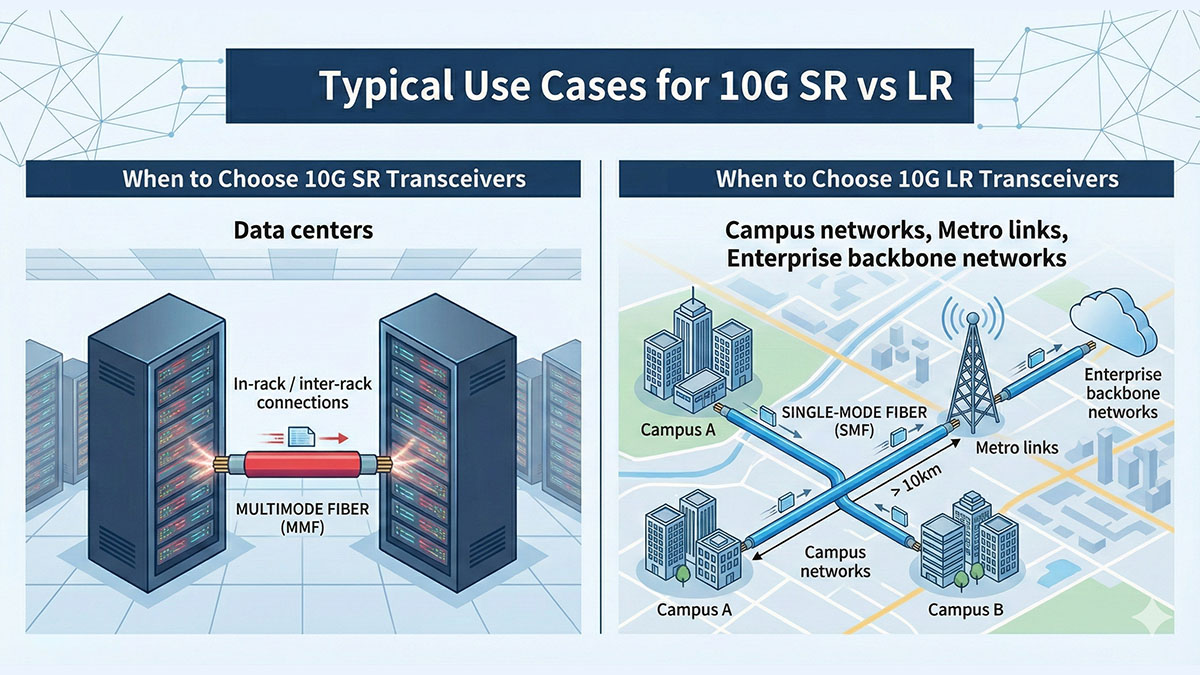
Typical Use Cases for 10G SR
10G SR is best suited for short, controlled links where multimode fiber is already in place.
-
In-rack server-to-switch connections
-
Inter-rack links within the same row
-
Data center aggregation at short distances
-
High-density environments where cost per port matters
Why SR fits these scenarios:
Short cable runs minimize dispersion impact, and the lower cost of SR modules enables dense 10G deployments without unnecessary overhead.
Typical Use Cases for 10G LR
10G LR is designed for environments where distance and signal stability are critical.
-
Building-to-building fiber links
-
Campus network backbones
-
Enterprise core and distribution layers
-
Metropolitan or extended-access networks
Why LR fits these scenarios:
Single-mode fiber and higher link budgets allow LR to maintain stable performance over long distances, even as environmental conditions vary.
Quick Use Case Comparison
Use case alignment often reveals the correct choice more clearly than raw specifications.
| Deployment Scenario | Recommended Type |
|---|---|
| Intra-data-center links | 10G SR |
| Campus backbone | 10G LR |
| Short-distance aggregation | 10G SR |
| Long-distance connectivity | 10G LR |
Note:
These recommendations assume standard fiber availability and typical link conditions. Exceptional environments may require further validation.
Edge Cases and Mixed Environments
Not all deployments fit neatly into “short” or “long” categories.
-
Data centers with single-mode fiber may prefer LR for consistency
-
Short links requiring high reliability may still justify LR
-
Mixed fiber environments often standardize on one transceiver type
Practical advice:
When in doubt, prioritize fiber type and future expansion over current distance alone.
? Compatibility and Interoperability Considerations
10G SR and 10G LR transceivers are electrically compatible at the SFP+ level, but optical compatibility depends on fiber type, wavelength, and vendor implementation. Ignoring these factors can result in link instability or complete connection failure, even when modules appear physically identical.
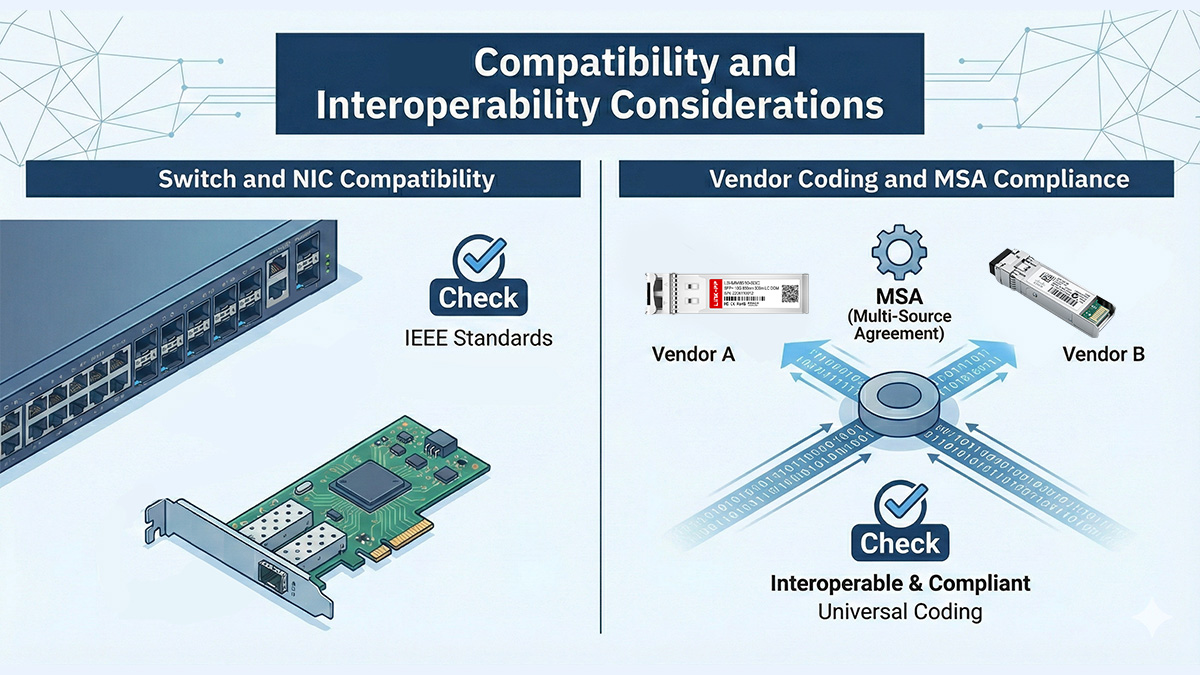
Switch and NIC Compatibility
Most modern switches and NICs support both 10G SR and LR, but support is not always symmetric.
-
SFP+ ports are physically identical for SR and LR
-
Firmware may restrict supported transceiver types
-
Power and thermal limits can differ by port design
Best practice:
Always verify that the target device explicitly supports the intended transceiver standard.
Optical Compatibility and Fiber Mismatch Risks
SR and LR are not optically interchangeable due to wavelength and fiber design.
| Scenario | Expected Outcome |
|---|---|
| SR on multimode fiber | Normal operation |
| LR on single-mode fiber | Normal operation |
| SR on single-mode fiber | Unstable or failed link |
| LR on multimode fiber | Link failure |
Explanation:
Multimode fiber cannot properly guide 1310nm single-mode signals, while single-mode fiber does not support 850nm multimode propagation without significant loss or distortion.
Vendor Coding and MSA Compliance
Interoperability is strongly influenced by how closely a transceiver follows MSA standards.
-
MSA-compliant modules improve cross-vendor compatibility
-
Vendor-specific coding may lock modules to certain devices
-
Third-party optics often require compatibility testing
Key insight:
Electrical compatibility alone does not guarantee operational compatibility.
Mixing SR and LR in the Same Network
Using SR and LR in the same network is common, but mixing them on the same link is not supported.
-
Both ends of a link must use the same transceiver type
-
SR-to-LR direct connections are not supported
-
Media converters are required for cross-type links
Deployment rule:
Always match SR-to-SR or LR-to-LR at each fiber link.
Operational and Maintenance Considerations
Compatibility issues often surface during maintenance, not initial deployment.
-
Replacing an SR with LR without checking fiber type
-
Extending links beyond original distance assumptions
-
Swapping modules during upgrades without documentation
Recommendation:
Label fiber type and transceiver type clearly to avoid future mismatches.
? How to Choose Between SR and LR for Your Network
Choosing between 10G SR and 10G LR should be driven by fiber type, required distance, and future scalability—not by transceiver price alone.
A structured decision process reduces deployment risk and avoids unnecessary upgrades.
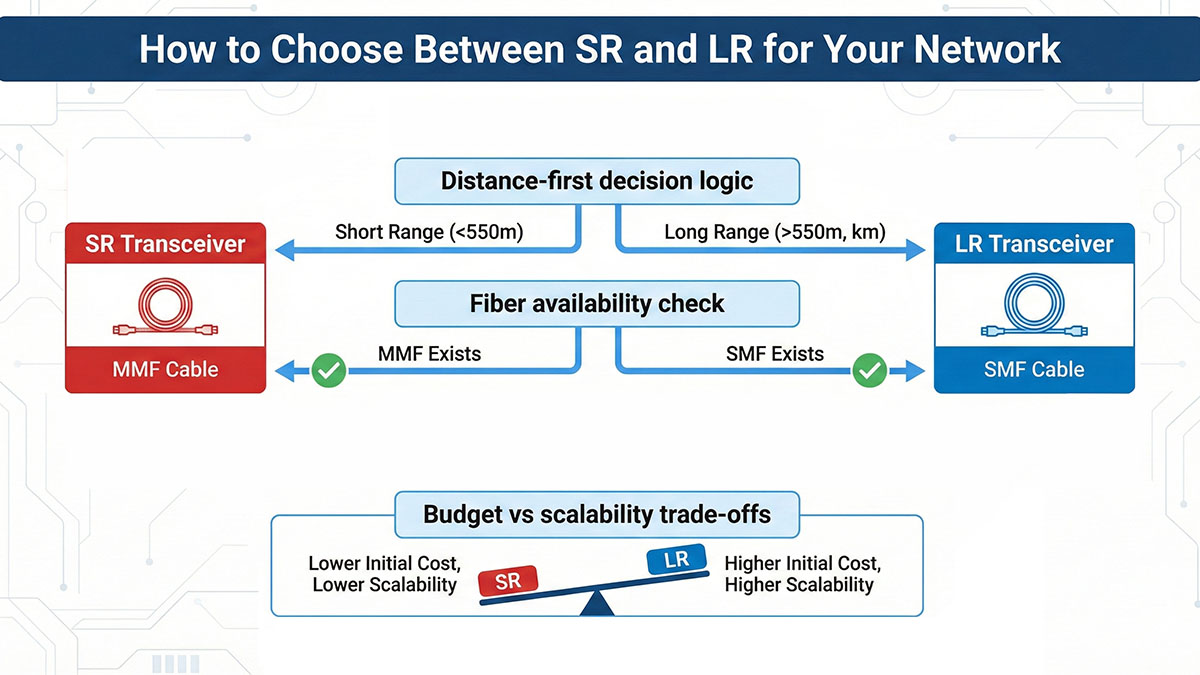
Step 1: Identify the Installed Fiber Type
Fiber type is the primary decision factor and cannot be negotiated.
-
Multimode fiber (OM3 / OM4) → 10G SR
-
Single-mode fiber (OS2) → 10G LR
Rule:
Do not select a transceiver first and attempt to adapt the fiber later.
Step 2: Confirm Required Transmission Distance
Distance determines whether the selected transceiver operates within a stable margin.
| Distance Requirement | Recommended Choice |
|---|---|
| ≤300m | 10G SR |
| >300m and ≤10km | 10G LR |
| Near distance limit | Prefer LR for margin |
Guidance:
Operating close to maximum distance increases sensitivity to fiber quality and connector loss.
Step 3: Evaluate Future Expansion Needs
Future-proofing often outweighs short-term cost savings.
-
Planned network expansion → Favor LR
-
Fixed, controlled environment → SR is sufficient
-
Unknown growth requirements → LR reduces redesign risk
Insight:
Re-cabling fiber is usually more disruptive than replacing transceivers.
Step 4: Check Device Compatibility and Policy Constraints
Hardware support and vendor policies may limit your options.
-
Confirm supported standards in switch/NIC documentation
-
Check for vendor-specific transceiver restrictions
-
Validate firmware compatibility before deployment
Action:
Perform compatibility testing in production-like conditions whenever possible.
Step 5: Balance Cost Against Operational Risk
The lowest upfront cost does not always produce the lowest operational cost.
-
SR minimizes initial spend
-
LR reduces risk over long distances and evolving networks
-
Downtime and troubleshooting have real cost implications
Decision principle:
Choose the transceiver that keeps your link comfortably within specification, not just barely functional.
Quick Decision Summary
A simple rule-of-thumb often resolves the choice quickly:
-
Short distance + multimode fiber → 10G SR
-
Long distance or single-mode fiber → 10G LR
-
Uncertain future or mixed environment → Lean toward LR
? Common Misconceptions About SR and LR Transceivers
Many issues in 10G deployments are caused not by hardware limitations, but by incorrect assumptions about SR and LR transceivers.
Clarifying these misconceptions helps prevent unnecessary cost, link instability, and redesign efforts.
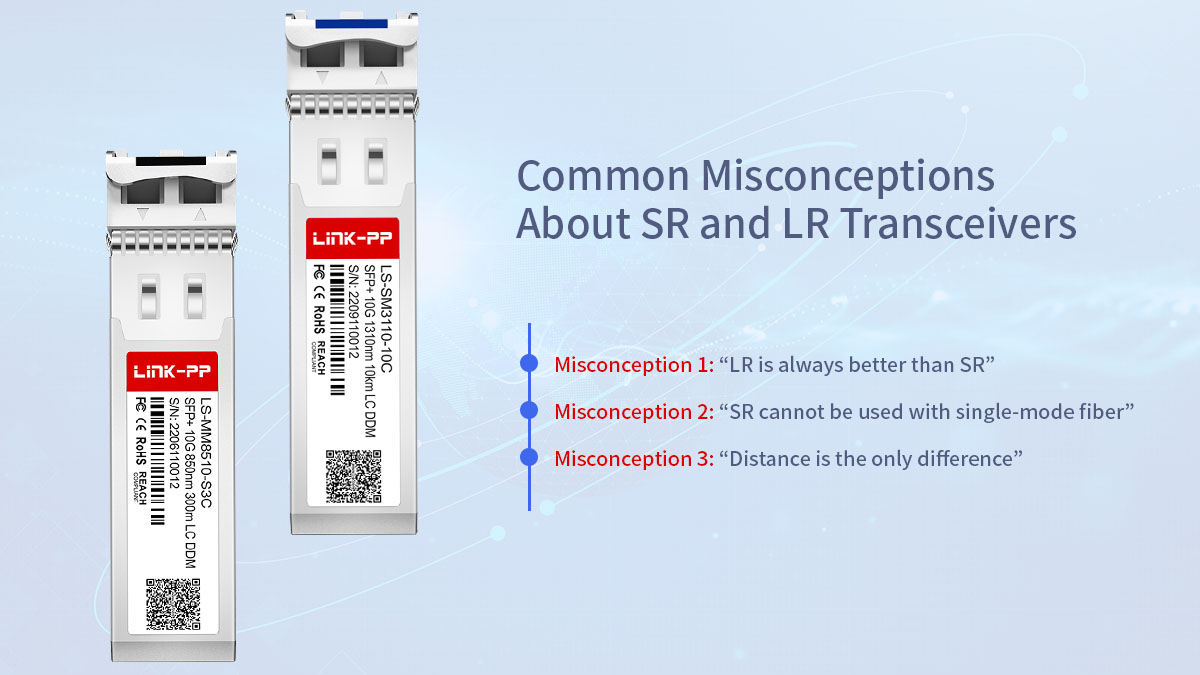
“10G LR Is Always Better Than 10G SR”
10G LR is not universally better; it is designed for different requirements.
-
LR supports longer distances
-
SR is optimized for short-range efficiency
-
Using LR where SR is sufficient increases cost without benefit
Correct understanding:
“Better” depends on distance, fiber type, and deployment goals—not on specifications alone.
“10G SR and LR Can Be Used Interchangeably”
SR and LR are not interchangeable, even though they share the same SFP+ form factor.
| Assumption | Reality |
|---|---|
| Same speed means same use | Speed does not define fiber compatibility |
| Same port fits both | Optical design still differs |
| Can mix SR and LR on one link | Both ends must match |
Key point:
Physical compatibility does not equal optical compatibility.
“Distance Is the Only Difference Between SR and LR”
Distance is the most visible difference, but not the root cause.
-
Wavelength determines attenuation behavior
-
Fiber design affects dispersion
-
Optical budget defines stability margins
Why this matters:
Ignoring these factors often leads to links that work initially but fail over time.
“10G SR Cannot Ever Be Used on Single-Mode Fiber”
In practice, 10G SR is not designed for single-mode fiber, even if the link appears to work temporarily.
-
Signal loss and reflections increase error rates
-
Results are inconsistent across environments
-
Not supported by standards
Recommendation:
Avoid non-standard configurations in production networks.
“Cheaper Transceivers Always Reduce Network Cost”
Lower module cost does not guarantee lower total cost.
-
Short-term savings may increase long-term risk
-
Re-cabling and downtime are expensive
-
Scalability limitations add hidden cost
Correct mindset:
Evaluate cost at the network level, not the component level.
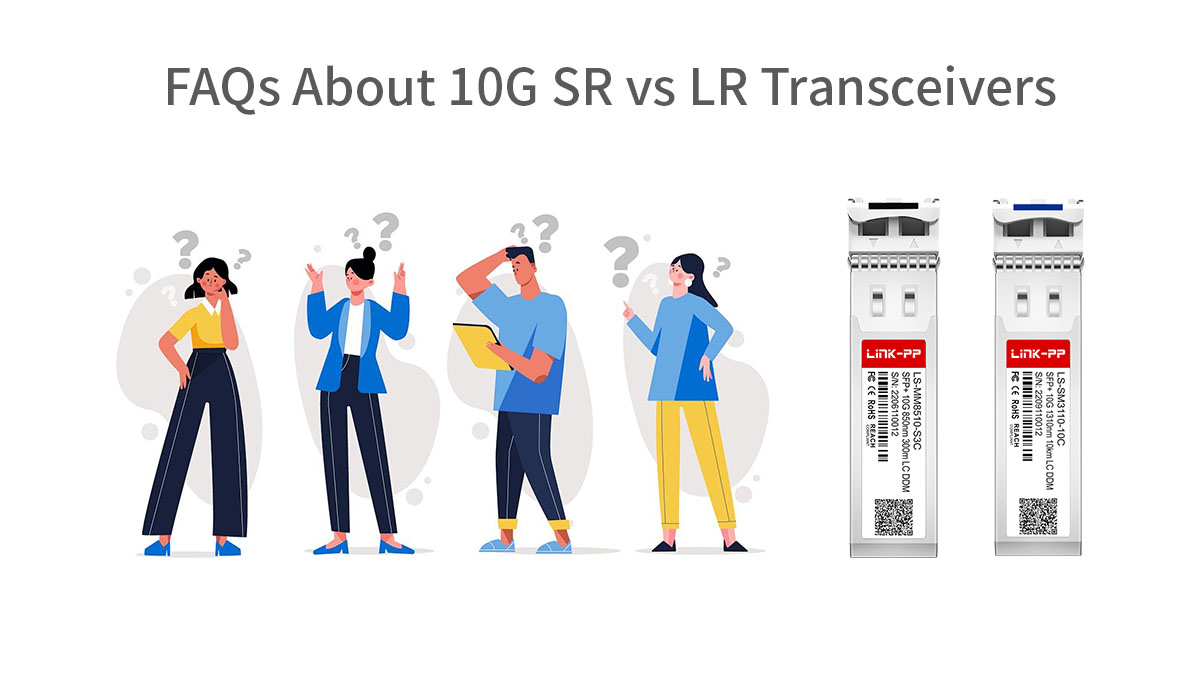
? FAQs About 10G SR vs LR Transceivers
Q1: Is 10G SR cheaper than 10G LR?
Yes, 10G SR is generally cheaper at the transceiver level.
This is because SR uses simpler 850nm VCSEL lasers, while LR relies on more complex 1310nm DFB lasers. However, fiber infrastructure and long-term scalability can outweigh this price difference.
Q2: Can I directly replace a 10G SR transceiver with a 10G LR?
Only if the fiber type is single-mode and both devices support LR.
Replacing SR with LR without changing multimode fiber will result in link failure or instability.
Q3: Does 10G LR consume more power than 10G SR?
In most cases, yes.
LR transceivers typically consume slightly more power due to higher optical output and longer-distance signal requirements, though the difference is usually within SFP+ port limits.
Q4: Can 10G SR and 10G LR be connected together on the same link?
No, both ends of a fiber link must use the same transceiver type.
SR-to-LR direct connections are not supported and will not establish a stable link.
Q5: Which transceiver is better for data center environments?
10G SR is usually the better choice for short, high-density data center links.
For longer distances or data centers using single-mode fiber, LR may be more appropriate.
Q6: Is fiber type more important than distance when choosing SR or LR?
Yes, fiber type should always be checked first.
Distance determines feasibility, but fiber type determines compatibility.
Q7: Can 10G LR be used for short distances?
Yes, as long as the fiber type is single-mode and power levels are within specification.
Using LR on short links is technically valid but may not be cost-efficient.
Q8: Do SR and LR follow the same IEEE standard?
They are defined under the same 10G Ethernet framework but use different specifications.
Both are part of IEEE 802.3ae, with separate definitions for SR and LR.
? Summary: SR vs LR — Which 10G Transceiver Is Right for You?
The choice between 10G SR and 10G LR is not about performance superiority, but about matching the transceiver to distance, fiber type, and network design goals. Both standards deliver the same 10G speed, yet they are optimized for fundamentally different environments.
Key takeaways from this guide:
-
10G SR is designed for short-range links over multimode fiber, making it ideal for data centers and controlled environments where cost and port density matter.
-
10G LR is built for long-distance transmission over single-mode fiber, offering higher stability and scalability for campus, enterprise, and backbone networks.
-
Fiber type should always be the first decision factor, followed by distance requirements and future expansion plans.
-
Selecting the right transceiver reduces not only upfront cost, but also long-term operational risk and redesign effort.
By understanding the technical differences, real-world use cases, and common misconceptions, network planners can confidently choose the transceiver that fits their infrastructure—without overengineering or underestimating future needs.
For readers who want to validate specifications, compare compliant options, or support real deployment decisions, you can explore standardized 10G SR and 10G LR transceiver solutions at the LINK-PP Official Store, where products are aligned with industry standards and typical network scenarios.