As 25G Ethernet becomes a mainstream upgrade path for data centers, campus networks, and 5G fronthaul deployments, selecting the right optical transceiver is no longer a purely technical decision—it is a procurement and deployment decision as well.
Among available 25G options, SFP28 SR and SFP28 LR transceivers are the two most widely adopted, yet they are often compared without fully understanding their practical differences.
Although both support 25Gbps data rates and follow the SFP28 MSA standard, SR and LR modules differ significantly in supported transmission distance, fiber type, optical design, cost structure, and typical deployment scenarios. Choosing the wrong variant can lead to unnecessary fiber upgrades, higher capital expenditure, or limited scalability.
What You Will Learn
In this guide, you will learn:
-
The practical differences between SFP28 SR and SFP28 LR, beyond headline specifications
-
How distance, fiber type, and deployment environment influence the right module choice
-
Which 25G SFP28 option fits common real-world scenarios, such as data centers, campus networks, and 5G fronthaul
-
How to select the right SFP28 transceiver based on application requirements, cost considerations, and scalability needs
? What Is SFP28-SR?
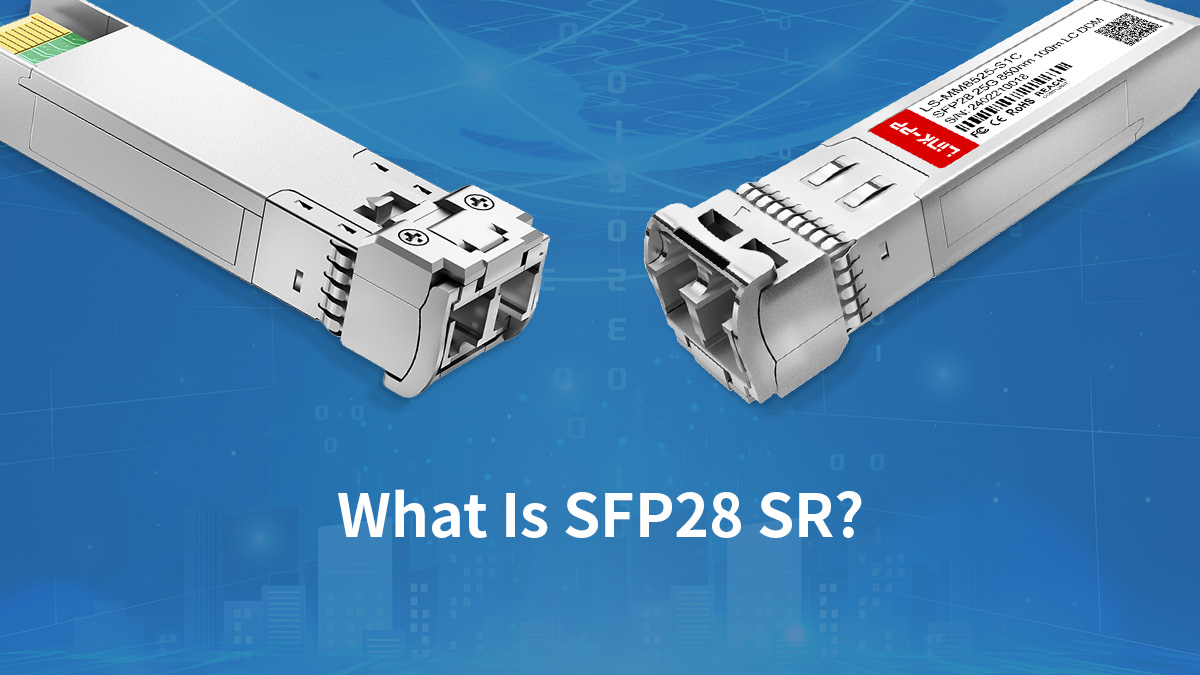
SFP28 SR (Short Reach) is a 25G Ethernet optical transceiver designed for short-distance transmission over multimode fiber.
It operates at a nominal wavelength of 850 nm and complies with the 25GBASE-SR specification defined by IEEE 802.3.
SFP28 SR modules support a 25.78125 Gbps line rate using NRZ modulation and are widely deployed in high-density data center environments where link distances are limited and cost efficiency is critical.
Key Technical Characteristics of SFP28 SR
| Parameter | Specification |
|---|---|
| Data rate | 25.78125 Gbps (25G Ethernet) |
| Wavelength | 850 nm |
| Fiber type | Multimode fiber (OM3 / OM4) |
| Maximum reach | Up to 70 m over OM3Up to 100 m over OM4 |
| Optical interface | LC duplex |
| Laser type | VCSEL |
| Modulation | NRZ |
| Standard compliance | IEEE 802.3by (25GBASE-SR), SFP28 MSA |
Note: Actual transmission distance may vary depending on fiber quality, connector loss, and overall link budget.
Typical Deployment Scenarios
SFP28 SR transceivers are primarily used in short-reach 25G links, including:
-
Top-of-Rack (ToR) to server or NIC connections
-
Leaf-to-spine links within the same data hall
-
High-port-density switching environments
-
25G server access networks in enterprise data centers
These scenarios benefit from lower transceiver cost, low power consumption, and the ability to reuse existing OM3/OM4 multimode fiber infrastructure.
Practical Considerations and Limitations
While SFP28 SR is cost-effective, it is distance-limited by design.
For links beyond 100 meters, or for campus and telecom deployments, multimode fiber and SR optics are typically not suitable.
In such cases, SFP28 LR transceivers, operating over single-mode fiber at 1310 nm, provide the required reach and scalability.
Why This Matters for Buyers
From a procurement perspective, SFP28 SR is best suited for environments where:
-
Link distances are predictable and short
-
Multimode fiber is already deployed
-
High port density and cost control are priorities
Understanding these constraints helps avoid over-specification or under-deployment when selecting 25G SFP28 module.
? What Is SFP28 LR?
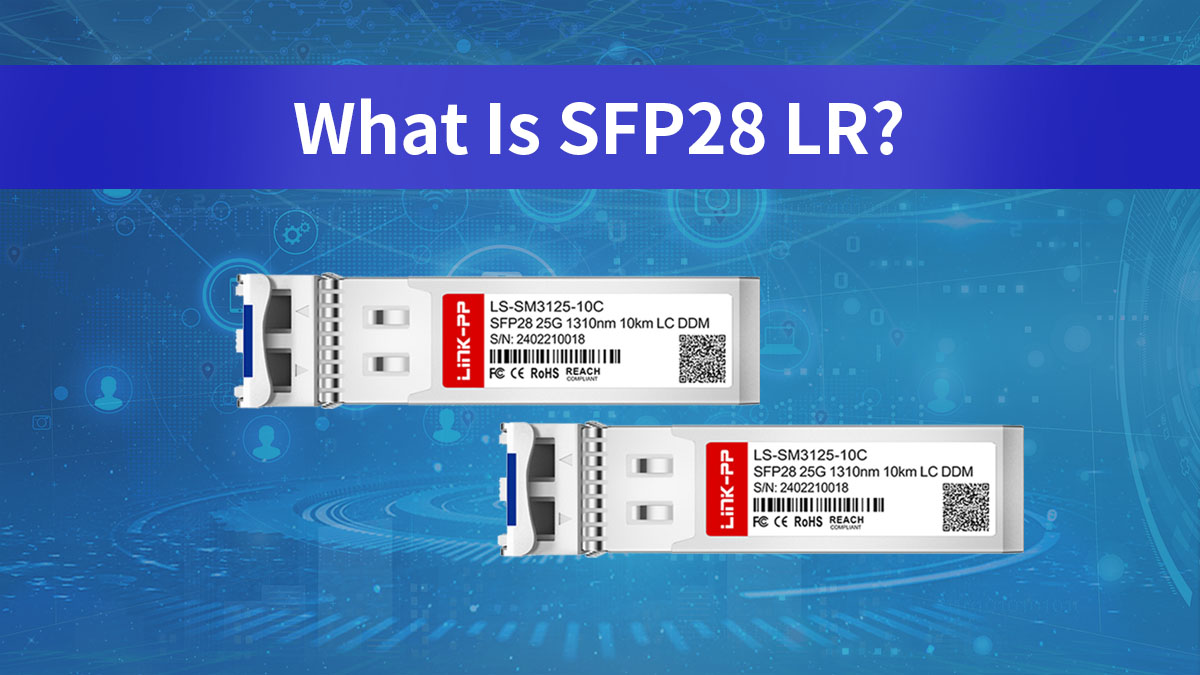
SFP28 LR (Long Reach) is a 25G Ethernet optical transceiver designed for long-distance transmission over single-mode fiber.
It operates at a nominal wavelength of 1310 nm and complies with the 25GBASE-LR specification defined in IEEE 802.3.
SFP28 LR modules support a 25.78125 Gbps line rate using NRZ modulation and are commonly deployed in campus networks, metro access links, and 5G fronthaul architectures, where extended reach and stable optical performance are required.
Key Technical Characteristics of SFP28 LR
| Parameter | Specification |
|---|---|
| Data rate | 25.78125 Gbps (25G Ethernet) |
| Wavelength | 1310 nm |
| Fiber type | Single-mode fiber (OS2) |
| Maximum reach | Up to 10 km |
| Optical interface | LC duplex |
| Laser type | DFB |
| Modulation | NRZ |
| Standard compliance | IEEE 802.3 (25GBASE-LR), SFP28 MSA |
Note: Actual transmission distance depends on fiber attenuation, connector and splice loss, and overall optical link budget.
Typical Deployment Scenarios
SFP28 LR transceivers are typically used where short-reach multimode solutions are insufficient, including:
-
Campus backbone networks
-
Building-to-building connections
-
Metro access and aggregation links
-
5G fronthaul and eCPRI-based deployments
These environments require longer reach, higher optical budget, and greater deployment flexibility, making SFP28 LR the preferred option.
Practical Considerations and Limitations
Compared with SFP28 SR, SFP28 LR modules generally have:
-
Higher unit cost due to DFB laser technology
-
Dependence on single-mode fiber infrastructure
-
Greater suitability for scalable, long-distance networks
For short, intra-rack or same-room connections, SFP28 LR is often over-specified, offering little practical benefit over SR modules.
Why This Matters for Buyers
From a procurement and network planning perspective, SFP28 LR is best suited for deployments where:
-
Link distances exceed multimode fiber limits
-
Single-mode fiber is already installed or planned
-
Network scalability and future expansion are priorities
Understanding these characteristics helps ensure the right balance between cost, performance, and long-term network design when selecting 25G SFP28 transceivers.
? SFP28 SR vs. LR — Technical Differences
While SFP28 SR and SFP28 LR share the same 25G form factor and electrical interface, they are optimized for very different optical transmission requirements.
Understanding these technical differences is essential when planning link architecture, fiber infrastructure, and procurement strategy.
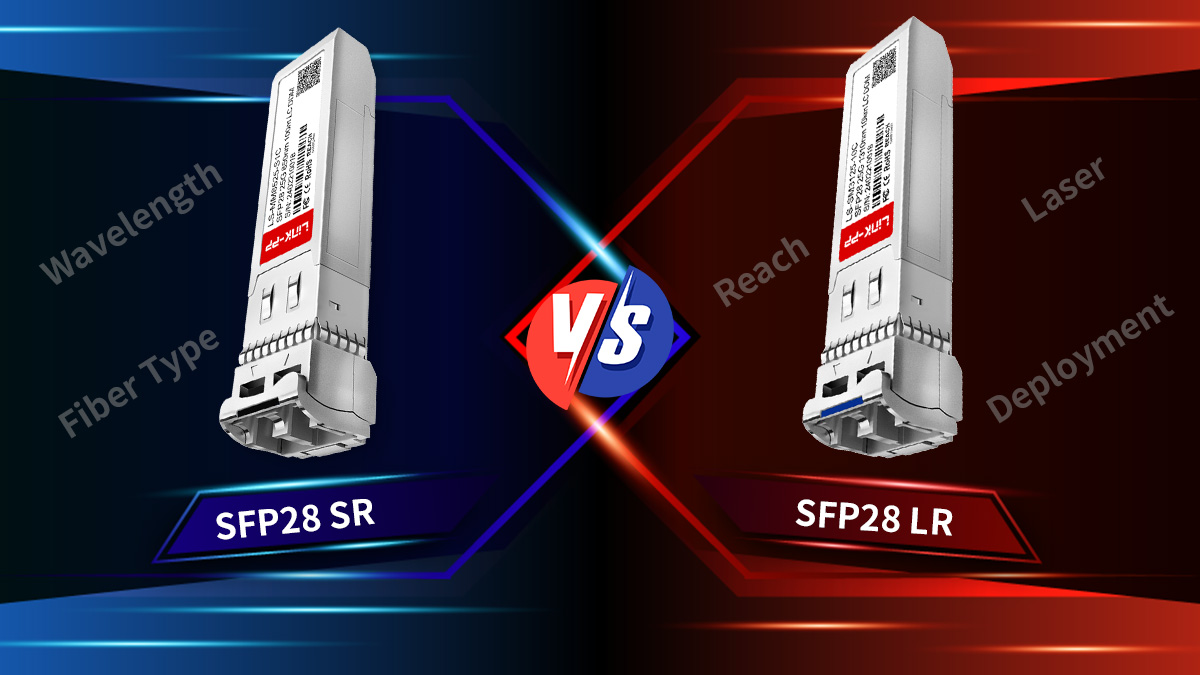
Technical Differences Between SFP28 SR and LR
| Technical Aspect | SFP28 SR | SFP28 LR |
|---|---|---|
| IEEE standard | 25GBASE-SR SFP28 | 25GBASE-LR |
| Nominal wavelength | 850 nm | 1310 nm |
| Fiber type | Multimode (OM3 / OM4) | Single-mode (OS2) |
| Maximum reach | 70 m (OM3) 100 m (OM4) |
Up to 10 km |
| Laser technology | VCSEL | DFB |
| Optical budget | Lower | Higher |
| Typical deployment | Short-reach data center links | Long-range campus / telecom links |
| Relative cost | Lower | Higher |
Note: Actual reach and performance depend on fiber quality, connector loss, and overall optical link budget design.
How These Differences Affect Long-Range Links
The most critical distinction between SR and LR lies in their optical reach and fiber compatibility:
-
SFP28 SR is designed for short, controlled environments, such as data halls, where multimode fiber is already deployed and link distances are predictable.
-
SFP28 LR, by contrast, supports long-range transmission over single-mode fiber, making it suitable for building-to-building connections, campus backbones, and telecom access networks.
Attempting to use SR optics beyond their intended reach can result in link instability, higher error rates, or complete link failure—issues that cannot be resolved through configuration alone.
Procurement Perspective: Why the Choice Matters
From a purchasing and planning standpoint, selecting SR or LR impacts:
-
Transceiver unit cost
-
Fiber infrastructure investment
-
Future scalability of the network
-
Operational risk in long-distance deployments
Over-specifying LR module for short links increases capital expenditure without tangible benefits, while under-specifying SR module for long links introduces reliability risks.
Key Takeaway
-
If your link distance is under 100 meters within a data center environment, SFP28 SR is usually sufficient and more cost-effective.
-
For building-to-building, campus backbone, or telecom links, SFP28 LR is the only practical option due to its long-reach capability and higher optical budget.
? SFP28 SR vs. LR — Cost & Installation Considerations
When evaluating SFP28-SR vs. SFP28-LR, module price alone does not tell the full story.
A practical purchasing decision should consider transceiver cost, fiber infrastructure, installation complexity, and long-term scalability.
SFP28 SR — Lower Cost, Faster Deployment
SFP28 SR modules are generally the most cost-effective option for short-reach 25G links, especially in data center environments.
Key advantages include:
-
Lower transceiver unit cost, driven by VCSEL-based optical design
-
Compatibility with existing OM3/OM4 multimode fiber, reducing additional cabling expenses
-
Well suited for top-of-rack (ToR) and end-of-row switching architectures
-
Lower optical power budget, which simplifies link planning and validation
From an operational perspective, SR optics are easier to deploy in high-density environments where distances are predictable and controlled.
SFP28 LR — Higher Cost, Longer Reach
SFP28 LR modules carry a higher upfront cost, but they are designed for extended reach and greater deployment flexibility.
Key considerations include:
-
Higher unit price due to the use of DFB laser technology
-
Requirement for single-mode fiber (OS2) infrastructure
-
Support for campus backbone, building-to-building, and 5G fronthaul links
-
Greater scalability, allowing networks to expand without replacing optics
In scenarios where link distances may increase over time, LR optics help avoid costly redesigns or mid-cycle upgrades.
Procurement Tip
While SFP28 SR modules are cheaper on a per-unit basis, fiber availability often determines the total project cost.
If single-mode fiber is already deployed or planned, choosing SFP28 LR can reduce long-term upgrade expenses and provide better future-proofing.
SFP28 Module Installation Considerations
Beyond cost and reach, proper installation planning is critical to ensure stable performance and avoid link issues when deploying SFP28 transceivers.
Fiber Type and Connector Compatibility
-
Verify that the fiber type matches the transceiver:
-
SFP28 SR → OM3 / OM4 multimode fiber
-
SFP28 LR → OS2 single-mode fiber
-
-
Both SR and LR typically use LC duplex connectors; ensure connector cleanliness and correct polarity during installation.
Using the wrong fiber type is a common cause of link failure and cannot be corrected through configuration.
Optical Power and Link Budget
-
SFP28 SR modules have a lower optical power budget, making them sensitive to excessive connector loss.
-
SFP28 LR modules offer a higher link budget, but long-distance links should still account for:
-
Fiber attenuation
-
Connector and splice loss
-
Patch panel insertion loss
-
A basic link budget check during planning helps prevent intermittent errors and unexpected signal degradation.
Switch and NIC Compatibility
-
Ensure the SFP28 module is electrically and logically compatible with the target switch or network interface card.
-
Verify:
-
SFP28 port support (25G capable)
-
Firmware or software requirements
-
Vendor compatibility or MSA compliance
-
For multi-vendor environments, pre-deployment compatibility testing can significantly reduce troubleshooting time.
Thermal and Port Density Considerations
-
High-density 25G deployments can increase thermal load at the switch front panel.
-
Ensure adequate airflow and avoid mixing optics with significantly different power profiles in tightly packed ports.
This is particularly important in data center leaf and spine switches populated with multiple SFP28 optical transceivers.
Why Installation Planning Matters
Many SFP28-related issues are not caused by defective optics, but by mismatched fiber, overlooked link budget limits, or compatibility assumptions.
Addressing these factors during installation planning helps ensure stable performance, predictable deployment timelines, and lower operational risk.
? Which SFP28 Modules Should You Buy? SR or LR?
Choosing the right SFP28 transceiver is not simply a matter of selecting the longest reach.
A sound decision should balance actual link distance, existing fiber infrastructure, deployment environment, and total cost of ownership (TCO).
The following table provides a use-case–driven reference to help network planners and buyers quickly identify the most appropriate option.
Quick Decision Table: Which SFP28 Transceivers Should You Buy?
| Use Case | Recommended Module |
|---|---|
| In-rack or adjacent rack connections | SFP28 SR |
| Data center spine–leaf architecture | SFP28 SR |
| Campus network backbone | SFP28 LR |
| 5G fronthaul / eCPRI links | SFP28 LR |
| Building-to-building connections | SFP28 LR |
| Cost-sensitive short links | SFP28 SR |
Decision Logic Behind the Recommendations
-
Data center environments typically have controlled distances and established multimode fiber infrastructure. In these cases, SFP28 SR offers the best balance of cost efficiency, power consumption, and deployment simplicity.
-
Campus, metro, and telecom deployments involve longer and less predictable link distances, where single-mode fiber and SFP28 LR provide the necessary optical reach and design margin.
Choosing based on actual deployment conditions—rather than maximum specifications—helps avoid unnecessary cost while ensuring reliable performance.
Procurement and Planning Considerations
Before finalizing a purchase, it is good practice to confirm:
-
Maximum link length, including patch panels and cross-connects
-
Installed or planned fiber type (multimode vs single-mode)
-
Switch and NIC compatibility with SFP28 optics
-
Future scalability requirements, especially for campus or 5G networks
These factors often have a greater impact on long-term network efficiency than the transceiver price alone.
Summary Recommendation
-
Choose SFP28 SR for short, high-density links where cost control and simplicity are priorities.
-
Choose SFP28 LR for long-distance or scalable deployments where reach and future expansion matter.
This structured approach enables more predictable deployments and more informed 25G SFP28 purchasing decisions.
? Recommended 25GBASE-SR & 25GBASE-LR Modules
Below are commonly deployed SFP28 SR and SFP28 LR transceiver options, compliant with SFP28 MSA and IEEE 802.3 standards, and widely used across data center, enterprise, and telecom networks.
All recommended modules are designed for plug-and-play deployment and validated for interoperability with major switch vendors.
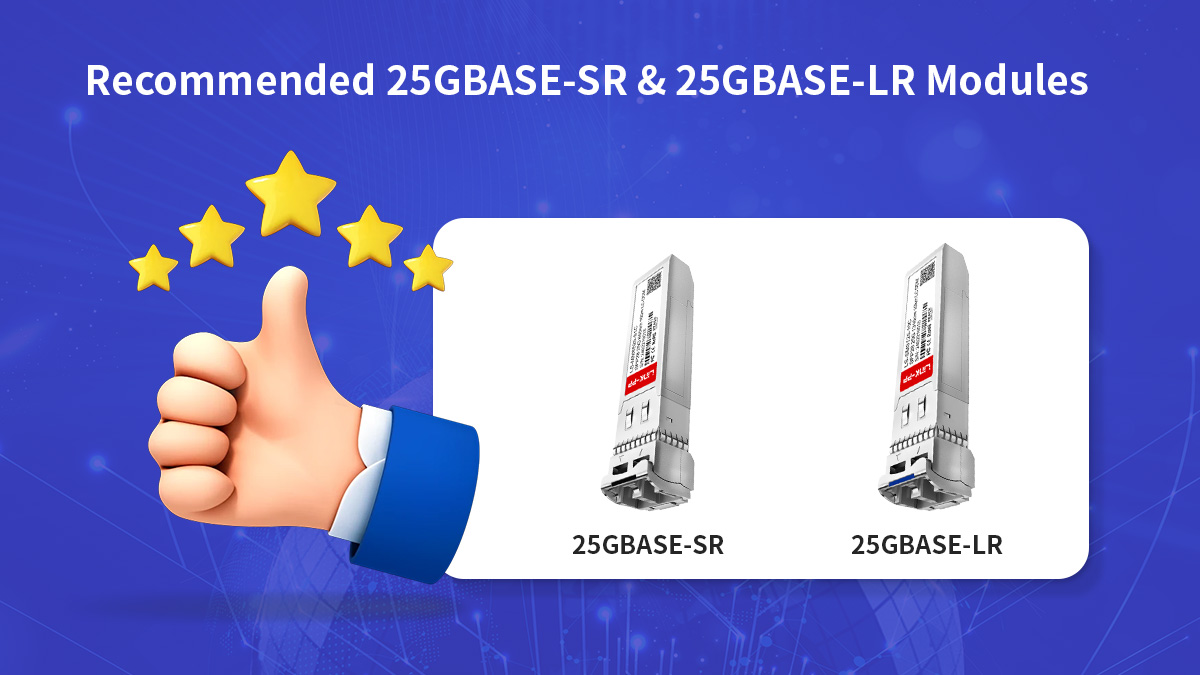
SFP28 SR (25GBASE-SR)
SFP28 SR Transceivers are optimized for short-reach, high-density optical links, making them a cost-effective choice for modern data centers.
Key Characteristics
-
Wavelength: 850 nm
-
Laser type: VCSEL
-
Maximum reach: Up to 100 m over OM4 multimode fiber
-
Low power consumption, suitable for dense switch environments
-
LC duplex interface, hot-pluggable SFP28 form factor
Typical Applications
-
Top-of-rack (ToR) and end-of-row switching
-
Spine–leaf data center architectures
-
High-port-density enterprise networks
Best for: Enterprise data centers, cloud and hyperscale environments
SFP28 LR (25GBASE-LR)
SFP28 LR Transceivers are designed for longer-reach single-mode links, where distance, stability, and future scalability are critical.
Key Characteristics
-
Wavelength: 1310 nm
-
Laser type: DFB
-
Maximum reach: Up to 10 km over OS2 single-mode fiber
-
Stable optical output for extended links
-
Suitable for outdoor, campus, and telecom deployments
Typical Applications
-
Campus and enterprise backbone networks
-
Building-to-building connections
-
5G fronthaul and eCPRI transport
-
Metro access and aggregation layers
Best for: Campus backbones, telecom infrastructure, 5G fronthaul
Compatibility & Procurement Notes
-
Always verify switch firmware and optics support lists before deployment
-
Both SR (short-reach) and LR (long-reach) modules are available in vendor-coded or open-standard versions
-
For large-scale projects, optical budget planning and fiber inspection are recommended to ensure long-term reliability
Selecting validated, standards-compliant SFP28 optics helps reduce deployment risk and ensures consistent 25G performance across mixed-vendor environments.
? SFP28 SR vs. LR: Final Buying Recommendation
Choosing between SFP28 SR and SFP28 LR ultimately comes down to link distance, fiber infrastructure, and long-term network planning, rather than raw data rate alone.
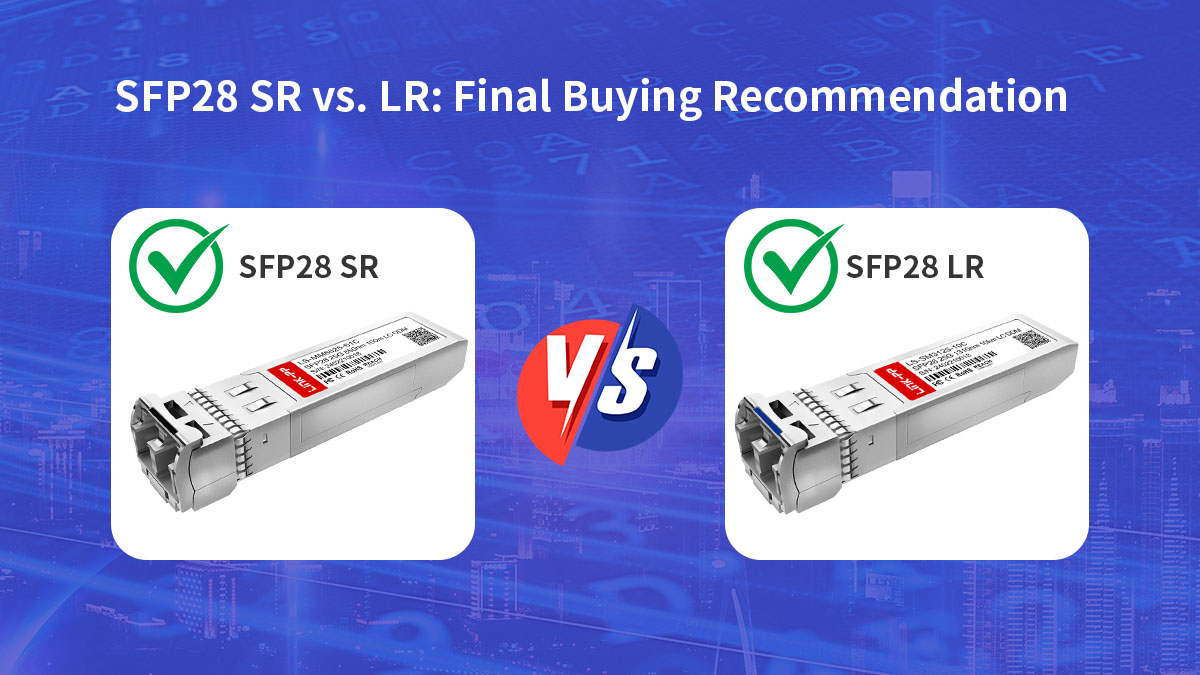
Choose SFP28 SR if:
-
Your optical links are within 100 meters, typically inside a data center
-
OM3 or OM4 multimode fiber is already installed
-
Cost efficiency and high port density are top priorities
-
You are deploying ToR, EoR (End-of-Row) , or spine–leaf architectures
➡ Bottom line: SFP28 SR offers the lowest cost per port and the simplest deployment for short-reach 25G Ethernet links.
Choose SFP28 LR if:
-
Your network requires kilometer-scale transmission distances
-
You are building or upgrading campus, metro, or telecom infrastructure
-
Single-mode fiber (OS2) is part of your existing or planned cabling
-
You want maximum scalability and future-proofing for network expansion
➡ Bottom line: SFP28 LR is the only practical choice for long-distance 25G links, providing greater flexibility for multi-building and carrier-grade deployments.
Final Tip for Buyers
While SR modules are cheaper per unit, fiber availability and upgrade strategy often determine the true total cost of ownership (TCO).
In many real-world projects, selecting the module that aligns with your current fiber plant and future growth plans delivers the best long-term value.
? Conclusion: Choosing the Right SFP28 for Your 25G Network
When comparing SFP28 SR vs. SFP28 LR, the right choice is rarely about data rate alone—both support 25Gbps Ethernet.
Instead, the decision should be driven by link distance, fiber infrastructure, deployment environment, and long-term scalability.
-
SFP28 SR is the most cost-effective and operationally simple solution for short-reach links inside data centers, especially where OM3/OM4 multimode fiber is already deployed.
-
SFP28 LR is essential for long-distance, campus, and telecom applications, offering the reach and stability required for building-to-building connections and 5G fronthaul networks.
By aligning your fiber transceiver choice with real-world application needs—not just specifications—you reduce deployment risk, control total cost of ownership, and ensure reliable 25G performance as your network scales.
Advantages of LINK-PP SFP28 Modules
LINK-PP SFP28 transceivers are engineered to meet the demands of data center, enterprise, and telecom networks, combining standards compliance, proven interoperability, and long-term supply reliability.
Key advantages include:
-
Standards-compliant design
Fully compliant with IEEE 802.3 specifications and SFP28 MSA, ensuring consistent 25G Ethernet performance across multi-vendor environments. -
Broad switch compatibility
Tested for interoperability with leading switch platforms, helping reduce deployment risk in mixed-network architectures. -
Stable optical performance
Carefully selected optical components and controlled manufacturing processes deliver reliable signal integrity and predictable link budgets. -
Deployment-ready form factor
Hot-pluggable SFP28 modules with LC duplex interfaces, designed for high-density and mission-critical installations. -
Scalable supply and customization
Support for bulk orders, OEM/ODM services, and project-based delivery, suitable for long-term network rollouts.
Need Help Choosing the Right SFP28 Module?
Not sure which SFP28 SR or LR transceiver fits your switch, fiber type, or application?
✔ Switch compatibility verification (Cisco / Arista / Juniper / HPE)
✔ Optical budget & datasheet confirmation
✔ Bulk pricing, lead time, and project support
When you’re ready to deploy, the LINK-PP provides a reliable sourcing channel for genuine 25G SFP28 optics.
▶ Request a Quote — Competitive pricing for volume and project orders
▶ Confirm Compatibility — Validate your switch and firmware before purchase
▶ Contact Sales — Get expert guidance for selecting the right SR or LR module
➡️ Visit the LINK-PP Official Store to explore certified 25G SFP28 SR & LR transceivers, or contact our sales team to request a quote tailored to your network deployment.
? FAQs About SFP28 SR and SFP28 LR
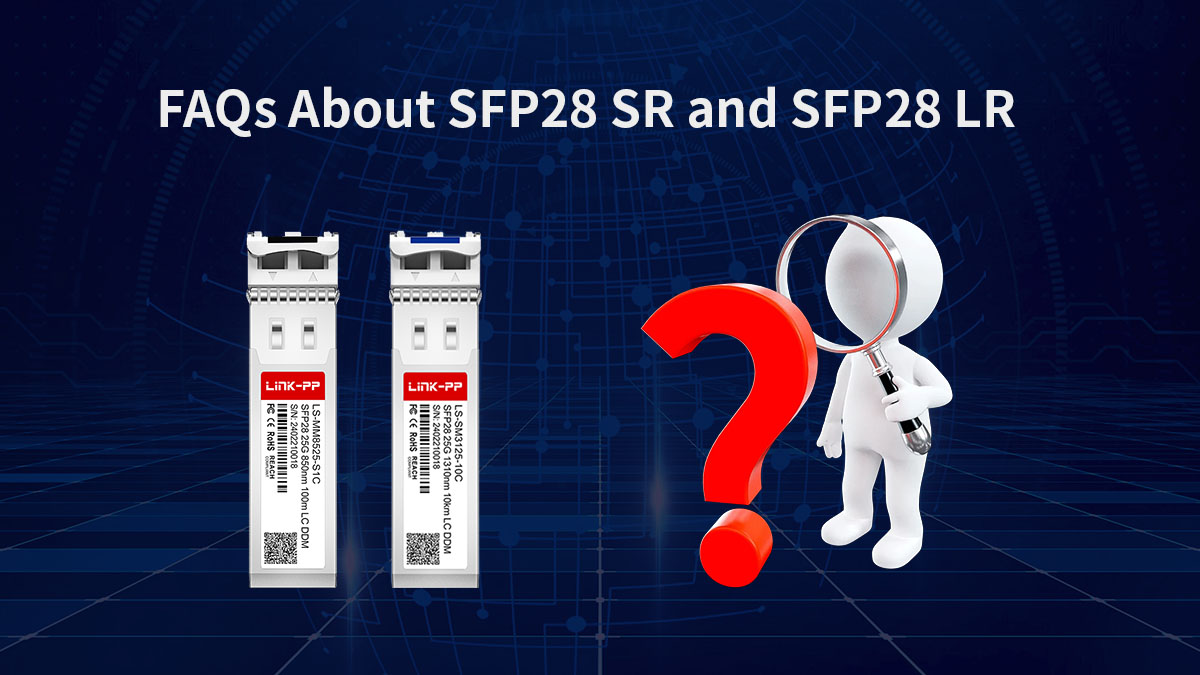
Q1: Can I use SFP28 SR on single-mode fiber?
No. SFP28 SR is designed exclusively for multimode fiber (OM3/OM4) and operates at 850 nm using a VCSEL laser.
Single-mode fiber has a much smaller core size, which causes severe coupling loss and signal instability when used with SR optics.
➡ Best practice:
-
Use SFP28 SR with OM3/OM4 multimode fiber
-
Use SFP28 LR with OS2 single-mode fiber
Q2: Is SFP28 LR compatible with 10G SFP+ ports?
No. SFP28 modules are not backward-compatible with SFP+ ports.
Although both use a similar physical form factor, SFP28 operates at 25G (25.78125 Gbps) and requires switch hardware and PHYs that explicitly support SFP28.
➡ Rule of thumb:
-
SFP+ port → use SFP+ (10G) optics
-
SFP28 port → supports SFP28 25G and often 10G SFP+ (downward compatibility depends on the switch)
Q3: What is the power consumption difference between SFP28 SR and LR?
-
SFP28 SR: typically lower power consumption
-
SFP28 LR: slightly higher power draw due to the DFB laser and longer reach
In most deployments, the difference is modest, but in high-density data center environments, SR modules are often preferred for better thermal efficiency.
Q4: Can SFP28 SR and LR be mixed on the same switch?
Yes. SFP28 SR and LR modules can be used on the same switch, as long as:
-
Each port supports SFP28
-
The correct fiber type is used for each link
-
Optical budgets are planned per connection
This is common in real-world networks where short-reach data center links and long-reach campus links coexist.
Q5: What is the difference between LR and SR fiber?
The difference is not the fiber itself, but how the optics use the fiber:
-
SR (Short Reach):
Uses multimode fiber, short distances, lower cost -
LR (Long Reach):
Uses single-mode fiber, long distances, higher reach
Q6: What is LR and SR?
-
SR (Short Reach): Designed for short-distance links, typically inside data centers
-
LR (Long Reach): Designed for long-distance transmission across campuses or telecom networks
Q7: Is single-mode LR or SR?
Single-mode fiber is used with LR optics, not SR.
LR modules are optimized for single-mode transmission at 1310 nm.
Q8: Is SFP28 the same as SFP+?
No.
-
SFP+: up to 10G
-
SFP28: up to 25G
They share a similar form factor, but SFP28 requires higher-speed electrical and optical components.