



































As 25G Ethernet becomes a key building block for modern data centers and enterprise networks, the SFP28 25G LR transceiver has emerged as a reliable solution for long-reach, high-speed optical connectivity. Designed for single-mode fiber and distances of up to 10 kilometers, SFP28 25G LR modules strike a balance between performance, scalability, and cost efficiency.
This product guide provides a comprehensive overview of SFP28 25G LR transceivers, including their technical specifications, key features, common use cases, and compatibility considerations. Whether you are upgrading a data center network, deploying 25G spine-leaf architecture, or evaluating third-party optics, this guide will help you determine if an SFP28 25G LR module is the right choice for your network.
✅ Introduction to SFP28 25G LR Modules
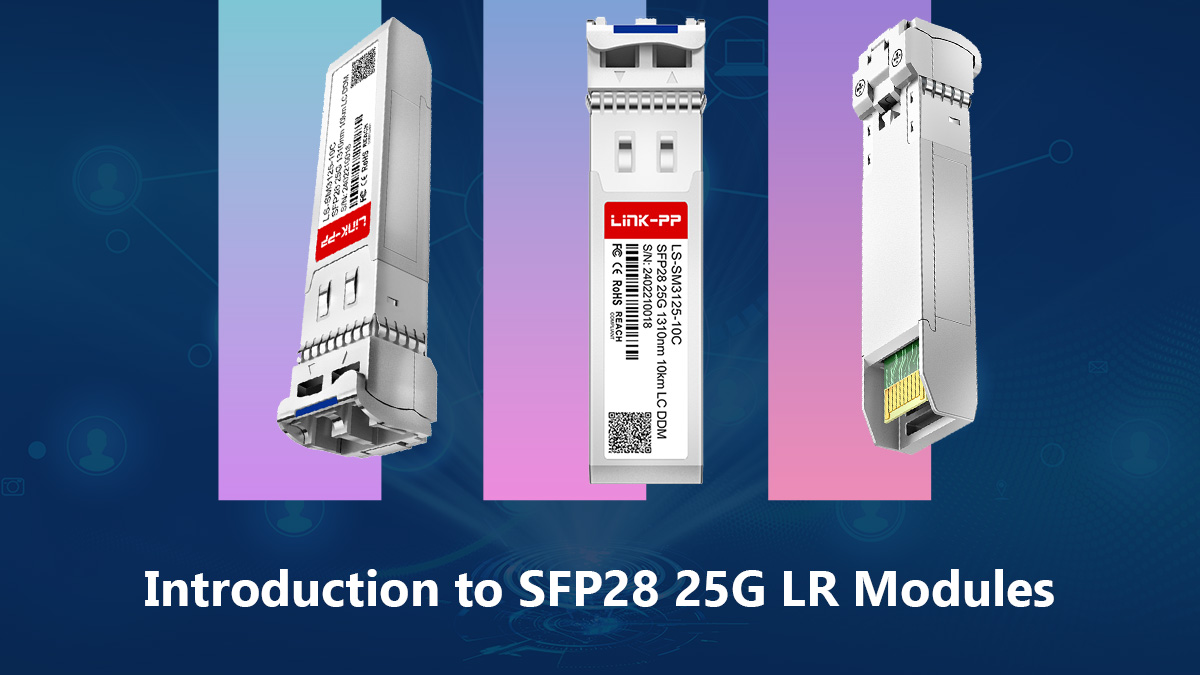
An SFP28 transceiver is a compact, hot-pluggable optical module designed to support data rates of up to 25Gbps over fiber or copper links. As an evolution of the widely used SFP+ form factor, SFP28 maintains the same physical size while significantly increasing bandwidth, making it an ideal choice for next-generation Ethernet networks that require higher throughput without increasing port density or power consumption. SFP28 transceivers are commonly used in 25G Ethernet switches, network interface cards (NICs), and routers across data center, enterprise, and telecom environments.
The SFP28 25G LR transceiver is a specific type of SFP28 module optimized for long-reach optical transmission. The “25G” refers to a data rate of approximately 25.78Gbps, while “LR” (Long Reach) indicates support for transmission distances of up to 10 kilometers over single-mode fiber (SMF). Operating at a 1310nm wavelength and typically compliant with IEEE 802.3cc standards, SFP28 25G LR modules are designed to deliver stable performance, low latency, and high signal integrity over extended fiber links.
The growing importance of 25G Ethernet in modern networks is driven by increasing east–west traffic, virtualization, cloud computing, and bandwidth-intensive applications such as AI, big data analytics, and 5G infrastructure. Compared to 10G Ethernet, 25G offers 2.5× higher bandwidth with a more favorable cost-per-bit, while also providing a smoother upgrade path to 100G and 400G architectures. As a result, 25G Ethernet has become a preferred choice for spine–leaf data center designs and high-capacity aggregation layers.
Typical buyers of SFP28 25G LR modules include data center operators, enterprise IT teams, and telecom service providers. In data centers, these modules are widely used for switch-to-switch and switch-to-server connections that require longer reach than multimode optics can provide. Enterprises deploy SFP28 25G LR for campus backbones and core network upgrades, while telecom operators rely on them for applications such as mobile fronthaul, midhaul, and metro access networks. Across these scenarios, SFP28 25G LR modules offer a reliable and scalable solution for high-speed, long-distance optical connectivity.
✅ What Is SFP28 25G LR? (Technical Overview)
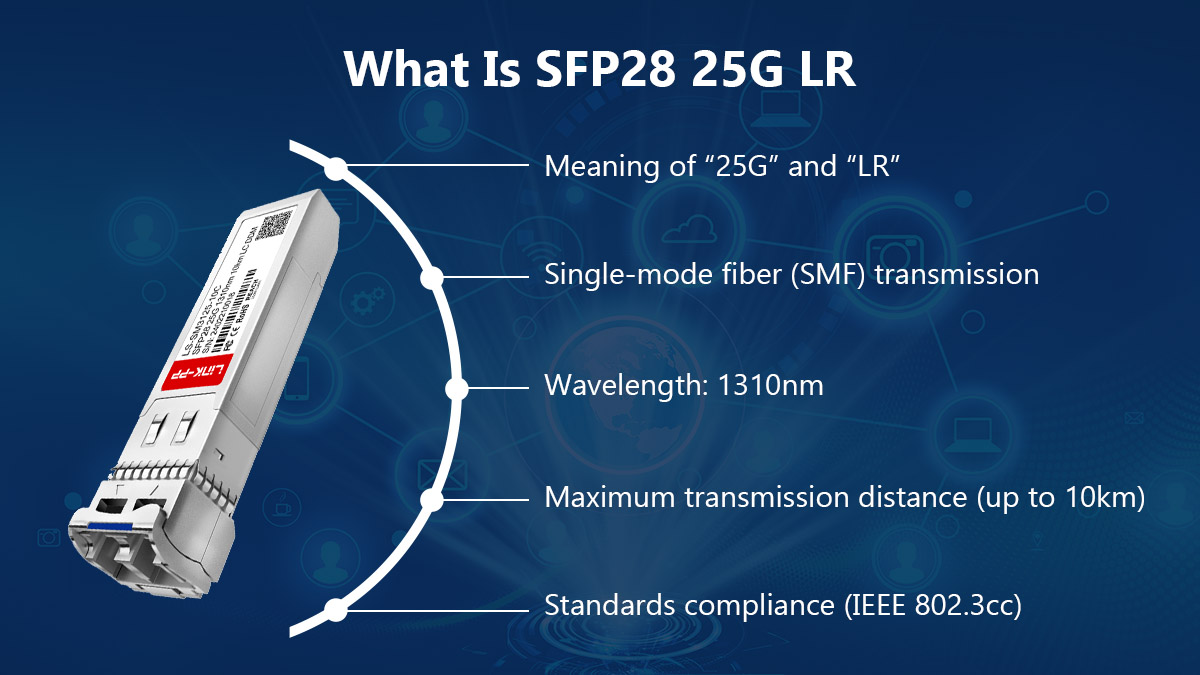
The term “SFP28 25G LR” describes a 25-gigabit optical transceiver that combines high-speed Ethernet performance with long-reach transmission capability. In this designation, “25G” refers to a line rate of 25.78Gbps, which supports 25 Gigabit Ethernet applications, while “LR” stands for Long Reach, indicating that the module is designed for extended transmission distances compared to short-reach optics. Together, these characteristics make SFP28 25G LR suitable for scenarios where both high bandwidth and longer fiber spans are required.
SFP28 25G LR transceivers are specifically engineered for single-mode fiber (SMF) transmission. Single-mode fiber allows light to propagate through a single optical path, minimizing modal dispersion and signal loss over long distances. This makes SMF the preferred medium for metro, campus, and data center interconnect (DCI) applications where reliability and reach are critical. Unlike multimode solutions, SMF-based SFP28 25G LR modules can maintain consistent performance over several kilometers without significant degradation.
A key technical characteristic of SFP28 25G LR is its operating wavelength of 1310nm. This wavelength is widely used in long-reach optical communications because it offers a favorable balance between attenuation and dispersion in single-mode fiber. Operating at 1310nm enables stable signal transmission while keeping power consumption and optical complexity within practical limits for compact SFP28 form factors.
In terms of reach, an SFP28 25G LR module typically supports transmission distances of up to 10 kilometers over standard single-mode fiber. This distance capability makes it suitable for inter-building connections, extended data center links, and access or aggregation layers in telecom networks. Actual achievable distance may vary depending on factors such as fiber quality, connector loss, and overall link power budget.
From a standards perspective, SFP28 25G LR transceivers are commonly compliant with IEEE 802.3cc, which defines the physical layer specifications for 25G Ethernet over single-mode fiber. Compliance with this standard ensures interoperability between equipment from different vendors and guarantees consistent performance in multi-vendor network environments. As a result, IEEE 802.3cc compliance is a key requirement for organizations deploying SFP28 25G LR modules in production networks.
✅ Key Features and Specifications of SFP28 25G LR
The SFP28 25G LR transceiver is engineered to provide high-speed, long-reach optical connectivity in a compact and energy-efficient form factor. Its specifications are designed to meet the requirements of modern 25G Ethernet networks across data center, enterprise, and telecom environments.
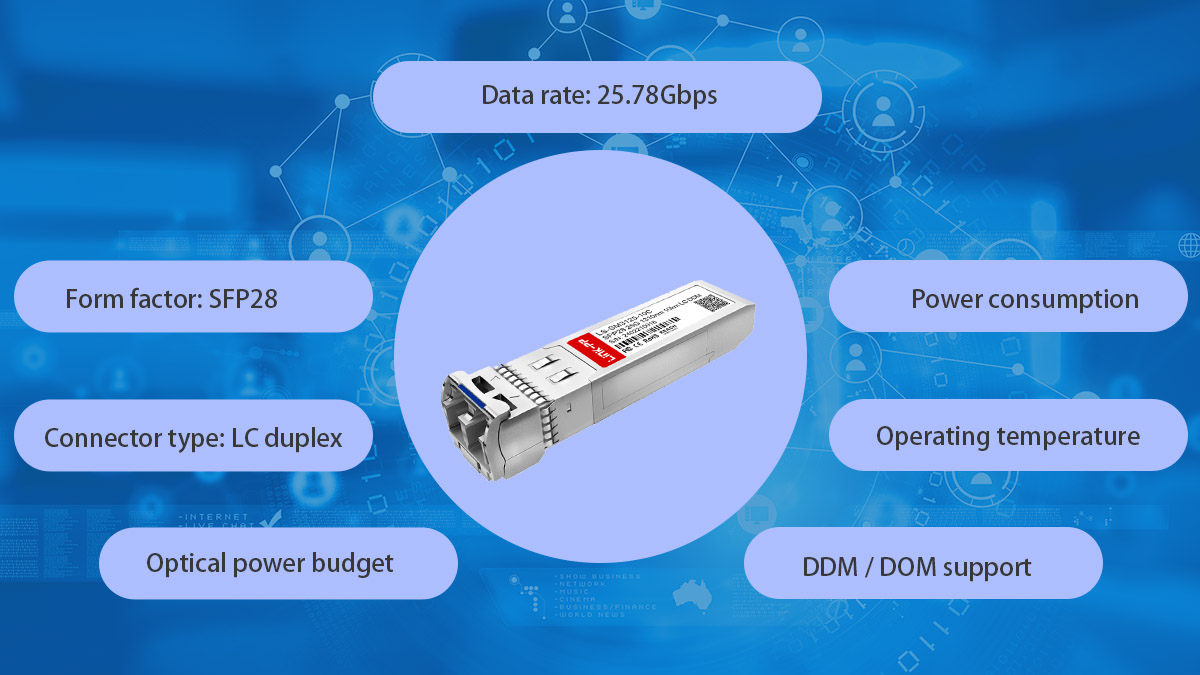
Key Specifications Overview
| Specification | Description |
|---|---|
| Data Rate | 25.78Gbps, compliant with 25 Gigabit Ethernet requirements |
| Form Factor | SFP28, same physical size as SFP/SFP+ |
| Fiber Type | Single-mode fiber (SMF) |
| Connector Type | LC duplex |
| Wavelength | 1310nm |
| Maximum Distance | Up to 10km |
| Optical Power Budget | Designed to support long-reach links with typical fiber and connector losses |
| Power Consumption | Low power, suitable for high-density deployments |
| Operating Temperature | Commercial (0°C to 70°C) / Industrial (–40°C to 85°C) |
| Monitoring | DDM / DOM supported |
Detailed Feature Explanation
SFP28 25G LR operates at a 25.78Gbps data rate, delivering significantly higher bandwidth than 10G solutions while maintaining a favorable cost-per-bit. This makes it a strong choice for network upgrades where performance and efficiency are equally important.
The SFP28 form factor allows these modules to be used in high-density switches and NICs without increasing physical footprint. Being hot-pluggable, they simplify installation and maintenance, reducing operational downtime.
With a standard LC duplex connector, SFP28 25G LR modules provide separate transmit and receive paths over single-mode fiber, ensuring stable and reliable signal transmission. LC connectors are widely supported and easy to integrate into existing fiber infrastructure.
The optical power budget of SFP28 25G LR is optimized for links of up to 10km, accounting for typical insertion losses from fiber, patch panels, and connectors. This makes the module suitable for inter-building connections, extended data center links, and access or aggregation networks.
In high-port-count environments, power consumption is a critical factor. SFP28 25G LR transceivers are designed to consume relatively low power compared to longer-reach or higher-speed optics, helping to reduce heat generation and overall system energy costs.
To support different deployment environments, SFP28 25G LR modules are available in both commercial-grade and industrial-grade temperature ranges. This flexibility allows the same optical technology to be used in controlled data centers as well as harsh telecom or outdoor environments.
Most SFP28 25G LR transceivers also include Digital Diagnostic Monitoring (DDM/DOM), enabling real-time visibility into module temperature, voltage, and optical power levels. This capability helps network operators proactively monitor link health and quickly troubleshoot potential issues.
✅ SFP28 25G LR vs Other 25G Optical Modules
When selecting a 25G optical transceiver, understanding the differences between SR, LR, and ER variants is essential. Each module type is designed for specific transmission distances, fiber types, and deployment scenarios. The following comparisons focus on how SFP28 25G LR differs from other commonly used 25G optical modules, helping network designers and buyers make informed decisions.
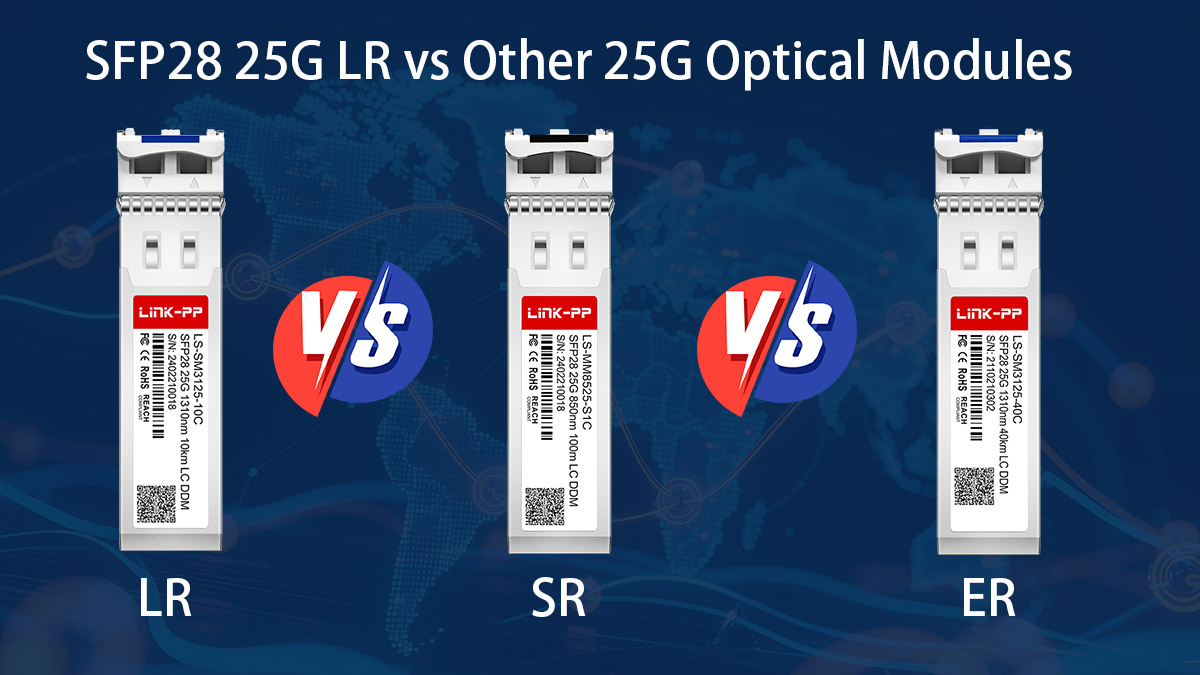
SFP28 25G LR vs SR
SFP28 25G SR (Short Reach) modules are optimized for short-distance connections within data centers, while SFP28 25G LR modules are designed for longer-reach links over single-mode fiber. The most important differences are transmission distance, fiber type, and overall cost structure.
Key Differences: LR vs SR
| Feature | SFP28 25G SR | SFP28 25G LR |
|---|---|---|
| Typical Distance | Up to 70m–100m | Up to 10km |
| Fiber Type | Multimode fiber (MMF) | Single-mode fiber (SMF) |
| Wavelength | 850nm | 1310nm |
| Use Case | In-rack / intra-data center | Inter-building / extended links |
| Module Cost | Lower | Higher than SR |
From a distance perspective, SFP28 25G SR transceiver is limited to short runs, making it ideal for switch-to-server or top-of-rack to end-of-row connections. In contrast, SFP28 25G LR supports distances up to 10km, enabling connectivity between data centers, buildings, or distant network segments.
The fiber type is another major differentiator. SR modules rely on multimode fiber, which is cost-effective for short links but not suitable for long distances. LR modules use single-mode fiber, which offers lower attenuation and greater scalability for future network expansion.
In terms of cost considerations, SR modules are typically less expensive than LR modules. However, when longer distances are required, LR becomes the more practical and sometimes more cost-efficient choice, as it avoids the need for additional network equipment such as repeaters or media converters.
SFP28 25G LR vs ER
SFP28 25G ER (Extended Reach) modules are designed for even longer distances than LR, typically targeting metro or telecom-grade deployments. Comparing LR and ER helps determine whether extended reach is truly necessary for a given network.
Key Differences: LR vs ER
| Feature | SFP28 25G LR | SFP28 25G ER |
|---|---|---|
| Maximum Distance | Up to 10km | Up to 40km |
| Fiber Type | Single-mode fiber | Single-mode fiber |
| Wavelength | 1310nm | 1310nm (higher optical power) |
| Power Consumption | Lower | Higher |
| Module Price | Moderate | Higher |
In terms of transmission reach, ER modules significantly extend the distance to around 40km, compared to the 10km limit of LR modules. This extended reach is achieved through higher transmit power and more sensitive receivers.
These performance gains come with trade-offs in power and price. ER modules typically consume more power and are priced higher than LR modules, which can impact operating costs and thermal design in high-density environments.
Regarding typical deployment scenarios, SFP28 25G LR is commonly used for data center interconnects, campus backbones, and aggregation layers where distances fall within 10km. SFP28 25G ER, on the other hand, is better suited for metro networks, telecom access, or long-haul applications where extended reach is essential and higher cost is justified.
Summary of 25G Optical Module Selection
In summary, SFP28 25G SR is ideal for short-distance, cost-sensitive deployments, SFP28 25G LR offers a balanced solution for long-reach and cost efficiency, and SFP28 25G ER transceiver is best reserved for extended-distance requirements. Understanding these differences helps ensure optimal performance, cost control, and scalability in 25G Ethernet networks.
✅ Common Use Cases for SFP28 25G LR
Thanks to its combination of high bandwidth, long reach, and efficient power consumption, the SFP28 25G LR transceiver is widely adopted across a range of networking environments. Its ability to deliver stable 25G connectivity over single-mode fiber makes it particularly suitable for applications that require both performance and distance.
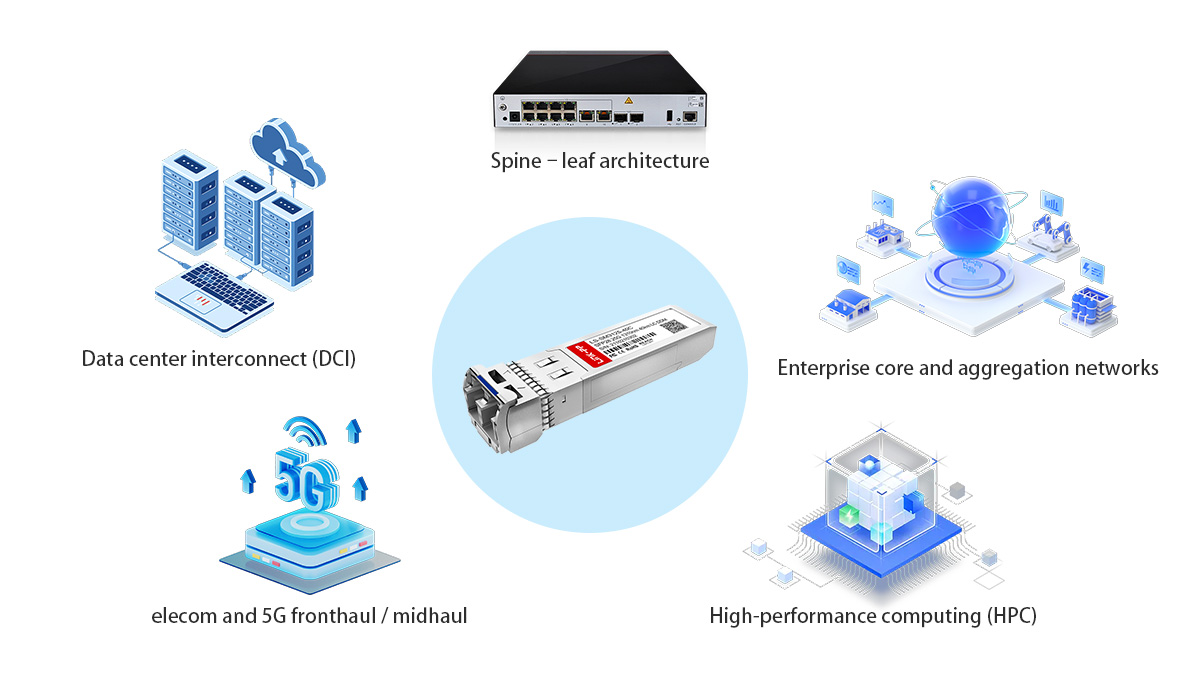
Data Center Interconnect (DCI)
In data center interconnect (DCI) scenarios, SFP28 25G LR modules are commonly used to connect separate data center buildings or facilities within a metropolitan area. With support for distances of up to 10 km, these modules enable high-speed links between data centers without the need for complex amplification or regeneration equipment. This makes SFP28 25G LR a cost-effective solution for synchronizing workloads, enabling data replication, and supporting cloud-scale operations.
Spine–Leaf Architecture
Modern data centers often rely on spine–leaf architectures to achieve predictable latency and high scalability. In this topology, SFP28 25G LR modules are frequently deployed on leaf switches to connect to spine switches when distances exceed the limits of short-reach optics. Their long-reach capability allows greater flexibility in rack placement and data hall design, while maintaining consistent 25G performance across the fabric.
Enterprise Core and Aggregation Networks
Enterprises use SFP28 25G LR modules in core and aggregation layers to support growing traffic demands from applications such as virtualization, unified communications, and cloud services. The 10km reach over single-mode fiber makes these modules well suited for connecting buildings across a campus or linking aggregation switches to core routers. As enterprises migrate from 10G to 25G Ethernet, SFP28 25G LR offers a scalable upgrade path without major changes to existing fiber infrastructure.
Telecom and 5G Fronthaul / Midhaul
In telecom networks, particularly those supporting 5G fronthaul and midhaul, SFP28 25G LR transceivers play a critical role. They provide the bandwidth required to transport high volumes of mobile traffic between radio units, distributed units, and centralized units over extended distances. Their reliability, standards compliance, and support for industrial temperature ranges make them suitable for demanding telecom environments.
High-Performance Computing (HPC)
High-performance computing (HPC) environments require low-latency, high-throughput interconnections to support data-intensive workloads. SFP28 25G LR modules are used to link compute nodes, storage systems, and aggregation switches across larger HPC clusters where distances exceed typical multimode limits. By leveraging single-mode fiber, these modules help maintain signal integrity and performance as HPC infrastructures scale.
✅ Compatibility and Interoperability
Compatibility and interoperability are critical factors when deploying SFP28 25G LR transceivers, especially in multi-vendor network environments. Ensuring that optical modules work seamlessly with switches, routers, and network interface cards helps reduce deployment risks, minimize downtime, and control operational costs.
Vendor Compatibility (Cisco, Arista, Juniper, Mellanox, etc.)
SFP28 25G LR modules are widely supported by leading network equipment vendors such as Cisco, Arista, Juniper, and Mellanox (NVIDIA). When properly coded, these transceivers can operate reliably in a wide range of 25G Ethernet switches and adapters. Many organizations deploy SFP28 25G LR modules across mixed environments, pairing third-party optics with branded hardware to achieve greater flexibility and cost efficiency.
However, compatibility can vary depending on device model, operating system version, and firmware. For this reason, it is important to verify that the SFP28 25G LR module is explicitly tested or certified for the target platform, particularly in mission-critical deployments.
MSA Compliance
Most SFP28 25G LR transceivers are designed in accordance with Multi-Source Agreement (MSA) specifications. MSA compliance ensures standardized electrical, mechanical, and optical characteristics, allowing modules from different manufacturers to interoperate with compatible network equipment. This standardization is especially valuable in multi-vendor environments, as it reduces vendor lock-in and simplifies procurement.
MSA-compliant SFP28 25G LR modules typically support consistent pin definitions, form factors, and management interfaces, making them suitable for use in open networking ecosystems.
Coding and EEPROM Considerations
One of the most important aspects of compatibility is EEPROM coding. The EEPROM contains vendor-specific identification data that network devices use to recognize and validate optical modules. Some switch vendors enforce strict checks on this information and may limit functionality or generate warnings if a non-approved module is detected.
Properly coded SFP28 25G LR transceivers can emulate the identification of original vendor optics, ensuring full functionality such as link initialization, DOM/DDM monitoring, and error-free operation. Selecting modules with accurate and reliable EEPROM programming is essential for stable long-term deployment.
Plug-and-Play vs Firmware Restrictions
In many cases, SFP28 25G LR modules offer true plug-and-play operation, allowing them to be inserted and used without additional configuration. This is common in open networking platforms and devices with relaxed compatibility policies.
However, some vendors implement firmware restrictions that may require specific configurations, software commands, or approved optics lists to enable third-party transceivers. Understanding these restrictions in advance helps network operators plan deployments more effectively and avoid unexpected compatibility issues.
✅ How to Choose the Right SFP28 25G LR Module
Selecting the right SFP28 25G LR transceiver requires more than matching speed and distance. Network operators must consider hardware compatibility, fiber infrastructure, environmental conditions, and budget constraints. The following guidelines outline the key factors to evaluate when choosing an SFP28 25G LR module.
Key Selection Criteria Overview
| Selection Factor | What to Check | Why It Matters |
|---|---|---|
| Device Compatibility | Switch / NIC model, OS version | Ensures stable operation and full functionality |
| Distance & Fiber Type | Link length, SMF availability | Confirms the module can meet reach requirements |
| Power Budget | Tx power and Rx sensitivity | Prevents link loss and performance degradation |
| Operating Environment | Temperature, indoor vs outdoor | Ensures reliability in real-world conditions |
| Optics Source | OEM vs third-party | Impacts cost, availability, and flexibility |
Verify Switch or NIC Requirements
The first step is to verify the requirements of the target switch or NIC. This includes confirming support for 25G Ethernet, SFP28 form factors, and IEEE 802.3cc compliance. Device documentation often specifies supported transceiver types and firmware versions. Ensuring compatibility at this stage reduces the risk of link failures or unsupported module warnings.
Distance and Fiber Type Selection
SFP28 25G LR modules are designed for single-mode fiber (SMF) and support transmission distances of up to 10km. Before selecting a module, it is important to measure the actual link distance and confirm the availability and quality of SMF infrastructure. If the required distance is significantly shorter or longer, alternative options such as SR or ER modules may be more appropriate.
Power Budget Planning
Proper power budget planning ensures reliable link performance. This involves accounting for transmit power, receiver sensitivity, fiber attenuation, connector losses, and any additional margin for aging or environmental factors. Choosing an SFP28 25G LR module with an adequate power budget helps prevent intermittent link issues and simplifies long-term maintenance.
Temperature and Environment Considerations
Deployment environment plays a critical role in module selection. Commercial-grade SFP28 25G LR modules are suitable for controlled indoor environments like data centers, while industrial-grade modules are designed for wider temperature ranges and harsher conditions. Selecting the appropriate temperature rating helps maintain performance and extend the operational lifespan of the transceiver.
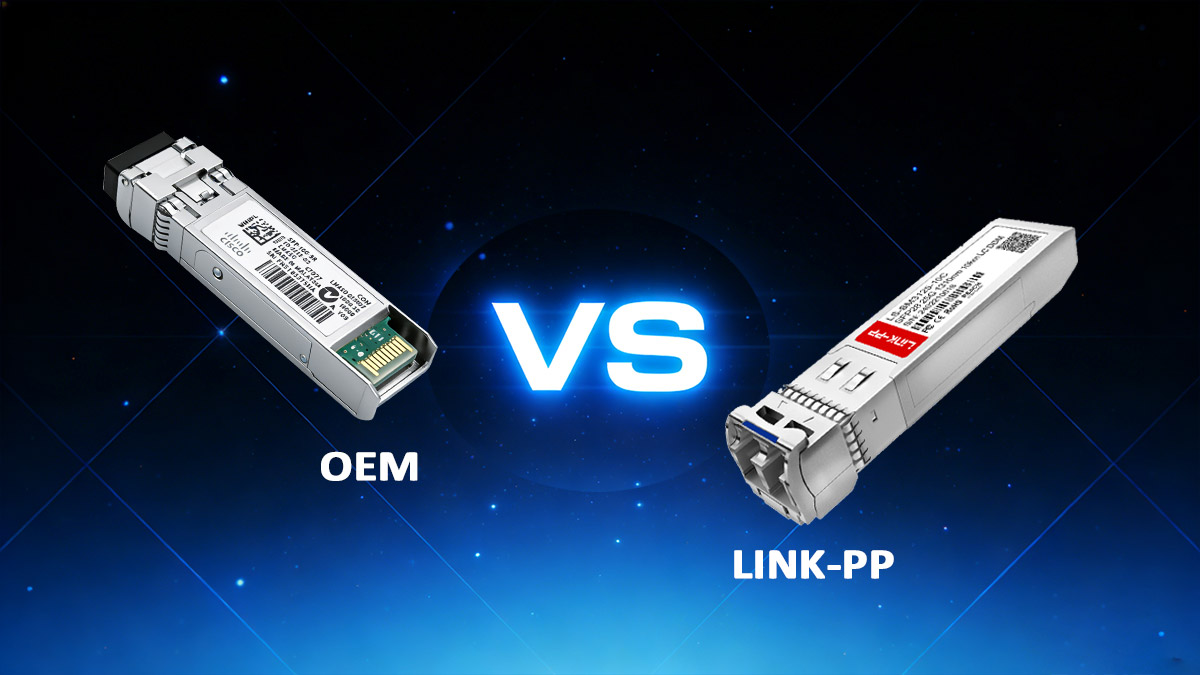
OEM vs Third-Party Optics
When choosing between OEM and third-party SFP28 25G LR optics, organizations must balance cost, support, and flexibility. OEM modules are typically more expensive but offer guaranteed compatibility and vendor support. Third-party optics, when properly coded and tested, can deliver equivalent performance at a significantly lower cost, making them an attractive option for large-scale or cost-sensitive deployments.
Selection Summary
By carefully evaluating device compatibility, distance requirements, power budget, environmental conditions, and sourcing options, network operators can confidently select the right SFP28 25G LR module for their specific application. This structured approach helps ensure optimal performance, reliability, and long-term value.
✅ Installation and Best Practices
Proper installation and maintenance are essential to ensure optimal performance and long-term reliability of SFP28 25G LR transceivers. Following best practices during handling, deployment, and monitoring can help prevent common issues such as signal loss, link instability, and premature hardware failure.
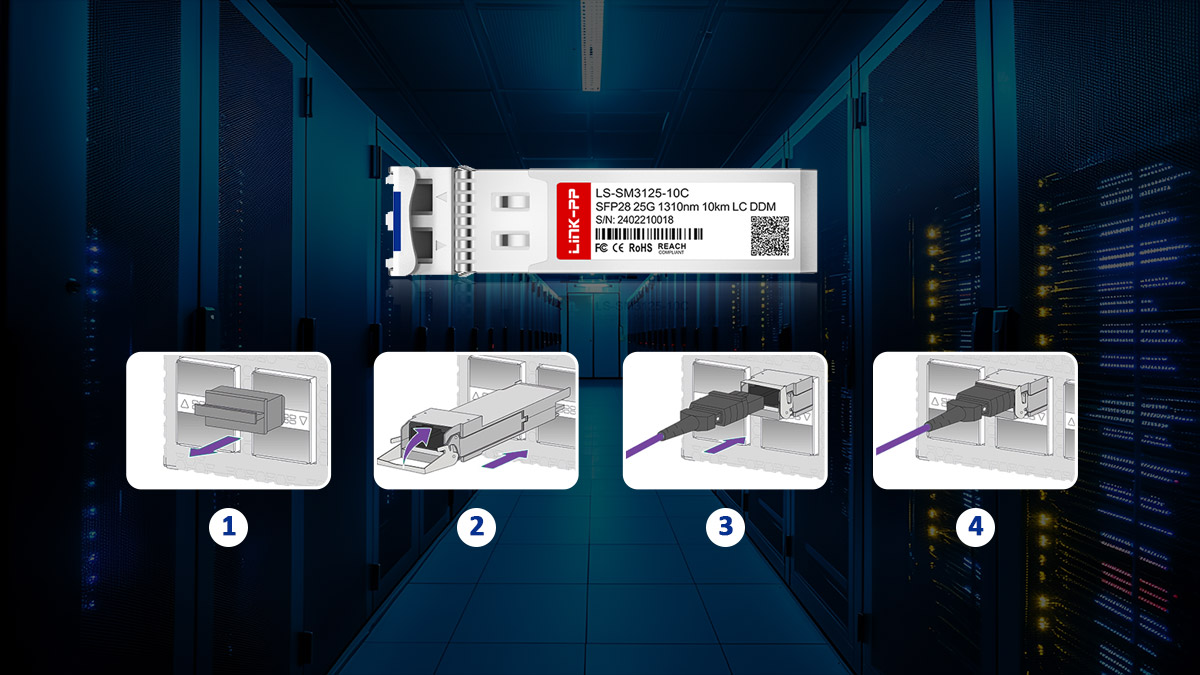
Handling and ESD Protection
SFP28 25G LR modules contain sensitive electronic and optical components that can be damaged by electrostatic discharge (ESD). Always handle transceivers in an ESD-safe environment and use grounded wrist straps when possible. Modules should remain in their protective packaging until installation and should be inserted or removed gently to avoid damaging the connector or cage. Proper handling reduces the risk of latent failures that may not be immediately visible.
Fiber Cleanliness and Inspection
Clean fiber connections are critical for high-speed optical links. Even microscopic dust or contamination on fiber end faces can cause significant signal degradation at 25G speeds. Before connecting an SFP28 25G LR module, both the module connector and fiber patch cord should be cleaned and inspected using appropriate tools. Regular inspection and cleaning practices help maintain low insertion loss and ensure consistent link performance.
Link Testing and Validation
After installation, it is important to perform link testing and validation to confirm proper operation. This may include checking link status indicators on the switch or NIC, verifying negotiated speed, and running basic traffic tests. In more complex environments, optical power measurements and bit error rate testing (BERT) can provide additional assurance that the SFP28 25G LR link meets performance expectations.
Monitoring with DOM/DDM
Most SFP28 25G LR transceivers support Digital Optical Monitoring (DOM) or Digital Diagnostic Monitoring (DDM), which allows real-time visibility into key operating parameters such as temperature, voltage, transmit power, and receive power. Regularly monitoring these values helps network operators detect early signs of degradation, such as increasing loss or abnormal temperature, enabling proactive maintenance and reducing the likelihood of unexpected outages.
✅ Summary: Is SFP28 25G LR Right for Your Network?
Key advantages recap
SFP28 25G LR provides an optimal balance of 25G bandwidth, long-reach capability, and cost efficiency. With support for up to 10 km over single-mode fiber, low power consumption, and broad standards compliance, it is well suited for scalable data center, enterprise, and telecom networks.
When to choose 25G LR over other options
Choose SFP28 25G LR when your network requires reliable 25G connectivity beyond short-reach limits.
It is the ideal option when 25G SR cannot meet distance requirements and 25G ER exceeds both reach and budget needs, making LR the most practical middle ground.
Final recommendations for buyers
For organizations upgrading from 10G or deploying new 25G infrastructure, SFP28 25G LR is a future-ready and dependable choice. Always verify device compatibility, fiber type, and distance requirements before purchasing.
To ensure quality, compatibility, and cost efficiency, source your optics from a trusted supplier such as the LINK-PP Official Store, where professionally tested SFP28 25G LR modules are available for a wide range of network platforms.
✅ FAQs About SFP28 25G LR
The following frequently asked questions address common concerns about SFP28 25G LR transceivers. Answers are written in a concise, direct format to improve readability and optimize eligibility for Google Featured Snippets.
Is SFP28 backward compatible with SFP+?
No, SFP28 is not backward compatible with SFP+ in terms of data rate.
Although SFP28 and SFP+ share the same physical form factor, SFP28 is designed for 25G operation, while SFP+ supports up to 10G. An SFP28 module cannot operate at 10G speeds unless explicitly designed as a multi-rate transceiver, and compatibility depends on the capabilities of the host device.
Can SFP28 25G LR work with 10G LR?
No, SFP28 25G LR cannot directly interoperate with 10G LR modules.
SFP28 25G LR operates at a 25G data rate and requires a 25G-capable port on both ends of the link. A 10G LR module uses different signaling and is not compatible with 25G Ethernet links. For mixed-speed environments, separate 10G and 25G links are required.
What fiber is required for 25G LR?
SFP28 25G LR requires single-mode fiber (SMF).
These modules operate at a wavelength of 1310nm and are designed specifically for SMF. Multimode fiber is not suitable for 25G LR transmission due to its higher attenuation and dispersion over long distances.
How far can SFP28 25G LR transmit reliably?
SFP28 25G LR can transmit reliably up to 10 kilometers over single-mode fiber.
Actual transmission distance may vary depending on fiber quality, connector loss, and overall link power budget. Proper installation and clean fiber connections help ensure maximum reach and stable performance.
Is third-party SFP28 safe to use?
Yes, third-party SFP28 modules are safe to use when sourced from reputable suppliers.
High-quality third-party SFP28 25G LR transceivers are typically MSA-compliant, fully tested, and properly coded for specific vendors. They can deliver performance comparable to OEM optics while offering significant cost savings, especially in large-scale deployments.







