





























The rapid growth of cloud computing, AI workloads, and 5G networks has pushed network infrastructure toward ultra-high bandwidth and low latency. Traditional 100G links are increasingly becoming a bottleneck in modern data centers and backbone networks.
QSFP 400G has emerged as a key optical transceiver to address these challenges, enabling higher port density and more efficient data transmission. It allows network operators to scale capacity while controlling power consumption and operational complexity.
This article will delve into the world of QSFP 400G optical module, exploring its working principle, various module types, and significant advantages. Also, we will explore its transformative use cases across AI data centers, data center interconnects, and spine-leaf network architectures, providing a comprehensive guide to its role in modern networking.
✳️ What is QSFP 400G
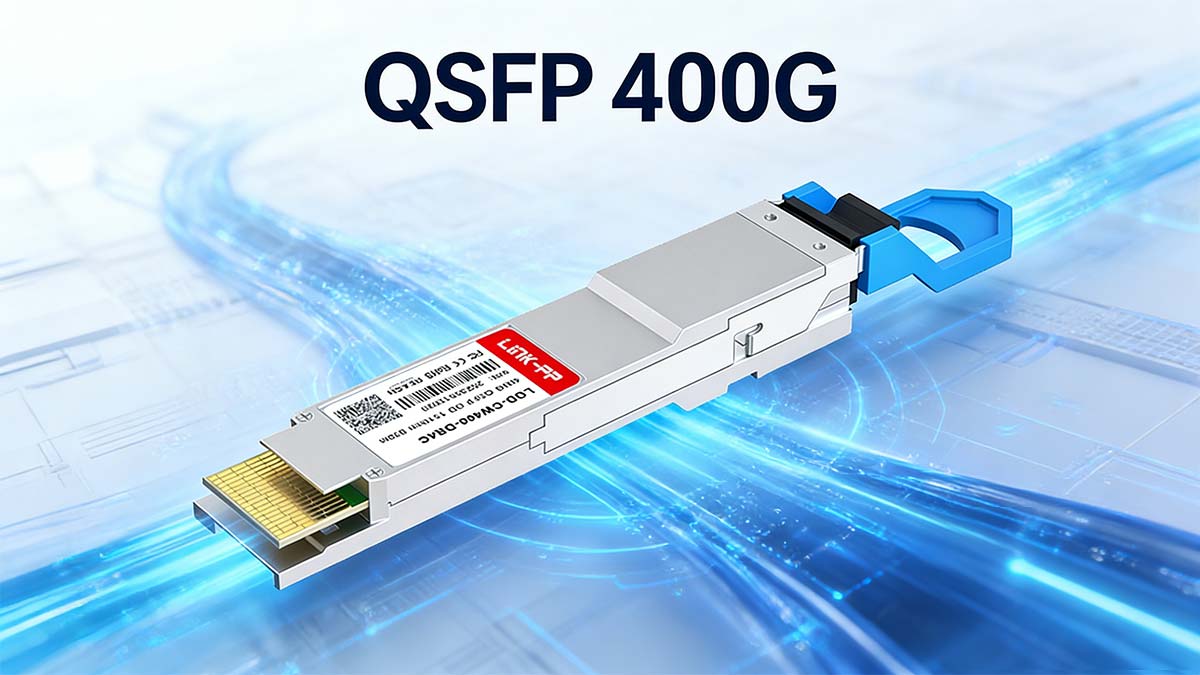
QSFP 400G is a high-density, high-speed optical transceiver designed to deliver 400Gbps of data transmission. It combines compact design with incredible bandwidth capacity to support dense, power-efficient networking solutions.
Definition and Basics of QSFP 400G
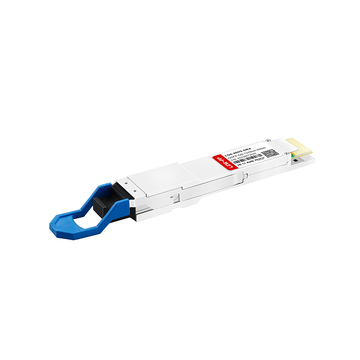
QSFP 400G refers to a Quad Small Form-factor Pluggable module that supports an aggregate data rate of 400Gbps. It is typically based on QSFP-DD (Double Density) form factor, which doubles the electrical lanes compared to QSFP28, allowing higher throughput within the same footprint.
From a physical perspective, QSFP 400G modules integrate advanced modulation schemes such as PAM4 to transmit more bits per symbol. This enables higher speeds without proportionally increasing the number of optical fibers or electrical interfaces.
How QSFP 400G Optical Transceivers Work
QSFP 400G optical modules operate by converting electrical signals from the switch or router into optical signals for transmission through fiber, then back to electrical signals at the receiving end. This conversion is handled by components such as laser drivers, photodiodes, and digital signal processors (DSPs).
In most implementations, the module divides data across eight optical lanes, each transmitting at 50Gbps, or uses advanced 4-lane 100Gbps PAM4 modulation. The digital signal processor ensures signal integrity and compensates for distortions, allowing stable long-distance transmission, typically spanning from 100m (SR8) to 10km (LR4).
Why QSFP 400G Is Critical for High-Bandwidth Networks
With the explosion of high-data-rate applications like AI training clusters and edge computing, the need for faster, denser connectivity has never been greater. QSFP 400G delivers the throughput and scalability required for these architectures while maintaining interoperability and improving operational efficiency.
The importance of QSFP 400G includes:
- Enabling aggregation of multiple 100G connections into a single 400G link, improving network efficiency.
- Reducing physical footprint in data centers by supporting high port density.
- Delivering lower power consumption per bit transmitted, reducing operational costs.
- Supporting scalable bandwidth growth as AI, cloud computing, and 5G continue expanding global traffic.
✳️ QSFP 400G Optical Transceiver Module Types
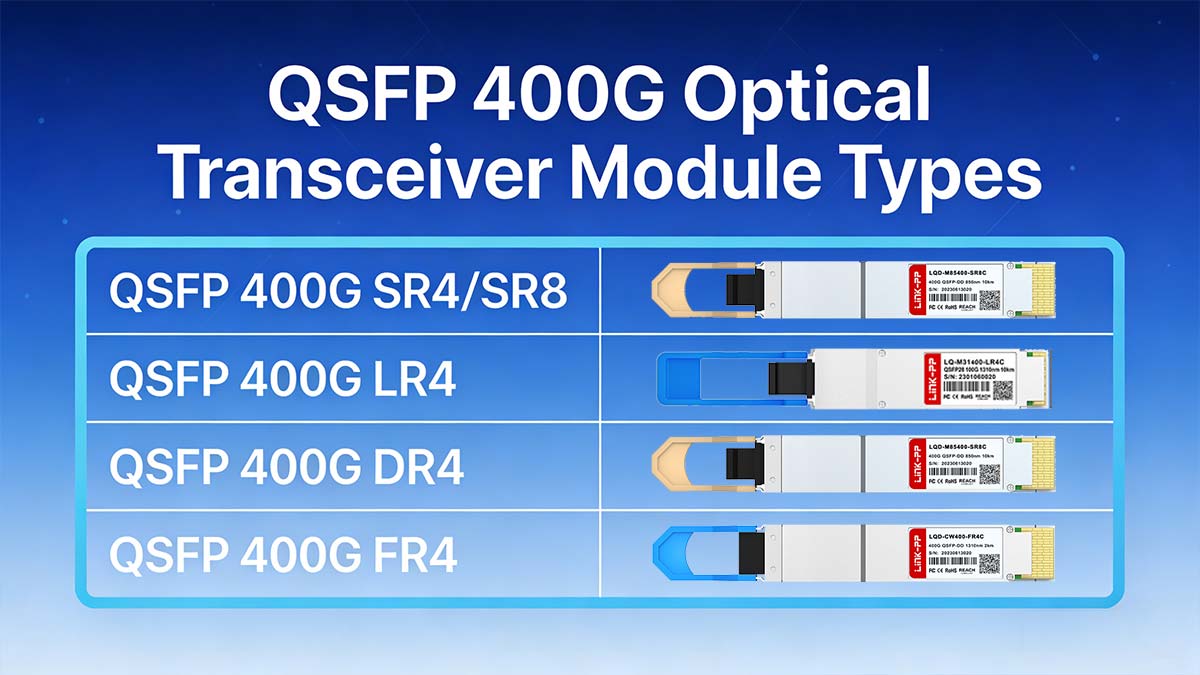
QSFP 400G optical transceiver modules are available in multiple variants to support different transmission distances, fiber types, and deployment scenarios within modern network infrastructures. Each module type is optimized for specific use cases such as short-reach intra–data center connections, long-reach data center interconnects (DCI), or high-density spine-leaf architectures. The table below summarizes the key distinctions between the main QSFP 400G module types:
| Module Type | SR4/SR8 | DR4 | FR4 | LR4 |
| Transmission Distance | Up to 70m (OM3) / 100m (OM4) | Up to 500m | Up to 2km | Up to 10km |
| Fiber Type | Multimode Fiber (MMF) | Single Mode Fiber (SMF) | Single Mode Fiber (SMF) | Single Mode Fiber (SMF) |
| Lane | 8 x 50G Lanes (SR8) 4 x 100G Lanes (SR4) |
4 x 100G Lanes | 4 x 100G Lanes | 4 x 100G Lanes |
| Wavelength | 850nm | 1310nm | 1310nm CWDM |
1310nm CWDM |
| Connector | MPO-12 / MPO-16 | MPO-12 | Duplex LC | Duplex LC |
| Typical Application | Intra-rack and Short-reach Data Center Links | Leaf-to-spine and Intra-data Center Connections | Medium-reach Data Center Iinterconnect | Long-reach DCI and Metro Networks |
QSFP 400G SR4/SR8
QSFP 400G SR4 and SR8 modules are designed for short-reach transmission over multimode fiber using an 850nm wavelength. QSFP SR4 typically uses four parallel lanes at 100G each, while SR8 uses eight parallel lanes at 50G each, enabling flexible breakout configurations. These optical modules rely on MPO connectors and are commonly deployed within data centers for intra-rack or row-to-row connections. Due to their low cost and low power consumption, SR modules are ideal for high-density environments where transmission distances are limited.
QSFP 400G LR4
QSFP 400G LR4 modules support long-reach transmission over single-mode fiber, typically up to 10km. They use four coarse wavelength division multiplexing (CWDM) lanes in the 1310nm range and transmit over a standard LC duplex connector. QSFP LR4 modules are widely used in data center interconnects, metro networks, and service provider environments where longer distances and high reliability are required. Although they consume more power than short-reach modules, LR4 transceivers offer exceptional performance for long-distance 400G deployments.
QSFP 400G DR4
QSFP 400G DR4 modules are optimized for single-mode fiber transmission up to 500m using four parallel lanes at 1310nm. With an MPO-12 connector, QSFP DR4 modules are well-suited for modern spine-leaf data center architectures, where high bandwidth and low latency are critical. DR4 has become a popular choice for hyperscale and cloud data centers due to its balance of cost, power efficiency, and performance. It also supports breakout configurations, enabling flexible network designs.
QSFP 400G FR4
QSFP 400G FR4 modules bridge the gap between DR4 and LR4 by offering transmission distances of up to 2km over single mode fiber. Like LR4, QSFP FR4 uses CWDM technology and duplex LC connectors, but with a shorter reach and lower power consumption. These modules are ideal for medium-distance data center interconnects and campus networks where DR4’s reach is insufficient and LR4 may be excessive. FR4 provides a cost-effective solution while maintaining high performance and compatibility.
✳️ Advantages of QSFP 400G in Network Infrastructure Deployment
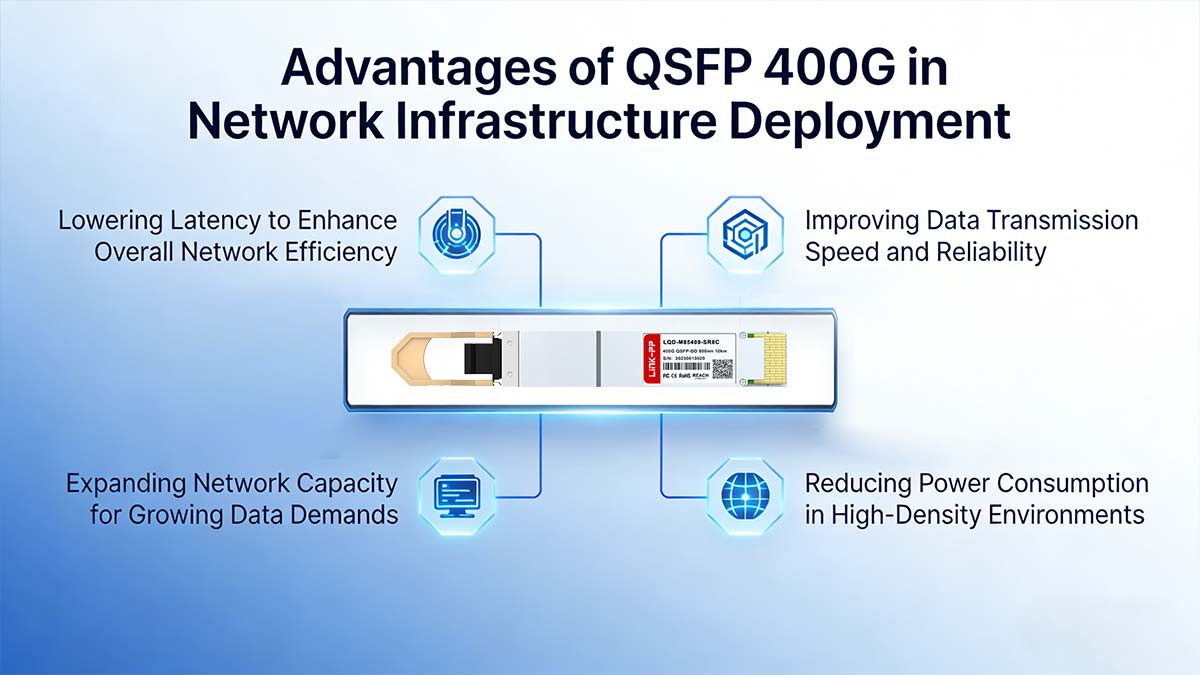
QSFP 400G fiber optic module delivers significant advantages in speed, density, and energy efficiency, addressing the ever-increasing demand for data transmission capacity. These benefits enable network operators to build scalable, high-performance infrastructures optimized for cloud computing, data center, and AI workloads.
Lowering Latency to Enhance Overall Network Efficiency
QSFP 400G modules minimize latency through high-throughput, parallel optical architecture, reducing the number of hops required between switches and servers. This low-latency performance is crucial in environments such as financial trading systems, AI processing, and real-time applications, where microseconds matter. By streamlining data flow, QSFP 400G ensures faster packet forwarding and optimizes overall network responsiveness.
Improving Data Transmission Speed and Reliability
Each QSFP 400G transceiver supports up to 400Gbps of transmission bandwidth, enabling organizations to move massive data volumes quickly and securely. Advanced modulation formats, such as PAM4, combined with digital signal processing (DSP) techniques, enhance error correction and transmission integrity. The result is fewer retransmissions, more stable links, and a network that consistently delivers reliable high-speed performance — even under heavy load.
Expanding Network Capacity for Growing Data Demands
QSFP 400G is a straightforward way to scale capacity without proportionally increasing physical footprint. By moving from 100G to 400G, you can quadruple bandwidth per port, which is crucial when data demands rise due to cloud expansion or AI workloads. This higher per-link capacity also supports cleaner upgrade paths: networks can add bandwidth by upgrading optics and line rates rather than redesigning the entire topology.
Reducing Power Consumption in High-Density Environments
In dense data center deployments, power and thermal limits often constrain growth more than rack space. QSFP 400G can reduce power usage by delivering much higher throughput per module, which helps operators meet bandwidth goals with fewer transceivers and fewer active ports overall. Fewer modules and ports can also decrease the heat load on cooling systems and lower operational costs — critical for high-density switch rows and large-scale clusters.
✳️ QSFP 400G for AI Data Center Scenarios
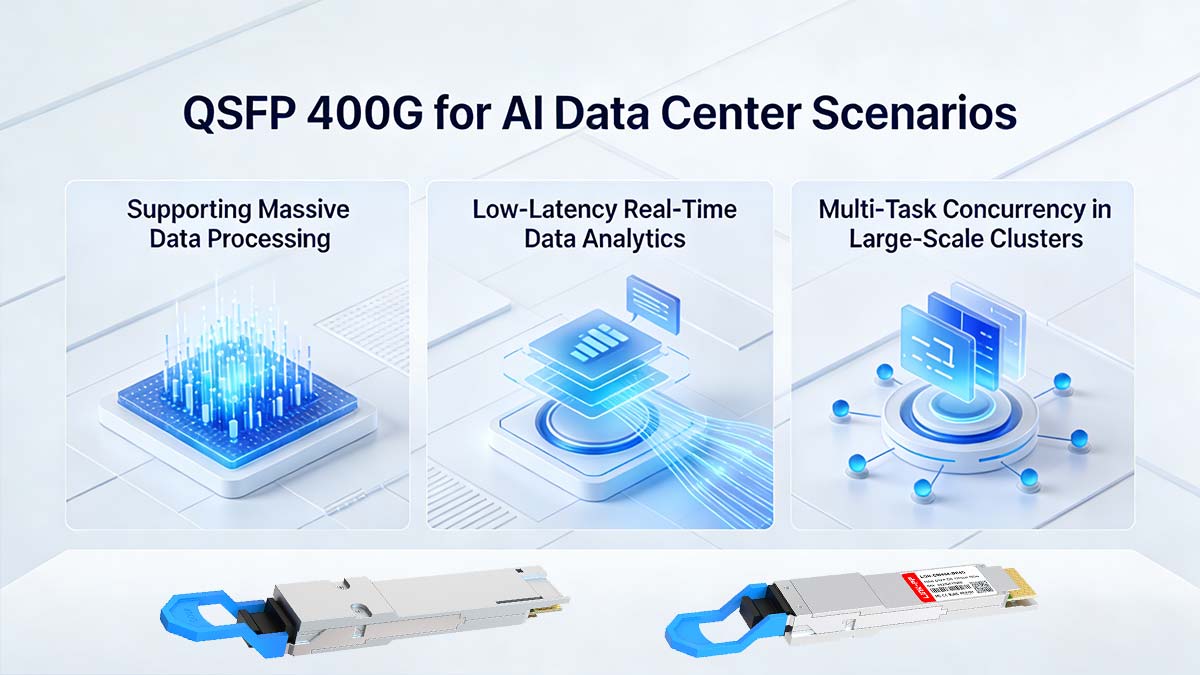
QSFP 400G modules empower AI data centers to achieve ultra-fast, low-latency communication across large computing clusters. Their scalability and bandwidth make them ideal for massive data training, real-time analytics, and multi-task parallel processing.
Supporting Massive Data Processing
QSFP 400G modules enable extremely high data throughput to manage the enormous datasets used in AI training and inference. By linking GPU clusters, CPUs, and distributed storage systems with stable, high-capacity connections, they significantly accelerate data exchange and model training cycles while minimizing processing bottlenecks across the network.
Low-Latency Real-Time Data Analytics
AI workloads depend on real-time data transfer for complex analytics and decision-making. QSFP 400G minimizes latency between components, ensuring that data moves seamlessly across processing units. This ultra-fast response supports applications like autonomous systems and interactive AI services where microseconds can define performance outcomes.
Multi-Task Concurrency in Large-Scale Clusters
In large-scale AI clusters, thousands of concurrent computations occur simultaneously. QSFP 400G ensures uninterrupted data flow between nodes by enabling sufficient bandwidth and parallel communication paths. This allows data centers to maintain balanced workloads, achieve efficient cluster utilization, and maximize the processing power of AI and HPC infrastructure.
✳️ QSFP 400G Applications in Data Center Interconnect

QSFP 400G plays a vital role in connecting large-scale data centers, enabling faster, more reliable interconnections across distributed computing environments. It supports high-bandwidth operations and minimizes latency for seamless data exchange between cloud, enterprise, and telecom infrastructures.
High-Speed Interconnection for Cloud Data Centers
QSFP 400G modules enable ultra-fast links between geographically distributed cloud facilities, ensuring high-throughput data replication and synchronization. They help cloud providers deliver low-latency, scalable services to meet dynamic workloads and user demand.
Enhancing Enterprise Data Center Performance
QSFP 400G links boost backbone speeds within and between enterprise campus data centers. They accelerate access to centralized storage, databases, and applications, improving performance for data-intensive operations and disaster recovery strategies.
Strengthening Telecom and Backbone Networks
QSFP 400G technology strengthens telecom and backbone networks through high-capacity optical links that support long-distance, high-density traffic. It accelerates data transport across metro and long-haul networks while maintaining reliability and minimal signal loss.
✳️ QSFP 400G Use Cases in Spine-Leaf Networks
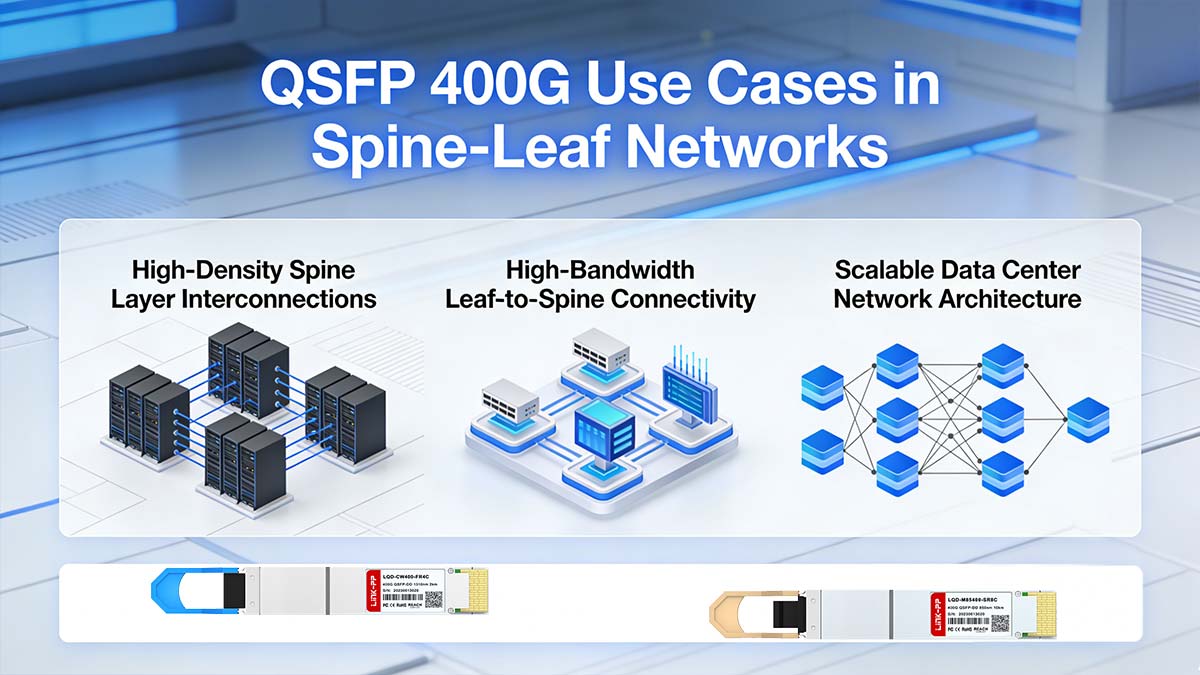
QSFP 400G modules are a natural fit for spine-leaf fabrics because they deliver very high throughput while keeping cabling and port counts manageable. In modern data centers, they help operators build flatter, faster fabrics that can scale out predictably as workload density increase.
High-Density Spine Layer Interconnections
In spine-leaf architectures, spine layer switches act as the central backbone for data traffic distribution. QSFP 400G modules enable massive port density within spine switches, supporting hundreds of high-throughput connections with minimal latency. This design facilitates rapid data exchange among multiple leaf switches, improving resource utilization and network agility while maintaining consistent packet forwarding performance across large-scale deployments.
High-Bandwidth Leaf-to-Spine Connectivity
For leaf-to-spine uplinks, QSFP 400G provides the bandwidth headroom required for traffic-heavy racks hosting virtualized clusters, storage nodes, and GPU servers. With fewer uplinks needed to achieve the same aggregate capacity, oversubscription can be reduced without exploding the number of cables and switch ports. This results in more predictable latency under load, faster east-west flows, and smoother performance for distributed applications that chat frequently.
Scalable Data Center Network Architecture
QSFP 400G supports the modular growth of spine-leaf architectures, making network scaling both straightforward and cost-efficient. It allows data centers to expand capacity by simply adding new leaf or spine switches without disrupting operations. This scalability ensures that performance grows in proportion to network demands, delivering a reliable and future-ready infrastructure capable of supporting next-generation computing and storage applications.
✳️ Recommended QSFP 400G Solutions from LINK-PP
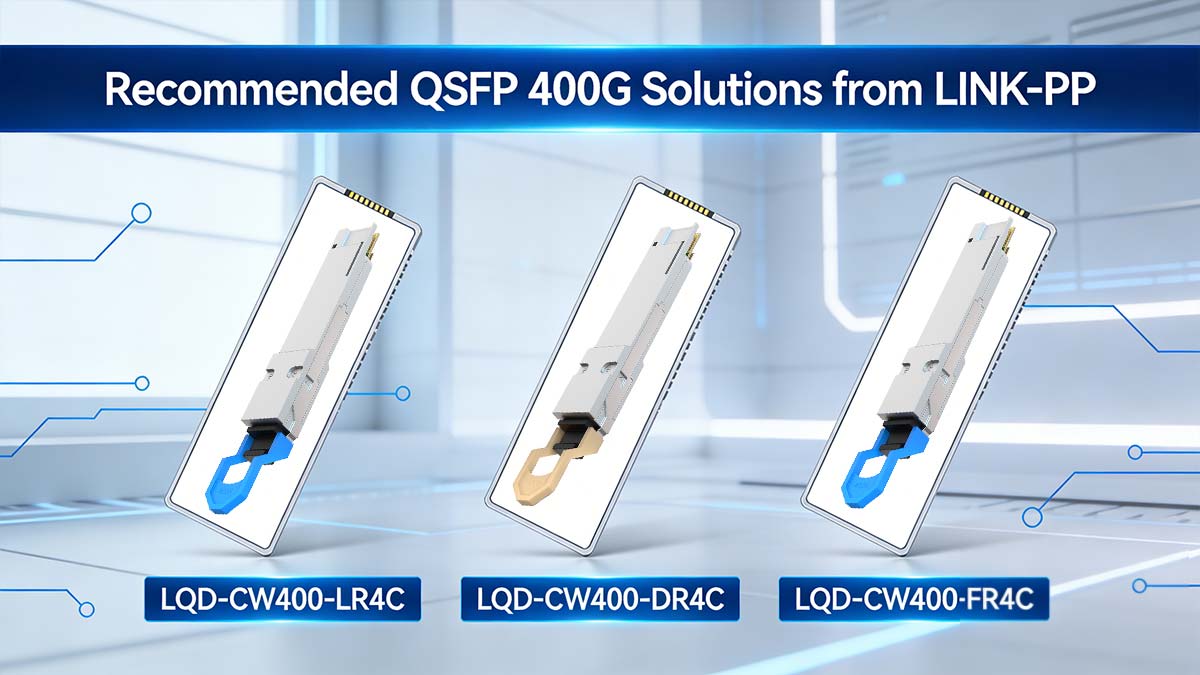
As 400G networks continue to mature, selecting reliable and standards-compliant QSFP optical modules becomes critical for ensuring performance, scalability, and long-term network stability. LINK-PP offers a portfolio of QSFP-DD 400G optical transceivers designed to address diverse deployment scenarios, from short-reach data center interconnects to longer-distance backbone links.
These QSFP solutions are engineered to align with IEEE standards, support broad switch compatibility, and deliver a balance of high bandwidth, power efficiency, and operational flexibility. The following recommended models — LR4, DR4, and FR4 — cover the most common 400G module types, enabling network architects to deploy infrastructures with confidence.
LQD-CW400-LR4C 400G QSFP-DD Transceiver
The LQD-CW400-LR4C 400GBASE LR4 module is designed for long-reach transmission over single mode fiber, typically supporting distances of up to 10km. Using four lanes, each operating at 100G, the LR4 module enables high-capacity links while minimizing fiber usage. This makes it particularly suitable for data center interconnect (DCI) scenarios, metro networks, and large campus environments where longer distances are required.
From a deployment perspective, the LR4 module simplifies network design by leveraging duplex LC connectors instead of parallel fiber infrastructure. This reduces cabling complexity and helps operators reuse existing single mode fiber assets. In addition, LINK-PP’s LR4 solution emphasizes low power consumption and robust thermal performance, which are essential in dense QSFP DD 400G switch environments. Its broad interoperability with mainstream switch platforms ensures smooth integration into heterogeneous networks.
LQD-CW400-LR4C QSFP-DD Module Technical Specification:
| Max Data Rate | 400Gbps |
| Wavelength | 1310nm |
| Max Cable Distance | 10km |
| Connector | Duplex LC |
| Transmitter Type | CWDM EML |
| Receiver Type | PIN |
| Max Power Consumption | 9.5W |
| Protocols | IEEE 802.3bs, QSFP-DD MSA |
LQD-CW400-DR4C 400G QSFP-DD Transceiver
For shorter-range, high-capacity links, the LQD-CW400-DR4C 400GBASE DR4 module provides exceptional cost-performance efficiency. This module supports up to 500m over single mode fiber using parallel MPO-12 connectors. Its design follows the DR4 transceiver specification and is particularly optimized for intra-data center connections such as leaf-to-spine architecture or AI cluster aggregation layers.
The DR4C module utilizes four parallel lanes of 100Gbps PAM4 signals, offering a total throughput of 400Gbps with minimal signal latency. Its Digital Diagnostics Monitoring (DDM) capability allows real-time tracking of key parameters, including module temperature, bias current, and optical power. Also, the module’s compatibility across multi-vendor switches — from Cisco and Arista to Juniper — ensures smooth deployment in mixed-network systems.
LQD-CW400-DR4C QSFP-DD Module Technical Specification:
| Max Data Rate | 400Gbps |
| Wavelength | 1310nm |
| Max Cable Distance | 500m |
| Connector | MTP/MPO-12 APC |
| Max Power Consumption | 9.5W |
| DDM/DOM | Supported |
| Protocols | IEEE 802.3bs, QSFP-DD MSA |
LQD-CW400-FR4C 400G QSFP-DD Transceiver
The LQD-CW400-FR4C 400GBASE FR4 module bridges the gap between short-reach DR4 and longer-reach LR4 solutions. Typically supporting distances of up to 2km, the FR4 module is well-suited for inter-building links, distributed data centers, and enterprise networks that require moderate reach without the cost overhead of LR4 optics.
Beyond speed and reach, the FR4 module showcases LINK-PP’s commitment to thermal stability and mechanical robustness. It features optimized PCB layout and efficient heat dissipation materials to accommodate sustained high-speed operation. Moreover, its plug-and-play design allows for rapid deployment without extensive configuration, providing a balance between simplicity and enterprise-grade performance.
LQD-CW400-FR4C QSFP-DD Module Technical Specification:
| Max Data Rate | 400Gbps |
| Wavelength | 1310nm |
| Max Cable Distance | 2km |
| Connector | Duplex LC |
| Transmitter Type | CWDM EML |
| Receiver Type | PIN |
| Max power consumption | 9.5W |
| Protocols | IEEE 802.3bs, QSFP-DD MSA |
✳️ Frequently Asked Questions about QSFP 400G

This section addresses common questions network engineers often have when deploying QSFP 400G optical modules. It focuses on infrastructure readiness, compatibility, interoperability, and practical deployment considerations to help ensure a smooth 400G network upgrade.
Which infrastructure requirements must be met for 400G QSFP deployment?
A QSFP 400G deployment requires switches or routers with native 400G ports, sufficient backplane capacity, and updated firmware or NOS support. Additionally, fiber cabling (such as MPO or LC) must meet distance and signal integrity requirements for the chosen 400G module type.
How to ensure compatibility between QSFP 400G and existing network setups?
Compatibility can be ensured by verifying switch vendor support lists, port speed configurations, and optical specifications. Properly matching fiber type, connector standards, and link distance is also essential to avoid interoperability issues.
Is it possible to use a QSFP 400G module in a 100G port?
No, QSFP 400G modules cannot operate in a standard 100G QSFP port due to electrical and protocol differences. However, some 400G QSFP-DD ports support breakout functionality, allowing them to connect to four 100G QSFP ports using a special breakout cable. The reverse (using a 400G module in a 100G port) is not supported.
Which connector is featured in QSFP 400G DR4 optical modules?
QSFP 400G DR4 modules typically use an MPO-12 connector. This connector type supports four transmitting and four receiving lanes, each operating at 100 Gbps to enable efficient short-reach 400G transmission within data centers.
Do QSFP 400G modules support Cisco, Arista, and Juniper network switches?
Yes, quality third-party QSFP 400G modules are often manufactured to be multi-vendor compatible. They use standardized firmware and protocols to ensure interoperability with major switch platforms from Cisco, Arista, Juniper, and others. It is always recommended to validate compatibility with the specific switch model and OS version before purchase.
Can third-party QSFP 400G modules perform reliably?
Quality third-party QSFP 400G modules (like LINK-PP transceivers) can perform as reliably as OEM versions when they meet industry standards such as IEEE and MSA specifications. Choosing a reputable manufacturer with proven compatibility testing ensures stable long-term operation.
✳️ Summary: Upgrade Your Network Infrastructure with QSFP 400G
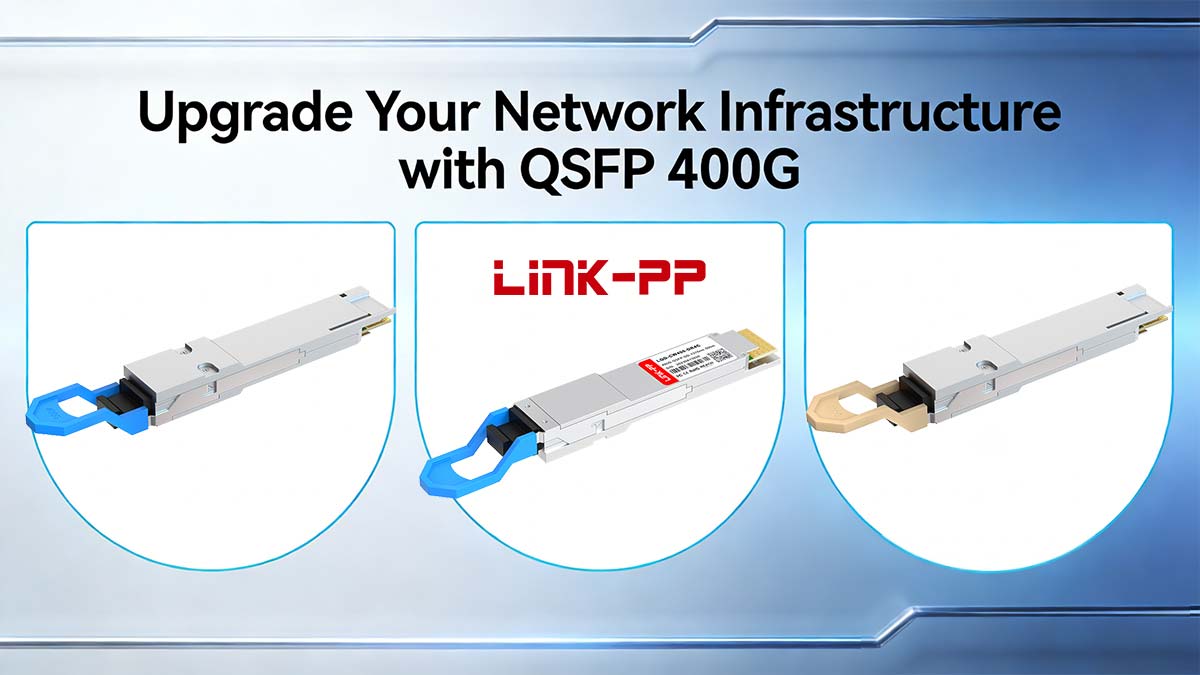
In today’s digital world, speed, reliability, and scalability define success. From streaming platforms and AI clusters to cloud computing and 5G networks, data is flowing faster than ever — and QSFP 400G technology is at the heart of this revolution. It delivers the bandwidth and performance needed to keep modern infrastructures running at their peak, empowering organizations to stay ahead in the race toward intelligent, high-speed connectivity.
Here’s why QSFP 400G is transforming network infrastructure:
- Accelerating the digital economy: With four times the capacity of 100G optics, QSFP 400G enables seamless handling of the surging data traffic generated by AI, cloud computing, and virtualized applications. This means businesses can process, store, and analyze data faster — unlocking new levels of efficiency and innovation.
- Designed for various network environments: Whether connecting racks within a hyperscale data center or linking campuses across cities, QSFP 400G modules (SR4, DR4, FR4, or LR4) deliver unmatched flexibility. Their modular design allows network operators to optimize for distance, performance, or cost — without compromise.
- Improved Energy Efficiency: By transmitting more data per module, QSFP 400G reduces power consumption per bit and minimizes the total number of optical ports required. This translates into lower operational costs, simplified cabling, and improved thermal management in high-density deployments.
In conclusion, QSFP 400G is not simply a faster optical transceiver — it is a strategic enabler for modern network infrastructure. Organizations planning for sustained growth, higher performance, and operational efficiency will find 400G QSFP solutions indispensable.
If you are ready to upgrade or design a high-performance 400G network, explore reliable and standards-compliant QSFP 400G solutions at the LINK-PP Official Store and take the next step toward building a scalable network infrastructure.