



































A multimode SFP transceiver is most commonly used to provide reliable and cost-effective fiber connectivity over short distances in enterprise networks, data centers, and campus environments. For applications where long-haul transmission is unnecessary, multimode SFP modules offer a practical balance between performance, deployment simplicity, and overall network cost.
In real-world network design, multimode SFP transceivers are typically deployed to connect switches, servers, and access devices within the same building or across nearby facilities. By operating over multimode fiber, they support high data rates while keeping optical budgets and cabling costs under control—making them especially suitable for access layers, aggregation layers, and short-reach data center interconnects.
Compared with single-mode optics, multimode SFP solutions focus less on extreme transmission distance and more on efficient short-reach communication. This makes them a preferred choice in environments where existing multimode fiber infrastructure is already in place or where ease of installation and scalability matter more than maximum reach.
This article explains where multimode SFP transceivers are used, what problems they solve, and how to choose the right solution based on specific application scenarios. By focusing on practical use cases and deployment considerations, it aims to help network planners, system integrators, and IT teams make informed decisions that align technical requirements with real operational needs.
✅ What Is a Multimode SFP Transceiver?
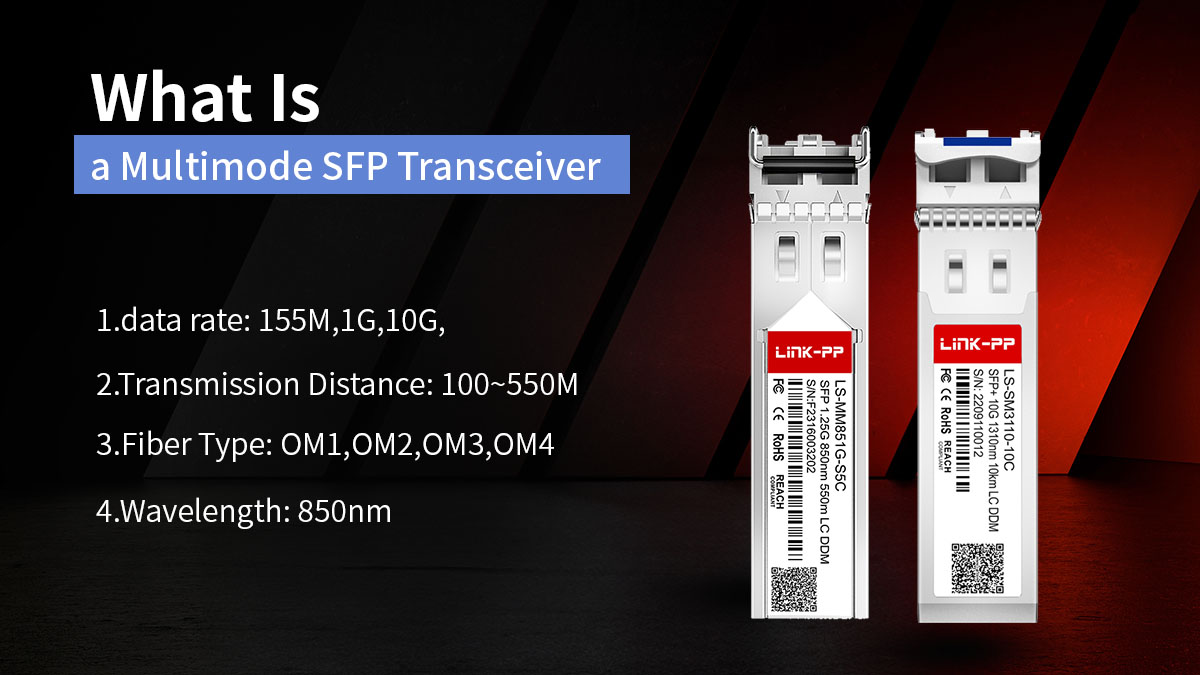
A multimode SFP transceiver is a hot-swappable optical module used to transmit and receive data over multimode fiber for short-distance network connections. It is primarily designed for enterprise, data center, and campus environments where high-speed fiber links are required within limited physical distances.
How a Multimode SFP Transceiver Works
A multimode SFP transceiver converts electrical signals from a network device into optical signals, sends them through multimode fiber, and then converts incoming optical signals back into electrical form at the receiving end.
Because multimode fiber supports multiple light paths, this transmission method is optimized for short-reach communication rather than long-haul transport.
Key Characteristics of Multimode SFP Transceivers
-
Short-reach optimization: Designed for connections within buildings or between nearby network areas
-
Cost-efficient deployment: Lower optical power requirements compared to long-reach optics
-
Hot-pluggable design: Allows installation or replacement without powering down equipment
-
High-speed support: Suitable for common enterprise and data center data rates
These characteristics make multimode SFP transceivers a practical choice for networks that prioritize efficiency and scalability over extreme distance.
Multimode SFP vs Single-Mode SFP (Conceptual Difference)
The primary difference between multimode and single-mode SFP transceivers lies in their application scope. Multimode SFP modules focus on short-distance communication using multimode fiber, while single mode SFP modules are built for long-distance transmission over single-mode fiber.
In scenarios where long reach is unnecessary, multimode SFP transceivers often provide a simpler and more economical solution.
When a Multimode SFP Transceiver Is Typically Used
In real-world deployments, multimode SFP transceivers are commonly used when:
-
Network links are short and confined to a single site
-
Multimode fiber infrastructure already exists
-
Cost control and ease of deployment are key considerations
Under these conditions, multimode SFP transceivers deliver reliable fiber connectivity without the added complexity of long-haul optical systems.
✅ Why Multimode SFP Transceivers Are Still Widely Used
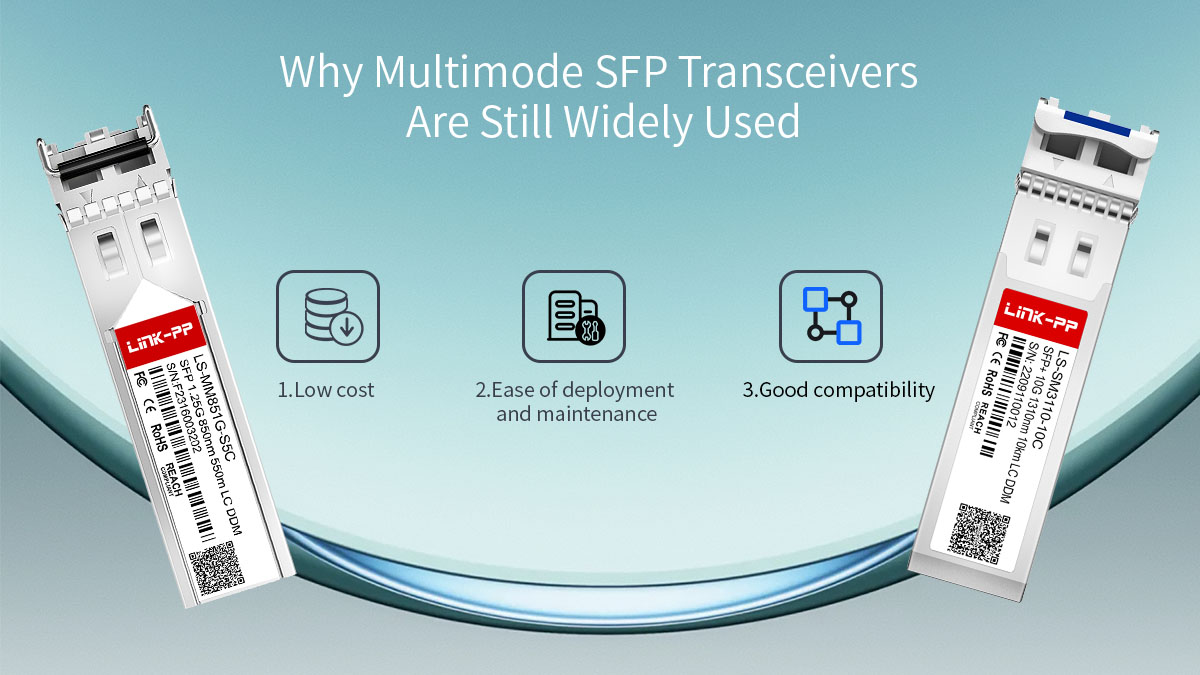
Multimode SFP transceivers remain widely used because they offer a practical balance between performance, cost, and deployment simplicity for short-distance fiber networks. In many enterprise and data center environments, long-reach optics are unnecessary, making multimode SFP a more efficient and rational choice.
Optimized for Short-Range Network Architecture
Most enterprise and access-layer networks are designed around short physical distances, such as connections within the same building or between adjacent network zones. Multimode SFP transceivers are specifically optimized for these architectures, delivering stable high-speed links without the added complexity of long-distance optical design.
From a network planning perspective, this short-range optimization reduces the need for excessive optical power budgeting and minimizes sensitivity to link loss, which simplifies both design and ongoing operations.
Cost Efficiency Without Compromising Reliability
One of the main reasons multimode SFP transceivers continue to be widely deployed is their cost efficiency. Compared with long-reach or single-mode optical solutions, multimode SFP modules typically require lower-cost optics and cabling while still meeting the performance requirements of most local networks.
In real-world deployments, this translates into lower initial investment and more predictable maintenance costs—an important factor for enterprises managing large numbers of access and aggregation ports.
Seamless Integration with Existing Multimode Fiber Infrastructure
Many buildings, campuses, and data centers already have multimode fiber installed as part of their structured cabling systems. Multimode SFP transceivers allow organizations to fully leverage this existing infrastructure without the need for costly re-cabling projects.
This backward compatibility makes multimode SFP an attractive option during network upgrades, where improving speed and reliability is required without disrupting physical cabling layouts.
Simpler Deployment and Day-to-Day Operations
Multimode SFP transceivers are easier to deploy and manage in environments where network teams prioritize operational simplicity. Their hot-swappable design supports quick replacement and scaling, while the shorter transmission distances reduce troubleshooting complexity related to signal degradation.
For IT teams responsible for large enterprise or campus networks, this operational simplicity can be just as valuable as raw performance.
A Practical Choice in Modern Network Design
While high-speed and long-distance optical technologies continue to evolve, not every network requires maximum reach or advanced optical features. Multimode SFP transceivers remain relevant because they address the most common networking scenarios, where reliability, cost control, and ease of use matter more than extreme transmission distances.
As a result, multimode SFP transceivers continue to play a central role in enterprise LAN, access networks, and short-reach data center interconnects.
✅ Common Application Scenarios for Multimode SFP Transceivers
Multimode SFP transceivers are primarily used in short-distance network environments where reliability, scalability, and cost efficiency are more important than long-haul transmission. The following application scenarios represent the most common and practical uses in real-world networks.

Enterprise Local Area Networks (LANs)
Multimode SFP transceivers are widely deployed in enterprise LANs to connect access, aggregation, and core switches within the same building or campus.
Typical characteristics of this scenario include:
-
Short and predictable link distances
-
High port density at access and aggregation layers
-
Strong demand for stable and interference-resistant connections
Why multimode SFP is a good fit:
-
Provides higher bandwidth than copper uplinks
-
Reduces susceptibility to electromagnetic interference
-
Integrates easily with structured multimode cabling systems
Data Centers and Server Rooms
In data centers and server rooms, multimode SFP transceivers are commonly used for short-reach interconnects between switches and servers.
Common deployment patterns include:
-
Switch-to-switch links within the same rack or row
-
Switch-to-server connections at the access layer
-
High-density environments with frequent port changes
Key advantages in data center scenarios:
-
Lower optical cost compared to long-reach solutions
-
Simplified optical power budgeting
-
Faster deployment and easier maintenance
Campus and Multi-Building Networks
Multimode SFP transceivers are often used to connect nearby buildings within a campus where link distances remain within multimode fiber limits.
Typical use cases include:
-
Academic or corporate campuses
-
Healthcare facilities with multiple buildings
-
Office parks with centralized IT infrastructure
Why multimode SFP is commonly chosen:
-
Leverages existing multimode fiber infrastructure
-
Avoids unnecessary investment in long-distance optics
-
Maintains consistent fiber standards across the site
Industrial and Commercial Environments
In industrial and commercial settings, multimode SFP transceivers are used to establish reliable fiber links in electrically noisy or harsh environments.
Common application conditions:
-
Presence of heavy machinery or electrical equipment
-
High risk of electromagnetic interference
-
Need for stable, low-maintenance network links
Benefits of multimode SFP in these environments:
-
Immunity to electromagnetic interference
-
Stable performance over short distances
-
Improved reliability compared to copper cabling
Network Upgrades from Copper to Fiber
Multimode SFP transceivers are frequently used during network upgrades where organizations transition from copper to fiber for short-distance links.
Typical upgrade drivers include:
-
Increased bandwidth requirements
-
Improved network reliability
-
Preparation for future scalability
Why multimode SFP supports smooth upgrades:
-
Minimal changes to network architecture
-
Easy integration with existing equipment
-
Lower overall migration cost
Scenario-Based Summary
Across all these scenarios, multimode SFP transceivers are selected because they match how networks are actually built and operated, not because they maximize technical specifications.
They are most effective when:
-
Transmission distances are short
-
Fiber infrastructure is localized
-
Cost control and operational simplicity are priorities
✅ Typical Multimode SFP Use Cases by Distance and Speed
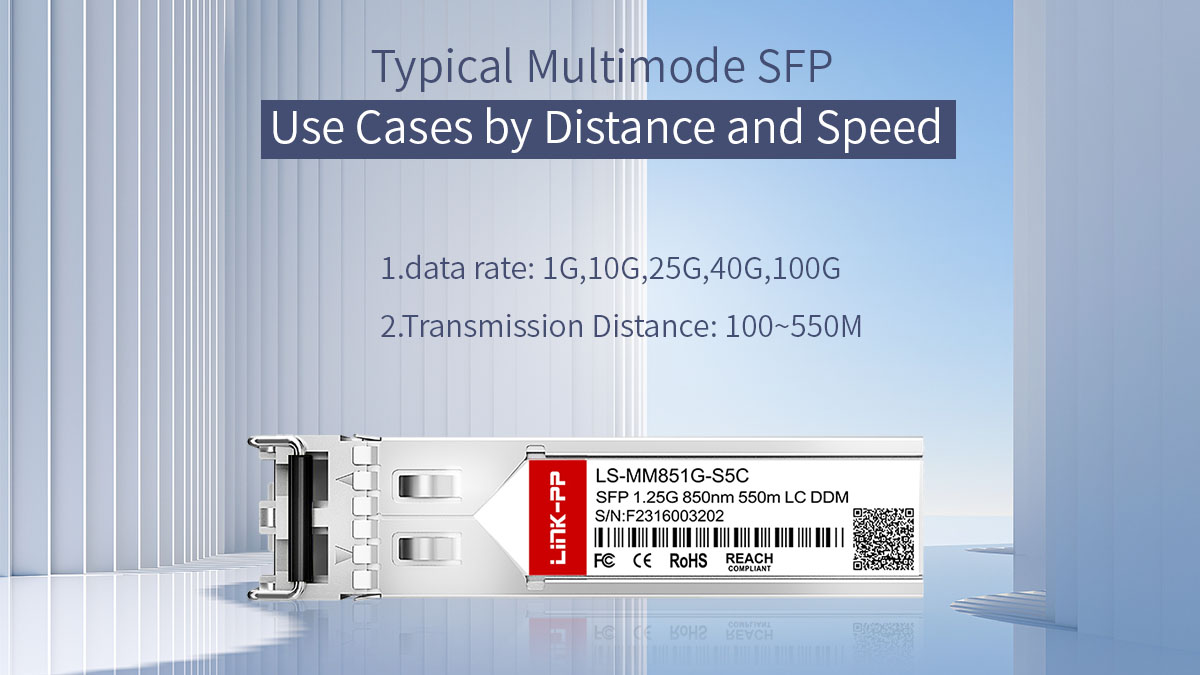
Multimode SFP transceivers are typically selected based on two practical variables: transmission distance and required data rate. In real-world network design, the goal is not to maximize specifications, but to align optical capabilities with actual deployment needs.
Short-Distance Links (Within the Same Room or Rack)
For very short fiber runs—such as connections within a single rack or equipment room—multimode SFP transceivers are a natural fit. These environments usually involve high port density, frequent configuration changes, and minimal tolerance for downtime. Because the physical distance is extremely limited, optical power budgeting and signal degradation are rarely a concern.
In these scenarios, multimode SFP modules provide sufficient bandwidth for common access-layer and server connections while keeping deployment simple and cost-effective. Their hot-swappable design also supports rapid replacement and scaling in dense environments.
Medium-Distance Links (Within a Building)
Medium-distance links are common in enterprise buildings and data centers where network equipment is distributed across floors or functional zones. These links are typically part of structured cabling systems and are expected to operate reliably over long periods with minimal maintenance.
Multimode SFP transceivers perform well in this range because they deliver stable high-speed connectivity without requiring complex optical design considerations. When paired with modern multimode fiber, they support aggregation and uplink traffic while maintaining a balanced cost-to-performance profile.
Typical characteristics of this use case include:
-
Predictable link distances within a building
-
Long-term, stable network layouts
-
Demand for reliable uplink and aggregation connectivity
Campus-Scale Links (Nearby Buildings)
Campus-scale links connect nearby buildings within a single site, such as a corporate campus, university, or healthcare facility. These links usually remain within the effective distance range of multimode fiber and benefit from centralized network management.
In these cases, multimode SFP transceivers allow organizations to standardize on a single optical approach across the campus. This avoids unnecessary investment in long-reach optics while still delivering consistent performance for internal backbone connections.
Multimode SFP is commonly chosen in campus environments because it:
-
Leverages existing multimode fiber infrastructure
-
Simplifies optical standardization across buildings
-
Supports scalable expansion without added complexity
Distance and Speed in Practical Selection
Across all these distance ranges, speed requirements vary depending on the network layer and application. Access-layer links typically demand moderate bandwidth, while aggregation links handle higher traffic volumes over similar physical distances.
Rather than selecting optics based on maximum supported speed, network planners benefit more from evaluating:
-
The actual fiber distance involved
-
Current and near-future bandwidth needs
-
Existing fiber types and port density
By aligning these factors, multimode SFP transceivers deliver reliable performance without introducing unnecessary optical overhead.
✅ Key Problems Solved by Multimode SFP Transceivers
Multimode SFP transceivers address several practical networking problems commonly found in enterprise, data center, and campus environments—especially where short-distance connectivity must remain reliable, scalable, and cost-efficient.

Overcoming the Limitations of Copper Cabling
Copper cabling becomes increasingly problematic as network speeds and port densities grow. Distance limitations, electromagnetic interference, and signal degradation can all affect performance in dense environments.
Multimode SFP transceivers solve these issues by enabling fiber-based links that support higher bandwidth over short distances while remaining immune to electromagnetic interference. This makes them particularly effective in offices, data centers, and industrial settings where electrical noise is unavoidable.
Supporting High-Density Network Designs
Modern networks often require large numbers of ports concentrated in limited physical space. In such designs, managing heat, cable volume, and maintenance complexity becomes a challenge.
By using multimode SFP transceivers, network designers can reduce cabling bulk and simplify port management. The compact, hot-swappable nature of SFP modules allows networks to scale horizontally without redesigning the underlying infrastructure.
This is especially beneficial in environments with:
-
High switch and server density
-
Frequent port changes or expansions
-
Strict uptime requirements
Controlling Optical Deployment Costs
Not all fiber links require long-distance transmission capabilities. Deploying long-reach or single-mode optics in short-range environments often results in unnecessary cost without delivering additional value.
Multimode SFP transceivers address this by providing an optical solution tailored specifically for short-reach applications. They deliver the required performance while keeping both optical modules and cabling costs aligned with actual network needs.
Simplifying Network Upgrades and Expansion
Network upgrades often involve replacing legacy copper links or increasing bandwidth within an existing physical layout. In these cases, minimizing disruption and preserving compatibility with current infrastructure are key concerns.
Multimode SFP transceivers support smooth transitions by integrating easily with existing multimode fiber and standard SFP interfaces. This allows organizations to improve network performance incrementally rather than through disruptive, large-scale changes.
Reducing Operational Complexity
Operational complexity increases when networks rely on overly specialized or mismatched optical components. Troubleshooting, inventory management, and maintenance all become more difficult.
By standardizing short-distance links around multimode SFP transceivers, network teams can reduce variability in optical components and simplify day-to-day operations. This standardization improves reliability while lowering the long-term cost of ownership.
In practice, this helps organizations:
-
Streamline maintenance and spare-part management
-
Shorten troubleshooting time
-
Maintain consistent performance across network segments
Problem–Solution Summary
Across these problem areas, multimode SFP transceivers are not chosen for maximum reach, but for fit-for-purpose networking. They solve real operational and design challenges by aligning optical capabilities with how networks are actually built and maintained.
✅ How to Choose the Right Multimode SFP for Your Scenario
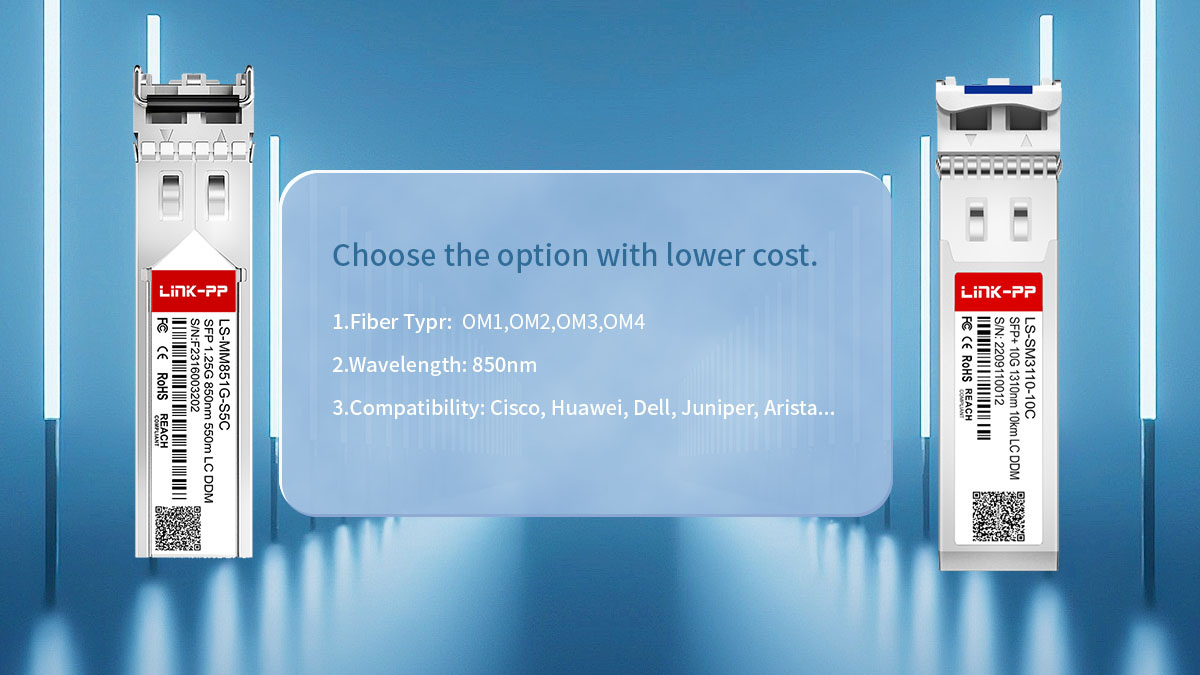
Choosing the right multimode SFP transceiver is primarily about matching the optical transceiver to your actual network scenario, rather than selecting the highest specification available. Distance, speed, fiber type, and compatibility all play a role, but their importance depends on how and where the module will be deployed.
Start with the Actual Transmission Distance
The first and most important factor is the real physical distance of the fiber link. Multimode SFP transceivers are designed for short-range communication, and selecting a module that aligns with your distance requirements helps avoid unnecessary cost and complexity.
When link distances are short and well-defined—such as within a building or across nearby network zones—multimode SFP solutions provide stable performance without the need for long-reach optics.
Align Speed Requirements with Network Layers
Different parts of the network have different bandwidth demands. Access-layer connections typically require moderate speeds, while aggregation or server-facing links may handle higher traffic volumes.
Instead of planning for theoretical maximum speed, it is more practical to evaluate:
-
Current traffic patterns
-
Expected growth in the near future
-
The role of the link within the network architecture
This approach ensures that the selected multimode SFP transceiver supports both present needs and reasonable future expansion.
Consider the Existing Multimode Fiber Infrastructure
The type and condition of the existing fiber infrastructure significantly influence module selection. Many enterprise and campus networks already use structured multimode cabling systems.
Before selecting a multimode SFP transceiver, network planners should confirm:
-
The multimode fiber type already installed
-
Connector standards and cabling quality
-
Whether upgrades will reuse or replace existing fiber
Aligning the transceiver choice with the existing infrastructure helps reduce deployment risk and cost.
Ensure Compatibility with Network Equipment
Compatibility remains a critical consideration, especially in networks with mixed-vendor equipment. While SFP interfaces are standardized, not all network devices interpret optical parameters in the same way.
To minimize deployment issues, it is important to:
-
Verify interoperability with the target switches or routers
-
Consider vendor testing and qualification practices
-
Avoid unnecessary customization unless required
This step is particularly important in large or mission-critical networks where unexpected incompatibility can lead to downtime.
Balance Cost, Reliability, and Operational Simplicity
The final decision often comes down to balancing technical requirements with operational realities. In short-distance networks, prioritizing reliability and ease of maintenance often delivers more long-term value than selecting optics designed for extreme performance.
A practical selection process typically follows this order:
-
Confirm distance and link type
-
Define realistic speed requirements
-
Match the module to existing fiber
-
Validate compatibility and operational fit
By following this structured approach, organizations can select multimode SFP transceivers that support stable operation, controlled costs, and scalable growth.
✅ Multimode SFP vs Single-Mode SFP in Real-World Applications
In real-world network deployments, the choice between multimode SFP and single-mode SFP transceivers is less about which technology is “better,” and more about which one fits the actual application environment. Each option is optimized for different distances, costs, and deployment scenarios.
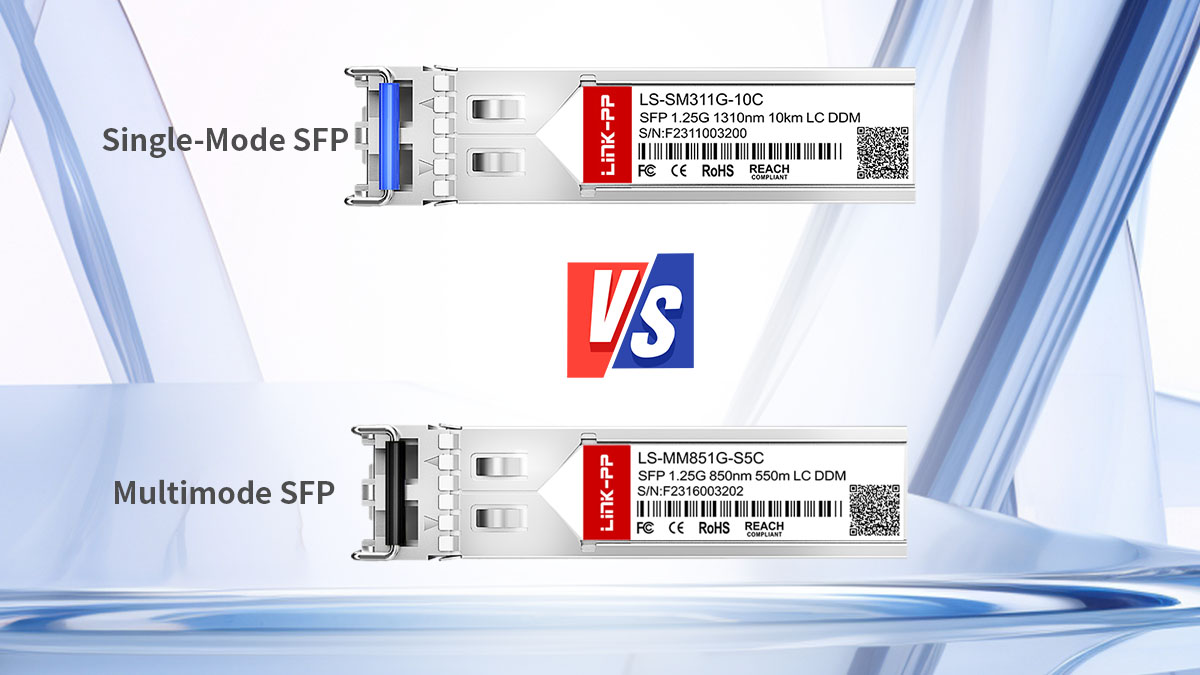
Understanding their practical differences helps network designers avoid overengineering short links or underestimating long-distance requirements.
Practical Differences in Typical Deployment Scenarios
Multimode SFP transceivers are commonly used in short-distance, high-density environments, such as data centers, enterprise buildings, and campus access networks. They are optimized for cost efficiency and ease of deployment when distances are limited.
Single-mode SFP transceivers, on the other hand, are designed for longer distances and broader network reach, making them suitable for metropolitan networks, backbone links, and inter-building connections where fiber runs extend well beyond typical multimode limits.
Multimode vs Single-Mode SFP: Real-World Comparison
| Aspect | Multimode SFP | Single-Mode SFP |
|---|---|---|
| Typical Transmission Distance | Short-range (within buildings or campuses) | Long-range (campus-to-campus or metro links) |
| Fiber Type | Multimode fiber (e.g., OM-series) | Single-mode fiber |
| Deployment Cost | Lower overall cost for short links | Higher module cost, optimized for long reach |
| Installation Complexity | Simple, well-suited for dense cabling | Requires more precise fiber management |
| Common Use Cases | Data centers, enterprise LANs, access layers | Backbone networks, aggregation, long-haul links |
| Scalability Focus | High port density, short reach | Long-distance scalability |
This comparison highlights that neither option replaces the other—they solve different problems in different parts of the network.
Choosing Based on Real Operational Needs
In practice, many networks deploy both multimode and single-mode SFP transceivers simultaneously, each serving a distinct role. Multimode SFPs often dominate access and intra-building links, while single-mode SFPs handle aggregation or inter-site connectivity.
A practical rule of thumb is:
-
Choose multimode SFP when distances are short, port density is high, and cost control is important
-
Choose single-mode SFP when distance flexibility and future expansion outweigh upfront cost
Rather than defaulting to a single technology, aligning transceiver selection with actual link distance, infrastructure, and growth plans results in a more balanced and reliable network design.
✅ Deployment Best Practices for Multimode SFP Transceivers
Successful deployment of multimode SFP transceivers depends less on the module itself and more on how well the physical layer, environment, and configuration are aligned. When deployed correctly, multimode SFPs deliver stable performance, predictable latency, and long-term operational reliability in short-reach networks.

Below are the most important best practices drawn from real-world enterprise and data center deployments.
Match the SFP Type to the Actual Link Conditions
Before installation, confirm that the selected multimode SFP matches the fiber type, distance, and speed requirements of the link. Multimode transceivers are designed for specific wavelength and fiber combinations, and mismatches can quickly lead to signal degradation.
Key checks to perform before deployment include:
-
Fiber grade consistency across the entire link
-
Link distance within the supported operating range
-
Speed compatibility with connected switches and NICs
Verifying these parameters upfront reduces troubleshooting time after installation.
Use Proper Fiber Cabling and Connector Management
Multimode fiber links are more sensitive to physical handling than many network teams expect. Poor connector quality or contamination is a common cause of performance issues.
Best practices in cabling and connectors include:
-
Ensuring connectors are clean before insertion
-
Avoiding excessive bending or tension on patch cords
-
Using high-quality, certified multimode fiber cables
These practices help maintain optimal signal integrity, especially in dense rack environments.
Ensure Vendor and Platform Compatibility
Although multimode SFP transceivers follow industry standards, not all network equipment enforces them equally. Compatibility testing is critical, particularly when using third-party optics.
To minimize risk:
-
Verify switch vendor compatibility lists when available
-
Confirm EEPROM coding alignment if required
-
Test transceivers in the target hardware before large-scale rollout
This approach ensures stable operation and avoids unexpected link failures.
Plan for Thermal and Power Considerations
In high-density deployments, heat accumulation can affect transceiver lifespan and performance. Multimode SFPs generally consume less power than long-range optics, but proper airflow is still essential.
Deployment best practices include:
-
Maintaining adequate airflow within racks
-
Avoiding unused transceivers blocking ventilation
-
Monitoring temperature alerts at the switch level
Thermal planning improves both reliability and long-term maintenance outcomes.
Validate Performance After Installation
Once deployed, links should be validated under real traffic conditions rather than relying solely on link-up indicators. Early performance testing helps catch marginal links before they impact production workloads.
Recommended validation steps include:
-
Monitoring error rates and packet loss
-
Verifying stable throughput at rated speeds
-
Checking link behavior under peak load
Post-deployment validation ensures the multimode SFP transceivers are operating as expected within the broader network.
Document and Standardize Deployment Practices
Finally, consistent documentation and standard operating procedures make future expansion and troubleshooting significantly easier. Standardizing multimode SFP deployment reduces configuration drift across sites.
Effective documentation typically covers:
-
Approved transceiver models
-
Supported fiber types and distances
-
Installation and testing procedures
This creates a repeatable, scalable deployment model as networks grow.
✅ LINK-PP Multimode SFP Transceiver Solutions for Real-World Applications
LINK-PP multimode SFP transceiver solutions are designed to address practical deployment challenges in enterprise, data center, and campus networks—where short-reach connectivity, cost efficiency, and operational stability matter most.

Rather than offering generic optics, LINK-PP focuses on application-aligned multimode SFP solutions that fit real network environments.
Designed for High-Density, Short-Reach Networks
In environments such as data centers and enterprise wiring closets, multimode SFP transceivers must deliver stable performance while supporting high port density. LINK-PP multimode SFPs are optimized for these scenarios, ensuring consistent signal quality across typical short-distance links.
Key application environments include:
-
Data center access and aggregation layers
-
Enterprise LAN and campus access networks
-
Server-to-switch and switch-to-switch connections
This makes LINK-PP multimode SFPs well suited for deployments where scalability and space efficiency are critical.
Broad Compatibility Across Network Platforms
One of the most common concerns when selecting third-party optics is compatibility. LINK-PP multimode SFP transceivers are engineered and tested to operate reliably across a wide range of mainstream network switches and platforms.
From an operational perspective, this reduces:
-
Interoperability risks during deployment
-
Unexpected link instability after installation
-
The need for vendor-locked optical modules
As a result, network teams can integrate LINK-PP multimode SFPs into existing infrastructures with confidence.
Optimized for Cost-Controlled Network Expansion
In many real-world projects, budget constraints play a major role in transceiver selection. LINK-PP multimode SFP solutions are positioned to support cost-effective network scaling without compromising reliability.
They are commonly adopted in:
-
Large-scale enterprise rollouts
-
Campus network expansions
-
Refresh projects replacing aging optics
This balance between performance and cost makes them a practical choice for growing networks.
Quality, Testing, and Long-Term Reliability
LINK-PP applies consistent quality control and testing processes to ensure each multimode SFP transceiver meets operational expectations before deployment. This focus on reliability helps reduce failure rates and ongoing maintenance effort.
For network operators, this translates into:
-
Fewer link-related support tickets
-
More predictable network behavior
-
Longer service life of optical components
Reliability at the physical layer ultimately improves overall network stability.
A Practical Choice for Real-World Multimode SFP Deployments
LINK-PP multimode SFP transceiver solutions are not positioned as one-size-fits-all optics. Instead, they are designed for specific, real-world multimode applications where short-distance fiber links dominate and efficiency matters.
For organizations seeking dependable multimode SFP solutions that align with real deployment needs, LINK-PP provides a balanced option between performance, compatibility, and cost control.
✅ Future Outlook: Is Multimode SFP Still Relevant?
Yes—multimode SFP transceivers remain highly relevant, but their role is becoming more clearly defined rather than universally expanding. In modern networks, multimode SFPs continue to be the preferred solution for short-reach connectivity where cost efficiency, density, and operational simplicity are critical.

Rather than being replaced, multimode SFP technology is evolving into a specialized but essential component of network architecture.
Why Multimode SFPs Continue to Be Widely Deployed
Despite the growth of high-speed and long-reach optical technologies, most enterprise and data center links still fall within short-distance ranges. Multimode SFP transceivers are well matched to these realities.
Their continued adoption is driven by:
-
The persistence of short intra-building and intra-rack links
-
The large installed base of multimode fiber infrastructure
-
Ongoing demand for cost-controlled network expansion
In these environments, replacing multimode optics with long-reach alternatives would add cost without delivering practical benefits.
Alignment with Modern Network Architectures
Modern network designs increasingly separate access, aggregation, and core layers, with each layer optimized for different requirements. Multimode SFP transceivers remain firmly positioned in access and short-range aggregation roles.
As networks scale horizontally, especially in data centers, the need for:
-
High port density
-
Predictable short-distance performance
-
Simple operational management
continues to support multimode SFP usage.
Impact of Higher Speeds and Emerging Standards
While higher-speed interfaces and advanced modulation technologies are reshaping parts of the optical market, they do not eliminate the need for multimode SFPs. Instead, they coexist with them.
In practice:
-
Multimode SFPs handle stable, short-reach workloads
-
Single-mode and advanced optics address long-distance or ultra-high-speed demands
This layered approach reflects how real networks evolve—incrementally rather than through full replacement.
What May Change Going Forward
The future relevance of multimode SFPs will depend on deployment discipline and correct positioning, not on raw technical capability alone. Organizations that align multimode SFP usage with appropriate distances and workloads will continue to benefit from them.
What is likely to evolve includes:
-
More emphasis on compatibility and energy efficiency
-
Tighter integration with high-density switch platforms
-
Continued focus on cost-to-performance optimization
These trends reinforce, rather than weaken, the case for multimode SFPs in short-reach scenarios.
The Bottom Line
Multimode SFP transceivers are not becoming obsolete—they are becoming more precisely applied. For real-world networks that prioritize efficiency, density, and predictable performance over short distances, multimode SFPs will remain a practical and widely deployed solution for years to come.
✅ Conclusion: When Multimode SFP Transceivers Are the Right Choice
Multimode SFP transceivers are the right choice when network design prioritizes short-distance connectivity, cost efficiency, and operational simplicity. Across enterprise, data center, and campus environments, they continue to solve real-world problems that newer or longer-reach optics are not designed to address.
Rather than being a legacy option, multimode SFPs remain a purpose-built solution for specific and highly common networking scenarios.
When Multimode SFP Transceivers Deliver the Most Value
Multimode SFPs make the most sense when:
-
Link distances stay within short-reach ranges common in buildings and data centers
-
Existing multimode fiber infrastructure is already deployed
-
High port density and scalable access-layer design are required
-
Budget control matters without compromising reliability
-
Fast deployment and predictable operation are key priorities
In these situations, multimode SFP transceivers offer a balanced combination of performance, stability, and cost efficiency.
A Scenario-Driven Approach to Optical Selection
The right transceiver choice should always be guided by real deployment conditions, not by assumptions about future scale or technology trends. When used in their intended role, multimode SFP transceivers reduce unnecessary complexity and help network teams build cleaner, more efficient architectures.
This scenario-driven approach is exactly why many organizations continue to standardize multimode SFPs for access and short-range aggregation layers.
Final Takeaway and Next Steps
Multimode SFP transceivers remain the right solution wherever short-range fiber links dominate and operational efficiency is essential. For teams planning new deployments or expanding existing networks, selecting reliable, compatible optics is just as important as choosing the right architecture.
If you are evaluating practical multimode SFP options for real-world applications, the LINK-PP Official Store offers a range of multimode SFP transceiver solutions designed for enterprise, data center, and campus environments—supporting consistent performance, broad compatibility, and scalable deployment needs.







