



































This article provides a structured, performance-focused comparison of LINK-PP SFP and Huawei SFP optical transceivers, designed for network engineers, solution designers, and procurement professionals. Rather than promoting a single vendor, the analysis concentrates on the technical factors that directly influence network reliability and deployment efficiency.
By reading this guide, you will learn:
-
How LINK-PP SFP and Huawei SFP compare in terms of data rate performance and traffic stability.
-
The practical differences in single-mode (SMF) and multi-mode (MMF) fiber support.
-
How wavelength options (850nm, 1310nm, 1550nm, CWDM, and DWDM) affect real-world deployment scenarios.
-
What transmission distance and optical power budget considerations mean for enterprise and data center networks.
-
How device compatibility and interoperability impact performance in multi-vendor environments.
-
Which SFP solution is better suited for open networks versus vendor-specific ecosystems.
The goal of this article is to help readers make a fact-based, deployment-driven decision when selecting SFP optical transceivers for enterprise, data center, or carrier-grade networks.
✅ Introduction: Why Compare LINK-PP and Huawei SFP Modules?
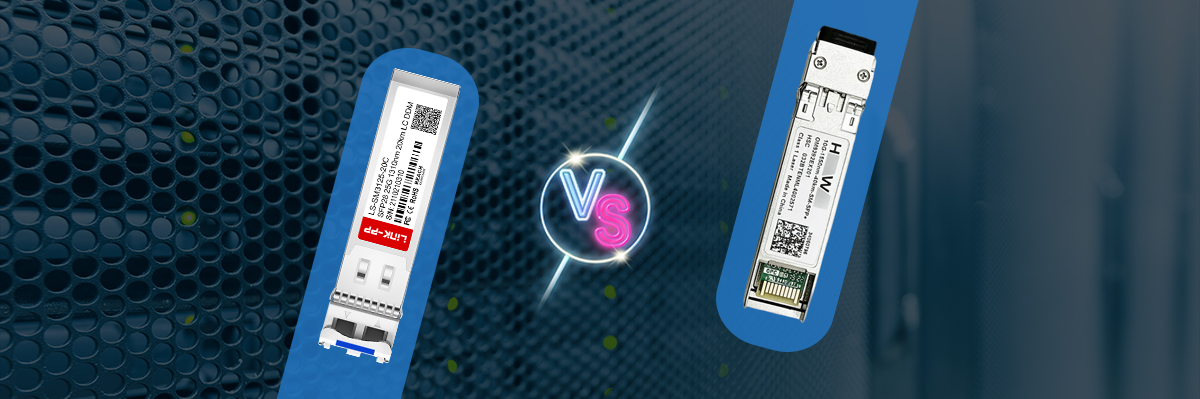
Selecting the right optical transceiver is fundamentally about aligning technical capabilities with business and network requirements. Although LINK-PP and Huawei both offer SFP and higher-speed optical modules, they occupy distinct positions in the market, shaped by different product strategies and deployment philosophies.
A structured comparison of LINK-PP SFP vs. Huawei SFP highlights how a vendor's strategic focus influences the performance, flexibility, and cost-effectiveness of its optical modules in practical deployments.
Key Technical Dimensions Worth Comparing
When evaluating SFP and related optical transceiver families, several technical dimensions consistently influence real-world performance and procurement decisions:
-
Supported data rates across access, aggregation, and data-center networks (1G, 10G, 25G, 40G, 100G, 200G, 400G, and emerging 800G)
-
Forward and backward compatibility across form factors, such as SFP ↔ SFP+, SFP28, QSFP+, QSFP28, QSFP-DD, and OSFP
-
Protocol support, including Ethernet, Fibre Channel, and telecom-oriented protocols such as CPRI / eCPRI
These factors directly affect how easily optical modules can be reused, upgraded, or integrated into multi-generation and multi-vendor networks.
Different Product Strategies: LINK-PP vs. Huawei
LINK-PP and Huawei approach optical transceiver design from fundamentally different strategic perspectives.
LINK-PP offers a broad and diversified SFP Modules product portfolio covering 1G through 800G, spanning form factors such as SFP, SFP+, SFP28, QSFP+, QSFP28, QSFP-DD, and OSFP. Its market positioning emphasizes:
-
Multi-rate and multi-form-factor flexibility
-
Compliance with MSA and industry standards
-
Support for mixed-vendor and open networking environments
This approach is particularly relevant for enterprises, data centers, and system integrators seeking vendor neutrality and long-term interoperability.
Huawei, by contrast, focuses on delivering a comprehensive optical module lineup aligned with modern data center and carrier-class speeds, especially 100G, 200G, and higher. Huawei SFP and higher-speed modules are closely integrated with:
-
Huawei switch and router platforms
-
Defined optical roadmaps (e.g., LR, LR4, DR, ZR families)
-
Native support documented across CloudEngine and related platforms
This tight integration supports performance optimization within Huawei-centric ecosystems, but can influence flexibility in heterogeneous deployments.
Why Performance Comparisons Matter in Practice
SFP (Small Form-factor Pluggable) optical transceivers remain foundational components in enterprise networks, data centers, and telecom access layers. When engineers and procurement teams assess SFP modules, performance consistency is often the deciding factor, as it directly impacts:
-
Network stability and uptime
-
Scalability during upgrades or expansion
-
Long-term operational reliability and maintenance complexity
Comparing LINK-PP SFP vs. Huawei SFP clarifies how a standards-based, multi-vendor compatibility model differs from a platform-optimized, vendor-integrated model in real-world performance scenarios. This understanding enables decision-makers to choose SFP solutions based on deployment requirements and network architecture, rather than brand preference alone.
✅ SFP Data Rate Comparison
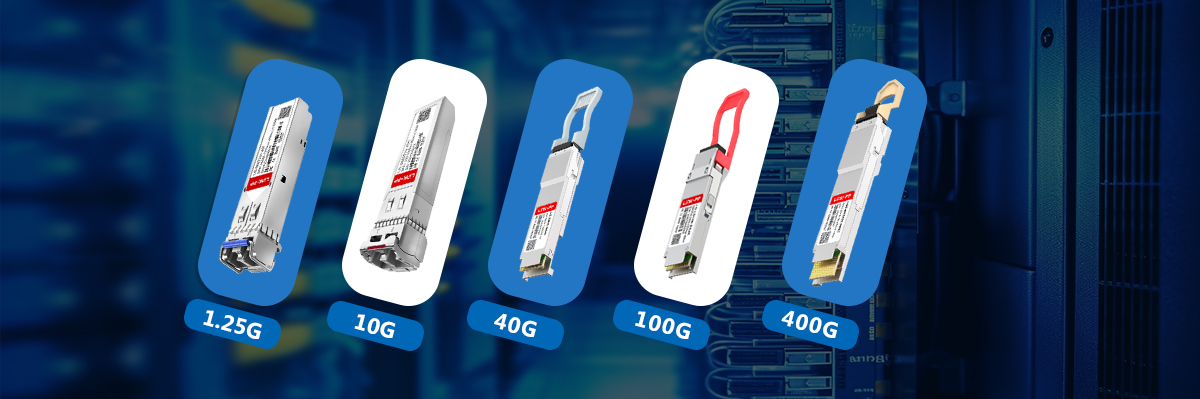
Overview of Multi-Rate SFP Modules
Both LINK-PP and Huawei offer optical transceivers across a wide range of speeds, including 1G, 10G, 25G, 40G, 50G, 100G, 200G, and 400G. These modules are designed to meet the requirements of enterprise, data center, and carrier-grade networks, but their design philosophies and ecosystem integration differ.
-
LINK-PP SFP family emphasizes multi-rate compatibility and MSA compliance, making it suitable for mixed-vendor networks and phased upgrades.
-
Huawei SFP modules are optimized for Huawei-centric environments, offering tight integration with Huawei switches and routers, especially at higher speeds.
Performance Characteristics by Data Rate
1. 1G and 10G SFP Modules
-
LINK-PP: Provides stable performance for access and aggregation layers with low latency, low jitter, and strong interoperability across vendor platforms.
-
Huawei: Performs reliably in Huawei-managed networks; ideal for enterprises fully standardizing on Huawei hardware.
Typical Applications: Enterprise LAN, access networks, campus connectivity, small to medium data center links.
2. 25G and 40G Modules
-
LINK-PP: Offers SFP28 and QSFP+ variants, supporting high-density connections while maintaining signal integrity under sustained loads.
-
Huawei: Optimized for CloudEngine and data center leaf-spine architectures, with native support for high-speed Ethernet fabrics.
Typical Applications: Mid-size data center uplinks, server aggregation, virtualization-heavy environments.
3. 50G and 100G Modules
-
LINK-PP: SFP56 and QSFP28 modules provide a balance of performance, power efficiency, and multi-vendor compatibility.
-
Huawei: Modules such as QSFP28 100G LR/DR/ZR are tightly integrated with Huawei platforms, ensuring predictable performance in carrier-grade and hyperscale deployments.
Typical Applications: Data center interconnects (DCI), backbone aggregation, high-performance computing clusters.
4. 200G and 400G Modules
-
LINK-PP: Offers QSFP56-DD, OSFP, and QSFP-DD modules, supporting ultra-high-density deployments and multi-vendor interoperability.
-
Huawei: Provides QSFP-DD 200G/400G modules optimized for Huawei CloudEngine or datacenter spine switches, with high reliability in end-to-end Huawei environments.
Typical Applications: Hyperscale data centers, high-performance computing (HPC), cloud provider networks, optical metro networks.
Key Considerations for Selecting Multi-Rate Modules
-
Deployment environment: Mixed-vendor vs. vendor-specific platforms.
-
Future scalability: LINK-PP modules allow smoother migration across generations; Huawei modules perform best within Huawei ecosystems.
-
Performance under load: Evaluate continuous traffic performance, latency, and signal integrity at your target data rate.
-
Cost vs. compatibility trade-offs: Multi-rate LINK-PP modules often provide better cost efficiency in heterogeneous networks, while Huawei modules ensure predictable performance in Huawei-standardized deployments.
✅ SMF vs. MMF SFP Comparison
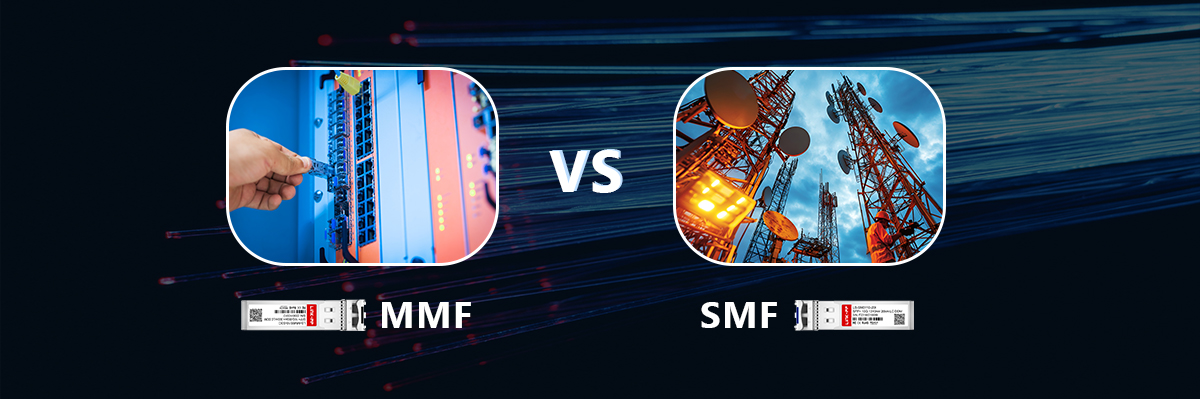
Fiber type selection is a critical factor when evaluating SFP and higher-speed optical transceivers, as it directly affects transmission distance, cost structure, and long-term scalability. Both LINK-PP and Huawei provide comprehensive support for multi-mode fiber (MMF) and single-mode fiber (SMF) across their optical module portfolios, but with different positioning and ecosystem considerations.
Key Criteria for Evaluating Fiber Type Support
When comparing LINK-PP SFP vs. Huawei SFP fiber compatibility, network engineers typically focus on the following aspects:
-
MMF vs. SMF SKUs: Availability of standardized SR (MMF) and LR/ER/ZR (SMF) modules
-
Modal bandwidth and fiber-grade matching: OM3/OM4 for MMF, ITU-T G.652 for SMF
-
Use-case alignment: Short-reach ToR and intra-rack links versus inter-rack, campus, metro, and long-haul deployments
Comparison Notes: LINK-PP vs. Huawei Fiber Support
LINK-PP offers a broad range of standard MMF and SMF optical modules designed for enterprise, data center, and metropolitan networks. Typical offerings include:
-
MMF SR modules (e.g., 10GBASE-SR at 850nm), commonly supporting distances up to 300 meters on OM3/OM4 fiber
-
SMF LR modules (e.g., 10GBASE-LR at 1310nm) with standard reaches up to 10 km, as well as higher-speed options such as 100G LR4 for longer links
LINK-PP product pages clearly specify fiber type, wavelength, and supported reach, making module selection straightforward in multi-vendor environments.
Huawei similarly publishes detailed MMF and SMF SKUs across its optical portfolio. Huawei datasheets reference standardized reach values, such as 10G SR 300 m on MMF, and a wide selection of SMF LR, ER, CWDM, and DWDM modules, including ZR-class optics supporting distances up to 80–100 km in carrier and metro scenarios. Huawei’s documentation places strong emphasis on platform-specific fiber and optics compatibility, especially for CloudEngine and carrier-grade systems.
Quick guidance:
-
For short-reach intra-rack or top-of-rack (ToR) connections, MMF SR optics at 850 nm are generally the most cost-efficient choice, regardless of vendor.
-
For inter-rack, campus, metro, or long-haul links, SMF LR/ER/ZR modules are preferred, and the optical link budget should always be verified against the actual fiber plant.
Single-Mode Fiber (SMF) Performance Characteristics
LINK-PP SMF SFP Modules are optimized for low attenuation and stable long-distance transmission, making them suitable for enterprise backbones, campus networks, and metropolitan links. Their standards-based design ensures predictable performance across different switch platforms.
Huawei SMF SFP modules are widely deployed in carrier-grade and large-scale data center environments, particularly where Huawei infrastructure is standardized end-to-end. In these scenarios, tight integration between optics, firmware, and switching platforms helps maintain consistent performance over extended distances.
Multi-Mode Fiber (MMF) Performance Characteristics
For short-reach applications, both LINK-PP and Huawei MMF SFP modules deliver reliable performance within the distance ranges typically required inside data centers.
LINK-PP MMF SFPs are frequently selected in deployments that prioritize cost efficiency, rapid procurement, and multi-vendor interoperability, especially in enterprise and colocation data centers.
Practical Deployment Scenarios for SMF and MMF
-
SMF: Enterprise backbone links, building-to-building connections, campus and metro networks
-
MMF: Data center access layers, equipment room interconnects, ToR and inter-rack links
Overall, LINK-PP SFP modules support both SMF and MMF without locking users into a single vendor ecosystem, offering greater flexibility for networks that evolve over time or incorporate equipment from multiple manufacturers.
✅ SFP Wavelength Options (850nm / 1310nm / 1550nm / CWDM / DWDM)
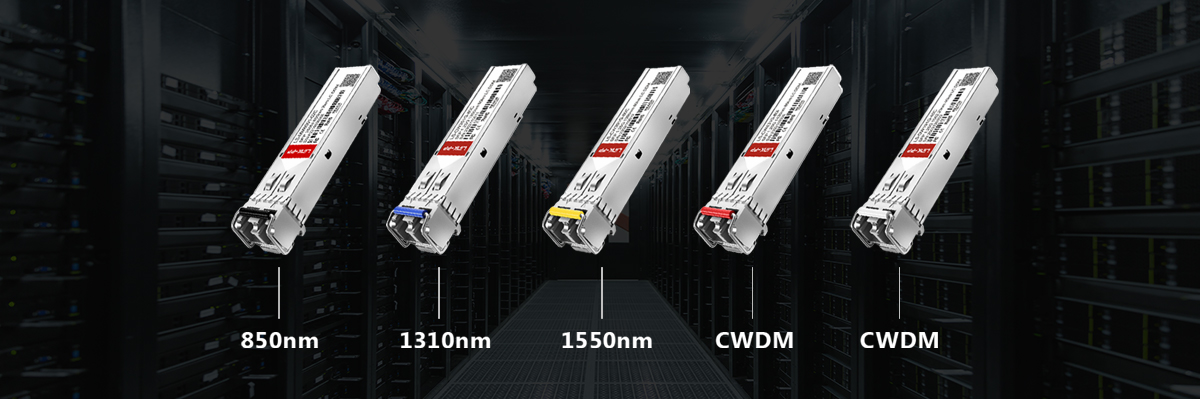
Wavelength selection is a core technical consideration when evaluating SFP optical transceivers, as it directly determines fiber type compatibility, standardized transmission reach, and deployment scenarios. Both LINK-PP and Huawei provide SFP modules covering all major industry-standard wavelength families. The key difference lies not in wavelength availability, but in how these wavelengths are positioned within open versus vendor-centric network architectures.
Industry-Standard SFP Wavelength Families
Modern SFP and SFP+ optical modules are commonly classified by operating wavelength, with each wavelength family aligned to well-defined IEEE and MSA specifications. These wavelength categories determine fiber type compatibility, standardized transmission reach, and typical network-layer placement.
Standard SFP Wavelength Categories and Characteristics
| Wavelength | Fiber Type | Typical Standards / Examples | Typical Reach (Standardized) | Common Network Use Cases |
|---|---|---|---|---|
| 850 nm | MMF (OM3 / OM4) | 1000BASE-SX, 10GBASE-SR | Up to 300m (OM3), 400m (OM4) | Intra-rack, inter-rack, ToR links in data centers |
| 1310 nm | SMF (G.652) | 1000BASE-LX, 10GBASE-LR, 25G LR | Up to 10km | Enterprise backbone, campus networks |
| 1550 nm | SMF (G.652 / G.655) | 10G ER, 10G ZR, 10G ZR | 40km / 80km (module class dependent) | Metro links, long-distance enterprise connectivity |
| CWDM | SMF | CWDM SFP (18-channel grid) | Typically 10–80km | Metro aggregation, fiber-constrained networks |
| DWDM | SMF | DWDM SFP / SFP+ (ITU-T grid) | 40–80km (100km+ with amplification) | High-density metro and long-haul transport |
These wavelength families define how far an SFP module can transmit, which fiber type it requires, and which network layer it best fits, providing engineers with a standardized framework for optical module selection.
Short-Range Wavelength Performance (850nm, 1310nm)
850nm SFP modules are based on VCSEL technology and are designed exclusively for multimode fiber (MMF):
-
Typical applications: intra-rack, inter-rack, and top-of-rack (ToR) links
-
Standardized reach:
-
Up to 300m on OM3
-
Up to 400m on OM4 (10GBASE-SR)
Both LINK-PP SFP SR and Huawei SFP SR modules follow these standardized definitions, delivering predictable short-reach performance in data center environments.
1310nm SFP modules are designed for single-mode fiber (SMF, ITU-T G.652) and support longer distances:
-
Typical standards:
-
1000BASE-LX
-
10GBASE-LR
-
25G SFP28 LR
-
Standardized reach:
-
Typically up to 10 km
LINK-PP SFP modules strictly follow IEEE wavelength and reach definitions, enabling consistent operation across multi-vendor switch platforms. Huawei SFP modules also adhere to standard wavelengths, with official documentation clearly specifying supported platforms and fiber expectations.
Long-Range Wavelength Performance (1550nm)
The 1550 nm wavelength window is widely used for extended-reach single-mode transmission, due to its lower fiber attenuation characteristics.
Typical use cases include:
-
10G ER / ZR SFP+ Modules
-
Long-distance enterprise, campus, and metro links
-
DWDM-capable optical systems
It is important to note:
1550 nm does not automatically imply DWDM.
DWDM SFPs require precise ITU channel spacing and wavelength locking, while standard ER/ZR modules operate at nominal 1550 nm without fixed channel grids.
LINK-PP 1550nm SFP modules are engineered with balanced optical output power and receiver sensitivity, supporting standardized extended-reach distances (e.g., 40 km, 80 km depending on module class) without excessive power margins.
Huawei 1550nm SFP modules are commonly deployed in carrier and metro environments, with product documentation clearly defining ER, ZR, and platform-specific optical classes.
CWDM and DWDM SFP Performance in Dense Networks
CWDM and DWDM SFP modules enable multiple optical channels to coexist on a single fiber, significantly increasing fiber utilization in metro and long-haul networks.
Key distinctions:
-
CWDM SFPs
-
Wider channel spacing
-
Lower cost
-
Typically used for metro aggregation links
-
DWDM SFPs
-
Fixed ITU-T channel grids
-
Narrow wavelength tolerances
-
Designed for high-density, long-haul transport
Huawei DWDM SFP modules are frequently deployed within Huawei-managed optical transport systems, where channel plans and platform firmware are tightly integrated.
LINK-PP DWDM and CWDM SFPs provide a vendor-neutral alternative, designed to operate in open optical networks that combine switches, routers, and transport equipment from multiple manufacturers.
For both vendors, engineers should always verify:
-
Exact ITU channel number
-
Wavelength tolerance
-
Supported optical link budget
as specified in the official datasheets.
Practical Guidance for SFP Wavelength Selection
-
Data center short reach → 850nm SFP SR on MMF
-
Enterprise and campus networks → 1310nm SFP LR on SMF
-
Extended-distance links → 1550nm ER / ZR SFP modules
-
High fiber utilization environments → CWDM or DWDM SFP solutions
From a wavelength perspective, both LINK-PP and Huawei cover all standardized SFP wavelength options, while LINK-PP emphasizes open standards and cross-platform interoperability, and Huawei aligns wavelength offerings closely with its integrated optical ecosystem.
✅ SFP Transmission Distance Performance
Transmission distance is one of the most practical performance metrics when evaluating SFP optical transceivers, as it directly affects network topology design, fiber selection, and total deployment cost. Both LINK-PP and Huawei provide SFP modules spanning standardized short-, mid-, and long-reach classes, with distances defined by IEEE specifications and optical link budgets rather than marketing claims.
Typical SFP Transmission Reach Classes
| Reach Class | Wavelength | Fiber Type | Typical Standardized Reach | Common Use Cases |
|---|---|---|---|---|
| SR | 850nm | MMF (OM3 / OM4) | Up to 300m | Intra-rack, inter-rack, and Top-of-Rack (ToR) connections |
| LR | 1310nm | SMF (G.652) | Up to 10km | Enterprise backbone links, campus networks |
| LR4 / 100G LR4 | 1310nm (4-lane) | SMF | Approximately 10km | High-speed aggregation, data center interconnect (DCI) |
| ER | 1550nm | SMF (G.652 / G.655) | Approximately 40km | Metro and extended enterprise links |
| ZR | 1550nm | SMF | Approximately 80km | Metro and long-haul transmission |
| ZR (with amplification) | 1550nm | SMF | 80–100+ km (system-dependent) | Long-haul networks with optical amplification |
| DWDM variants | ITU-T grid (C-band) | SMF | 40–80km (100 km+ with amplification) | High-density metro and long-haul transport |
What the Datasheets Show
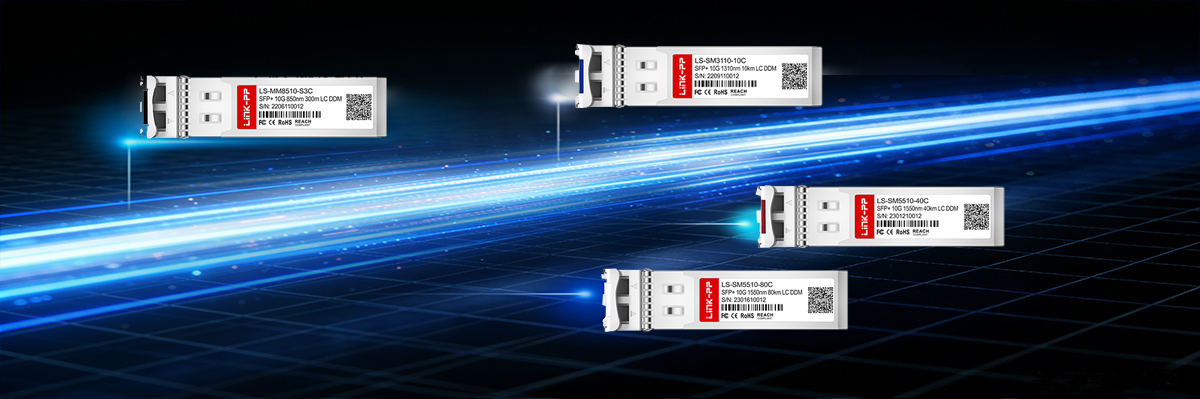
LINK-PP SFP modules provide clearly defined transmission distances on a per-SKU basis, with product pages specifying wavelength, fiber type, typical reach, and DOM (Digital Optical Monitoring) support. Common examples include:
-
10GBASE-SR: up to 300m on MMF
-
10GBASE-LR: up to 10km on SMF
This per-SKU transparency supports precise distance planning in enterprise and multi-vendor environments.
Huawei SFP modules are documented extensively in optics datasheets and CloudEngine platform compatibility guides. Huawei documentation lists standardized reach classes such as:
-
10G SR: 0.3km
-
10G LR: 10km
-
10G ZR: up to 80km
-
100G DR / FR / LR4 / ZR classes for higher-speed platforms
Huawei’s materials clearly map each optical module to supported switch platforms and distance categories, reinforcing tight integration with its hardware ecosystem.
Representative Transmission Distance Comparison
| Reach Class | Typical LINK-PP SFP SKU | Typical Huawei SFP SKU |
|---|---|---|
| MMF SR (850nm) | 10GBASE-SR — up to 300 m | 10GBASE-SR — up to 300 m |
| SMF LR (1310nm) | 10GBASE-LR — up to 10 km | 10GBASE-LR — up to 10 km |
| Long-haul ER / ZR | Select LINK-PP ER / ZR SKUs (SKU-dependent) | Huawei ER / ZR classes up to ~80–100 km |
Note: Exact reach depends on fiber type (G.652 vs. G.655), connector and splice losses, and conservative link-budget engineering. Engineers should always verify Tx/Rx optical power budgets in the official datasheet before deployment.
Optical Power Budget and Signal Margin Considerations
LINK-PP SFP modules are designed with practical optical power budgets, allowing engineers to match reach requirements without unnecessary excess margin. This approach helps reduce cost, power consumption, and thermal load in dense network environments.
Huawei SFP modules are optimized within Huawei-managed systems, where optical parameters and alarms are closely coordinated by platform firmware. This tight integration supports predictable performance in Huawei-standardized networks.
Distance Performance vs. Network Design Trade-offs
Selecting SFP modules with longer reach than required can increase both unit cost and power consumption, while offering no practical benefit.
LINK-PP SFP modules enable engineers to align transmission distance precisely with actual network design needs, supporting efficient architectures in enterprise, data center, and metro deployments.
✅ SFP Compatibility With Mainstream Networks
Why Compatibility Matters in Modern Networks
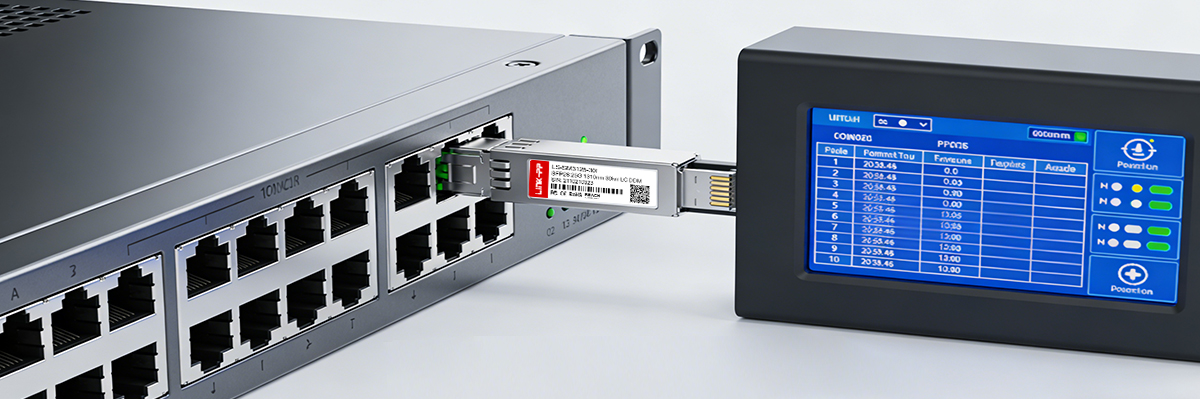
SFP compatibility is no longer a simple plug-and-play question. Modern switches and routers commonly validate transceiver EEPROM fields, including vendor OUI, part number identifiers, supported diagnostics (DOM/DDM), and compliance flags.
In mixed-vendor networks, these checks directly affect whether an SFP module is:
-
Correctly recognized by the device
-
Allowed to operate at full line rate
-
Able to expose diagnostics and monitoring data
-
Free from compatibility warnings or administrative shutdowns
As a result, SFP compatibility with mainstream switches has a direct impact on network stability, operational visibility, and long-term maintainability.
Practical Compatibility Comparison: LINK-PP vs. Huawei
LINK-PP positions its SFP modules around broad multi-vendor interoperability. Product documentation and compatibility statements indicate testing with a wide range of mainstream network vendors, including Cisco, Juniper, Arista, HPE, and others. Many LINK-PP SFP SKUs are positioned as direct functional equivalents to OEM part numbers, while still adhering to MSA standards.
Key characteristics of LINK-PP’s compatibility approach include:
-
Emphasis on cross-platform recognition
-
DOM/DDM support for real-time optical monitoring
-
Suitability for heterogeneous environments where multiple switch brands coexist
This makes LINK-PP SFP modules a practical option for cost-sensitive deployments or networks undergoing gradual vendor transitions.
Huawei, by contrast, follows a systems-oriented compatibility model. Huawei’s official SFP modules are certified specifically for Huawei platforms and typically come with vendor-backed interoperability guarantees, full feature enablement, and alignment with Huawei’s software and telemetry frameworks. Huawei documentation and support pages clearly list certified optics SKUs for platforms such as CloudEngine switches, and enterprises often rely on these lists to avoid edge-case incompatibilities.
While non-Huawei SFP modules may function in Huawei equipment, many organizations choose Huawei-certified optics to reduce the risk of:
-
Vendor lockout mechanisms
-
Unsupported configurations
-
Ambiguous support boundaries during troubleshooting
Interoperability With Multi-Vendor Switches and Routers
LINK-PP SFP modules are tested for interoperability across a broad range of mainstream switches and routers, making them well-suited for multi-vendor network architectures. This is particularly valuable in environments where Cisco, HPE, Arista, and other platforms coexist within the same data center or campus network.
Huawei SFP modules, while highly stable within Huawei ecosystems, are primarily optimized for Huawei-native deployments, where end-to-end compatibility and feature consistency are prioritized.
EEPROM Coding and Platform Recognition
EEPROM coding plays a central role in SFP recognition and acceptance by network devices.
-
LINK-PP applies standardized EEPROM coding strategies, enabling predictable platform recognition while remaining compliant with MSA and IEEE requirements.
-
Huawei SFP modules may use proprietary or platform-specific EEPROM profiles, aligned closely with Huawei switches and routers to enable deeper system integration.
These differences influence how easily SFP modules can be reused across platforms during network expansion or hardware refresh cycles.
Performance Stability in Mixed-Vendor Environments
In mixed-vendor environments, LINK-PP SFP Fiber Modules typically offer more consistent operational behavior, with fewer compatibility-related warnings or restrictions. This can help reduce operational overhead, simplify inventory management, and lower the risk of unexpected interoperability issues.
Huawei SFP modules deliver their strongest performance characteristics in Huawei-standardized networks, where tight integration between optics, hardware, and software ensures predictable behavior at scale.
Deployment Recommendations
-
Single-vendor Huawei networks (large campus, carrier-grade, or CloudEngine deployments):
Use Huawei-certified SFP modules to ensure full vendor support, simplified maintenance, and clear accountability. -
Mixed-vendor or cost-sensitive networks:
LINK-PP SFP modules provide a pragmatic balance of compatibility, performance, and flexibility, but should be validated through small-scale pilot testing before wide rollout.
✅ Summary: LINK-PP SFP vs. Huawei SFP Which is Better
There is no universally “better” SFP vendor — the optimal choice depends on network architecture, vendor strategy, and operational priorities. From a practical engineering perspective, LINK-PP and Huawei SFP modules excel in different deployment models.
Decision Map
Choose LINK-PP if:
-
You operate a mixed-vendor environment (Cisco, Juniper, Arista, HPE, etc.)
-
Cost efficiency and vendor-neutral compatibility are key purchasing drivers
-
You require broad SKU availability for phased upgrades or large-scale rollouts
-
Supply flexibility and lead-time reliability are important for ongoing operations
LINK-PP’s SFP portfolio is designed around OEM/ODM equivalency and interoperability testing, making it well-suited for enterprise, data center, and integrator-led deployments where flexibility outweighs platform-specific optimization.
Choose Huawei if:
-
Your network is built primarily on Huawei switching and routing platforms
-
You require official platform certification, integrated telemetry, and full feature enablement
-
Vendor-backed warranty, software support, and lifecycle alignment are mandatory
Typical use cases include operator networks, carrier and metro deployments, and large Huawei-centric enterprise environments, where tight system integration and standardized optics simplify long-term operations.
Final Engineering Checklist Before Purchase
Before finalizing any SFP selection, network engineers and procurement teams should validate the following:
-
Confirm the required data rate and form factor
(SFP, SFP+, SFP28, QSFP28, etc.) -
Check per-SKU optical parameters
Review Tx/Rx optical power, receiver sensitivity, and calculate link budget based on fiber type and distance. -
Verify monitoring and environmental features
Ensure DOM/DDM support is available and confirm temperature ratings
(commercial vs. industrial). -
Validate device compatibility
Test optics on representative hardware or reference vendor-published compatibility lists. -
Compare total cost of ownership (TCO)
Go beyond unit price — factor in replacement risk, warranty coverage, support boundaries, inventory strategy, and operational overhead.
Final Takeaway
From an engineering standpoint, LINK-PP prioritizes interoperability, cost control, and deployment flexibility, while Huawei emphasizes platform-optimized performance, certification, and ecosystem consistency. Aligning the optic strategy with your network design philosophy is the most reliable way to ensure long-term stability and value.







