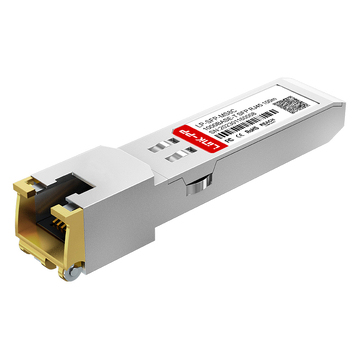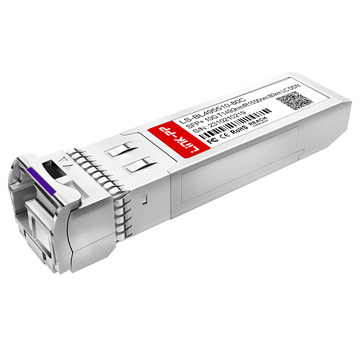
The 10G SFP+ module is the standard transceiver form factor for 10 Gigabit Ethernet (10GbE) links in modern data centers and enterprise networks. Designed as a compact, hot-pluggable interface, it allows switches, routers, and servers to flexibly support high-speed connections over optical fiber or copper cabling without changing the host hardware.
In practice, SFP+ 10G modules serve a wide range of deployment scenarios—from short-reach multimode fiber links inside data centers to long-reach single-mode connections between buildings, as well as short-distance copper connections using RJ45 Ethernet. Common variants include 10GBASE-SR, 10GBASE-LR, 10GBASE-ER, 10GBASE-ZR, and 10GBASE-T, each optimized for different transmission distances, media types, and power budgets.
This article provides a clear, technically accurate overview of 10G SFP+ modules, focusing on how different types compare, how to select the right module based on real-world requirements, and how to avoid common compatibility and deployment issues. It also includes a concise specification reference and a practical FAQ section that can be reused in product pages or procurement documentation.
What you’ll learn from this guide:
By reading this article, you will be able to:
-
Understand the differences between 10GBASE-SR, LR, ER/ZR, and 10GBASE-T SFP+ modules, and choose the correct type based on distance, fiber or cable type, and application scenario.
-
Interpret key technical specifications—such as wavelength, typical reach, connector type, and power characteristics—so you can make confident engineering or procurement decisions.
-
Identify and avoid common interoperability pitfalls, including vendor compatibility limitations and host device restrictions, before deployment.
? Types of 10G SFP+ Modules (SR / LR / ER / ZR / 10G-T)
The 10G SFP+ family includes several standardized variants, each designed for a specific transmission medium, distance range, and deployment scenario. Understanding these differences is essential for correct optical planning, cost control, and long-term network stability. The most commonly deployed types are 10GBASE-SR, 10GBASE-LR, 10GBASE-ER/ZR, and 10GBASE-T.
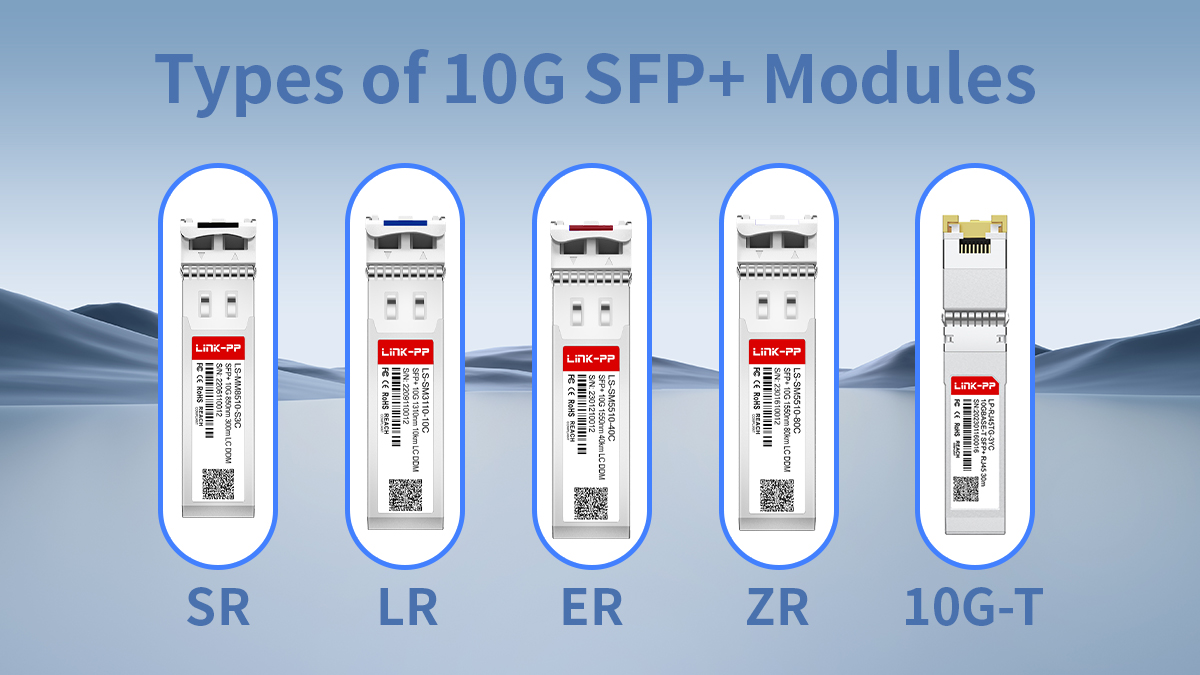
Below, each type is explained with practical engineering context rather than abstract specifications.
1. 10GBASE-SR SFP+ Module (Short Reach, Multimode Fiber)
SFP+ SR is the most widely used 10Gb SFP+ optical module in data centers.
Key characteristics
-
Wavelength: 850 nm (VCSEL)
-
Fiber type: Multimode fiber (MMF)
-
Typical reach:
-
Up to 300 m on OM3
-
Up to 400 m on OM4
-
-
Connector: LC duplex
Typical use cases
-
Switch-to-switch links within the same data hall
-
Top-of-rack (ToR) to end-of-row (EoR) connections
-
High-density environments where short distances dominate
Why choose 10GBASE-SR
-
Lower cost compared to long-reach optics
-
Lower power consumption than copper-based 10G solutions
-
Well-suited for legacy MMF infrastructure commonly found in enterprise data centers
Limitations
-
Not compatible with single-mode fiber
-
Distance is strictly limited by multimode fiber grade and link budget
2. 10GBASE-LR SFP+ Module (Long Reach, Single-Mode Fiber)
SFP+ LR is designed for longer-distance optical transmission over single-mode fiber.
Key characteristics
-
Wavelength: 1310 nm (DFB laser)
-
Fiber type: Single-mode fiber (SMF, typically G.652)
-
Typical reach: Up to 10 km
-
Connector: LC duplex
Typical use cases
-
Inter-building campus networks
-
Data center interconnects (DCI) within metro areas
-
Enterprise backbone links requiring higher reach than MMF allows
Why choose 10GBASE-LR
-
Significantly longer reach compared to SR
-
Stable optical performance over long distances
-
Widely supported across major switch and router platforms
Limitations
-
Higher cost than SR modules
-
Requires single-mode fiber infrastructure
3. 10GBASE-ER / ZR SFP+ Module (Extended & Very Long Reach)
SFP+ ER and SFP+ ZR extend 10GbE transmission well beyond standard LR distances.
Key characteristics
-
Typical wavelength: 1550 nm
-
Fiber type: Single-mode fiber
-
Typical reach:
-
ER: around 40 km
-
ZR: up to 80 km (vendor-dependent)
-
-
Connector: LC duplex
Typical use cases
-
Metro or regional network links
-
Long-distance campus or industrial networks
-
Scenarios where intermediate amplification is not desired
Why choose ER/ZR
-
Enables long-distance 10GbE without media converters
-
Suitable for carrier-grade and critical infrastructure deployments
Limitations
-
Higher optical power and stricter link budget requirements
-
More expensive and may require careful attention to dispersion and attenuation
-
Not all switches officially support ZR-class optics
4. 10GBASE-T SFP+ Module (Copper, RJ45)
SFP+10GBASE-T modules provide 10GbE over twisted-pair copper cabling in an SFP+ form factor.
Key characteristics
-
Interface: RJ45 Ethernet
-
Cable type: Cat6A / Cat7
-
Typical reach: Commonly up to 30 m (module- and cable-dependent)
-
Form factor: SFP+ with integrated copper PHY
Typical use cases
-
Server connections within the same rack
-
Short-distance switch uplinks where fiber is unavailable
-
Transitional deployments upgrading from 1GBASE-T to 10GBASE-T
Why choose 10GBASE-T
-
Uses familiar copper cabling and RJ45 connectors
-
Simplifies migration from 1G Ethernet environments
-
Eliminates the need for fiber patching in short links
Limitations
-
Higher power consumption and heat output than optical SFP+ modules
-
Shorter practical reach in SFP+ form factor compared to fixed 10GBASE-T ports
-
Not suitable for high-density or thermally constrained switches
5. Summary: Choosing the Right SFP+ 10G Module Type
| Module Type | Medium | Typical Reach | Best For |
|---|---|---|---|
| 10GBASE-SR | MMF | 300–400 m | Intra–data center links |
| 10GBASE-LR | SMF | Up to 10 km | Campus & inter-building |
| 10GBASE-ER/ZR | SMF | 40–80 km | Metro & long-distance |
| 10GBASE-T | Copper | ~30 m | Short RJ45-based links |
? Selection Checklist for SFP+ 10G Module
Selecting the right 10G SFP+Transceiver is not only about matching speed. In real deployments, distance, fiber type, host compatibility, and power constraints all play a role. The checklist below walks through the key technical factors engineers and buyers should verify before placing an order or deploying modules at scale.
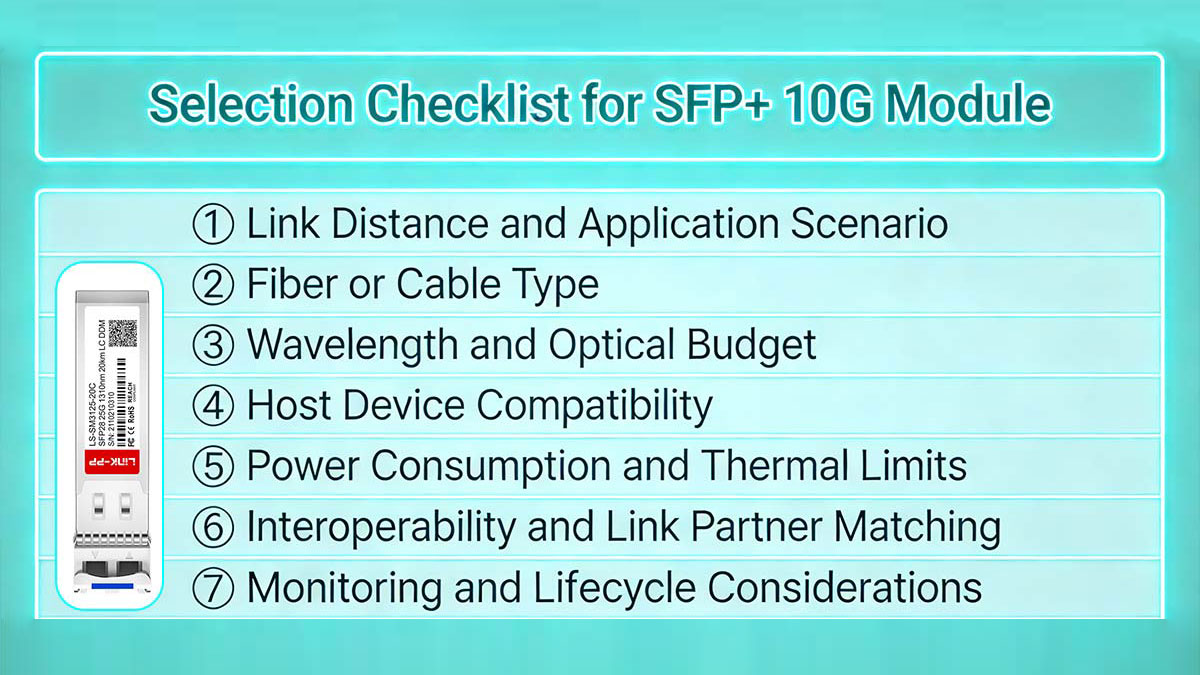
① Link Distance and Application Scenario
Start by defining the actual link distance, not the theoretical maximum:
-
≤ 100 m inside a rack or room → 10GBASE-SR (MMF) or 10GBASE-T (Cat6a)
-
100–400 m inside a data center → 10GBASE-SR on OM3/OM4
-
400 m–10 km between buildings or floors → 10GBASE-LR
-
> 10 km metro or campus links → 10GBASE-ER / ZR
Always leave margin for:
-
Fiber aging
-
Connector and splice loss
-
Patch panel insertion loss
② Fiber or Cable Type
Verify the installed cabling before choosing a module.
| Module Type | Cable Type | Connector | Typical Reach |
|---|---|---|---|
| 10GBASE-SR | OM3 / OM4 MMF | LC duplex | 300 m / 400 m |
| 10GBASE-LR | OS2 SMF | LC duplex | 10 km |
| 10GBASE-ER | OS2 SMF | LC duplex | 40 km |
| 10GBASE-ZR | OS2 SMF | LC duplex | 80 km (vendor-specific) |
| 10GBASE-T | Cat6a copper | RJ45 | 100 m |
Tip: Avoid mixing SFP+ MMF modules with single-mode fiber or vice versa—this is a common cause of link failures.
③ Wavelength and Optical Budget
Each optical SFP+ type operates at a fixed wavelength:
-
850 nm → 10GBASE-SR
-
1310 nm → 10GBASE-LR
-
1550 nm → 10GBASE-ER / ZR
Check the optical power budget in the SFP+ datasheet:
-
Tx power (dBm)
-
Rx sensitivity (dBm)
-
Maximum supported attenuation (dB)
This ensures the link remains stable under real-world conditions, not just in lab tests.
④ Host Device Compatibility
Not every SFP+ module works in every switch or NIC.
Before deployment, confirm:
-
Maximum supported module power class
-
Vendor coding or whitelist restrictions in firmware
If using third-party or compatible modules, verify that:
-
The EEPROM coding matches the host’s requirements
-
The vendor provides compatibility testing or a qualification list
⑤ Power Consumption and Thermal Limits
Power draw matters, especially in dense switch environments.
Typical ranges:
-
Optical SFP+ (SR/LR): ~0.8–1.5 W
-
Long-reach ER/ZR: ~1.5–2.5 W
-
10GBASE-T SFP+: often 2.5–3.5 W or higher
High-power modules may:
-
Trigger thermal alarms
-
Be disabled by the host
-
Reduce port density in compact switches
Always check both module and host thermal specifications.
⑥ Interoperability and Link Partner Matching
For optical links:
-
Ensure both ends use the same standard and wavelength
-
Avoid mixing SR with LR, or 1310 nm with 1550 nm modules
For copper links:
-
Confirm Cat6a cabling quality
-
Verify auto-negotiation behavior and firmware support
When connecting to third-party equipment, matching standards is more reliable than matching brand names.
⑦ Monitoring and Lifecycle Considerations
If long-term stability and maintenance matter, check for:
-
DOM/DDM support (Tx/Rx power, temperature)
-
Clearly defined operating temperature range
-
MTBF and compliance certifications (RoHS, CE, FCC)
These factors are often overlooked but become critical in production networks.
⑧ Quick Pre-Deployment Checklist
Before finalizing your selection, confirm:
-
✅ Correct module type for distance and media
-
✅ Matching wavelength and connector
-
✅ Host port supports SFP+ and required power class
-
✅ Thermal limits are not exceeded
-
✅ Compatibility tested with target hardware
? How a 10G SFP+ Module Works
To properly evaluate datasheets, compatibility lists, and deployment limits, it helps to understand how a 10G SFP+ module operates at both the physical and electrical levels. While SFP+ modules are compact and hot-pluggable, internally they integrate multiple standardized subsystems defined by MSAs and IEEE Ethernet specifications.
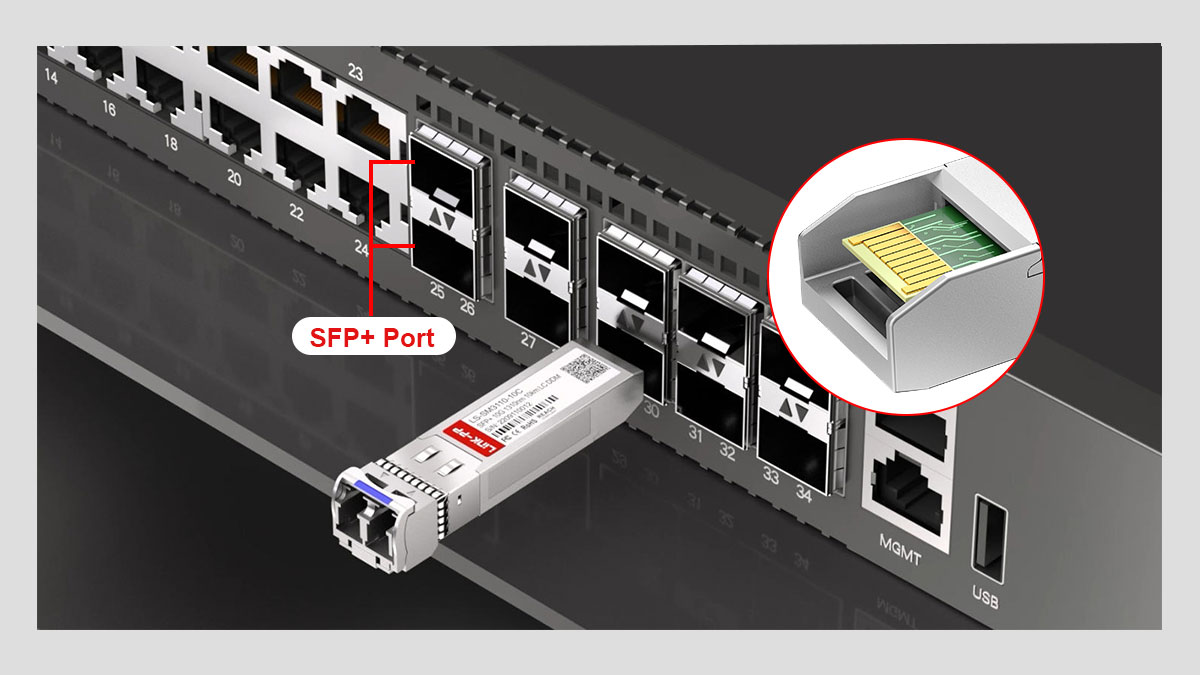
▷ Standards Foundation: MSA and IEEE Compliance
A SFP+ Transceiver is an enhanced version of the original SFP form factor, defined primarily by Multi-Source Agreements (MSAs) and Ethernet standards:
-
SFF-8431 – Defines the electrical interface between the SFP+ module and the host (10G serial electrical signaling).
-
SFF-8432 / SFF-8472 – Define the mechanical dimensions, pinout, EEPROM layout, and Digital Optical Monitoring (DOM).
-
IEEE 802.3ae – Covers 10GBASE-SR, LR, ER optical Ethernet standards.
-
IEEE 802.3an – Defines 10GBASE-T over twisted-pair copper.
Compliance with these specifications ensures that SFP+ modules from different vendors can interoperate with compliant switches, NICs, and routers, subject to vendor coding and firmware policies.
▷ Electrical Interface: Host-to-Module Communication
On the host side, the SFP+ module connects via a 20-pin edge connector, carrying:
-
High-speed serial differential signals (10.3125 Gb/s line rate for 10GbE)
-
Low-speed management signals (I²C interface for EEPROM and DOM access)
-
Power rails (typically 3.3 V)
Unlike earlier SFP modules, SFP+ moves most signal conditioning (clock recovery, equalization) to the host ASIC, which reduces module cost and power consumption but places stricter requirements on host signal integrity.
This architecture is why:
-
Not all SFP ports can accept SFP+ modules
-
Host PCB design and firmware strongly affect interoperability
▷ Physical Layer Conversion: Electrical ↔ Optical (or Copper)
The core function of a 10G SFP+ module is physical-layer signal conversion:
For optical SFP+ modules (SR / LR / ER / ZR):
-
A laser diode (VCSEL for SR, DFB for LR/ER/ZR) converts electrical data into modulated light.
-
An optical sub-assembly couples the signal into fiber via an LC connector.
-
On the receive side, a photodiode converts incoming light back into an electrical signal.
For 10GBASE-T SFP+ modules:
-
The module integrates a copper PHY, performing:
-
PAM-16 modulation/demodulation
-
Echo cancellation and DSP
-
Auto-negotiation and link training
-
-
The output connects to an RJ45 interface supporting Cat6a (up to 100 m).
Because copper PHY processing is power-intensive, 10GBASE-T SFP+ modules typically consume more power and generate more heat than optical SFP+ modules.
▷ Digital Optical Monitoring (DOM / DDM)
Most modern 10Gb SFP+ optical modules support Digital Optical Monitoring (DOM), as defined in SFF-8472. DOM provides real-time operational data, including:
| Parameter | Description | Typical Use |
|---|---|---|
| Temperature | Internal module temperature | Thermal monitoring |
| Tx Optical Power | Laser output power | Detect degradation |
| Rx Optical Power | Received signal strength | Link health validation |
| Supply Voltage | Internal operating voltage | Power stability checks |
| Laser Bias Current | Drive current for laser | Aging analysis |
These values can be read via the host’s I²C interface and are widely used in:
-
Network monitoring systems
-
Preventive maintenance
-
Troubleshooting marginal links
Note: DOM availability and accuracy may vary by vendor and host platform.
▷ Why This Matters for Compatibility and Selection
Understanding how a 10Gb module works helps you:
-
Interpret datasheets correctly (e.g., why SR uses 850 nm and OM3/OM4 fiber)
-
Assess host compatibility (electrical signaling, power budget, firmware checks)
-
Choose between optical and copper solutions based on reach, latency, and thermal constraints
-
Use DOM data effectively for diagnostics instead of treating it as “extra information”
In short, a SFP+ module is not just a passive connector—it is a standards-driven, active physical-layer device whose behavior is tightly coupled to both the host system and the transmission medium.
? Install, Test, and Common Pitfalls for 10G SFP+ Module Deployments
Correct installation and validation are essential to ensure a 10GBase SFP+ module performs as expected. Most deployment issues are not caused by faulty optics, but by configuration mismatches, cabling errors, or environmental limits.
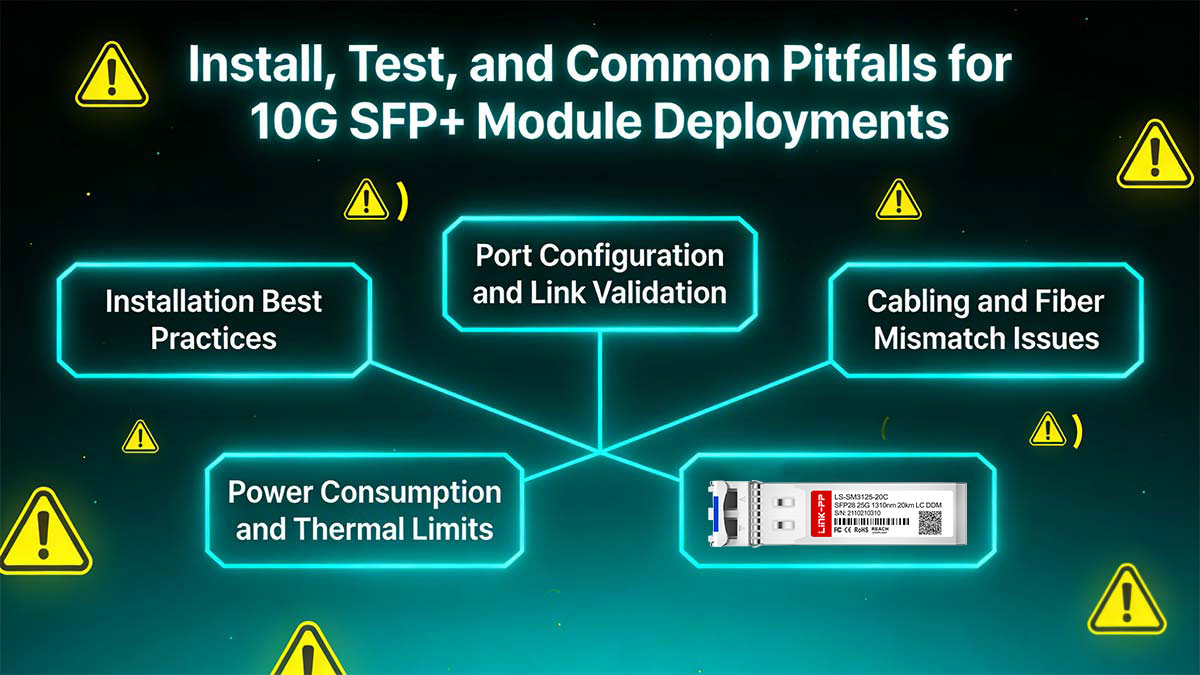
1. Installation Best Practices
-
Hot-plug with care: SFP+ modules are hot-pluggable, but always follow vendor installation guidelines and standard ESD precautions. Insert and remove modules straight and gently—never force the cage or exceed recommended insertion force.
-
Cleanliness matters: Keep protective dust caps on until installation. Contaminated fiber end faces are a common cause of high loss and link instability.
2. Port Configuration and Link Validation
-
Verify port speed and mode: Some switch ports support multiple speeds (1G/10G). Ensure the port is explicitly set to 10GbE where required, and confirm flow control and auto-negotiation settings.
-
Check link indicators and logs: Use switch diagnostics to confirm link state, negotiated speed, and error counters before declaring the link operational.
3. Cabling and Fiber Mismatch Issues
-
Match optics to fiber:
-
MMF optics (e.g., 10GBASE-SR) require OM3/OM4 fiber for rated reach.
-
SMF optics (e.g., 10GBASE-LR/ER) must use single-mode fiber.
Mixing MMF and SMF will prevent link establishment.
-
-
Confirm connector type and polarity: LC duplex polarity errors or reversed patch cords are frequent causes of “no link” conditions.
4. Power Consumption and Thermal Limits
-
Watch heat output: 10GBASE-T modules consume significantly more power than optical SFP+ modules and generate more heat.
-
Ensure adequate airflow: In densely populated switches, insufficient cooling can trigger thermal alarms or cause ports to shut down. Always verify the host’s supported power class and thermal design limits.
5. Quick Deployment Checklist
-
Correct SFP+ type for distance and fiber/cable
-
Port configured for 10GbE operation
-
Clean connectors and verified polarity
-
DOM/DDM readings within normal range
-
Adequate airflow, especially for 10GBASE-T
Key takeaway: Successful 10Gb SFP+ Transceiver deployments depend on careful installation, correct port configuration, proper cabling, and thermal awareness—especially in high-density or copper-based designs.
? 10G SFP+ Module Interoperability & Vendor Compatibility
Although SFP+ 10G modules share a standardized form factor, interoperability is often controlled by switch and NIC firmware rather than hardware alone. Many vendors verify transceiver vendor IDs and may restrict or warn against unapproved optics.
Major platforms such as Cisco, Juniper, HPE, Arista, and H3C publish official compatibility lists that specify supported SFP+ types, firmware versions, and features like DOM/DDM. For production networks where stability matters, vendor-qualified modules remain the lowest-risk option.
Cost-sensitive deployments commonly use third-party compatible SFP+ modules. Reputable suppliers program EEPROM vendor IDs and validate optics against specific platforms. Even so, best practice is to test third-party optics in a staging environment before large-scale deployment.
For 10GBASE-T SFP+ copper modules, compatibility depends heavily on the PHY chipset (for example, Marvell or Broadcom) and host power limits. Always confirm chipset support and cable requirements to avoid link negotiation issues.
Key takeaway: physical SFP+ compliance does not guarantee interoperability—firmware policies, PHY design, and validation testing ultimately determine reliable operation.
Common product types include 10GBASE-SR (850 nm, 300 m OM3) and 10GBASE-LR (1310 nm, 10 km SMF). These parts are available as brand OEM SKUs and as third-party compatible parts. LINK-PP and other optics vendors publish datasheets showing 10GBASE-T (RJ-45 SFP+ / 30 m) and optical transceivers that conform to SFF and IEEE standards — always cross-check the product datasheet for exact power, temperature and reach values before procurement.
? FAQ About 10G SFP+ Modules
These FAQs address the most common real-world questions engineers and procurement teams face when selecting and deploying SFP+ Optical module, helping reduce risk, downtime, and compatibility surprises.
Q1. What is the difference between 10GBASE-SR and 10GBASE-LR?
10GBASE-SR is a short-reach multimode optic operating at 850 nm, typically used with OM3/OM4 MMF for distances up to ~300 m, making it ideal for intra-data-center or campus links.
10GBASE-LR operates at 1310 nm over single-mode fiber (SMF) and supports distances of up to ~10 km, making it better suited for inter-building or metro links.
Q2. Can I use a third-party SFP+ module in Cisco or Juniper switches?
Often yes, but it depends on the platform and firmware. Some switches enforce vendor ID checks and may warn, limit features, or disable ports. For production networks, use vendor-validated optics or thoroughly test third-party SFP+ modules in a staging environment.
Q3. What cable grade is required for 10GBASE-T SFP+ modules?
Cat6A or higher cabling is recommended to reliably support 10 GbE up to 30 m. Some PHY implementations may allow longer distances with high-quality cabling, but results vary—always follow the module and switch vendor specifications.
Q4. Do 10G SFP+ Transceivers support DOM?
Many SFP+ optical modules support DOM, providing real-time data such as Tx/Rx optical power, temperature, voltage, and alarm thresholds. DOM is useful for remote diagnostics and proactive maintenance, but support is model-specific and should be confirmed in the datasheet.
Q5. Are SFP+ modules backward compatible with SFP ports?
Electrically and mechanically, SFP+ modules fit only in SFP+ ports. Some SFP+ ports can accept 1G SFP modules, but 10G SFP+ modules will not operate in 1G-only SFP ports.
Q6. What is the typical power consumption of a 10Gb SFP+?
Optical SFP+ modules (SR/LR) typically consume ~0.8–1.5 W, while 10GBASE-T SFP+ modules can draw 2.5–3.5 W or more. Higher power consumption increases heat output and may impact port density and airflow requirements.
Q7. How do I choose between optical SFP+ and 10GBASE-T SFP+?
Choose optical SFP+ (SR/LR) for longer distances, lower latency, and lower power consumption. Choose SFP+ 10GBASE-T when reusing existing copper cabling for short-reach connections and where power and thermal budgets allow.
Q8. What are common causes of “no link” with 10Gb SFP+ modules?
Typical issues include fiber type mismatch (MMF vs. SMF), incorrect duplex polarity, unsupported vendor IDs, incompatible firmware, insufficient port power, or thermal shutdown—especially with 10GBASE-T modules.
? Conclusion
The 10G SFP+ module remains a practical and widely deployed solution for 10 Gigabit Ethernet, balancing speed, flexibility, and cost across data centers, enterprise networks, and campus environments. By understanding the differences between SR, LR, ER, and 10GBASE-T options—and by paying attention to fiber type, reach, power consumption, and vendor compatibility—you can avoid common deployment issues and make more confident procurement decisions.
Successful deployments are rarely about the module alone. They depend on correct port configuration, validated interoperability, proper cabling, and thermal planning, especially in high-density switches or copper-based designs. Treat SFP+ selection as a system-level decision, and validate optics in a test environment whenever uptime matters.
10G SFP+ Module — Technical Specifications Summary
| Parameter | 10GBASE-SR SFP+ | 10GBASE-LR SFP+ | 10GBASE-ER SFP+ | 10GBASE-T SFP+ |
|---|---|---|---|---|
| Ethernet Standard | IEEE 802.3ae | IEEE 802.3ae | IEEE 802.3ae | IEEE 802.3an |
| Data Rate | 10.3125 Gbps | 10.3125 Gbps | 10.3125 Gbps | 10.3125 Gbps |
| Wavelength | 850 nm | 1310 nm | 1550 nm | N/A (Electrical) |
| Fiber / Cable Type | MMF | SMF | SMF | Cat6A / Cat7 |
| Typical Reach | Up to 300 m (OM3/OM4) | Up to 10 km | Up to 40 km* | Up to 30 m* |
| Connector | LC Duplex | LC Duplex | LC Duplex | RJ45 |
| Optical Output Power | −7.3 to −1 dBm | −8.2 to 0.5 dBm | 0 to +4 dBm | N/A |
| Receiver Sensitivity | ~−11.1 dBm | ~−14.4 dBm | ~−15.8 dBm | N/A |
| Power Consumption (Typical) | ~0.8–1.0 W | ~1.0–1.5 W | ~1.5–2.0 W | ~2.5–3.5 W |
| DOM / DDM Support | Yes (model dependent) | Yes (model dependent) | Yes (model dependent) | Limited / No* |
| Operating Temperature | 0 to 70°C (Industrial optional) | 0 to 70°C | 0 to 70°C | 0 to 70°C |
| Hot-Pluggable | Yes | Yes | Yes | Yes |
| Typical Use Case | Intra-DC / rack-to-rack | Building / campus links | Metro / long-haul | Short-reach copper reuse |
What to Do Next
-
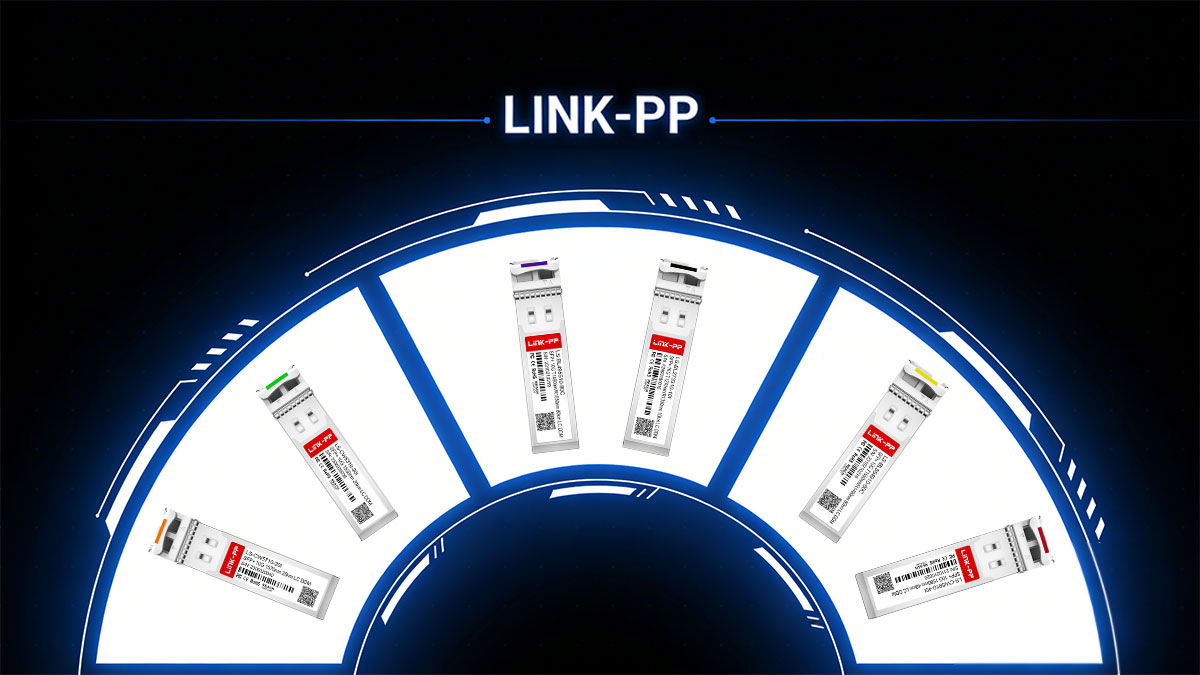
Explore validated products: Visit the LINK-PP Official Store to review a full range of 10Gb SFP+ Modules designed for reliable interoperability.
-
Browse by application: See the dedicated LINK-PP 10G SFP+ Transceivers collection at .
-
Reduce deployment risk: If you are unsure which optic fits your distance, fiber type, or switch platform, consult your vendor documentation or perform a staging test to verify compatibility before production rollout.
Choosing the right 10Gb SFP+ module upfront saves time, minimizes downtime, and ensures your 10GbE network scales smoothly.
key References
-
Cisco 10G SFP+ product/data notes (distances & hot-swap).
-
10GBASE-LR / 10GBASE-SR product datasheets and guides (spec distances & DOM).
-
Gigalight / 10GBASE-T product notes (copper SFP+ distance & power).
- LINK-PP product datasheet (10GBase-T SFP+ copper transceiver example).
Need verified 10G SFP+ modules, datasheets and compatibility support? Visit our store for product selection and procurement assistance.