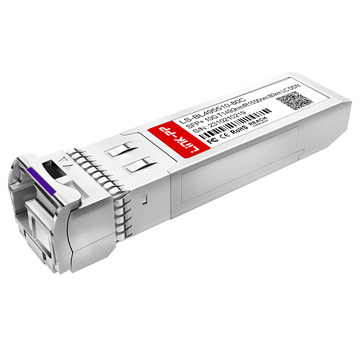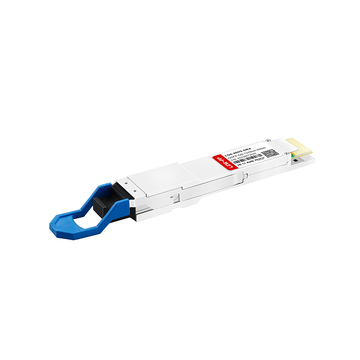
CWDM vs DWDM is not about which technology is better, but which one fits your network’s distance, capacity, and cost requirements.
Both CWDM (Coarse Wavelength Division Multiplexing) and DWDM (Dense Wavelength Division Multiplexing) are designed to increase fiber capacity by transmitting multiple wavelengths over a single fiber, but they target very different network scenarios.
In practical terms, CWDM focuses on cost-efficient wavelength expansion for short to medium distances, while DWDM is built for high-capacity, long-haul, and highly scalable optical networks. This fundamental difference affects everything from wavelength spacing and transmission distance to equipment cost and operational complexity.
Because modern networks range from enterprise campuses to hyperscale data center interconnects, understanding the key differences between CWDM and DWDM has become essential for network designers, operators, and system integrators. Choosing the wrong WDM technology can lead to unnecessary cost, limited scalability, or over-engineered infrastructure.
In this guide, we will break down CWDM vs DWDM from an engineering and deployment perspective—covering how each technology works, where each one fits best, how they compare in cost and performance, and how to choose the right option based on real-world use cases rather than theoretical specs.
☑️ What Is CWDM (Coarse Wavelength Division Multiplexing)?
CWDM is a wavelength division multiplexing technology designed to increase fiber capacity in a simple and cost-effective way for short to medium transmission distances.
Instead of pushing channel density to the limit, CWDM prioritizes wider wavelength spacing, lower power consumption, and reduced system complexity.
How CWDM Works
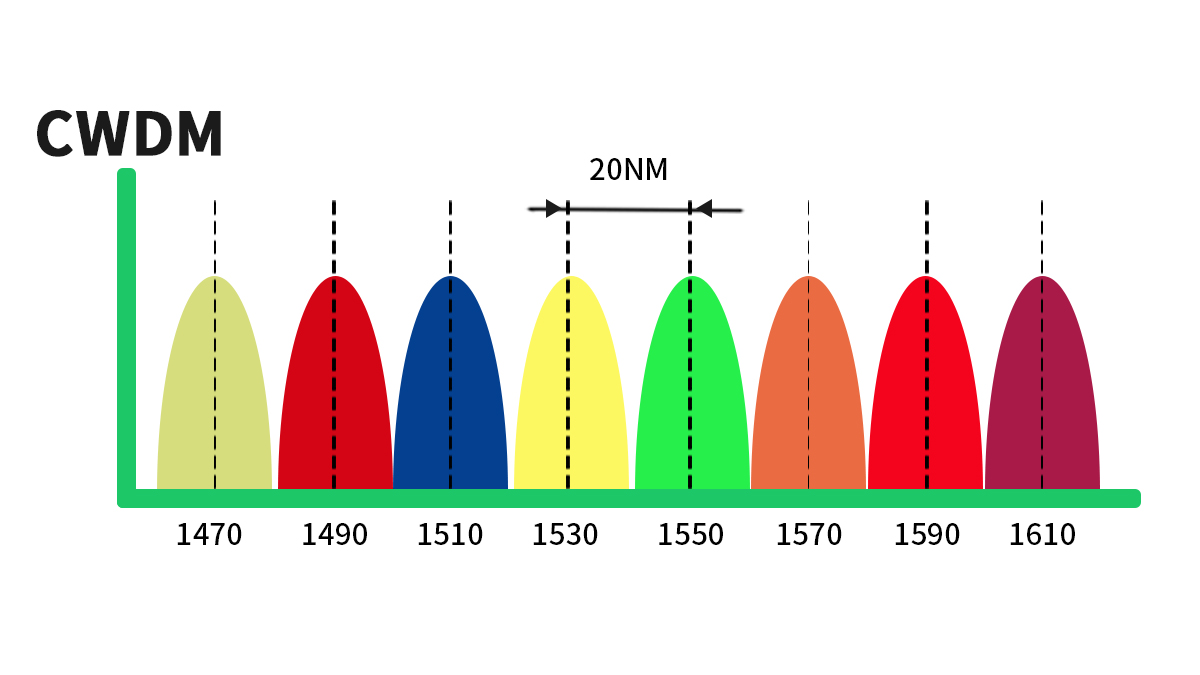
CWDM allows multiple optical signals to be transmitted over a single fiber by assigning each signal a different wavelength. These wavelengths are combined and separated using passive CWDM MUX/DEMUX devices, which require no power or active cooling.
From a system perspective, CWDM is intentionally designed to be easy to deploy and maintain, making it well suited for access and aggregation networks.
CWDM Wavelength Grid and Channel Spacing
-
Standard CWDM uses 20nm wavelength spacing
-
Typical wavelength range: 1270nm to 1610nm
-
Supports up to 18 wavelengths on a single fiber
The wide spacing reduces interference between channels and allows the use of uncooled laser transmitters, which directly contributes to lower module cost and power consumption.
Transmission Distance and Capacity
-
Typical transmission distance: 10km–80km, depending on wavelength and fiber quality
-
Channel capacity: commonly 1G, 10G, 25G, and higher in modern deployments
-
Overall system capacity scales linearly by adding wavelengths rather than increasing complexity
CWDM is not designed for ultra-long-haul transmission, but it provides sufficient reach for most enterprise, campus, and metro-access networks.
Key Characteristics of CWDM
-
Fewer channels compared to DWDM
-
Lower cost per transceiver and passive components
-
Minimal operational complexity
-
No need for optical amplification in most scenarios
These characteristics make CWDM a practical choice when bandwidth expansion is needed without significantly increasing network cost or management overhead.
Typical CWDM Use Cases
-
Enterprise and campus networks
-
Metro access and aggregation layers
-
Fiber-constrained environments requiring simple capacity upgrades
-
Networks with moderate bandwidth growth expectations
? In summary, CWDM is optimized for simplicity and cost efficiency, making it an ideal solution when long-distance transmission and extreme scalability are not primary requirements.
☑️ What Is DWDM (Dense Wavelength Division Multiplexing)?
DWDM is a wavelength division multiplexing technology designed for ultra-high capacity and long-distance optical transmission.
Unlike CWDM, DWDM maximizes fiber utilization by packing a large number of wavelengths into a very narrow optical spectrum, making it the preferred choice for backbone, long-haul, and data center interconnect networks.
How DWDM Works
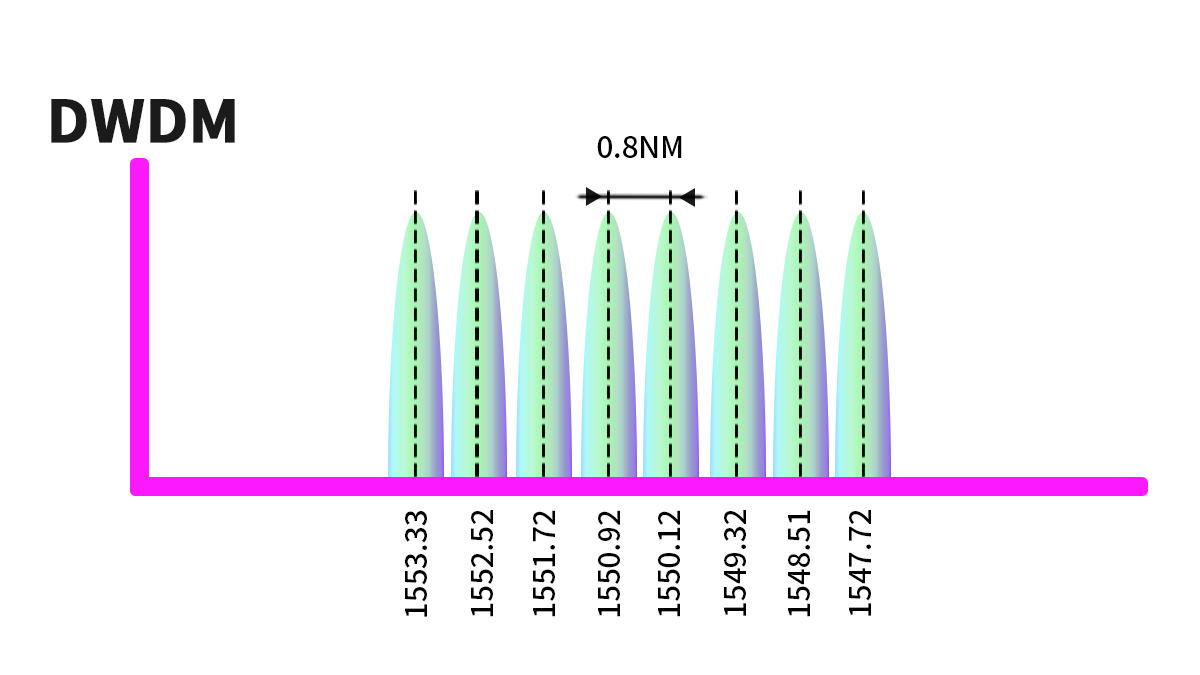
DWDM transmits multiple optical signals over a single fiber by assigning each signal a tightly spaced wavelength. These wavelengths are combined and separated using DWDM MUX/DEMUX systems, and the optical signals can be amplified directly in the optical domain using devices such as EDFA (Erbium-Doped Fiber Amplifiers).
This ability to amplify multiple wavelengths simultaneously is a key reason DWDM scales efficiently over long distances.
DWDM Wavelength Grid and Channel Spacing
-
Standard DWDM systems use dense wavelength spacing, typically 100GHz (≈0.8nm) or 50GHz (≈0.4nm)
-
Operates mainly in the C-band and L-band (approximately 1530nm–1625nm)
-
Supports 40, 80, or even more wavelengths on a single fiber
The tight spacing enables extremely high aggregate bandwidth but requires cooled lasers and precise wavelength control, increasing system complexity compared to CWDM.
Transmission Distance and Capacity
-
Typical transmission distance: 80km–160km+, depending on system design and amplification
-
Channel capacity: 10G, 25G, 100G, 400G, and beyond
-
Total fiber capacity can reach multiple terabits per second
DWDM is engineered for environments where both distance and scalability are critical, and where fiber resources must be used as efficiently as possible.
Key Characteristics of DWDM
-
Very high channel density
-
Long-haul and ultra-long-haul capability
-
Support for optical amplification and advanced modulation
-
Higher initial cost and operational complexity
These characteristics make DWDM less suitable for small or simple networks, but indispensable for large-scale, high-performance infrastructures.
Typical DWDM Use Cases
-
Carrier and ISP backbone networks
-
Long-haul and metro core networks
-
Data center interconnect (DCI)
-
High-capacity enterprise or government networks
? In summary, DWDM is optimized for maximum capacity and long-distance transmission, making it the go-to WDM technology when scalability and performance outweigh cost and simplicity considerations.
☑️ CWDM vs DWDM: Core Technical Differences
The core difference between CWDM and DWDM lies in how aggressively each technology uses the optical spectrum to balance cost, capacity, and transmission distance.
CWDM is optimized for simplicity and affordability, while DWDM is engineered for maximum scalability and long-haul performance.
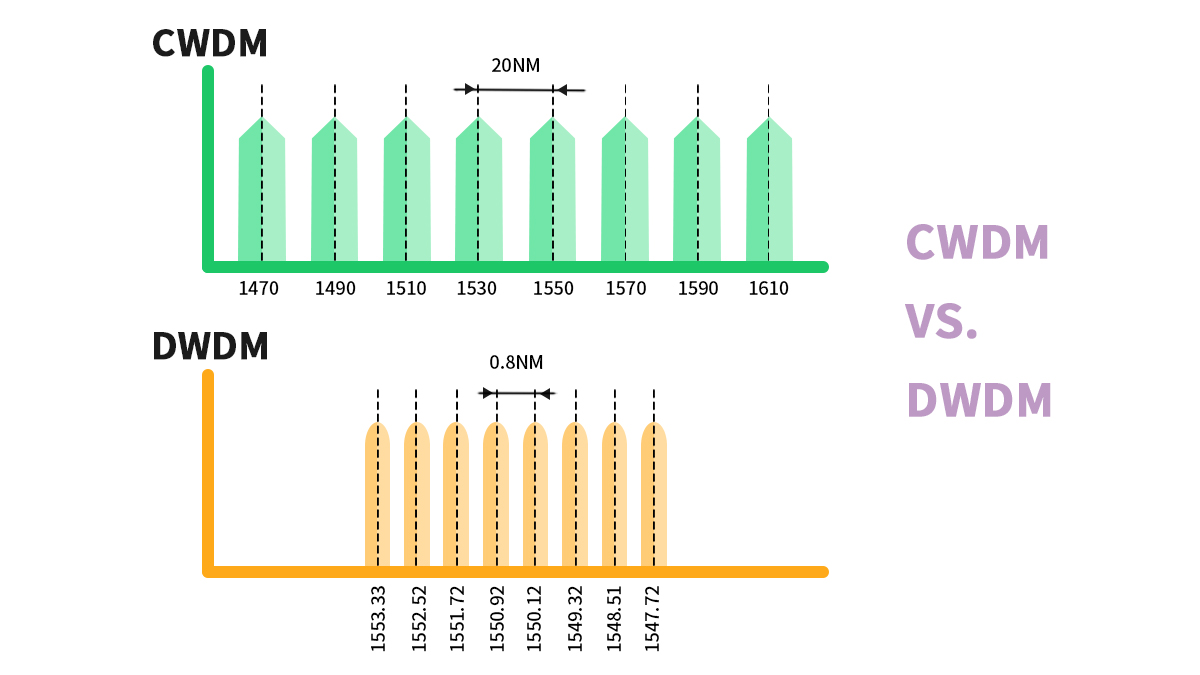
Below are the key technical dimensions that clearly distinguish CWDM vs DWDM in real-world network deployments.
CWDM vs DWDM: Key Differences at a Glance
| Technical Dimension |
CWDM |
DWDM |
| Wavelength Spacing |
20nm |
100GHz (≈0.8nm) / 50GHz (≈0.4nm) |
| Wavelength Range |
1270nm–1610nm |
Mainly C-band and L-band |
| Number of Channels |
Up to 18 |
40–80+ |
| Typical Distance |
10km–80km |
80km–160km+ |
| Laser Type |
Uncooled |
Cooled |
| Optical Amplification |
Not required |
EDFA / Raman supported |
| Power Consumption |
Lower |
Higher |
| System Complexity |
Low |
High |
| Cost Profile |
Lower upfront cost |
Higher upfront, better at scale |
Wavelength Spacing
-
CWDM: Uses wide wavelength spacing of 20nm, reducing channel interference and laser precision requirements
-
DWDM: Uses dense spacing such as 100GHz (≈0.8nm) or 50GHz (≈0.4nm), allowing far more wavelengths on the same fiber
Impact: Tighter spacing enables higher capacity but requires more precise and expensive optical components.
Number of Supported Channels
-
CWDM: Typically supports up to 18 channels across 1270nm–1610nm
-
DWDM: Commonly supports 40–80 channels, with some systems supporting even more
Impact: DWDM scales much better for networks with long-term bandwidth growth requirements.
Transmission Distance
Impact: CWDM fits access and aggregation networks, while DWDM is essential for long-haul and backbone deployments.
Optical Amplification
-
CWDM: Generally does not require optical amplifiers, simplifying deployment
-
DWDM: Actively supports EDFA and Raman amplification across multiple wavelengths
Impact: Amplification enables DWDM’s long reach but increases system complexity and cost.
Power Consumption and Thermal Design
-
CWDM: Uses uncooled lasers, resulting in lower power consumption
-
DWDM: Requires cooled lasers for wavelength stability
Impact: DWDM systems consume more power and require stricter thermal management.
Cost Structure
-
CWDM: Lower transceiver cost and simpler passive components
-
DWDM: Higher module cost, plus additional investment in amplifiers and management systems
Impact: CWDM offers lower total cost for small to medium-scale networks, while DWDM delivers better cost efficiency at high capacity and long distance.
Summary of Technical Differences
In short, CWDM trades spectral efficiency for simplicity and cost savings, whereas DWDM trades higher complexity for unmatched capacity and distance. Understanding these technical differences is critical for selecting the right WDM technology based on actual network requirements rather than theoretical performance.
☑️ CWDM vs DWDM Cost Comparison
CWDM is generally more cost-effective than DWDM, but only when it is used within its intended distance and capacity range.
The cost difference between CWDM and DWDM is not limited to transceiver pricing—it spans initial deployment, operational expenses, and long-term scalability.
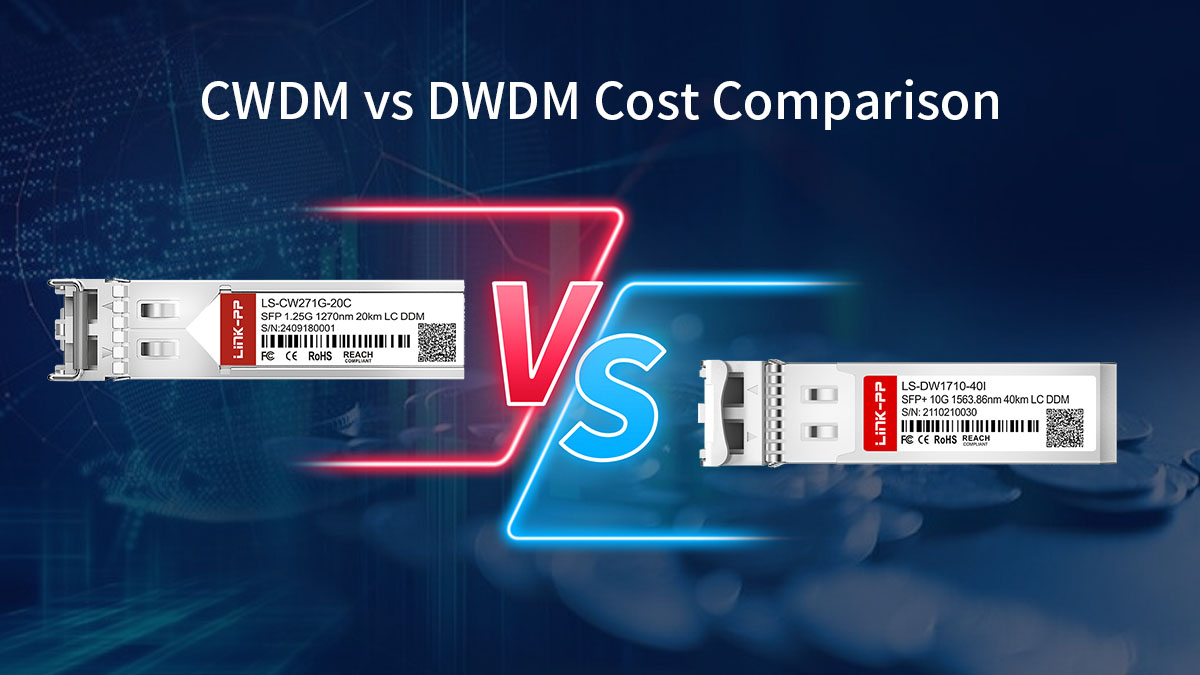
To make a practical comparison, cost should be evaluated across the entire system lifecycle.
Initial Hardware Cost
-
CWDM:
-
Lower transceiver cost due to uncooled lasers
-
Passive MUX/DEMUX modules with no power requirements
-
Minimal supporting equipment
-
DWDM:
-
Higher transceiver cost driven by cooled lasers and precise wavelength control
-
Requires DWDM MUX/DEMUX, optical amplifiers, and monitoring components
Cost impact: CWDM significantly reduces upfront investment for short and medium-distance links.
Deployment and Installation Cost
-
CWDM:
-
DWDM:
-
More complex system design
-
Requires optical power budgeting and amplification planning
-
Higher engineering and commissioning cost
Cost impact: DWDM deployment typically requires more specialized expertise.
Operational Cost (OPEX)
-
CWDM:
-
DWDM:
-
Higher power usage due to amplifiers and cooled optics
-
Ongoing monitoring and performance management
-
Increased cooling and space requirements
Cost impact: CWDM offers lower ongoing operational expenses in stable, low-growth environments.
Cost per Wavelength vs Cost per Capacity
Cost impact: As bandwidth demand increases, DWDM becomes more cost-efficient despite higher initial costs.
Long-Term Scalability Cost
Cost impact: DWDM reduces future upgrade cost in high-growth networks.
Cost Comparison Summary
In short, CWDM minimizes cost for modest bandwidth and distance requirements, while DWDM delivers better long-term cost efficiency for large-scale, high-capacity networks. Choosing between CWDM and DWDM based on total cost of ownership—rather than transceiver price alone—leads to more sustainable network design decisions.
☑️ CWDM vs DWDM Use Cases and Applications
CWDM and DWDM are designed for fundamentally different network environments, and their ideal use cases reflect their technical and cost characteristics.
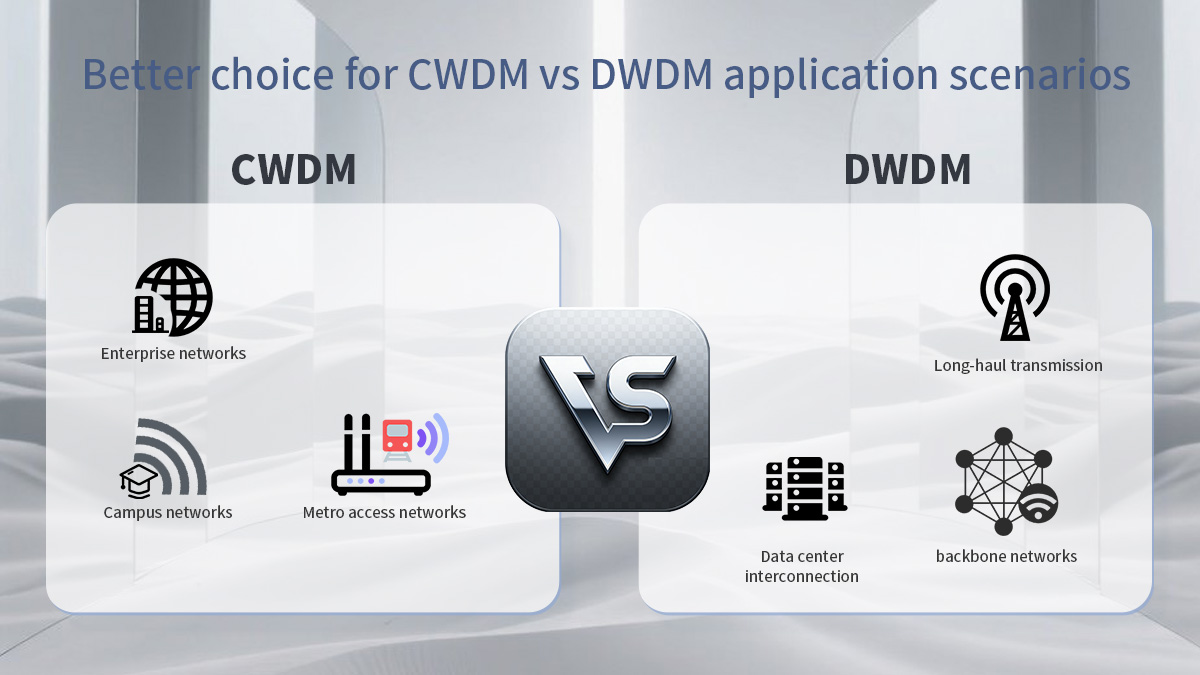
Understanding where each technology fits best helps avoid underutilized capacity or unnecessary infrastructure complexity.
When CWDM Is the Better Choice
CWDM is best suited for networks that require moderate bandwidth expansion without the need for long-distance transmission or extreme scalability.
Typical CWDM applications include:
-
Enterprise and campus networks with limited fiber resources
-
Metro access and aggregation layers where distances are typically within 10km–80km
-
Cost-sensitive deployments that prioritize simplicity and low power consumption
-
Bandwidth upgrades over existing fiber without redesigning the entire network
In these scenarios, CWDM delivers an efficient balance between capacity and cost while keeping network operations straightforward.
When DWDM Is the Better Choice
DWDM is designed for environments where high capacity, long reach, and future scalability are critical requirements.
Typical DWDM applications include:
-
Carrier and ISP backbone networks
-
Long-haul and metro core networks spanning hundreds of kilometers
-
Data center interconnect (DCI) requiring massive bandwidth and low latency
-
High-growth enterprise or government networks with long-term expansion plans
In these use cases, DWDM’s ability to scale capacity by adding wavelengths—without laying new fiber—provides a decisive operational advantage.
CWDM vs DWDM in Access, Metro, and Core Networks
-
Access networks: CWDM is often sufficient due to shorter distances and lower capacity demand
-
Metro ethernet networks: CWDM may be used at the edge, while DWDM dominates the core
-
Core and long-haul networks: DWDM is typically the only viable option
This layered deployment model is common in modern optical network architectures.
Application-Oriented Summary
In practice, CWDM excels in simplicity-driven, short to medium-distance applications, while DWDM is indispensable for high-capacity, long-distance transmission. Selecting the right technology based on application context ensures optimal performance, cost control, and future scalability.
☑️ CWDM vs DWDM in Modern Network Design
In modern network design, CWDM and DWDM are not competing technologies but complementary tools used at different layers of the optical network.
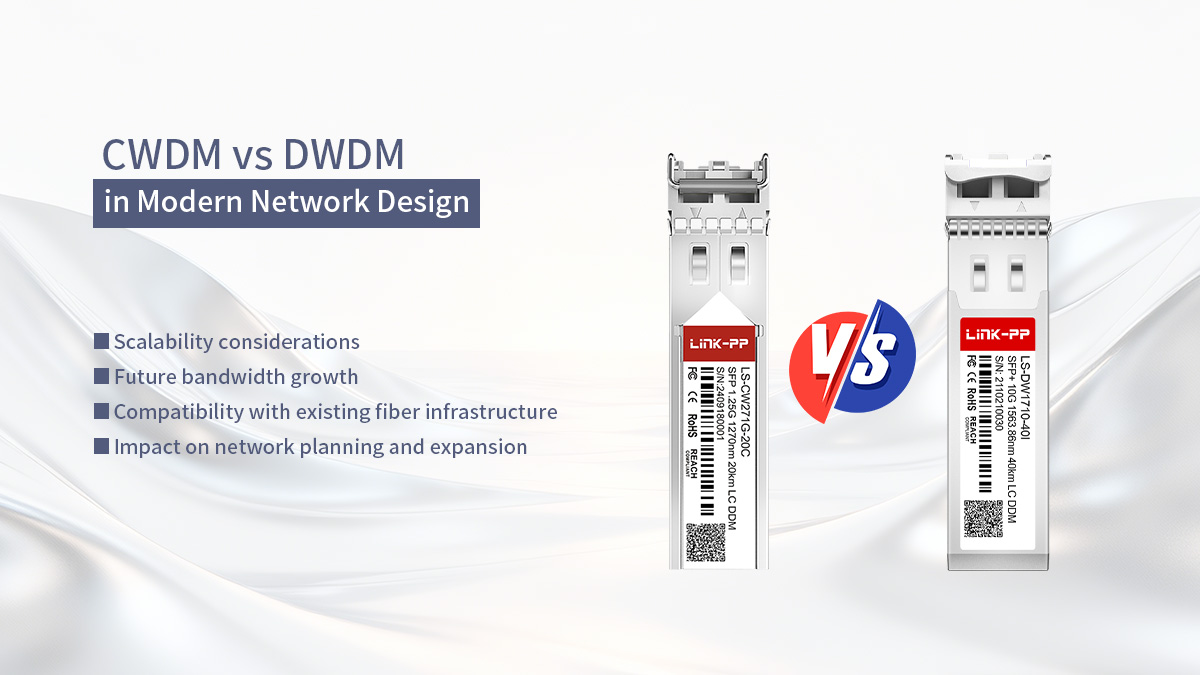
The choice between them directly influences scalability, upgrade flexibility, and long-term network efficiency.
Scalability and Future Bandwidth Growth
-
CWDM:
-
Suitable for predictable, moderate traffic growth
-
Limited by channel count and wavelength spacing
-
Scaling beyond initial design often requires architectural changes
-
DWDM:
-
Designed for continuous capacity expansion
-
New wavelengths or higher-speed transceivers can be added incrementally
-
Supports long-term bandwidth growth without reworking the fiber layer
Design implication: Networks with uncertain or rapid growth trends benefit more from DWDM.
Fiber Resource Utilization
Design implication: DWDM is preferred where fiber availability is limited or expansion is expensive.
Compatibility with Existing Infrastructure
-
CWDM:
-
DWDM:
-
Requires careful power budgeting and wavelength planning
-
Often integrated with ROADMs, amplifiers, and monitoring systems
Design implication: CWDM offers faster deployment, while DWDM supports more advanced optical architectures.
Operational Complexity and Management
Design implication: Organizations with limited optical expertise may prefer CWDM unless capacity demands justify DWDM.
Hybrid CWDM and DWDM Architectures
Modern networks often deploy CWDM at the access or aggregation layer and DWDM at the metro core or backbone layer. This hybrid approach balances cost efficiency at the edge with scalability and performance in the core.
Network Design Summary
In modern network architectures, CWDM enables cost-effective access and aggregation, while DWDM provides the scalable foundation for core and long-haul transmission. Designing with both technologies in mind allows networks to evolve smoothly as bandwidth demands increase.
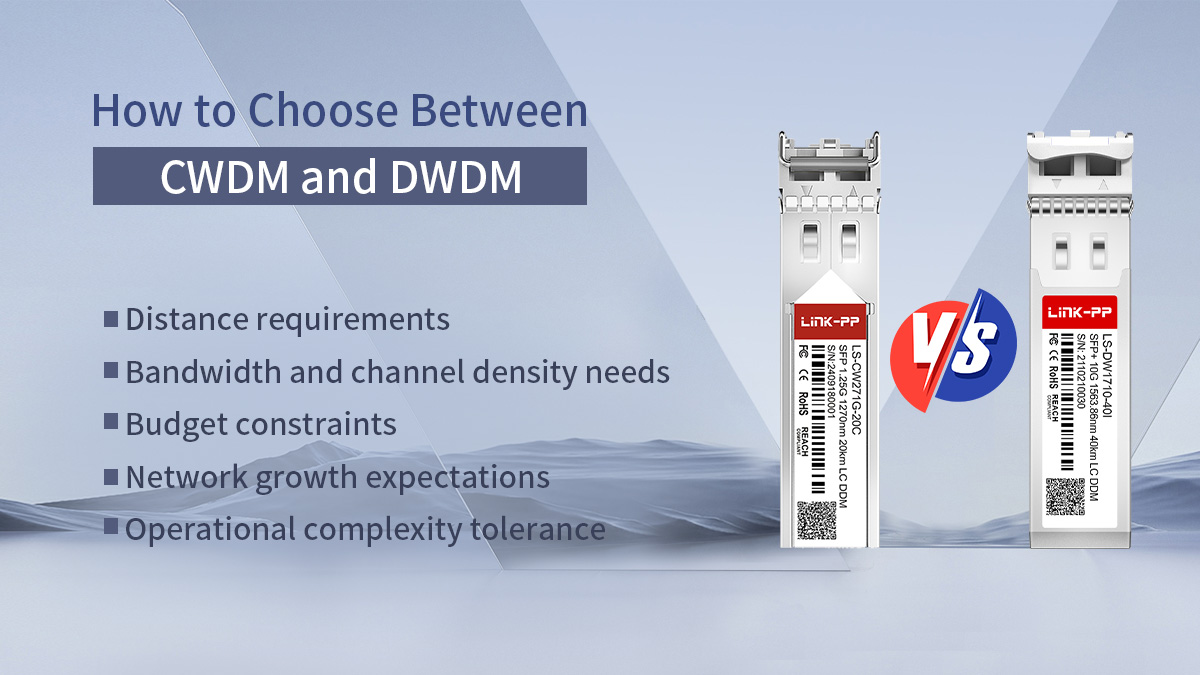
☑️ How to Choose Between CWDM and DWDM
Choosing between CWDM and DWDM depends on aligning network requirements with the strengths and limitations of each technology.
Rather than selecting based on maximum specifications, the optimal decision is driven by distance, capacity, budget, and long-term growth expectations.
Transmission Distance Requirements
Decision logic: Distance is often the first and most decisive factor.
Bandwidth and Capacity Needs
Decision logic: If future capacity demand is uncertain or expected to grow rapidly, DWDM provides more flexibility.
Budget Constraints
Decision logic: CWDM lowers short-term cost, while DWDM optimizes long-term cost efficiency at scale.
Network Growth and Scalability
Decision logic: DWDM avoids costly redesigns as capacity demands increase.
Operational Complexity and Expertise
Decision logic: Operational readiness should match the chosen technology.
Final Selection Guideline
In summary, CWDM is ideal for short to medium distances, controlled budgets, and simpler networks, while DWDM is the better choice for long-distance, high-capacity, and future-proof network designs. A clear understanding of current requirements and future goals ensures the right WDM technology is selected from the start.
☑️ How LINK-PP Optical Modules Apply CWDM and DWDM Technologies
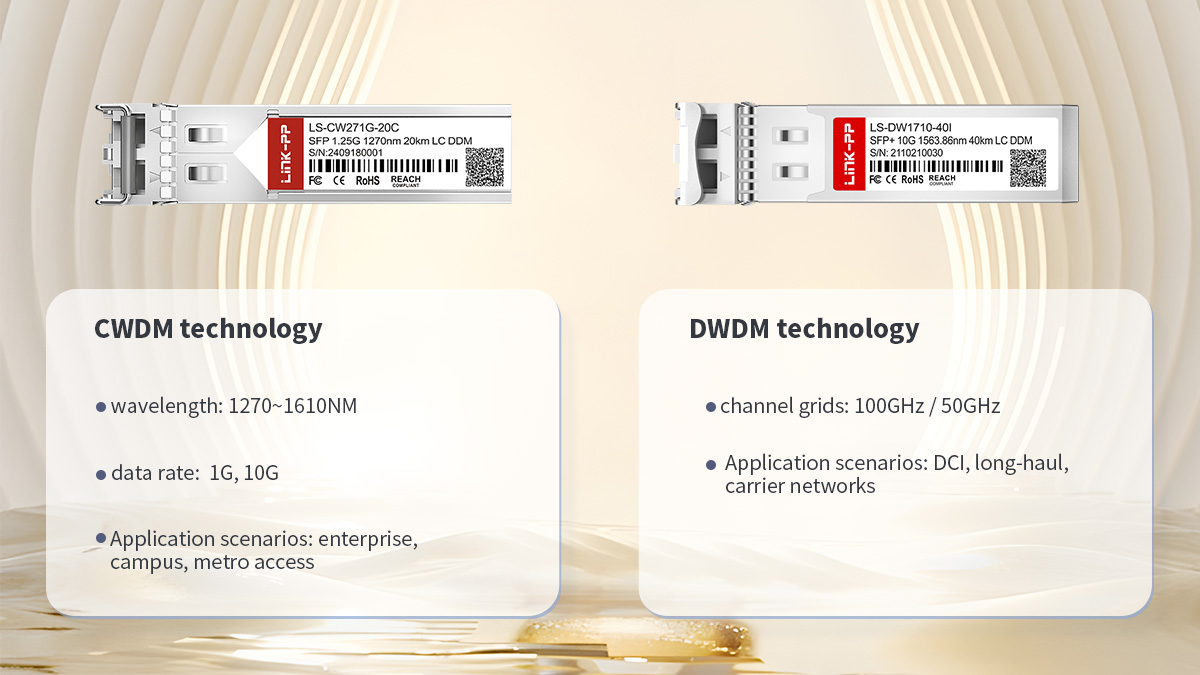
LINK-PP optical module are designed to support both CWDM and DWDM technologies, enabling flexible deployment across access, metro, and core network layers.
Rather than focusing on a single WDM approach, LINK-PP aligns its optical module portfolio with real-world network design requirements.
LINK-PP CWDM Optical Module Implementation
LINK-PP applies CWDM technology to provide cost-efficient wavelength expansion for short to medium-distance networks.
Key CWDM implementation characteristics:
-
Support for standard CWDM wavelengths from 1270nm to 1610nm
-
Common form factors including SFP and SFP+
-
Optimized for 10km–80km transmission without optical amplification
-
Compatible with passive CWDM MUX/DEMUX systems
Typical CWDM application scenarios:
-
Enterprise and campus networks
-
Metro access and aggregation layers
-
Fiber-constrained environments requiring simple capacity upgrades
LINK-PP DWDM Optical Module Implementation
For high-capacity and long-distance transmission, LINK-PP applies DWDM technology with precise wavelength control and long-reach design.
Key DWDM implementation characteristics:
-
Support for 100GHz and 50GHz channel grids
-
Operation mainly in the C-band, with extended options for advanced deployments
-
Common form factors including SFP+, XFP, QSFP+, and higher-speed modules
-
Designed for 80km–1000km+ transmission with optical amplification
Typical DWDM application scenarios:
-
Data center interconnect (DCI)
-
Metro core and long-haul networks
-
Carrier and service provider backbones
CWDM vs DWDM with LINK-PP Modules: Feature Comparison
| Feature |
LINK-PP CWDM SFP Module |
LINK-PP DWDM SFP Module |
| Wavelength Range |
1270nm–1610nm |
C-band / L-band |
| Channel Spacing |
20nm |
100GHz / 50GHz |
| Typical Distance |
10km–80km |
80km–160km+ |
| Laser Type |
Uncooled |
Cooled |
| Amplification |
Not required |
EDFA / Raman |
| Deployment Complexity |
Low |
High |
| Typical Use Case |
Access / Aggregation |
Core / Long-haul |
Deployment Considerations with LINK-PP Modules
When deploying LINK-PP CWDM or DWDM optical modules, network designers typically evaluate:
-
Required transmission distance and channel count
-
Compatibility with existing WDM MUX/DEMUX infrastructure
-
Power budget and amplification strategy
-
Long-term scalability and upgrade path
Why LINK-PP Modules Fit Both CWDM and DWDM Networks
LINK-PP optical transceiver are engineered to meet industry standards and interoperability requirements, enabling consistent performance across different WDM environments. By supporting both CWDM and DWDM technologies, LINK-PP provides flexible options that align with diverse network architectures without forcing a one-size-fits-all approach.
This dual-technology support allows networks to evolve from cost-efficient CWDM deployments to high-capacity DWDM architectures as bandwidth demands grow.
☑️ FAQs About CWDM And DWDM
1. Is CWDM cheaper than DWDM?
Yes, in most cases. CWDM typically has lower transceiver and system costs because it uses uncooled lasers and passive components, making it more cost-effective for short to medium distances.
2. Does CWDM support long-distance transmission?
No. CWDM is generally limited to 10km–80km and does not support optical amplification, which makes it unsuitable for long-haul or backbone networks.
3. Can CWDM and DWDM be used on the same fiber?
It depends. While they use different wavelength spacing and equipment, CWDM and DWDM can coexist on the same fiber with proper planning, but this is not common in standard deployments.
4. Which is better for data center interconnect (DCI)?
DWDM. DCI requires high capacity, long distance, and scalability, all of which align with DWDM’s strengths.
5. Is DWDM overkill for enterprise networks?
Often yes. For most enterprise and campus networks, CWDM provides sufficient capacity at a lower cost and with simpler operation.
6. Does DWDM always require optical amplifiers?
Not always. For shorter DWDM links, amplification may not be necessary, but it becomes essential as distance and channel count increase.
? These concise answers reflect the most common questions users ask when comparing CWDM vs DWDM, helping readers quickly validate their technology choices without revisiting detailed technical sections.
☑️ Summary: CWDM vs DWDM — Which One Should You Choose?
CWDM vs DWDM comes down to matching network distance, capacity, and growth expectations rather than choosing the most advanced technology.
Key Takeaways
-
CWDM offers cost-efficient wavelength expansion for 10km–80km links with simple deployment and low operational overhead
-
DWDM delivers ultra-high capacity and long-distance transmission for 80km–1000km+ networks
-
CWDM prioritizes simplicity and lower cost, while DWDM prioritizes scalability and spectral efficiency
-
The wrong choice can lead to either wasted investment or limited future growth
When to Choose CWDM
-
Short to medium-distance networks
-
Predictable bandwidth demand
-
Cost-sensitive environments
-
Access, aggregation, and enterprise networks
When to Choose DWDM
-
Long-haul or metro core transmission
-
High or rapidly growing bandwidth demand
-
Fiber-constrained environments
-
Data center interconnect and carrier networks
Final Recommendation
If your goal is fast deployment and controlled cost, CWDM is usually the right choice. If your network requires long reach, massive capacity, and future-proof scalability, DWDM is the better long-term investment. By aligning CWDM or DWDM with actual network requirements, you can build an optical infrastructure that is both efficient today and ready for tomorrow.
? Learn more and explore available options at the LINK-PP Official Store, where CWDM and DWDM solutions are organized by application scenarios to help simplify your selection process.