



































A 1550nm SFP transceiver is the preferred choice when your fiber network requires long-distance, stable, and low-loss transmission, typically beyond 40km on single-mode fiber. Compared with 850nm or 1310nm SFP modules, 1550nm SFPs are designed for scenarios where signal attenuation, link budget, and long-haul reliability matter more than short-range cost efficiency.
In real purchasing scenarios, engineers and network planners usually consider a 1550nm SFP module when deploying telecom backbones, metropolitan area networks (MAN), ISP aggregation links, or industrial fiber connections. The wavelength’s lower attenuation window allows signals to travel farther with fewer repeaters, making it a cost-effective solution for long-distance optical links despite a higher per-module price.
This guide is written for buyers who are already comparing options rather than learning fiber optics from scratch. It focuses on how to choose the right 1550nm SFP transceiver based on transmission distance, module type, compatibility, and pricing—so you can quickly determine whether a 1550nm SFP fits your network and which option delivers the best balance between performance and cost.
? What Is a 1550nm SFP Transceiver?
A 1550nm SFP transceiver is a single-mode optical module designed for long-distance fiber transmission, typically 40km, 80km, or 120km, where low signal loss and high link stability are required.
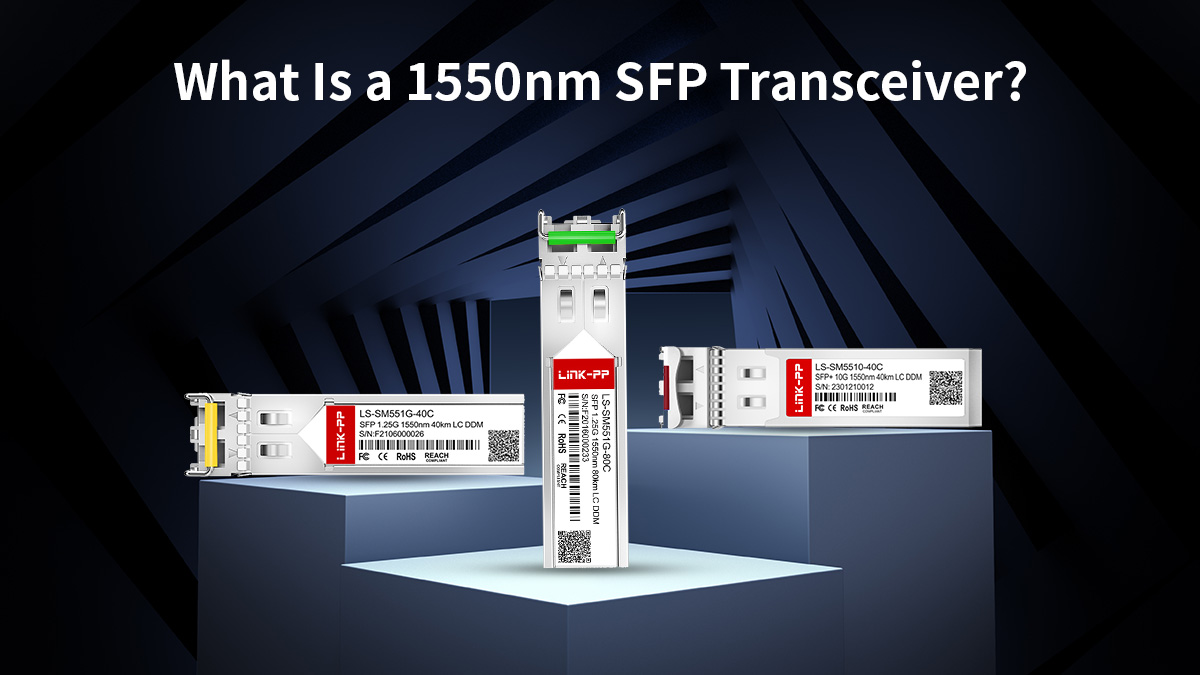
Key Characteristics of a 1550nm SFP
-
Wavelength: 1550nm, operating in the lowest-attenuation window of single-mode fiber
-
Fiber Type: Single-mode fiber (SMF)
-
Typical Data Rate: 1G SFP (MSA-compliant)
-
Common Distances: 40km / 80km / 120km
-
Connector Type: LC
-
Form Factor: Standard SFP, hot-swappable
Why 1550nm Is Used for Long-Distance Links
-
1550nm experiences significantly lower attenuation than 850nm or 1310nm
-
Enables longer transmission spans with fewer repeaters
-
Improves overall link budget and stability in long-haul deployments
Typical Network Scenarios
-
Telecom and ISP backbone networks
-
Metropolitan area networks (MAN)
-
Long-distance enterprise or industrial fiber links
How a 1550nm SFP Differs from Other SFP Types
-
Compared with 850nm SFP: designed for single-mode, not short-reach multimode links
-
Compared with 1310nm SFP: optimized for longer distances beyond standard SMF reach
-
Selected for distance and reliability, not lowest cost
In short, a 1550nm SFP transceiver is chosen when transmission distance exceeds the practical limits of 1310nm SFP modules and network reliability becomes the primary concern.
? Key Specifications of 1550nm SFP Modules
The key specifications of a 1550nm SFP module directly determine how far it can transmit, how stable the link will be, and whether it is suitable for your network equipment.
For buyers, these parameters should be evaluated as decision factors, not as isolated technical numbers.
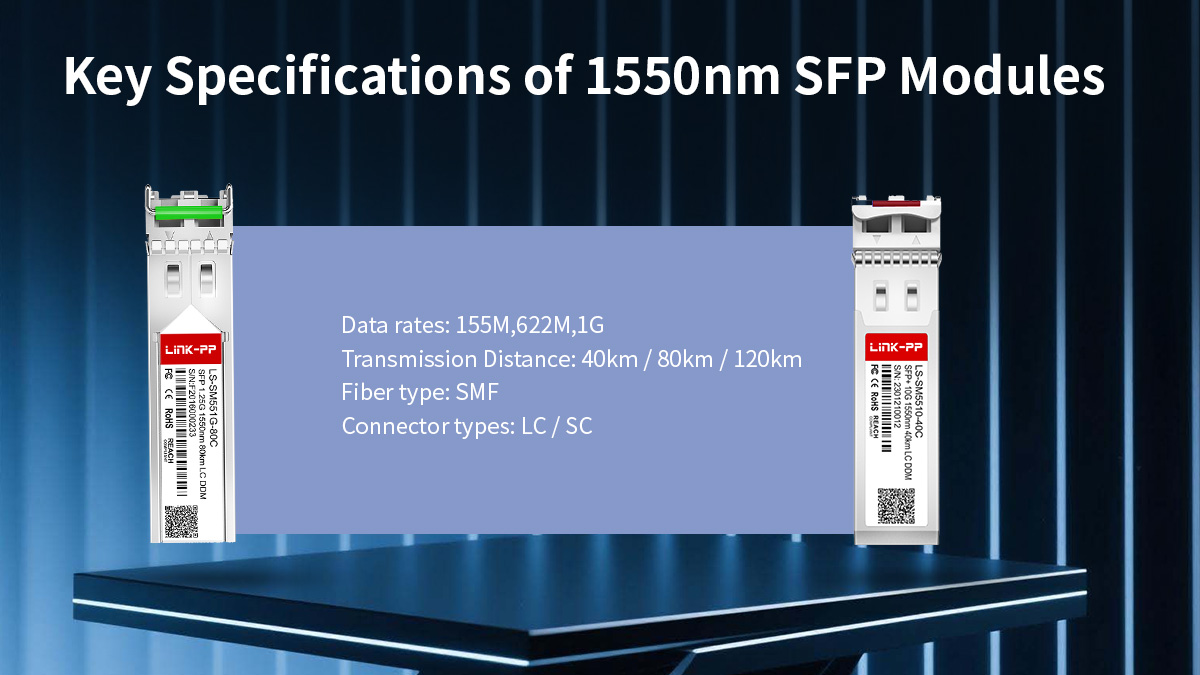
Wavelength and Fiber Type
-
Wavelength: 1550nm
-
Fiber Type: Single-mode fiber (SMF) only
1550nm operates in the lowest-loss transmission window of single-mode fiber, which is why 1550nm SFP modules are specifically designed for long-distance links and are not interchangeable with multimode SFP.
Data Rate and Protocol Support
-
Typical Data Rate: 155M, 622M, 1G (Gigabit Ethernet)
-
Supported Standards: IEEE 802.3z (1000BASE-ZX / long-reach variants)
Most 1550nm SFP modules on the market are 1G SFP transceivers, making them suitable for legacy networks, carrier infrastructure, and industrial systems where Gigabit links remain widely deployed.
Transmission Distance
-
40km SFP: Common for metro and regional links
-
80km SFP: Used in extended MAN or aggregation networks
-
120km SFP: Designed for long-haul and backbone applications
The transmission distance is primarily determined by the optical link budget, not just the wavelength. When selecting a 1550nm SFP, distance should always be matched to real fiber length, splice loss, and connector loss.
Optical Budget and Sensitivity
-
Higher optical budget enables longer reach and greater tolerance to signal loss
-
Receiver sensitivity defines how well the module performs under low-power conditions
For long-distance deployments, choosing a module with sufficient optical margin is critical to maintaining link stability over time.
Connector Type and Form Factor
-
Connector: LC
-
Form Factor: Standard SFP, hot-swappable
This ensures broad compatibility with mainstream switches, routers, and optical line equipment that support SFP interfaces.
Compatibility and MSA Compliance
-
MSA-compliant design ensures cross-vendor interoperability
-
Compatibility testing is essential when using third-party SFP modules
For buyers evaluating third-party options, compatibility with major brands and platforms is often just as important as raw specifications.
In practice, selecting the right 1550nm SFP module means balancing distance, optical budget, and compatibility—rather than choosing the highest specification on paper.
? Main Types of 1550nm SFP Transceivers
1550nm SFP transceivers are not a single, uniform product type. They are commonly categorized by fiber usage, wavelength implementation, and application scenario, which directly affects fiber consumption, deployment cost, and compatibility.
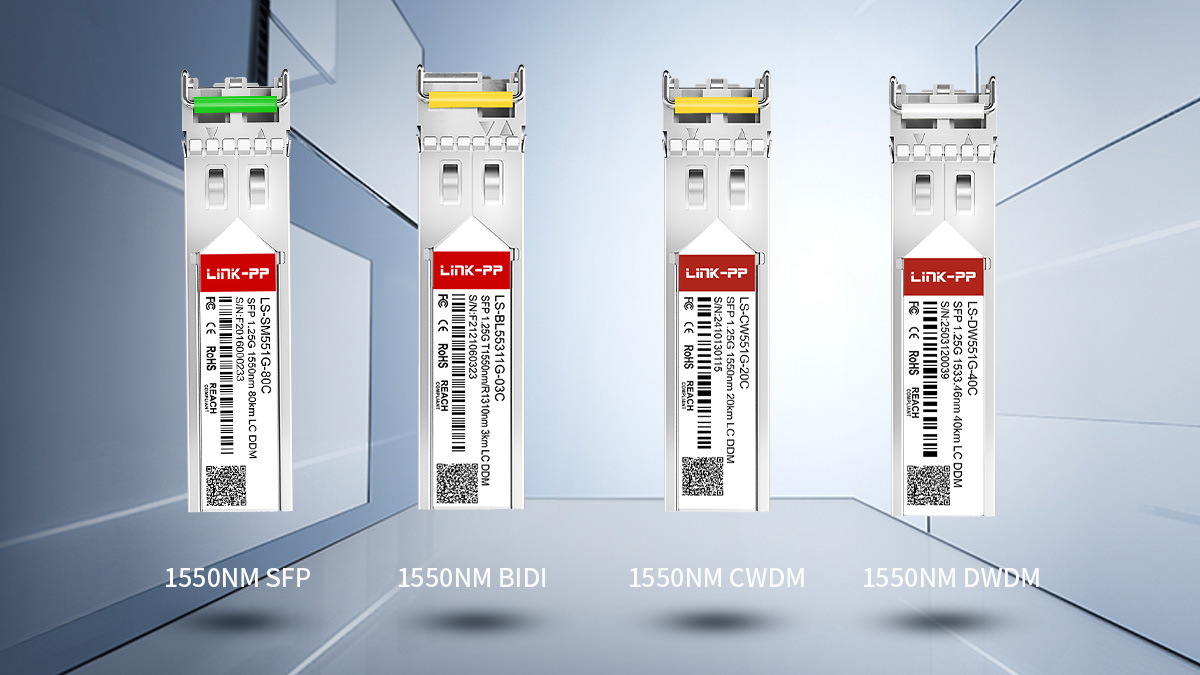
Dual-Fiber 1550nm SFP Transceivers
-
Use two fibers: one for transmit (TX) and one for receive (RX)
-
Typically paired with another 1550nm SFP at the opposite end
-
Common distances: 40km / 80km / 120km
-
Straightforward design and easy troubleshooting
Dual-fiber 1550nm SFP modules are widely used in traditional long-distance single-mode networks, especially where fiber resources are sufficient and network design prioritizes simplicity.
Single-Fiber (BiDi) 1550nm SFP Transceivers
-
Use one single-mode fiber for both TX and RX
-
Operate in wavelength pairs (for example, 1550nm paired with 1310nm)
-
Require matched BiDi SFPs at each end of the link
1550nm BiDi SFP transceivers are chosen when fiber availability is limited or when reducing fiber infrastructure cost is a priority. They are commonly deployed in metro access and aggregation networks.
CWDM / DWDM-Based 1550nm SFP Transceivers
-
Utilize CWDM or DWDM technology to enable wavelength multiplexing
-
Allow multiple channels to run over a single fiber pair
-
Suitable for high-capacity or scalable long-distance networks
These 1550nm SFP variants are typically used in carrier-grade or expansion-ready networks, where future bandwidth growth is planned.
Commercial vs Industrial-Grade 1550nm SFP Modules
-
Commercial-grade: Standard temperature range for data centers and enterprise networks
-
Industrial-grade: Extended temperature range for outdoor or harsh environments
Choosing between commercial and industrial-grade modules depends on deployment conditions, not transmission distance.
Which Type Should You Choose?
-
Choose dual-fiber 1550nm SFPs for simple, stable long-distance links
-
Choose 1550nm BiDi SFP when fiber resources are limited
-
Choose 1550nm CWDM SFP & DWDM SFP for scalable or high-capacity networks
Understanding these types helps narrow down the right 1550nm SFP transceiver before comparing pricing, compatibility, and vendor options.
? Common Use Cases for 1550nm SFP Modules
1550nm SFP modules are primarily deployed in networks where transmission distance, link stability, and long-term reliability are more important than short-reach cost efficiency. They are selected based on real-world deployment needs, not laboratory specifications.
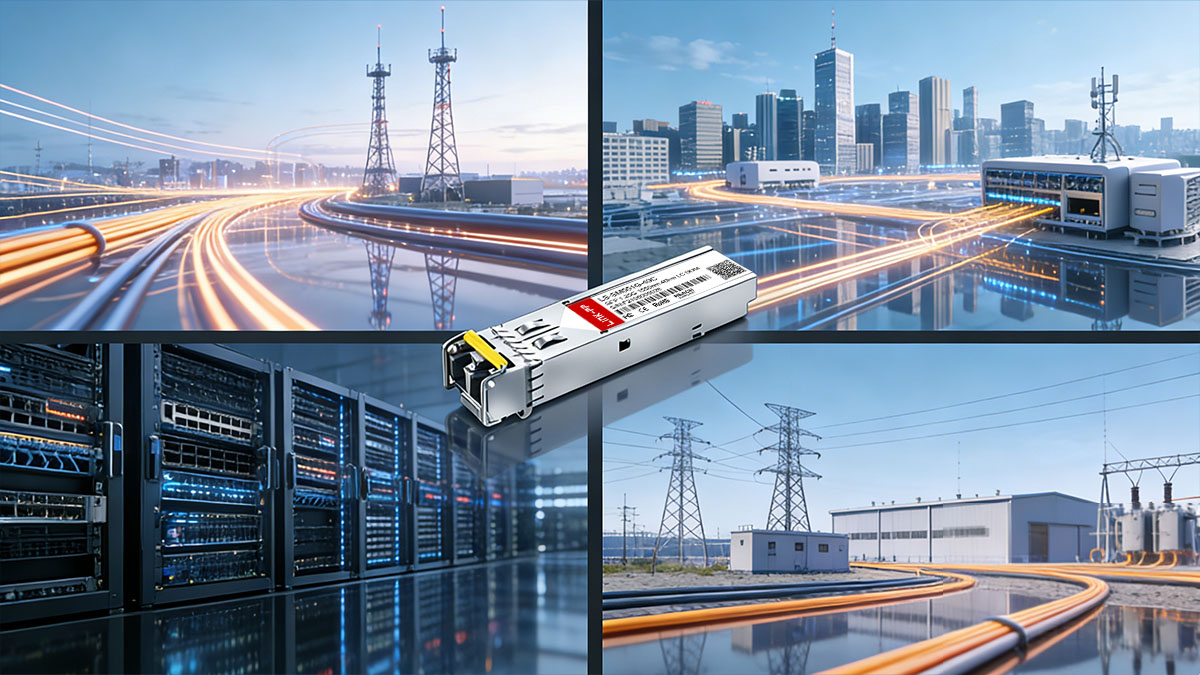
Telecom Backbone Networks
-
Used for long-distance point-to-point links between core network nodes
-
Support 40km, 80km, and 120km transmission without intermediate amplification
-
Reduce the number of repeaters, improving network stability and operational efficiency
In telecom backbone environments, 1550nm SFP transceivers are a standard choice due to their low attenuation and strong performance over long fiber spans.
Metropolitan Area Networks (MAN)
-
Connect aggregation points across cities or regions
-
Often deployed with dual-fiber or 1550nm BiDi SFP modules
-
Balance distance capability with fiber resource efficiency
For MAN deployments, 1550nm SFP modules provide the flexibility to cover extended distances while maintaining predictable performance.
ISP Aggregation and Access Networks
-
Used between access nodes and aggregation switches
-
Common in scenarios where fiber availability is limited
-
Frequently combined with 1550nm BiDi SFP transceiver to reduce fiber usage
ISPs choose 1550nm SFPs to extend reach without redesigning existing fiber infrastructure.
Enterprise and Industrial Long-Distance Links
-
Connect campuses, factories, substations, or remote facilities
-
Require stable links over tens or hundreds of kilometers
-
Often operate in harsh or outdoor environments
In these scenarios, industrial-grade 1550nm SFP modules are preferred for their reliability and environmental tolerance.
When a 1550nm SFP Is Not the Right Choice
-
Short-reach links within buildings or data centers
-
Multimode fiber environments
-
Cost-sensitive deployments under 10km
In such cases, 850nm or 1310nm SFP modules are usually more practical and economical.
In summary, 1550nm SFP modules are best suited for long-distance, mission-critical fiber links where reliability and reach outweigh initial module cost.
? How to Choose the Right 1550nm SFP Module
Choosing the right 1550nm SFP module is a decision about distance, compatibility, and long-term network stability—not simply about wavelength.
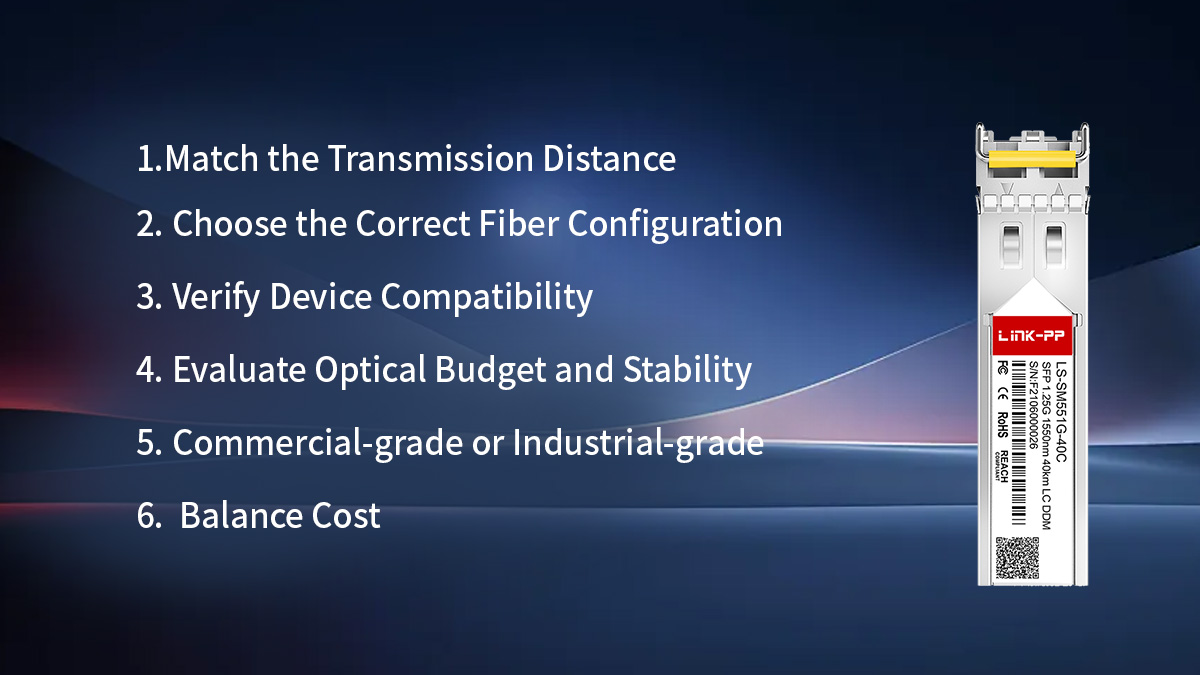
The following criteria help narrow down the correct option for real-world deployments.
Step 1: Match the Transmission Distance to Your Link
-
40km SFP: Suitable for metro and regional connections
-
80km SFP: Used for extended MAN and aggregation networks
-
120km SFP: Designed for long-haul or backbone links
Always select a distance rating that exceeds your actual fiber length, allowing margin for splice loss, connector loss, and future degradation.
Step 2: Choose the Correct Fiber Configuration
-
Dual-fiber SFP: Requires two fibers (TX/RX), simple and widely compatible
-
BiDi SFP: Uses a single fiber, ideal when fiber resources are limited
For BiDi deployments, ensure the wavelength pairing is correct at both ends of the link.
Step 3: Verify Device Compatibility
-
Confirm your switch or router supports MSA-compliant SFP modules
-
Check compatibility with major brands (Cisco, Huawei, HPE, etc.)
-
Decide whether OEM or third-party SFPs are acceptable in your network
Compatibility testing is critical when deploying third-party 1550nm SFP modules at scale.
Step 4: Evaluate Optical Budget and Stability
-
Ensure sufficient optical budget for your required distance
-
Avoid selecting the highest power module unnecessarily
-
Prioritize stable performance over extreme specifications
Overpowered modules can introduce risk, while underpowered ones lead to unstable links.
Step 5: Consider Environment and Reliability
-
Commercial-grade: Controlled indoor environments
-
Industrial-grade: Outdoor, high/low temperature, or electrically noisy environments
Environmental conditions often determine whether a standard or industrial-grade 1550nm SFP is appropriate.
Step 6: Balance Cost and Long-Term Value
-
Lower upfront cost does not always mean lower total cost
-
Consider deployment scale, maintenance effort, and replacement cycles
-
Third-party SFP modules often provide better cost-performance when properly tested
In practice, the right 1550nm SFP module is the one that meets your distance and compatibility requirements with sufficient margin—without unnecessary cost or complexity.
? Compatibility and Interoperability Considerations for 1550nm SFP
Compatibility is one of the most critical factors when deploying 1550nm SFP modules, especially in long-distance and multi-vendor networks.
Even when specifications match on paper, interoperability issues can lead to link instability or complete connection failure.
MSA Compliance and Why It Matters
-
Most 1550nm SFP modules follow SFP MSA standards
-
MSA compliance ensures basic electrical and optical interoperability
-
However, MSA alone does not guarantee compatibility with all vendors
In practice, device firmware and vendor restrictions often influence whether a module will be accepted.
OEM Devices and Third-Party SFP Support
-
Some switches and routers fully support third-party SFP modules
-
Others may require vendor-approved or coded optics
-
Compatibility behavior varies by brand, model, and firmware version
Before purchasing 1550nm SFPs, it is essential to verify whether your equipment allows third-party optics.
Distance and Power Matching Considerations
-
Both ends of the link should use matching distance-rated 1550nm SFPs
-
Mixing different power levels can cause:
-
Receiver overload on short links
-
Insufficient margin on long links
-
For stable operation, distance rating and optical budget should be aligned at both ends.
BiDi and Wavelength Pairing Compatibility
-
1550nm BiDi SFPs must be used with the correct paired wavelength module
-
Incorrect pairing will result in no link establishment
-
Labeling and documentation are critical in BiDi deployments
This is a common source of errors in field installations.
Best Practices to Avoid Compatibility Issues
-
Confirm device support for MSA-compliant or third-party SFPs
-
Match wavelength, distance, and fiber type at both ends
-
Avoid overpowered modules unless attenuation is properly managed
-
Test modules in target devices before large-scale rollout
In short, a 1550nm SFP that is fully compatible with your equipment is far more valuable than one with higher specifications but uncertain interoperability.
? Are LINK-PP 1550nm SFP Modules Worth Buying?
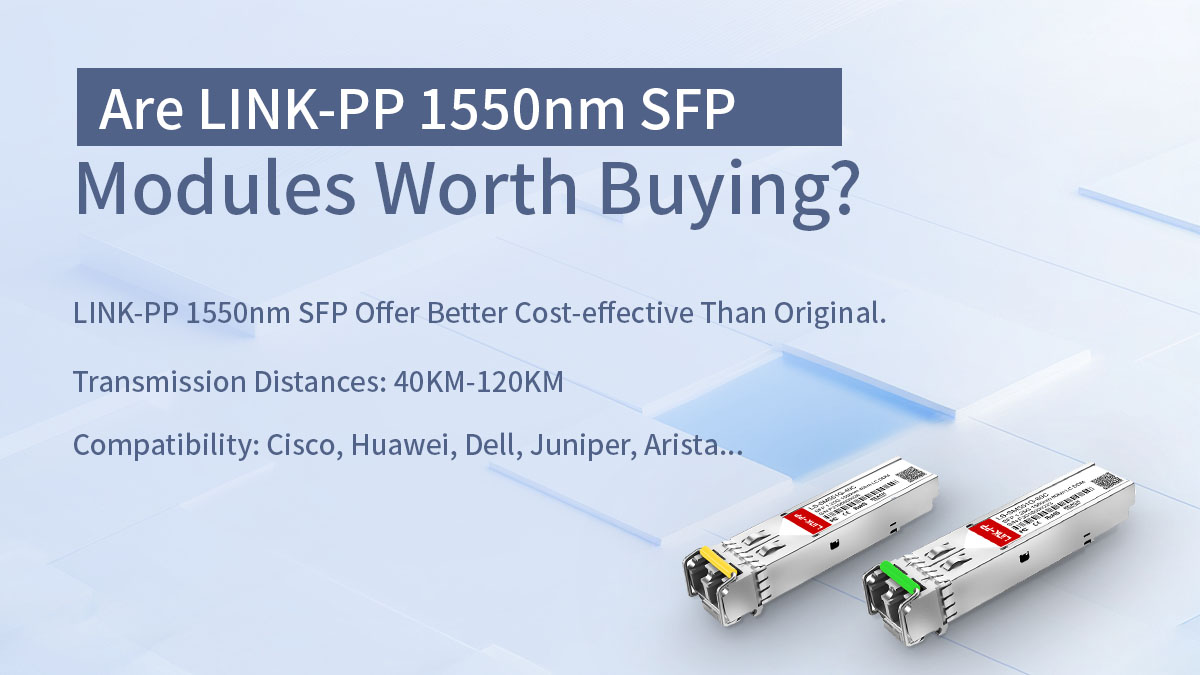
LINK-PP 1550nm SFP modules are a cost-effective alternative to OEM branded optical transceivers, offering strong compatibility, stable performance, and reliable quality for long-distance single-mode deployments.
For many buyers—especially network engineers and procurement teams—LINK-PP strikes an optimal balance between price, performance, and interoperability.
Strong Compatibility Across Major Platforms
-
LINK-PP 1550nm SFP modules are designed to be MSA-compliant, ensuring broad interoperability.
-
They are commonly compatible with leading networking brands (such as Cisco, Huawei, HPE, Juniper, and others) when devices support third-party optics.
-
Compatibility matters because many network devices lock or restrict optical modules; choosing an SFP with proven compatibility avoids installation issues and link errors.
In short: LINK-PP 1550nm SFPs work with most enterprise and carrier-grade switches/routers, provided your hardware supports MSA optics.
Cost Efficiency Without Sacrificing Performance
-
OEM 1550nm SFP transceivers typically carry significantly higher price tags due to brand premiums.
-
LINK-PP modules deliver performance that meets or approaches OEM specs while reducing procurement cost.
-
For large-scale deployments (multiple links or sites), the cumulative cost savings can be substantial without materially affecting link reliability.
In practice: You’re not paying extra for a brand name—just for optical performance you already need.
Quality Assurance and Reliability
-
LINK-PP 1550nm SFPs undergo production testing to verify key metrics such as optical output, receiver sensitivity, and eye-diagram performance.
-
Many models also undergo burn-in tests to screen early failures and improve field reliability.
-
While not every third-party SFP has the same QA rigor, LINK-PP’s quality track record is competitive within the third-party optics market.
The takeaway: LINK-PP offers practical reliability, especially when modules are tested before deployment.
When LINK-PP Makes Sense
Choose LINK-PP 1550nm SFP modules when:
-
You are cost-sensitive and seeking value over OEM branding
-
Your network equipment supports third-party optics
-
You need multiple long-distance links with predictable performance
-
You want flexible procurement cycles without long OEM lead times
These conditions align with many enterprise, ISP, and industrial deployments where performance and budget must coexist.
When You Might Prefer OEM Optics
There are scenarios where OEM optics may still be preferred:
-
Vendor contracts or support agreements require OEM transceivers
-
Specific hardware only accepts branded modules
-
Regulatory or compliance environments mandate certified optics
In such cases, the choice is less about technology and more about policy or support requirements.
Overall, LINK-PP 1550nm SFP modules are worth buying when compatibility and cost efficiency are priorities. They represent a practical, reliable, and budget-friendly alternative to branded optics for long-distance fiber links—especially when your devices support third-party SFPs.
? LINK-PP 1550nm SFP Pricing Guide
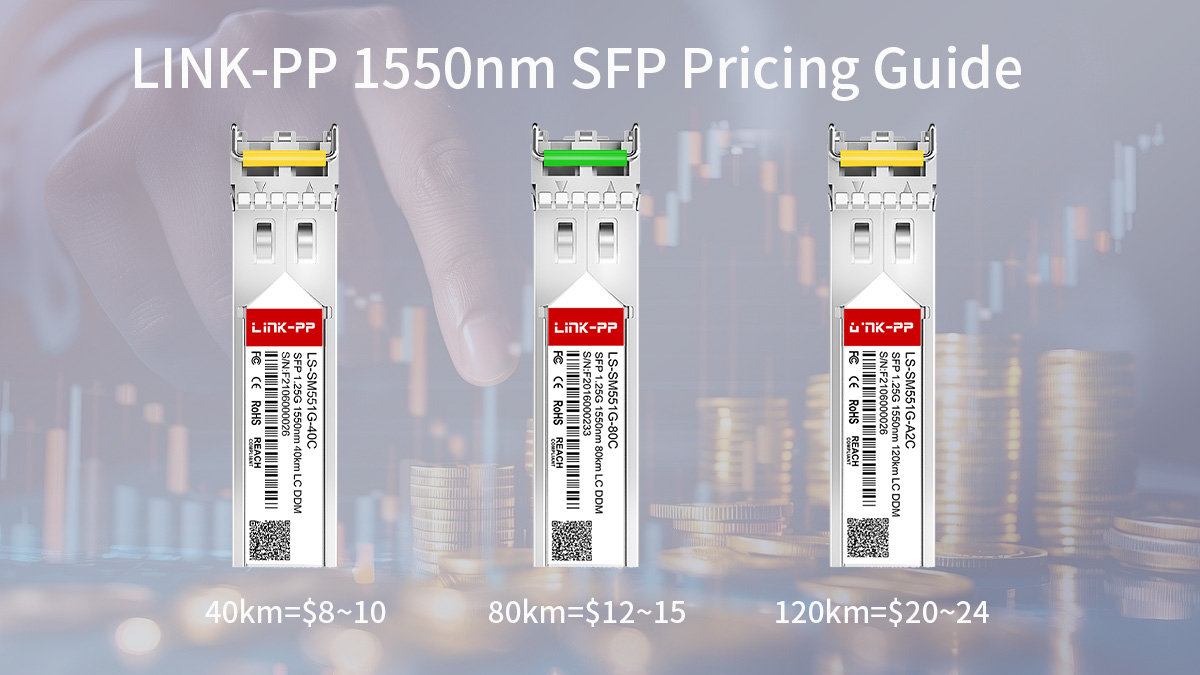
LINK-PP 1550nm SFP modules are priced primarily based on transmission distance, fiber configuration, and application grade, making them a predictable and scalable choice for long-distance deployments. Compared with OEM-branded optics, LINK-PP focuses on cost-performance balance, which is especially important for multi-link or large-scale projects.
Typical Price Ranges of LINK-PP 1550nm SFP Modules
The table below reflects common market-level positioning for LINK-PP 1550nm SFPs. Actual pricing may vary by order volume, compatibility requirements, and customization.
| LINK-PP 1550nm SFP Type | Transmission Distance | Fiber Type | Typical Pricing Position* |
|---|---|---|---|
| 1550nm SFP (Dual-Fiber) | 40km | SMF | 8-10 (USD) |
| 1550nm SFP (Dual-Fiber) | 80km | SMF | 12-15 (USD) |
| 1550nm SFP (Dual-Fiber) | 100km | SMF | 26-31 (USD) |
| 1550nm SFP (Dual-Fiber) | 120km | SMF | 20-24 (USD) |
| 1550nm BiDi SFP | 40km | SMF | 9-11 (USD) |
| 1550nm BiDi SFP | 80km | SMF | 7-9 (USD) |
*Pricing position is relative within the 1550nm SFP category, not absolute retail pricing.
Key Factors That Affect LINK-PP 1550nm SFP Pricing
LINK-PP pricing is specification-driven, not brand-premium-driven. The main cost factors include:
-
Transmission distance: Longer reach requires higher optical budget and stricter component selection
-
Laser type: Higher stability lasers increase cost at 80km and 120km distances
-
Fiber configuration: BiDi designs are typically priced higher due to wavelength pairing complexity
-
Compatibility requirements: Custom coding or extended compatibility testing may affect pricing
-
Grade selection: Industrial-grade modules cost more than standard commercial-grade versions
LINK-PP vs OEM: Pricing Perspective
-
OEM 1550nm SFP modules often include significant brand premiums
-
LINK-PP modules focus on meeting functional requirements without unnecessary markup
-
For deployments with multiple long-distance links, the total cost difference can be substantial
From a procurement standpoint, LINK-PP enables budget predictability while maintaining technical reliability.
How to Choose the Most Cost-Effective LINK-PP Option
-
Select 40km modules when your actual fiber length is well below the limit
-
Avoid over-specifying 80km or 120km SFPs unless distance margin is truly required
-
Use BiDi SFPs only when fiber savings justify the higher module cost
-
Confirm compatibility upfront to prevent rework or replacement expenses
In summary, LINK-PP 1550nm SFP pricing is transparent and specification-based, making it well-suited for engineers and buyers who need reliable long-distance optics without OEM-level costs.
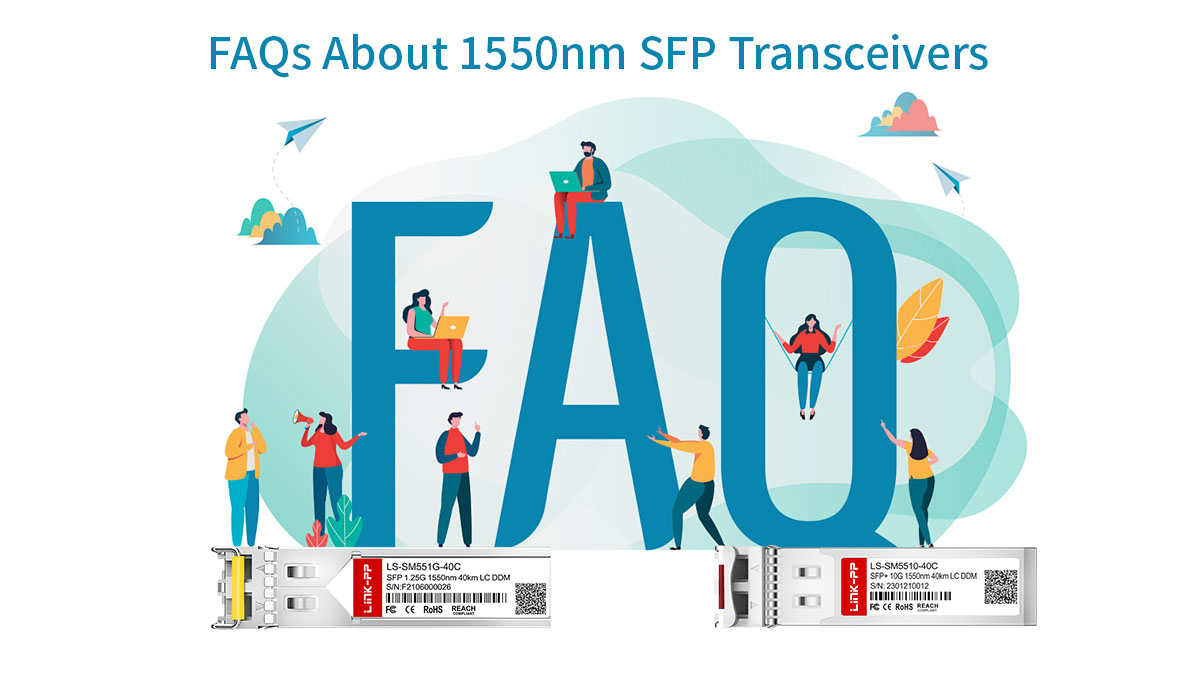
? FAQs About 1550nm SFP Transceivers
Can a 1550nm SFP work with 1310nm at the other end?
No. Both ends of the fiber link must use matching wavelengths. A 1550nm SFP cannot directly communicate with a 1310nm SFP unless the modules are specifically designed as a BiDi wavelength pair.
Is a 1550nm SFP compatible with multimode fiber?
No. 1550nm SFP modules are designed exclusively for single-mode fiber (SMF). Using them with multimode fiber will result in signal loss or link failure.
Do both ends need the same 1550nm SFP module?
Yes, in most cases. For dual-fiber links, both ends should use 1550nm SFPs with the same distance rating. For BiDi links, the two ends must use correctly paired wavelengths.
Can I use a 1550nm SFP for short distances?
It depends. While technically possible, using a 1550nm SFP for short links is usually unnecessary and cost-inefficient. For distances under 10km, 850nm or 1310nm SFPs are typically a better choice.
Are third-party 1550nm SFP modules reliable?
Yes, when properly tested. MSA-compliant third-party 1550nm SFPs, such as LINK-PP modules, can deliver stable performance when compatibility and quality testing are verified in advance.
When should I choose a 1550nm SFP instead of 1310nm?
Choose 1550nm when distance is the priority.
If your link exceeds the practical limits of 1310nm SFPs or requires higher optical margin, a 1550nm SFP is the more appropriate solution.
? Summary: Is a 1550nm SFP the Right Choice for You?
A 1550nm SFP is the right choice when your network requires reliable long-distance transmission—typically 40km or more—over single-mode fiber, with strong signal stability and sufficient optical margin. It is not designed to replace short-reach SFPs, but to solve distance and reliability challenges that other wavelengths cannot efficiently address.
Key Takeaways
-
Choose a 1550nm SFP when link distance, attenuation control, and long-term stability are your top priorities
-
Typical deployment distances include 40km, 80km, and 120km on single-mode fiber
-
Not ideal for short links where 850nm or 1310nm SFPs are more cost-effective
-
Module selection matters: distance rating, fiber type, compatibility, and environment should guide the decision
-
Third-party options, such as LINK-PP 1550nm SFP modules, offer a practical balance between cost and performance when compatibility is confirmed
When a 1550nm SFP Makes Sense
-
Telecom, ISP, or MAN networks with long fiber spans
-
Enterprise or industrial links connecting remote sites
-
Deployments where reducing repeaters improves reliability and operating cost
When It May Not Be the Best Option
-
Short-distance links under 10km
-
Multimode fiber environments
-
Budget-driven projects where long-distance capability is unnecessary
Final Recommendation: If your network link exceeds the effective reach of 1310nm SFP modules and demands stable, long-distance performance, a 1550nm SFP transceiver is a justified and strategic choice. By selecting the correct distance rating and a well-tested module—such as those offered from LINK-PP Official Store—you can achieve reliable long-haul connectivity without unnecessary complexity or OEM-level costs.







