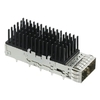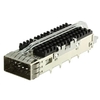
As network traffic continues to grow due to cloud computing, AI workloads, and high-speed enterprise applications, 100G QSFP28 has become the dominant form factor for 100-gigabit Ethernet connectivity. With its compact design, high port density, and excellent power efficiency, QSFP28 transceivers are widely deployed across modern data centers, cloud platforms, telecom networks, and high-performance computing environments.
In large-scale network architectures, 100G QSFP28 transceivers now serve as the standard interface for switch interconnects, aggregation layers, and high-bandwidth fabrics, enabling scalable and cost-effective network expansion.
By reading this article, you will gain a clear, application-driven understanding of where and why 100G QSFP28 is deployed, helping network designers, system integrators, and procurement teams design, select, and scale 100G networks with confidence.
? What Is 100G QSFP28?
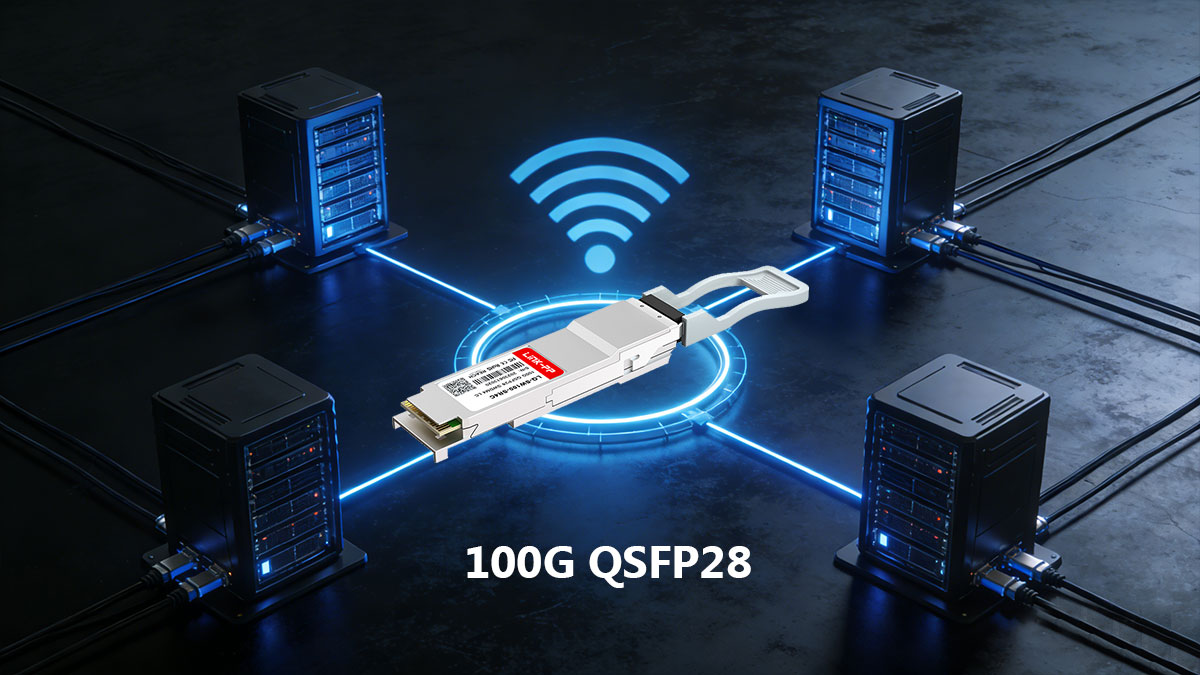
100G QSFP28 is a high-speed optical transceiver form factor designed to support 100-gigabit Ethernet (100GbE) connections. The term QSFP28 stands for Quad Small Form-factor Pluggable 28, indicating that the module uses four electrical lanes, each operating at up to 25 Gbps, to achieve a total data rate of 100 Gbps.
Unlike earlier 100G solutions, 100G QSFP28 delivers significantly higher bandwidth density while maintaining low power consumption, typically ranging from 2.5 W to 4 W, depending on the transmission distance and optical technology used.
From a physical perspective, QSFP28 modules feature a hot-pluggable design, allowing them to be installed or replaced without interrupting network operations. This makes 100G QSFP28 particularly suitable for high-density switches, routers, and network interface cards used in modern data centers and carrier-grade networks.
How Does 100G QSFP28 Work?
A 100G QSFP28 transceiver converts electrical signals from network equipment into optical signals for transmission over fiber, and then converts incoming optical signals back into electrical form at the receiving end.
The basic operating principle includes:
-
Electrical 100GbE signals enter the QSFP28 module
-
Signals are distributed across four 25G lanes
-
Optical transmission occurs over single-mode or multimode fiber
-
The receiving module reconstructs the 100G electrical signal
Depending on the module type, transmission may use parallel optics (SR4, PSM4) or wavelength-division multiplexing (CWDM4, LR4, ER4) to carry data efficiently over different distances.
Why Is QSFP28 the Standard Form Factor for 100G Ethernet?
QSFP28 became the industry-standard form factor for 100G Ethernet due to several technical and operational advantages:
| Key Advantage |
Technical Explanation |
Practical Benefit |
| High port density |
Compact QSFP28 form factor allows more 100G ports per switch |
Enables high-density 100G deployments and better rack utilization |
| Lower power consumption |
Consumes significantly less power than earlier CFP-based modules |
Reduces heat generation and overall operating costs |
| Broad platform compatibility |
Supported by most mainstream switches, routers, and NICs |
Simplifies multi-vendor network designs and upgrades |
| Flexible media options |
Supports fiber, DAC, AOC, and breakout configurations |
Adapts to short-, medium-, and long-reach applications |
| Mature ecosystem |
Widely adopted with extensive module availability |
Lowers risk and improves long-term supply stability |
These advantages make 100G QSFP28 the preferred choice for scalable, high-performance network deployments.
? What Is 100G QSFP28 Used For?
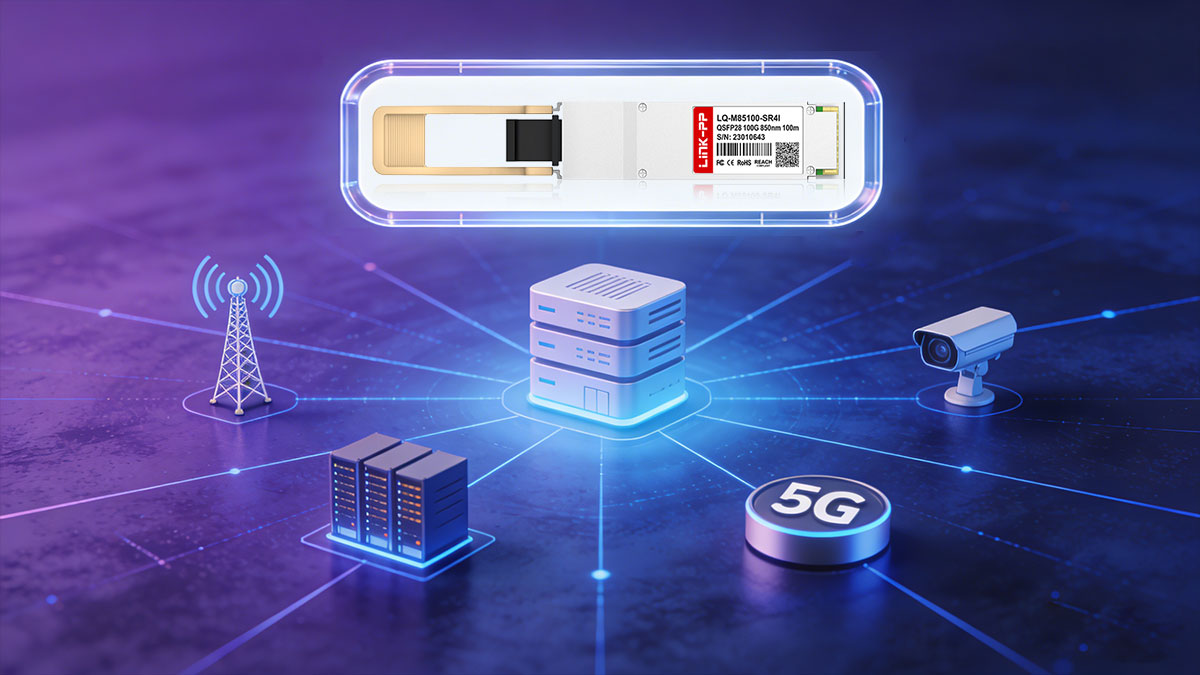
100G QSFP28 is primarily used to deliver high-density, high-bandwidth 100-gigabit Ethernet connectivity across short-, medium-, and long-distance network environments. It enables scalable network designs by consolidating multiple lower-speed links into a single 100G interface.
Typical 100G QSFP28 application scenarios include:
-
High-speed switch-to-switch interconnects in data center fabrics
-
Aggregation and core network links for enterprise and carrier networks
-
Data Center Interconnect (DCI) between geographically separated facilities
-
AI and high-performance computing (HPC) clusters requiring low latency and high throughput
Thanks to its flexibility, a single QSFP28 port can support optical fiber modules, DAC cables, AOC cables, and breakout configurations, allowing network architects to optimize cost, distance, and performance for different deployment models.
What Makes QSFP28 Ideal for 100G Applications?
Before examining specific deployment scenarios, it is important to understand why QSFP28 became the industry-standard form factor for 100G Ethernet.
Key advantages of 100G QSFP28 include:
-
Four-lane 25G architecture, enabling native 100GbE support
-
High port density, with up to 36 × 100G ports in a 1U switch
-
Lower power consumption compared to earlier 100G form factors
-
Broad ecosystem compatibility across switches, routers, and network interface cards
-
Multiple media options, including fiber, DAC, AOC, and breakout cables
These characteristics make 100G QSFP28 suitable for both short-reach intra-data-center links and long-reach inter-data-center or carrier-grade deployments, providing a balance of performance, efficiency, and scalability.
? 100G QSFP28 in Data Center Leaf–Spine Architecture
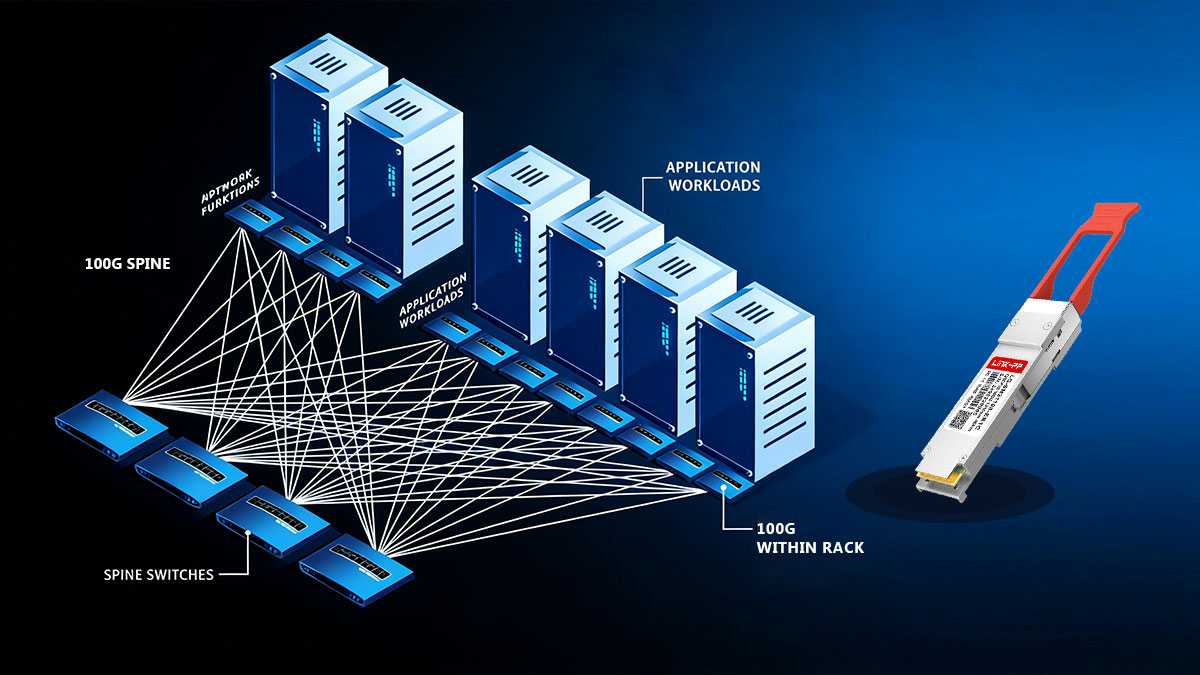
The leaf–spine architecture is the most common deployment model for 100G QSFP28 in modern data centers. In this topology, every leaf switch connects to every spine switch, creating a non-blocking fabric that requires a large number of high-bandwidth, low-latency interconnects to handle massive east-west traffic.
To meet these performance and scalability requirements, QSFP28 100G transceivers have become the standard interface for leaf-to-spine and spine-to-spine connections.
Typical QSFP28 Solutions for Leaf–Spine Networks
Depending on link distance, cabling strategy, and cost considerations, data center operators typically deploy the following 100G QSFP28 modules:
-
QSFP28 SR4 – Short-reach connections over OM3/OM4 multimode fiber, supporting distances up to 100 meters
-
QSFP28 PSM4 / QSFP28 CWDM4 – Medium-reach solutions designed for links ranging from 500 meters to 2 kilometers
-
QSFP28 DAC / AOC – Cost-effective options for in-rack or row-to-row connections, typically within short distances
These options allow flexible network design while maintaining consistent 100G performance across the fabric.
Why QSFP28 Is Preferred in Leaf–Spine Deployments
100G QSFP28 is widely adopted in leaf–spine architectures due to several key advantages:
-
High port density, enabling large numbers of 100G ports in compact 1U switches
-
Simplified cabling, reducing fiber count and management complexity
-
Lower cost per gigabit compared to legacy 40G and early 100G form factors
-
Optimized for scalable switch platforms, supporting future network expansion
Together, these benefits make QSFP28 ideal for building scalable, efficient, and cost-effective data center fabrics.
100G QSFP28 is the de facto standard for leaf–spine interconnects in modern data centers, delivering the bandwidth density and operational efficiency required by today’s high-performance network architectures.
? 100G QSFP28 in Cloud and Hyperscale Data Centers
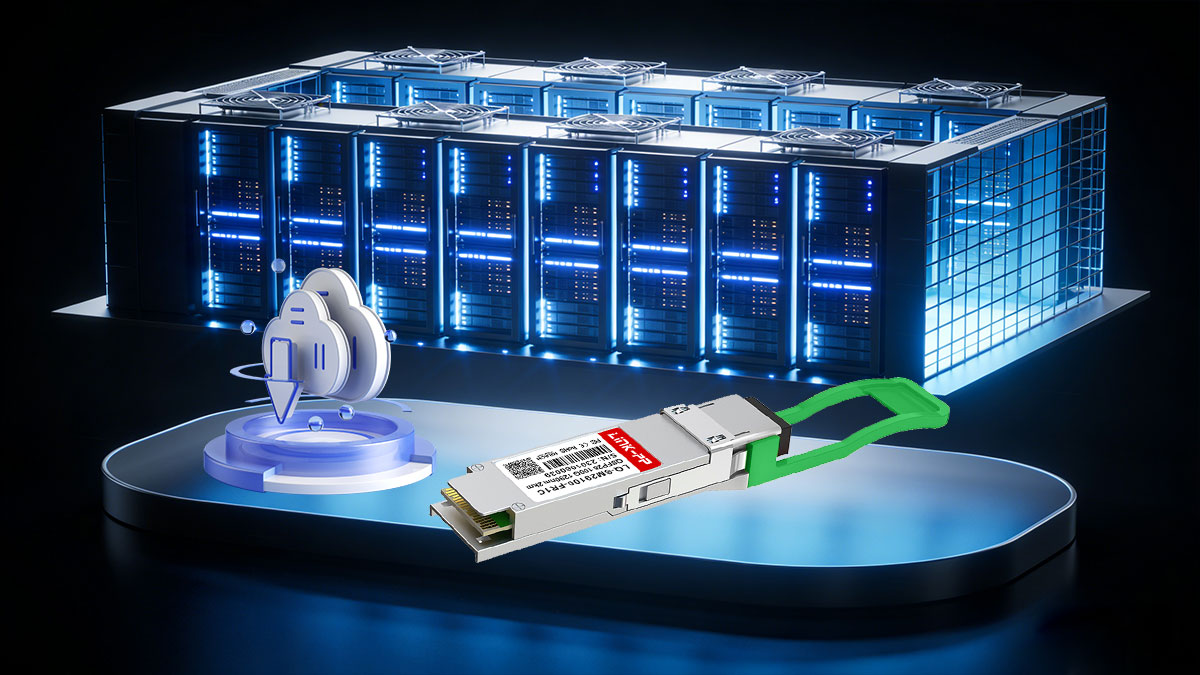
Cloud and hyperscale data centers rely heavily on 100G QSFP28 to support massive east-west traffic between compute, storage, and network layers. In these environments, network scalability, power efficiency, and operational simplicity are critical, making QSFP28 the preferred interface for large-scale 100G deployments.
For hyperscale operators, 100G QSFP28 transceivers provide an optimal balance between bandwidth density, energy consumption, and cost, enabling efficient expansion of cloud infrastructure.
Key Characteristics of Hyperscale Deployments
In cloud and hyperscale environments, QSFP28 100G Module is typically deployed under the following conditions:
-
Extremely high port counts, requiring compact form factors and dense switch designs
-
High volumes of east-west traffic, driven by distributed applications and microservices
-
Strong emphasis on power efficiency, reducing operational expenditure at scale
-
Interoperability across multi-vendor platforms, ensuring supply chain flexibility
These requirements strongly favor QSFP28 over larger or less efficient 100G form factors.
Typical Use Cases for 100G QSFP28 in Cloud Networks
Common 100G QSFP28 application scenarios in cloud and hyperscale data centers include:
-
Switch uplinks and downlinks within leaf–spine fabrics
-
QSFP28 to 4×25G breakout connections for high-density server access
-
High-bandwidth spine-to-spine interconnects supporting non-blocking fabrics
These use cases allow cloud operators to scale network capacity while maintaining consistent performance and predictable costs.
Common QSFP28 Module Types
To meet different distance and cabling requirements, hyperscale deployments commonly use:
Trend Insight: Evolution Beyond SR4
As hyperscale networks continue to evolve, many operators are gradually transitioning from QSFP28 SR4 to single-lambda solutions such as DR1-based architectures. This shift is driven by the need to reduce fiber complexity, simplify network design, and prepare for future migration to 200G and 400G interfaces.
Despite this evolution, 100G QSFP28 remains a critical stepping stone in the transition toward higher-speed Ethernet technologies.
? 100G QSFP28 for Data Center Interconnect (DCI)
Data Center Interconnect (DCI) refers to high-capacity links that connect two or more data centers across metro or regional distances. Compared with intra-data-center links, DCI deployments require higher optical budgets, longer reach, and carrier-grade stability.
In these scenarios, 100Gb QSFP28 transceivers are widely used to deliver long-distance 100G Ethernet connectivity while maintaining a compact form factor and simplified network architecture.
Common QSFP28 Options for DCI
Depending on distance and fiber infrastructure, typical 100G QSFP28 DCI modules include:
-
QSFP28 100Gbase CWDM4 – Up to 2km, suitable for short metro DCI
-
QSFP28 LR4 – Up to 10km, common for campus and metro links
-
QSFP28 ER4 – Up to 40km, for extended metro or regional connections
-
QSFP28 ZR4 – Up to 80km or more, supporting long-haul DCI deployments
These modules leverage WDM (Wavelength Division Multiplexing) to transmit multiple wavelengths over a single pair of single-mode fibers.
Why QSFP28 Is Well-Suited for DCI Applications
100G QSFP28 has become a popular choice for DCI due to several key advantages:
-
Supports WDM technologies, maximizing fiber utilization
-
High optical budget, enabling stable long-distance transmission
-
Compatible with carrier-grade switches and routers, including IPoDWDM architectures
-
Eliminates the need for external transponders in many deployments, reducing cost, power consumption, and rack space
By integrating optical functions directly into the QSFP28 module, network operators can deploy simpler and more cost-effective DCI solutions.
For metro and regional Data Center Interconnect, 100G QSFP28 provides a scalable and efficient solution that bridges the gap between traditional data center optics and long-haul transport networks—making it a critical building block in modern cloud and carrier infrastructures.
? Carrier and ISP Network Applications of 100G QSFP28
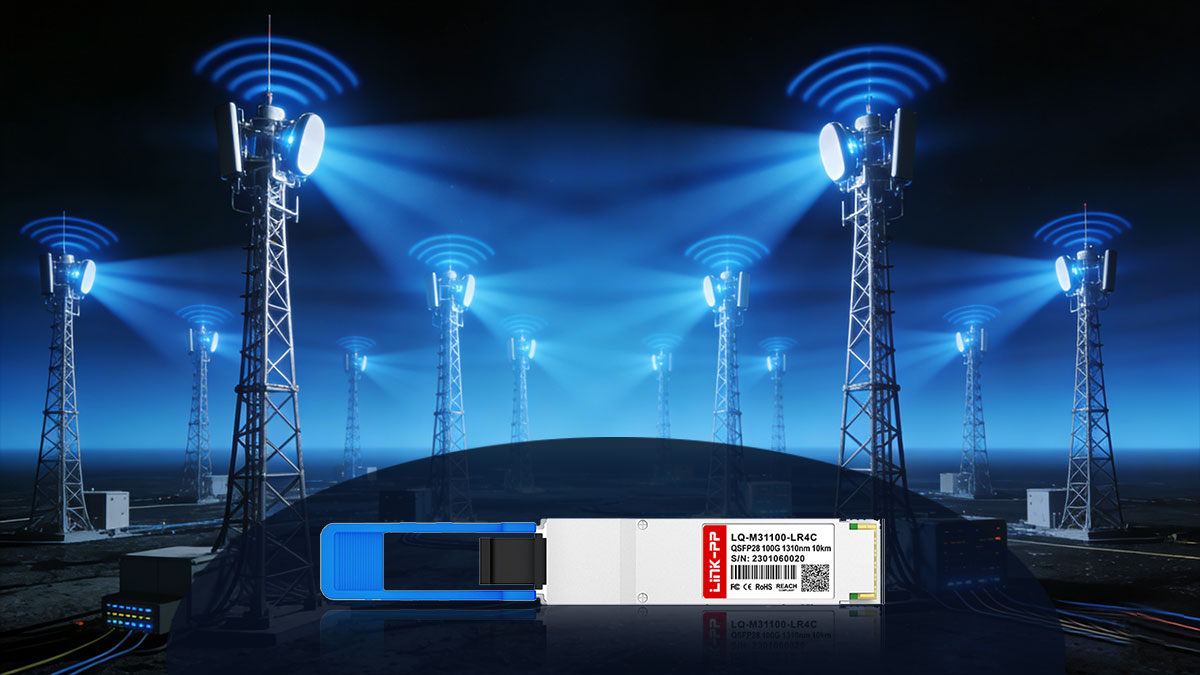
Telecom operators and Internet Service Providers (ISPs) deploy 100G QSFP28 transceivers across aggregation and core network layers to handle rapidly growing subscriber traffic driven by 5G, cloud services, and broadband access.
Compared with data center environments, carrier networks demand longer transmission distances, higher reliability, and strict interoperability standards, making QSFP28 a critical interface for modern telecom infrastructures.
Typical Carrier and ISP Deployment Scenarios
QSFP28 100G transceiver is commonly used in the following carrier-grade network applications:
-
Metro aggregation networks, consolidating traffic from access and edge nodes
-
Mobile fronthaul and backhaul, supporting 4G/5G base station connectivity
-
IP over DWDM (IPoDWDM) systems, integrating routing and optical transport
-
Core and edge router interconnects, enabling scalable 100G backbone capacity
These deployments often span metro to regional distances, requiring robust optical performance.
Key Requirements in Carrier Environments
To operate reliably in telecom networks, 100G QSFP28 modules must meet several carrier-specific requirements:
-
Long-distance transmission capability, typically using LR4, ER4, or ZR-class optics
-
High reliability and continuous uptime, supporting mission-critical services
-
Wide operating temperature ranges, suitable for central offices and outdoor cabinets
-
Interoperability with multi-vendor carrier equipment, ensuring smooth network integration
Carrier-grade QSFP28 modules are designed to comply with telecom standards and strict qualification processes, enabling stable performance under demanding conditions.
Why QSFP28 Is Used in Carrier and ISP Networks
100G QSFP28 Module offers a balance of capacity, reach, and operational efficiency, allowing carriers to:
-
Scale aggregation and core networks without increasing footprint
-
Reduce power consumption compared to legacy 100G form factors
-
Simplify network architecture through direct 100G pluggable optics
As telecom networks continue to evolve toward higher capacities and converged IP and optical layers, QSFP28 remains a foundational interface for carrier and ISP 100G deployments.
? 100G QSFP28 in AI, Machine Learning, and HPC Clusters
AI training, machine learning workloads, and high-performance computing (HPC) clusters require extremely high throughput, ultra-low latency, and predictable performance.
To meet these demands, 100G QSFP28 Modules have become a core building block for modern AI and HPC network fabrics.
Unlike traditional enterprise networks, AI and HPC environments generate massive east-west traffic between GPUs, accelerators, storage systems, and compute nodes, making link performance and latency consistency critical.

Common AI and HPC Use Cases
100G QSFP28 is widely deployed in the following AI and high-performance computing scenarios:
-
GPU-to-GPU cluster interconnects, supporting distributed AI training
-
Storage-to-compute fabrics, enabling fast data access for large datasets
-
High-bandwidth east-west traffic paths within AI pods and HPC racks
-
Leaf-to-leaf or spine connections in AI-optimized network topologies
These use cases demand high port density and deterministic latency at scale.
Frequently Used QSFP28 Media Types in AI Clusters
To optimize performance and cost, AI and HPC clusters typically use short-reach QSFP28 solutions:
| QSFP28 Media Type |
Transmission Medium |
Typical Reach |
Key Advantages |
Common AI / HPC Use Cases |
| QSFP28 SR4 |
Multimode fiber (OM3/OM4) |
Up to 100m |
High port density, stable signal quality |
Intra-cluster links, leaf-to-leaf connections |
| QSFP28 AOC |
Active optical cable |
Up to 30–100m |
Lightweight, flexible cabling, easy deployment |
Rack-to-rack and row-level AI cluster connections |
| QSFP28 DAC |
Twinax copper cable |
Up to 5m (typ.) |
Ultra-low latency, lowest cost |
Ultra-short GPU-to-switch or switch-to-switch links |
These media types are optimized for short reach, minimal signal loss, and high reliability.
rmance Advantages of QSFP28 for AI and HPC
100G QSFP28 offers several key advantages for parallel computing workloads:
-
Ultra-low latency, critical for synchronized GPU operations
-
Excellent signal integrity, supporting stable high-speed data transfer
-
High port density, enabling scalable AI pod architectures
-
Lower power consumption, reducing thermal pressure in dense GPU clusters
Key takeaway:
100G QSFP28 delivers the optimal balance of bandwidth, latency, and efficiency required for large-scale AI and HPC deployments.
? Enterprise and Campus Network Use Cases of 100G QSFP28
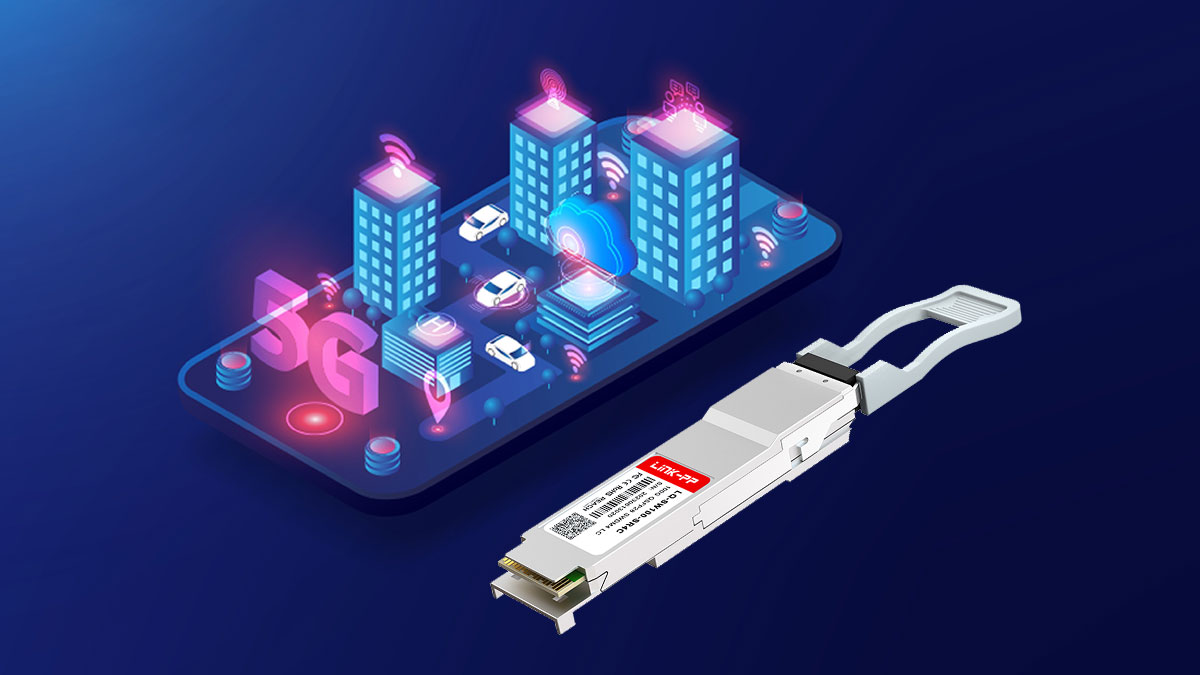
Large enterprises and campus networks deploy 100G QSFP28 transceivers at the core and aggregation layers to support high-capacity backbone connectivity across buildings and network domains.
As campus environments continue to expand in size and bandwidth demand, 100G QSFP28 provides a scalable upgrade path from legacy 10G and 40G infrastructures.
Compared to hyperscale data centers, enterprise and campus networks typically prioritize link stability, longer reach, and simplified fiber management over extreme port density.
Typical Enterprise and Campus Applications
Common 100G QSFP28 deployment scenarios in enterprise and campus networks include:
-
Core switch interconnections between main network nodes
-
Building-to-building backbone links across large campuses
-
High-capacity uplinks for aggregation switches
-
Consolidation of multiple 10G/40G links into a single 100G connection
These applications require reliable long-distance transmission with minimal operational complexity.
Recommended QSFP28 Modules for Campus Networks
To match enterprise network requirements, the following QSFP28 modules are commonly selected:
-
QSFP28 100Gbase LR4– Ideal for long-distance campus links, typically up to 10 km
-
100G CWDM4 – Suitable for mid-range deployments where fiber optimization is required
Both options offer stable performance and compatibility with mainstream enterprise switching platforms.
Why QSFP28 Fits Enterprise and Campus Networks
QSFP28 100G Transceiver is well-suited for enterprise environments because it:
-
Enables high-capacity backbone upgrades without major architectural changes
-
Reduces fiber count compared to parallel-optics solutions
-
Supports gradual migration from legacy network speeds
-
Offers a mature ecosystem with broad vendor compatibility
Key takeaway:
100G QSFP28 provides enterprises and campus networks with a future-ready backbone solution that balances bandwidth, reach, and operational simplicity.
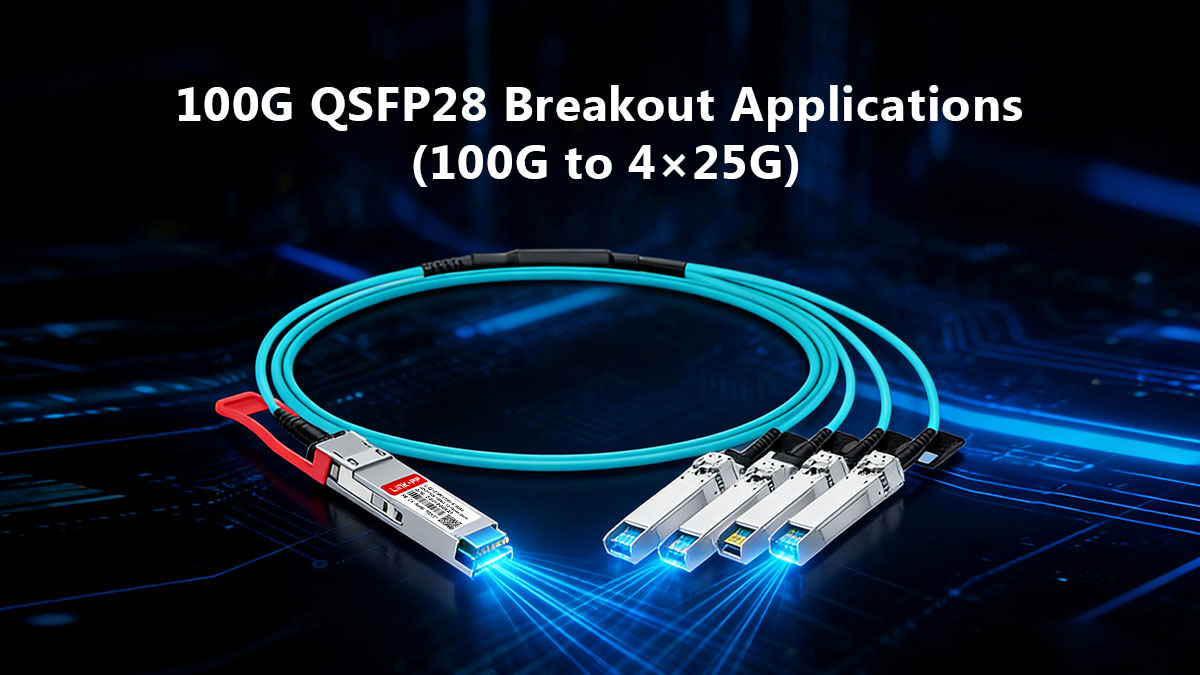
? 100G QSFP28 Breakout Applications (100G to 4×25G)
100G QSFP28 breakout allows a single 100G port to be split into four independent 25G Ethernet links, enabling flexible network design and efficient bandwidth utilization.
This capability makes QSFP28 breakout particularly valuable in server access layers, Top-of-Rack (ToR) switching, and gradual network migrations.
By leveraging breakout configurations, network operators can maximize port utilization while maintaining compatibility with existing 25G infrastructure.
Common 100G to 4×25G Breakout Use Cases
100G QSFP28 breakout is widely used in the following scenarios:
-
Connecting a 100G switch port to four 25G server NICs
-
High-density server access in ToR and leaf switches
-
Incremental migration from 25G to 100G architectures
-
Optimizing switch port usage in space- and power-constrained environments
These use cases allow operators to scale bandwidth without replacing all downstream equipment.
Typical Breakout Media Options for 100G QSFP28
Several QSFP28 media types support breakout configurations:
| Breakout Media Type |
Connection Type |
Typical Reach |
Key Advantages |
Common Use Cases |
| QSFP28 DAC breakout cable (100G to 4×25G) |
Twinax copper |
Up to 5 m |
Lowest cost, ultra-low latency |
Short-distance server access, ToR switch connections |
| QSFP28 AOC breakout cable |
Active optical cable |
Up to 30–100 m |
Lightweight, flexible, easy cable management |
Rack-to-rack and row-level connections |
| QSFP28 SR4 with MPO-to-LC breakout harness |
Multimode fiber (OM3/OM4) |
Up to 100 m |
Fiber-based breakout, higher port density |
Structured cabling in data centers |
Each breakout option offers different trade-offs in reach, cost, and cable management, allowing network designers to select the most appropriate solution for their deployment.
Key Considerations for QSFP28 Breakout Deployments
Before deploying 100G QSFP28 breakout 25G, consider the following factors:
-
Switch and NIC compatibility with breakout modes
-
Correct port configuration (100G to 4×25G mode in switch OS)
-
Cable polarity and connector type (MPO-12 vs. LC)
-
Distance limitations based on the selected media
Proper planning ensures stable operation and avoids link mismatches.
Why Breakout Makes QSFP28 More Versatile
QSFP28 breakout significantly enhances deployment flexibility by:
-
Supporting mixed-speed environments
-
Reducing upfront upgrade costs
-
Allowing gradual network scaling
-
Maximizing the value of each 100G port
Key takeaway:
100G QSFP28 breakout enables high-density, cost-efficient connectivity by bridging 100G backbone ports and 25G server links within modern networks.
? How to Choose the Right 100G QSFP28 for Different Applications
Selecting the right 100G QSFP28 transceiver depends on transmission distance, network architecture, cabling preferences, and cost considerations.
Different application scenarios place very different requirements on reach, fiber type, and power consumption.
Key Factors to Consider When Choosing a 100G QSFP28
Before selecting a module, evaluate the following parameters:
-
Transmission distance (short-, mid-, or long-reach)
-
Network environment (data center, campus, DCI, carrier, AI cluster)
-
Cabling type (multimode fiber, single-mode fiber, DAC, AOC)
-
Port density and power budget
-
Compatibility with switches and optics ecosystem
Recommended 100G QSFP28 Modules by Application
| Application Scenario |
Typical Distance |
Recommended QSFP28 Type |
Key Selection Reason |
| Leaf–Spine Data Center |
≤100 m |
QSFP28 SR4 / DAC / AOC |
High density, low cost, low latency |
| Cloud & Hyperscale DC |
≤500 m – 2 km |
QSFP28 SR4 / CWDM4 / DR1 |
Fiber efficiency, scalability |
| AI & HPC Clusters |
≤30 m – 100 m |
QSFP28 SR4 / AOC / DAC |
Ultra-low latency, signal integrity |
| Enterprise & Campus Backbone |
Up to 10 km |
QSFP28 LR4 |
Stable long-distance links |
| Data Center Interconnect (DCI) |
2 km – 80 km+ |
QSFP28 CWDM4 / LR4 / ER4 / ZR4 |
Long reach, WDM support |
| Breakout (100G → 4×25G) |
≤100 m |
QSFP28 DAC / AOC / SR4 breakout |
Flexible server access |
Selection Tips for Maximizing Performance and Cost Efficiency
-
Use DAC or AOC whenever possible for short-reach connections to reduce cost
-
Choose single-lambda solutions (QSFP28 DR1 / 100G FR1) to simplify fiber management
-
For campus and DCI links, prioritize optical budget and link stability
-
Verify switch OS support and interoperability before deployment
Key Takeaway
There is no single “best” 100G QSFP28 module for all networks.
The optimal choice depends on where the link is deployed, how far it needs to reach, and how the network is expected to scale.
Choosing the right QSFP28 ensures reliable performance, lower total cost of ownership, and a future-ready 100G infrastructure.
? Conclusion: Choosing the Right QSFP28 Modules
The widespread adoption of 100G QSFP28 transceivers is driven by their unmatched balance of bandwidth, port density, power efficiency, and deployment flexibility. From data center leaf–spine architectures and cloud-scale networks to carrier-grade aggregation and AI/HPC clusters, QSFP28 continues to serve as the foundation of modern 100G Ethernet infrastructure.
Selecting the right QSFP28 module depends on several key factors, including transmission distance, fiber type, network architecture, and long-term scalability requirements. Evaluating these parameters during the network design phase ensures optimal performance, lower total cost of ownership, and a smoother upgrade path toward higher-speed interfaces such as 200G and 400G.
As 100G Ethernet remains a critical building block for today’s high-bandwidth networks, making informed QSFP28 choices is essential for building reliable, future-ready infrastructures.
? LINK-PP 100G QSFP28 Solutions
LINK-PP offers a comprehensive portfolio of 100G QSFP28 transceivers, including SR4, CWDM4, LR4, ER4, ZR4, DAC, AOC, and breakout solutions, designed for data centers, carrier networks, enterprise backbones, and AI-driven infrastructures.
All LINK-PP QSFP28 products are engineered for broad platform compatibility, stable performance, and cost-efficient deployment, helping network designers and procurement teams build scalable and future-ready 100G Ethernet networks.
? Visit the LINK-PP Official Store:
? https://www.l-p.com/
Explore detailed specifications, compatibility information, and application-specific solutions, or contact LINK-PP’s technical team for expert guidance on selecting the right 100G QSFP28 for your network.
? Also Read
To further explore related 100G QSFP28 topics, you may find these articles helpful: