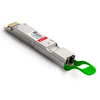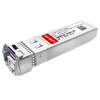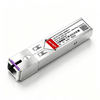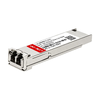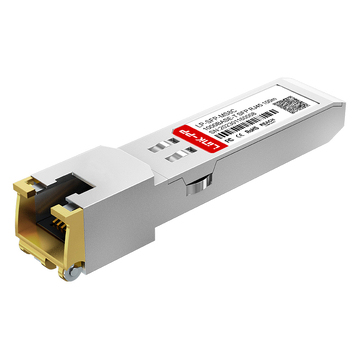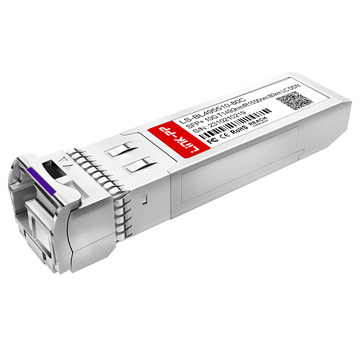
A 1000BASE-SX SFP transceiver module is a Gigabit Ethernet optical module designed for short-range data transmission over multimode fiber, typically up to 550m, making it a practical and cost-effective choice for enterprise and data center networks.
As part of the IEEE 802.3z standard, 1000BASE-SX uses an 850nm wavelength and is widely deployed in environments where high bandwidth, low latency, and reliable short-distance connectivity are required—such as wiring closets, switch-to-switch links, and intra-data-center connections. Compared with long-reach alternatives like 1000BASE-LX, SX modules prioritize simplicity and efficiency over distance, which is why they remain relevant in modern Gigabit Ethernet infrastructures.
In this guide, you’ll learn how a 1000BASE-SX SFP transceiver module works, its key specifications, supported fiber types, typical applications, and selection considerations. By the end, you’ll be able to quickly determine whether a 1000BASE-SX SFP is the right fit for your network design and deployment needs.
✅ What Is a 1000BASE-SX SFP Transceiver Module?
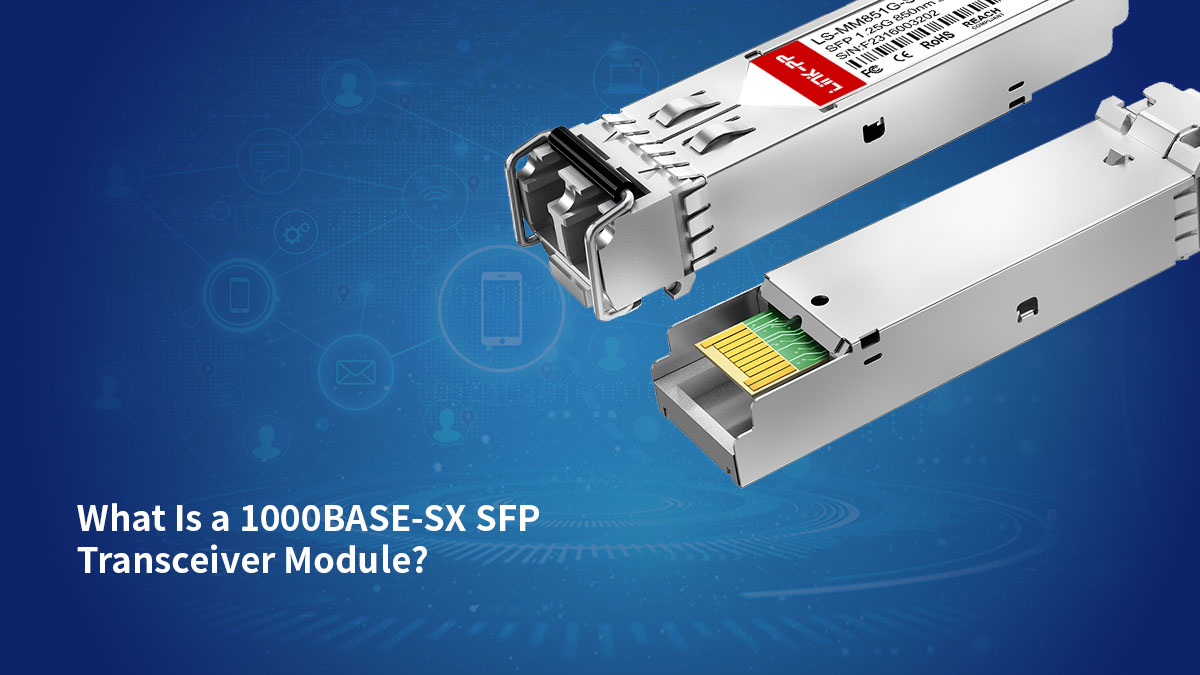
A 1000BASE-SX SFP transceiver module is a hot-swappable optical transceiver defined by the IEEE 802.3z standard for delivering 1G Gigabit Ethernet over multimode fiber using an 850nm short-wavelength laser.
IEEE 802.3z Standard Overview
IEEE 802.3z is the original specification that introduced Gigabit Ethernet over fiber. Within this standard, 1000BASE-SX is designed specifically for short-distance optical links, balancing bandwidth, cost, and ease of deployment. It standardizes critical parameters such as data rate, optical wavelength, encoding method, and link performance to ensure multi-vendor interoperability.
In practical terms, compliance with IEEE 802.3z means a 1000BASE-SX SFP module can work reliably across compliant switches, routers, and network interface cards without proprietary lock-in.
Meaning of “SX” (Short Wavelength, 850nm)
The “SX” in 1000BASE-SX stands for short wavelength, referring to its use of an 850nm optical signal. This wavelength is optimized for multimode fiber (MMF) and is typically generated by a VCSEL (Vertical-Cavity Surface-Emitting Laser).
Short-wavelength transmission enables lower-cost optics and simpler fiber alignment compared to long-wavelength solutions. However, it also limits maximum reach, which is why 1000BASE-SX is best suited for links within buildings, floors, or data halls rather than long-haul connections.
How It Fits into Gigabit Ethernet Architecture
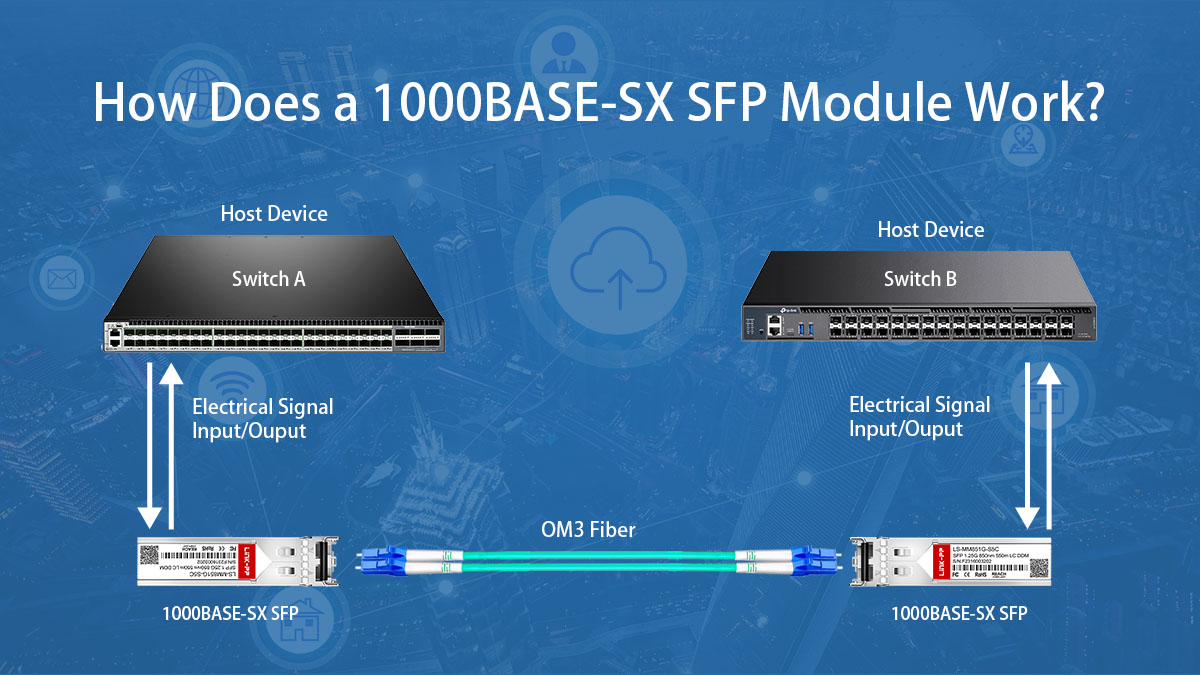
Within a Gigabit Ethernet architecture, a 1000BASE-SX SFP module functions as the optical interface between network equipment and fiber cabling. Installed in an SFP port, it converts electrical Ethernet signals from the switch or NIC into optical signals for transmission over multimode fiber, and vice versa at the receiving end.
Because of its standardized design and short-reach focus, 1000BASE-SX is commonly used for:
-
Switch-to-switch uplinks within a rack or row
-
Access-to-distribution layer connections
-
High-density Gigabit deployments where cost and power efficiency matter
In short, a 1000BASE-SX SFP transceiver module occupies the role of a reliable, short-distance building block in Gigabit Ethernet networks, bridging performance needs with practical deployment constraints.
✅ How Does a 1000BASE-SX SFP Module Work?
A 1000BASE-SX SFP module works by converting electrical Gigabit Ethernet signals into 850nm optical signals, transmitting them over multimode fiber, and then converting them back into electrical signals at the receiving end.
Optical Signal Transmission at 850nm
At the core of 1000BASE-SX transmission is the 850nm short-wavelength optical signal, which is optimized for multimode fiber. This wavelength supports high-speed data transfer over short distances with stable performance, making it ideal for in-building and data center environments.
Because multimode fiber has a larger core size than single-mode fiber, it allows light to travel through multiple paths. The 850nm wavelength is specifically chosen to minimize signal distortion over these short links while keeping optical components cost-effective.
Role of VCSEL Laser and Multimode Fiber
A 1000BASE-SX SFP module uses a VCSEL (Vertical-Cavity Surface-Emitting Laser) as its light source. VCSELs are well-suited for short-reach applications because they:
-
Provide efficient optical output at 850nm
-
Consume relatively low power
-
Enable compact, high-density SFP designs
Multimode fiber complements VCSEL technology by offering easier alignment and lower installation costs compared to single-mode fiber. Together, the VCSEL laser and multimode fiber form a transmission system optimized for short-distance, high-reliability Gigabit Ethernet links.
Tx/Rx Process Simplified for Non-Engineers
From a simplified perspective, the transmit and receive process works as follows:
-
Transmit (Tx): The switch sends an electrical Ethernet signal to the SFP module, which converts it into an 850nm optical signal and launches it into the multimode fiber.
-
Propagation: The optical signal travels through the fiber over the specified distance, typically within the same building or data hall.
-
Receive (Rx): The receiving SFP module detects the optical signal and converts it back into an electrical signal for the destination device.
This straightforward Tx/Rx conversion process is why 1000BASE-SX SFP modules are widely adopted—they deliver dependable Gigabit connectivity without the complexity of long-haul optical systems.
✅ Key Specifications of 1000BASE-SX SFP Modules
The performance and deployment scope of a 1000BASE-SX SFP transceiver module are defined by a small set of standardized specifications. Understanding these parameters helps determine whether SX is suitable for a specific network environment.
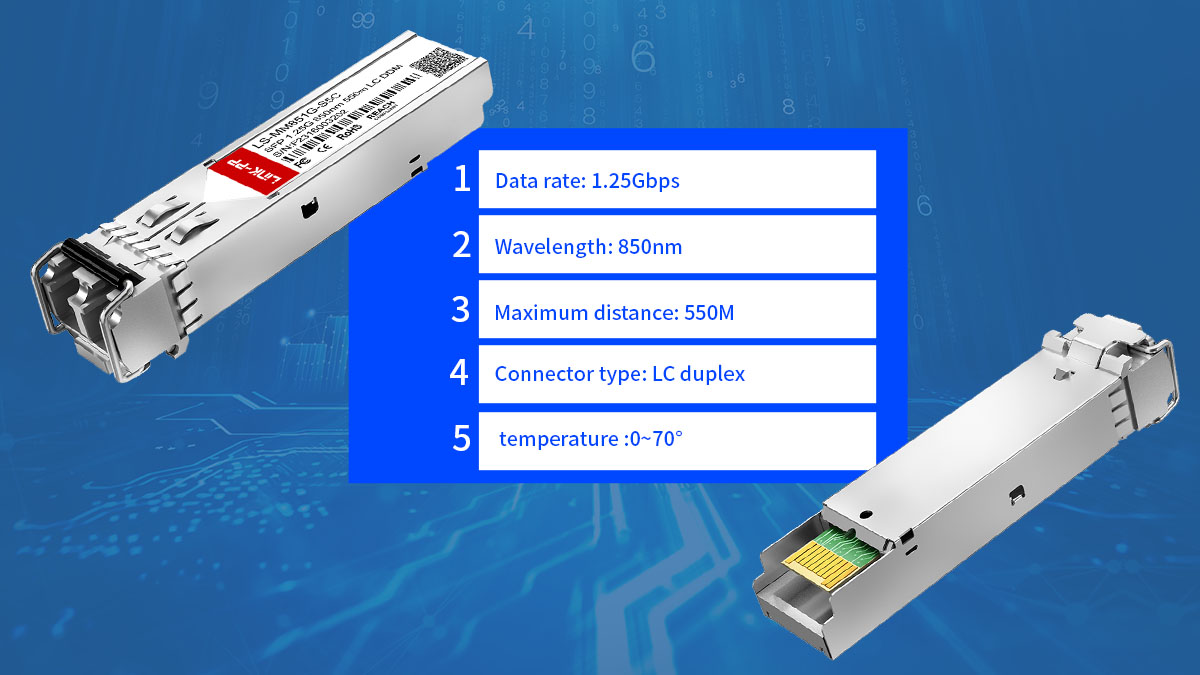
Data Rate: 1.25Gbps
A 1.25g SFP module operates at a nominal line rate of 1.25Gbps, which supports 1G Gigabit Ethernet after encoding overhead. This data rate is fixed by the IEEE 802.3z standard and ensures consistent performance across compliant devices.
In practical deployments, this makes 1000BASE-SX ideal for access and aggregation links where stable 1G bandwidth is required without overprovisioning.
Wavelength: 850nm
1000BASE-SX uses an 850nm short-wavelength optical signal, specifically optimized for multimode fiber transmission. This wavelength enables the use of cost-effective optical components and supports high-density installations commonly found in enterprise networks and data centers.
Maximum Transmission Distance by Fiber Type
The achievable distance of a 1000BASE-SX SFP module depends directly on the multimode fiber grade:
-
OM1: up to 275m
-
OM2: up to 550m
-
OM3: up to 550m
-
OM4: up to 550m
While newer fiber types do not significantly extend distance for 1G SX links, they offer improved signal quality and future-proofing for higher-speed optics.
Connector Type: LC Duplex
Most 1000BASE-SX SFP modules use an LC duplex connector, which provides separate transmit and receive fiber paths. The compact LC form factor supports high port density on switches and patch panels, making it the industry standard for SFP-based optical links.
Optical Components: VCSEL Laser & PIN Photodiode
Internally, a 1000BASE-SX SFP module relies on:
This combination delivers reliable signal conversion with low power consumption, contributing to the long service life and stability of SX transceivers.
Operating Temperature Options
1000BASE-SX SFP modules are available in multiple operating temperature ranges to match different environments:
-
Commercial: 0°C to 70°C, suitable for offices and data centers
-
Industrial: -40°C to 85°C, designed for harsh or outdoor-adjacent installations
Selecting the appropriate temperature grade ensures consistent performance and reduces the risk of optical degradation over time.
✅ Supported Fiber Types and Maximum Transmission Distance
The maximum reach of a 1000BASE-SX SFP transceiver module is determined not only by the transceiver itself, but also by the type and quality of multimode fiber used in the link. Understanding these differences is critical for predictable network performance.
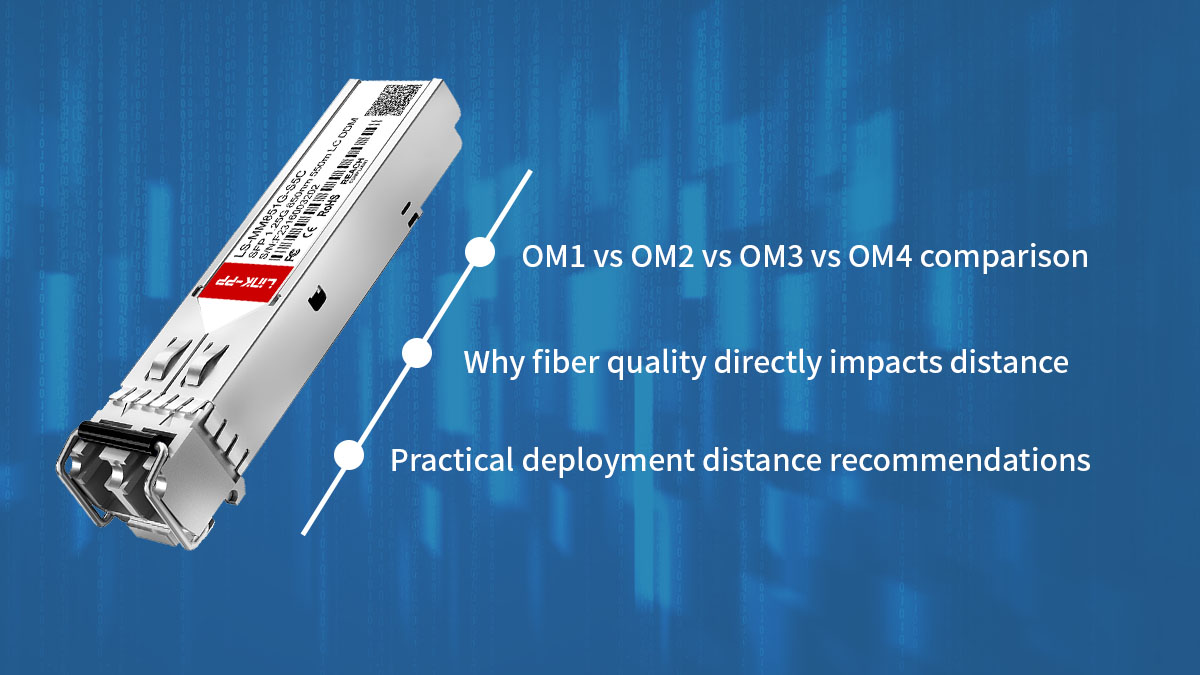
OM1 vs OM2 vs OM3 vs OM4 Comparison
1000BASE-SX is compatible with all common multimode fiber types, but each grade supports different transmission distances:
-
OM1 (62.5µm core): up to 275m
-
OM2 (50µm core): up to 550m
-
OM3 (laser-optimized 50µm): up to 550m
-
OM4 (enhanced laser-optimized 50µm): up to 550m
While OM3 and OM4 are designed to support higher-speed applications such as 10G SFP+ and beyond, their maximum distance for 1G SX links remains capped by the IEEE 802.3z specification rather than the fiber’s physical capability.
Why Fiber Quality Directly Impacts Distance
Even when using the correct fiber type, fiber quality plays a decisive role in real-world transmission distance. Factors such as insertion loss, connector cleanliness, splice quality, and cable aging can all reduce the effective reach of a 1000BASE-SX link.
Short-wavelength transmission over multimode fiber is particularly sensitive to:
These issues increase signal dispersion and loss, which can lead to intermittent link failures before the theoretical maximum distance is reached.
Practical Deployment Distance Recommendations
To ensure stable operation, it is best practice to design links with a safety margin rather than pushing the absolute distance limits:
-
For OM1, keep links within 200m when possible
-
For OM2, target 400–500m for long-term stability
-
For OM3 and OM4, SX is reliable well below 550m, but these fibers are often better reserved for future 10G or higher upgrades
In summary, a 1000BASE-SX SFP transceiver module delivers predictable short-range performance when paired with the right multimode fiber and deployed with realistic distance planning.
✅ Common Applications of 1000BASE-SX SFP Transceivers
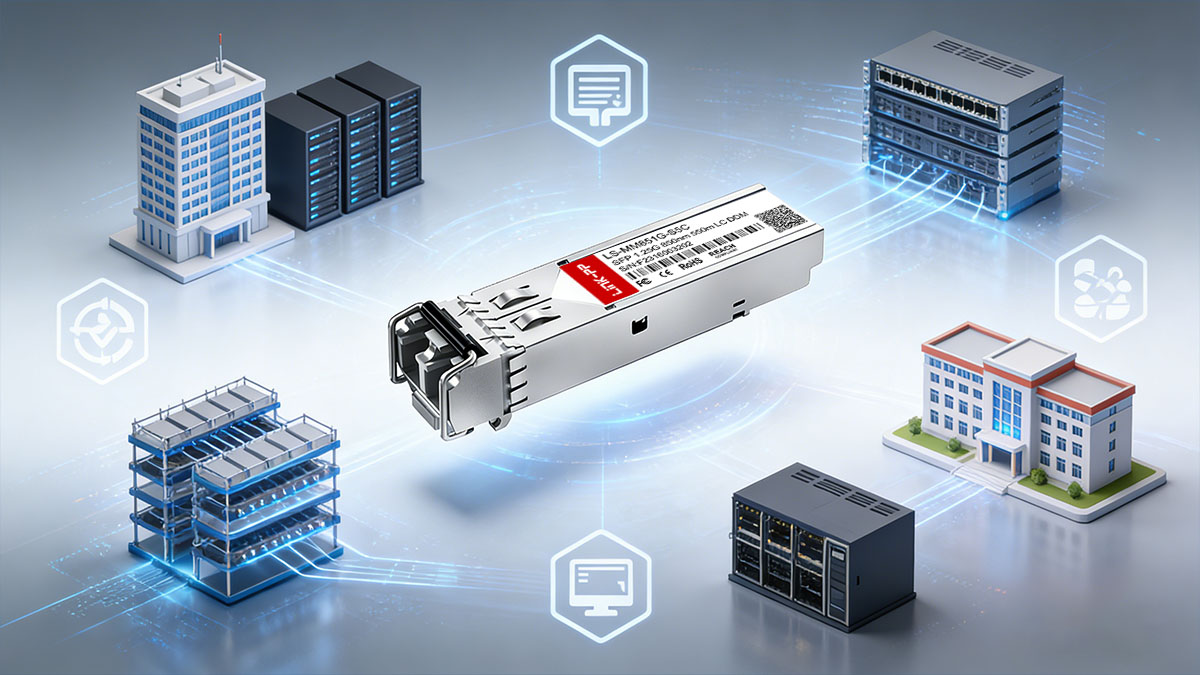
A 1000BASE-SX SFP transceiver is primarily used in environments where short-distance, high-reliability Gigabit Ethernet is required. Its cost efficiency and wide compatibility make it a common choice across multiple network layers.
Enterprise LANs
In enterprise local area networks, 1000BASE-SX SFP modules are widely deployed for access and distribution layer connections. They are commonly used to link switches between floors, wiring closets, or nearby buildings where multimode fiber infrastructure already exists.
For organizations that prioritize stability and standardized components, SX modules offer a straightforward way to deliver consistent 1G bandwidth without the complexity of long-reach optics.
Data Center Intra-Rack and Inter-Rack Links
Within data centers, 1000BASE-SX is frequently used for intra-rack and short inter-rack connections. These links typically fall well within the supported distance limits and benefit from the low power consumption and compact form factor of SX SFP modules.
Although higher-speed optics are common in modern data centers, 1000BASE-SX remains relevant for:
Campus Networks and Wiring Closets
Campus networks often involve multiple wiring closets connected over short fiber runs. 1000BASE-SX SFP transceivers are well-suited for these scenarios, especially when multimode fiber is already installed between buildings or network rooms.
Their predictable performance and broad vendor compatibility simplify maintenance across large-scale deployments.
When SX Is Preferred Over LX
1000BASE-SX is generally preferred over 1000BASE-LX when:
-
Link distances are well under 550m
-
Multimode fiber is already in place
-
Lower optical module cost is a priority
-
Long-haul or single-mode fiber is unnecessary
In contrast, 1000BASE-LX sfp is better suited for longer distances or single-mode fiber environments. Choosing SX over LX in short-range scenarios avoids unnecessary cost and complexity while delivering the required network performance.
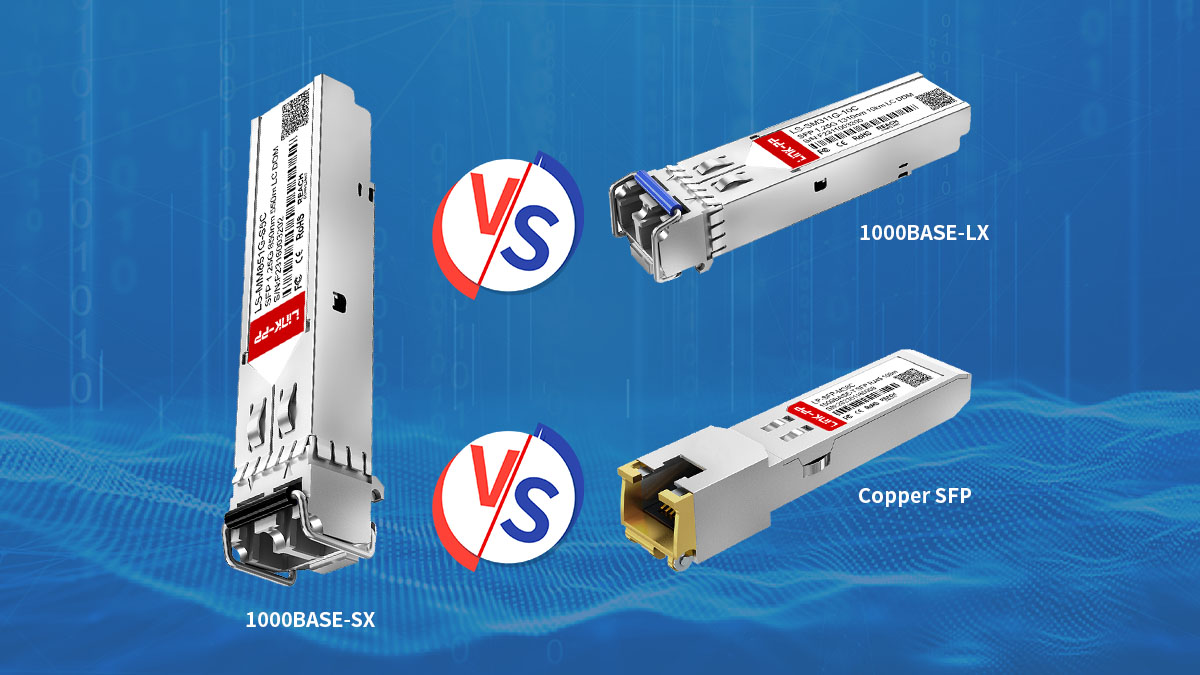
✅ 1000BASE-SX vs Other Gigabit SFP Modules
When selecting a Gigabit SFP transceiver, it’s important to understand how 1000BASE-SX compares with other common 1G options, particularly 1000BASE-LX and 1000BASE-T. Each serves a different deployment need in terms of distance, cabling, and cost.
1000BASE-SX vs 1000BASE-LX
Both SX and LX support 1G Ethernet over fiber, but they are optimized for very different transmission ranges and fiber types.
| Feature |
1000BASE-SX |
1000BASE-LX |
| Wavelength |
850nm |
1310nm |
| Fiber Type |
Multimode fiber |
Single-mode fiber (MMF with mode conditioning) |
| Max Distance |
Up to 550m |
Up to 10km |
| Typical Use Case |
Short-range, in-building links |
Long-range or campus links |
| Relative Cost |
Lower |
Higher |
Key takeaway:
1000BASE-SX is the better choice for short-distance multimode deployments, while 1000BASE-LX is designed for long-distance single-mode links where reach matters more than cost.
1000BASE-SX vs 1000BASE-T (Copper SFP)
1000BASE-T SFP modules use copper cabling instead of fiber, which changes both performance characteristics and deployment considerations.
| Feature |
1000BASE-SX |
1000BASE-T |
| Transmission Medium |
Multimode fiber |
Cat5e / Cat6 copper cable |
| Max Distance |
Up to 550m |
Up to 100m |
| EMI Susceptibility |
Immune |
Susceptible |
| Power Consumption |
Low |
Higher |
| Typical Use Case |
Fiber-based network links |
Short copper patch connections |
Key takeaway:
Copper SFP is convenient for very short connections, but 1000BASE-SX offers longer reach, better noise immunity, and lower latency in structured fiber networks.
Key Differences in Distance, Fiber Type, and Cost
From a practical network design perspective:
-
Distance: SX fills the gap between short copper links and long-haul fiber links
-
Fiber type: SX is optimized for multimode fiber already deployed in many enterprise environments
-
Cost: SX modules are typically more cost-effective than LX optics for short-range applications
Overall, a 1000BASE-SX SFP transceiver module is the most balanced choice when you need reliable Gigabit performance over short fiber distances without unnecessary optical complexity or cost.
✅ Compatibility and Interoperability Considerations
A 1000BASE-SX SFP transceiver module is designed to be widely interoperable, but real-world compatibility depends on several technical and vendor-related factors. Understanding these considerations helps avoid link failures and deployment issues.
SFP MSA Compliance
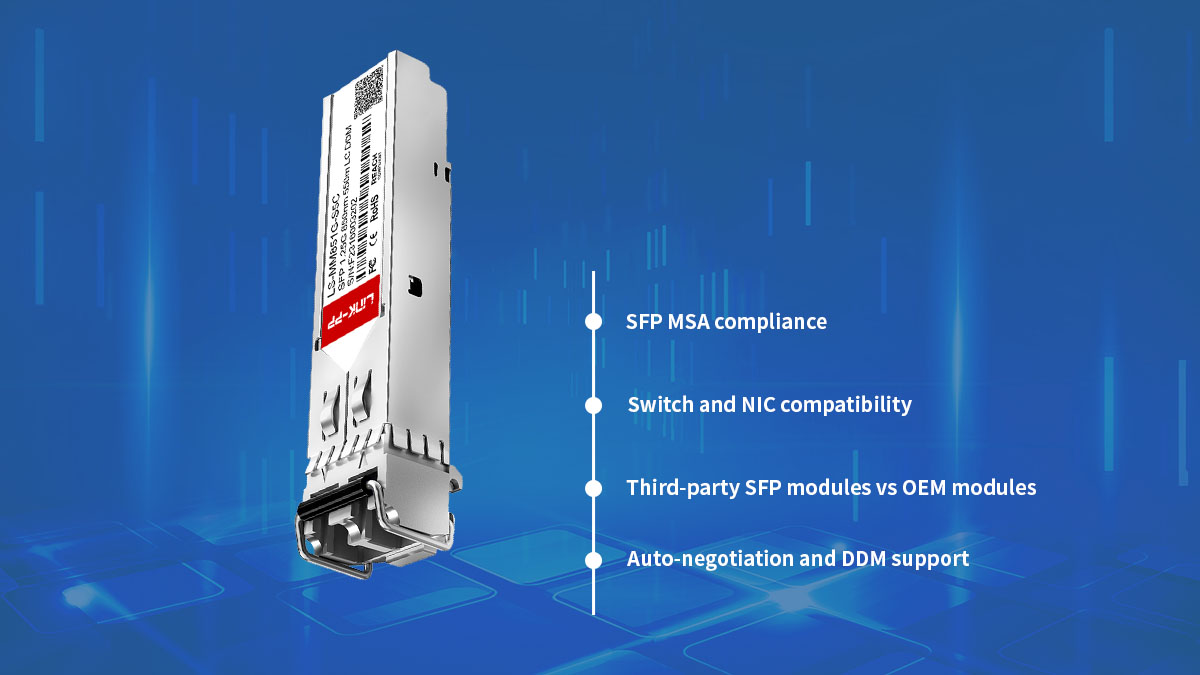
Most 1000BASE-SX SFP modules are built in accordance with the SFP Multi-Source Agreement (MSA). MSA compliance standardizes the electrical interface, mechanical dimensions, and optical parameters of SFP modules, enabling cross-vendor interoperability.
In practice, an MSA-compliant SX SFP can operate in SFP ports from different manufacturers, provided the device does not enforce vendor-specific restrictions.
Switch and NIC Compatibility
While the optical standard is universal, network equipment vendors may implement firmware-level compatibility checks. Some switches and network interface cards only accept approved or coded SFP modules, while others allow third-party optics without limitations.
Before deployment, it is best practice to:
-
Verify the switch or NIC SFP compatibility list
-
Confirm support for 1G SX optics at 850nm
-
Check whether firmware updates affect third-party module recognition
LINK-PP SFP Modules vs OEM Modules
From a functional perspective, LINK-PP 1000BASE-SX SFP modules and OEM modules follow the same IEEE and MSA standards. The primary differences lie in branding, price, and support policies.
-
OEM modules: Higher cost, guaranteed vendor support
-
LINK-PP modules: Lower cost, broad compatibility, flexible sourcing
In environments without strict vendor lock-in, LINK-PP SX SFP modules are commonly used to reduce network hardware costs while maintaining reliable performance.
Auto-Negotiation and DDM Support
1000BASE-SX SFP modules typically support auto-negotiation at the electrical interface, allowing devices to establish stable 1G links automatically when both ends are configured correctly.
Many SX SFP modules also support Digital Diagnostic Monitoring (DDM or DOM), which provides real-time visibility into parameters such as:
-
Optical transmit power
-
Optical receive power
-
Module temperature
-
Supply voltage
DDM support is especially valuable for monitoring link health and diagnosing fiber-related issues in large-scale or mission-critical networks.
✅ Advantages and Limitations of 1000BASE-SX SFP Modules
A 1000BASE-SX SFP transceiver module is designed for a specific networking role. Understanding both its strengths and constraints helps determine whether it is the right solution for a given deployment.
Advantages
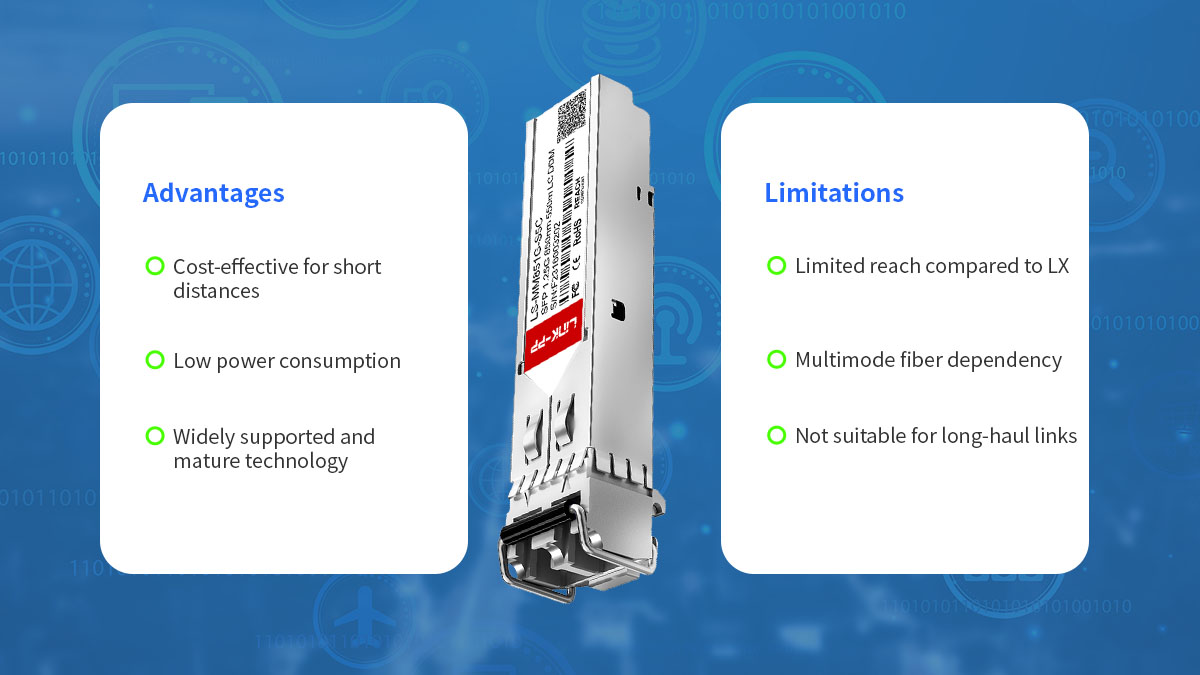
Cost-effective for short distances
1000BASE-SX SFP modules are generally more affordable than long-reach fiber options such as LX. For links well within 550m, SX delivers the required performance without the added cost of single-mode optics or specialized fiber infrastructure.
Low power consumption
Thanks to the use of 850nm VCSEL technology, SX SFP modules consume relatively little power. This makes them well-suited for high-density switch environments where thermal management and energy efficiency are important considerations.
Widely supported and mature technology
As one of the earliest Gigabit Ethernet fiber standards, 1000BASE-SX is a well-established and stable technology. It is supported by a wide range of network equipment, and its behavior is predictable across vendors and deployment scenarios.
Limitations
Limited reach compared to LX
The primary limitation of 1000BASE-SX is transmission distance. Even under ideal conditions, SX links are limited to 550m, which is significantly shorter than the multi-kilometer reach of 1000BASE-LX.
Multimode fiber dependency
1000BASE-SX is optimized for multimode fiber only. Networks built entirely on single-mode fiber cannot take advantage of SX optics without additional components or infrastructure changes.
Not suitable for long-haul links
For campus backbones, building-to-building connections over long distances, or carrier-grade networks, 1000BASE-SX is not the appropriate choice. In these cases, long-reach fiber standards provide better scalability and reliability.
In summary, a 1000BASE-SX SFP module excels in short-range, fiber-based Gigabit networks, but it must be selected with a clear understanding of its distance and fiber limitations.
✅ How to Choose the Right 1000BASE-SX SFP Transceiver Module
Choosing the right 1000BASE-SX SFP transceiver module comes down to matching the module’s specifications with your actual network environment. A structured selection process helps avoid overengineering or unexpected compatibility issues.
Confirm Fiber Type and Distance
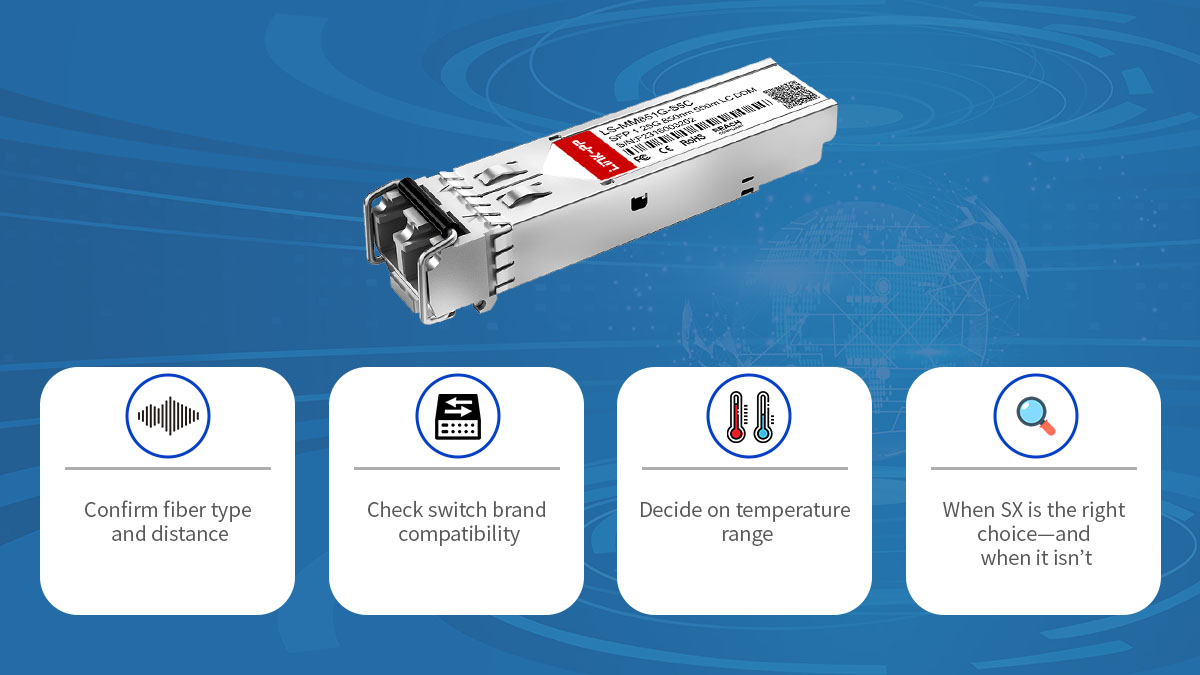
Start by verifying the multimode fiber type already deployed in your network and the required link distance. 1000BASE-SX is suitable when the fiber run stays within the supported limits of OM1, OM2, OM3, or OM4 fiber.
If the link distance approaches the upper limit of the fiber type, building in a safety margin is recommended to ensure long-term stability.
Check Switch Brand Compatibility
Next, confirm that your switch or network interface card supports 1G SX SFP modules at 850nm. Some vendors restrict the use of non-OEM optics through firmware controls, while others allow third-party modules without limitation.
Reviewing compatibility lists or selecting pre-coded third-party SFPs can prevent recognition issues during installation.
Decide on Temperature Range
Consider the operating environment of the SFP module. For controlled indoor environments such as data centers and offices, a commercial temperature range is usually sufficient. For industrial sites or edge deployments with temperature fluctuations, an industrial-grade SX SFP may be necessary.
Selecting the appropriate temperature rating improves reliability and reduces the risk of premature module failure.
When SX Is the Right Choice—and When It Isn’t
A 1000BASE-SX SFP transceiver module is the right choice when:
-
The link distance is short
-
Multimode fiber is already installed
-
Cost and power efficiency are priorities
SX may not be the best option when:
-
Long-distance transmission is required
-
Only single-mode fiber is available
-
Future upgrades demand higher-speed optics over the same link
By aligning these factors with your network design goals, you can confidently determine whether 1000BASE-SX is the optimal solution for your deployment.
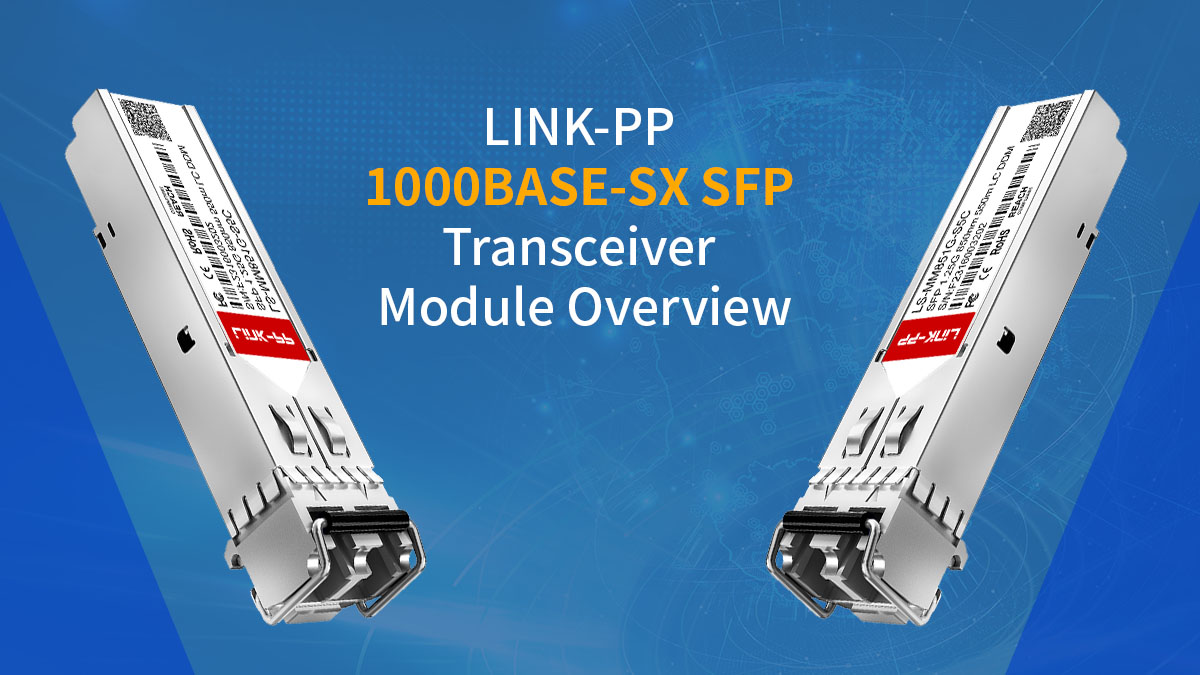
✅ LINK-PP 1000BASE-SX SFP Transceiver Module Overview
The LINK-PP 1000BASE-SX SFP transceiver module is designed to provide reliable Gigabit Ethernet connectivity for short-range multimode fiber links, combining standardized performance with practical deployment flexibility.
LINK-PP as a Professional SFP Transceiver Manufacturer
LINK-PP is a professional manufacturer specializing in optical transceivers and connectivity solutions. With a focus on standardized design and consistent quality, LINK-PP SFP modules are developed to support enterprise, data center, and industrial networking environments where compatibility and stability are critical.
Standards Compliance: IEEE 802.3z and SFP MSA
LINK-PP 1000BASE-SX SFP modules are fully compliant with the IEEE 802.3z standard and the SFP MSA. This ensures predictable electrical and optical behavior and allows the modules to interoperate with a wide range of SFP-enabled switches and network interface cards.
Key Technical Highlights
LINK-PP 1000BASE-SX SFP modules follow the standard SX specification while emphasizing consistency and reliability:
-
Data rate: 1.25Gbps
-
Wavelength: 850nm VCSEL laser
-
Fiber support: OM1, OM2, OM3, and OM4 multimode fiber
-
Maximum distance: up to 550m, depending on fiber type and quality
These specifications make the modules suitable for most short-range Gigabit Ethernet applications.
Compatibility with Mainstream Network Equipment Vendors
LINK-PP 1000BASE-SX SFP transceivers are designed for broad interoperability with mainstream network equipment vendors. Their MSA-compliant design allows them to function seamlessly in environments where multi-vendor hardware is deployed, reducing integration complexity during upgrades or expansions.
Reliability and Monitoring Features
To ensure stable long-term operation, LINK-PP incorporates multiple reliability-focused features:
-
Factory testing and optical performance verification to ensure consistent output and sensitivity
-
Optional DDM / DOM support for real-time monitoring of optical and electrical parameters
-
Commercial and industrial temperature options to match different environmental conditions
These features help network operators maintain visibility and confidence in link performance.
Typical Deployment Scenarios
The LINK-PP 1000BASE-SX SFP transceiver module is a cost-effective choice for:
-
Enterprise LAN uplinks and access-layer connections
-
Data center intra-rack and short inter-rack links
-
Campus wiring closets with existing multimode fiber infrastructure
In these scenarios, LINK-PP 1000BASE-SX SFP modules provide a balanced combination of performance, compatibility, and value without unnecessary optical complexity.
✅ FAQ About 1000BASE-SX SFP Transceiver Modules
Can 1000BASE-SX SFP work with single-mode fiber?
No. 1000BASE-SX SFP modules are designed specifically for multimode fiber at 850nm. Using single-mode fiber typically results in unstable links or no link at all unless special conditioning is applied, which is not recommended for standard deployments.
Is 1000BASE-SX still relevant today?
Yes. 1000BASE-SX remains widely used in enterprise and data center networks for short-range Gigabit links. It continues to be a practical choice for legacy systems, management networks, and cost-sensitive 1G deployments.
Does fiber type affect performance?
Yes. The multimode fiber type directly affects the maximum supported distance and signal stability. Higher-grade fiber reduces attenuation and dispersion, helping SX links operate more reliably within their specified range.
Can I mix different SX SFP brands?
It depends. From a standards perspective, MSA-compliant SX SFP modules can interoperate across brands. However, some switches enforce vendor restrictions, so compatibility should be verified before mixing different manufacturers.
When should I choose SX instead of LX?
Choose SX when your link distance is short and multimode fiber is already installed. Choose LX when longer distances or single-mode fiber are required. Selecting SX in short-range scenarios avoids unnecessary cost and complexity.
✅ Conclusion
A 1000BASE-SX SFP transceiver module is the optimal solution for short-range Gigabit Ethernet links over multimode fiber, offering a cost-effective and widely compatible way to deliver stable 1G connectivity.
Key Takeaways
-
Standardized performance: Operates at 1.25Gbps using the IEEE 802.3z standard and 850nm wavelength
-
Predictable distance: Supports up to 550m on OM2 / OM3 / OM4 multimode fiber
-
Low operational overhead: Low power consumption and mature VCSEL-based design
-
Broad interoperability: MSA-compliant and supported by most enterprise switches
When to Choose — and When Not
Choose 1000BASE-SX if your network uses multimode fiber, link distances are short, and cost efficiency matters.
Avoid 1000BASE-SX if you require long-distance transmission, rely on single-mode fiber, or plan near-term upgrades to higher-speed optics over the same links.
Final Recommendation
For enterprise LANs, data center short links, and campus wiring closets, a 1000BASE-SX SFP transceiver module delivers reliable Gigabit performance without unnecessary complexity. If you’re evaluating dependable third-party options, the LINK-PP Official Store offers 1000BASE-SX SFP modules designed for standards compliance, interoperability, and long-term stability.