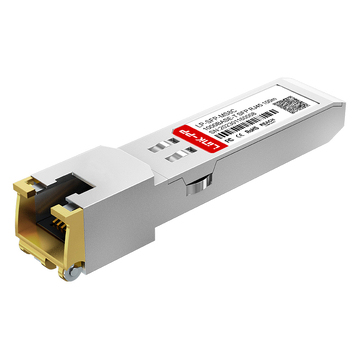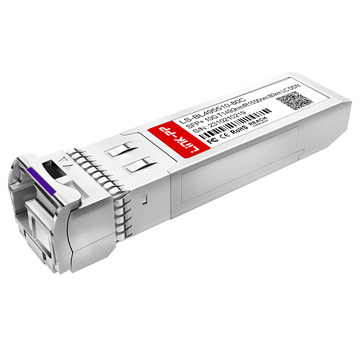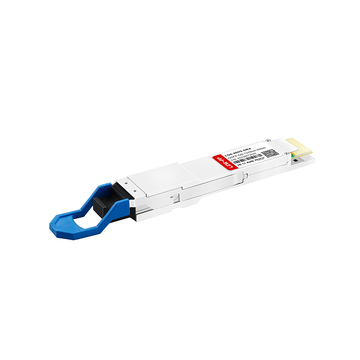

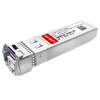

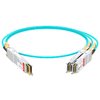
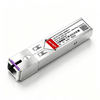
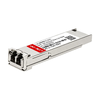

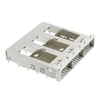

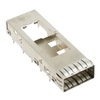
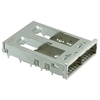
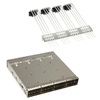




The core difference between SFP28 and QSFP lies in lane architecture and deployment role: SFP28 delivers 25G over a single lane for high-density server and access-layer connections, while QSFP (40G) aggregates four 10G lanes to provide 40G bandwidth for switch-to-switch and backbone links.
Although both form factors are common in modern data center networks, they are not interchangeable in practice. Choosing between SFP28 (25G) and QSFP (40G) directly affects switch port utilization, cabling topology, fiber count, and long-term upgrade planning. Treating them as generic “higher vs lower speed” options often leads to inefficient designs or unnecessary hardware changes.
In typical leaf–spine architectures, SFP28 is most often deployed on server-facing ports where port density and flexibility are critical, while QSFP (40G) is used for inter-switch links that require stable, aggregated throughput. This separation reflects not only speed differences, but also how traffic flows are distributed across access and aggregation layers.
The following sections provide a structured comparison of SFP28 and QSFP (40G), focusing on technical characteristics, deployment scenarios, compatibility considerations, and selection criteria. The goal is to help network designers choose the appropriate form factor based on architecture and scaling needs—not just headline bandwidth.
✅ What Is SFP28?
SFP28 is a 25G optical transceiver form factor designed for single-lane transmission, primarily used in high-density server access and Top-of-Rack (ToR) deployments. It delivers 25Gbps per port while maintaining the same physical size as SFP+ modules, allowing network operators to increase bandwidth without reducing port density.
From an architectural perspective, SFP28 enables a clean migration path from 10G to 25G at the access layer, improving bandwidth efficiency while minimizing changes to switch hardware layouts and cabling practices.
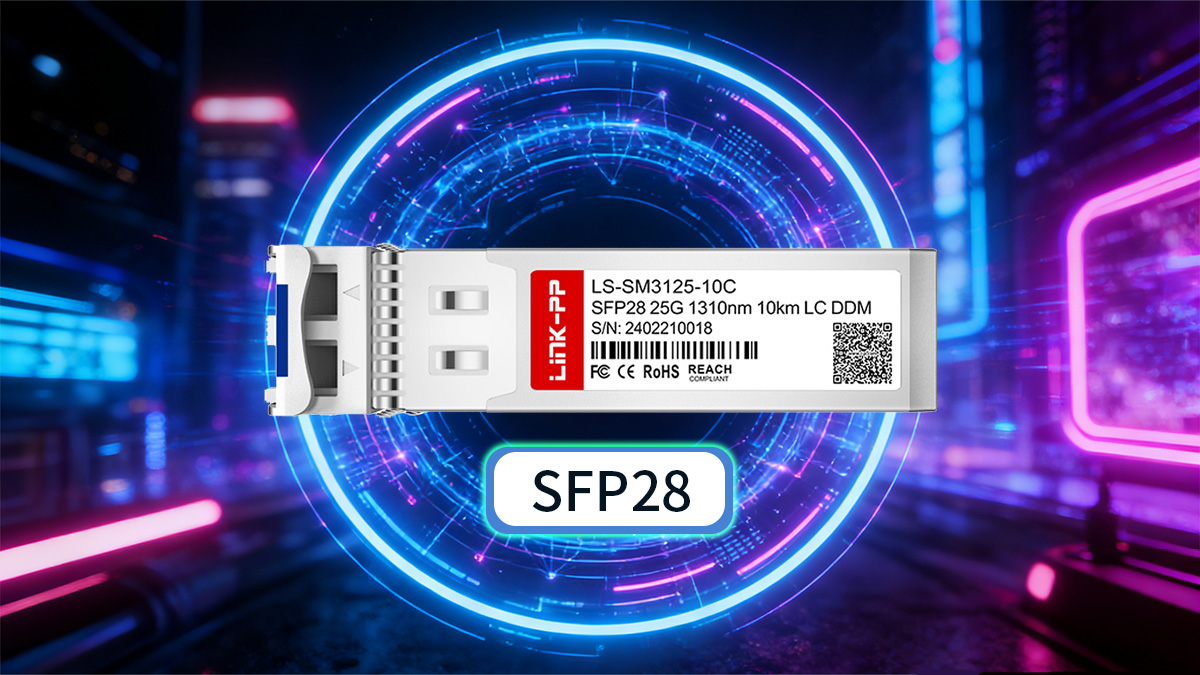
Key Characteristics of SFP28 Transceivers
SFP28 is defined by its single-lane design and compact form factor, which prioritize port density and flexible deployment over aggregated bandwidth. These characteristics make it fundamentally different from multi-lane form factors such as QSFP (40G).
| Parameter | SFP28 Specification |
|---|---|
| Data Rate | 25Gbps |
| Lane Count | 1 lane |
| Form Factor | SFP28 (SFP-sized) |
| Typical Fiber | Single-mode or multimode |
| Common Wavelengths | 850nm / 1310nm |
Because SFP28 uses only one electrical and optical lane, each port operates independently at 25G. This simplifies link design and makes capacity planning more predictable, especially in environments with large numbers of server connections.
Typical Deployment Role of SFP28
SFP28 is most commonly deployed at the network access layer, where many short- to mid-range links are required rather than a few high-capacity uplinks.
Common deployment scenarios include:
-
Server-to-switch connections in 25G Ethernet environments
-
Top-of-Rack (ToR) switches in leaf–spine architectures
-
Enterprise and data center access layers prioritizing port density
-
Incremental upgrades from 10G SFP+ to 25G without redesigning switch layouts
In these scenarios, SFP28 allows operators to scale bandwidth horizontally—by adding more 25G ports—rather than vertically aggregating bandwidth into fewer high-speed links.
Why SFP28 Is Not Simply “A Faster SFP+”
Although SFP28 shares the same physical footprint as SFP+, it is optimized for a different performance and economic model. The move from 10G to 25G improves bandwidth-per-port efficiency, reduces the number of required switch ports for the same total throughput, and aligns better with modern server NIC capabilities.
This design philosophy explains why SFP28 has become the dominant choice for 25G server access, even when higher-speed form factors such as QSFP (40G) are present elsewhere in the network.
✅ What Is QSFP?
QSFP (Quad Small Form-factor Pluggable) is a multi-lane optical module form factor designed to deliver higher bandwidth per port through lane aggregation. A QSFP module combines four parallel lanes into a single interface, making it suitable for switch-to-switch and aggregation links where per-port throughput is more important than port density.
Unlike SFP28, which scales bandwidth by increasing the number of independent ports, QSFP scales bandwidth by aggregating multiple lanes within one port. This fundamental difference affects switch architecture, cabling topology, and how traffic is consolidated across the network.
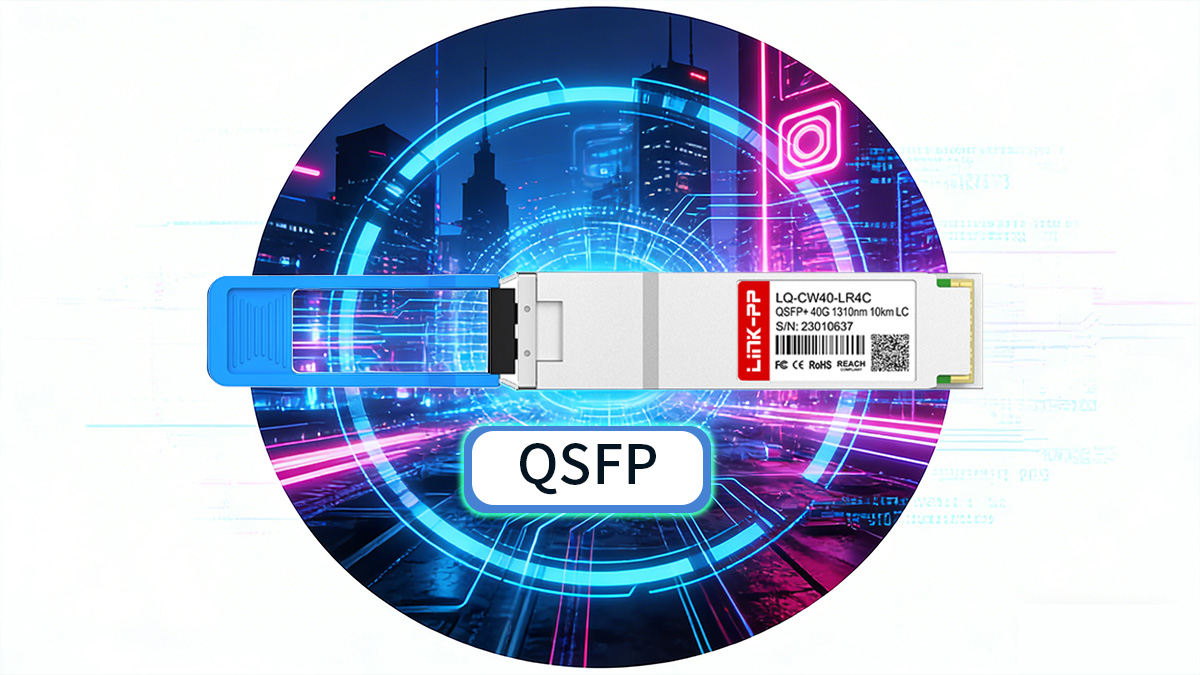
Key Characteristics of QSFP Transceivers
QSFP is defined by its four-lane architecture and higher per-port capacity, prioritizing link throughput over granular scaling.
| Parameter | QSFP Specification |
|---|---|
| Data Rate | 40Gbps |
| Lane Count | 4 lanes |
| Per-Lane Speed | 10Gbps |
| Form Factor | QSFP+ |
| Typical Fiber | Multimode fiber or single-mode fiber |
Because data is transmitted across four parallel lanes, overall link performance depends on lane alignment and signal integrity across all channels. This makes QSFP most effective in structured, point-to-point inter-switch connections.
Typical Deployment Role of QSFP
QSFP is primarily deployed in aggregation and backbone roles, where fewer ports must carry significantly more traffic.
Common deployment scenarios include:
-
Leaf-to-spine links in data center fabrics
-
Switch uplinks requiring predictable, sustained throughput
-
Aggregation connections consolidating multiple access-layer ports
-
Existing 40G Ethernet deployments in data center networks
In these scenarios, QSFP reduces the number of physical interfaces and fiber pairs needed to transport large volumes of traffic between network tiers.
Architectural Implications of Using QSFP
Using QSFP shifts network scaling from port-based expansion to bandwidth aggregation. Instead of adding more interfaces to increase total capacity, designers increase per-port throughput, which simplifies cabling but reduces flexibility at the network edge.
This trade-off explains why QSFP is rarely used for direct server connections and is typically reserved for links where traffic aggregation and stable load patterns are expected.
✅ SFP28 vs QSFP: Core Technical Differences
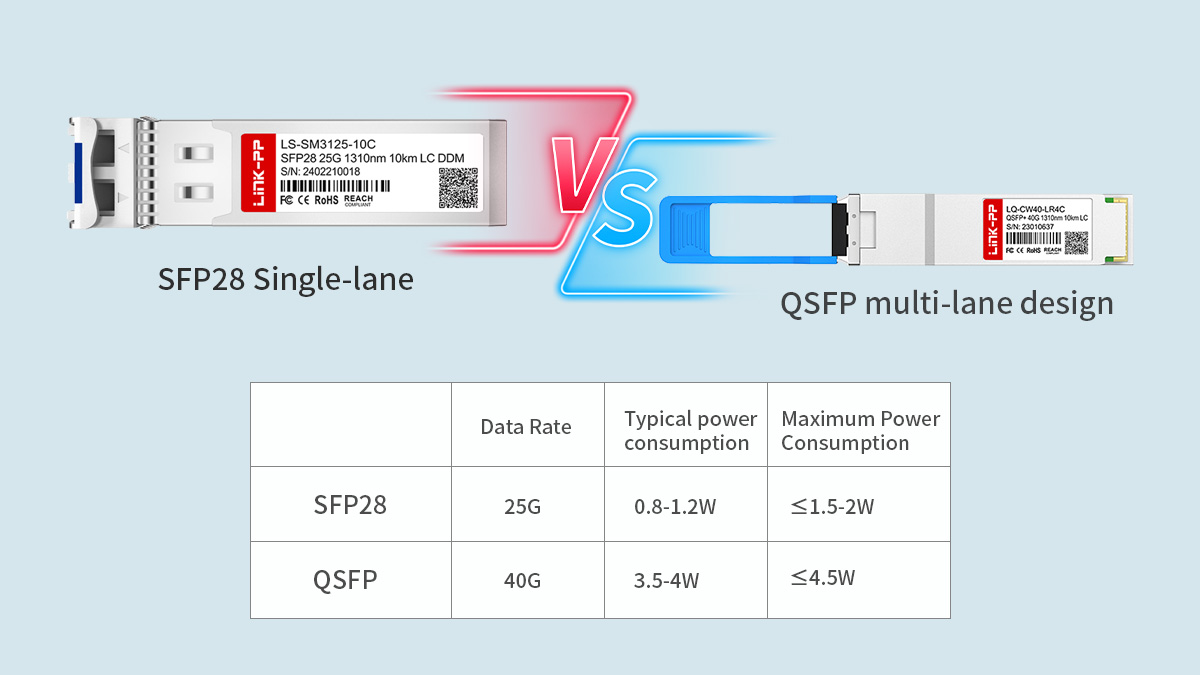
The fundamental technical difference between SFP28 and QSFP is how bandwidth is delivered: SFP28 transceiver provides 25Gbps per independent port using a single lane, while QSFP transceiver delivers higher per-port bandwidth by aggregating multiple lanes into one interface. This distinction determines port density, cabling design, and how capacity scales across the network.
| Attribute | SFP28 | QSFP |
|---|---|---|
| Data Rate per Port | 25Gbps | 40Gbps |
| Lane Architecture | Single lane | 4 lanes |
| Scaling Method | More ports | More bandwidth per port |
| Typical Port Density | High | Lower |
Because SFP28 assigns one lane to one port, each link operates independently and can be added or removed without affecting others. QSFP, by contrast, concentrates multiple lanes into a single port, which increases per-link capacity but reduces the number of available interfaces on a switch.
Bandwidth Scaling and Port Density
SFP28 and QSFP scale network capacity in fundamentally different ways, which directly affects switch design.
-
SFP28 increases total bandwidth by adding more physical ports
-
QSFP increases total bandwidth by increasing throughput per port
-
SFP28 favors granular growth and flexible port usage
-
QSFP favors consolidated links and simplified inter-switch topology
As a result, SFP28 is better suited to environments where traffic grows horizontally across many endpoints, while QSFP aligns with designs where traffic is aggregated upward between network tiers.
Cabling and Fiber Utilization Differences
Lane architecture also influences how fiber resources are consumed.
| Aspect | SFP28 | QSFP |
|---|---|---|
| Fiber Usage Model | One link per port | Multiple lanes per port |
| Cabling Pattern | Highly distributed | More centralized |
| Link Granularity | Fine-grained | Coarse-grained |
With SFP28, each port typically maps to a single fiber link, simplifying troubleshooting and incremental expansion. QSFP concentrates traffic into fewer physical links, which can reduce total fiber count but makes each link more critical to overall network performance.
Impact on Network Design Decisions
Choosing between SFP28 and QSFP is less about raw speed and more about architectural intent. Networks built around SFP28 emphasize port density, incremental growth, and access-layer flexibility. Networks built around QSFP emphasize bandwidth concentration, predictable traffic aggregation, and reduced inter-switch complexity.
This is why SFP28 commonly appears on server-facing and access-layer ports, while QSFP is reserved for uplinks and inter-switch connections—even within the same network fabric.
✅ Performance and Bandwidth Considerations
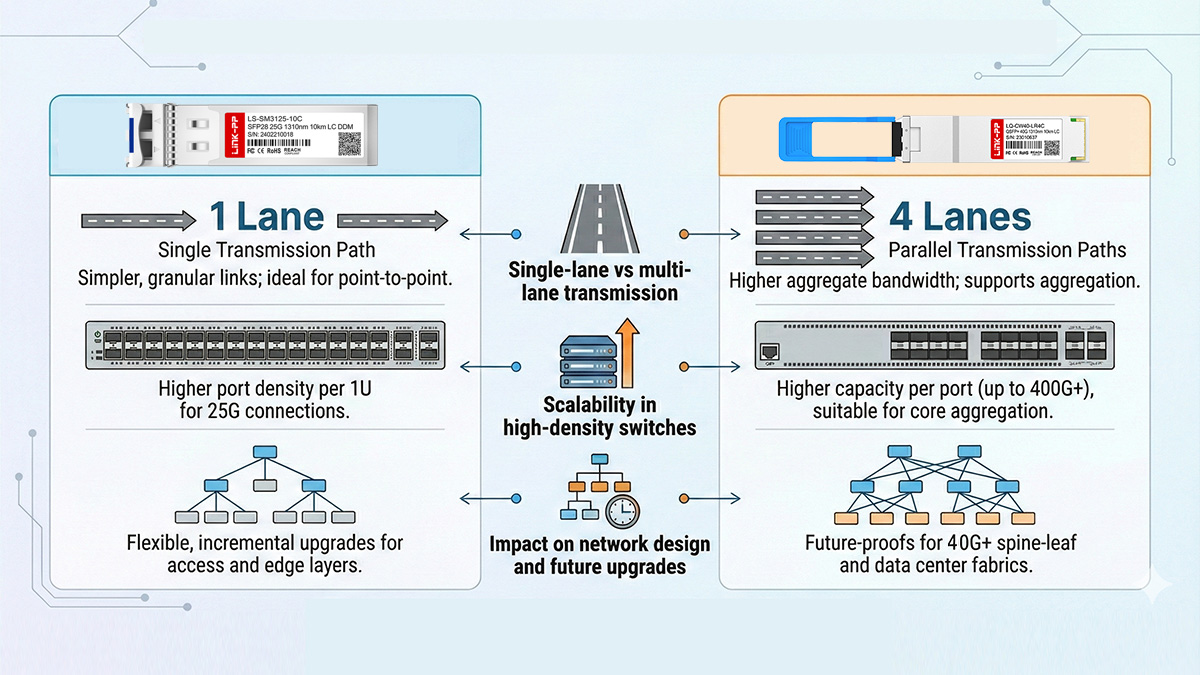
Performance differences between SFP28 and QSFP are driven by how bandwidth is allocated and consumed, rather than by headline throughput alone. SFP28 delivers predictable performance on a per-link basis, while QSFP concentrates bandwidth into fewer, higher-capacity links, which changes how congestion, oversubscription, and failure impact the network.
| Performance Aspect | SFP28 | QSFP |
|---|---|---|
| Bandwidth Allocation | Per-port | Per aggregated link |
| Traffic Distribution | Even across ports | Concentrated per link |
| Oversubscription Impact | Localized | More pronounced |
| Failure Blast Radius | Smaller | Larger |
With SFP28, each 25Gbps link serves a single endpoint or flow group, so congestion or link failure affects only that connection. QSFP, by aggregating multiple lanes into one port, carries a larger share of traffic per link, making performance more sensitive to traffic patterns and link health.
Throughput Efficiency vs Traffic Patterns
Actual throughput efficiency depends heavily on traffic distribution rather than theoretical capacity.
-
SFP28 performs best when traffic is spread across many endpoints
-
QSFP performs best when traffic is aggregated and predictable
-
Bursty or uneven traffic benefits from SFP28’s granular links
-
Steady, high-volume flows favor QSFP’s higher per-link bandwidth
In mixed workloads, this difference often matters more than raw bandwidth numbers, especially in environments with east–west traffic.
Latency and Congestion Behavior
Latency behavior is influenced by how queues form and drain on each link type.
Because SFP28 links operate independently, congestion tends to be isolated and easier to manage with per-port queueing. QSFP links, carrying aggregated traffic, are more likely to experience queue buildup under contention, which can increase latency if traffic engineering is not carefully planned.
This does not make QSFP slower by default, but it does make performance more dependent on traffic shaping and load balance mechanisms.
Performance Implications for Scaling
As networks scale, performance consistency becomes as important as peak bandwidth. SFP28 supports incremental scaling by adding more links with predictable behavior, while QSFP supports vertical scaling by increasing capacity per link.
These different scaling models explain why SFP28 is favored for access-layer expansion and QSFP is favored for inter-switch connectivity, even when both coexist in the same network fabric.
✅ Typical Use Cases for SFP28
SFP28 module is best suited for environments that require high port density, granular scaling, and predictable per-link performance. It is commonly deployed where many independent connections are needed rather than a small number of high-capacity links.
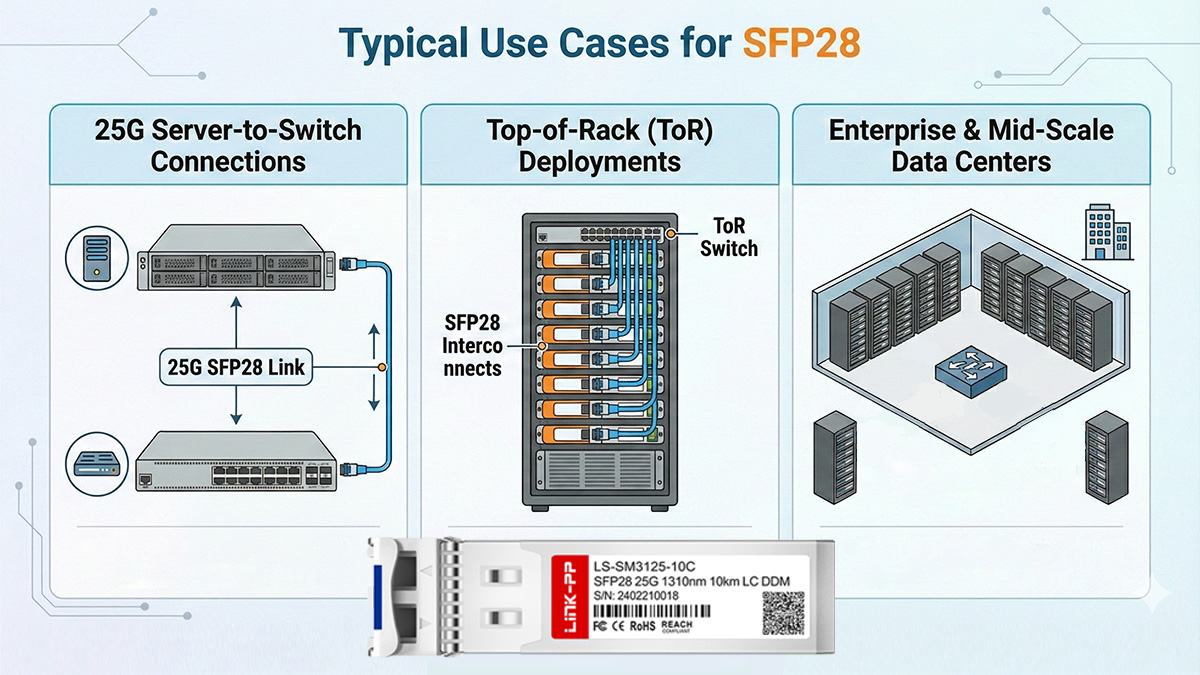
Server-to-Switch Access Connections
SFP28 is a natural fit for server-facing ports in modern data centers.
Typical characteristics of this scenario:
-
Large number of endpoints with similar bandwidth requirements
-
East–west traffic distributed across many servers
-
Need for incremental expansion without re-architecting the network
-
Preference for isolating congestion and failures at the port level
In these environments, SFP28 provides consistent 25Gbps performance per server while maintaining high switch port density.
Top-of-Rack (ToR) Switch Deployments
SFP28 is widely used on Top-of-Rack switches where access-layer flexibility is critical.
| Deployment Factor | Why SFP28 Fits |
|---|---|
| Port Density | Supports many server links per switch |
| Scalability | Easy to add ports incrementally |
| Cabling | Simple one-to-one link mapping |
| Operational Impact | Localized failure domains |
Using SFP28 at the ToR layer allows network operators to scale bandwidth horizontally while keeping cabling and troubleshooting straightforward.
Incremental Upgrades from 10G Environments
SFP28 enables a smooth transition from 10G to higher access-layer bandwidth.
Common upgrade drivers include:
-
Servers equipped with 25G NICs
-
Need to increase throughput without changing switch form factor
-
Reuse of existing cabling infrastructure where possible
Because SFP28 maintains the same physical footprint as SFP+, it allows bandwidth upgrades without sacrificing port count or requiring a full redesign of access-layer hardware.
Environments Prioritizing Fault Isolation
Networks that value fault isolation benefit from SFP28’s per-port architecture.
When each link operates independently:
-
Link failures affect only a single endpoint
-
Congestion remains localized
-
Troubleshooting is faster and more predictable
This makes SFP28 especially attractive in large-scale environments where operational simplicity and predictable behavior are critical.
✅ Typical Use Cases for QSFP
QSFP module is best suited for scenarios where higher bandwidth per port and traffic aggregation are more important than port-level granularity. It is commonly used in parts of the network where traffic converges and predictable throughput is required between switching tiers.
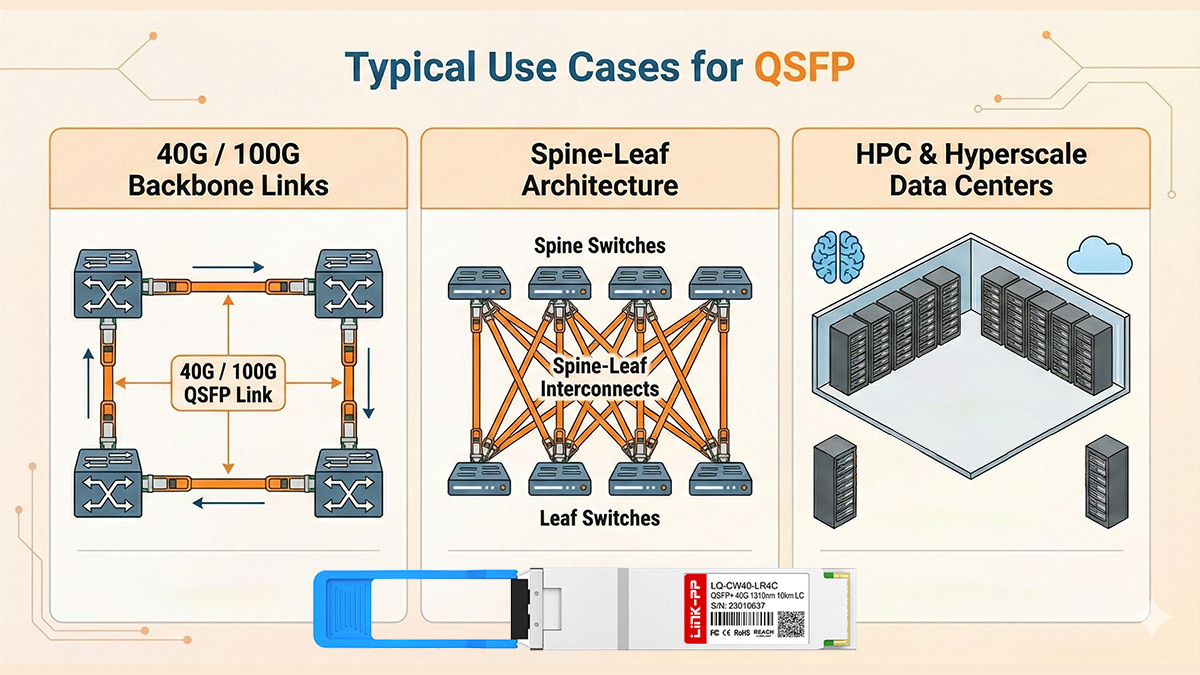
Inter-Switch Uplinks
QSFP is widely deployed for switch-to-switch connections that must carry aggregated traffic.
Typical characteristics of this scenario:
-
Multiple access-layer links converging into fewer uplinks
-
Sustained, high-throughput traffic patterns
-
Lower sensitivity to per-port fault isolation
-
Emphasis on reducing the number of physical links
By consolidating bandwidth into fewer high-capacity links, QSFP simplifies inter-switch connectivity while maintaining sufficient throughput for aggregated traffic.
Leaf–Spine Fabric Connections
QSFP is commonly used for connections between leaf and spine switches in data center fabrics.
| Deployment Factor | Why QSFP Fits |
|---|---|
| Per-Port Bandwidth | Supports higher uplink capacity |
| Link Count | Reduces total number of interconnects |
| Cabling Complexity | Fewer physical links to manage |
| Traffic Pattern | Aggregated and predictable |
In leaf–spine architectures, QSFP helps maintain a clean, scalable fabric by minimizing the number of links required between switching tiers.
Aggregation and Backbone Links
QSFP is well suited for aggregation and backbone roles where traffic from many sources must be transported efficiently.
Common deployment drivers include:
-
Consolidating traffic from multiple racks or access switches
-
Maintaining consistent throughput between network layers
-
Limiting port consumption on core switches
In these roles, the higher per-port capacity of QSFP reduces hardware footprint and simplifies capacity planning.
Environments Favoring Link Consolidation
Networks that prioritize link consolidation over granular scaling often prefer QSFP.
In such environments:
-
Bandwidth growth is handled by increasing per-link capacity
-
Network topology remains stable over time
-
Operational overhead is reduced by managing fewer links
This makes QSFP a practical choice in networks where topology simplicity and predictable traffic aggregation outweigh the need for fine-grained port-level control.
✅ Compatibility and Breakout Scenarios
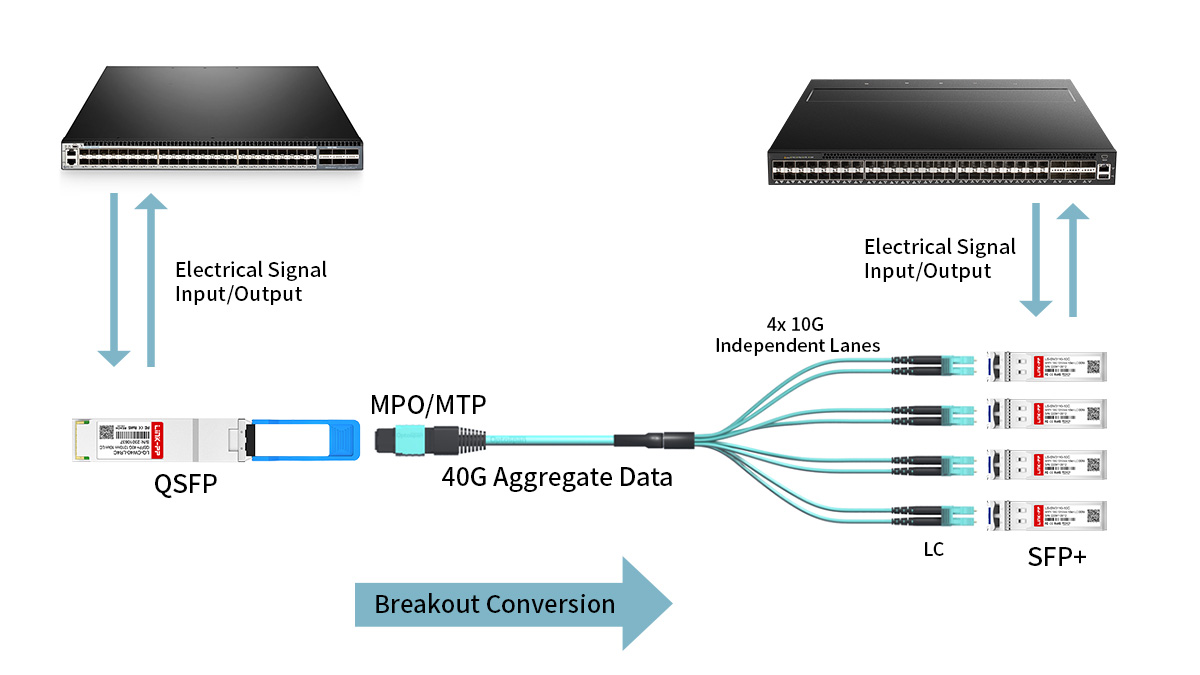
SFP28 and QSFP can coexist in the same network, but they are not directly interchangeable without specific hardware and configuration support. Compatibility depends on switch port capabilities, lane mapping, and whether breakout is supported at both the hardware and software levels.
Direct Compatibility Limitations
SFP28 and QSFP are not natively compatible at the port level.
| Aspect | SFP28 | QSFP |
|---|---|---|
| Physical Port Type | SFP28 | QSFP |
| Electrical Interface | Single lane | Multi-lane |
| Direct Plug-in | Supported only in same form factor | Not supported across types |
An SFP28 module cannot be inserted into a QSFP port, and a QSFP module cannot be used in an SFP28 port. Any interoperability must be achieved through breakout or dedicated uplink design, not direct substitution.
QSFP Breakout to Lower-Speed Links
QSFP supports breakout configurations that split a single high-bandwidth port into multiple lower-speed links, enabling flexible integration with access-layer connections.
| Breakout Mode | Resulting Links | Common Use |
|---|---|---|
| QSFP → 4×10G | Four independent links | Aggregation to access |
| QSFP → Mixed Speeds | Platform-dependent | Transitional designs |
In breakout scenarios, a single QSFP port can replace multiple lower-speed uplinks, reducing port consumption on aggregation switches while maintaining logical separation at the access layer.
Practical Constraints of Breakout Designs
Breakout is not a universal solution and introduces its own constraints.
Key considerations include:
-
Switch ASIC and port group support
-
Firmware and configuration requirements
-
Cabling type and lane mapping consistency
-
Reduced flexibility once lanes are grouped
Breakout works best when planned into the architecture from the beginning rather than added as a workaround later.
Designing for Coexistence
The most common and stable approach is to use SFP28 and QSFP at different layers of the network rather than attempting to mix them at the same port level.
Typical coexistence pattern:
-
SFP28 on server-facing and access-layer ports
-
QSFP on uplinks and inter-switch connections
-
Clear separation of scaling models across layers
This approach avoids compatibility issues while allowing each form factor to operate in the role it was designed for.
When Compatibility Becomes a Design Risk
Compatibility becomes a risk when breakout is used to compensate for poor capacity planning. Overusing breakout can complicate cabling, reduce operational clarity, and make future upgrades harder.
As a rule, breakout should enable architectural intent—not replace it.
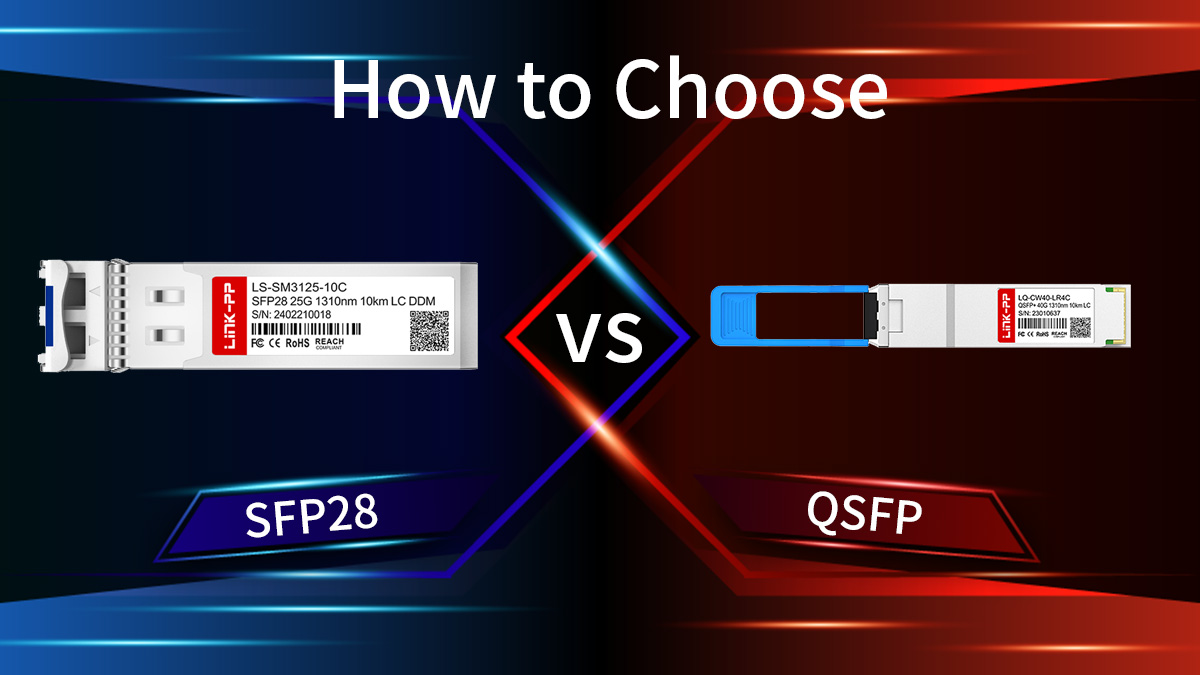
✅ How to Choose Between SFP28 and QSFP
The choice between SFP28 and QSFP should be driven by network architecture and traffic behavior, not by maximum bandwidth alone. The right option depends on where the port sits in the network, how traffic scales, and how much flexibility is required over time.
Choose SFP28 If Your Network Prioritizes Port Density
SFP28 is the better choice when you need many independent links with predictable performance.
Typical indicators include:
-
Large number of server-facing or endpoint connections
-
Preference for incremental, port-by-port scaling
-
Need to isolate congestion and failures at the link level
-
Access-layer or Top-of-Rack deployments
In these scenarios, SFP28 provides greater flexibility and operational simplicity.
Choose QSFP If Your Network Prioritizes Bandwidth per Port
QSFP is better suited for environments where traffic is aggregated and high throughput per link is required.
Typical indicators include:
-
Switch-to-switch or uplink connections
-
Aggregation or backbone roles
-
Stable, predictable traffic patterns
-
Desire to reduce the number of physical links
QSFP simplifies inter-switch connectivity by concentrating bandwidth into fewer ports.
Consider Long-Term Scalability and Upgrade Paths
Selection should account for how the network will evolve, not just current demand.
Key questions to ask:
-
Will capacity growth be horizontal (more endpoints) or vertical (more bandwidth per link)?
-
Is port availability or switch slot count a limiting factor?
-
How disruptive should future upgrades be?
Networks expecting frequent, incremental growth often benefit from SFP28, while networks planning fewer but larger upgrades often align better with QSFP.
Balance Operational Complexity
Operational clarity is often overlooked but critical.
-
SFP28 offers simpler troubleshooting and clearer fault isolation
-
QSFP reduces cabling volume but increases link criticality
-
Overuse of breakout can complicate day-to-day operations
Choosing the form factor that aligns with your team’s operational model can be just as important as raw performance.
Quick Decision Summary
If your network edge needs flexibility, choose SFP28. If your network core needs throughput, choose QSFP.
Most modern networks use both—each in the layer where it delivers the most value.
✅ FAQs About SFP28 vs QSFP
Is SFP28 interchangeable with QSFP?
No. SFP28 and QSFP use different physical form factors and lane architectures, so they cannot be directly swapped or plugged into each other’s ports.
Is QSFP always faster than SFP28?
At the port level, yes—QSFP provides higher total bandwidth per port, while SFP28 provides higher flexibility by distributing bandwidth across more independent ports.
Can SFP28 and QSFP be used in the same network?
Yes. They are commonly deployed together at different network layers, with SFP28 at the access layer and QSFP at aggregation or inter-switch links.
Does using QSFP reduce the number of required ports?
Yes. QSFP concentrates bandwidth into fewer physical ports, which can reduce port consumption on switches, especially for uplinks and backbone connections.
Which is easier to scale over time, SFP28 or QSFP?
SFP28 is easier to scale incrementally by adding ports, while QSFP is better suited for scaling by increasing bandwidth per link in planned upgrades.
✅ Conclusion: SFP28 vs QSFP — Choosing the Right Form Factor
SFP28 and QSFP are designed for different roles within the same network, not as direct replacements for one another. SFP28 excels at providing high port density, granular scaling, and predictable performance at the access layer, while QSFP is better suited for aggregation and inter-switch links where higher bandwidth per port and link consolidation are required.
Understanding this distinction allows network designers to align transceiver selection with traffic patterns, scalability goals, and operational constraints—avoiding overbuilt access layers or congested uplinks. In practice, the most efficient architectures use SFP28 and QSFP together, each where it delivers the greatest technical and operational value.
If you are evaluating SFP28 or QSFP transceivers for a specific deployment, reviewing compatible, standards-compliant module options can help translate design decisions into reliable implementations. You can explore a wide range of SFP28 and QSFP solutions at the LINK-PP Official Store, where specifications, compatibility information, and deployment-focused options are clearly presented to support informed purchasing decisions.