



































A CWDM SFP module is an optical transceiver that uses Coarse Wavelength Division Multiplexing (CWDM) technology to transmit multiple data channels over a single strand of single-mode fiber, helping networks expand capacity without deploying additional fiber.
In practical terms, CWDM SFP modules are widely used when organizations need to increase bandwidth efficiently, control infrastructure costs, and maintain simple optical network architectures—especially in enterprise backbones, campus networks, and metro Ethernet links.
Unlike standard SFP modules that operate on a single fixed wavelength per fiber pair, CWDM SFP modules work as part of a wavelength-multiplexed system. Each module transmits on a specific CWDM wavelength, allowing multiple optical signals to coexist on the same fiber when combined with CWDM MUX/DEMUX devices.
This makes CWDM SFP a strategic middle ground in optical networking:
-
More fiber-efficient than traditional single-wavelength SFP deployments
-
Less complex and more cost-effective than DWDM solutions
-
Well-suited for short- to medium-distance fiber expansion scenarios
In the following sections, we will break down how CWDM SFP modules work, which wavelengths they use, where they are commonly deployed, and how to choose the right CWDM SFP module for real-world network designs.
? What Is a CWDM SFP Module?
A CWDM SFP module is a small form-factor optical transceiver designed to operate at a fixed CWDM wavelength and enable wavelength-division multiplexing over single-mode fiber, allowing multiple optical signals to share the same physical fiber infrastructure.
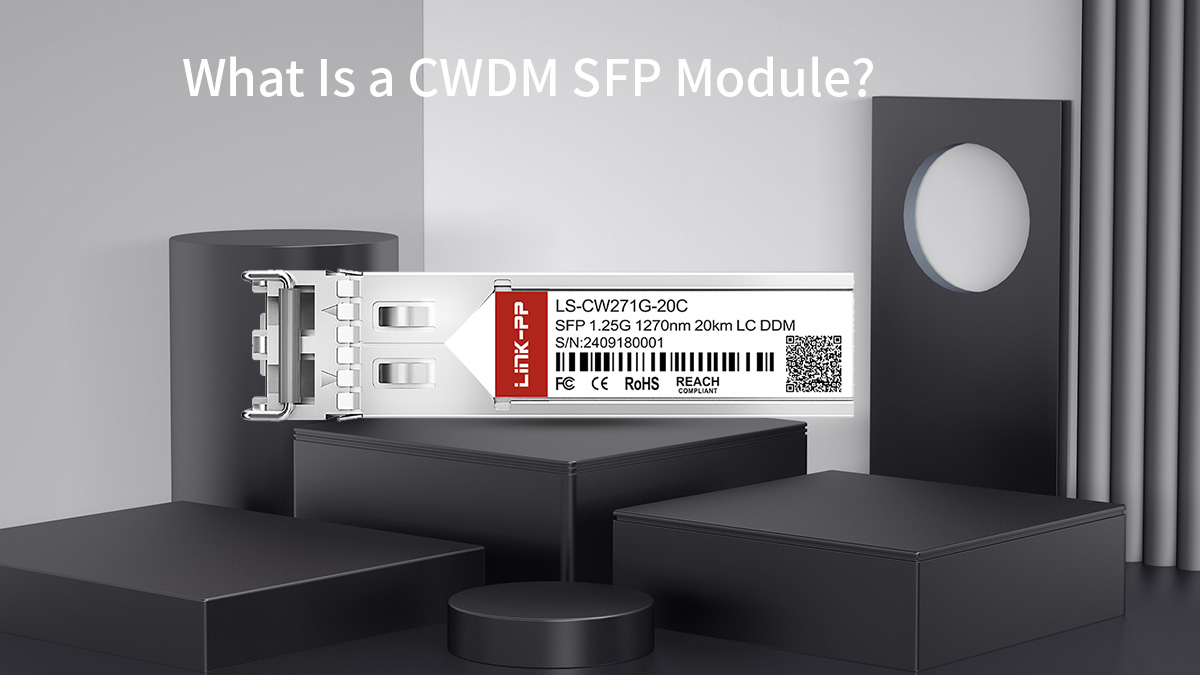
From a technical perspective, CWDM SFP modules follow standard SFP or SFP+ form factors while integrating lasers tuned to CWDM wavelengths defined by the ITU-T grid. Each module transmits and receives data on one specific wavelength, and when paired with CWDM MUX/DEMUX equipment, multiple CWDM SFP modules can run simultaneously over a single fiber pair.
To better understand its role in optical networks, a CWDM SFP module can be viewed as having three core characteristics:
-
Fixed CWDM wavelength operation
Unlike tunable optics, CWDM SFP modules are manufactured for a specific wavelength (such as 1470nm or 1550nm), ensuring stable performance and predictable network planning. -
Compatibility with standard network equipment
CWDM SFP modules are electrically identical to standard SFP modules, making them compatible with common Ethernet switches, routers, and optical transport devices that support SFP/SFP+ interfaces. -
Dependence on passive CWDM infrastructure
The multiplexing and demultiplexing of wavelengths is handled by passive CWDM MUX/DEMUX devices, allowing the transceivers themselves to remain simple and cost-efficient.
In practice, CWDM SFP modules are not standalone bandwidth enhancers. Their real value emerges when they are deployed as part of a CWDM system, where multiple wavelength-specific SFP modules work together to maximize fiber utilization while keeping optical design and maintenance straightforward.
? How Does a CWDM SFP Module Work?
A CWDM SFP module works by transmitting data on a single, fixed optical wavelength and relying on passive CWDM MUX/DEMUX devices to combine and separate multiple wavelengths over the same fiber.
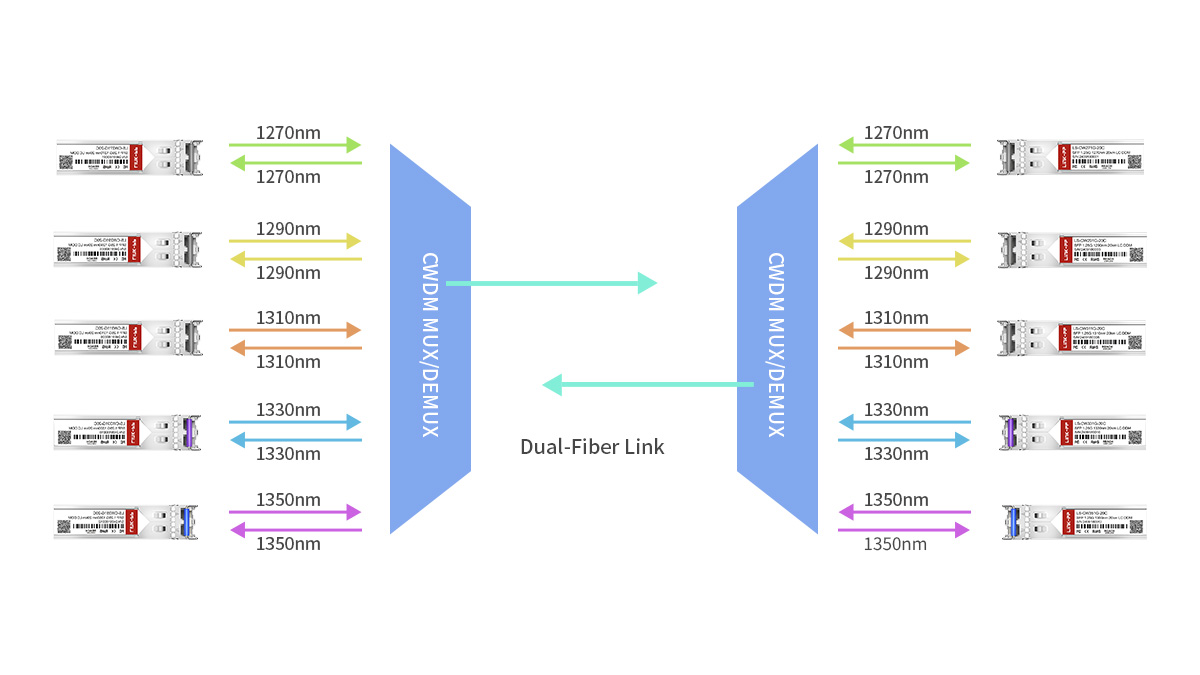
At the module level, each CWDM SFP functions much like a standard SFP transceiver: it converts electrical signals from a switch or router into optical signals, transmits them over fiber, and converts received optical signals back into electrical form. The key difference lies in the wavelength of the laser, which is precisely tuned to a CWDM channel.
At the system level, CWDM transmission follows a three-step workflow:
1. Wavelength-Specific Transmission at the Source
Each CWDM SFP module operates on a predefined CWDM wavelength (for example, 1310nm, 1490nm, or 1550nm). When multiple switches are equipped with CWDM SFP modules—each using a different wavelength—they can all send optical signals simultaneously without interference.
2. Passive Multiplexing onto a Single Fiber
The optical outputs from these CWDM SFP modules are fed into a CWDM MUX (Multiplexer). The MUX combines multiple wavelengths into one composite optical signal, which is then transmitted over a single-mode fiber pair.
3. Demultiplexing and Signal Recovery at the Destination
At the receiving end, a CWDM DEMUX (Demultiplexer) separates the combined signal back into individual wavelengths. Each separated wavelength is then delivered to its corresponding CWDM SFP module, which converts the optical signal back into electrical data for the connected device.
Because CWDM systems use passive optical components, no additional power or active wavelength management is required within the MUX/DEMUX layer. This design keeps CWDM networks simple, reliable, and cost-efficient, especially when compared to more complex DWDM systems.
In summary, a CWDM SFP module does not increase bandwidth on its own. Instead, it acts as a wavelength-specific building block within a CWDM architecture, enabling multiple independent data links to coexist over the same fiber infrastructure.
? CWDM Wavelengths and Channel Spacing Explained
CWDM uses a standardized set of optical wavelengths with wide channel spacing, allowing multiple signals to coexist on a single fiber without complex wavelength control.
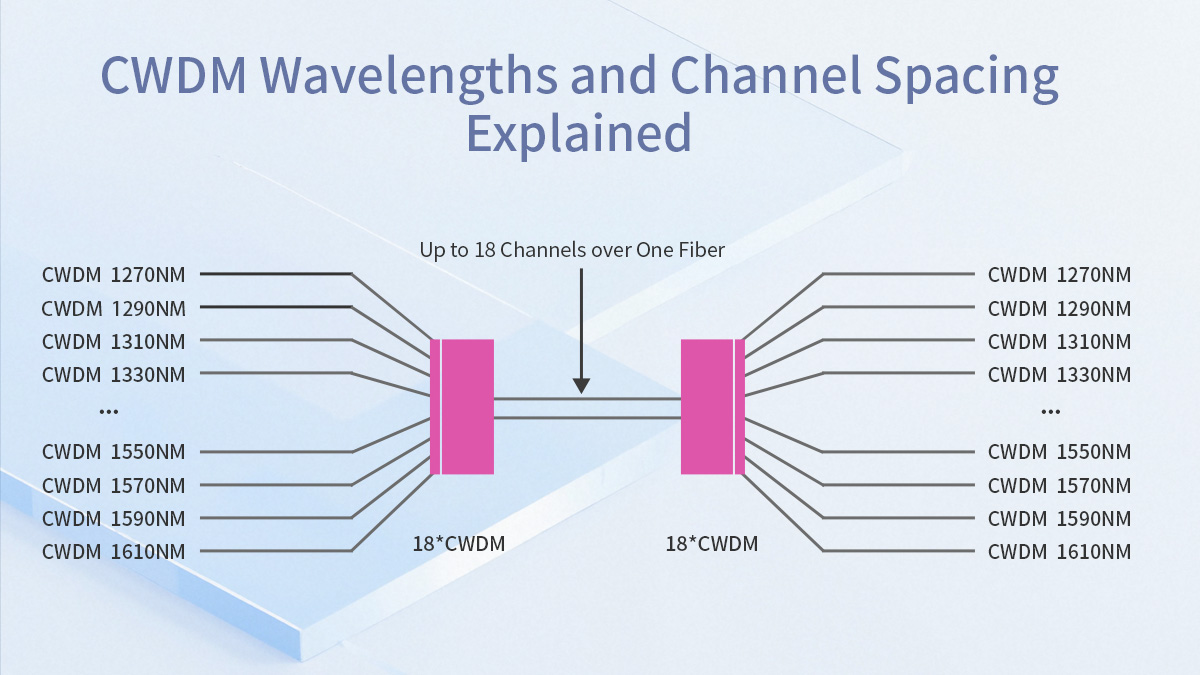
In CWDM systems, each SFP module operates on one fixed wavelength defined by the ITU-T CWDM grid. The wide spacing between wavelengths is what makes CWDM simpler, more tolerant, and more cost-effective than dense wavelength division multiplexing.
Standard CWDM Wavelength Range
CWDM wavelengths typically span from 1270nm to 1610nm, covering the O-band, E-band, S-band, C-band, and L-band of single-mode fiber. These wavelengths are standardized to ensure interoperability across CWDM components.
Common CWDM wavelengths include:
1270nm, 1290nm, 1310nm, 1330nm, 1350nm, 1370nm, 1390nm, 1410nm, 1430nm,
1450nm, 1470nm, 1490nm, 1510nm, 1530nm, 1550nm, 1570nm, 1590nm, 1610nm
Not all deployments use every wavelength; practical CWDM systems typically select a subset of channels based on capacity needs and optical budget.
CWDM Channel Spacing: Why 20nm Matters
CWDM channels are spaced 20nm apart, which is significantly wider than DWDM channel spacing (often 0.8nm or 0.4nm). This wide spacing delivers several practical advantages:
-
Reduced wavelength drift sensitivity
CWDM lasers do not require active temperature control, keeping module cost and power consumption low. -
Simpler optical design
Passive CWDM MUX/DEMUX devices can be used without amplification or wavelength stabilization. -
Higher tolerance to environmental variation
CWDM systems remain stable across a broader temperature range, making them suitable for enterprise and metro environments.
Practical Limits of CWDM Channel Capacity
While the CWDM standard defines up to 18 possible wavelengths, real-world deployments often use 4, 8, or fewer channels. This is due to:
-
Fiber attenuation variations across wavelength bands
-
Optical budget constraints at longer distances
-
Cost and scalability trade-offs compared with DWDM
As a result, CWDM is best positioned as a medium-capacity fiber expansion solution, rather than a maximum-density transport technology.
In summary, CWDM wavelengths and their 20nm channel spacing are the foundation of CWDM’s value proposition: more capacity over existing fiber, achieved through simplicity rather than precision engineering.
? Key Specifications of CWDM SFP Modules
The key specifications of a CWDM SFP module define not only how fast data can be transmitted, but also how far, how reliably, and in what network scenarios the module can be deployed.
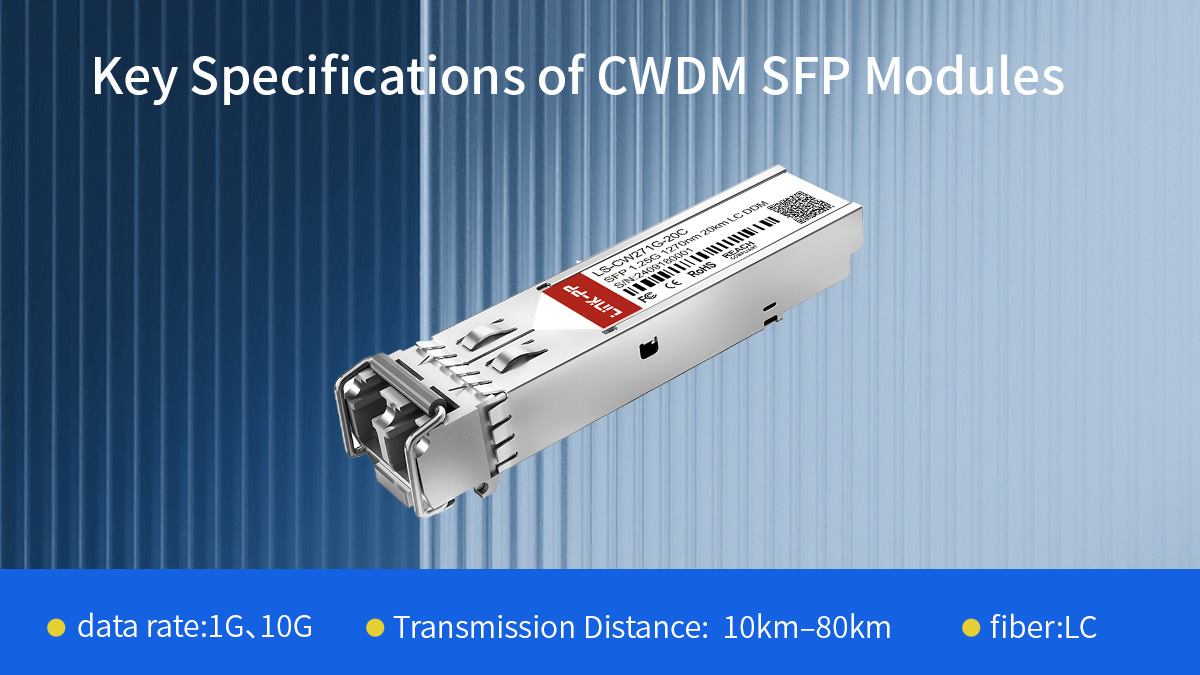
When evaluating CWDM SFP modules, the following parameters are the most critical.
Data Rates Supported
CWDM SFP modules are available in multiple speed variants to match different network layers:
-
1G CWDM SFP – Commonly used in enterprise access and aggregation networks
-
10G CWDM SFP+ – Widely deployed in campus backbones and metro Ethernet links
The data rate determines switch compatibility and directly impacts optical budget requirements, especially over longer distances.
Transmission Distance
Typical CWDM SFP module transmission distances include:
-
10km – Short to medium-range fiber links
-
20km – Common choice for campus and metro deployments
-
40km to 80km – Extended-reach scenarios with stricter optical budgets
Actual achievable distance depends on fiber quality, wavelength selection, and system losses introduced by MUX/DEMUX components.
Optical Wavelength
Each CWDM SFP module operates at one fixed CWDM wavelength, selected from the standardized CWDM grid. The chosen wavelength must match:
-
The channel plan of the CWDM MUX/DEMUX
-
The corresponding CWDM SFP module at the remote end
Mismatched wavelengths will result in link failure, even if all other specifications are correct.
Fiber Type and Connector
CWDM SFP modules are designed for:
-
Single-mode fiber (SMF)
-
Duplex LC connectors (most common form factor)
CWDM is not intended for multimode fiber due to wavelength range and attenuation characteristics.
Optical Power Budget
The optical power budget defines how much total loss a CWDM link can tolerate, including:
-
Fiber attenuation
-
Connector and splice loss
-
Insertion loss from CWDM MUX/DEMUX devices
CWDM links typically require careful budget planning, especially at longer distances or when multiple wavelengths are multiplexed.
Monitoring and Diagnostics
Many CWDM SFP modules support Digital Optical Monitoring (DOM/DDM), enabling real-time visibility into:
-
Transmit and receive optical power
-
Module temperature
-
Supply voltage
This capability is essential for proactive maintenance and troubleshooting in multi-wavelength environments.
In summary, CWDM SFP module specifications must be evaluated as part of a complete CWDM system, not in isolation. Understanding how speed, distance, wavelength, and optical budget interact is key to building a stable and scalable CWDM deployment.
? Common Use Cases for CWDM SFP Modules
CWDM SFP modules are most commonly used when fiber resources are limited, but bandwidth demand continues to grow.
They allow network designers to scale capacity efficiently without the cost and disruption of deploying new fiber.

Below are the most practical and widely deployed CWDM SFP application scenarios.
Enterprise Campus Backbone Networks
In large enterprise or university campuses, fiber links between buildings are often constrained by existing conduit capacity. CWDM SFP modules enable multiple logical links to share the same fiber infrastructure, making them ideal for:
-
Aggregating traffic from multiple access switches
-
Extending backbone links over 10km to 20km distances
-
Supporting gradual network expansion without redesigning the physical layer
CWDM offers a balance between performance and simplicity that suits non-carrier environments.
Metro Ethernet and Aggregation Networks
CWDM SFP modules are widely used in metro Ethernet network, where service providers and enterprises need cost-effective bandwidth scaling over medium distances.
Typical use cases include:
-
Point-to-point and ring topologies
-
Aggregation of multiple customer or site connections
-
Link distances ranging from 20km up to 40km
The passive nature of CWDM MUX/DEMUX systems reduces operational complexity while maintaining reliable multi-wavelength transmission.
Data Center Interconnection (DCI)
For short- to medium-range data center interconnection, CWDM SFP modules provide a practical alternative to dark fiber expansion.
Common scenarios:
-
Interconnecting data centers within the same metropolitan area
-
Reusing existing single-mode fiber for multiple services
-
Avoiding the cost and power consumption of DWDM equipment for distances under 80km
CWDM is often chosen when simplicity and cost predictability are prioritized over maximum channel density.
Telecom and Utility Fiber Networks
In telecom access networks and utility fiber infrastructures, CWDM SFP modules are used to maximize the value of limited fiber assets.
Typical deployments include:
-
Mobile backhaul and fronthaul aggregation
-
Utility monitoring and control networks
-
Long-distance links where fiber availability is restricted but traffic growth is steady
CWDM SFP modules enable incremental capacity upgrades without major architectural changes.
In summary, CWDM SFP modules are best suited for medium-capacity, medium-distance optical networks where fiber efficiency, cost control, and operational simplicity are more important than ultra-high wavelength density.
? CWDM SFP vs Standard SFP Modules
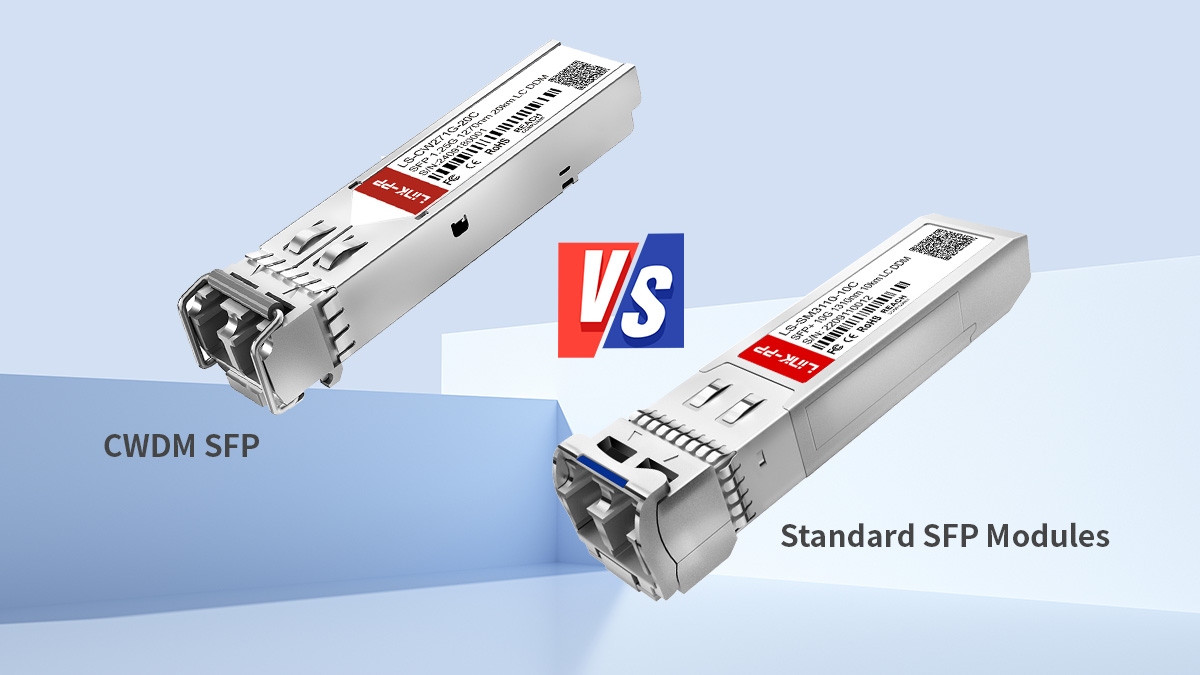
The key difference between CWDM SFP modules and standard SFP modules lies in how efficiently they use fiber.
While both share the same physical form factor, CWDM SFP modules enable multi-wavelength transmission, whereas standard SFP modules are limited to one link per fiber pair.
Functional Comparison
| Feature | CWDM SFP Module | Standard SFP Module |
|---|---|---|
| Transmission method | Multiple wavelengths over shared fiber | Single wavelength per fiber pair |
| Fiber utilization | High (wavelength multiplexing) | Low (one link per fiber) |
| Required components | CWDM MUX/DEMUX | None |
| Typical wavelengths | 1270nm–1610nm (fixed) | 850nm / 1310nm / 1550nm |
| Typical distances | 10km, 20km, 40km, up to 80km | 550m to 40km (depending on type) |
| Network complexity | Moderate (system-based) | Low (point-to-point) |
When CWDM SFP Modules Make More Sense
CWDM SFP modules are the better choice when:
-
Fiber resources are limited or expensive to deploy
-
Multiple logical links must coexist over the same fiber
-
Network distances fall within 10km to 80km
-
Long-term scalability is required without re-cabling
In these scenarios, CWDM provides a clear efficiency advantage over standard SFP modules.
When Standard SFP Modules Are the Better Option
Standard SFP modules are more suitable when:
-
Fiber availability is not a constraint
-
Network topology is simple point-to-point
-
Initial cost must be minimized
-
No future bandwidth expansion is expected
Without the need for MUX/DEMUX equipment, standard SFP deployments remain the simplest solution.
In summary, CWDM SFP modules are not replacements for standard SFP modules, but rather an evolution path for networks that need to grow beyond single-wavelength limitations while preserving existing fiber infrastructure.
? CWDM SFP vs DWDM SFP Modules
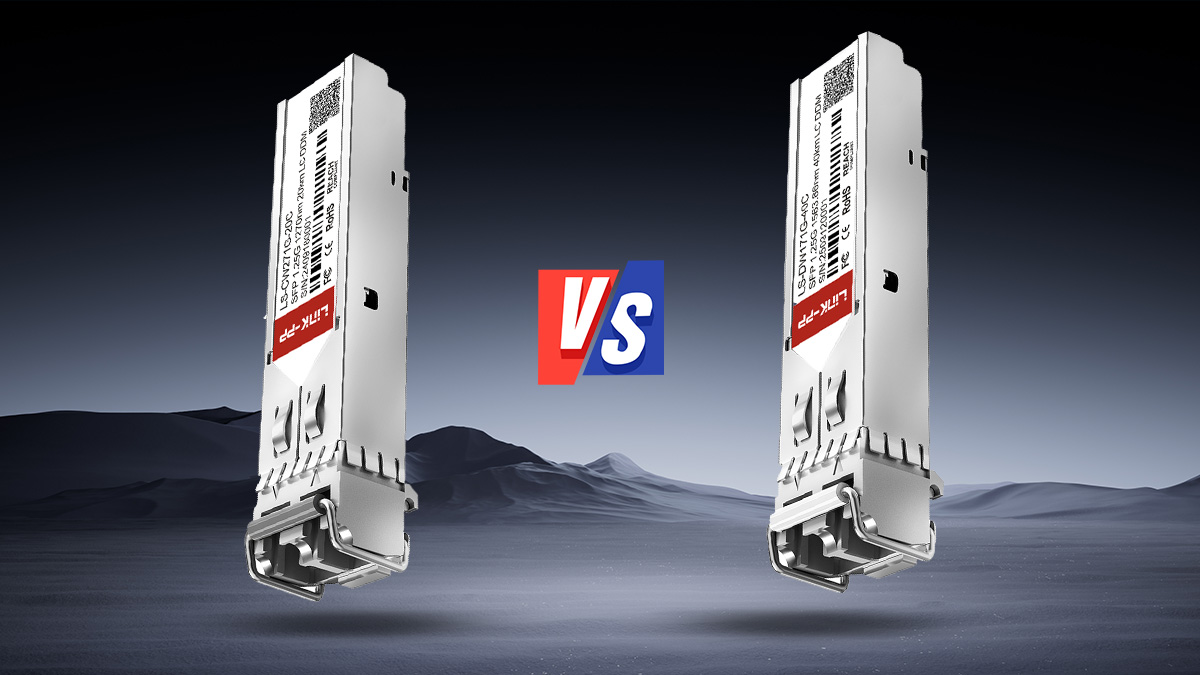
The core difference between CWDM SFP and DWDM SFP module is capacity density versus system complexity.
CWDM prioritizes simplicity and cost efficiency, while DWDM focuses on maximum wavelength density and long-haul performance.
Technical Comparison
| Feature | CWDM SFP Module | DWDM SFP Module |
|---|---|---|
| Channel spacing | 20nm | ~0.8nm or 0.4nm |
| Typical wavelengths | 1270nm–1610nm | C-band (around 1525nm–1565nm) |
| Max channel count (per fiber) | Up to 18 (practical: fewer) | 40, 80, or more |
| Transmission distance | 10km–80km | 80km to several hundred km |
| Laser stability | Uncooled | Temperature-controlled |
| MUX/DEMUX type | Passive | Often active or amplified |
| System complexity | Low to moderate | High |
| Cost per channel | Lower | Higher |
Operational and Deployment Differences
CWDM SFP modules are designed for environments where:
-
Fiber expansion is needed without complex optical engineering
-
Power consumption and cooling must be minimized
-
Networks operate within metro or campus distances
DWDM SFP modules are better suited for:
-
High-capacity backbone and long-haul transport
-
Carrier-grade networks requiring massive scalability
-
Scenarios where precise wavelength control and amplification are acceptable trade-offs
Choosing Between CWDM and DWDM
A practical decision framework:
-
Choose CWDM SFP modules if your priority is cost control, operational simplicity, and distances up to 80km
-
Choose DWDM SFP modules if your network demands ultra-high capacity, long-haul reach, and fine-grained wavelength management
In most enterprise and metro aggregation networks, CWDM SFP modules provide the best balance between scalability and simplicity, while DWDM remains a specialized solution for carrier-scale transport.
? Advantages and Limitations of CWDM SFP Modules
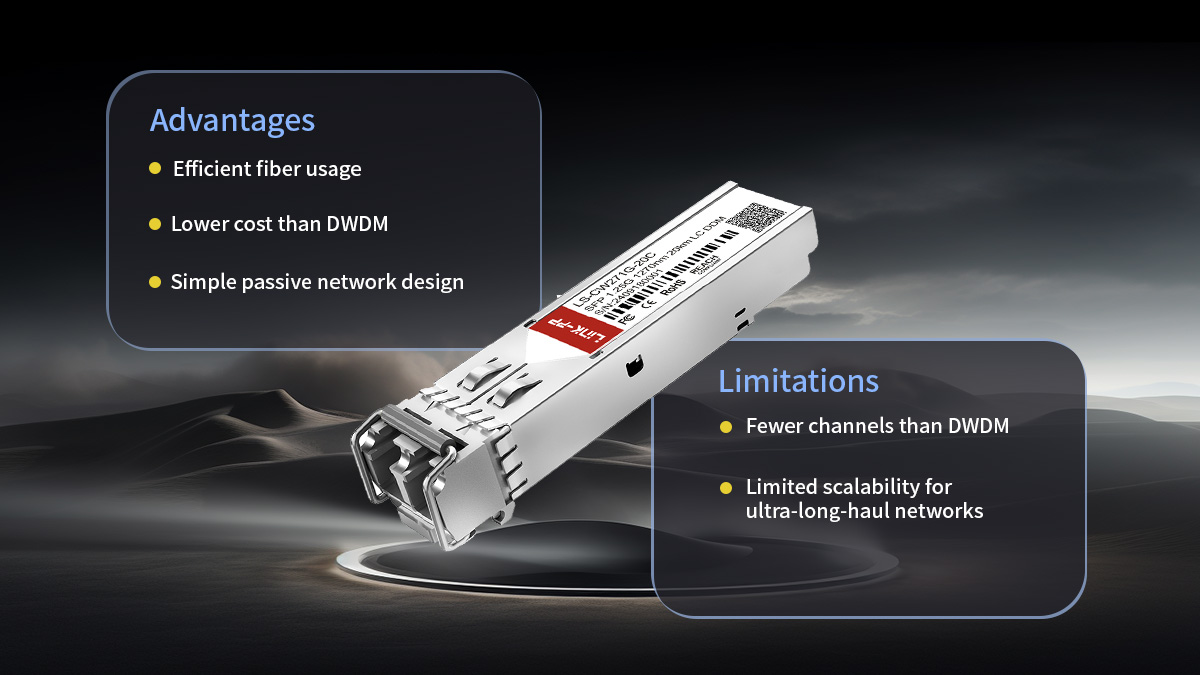
CWDM SFP modules offer an efficient way to expand fiber capacity, but they are not a universal solution for every optical network.
Understanding both their strengths and limitations is essential for making the right deployment decision.
Key Advantages of CWDM SFP Modules
CWDM SFP modules are widely adopted because they deliver practical benefits at the system level:
-
Efficient fiber utilization
Multiple wavelengths can share the same fiber pair, significantly increasing capacity without additional cabling. -
Lower system cost compared to DWDM
Uncooled lasers and passive MUX/DEMUX components keep both capital and operational expenses under control. -
Simple and reliable architecture
Passive optical components reduce failure points and simplify network maintenance. -
Good scalability for medium-capacity networks
CWDM allows incremental expansion by adding wavelengths as bandwidth demand grows. -
Broad equipment compatibility
Standard SFP/SFP+ form factors enable deployment across a wide range of switches and routers.
Practical Limitations to Consider
Despite its advantages, CWDM SFP modules have inherent constraints:
-
Limited wavelength density
With 20nm channel spacing, CWDM supports fewer channels than DWDM, restricting maximum capacity. -
Distance sensitivity at certain wavelengths
Fiber attenuation varies across the CWDM spectrum, which can limit reach on some channels. -
Not ideal for ultra-long-haul networks
CWDM typically supports distances up to 80km without amplification, beyond which DWDM is more suitable. -
System-level planning required
Successful deployment depends on proper wavelength planning, optical budgeting, and MUX/DEMUX selection.
In summary, CWDM SFP modules excel in medium-distance, cost-sensitive fiber expansion scenarios, but they are not designed to replace DWDM in high-density or long-haul optical transport networks.
? How to Choose the Right CWDM SFP Module
Choosing the right CWDM SFP module is primarily about matching wavelength, distance, and system design—rather than simply selecting the highest specification.
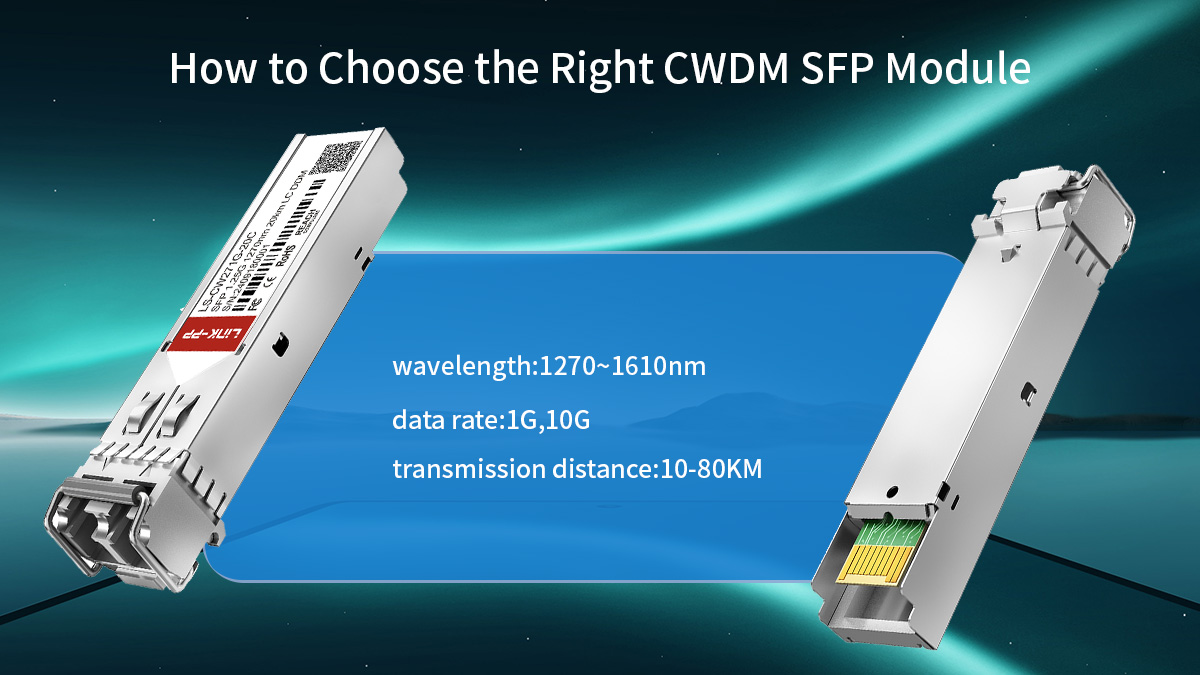
A structured selection process helps avoid interoperability issues and ensures long-term network stability.
1. Confirm the Required Data Rate
Start by identifying the network speed requirement:
-
1G CWDM SFP for access and aggregation layers
-
10G CWDM SFP+ for backbone, metro, or data center interconnection
The data rate must match both the switch port capability and the target application.
2. Select the Correct CWDM Wavelength
Each CWDM SFP module operates on a fixed wavelength, which must align with:
-
The CWDM MUX/DEMUX channel plan
-
The corresponding module at the remote end
Wavelength mismatches are one of the most common causes of CWDM link failures.
3. Evaluate Transmission Distance and Optical Budget
Choose a CWDM SFP module rated for the required link distance:
-
Typical options include 10km, 20km, 40km, and 80km
When calculating the optical budget, consider:
-
Fiber attenuation
-
Connector and splice losses
-
Insertion loss from CWDM MUX/DEMUX devices
Adequate margin is essential for long-term reliability.
4. Verify Equipment Compatibility
Although CWDM SFP modules follow MSA standards, compatibility can still vary. Check:
-
Switch and router vendor compatibility lists
-
Support for DOM/DDM monitoring
-
Firmware or port-specific limitations
Third-party CWDM SFP modules are commonly used, but validation is critical.
5. Plan for Future Scalability
CWDM systems are often expanded gradually. When selecting modules:
-
Reserve unused CWDM channels for future growth
-
Choose MUX/DEMUX devices that support additional wavelengths
-
Maintain consistent wavelength documentation across the network
Good planning reduces future upgrade complexity and cost.
In summary, selecting a CWDM SFP module is a system-level decision. Aligning speed, wavelength, distance, and compatibility ensures the CWDM deployment delivers both immediate performance and long-term flexibility.
? LINK-PP CWDM SFP Module Overview
LINK-PP CWDM SFP modules are designed to provide reliable, standards-compliant wavelength-division connectivity for cost-sensitive and scalable optical networks.
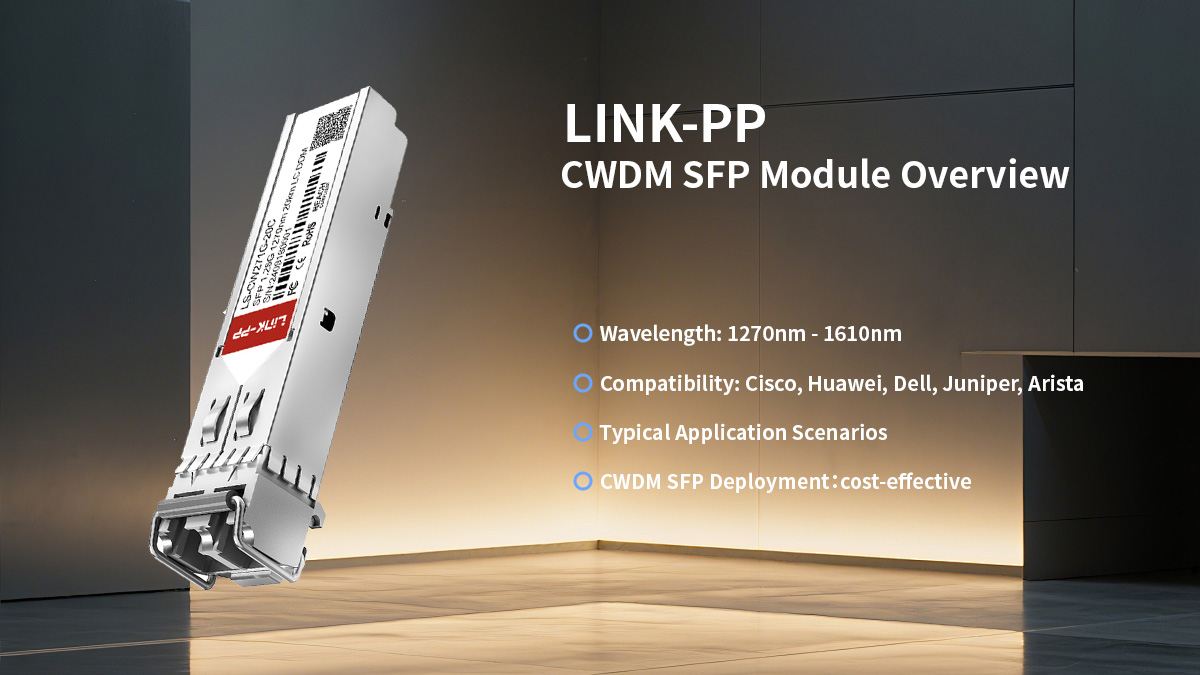
As an experienced optical transceiver manufacturer, LINK-PP focuses on delivering CWDM SFP and SFP+ modules that align with real-world deployment requirements—balancing performance, compatibility, and long-term stability.
Product Positioning and Portfolio Coverage
LINK-PP CWDM SFP modules are positioned for enterprise, campus, metro, and data center interconnection environments where CWDM is used to extend fiber capacity efficiently.
Typical portfolio coverage includes:
-
1G CWDM SFP modules for access and aggregation layers
-
10G CWDM SFP+ modules for backbone and metro Ethernet links
-
Fixed CWDM wavelengths across the 1270nm–1610nm range
-
Transmission distances such as 10km, 20km, 40km, and up to 80km
This range allows network designers to select modules that precisely match system-level requirements.
Technical Characteristics and Compatibility
LINK-PP CWDM SFP modules are built around widely adopted industry standards:
-
MSA-compliant SFP / SFP+ form factors
-
Designed for single-mode fiber with duplex LC connectors
-
Support for DOM/DDM to enable real-time optical monitoring
-
Hot-pluggable design for simplified installation and maintenance
These characteristics help ensure broad interoperability with mainstream switches, routers, and CWDM MUX/DEMUX systems.
Deployment Value in CWDM Systems
In practical CWDM deployments, LINK-PP CWDM SFP modules are typically used to:
-
Expand bandwidth over existing fiber without re-cabling
-
Maintain predictable optical performance across multiple wavelengths
-
Support phased network growth by adding channels as demand increases
By focusing on consistent optical behavior and system compatibility, LINK-PP modules fit naturally into CWDM architectures that prioritize operational simplicity and cost control.
In summary, LINK-PP CWDM SFP modules serve as reliable wavelength-specific building blocks within CWDM networks, offering a balanced option for organizations seeking scalable fiber expansion without the complexity of DWDM solutions.
? FAQs About CWDM SFP Modules
What does CWDM mean in an SFP module?
CWDM stands for Coarse Wavelength Division Multiplexing. It allows multiple fixed-wavelength SFP modules to transmit data over the same fiber using wide (20nm) wavelength spacing.
Do CWDM SFP modules require special switches?
No. CWDM SFP modules use standard SFP/SFP+ electrical interfaces and work with common switches and routers that support SFP ports.
Can CWDM SFP modules work without MUX/DEMUX devices?
It depends. A single CWDM SFP link can work point-to-point, but multiplexing multiple wavelengths on one fiber requires CWDM MUX/DEMUX devices.
Are CWDM SFP modules hot-swappable?
Yes. CWDM SFP modules are hot-pluggable, allowing installation or replacement without powering down network equipment.
How many CWDM channels can one fiber support?
Up to 18 channels in theory. In practice, most CWDM deployments use fewer channels due to optical budget and application requirements.
Is CWDM suitable for long-distance transmission?
It depends on the distance and capacity needs. CWDM typically supports links from 10km up to 80km, while longer or higher-density networks usually require DWDM.
? Summary: Is a CWDM SFP Module Right for Your Network?
A CWDM SFP module is the right choice when you need to increase fiber capacity efficiently over 10km–80km links without adding new fiber or deploying complex DWDM systems.
Key Takeaways
-
CWDM SFP modules use fixed wavelengths (1270nm–1610nm) to enable multiple data channels over a single fiber pair
-
20nm channel spacing allows uncooled lasers and passive MUX/DEMUX, reducing system cost and complexity
-
Typical transmission distances range from 10km to 80km, making CWDM ideal for campus and metro networks
-
Best suited for medium-capacity expansion, where simplicity and scalability matter more than maximum density
When to Choose a CWDM SFP Module
Choose CWDM SFP modules if:
-
Fiber resources are limited or expensive to deploy
-
Your network operates within 10km–80km distances
-
You want a scalable solution without active optical components
-
Operational simplicity and predictable costs are priorities
When CWDM May Not Be the Best Option
CWDM may not be ideal if:
-
Ultra-high wavelength density is required
-
Transmission distances exceed 80km
-
Your network demands fine-grained wavelength tuning or amplification
-
Carrier-grade long-haul transport is the primary use case
Final Recommendation
For enterprise backbones, campus networks, metro Ethernet, and cost-sensitive data center interconnections, CWDM SFP modules provide a practical balance between performance, scalability, and simplicity.
When implemented with a well-planned wavelength strategy and compatible components—such as CWDM MUX/DEMUX and reliable CWDM SFP modules from LINK-PP Official Store—CWDM becomes a long-term fiber expansion solution rather than a temporary workaround.







