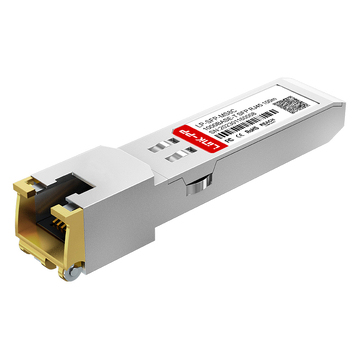
For short-reach 10G Ethernet connections, 10G SFP+ SR is one of the most cost-effective and widely adopted transceiver types. It provides reliable 10Gbps performance over multimode fiber at a lower unit cost than long-reach optics, which is why it is commonly used in data centers, enterprise access networks, and high-density switch deployments.
In real purchasing scenarios, most buyers focus on three factors: price, compatibility, and distance limits. Although 10G SFP+ SR is a mature standard, market prices can vary significantly depending on the supplier, coding method, and testing standards. At the same time, incorrect assumptions about fiber type or switch compatibility often lead to unnecessary upgrades or replacement costs.
This guide focuses on the practical buying considerations of 10G SFP+ SR transceivers. It explains what influences pricing, which specifications matter in real deployments, and how to determine whether SR optics are the right choice compared to other 10G transceiver options.
By the end of this guide, you will have a clear understanding of:
-
What drives price differences between 10G SFP+ SR modules
-
Which technical parameters affect deployment and compatibility
-
How to select the right 10G SFP+ SR for your network and budget
↪️ What Is a 10G SFP+ SR Transceiver?
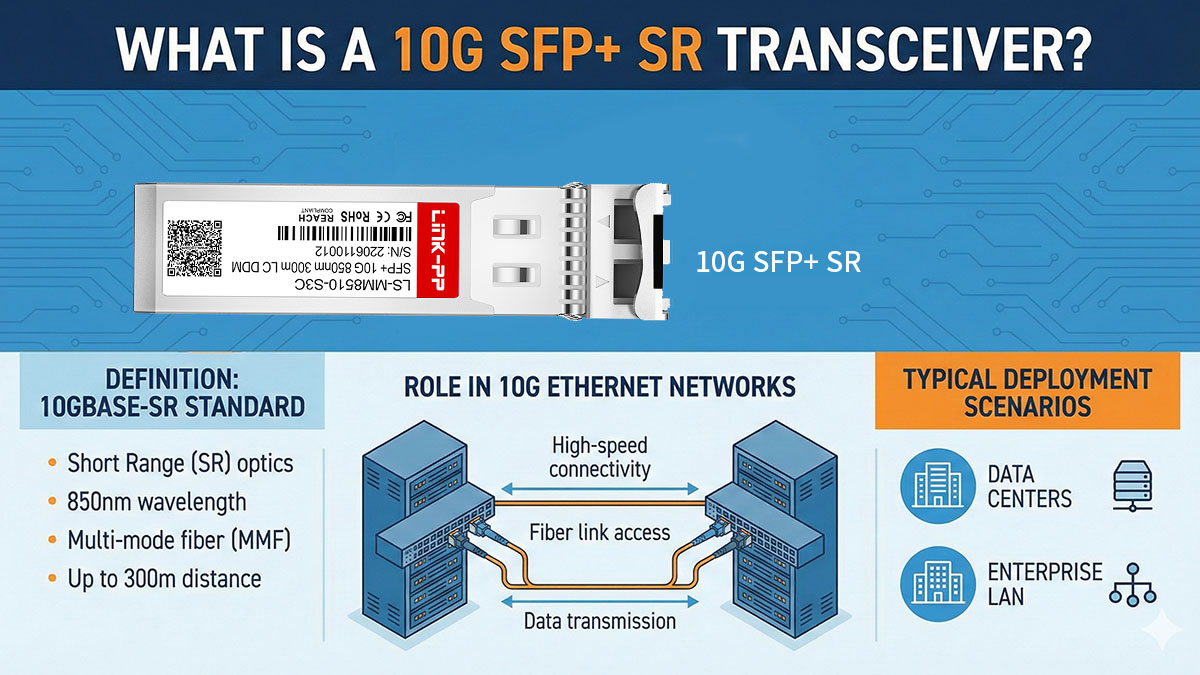
A 10G SFP+ SR transceiver is a short-reach optical module designed for 10GbE links over multimode fiber, optimized for high-density and cost-sensitive deployments. It follows the 10GBASE-SR standard and is widely used where link distances are limited but port density and budget efficiency matter most.
At a technical level, 10G SFP+ SR modules operate at 850nm wavelength and support 10.3125Gbps line rate, making them suitable for server-to-switch and switch-to-switch connections within the same room or building. Compared with long-reach optics, SR modules trade distance for lower optical power requirements and significantly lower unit cost.
Core Characteristics of 10G SFP+ SR
The defining features of 10G SFP+ SR can be summarized as follows:
-
Designed for multimode fiber (MMF) only
-
Optimized for short-reach transmission rather than campus or metro links
-
Low power consumption, suitable for high-port-density switches
-
Hot-pluggable SFP+ form factor, supporting flexible network expansion
In practical procurement, the most important question is not what SR stands for, but how far it can reliably transmit and under what fiber conditions.
Typical transmission capability of 10G SFP+ SR modules:
| Fiber Type | Max Distance | Deployment Scope |
|---|---|---|
| OM3 MMF | up to 300m | Data center rows |
| OM4 MMF | up to 400m | High-density switching |
| OM2 MMF | up to 82m | Legacy environments |
These distance limits explain why 10G SFP+ SR is commonly selected for in-rack, row-to-row, or floor-level connections, but rarely used for cross-campus or building-to-building links.
How 10G SFP+ SR Differs From Other 10G Optics
From a buyer’s perspective, 10G SFP+ SR is best understood by what it is not. It is not designed for single-mode fiber, and it is not intended to replace long-reach modules such as LR or ER.
Instead, SR optics fill a specific role: providing reliable 10G connectivity at the lowest possible optical cost when distance requirements are limited. This positioning is what makes 10G SFP+ SR a standard choice in modern data centers, even as higher-speed optics become available.
In the following sections, we will examine pricing factors, compatibility considerations, and buying criteria, so you can determine whether 10G SFP+ SR is the right option for your network design and budget.
↪️ Key Specifications of 10G SFP+ SR
The key specifications of a 10G SFP+ SR transceiver directly determine its compatibility, transmission limits, and total deployment cost. For procurement and planning, these parameters matter far more than branding or packaging, because they define where and how the module can be used.
Core Technical Parameters
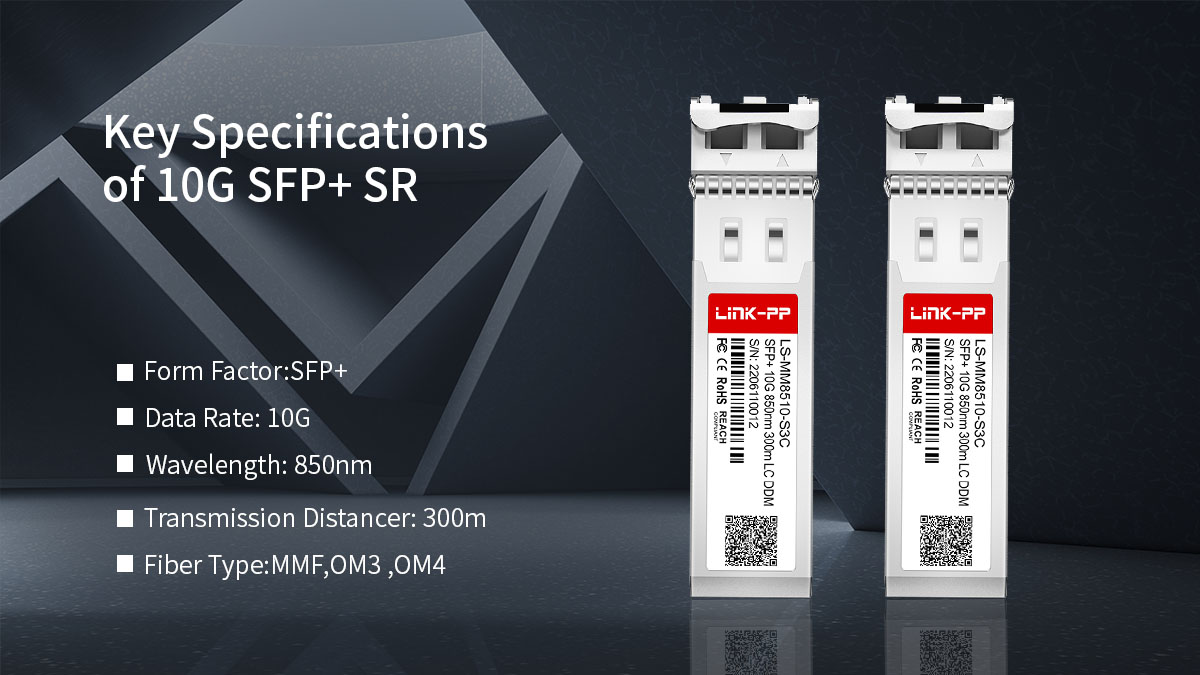
At a minimum, a standard-compliant 10G SFP+ SR module should meet the following baseline specifications:
| Parameter | Typical Value | Practical Impact |
|---|---|---|
| Data Rate | 10.3125Gbps | Supports 10GbE links |
| Wavelength | 850nm | MMF-only transmission |
| Fiber Type | OM3 / OM4 | Determines max distance |
| Max Distance | 300m–400m | Short-reach deployment |
These values define the usable boundary of 10G SFP+ SR. If your link exceeds these limits, a different optical type—not a different vendor—will be required.
Fiber Type and Distance Limits
Fiber grade is the primary factor that determines how far a 10G SFP+ SR module can transmit. Higher-grade multimode fiber allows longer distances without increasing optical cost.
| Fiber Type | Max Distance | Typical Use Case |
|---|---|---|
| OM3 | up to 300m | Standard data centers |
| OM4 | up to 400m | High-density switching |
| OM2 | up to 82m | Legacy infrastructure |
For buyers, this means that upgrading fiber from OM3 to OM4 may be more cost-effective than switching to long-reach optics when distances are close to the limit.
Optical Interface and Connector Type
10G SFP+ SR transceivers use LC duplex connectors and support hot-pluggable SFP+ interfaces, allowing modules to be installed or replaced without powering down network equipment.
From a deployment perspective:
-
LC connectors simplify high-density patching
-
SFP+ form factor ensures broad switch compatibility
-
Hot-pluggability reduces maintenance downtime
These characteristics are standard across compliant SR modules, so they rarely affect price differences unless special mechanical requirements are involved.
Power Consumption and Thermal Characteristics
Low power consumption is one of the reasons 10G SFP+ SR remains suitable for high-port-density environments. Typical power usage is lower than long-reach 10G optics, which helps reduce overall switch heat output.
| Specification | Typical Range | Deployment Impact |
|---|---|---|
| Power Consumption | ≤1W | Supports dense line cards |
| Operating Temp | 0–70°C | Standard commercial use |
For most indoor deployments, standard temperature SR modules are sufficient. Extended temperature versions exist but usually come at a higher cost and are only justified in industrial or non-conditioned environments.
Why These Specifications Matter for Buyers
Each specification above directly influences where the module can be used, how much it costs to deploy, and whether future upgrades will be required. In procurement decisions, mismatching specifications—especially fiber type and distance—often leads to unnecessary spending or early replacement.
In the next section, we will look at 10G SFP+ SR pricing, breaking down what actually drives cost differences between vendors and how to evaluate value beyond the list price.
↪️ 10G SFP+ SR Price Overview
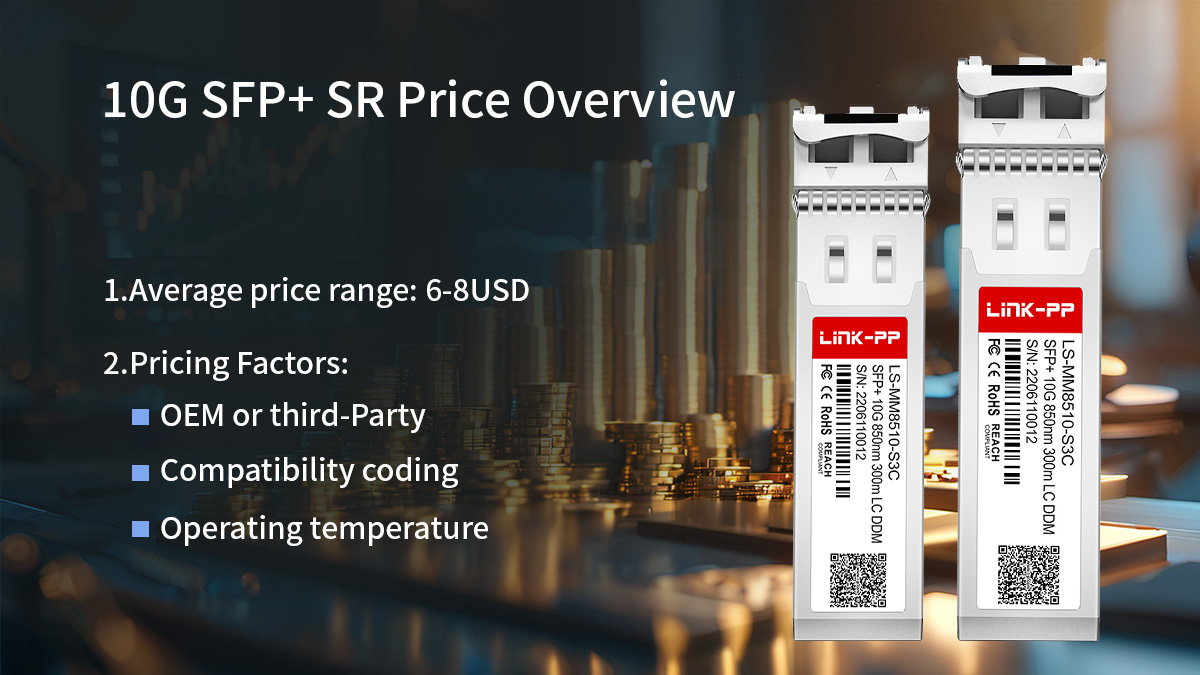
10G SFP+ SR is one of the lowest-cost optical options for 10GbE deployments, but actual pricing varies widely depending on sourcing and specifications. Understanding what drives these price differences is essential for making cost-effective purchasing decisions, especially in large-volume or multi-site deployments.
Typical Market Price Range
In the current market, 10G SFP+ SR transceivers generally fall into the following price tiers:
| Supplier Type | Unit Price Range | Typical Buyer Profile |
|---|---|---|
| OEM branded | High | Vendor-locked networks |
| Third-party compatible | Medium | Enterprise & integrators |
| Generic bulk supply | Low | Cost-driven projects |
The price gap between OEM and compatible modules can be substantial, even though the underlying optical specifications are often identical. For buyers managing hundreds of ports, this difference directly impacts total network cost.
Key Factors That Influence 10G SFP+ SR Pricing
Price differences are rarely random—they are usually tied to specific technical or commercial factors. The most common ones include:
-
Compatibility coding
Modules pre-coded for specific switch brands often cost more than open or MSA-based versions. -
Testing and quality control
Each additional testing step—such as switch-level interoperability testing or burn-in—adds to the unit cost. -
Operating temperature range
Extended temperature versions are priced higher than standard 0–70°C modules. -
Warranty and support terms
Longer warranties and replacement guarantees are typically reflected in the price.
OEM vs Third-Party Cost Comparison
From a cost-performance standpoint, third-party compatible 10G SFP+ SR modules often deliver the best value. They meet the same 10GBASE-SR specifications while avoiding vendor markups.
| Aspect | OEM Module | Compatible Module |
|---|---|---|
| Unit Cost | High | Lower |
| Spec Compliance | Standard-based | Standard-based |
| Vendor Lock-in | Yes | No |
| Bulk Discount Flexibility | Limited | Higher |
For most enterprise and data center environments, compatible modules provide a lower total cost of ownership without sacrificing performance, provided they are properly tested and coded.
When Higher-Priced SR Modules Make Sense
Higher-priced 10G SFP+ SR modules may still be justified in certain scenarios:
-
Networks under strict vendor support contracts
-
Environments requiring certified part numbers
-
Projects where support compliance outweighs cost
Outside these cases, paying a premium does not necessarily translate into better optical performance.
Pricing Takeaway for Buyers
The lowest-priced 10G SFP+ SR is not always the best choice—but the highest-priced option rarely is. Buyers should evaluate price in context with compatibility, testing standards, and deployment scale to avoid unnecessary spending.
In the next section, we will examine compatibility considerations, including how to ensure a 10G SFP+ SR module works reliably with your existing switches and network equipment.
↪️ OEM vs Third-Party 10G SFP+ SR Modules
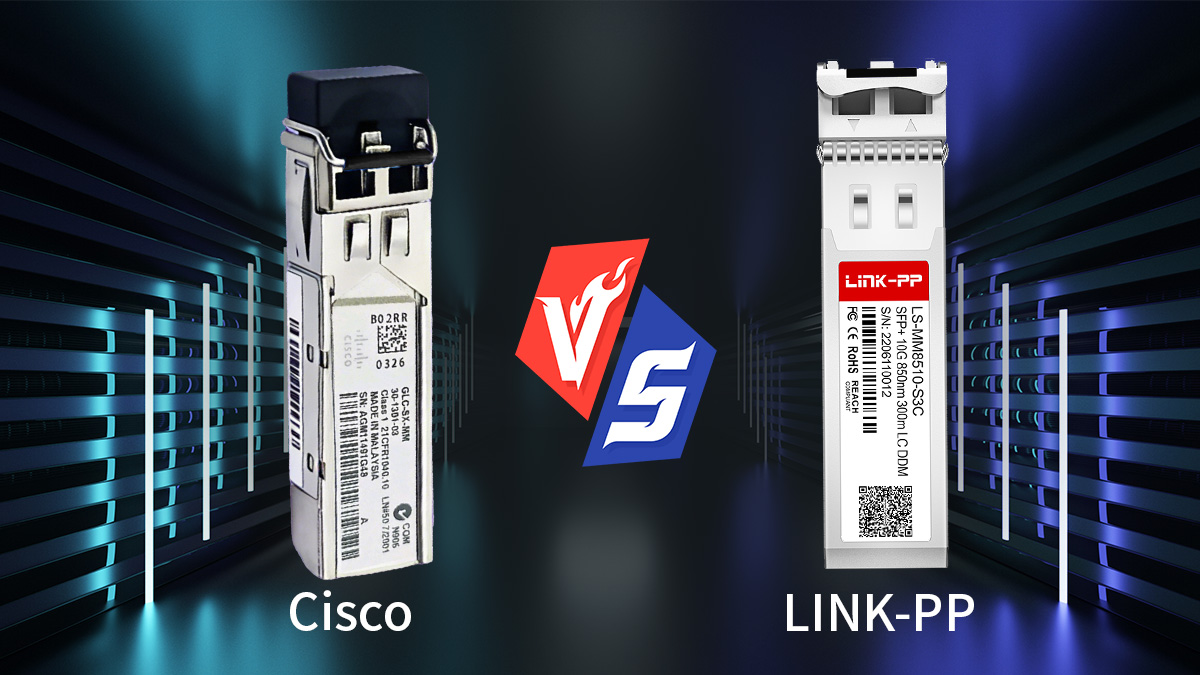
For most buyers, the choice between OEM and third-party 10G SFP+ SR modules is a cost–risk trade-off rather than a technical one. Both options are based on the same 10GBASE-SR standard, but they differ significantly in pricing, sourcing flexibility, and long-term procurement strategy.
Technical Equivalence vs Commercial Differences
From a specification standpoint, OEM and third-party 10G SFP+ SR modules share the same core parameters: 10.3125Gbps data rate, 850nm wavelength, and multimode fiber support. In normal operating conditions, performance differences are rarely caused by the optical design itself.
The real distinction lies in commercial positioning and ecosystem control, not transmission capability.
| Aspect | OEM Modules | Third-Party Modules |
|---|---|---|
| Standards Compliance | 10GBASE-SR | 10GBASE-SR |
| Optical Performance | Equivalent | Equivalent |
| Pricing Model | Vendor premium | Market-based |
| Procurement Flexibility | Restricted | Flexible |
Compatibility and Vendor Lock-In
OEM modules are typically locked to specific switch brands, which can limit sourcing options and inflate replacement costs. Third-party modules, when properly coded, are designed to work across multiple platforms.
| Factor | OEM | Third-Party |
|---|---|---|
| Switch Vendor Binding | Yes | Optional |
| Multi-Vendor Networks | Limited | Supported |
| Replacement Lead Time | Longer | Shorter |
For networks with mixed switch environments or frequent expansion, third-party optics offer a clear operational advantage.
Warranty, Support, and Risk Considerations
One of the main reasons buyers choose OEM modules is perceived risk reduction. OEMs often bundle optics with broader support contracts, which may be mandatory in certain enterprise or regulated environments.
However, reputable third-party suppliers typically provide:
-
Multi-year warranties
-
Advance replacement options
-
Compatibility guarantees by switch model
In practice, failure rates for compliant 10G SFP+ SR modules are low, making the risk difference smaller than many buyers expect.
When OEM Modules Are Justified
OEM 10G SFP+ SR modules may be the right choice when:
-
Vendor support contracts explicitly require OEM optics
-
Compliance or audit policies mandate branded components
-
The deployment scale is small and cost impact is limited
Outside these scenarios, OEM pricing rarely delivers proportional technical benefits.
Buyer Takeaway
Third-party 10G SFP+ SR modules generally provide better cost efficiency and sourcing flexibility without compromising performance. For most data center and enterprise deployments, they represent the more practical choice—especially at scale.
Next, we will look at compatibility considerations, focusing on how to ensure a 10G SFP+ SR module works reliably with specific switch vendors and platforms.
↪️ Compatibility Considerations When Buying 10G SFP+ SR
Compatibility is the most common risk point when purchasing 10G SFP+ SR modules, and it has a greater impact on deployment success than price differences. Most failures attributed to “bad optics” are actually caused by mismatched coding, unsupported firmware, or incorrect assumptions about fiber infrastructure.
Switch Vendor Compatibility
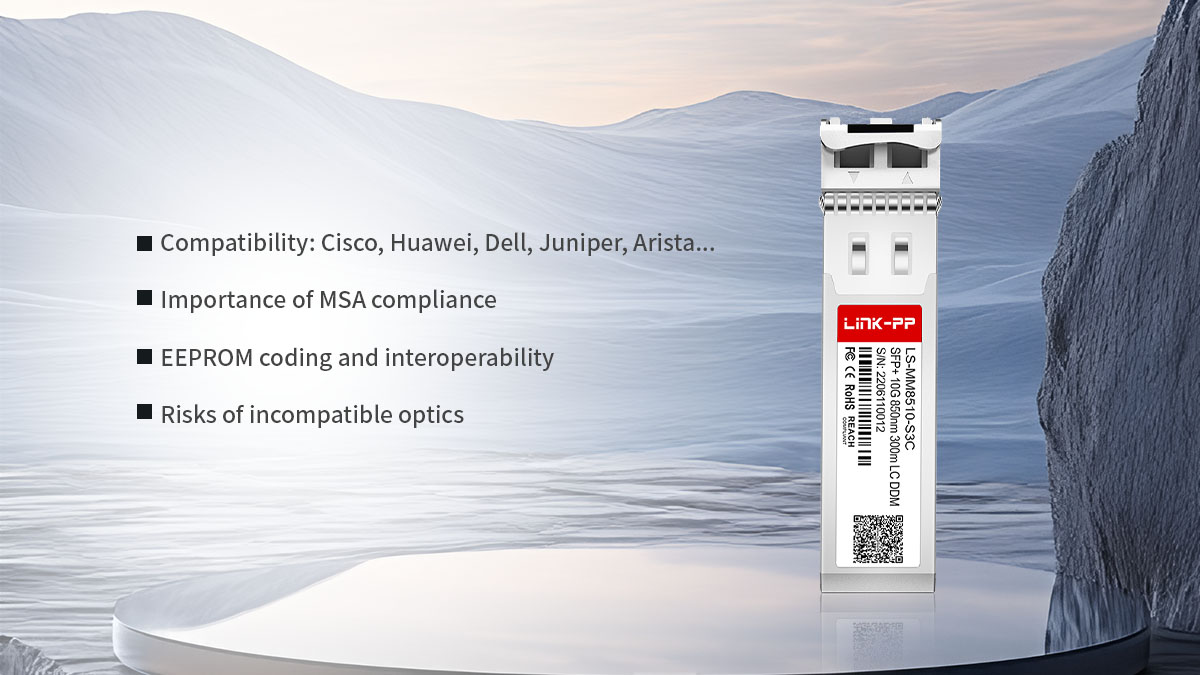
10G SFP+ SR modules are based on the MSA and 10GBASE-SR standards, but many switch vendors enforce EEPROM checks to control which optics are accepted.
| Compatibility Factor | What to Check | Why It Matters |
|---|---|---|
| Switch Brand | Cisco, HPE, Juniper, etc. | Vendor-specific validation |
| Coding Method | OEM-coded or compatible-coded | Determines recognition |
| Firmware Version | Switch OS level | Affects optics acceptance |
Before purchasing, buyers should always confirm which switch models and firmware versions the module has been tested against.
MSA Compliance vs Vendor Coding
MSA compliance alone does not guarantee plug-and-play compatibility. While it ensures electrical and optical standards are met, vendor coding determines whether the switch will allow the port to come up.
In practical terms:
-
Open or generic coding works in some environments
-
Brand-specific coding is often required in production networks
-
Re-coding capability can reduce long-term sourcing risk
Choosing modules that support multiple coding profiles can simplify future upgrades or vendor changes.
Fiber and Infrastructure Compatibility
Even when the optics are compatible with the switch, fiber mismatches can still cause link issues.
| Infrastructure Item | Requirement | Common Mistake |
|---|---|---|
| Fiber Type | OM3 / OM4 MMF | Using single-mode fiber |
| Connector Type | LC duplex | Mixed connector adapters |
| Link Distance | Within SR limits | Exceeding max distance |
Ensuring that existing cabling meets SR specifications is a critical step before procurement, especially in legacy environments.
Multi-Vendor Network Considerations
In mixed environments, compatibility planning should extend beyond a single switch brand. Using third-party 10G SFP+ SR modules with verified multi-vendor support can significantly reduce inventory complexity.
Benefits include:
-
Fewer SKUs to manage
-
Faster replacement across platforms
-
Lower spare optics inventory costs
This approach is particularly effective for data centers and system integrators managing diverse hardware stacks.
Compatibility Takeaway for Buyers
A 10G SFP+ SR module is only “compatible” if it works with your exact switch model, firmware, and fiber infrastructure. Verifying these three elements before purchase prevents deployment delays and avoids unnecessary returns or replacements.
In the next section, we will move from compatibility to decision-making, outlining how to choose the right 10G SFP+ SR module for your specific network scenario.
↪️ How to Choose the Right 10G SFP+ SR for Your Network
Choosing the right 10G SFP+ SR module is about matching technical limits to real deployment conditions, not selecting the most expensive option. A correct choice minimizes cost, avoids compatibility issues, and ensures stable operation over the full lifecycle of the network.
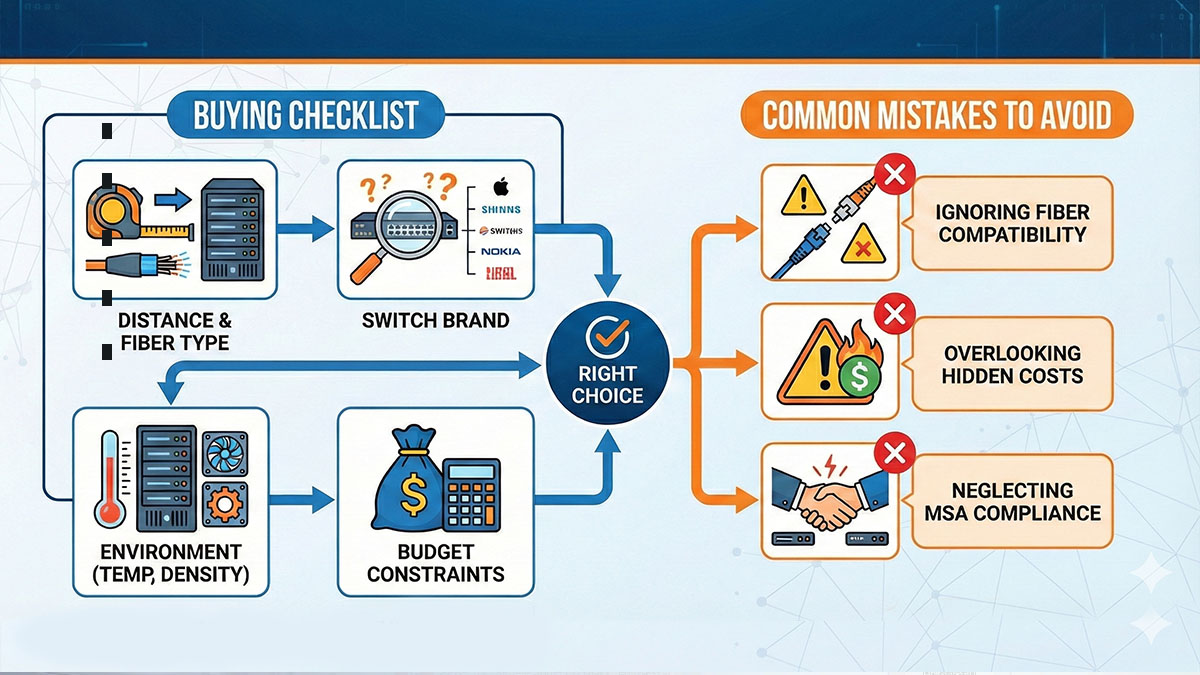
Step 1: Confirm Link Distance and Fiber Type
The first and most important decision factor is whether your physical infrastructure fits within SR limits.
| Fiber Type | Supported Distance | Decision Impact |
|---|---|---|
| OM3 MMF | up to 300m | Standard SR use |
| OM4 MMF | up to 400m | Extended SR range |
| OM2 MMF | up to 82m | Limited suitability |
If the required link distance exceeds these values, SR optics are not the right choice—switching to LR or other long-reach modules is necessary.
Step 2: Verify Switch Model and Firmware
Even a technically correct SR module can fail if the switch does not accept it. Before purchase, confirm:
-
Exact switch model
-
Installed firmware or OS version
-
Vendor optics policy
This step is especially critical when using third-party modules in branded switch environments.
Step 3: Decide on OEM vs Third-Party Optics
Cost and procurement flexibility should guide this decision.
| Decision Factor | OEM | Third-Party |
|---|---|---|
| Unit Cost | Higher | Lower |
| Multi-Vendor Use | Limited | Supported |
| Lead Time | Longer | Shorter |
For most enterprise and data center deployments, third-party 10G SFP+ SR modules offer better cost efficiency without sacrificing performance.
Step 4: Evaluate Environmental Requirements
Standard 10G SFP+ SR modules are designed for 0–70°C operating environments. Only consider extended temperature versions if:
-
Equipment is installed in non-conditioned spaces
-
Outdoor or industrial cabinets are involved
Choosing extended temperature optics unnecessarily increases cost.
Step 5: Plan for Scale and Spares
For larger deployments, consistency matters more than individual unit price.
-
Standardize on fewer SKUs
-
Choose optical modules with broad compatibility
-
Maintain a shared spare pool across platforms
This approach reduces inventory complexity and long-term maintenance cost.
Selection Takeaway
The right 10G SFP+ SR module is the one that meets your distance, compatibility, and environment requirements at the lowest total cost. Careful verification upfront prevents costly redesigns and replacements later.
Next, we will look at typical use cases for 10G SFP+ SR, showing where this transceiver type delivers the most value in real-world networks.
↪️ Typical Use Cases for 10G SFP+ SR
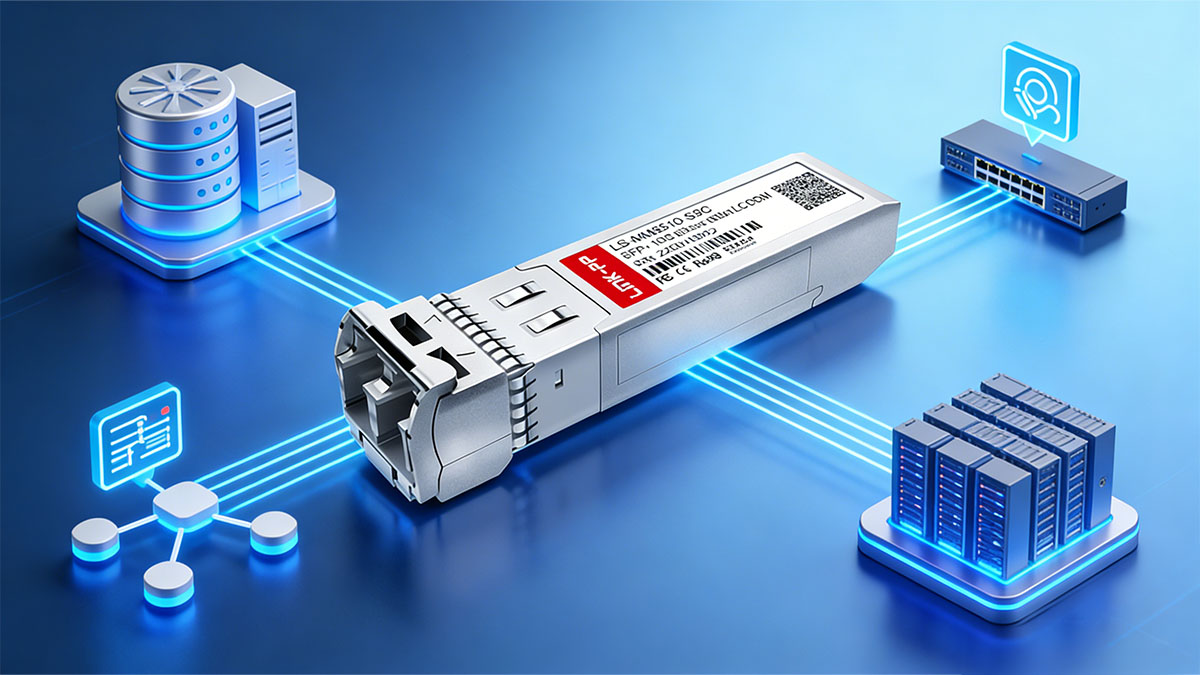
10G SFP+ SR is best suited for short-distance, high-density network environments where cost efficiency and simplicity are priorities. Its technical characteristics make it a natural fit for scenarios where fiber runs are limited and large numbers of 10G ports are required.
Data Center Server-to-Switch Links
One of the most common use cases for 10G SFP+ SR is server access connectivity inside data centers.
| Deployment Area | Distance Range | Why SR Fits |
|---|---|---|
| Top-of-Rack | <100m | Low cost, low power |
| End-of-Row | 100m–300m | OM3/OM4 support |
| Same Hall | up to 400m | No need for LR optics |
In these scenarios, SR optics provide sufficient reach without the cost premium of long-reach modules.
Switch-to-Switch Connections
10G SFP+ SR is also widely used for aggregation and distribution layer links within the same facility.
-
High port density requirements
-
Short, predictable fiber paths
-
Controlled indoor environments
These conditions align well with SR specifications, especially when OM4 fiber is available.
Enterprise Network Upgrades
For enterprises upgrading from 1G to 10G, SR modules offer a practical transition path.
| Upgrade Scenario | Existing Infrastructure | SR Suitability |
|---|---|---|
| Campus buildings | MMF backbone | Suitable within distance |
| Server rooms | OM3/OM4 cabling | Ideal |
| Floor switches | Short MMF runs | Cost-effective |
When existing multimode fiber is already in place, SR optics minimize both material and labor costs.
High-Density Switching Environments
In environments where power consumption and thermal load are critical, such as high-density leaf switches, SR optics are preferred over long-reach alternatives.
-
Lower per-port power draw
-
Reduced heat output
-
Better suitability for dense line cards
These advantages become more significant as port counts increase.
Use Case Takeaway
10G SFP+ SR delivers the most value in short-reach, indoor, high-density deployments. When distances are controlled and multimode fiber is available, it remains one of the most economical and reliable 10G optical solutions.
Next, we will introduce LINK-PP 10G SFP+ SR transceiver options, focusing on how they support practical selection and deployment needs without changing the core technical criteria.
↪️ LINK-PP 10G SFP+ SR Transceiver Solution
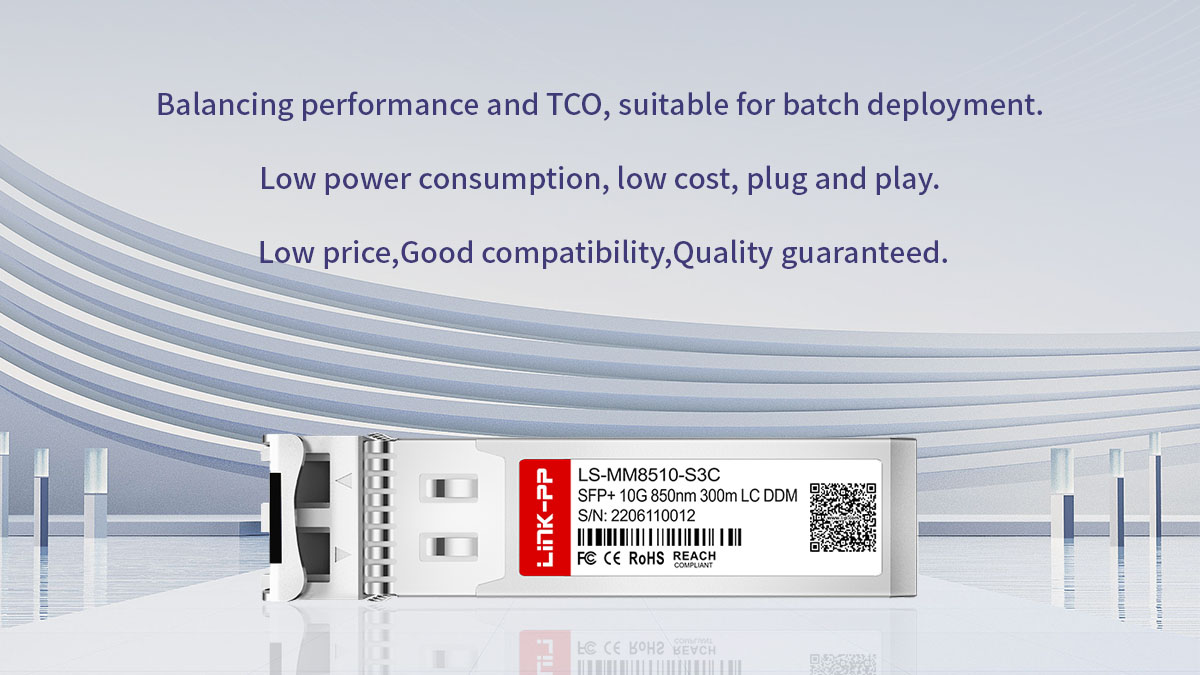
LINK-PP 10G SFP+ SR transceivers are designed to support cost-efficient deployment while maintaining strict compatibility and quality control standards. They are positioned as a practical option for buyers who already understand the technical requirements and are looking for a reliable sourcing choice rather than experimental alternatives.
Product Positioning and Technical Scope
LINK-PP 10G SFP+ SR modules fully comply with the 10GBASE-SR standard and are built for short-reach multimode fiber applications.
| Specification Item | LINK-PP SR Module | Deployment Relevance |
|---|---|---|
| Data Rate | 10.3125Gbps | Stable 10GbE links |
| Wavelength | 850nm | MMF compatibility |
| Fiber Support | OM3 / OM4 | Short-reach networks |
| Max Distance | up to 400m | Data center coverage |
These baseline specifications ensure that LINK-PP SR modules can be deployed in the same scenarios as standard OEM optics without changing network design assumptions.
Compatibility and Coding Support
Compatibility is a core focus of LINK-PP SR transceivers. Modules are available with vendor-specific coding to support mainstream switch platforms.
-
Pre-coded for major brands (Cisco, HPE, Juniper, etc.)
-
Tested against common switch models and firmware
-
Optional re-coding support for multi-vendor environments
This approach reduces the risk of port rejection and simplifies deployment across mixed hardware platforms.
Quality Control and Reliability
LINK-PP applies multiple verification steps before shipment to ensure stable field performance:
| Quality Step | Purpose | Buyer Benefit |
|---|---|---|
| Optical parameter testing | Signal stability | Consistent links |
| Switch-level validation | Interoperability | Reduced failure risk |
| Burn-in testing | Early fault detection | Higher reliability |
These controls are especially important for buyers deploying SR optics at scale, where even small failure rates can impact operations.
Cost and Procurement Advantages
From a procurement perspective, LINK-PP 10G SFP+ SR modules are positioned to balance cost efficiency and deployment confidence.
-
Competitive pricing compared to OEM optics
-
Flexible order quantities for projects of different sizes
-
Shorter lead times for bulk procurement
This makes them suitable for enterprises, system integrators, and data center operators seeking predictable sourcing.
Solution Takeaway
LINK-PP 10G SFP+ SR transceivers provide a standards-compliant, compatible, and cost-conscious option for short-reach 10G deployments. They are best suited for buyers who have defined their technical needs and want a dependable supply option without OEM pricing overhead.
Next, we will address common buyer questions in the FAQ section, focusing on practical concerns around deployment, compatibility, and long-term use.
↪️ FAQs About 10G SFP+ SR Transceivers
This section answers the most common buyer questions about 10G SFP+ SR modules, focusing on compatibility, deployment, and cost considerations. Each answer is concise and actionable for procurement and network planning.
1. Is 10G SFP+ SR cheaper than 10G LR?
Yes. SR modules are designed for short-reach multimode fiber, which requires less optical power and simpler transceiver components. This makes them significantly less expensive than LR modules that support single-mode fiber over long distances.
2. Can 10G SFP+ SR work with OM2 fiber?
Partially, but with distance limitations. OM2 fiber supports up to 82m for 10GBASE-SR, which may be insufficient for most modern data center or enterprise links. OM3 or OM4 fiber is recommended to achieve full short-reach distances.
3. Can I mix OEM and third-party 10G SFP+ SR modules on the same switch?
Yes, if compatibility is verified. The modules must match the switch firmware and coding requirements. Third-party modules with proper vendor coding are generally compatible with OEM optics, but it is important to test or confirm vendor compatibility lists before deployment.
4. How long do 10G SFP+ SR modules last?
Typically 5–10 years in normal conditions. Module lifespan depends on operating temperature, usage cycles, and handling. Standard modules rated for 0–70°C are sufficient for most indoor environments.
5. Are 10G SFP+ SR modules still cost-effective today?
Yes, especially for short-reach, high-density deployments. Even with the availability of newer 25G/40G optics, 10G SR remains a practical choice where existing multimode fiber is installed and distance requirements are limited.
↪️ Conclusion: Is 10G SFP+ SR the Right Choice for Your Network?
10G SFP+ SR transceivers remain one of the most cost-effective and reliable options for short-reach 10GbE deployments. They are ideal for data center server-to-switch links, switch-to-switch connections within the same facility, and enterprise network upgrades where multimode fiber is already in place.
When choosing a module, buyers should prioritize three factors: distance and fiber type, switch compatibility, and deployment environment. Third-party modules, such as LINK-PP 10G SFP+ SR, often offer the best balance of cost efficiency and multi-vendor flexibility, while OEM modules may be justified only when vendor support contracts or compliance requirements demand them.
Key takeaways for procurement decisions:
-
Confirm that fiber type and link distance meet SR specifications.
-
Verify switch model and firmware for proper module recognition.
-
Consider third-party modules for lower total cost without sacrificing performance.
-
Plan for spares and standardize SKUs to simplify large deployments.
For buyers ready to source reliable, cost-effective 10G SFP+ SR transceivers, visit the LINK-PP Official Store to explore compatible options, check pricing, and ensure modules meet your network’s technical requirements.
Choosing the right 10G SFP+ SR module now ensures predictable performance, minimizes deployment risks, and reduces long-term costs.