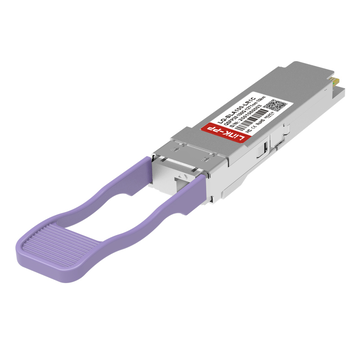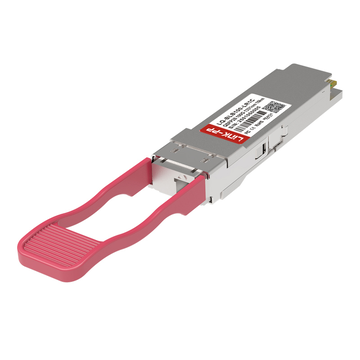
The fundamental difference is directional capability. A transmitter (Tx) is a unidirectional device that exclusively encodes and sends data (Simplex communication); it cannot receive signals. A transceiver (Tx/Rx) integrates both a transmitter and a receiver into a single housing, enabling simultaneous, two-way data exchange (Full-Duplex communication). In modern IT networking, transceivers (like MSA-compliant SFP modules) are the universal standard, whereas standalone transmitters are strictly procured for one-way broadcast environments, such as Commercial AV (SDI-over-fiber) or RF telemetry.
For network architects, AV integrators, and IT procurement managers, confusing a transmitter with a transceiver is not merely a semantic error—it is an architectural flaw that leads to incompatible hardware, wasted fiber optic strands, and inflated Capital Expenditure (CAPEX). While both components manipulate electromagnetic waves or photons to propagate data across a medium, their physical layer (OSI Layer 1) mechanics serve entirely different networking topologies.
The procurement logic between these two devices is dictated by the required data protocol. In enterprise data centers operating under IEEE 802.3 Ethernet standards, network traffic relies on TCP/IP protocols that require constant, two-way handshakes. This mandates the bi-directional efficiency of a transceiver. Conversely, in a sports stadium broadcasting a 4K camera feed to a control room, there is zero IP data returning to the camera. In this scenario, purchasing a transceiver wastes budget on an unused return path, making a dedicated standalone optical transmitter the mathematically correct choice.
Micro-definition: Simplex vs. Duplex. Simplex refers to a communication channel that sends information in one direction only (Transmitter). Duplex refers to a channel capable of transmitting and receiving data simultaneously (Transceiver).
This comprehensive 2025 selection guide deconstructs the structural and functional divergence between transceivers and transmitters. By analyzing optical and RF form factors, evaluating industry-specific deployment scenarios, and comparing total lifecycle costs, we provide a definitive framework to ensure your procurement strategy aligns perfectly with your network's operational requirements.
🟠 What Is the Difference Between a Transceiver and a Transmitter?
The core difference lies in signal directionality and hardware integration. A transmitter operates strictly in simplex mode, generating and pushing an electrical, RF, or optical signal in one direction without the hardware capacity to receive incoming data. A transceiver merges both a transmitter and a receiver (Tx/Rx) into a single unified module. This integration allows a single device or network port to achieve half-duplex or full-duplex bi-directional communication, drastically reducing physical footprint and power consumption.
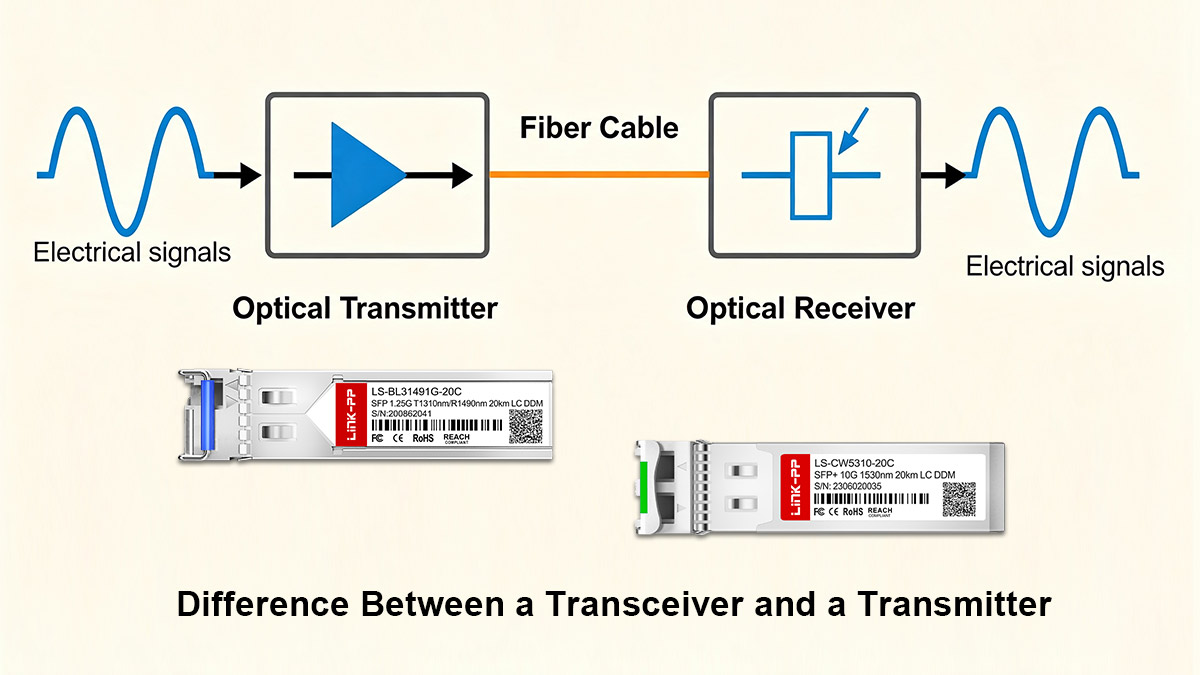
To understand why procurement teams specify one over the other, it is necessary to examine the internal architecture and physical layer (Layer 1) behavior of both devices.
Definition of a Transceiver
A transceiver—a portmanteau of "transmitter" and "receiver"—is a bi-directional endpoint device. Rather than utilizing two separate pieces of hardware to maintain a two-way conversation, engineers integrate both functions into a shared circuitry or housing. This is the foundational building block of modern interactive networks, from cellular base stations to enterprise data centers.
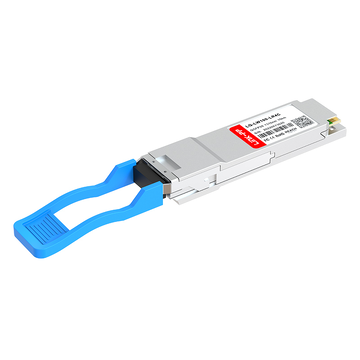
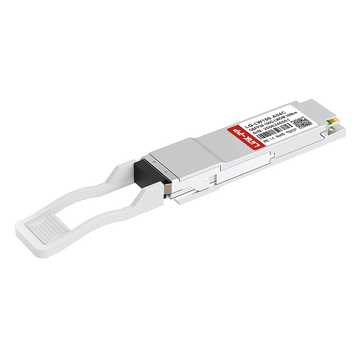
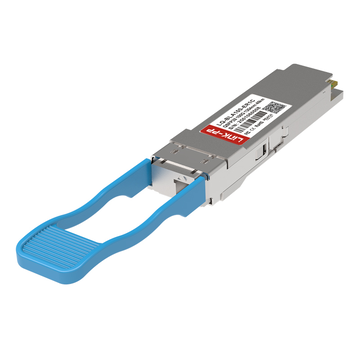
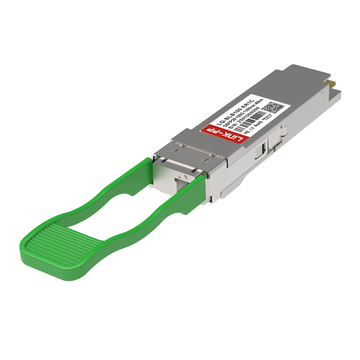
In the context of optical networking, a fiber optic transceiver (such as an IEEE 802.3-compliant QSFP28 module) relies on two distinct sub-components housed within its metal casing:
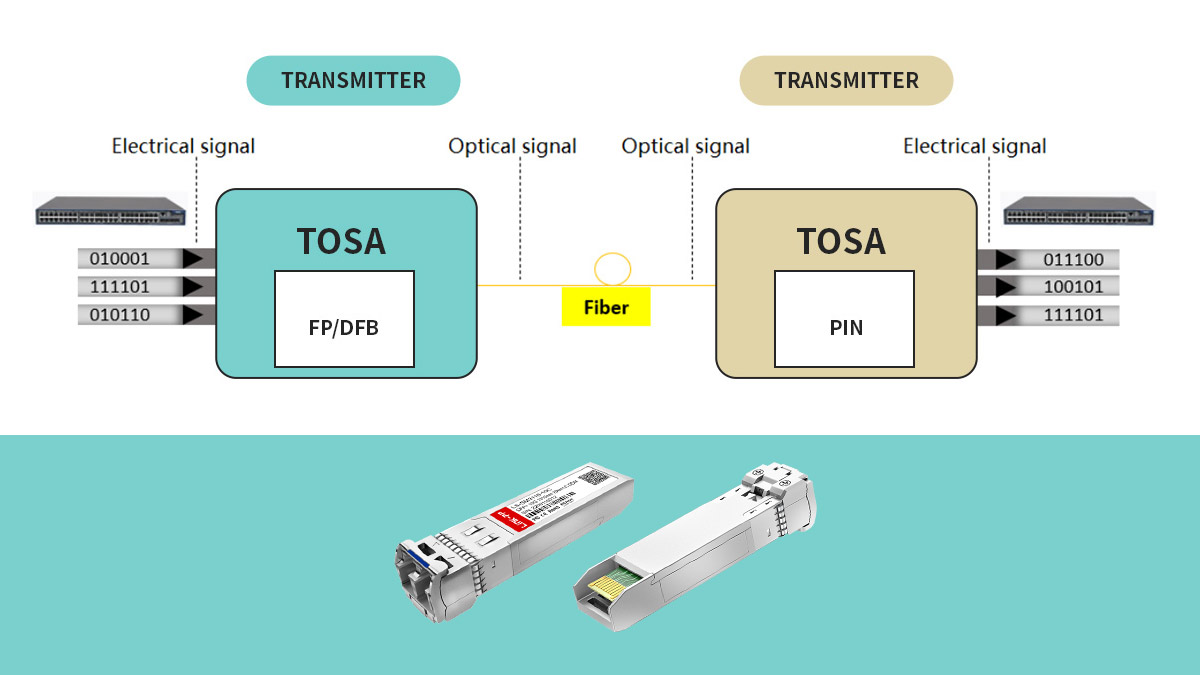
Micro-definition: TOSA and ROSA. The TOSA (Transmitter Optical Sub-Assembly) converts electrical data from the switch ASIC into pulses of laser light. The ROSA (Receiver Optical Sub-Assembly) utilizes a photodiode to receive incoming light pulses and convert them back into electrical signals. A transceiver contains both.
Because it possesses both a TOSA and a ROSA, a standard optical transceiver operates in Full-Duplex mode. It can transmit a webpage request and simultaneously receive a file download without signal collision.
Definition of a Transmitter
A transmitter (Tx) is an electronic device designed exclusively to originate and propagate a signal. It accepts a baseband payload (such as an audio feed, video stream, or raw binary data), modulates it onto a carrier wave or light source, and pushes it across a physical medium. It is "blind and deaf" to any incoming return traffic.
Because it lacks receiving circuitry (no ROSA in optical terms, or no demodulator in RF terms), a transmitter operates in Simplex mode. Standalone transmitters are highly specialized. For example, an optical video transmitter uses a high-power DFB (Distributed Feedback) laser to push an uncompressed 12G-SDI video signal 10 kilometers to a remote broadcast truck. The transmitter executes this flawless one-way delivery without requiring network handshakes or return-path acknowledgment.
Quick Comparison Table
The following matrix outlines the functional boundaries and typical architectural deployments of both devices, providing a quick reference for technical procurement mapping.
| Feature | Transmitter (Tx) | Transceiver (Tx/Rx) |
|---|---|---|
| Primary Function | Modulates and sends signals exclusively. | Both sends and receives signals. |
| Communication Mode | Simplex (One-way street). | Half-Duplex or Full-Duplex (Two-way street). |
| Internal Architecture (Optical) | Contains a Laser/TOSA only. | Contains both a Laser/TOSA and a Photodiode/ROSA. |
| Common IT/AV Use Cases | Security camera feeds, FM radio broadcast, HDMI-over-fiber extenders. | Ethernet switches, Wi-Fi access points, IP routers, smartphones. |
| Port Utilization | Requires 1 fiber strand (Tx only). | Requires 2 fiber strands (Tx and Rx), or 1 strand via BiDi WDM technology. |
🟠 The Standalone Transmitter: One-Way Communication
A standalone transmitter is engineered for dedicated, one-way (simplex) data propagation. In environments where no return data path is required—such as broadcasting a live 4K video feed from a stadium camera, transmitting FM radio signals, or sending telemetry data from a remote industrial sensor—procuring a standalone transmitter optimizes bandwidth and eliminates the unnecessary hardware costs associated with receiver circuitry.
In modern IT enterprise environments, encountering a standalone transmitter is rare; IP networking inherently relies on two-way handshakes. However, in specific vertical markets like Commercial Audio/Visual (AV), broadcasting, and industrial telemetry, the standalone transmitter remains a critical and heavily procured piece of infrastructure.
The Mechanics of Simplex Transmission
The defining characteristic of a standalone transmitter is its simplex communication model. It acts as an absolute origin point for data.
When a transmitter receives a baseband signal—for instance, an uncompressed HDMI video feed—its internal circuitry encodes that raw data. In an optical transmitter, a laser driver then modulates a laser diode (such as a VCSEL or DFB laser) to flash billions of times per second, pushing the encoded video down a single strand of fiber optic cable. The transmitter never expects an acknowledgment packet (ACK) from the receiving end; it simply pushes data continuously until powered down.
Primary Use Cases for Standalone Transmitters
Procurement teams specify standalone transmitters when the application requires high-bandwidth, uninterrupted delivery without the need for interactive feedback. Common deployments include:
- Commercial AV (Video over Fiber): In large venues, routing uncompressed 4K or 8K video from a source (a camera or media server) to a distant display (a jumbotron or control room monitor) requires massive bandwidth. AV integrators procure "Optical Transmitter" boxes that convert SDI or HDMI to optical signals. Because the monitor does not send data back to the camera, a transceiver would be a wasted expense.
- RF Broadcasting: Television and FM radio towers utilize massive RF transmitters to radiate signals over vast geographic areas. The tower does not—and cannot—receive signals back from the millions of car radios or televisions tuned into the broadcast.
- Security and Surveillance: Perimeter security cameras situated kilometers away from a guardhouse often use analog or raw digital video transmitters to push the live feed over a single strand of fiber back to the central DVR/NVR setup.
The Procurement Advantage: Fiber Strand Conservation
From an infrastructure perspective, utilizing standalone transmitters in simplex environments saves physical cabling. Standard transceivers require two strands of fiber optic cable (a Tx strand and an Rx strand) to complete a duplex link.
Dark Fiber. Unused optical fiber strands within a deployed cable bundle. By using simplex transmitters for one-way feeds, network architects preserve "dark fiber" for future network expansion, avoiding expensive new cable pulls.
If an AV team needs to connect six remote cameras to a production truck, using standalone optical transmitters means they only need to utilize six strands of fiber. If they incorrectly procured standard IT transceivers for this one-way job, they would unnecessarily consume twelve strands of fiber, potentially exhausting the venue's available fiber infrastructure.
🟠 The Transceiver: Bi-Directional Network Efficiency
The transceiver is the foundational hardware of modern two-way networking. By housing both a transmitting laser and a receiving photodiode in a single, compact module (such as an SFP or QSFP), transceivers enable Full-Duplex communication. This design allows IT networks to drastically reduce hardware footprint, lower power consumption, and flawlessly execute the continuous request-and-response handshakes required by standard TCP/IP network protocols.
If the standalone transmitter is a one-way street, the transceiver is a multi-lane highway. In the realm of Information Technology (IT), enterprise data centers, and telecom infrastructure, the transceiver has rendered standalone transmitters entirely obsolete. The procurement of network hardware today is almost exclusively focused on transceivers.
Why IT Networks Mandate Transceivers
To understand the dominance of the transceiver, one must look at how internet protocols function. The backbone of IT networking is the TCP/IP suite. Unlike a one-way video broadcast, TCP/IP requires constant, bi-directional interaction.
When a server sends a packet of data to a client computer, the server must receive an Acknowledgment (ACK) packet back from the client confirming the data arrived intact. If the server only had a transmitter, it would be blind to the network's status. By integrating a receiver (ROSA) and a transmitter (TOSA) into a single transceiver module, a single port on an Ethernet switch can simultaneously transmit data payloads and receive corresponding ACK packets without collision.
The Hardware Efficiency of MSA Form Factors
The true genius of the modern transceiver lies in miniaturization and standardization. Before the early 2000s, network switches required large, bulky, and separate Tx and Rx cards. Today, the industry relies on Multi-Source Agreements (MSAs).
Form Factor. The standardized physical size, shape, and electrical interface of a hardware component. In transceivers, standard form factors like SFP (Small Form-factor Pluggable) ensure that a module manufactured by one company will seamlessly plug into a switch manufactured by another.
By combining Tx and Rx into a hot-swappable SFP module roughly the size of a pack of gum, hardware manufacturers can fit 48 bi-directional ports onto a single 1RU (Rack Unit) network switch. This consolidation drastically reduces the physical footprint, cooling requirements, and overall CAPEX for data center build-outs.
Advanced Efficiency: The BiDi (Bi-Directional) Transceiver
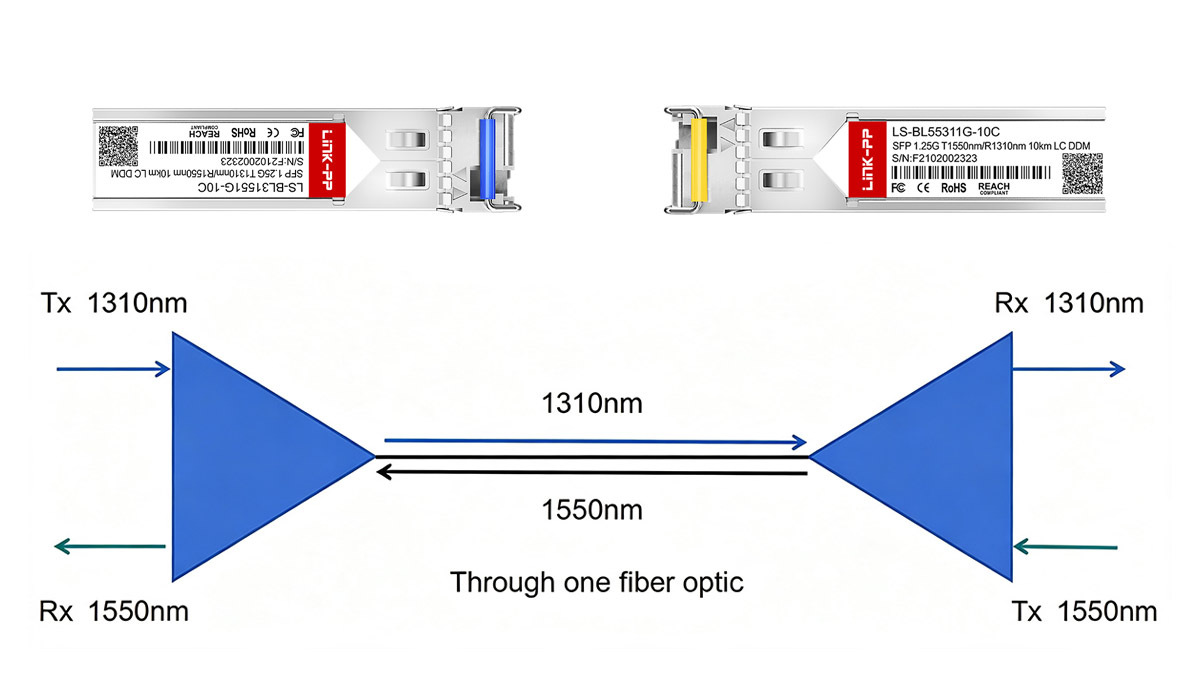
Standard transceivers achieve two-way communication by using two physical strands of fiber (one dedicated to transmitting, one to receiving). However, optical engineers have pushed transceiver efficiency even further with the development of the BiDi Transceiver.
BiDi transceivers utilize Wavelength Division Multiplexing (WDM) to transmit and receive data simultaneously over a single strand of fiber optic cable. They accomplish this by using different wavelengths (colors) of light for each direction.
- How it works: Transceiver "A" transmits light at 1310nm and receives light at 1490nm. On the other end of the single fiber strand, Transceiver "B" transmits at 1490nm and receives at 1310nm. Internal prisms separate the incoming and outgoing light, preventing interference.
- The Procurement Win: If a campus network exhausts its available underground fiber, pulling new cable can cost tens of thousands of dollars. By simply swapping standard transceivers for BiDi transceivers, procurement teams can instantly double the capacity of their existing fiber infrastructure without laying a single inch of new cable.
🟠 Common Types of Transceivers and Transmitters
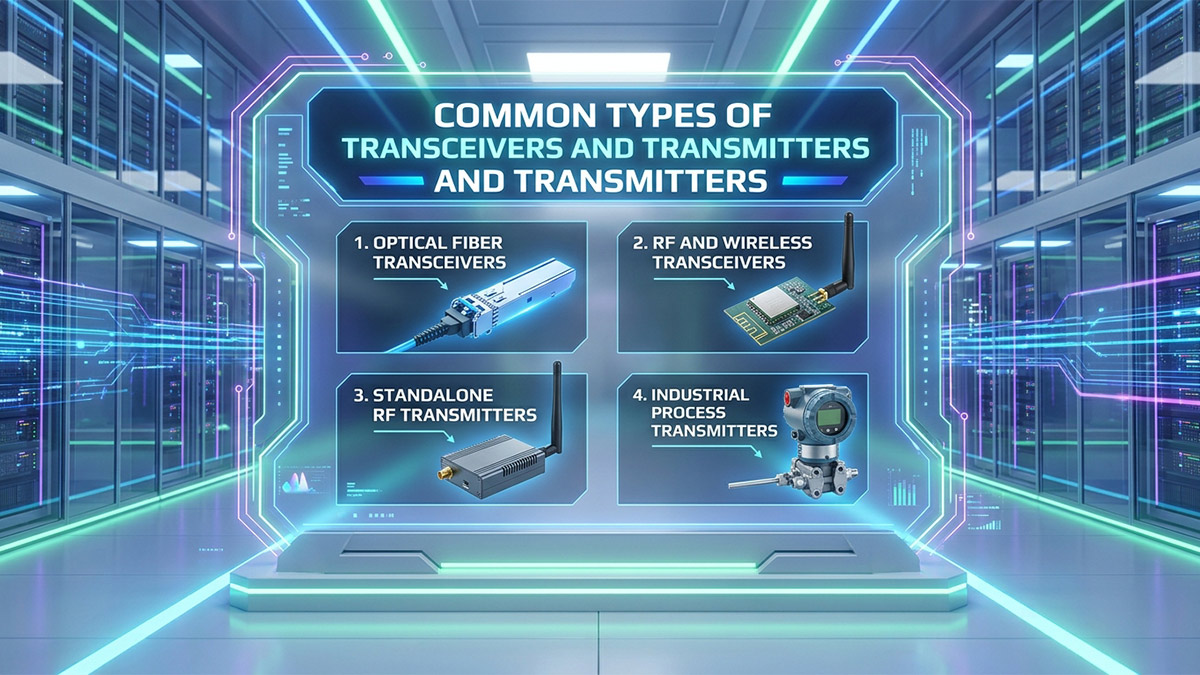
Transceivers and transmitters are categorized by the physical medium they use to propagate signals. Optical fiber transceivers (like SFP modules) use lasers to transmit data via light pulses over glass cores. RF transceivers (like Wi-Fi routers or smartphones) use antennas to send and receive radio waves through the air. Standalone RF transmitters are used for massive one-way public broadcasting (TV/Radio), while Industrial Process transmitters are specialized sensors that convert physical measurements (like pressure or temperature) into electrical telemetry data.
When a procurement manager receives a requisition for a "transceiver" or a "transmitter," the context of the physical medium is everything. A buyer in an enterprise data center is looking for vastly different hardware than a buyer in an oil refinery or a television station. Below are the four primary categories defining the modern hardware landscape.
1. Optical Fiber Transceivers
These are the backbone of the global internet and enterprise IT networks. Optical transceivers convert electrical data from a switch or router into optical light pulses (and vice versa) for transmission over fiber optic cables.
- Key Technologies: They utilize semiconductor lasers (VCSEL for short-reach, DFB/EML for long-reach) for the transmitter portion, and photodiodes (PIN or APD) for the receiver portion.
- Form Factors: Governed strictly by Multi-Source Agreements (MSAs). Common form factors include SFP (1G), SFP+ (10G), QSFP28 (100G), and QSFP-DD (400G/800G).
- Procurement Profile: High-volume commodities. Buyers focus heavily on compatibility (e.g., ensuring a module is coded to work with Cisco or Arista hardware) and matching the module to the correct fiber type (Single-mode vs. Multimode).
2. RF and Wireless Transceivers
Instead of using light and glass, Radio Frequency (RF) transceivers utilize antennas to transmit and receive electromagnetic waves through the air. They are the core components of all modern wireless communication.
Micro-definition: Baseband vs. Passband. RF transceivers take raw digital data (baseband), modulate it onto a high-frequency carrier wave (passband), and transmit it via an antenna. The receiving end reverses this process.
- Examples: The Wi-Fi chip inside your laptop, Bluetooth modules in wireless headphones, cellular modems in smartphones, and satellite communication terminals.
- Procurement Profile: Usually integrated directly into consumer electronics or purchased as Access Points (APs) for enterprise WLAN (Wireless Local Area Network) deployments.
3. Standalone RF Transmitters
These are massive, high-power devices designed strictly for one-way (simplex) public broadcasting or deep-space telemetry. They push signals over vast geographic areas but possess absolutely no receiving capabilities.
- Examples: FM radio station towers, VHF/UHF television broadcast antennas, and GPS satellites (which continuously transmit timing data to Earth without receiving user location data).
- Procurement Profile: Highly specialized, low-volume, massive CAPEX investments. Procured by telecom conglomerates, government agencies, and broadcasting corporations.
4. Industrial Process Transmitters
In the industrial engineering and manufacturing sectors, the word "transmitter" has a completely different meaning. An industrial process transmitter is essentially a highly calibrated sensor that measures a physical variable and "transmits" that reading back to a central control system (like a PLC or SCADA system).
- Examples: Pressure transmitters in an oil pipeline, temperature transmitters in a chemical reactor, or flow transmitters in a water treatment plant. They typically convert physical measurements into a standard 4-20mA analog electrical signal.
- Procurement Profile: Sourced by operational technology (OT) engineers and industrial automation buyers. Key purchasing factors include environmental ruggedness (e.g., explosion-proof NEMA enclosures) and calibration accuracy, rather than data bandwidth.
🟠 Transceiver vs. Transmitter in Networking and Fiber Optics
In modern fiber optic networking, transceivers (like SFP and QSFP modules) completely dominate the landscape because IP routing requires full-duplex, two-way communication. Standalone optical transmitters are relegated to niche, one-way "broadcast" applications, such as transmitting uncompressed SDI video in commercial AV setups or pushing analog security camera feeds to a central server. For enterprise data centers and telecom backbones, procurement is 100% focused on standardized transceiver modules.
To optimize network budgets and ensure hardware compatibility, IT directors must understand how these physical layer components map to specific enterprise topologies. The physical form factor of the module dictates its bandwidth, thermal limits, and ultimate use case.
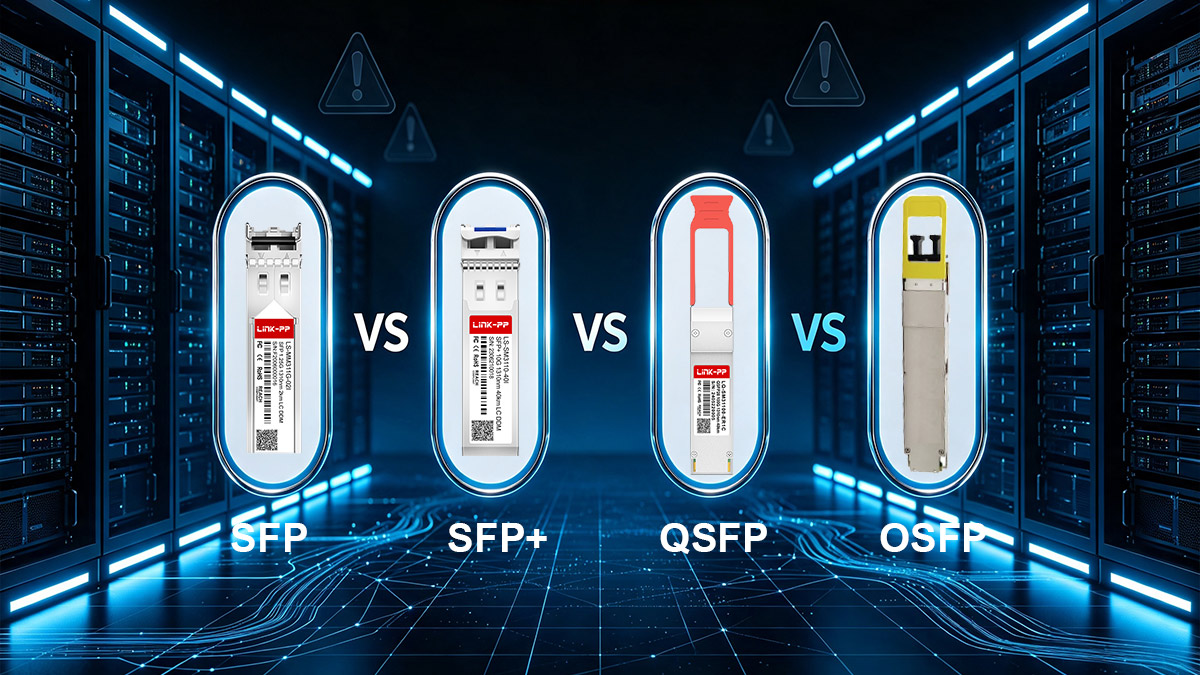
SFP, SFP+, QSFP, and OSFP Transceivers
The optical transceiver market is defined by Multi-Source Agreement (MSA) form factors. These standardized sizes allow network engineers to hot-swap modules without powering down the switch.
- SFP (Small Form-factor Pluggable): The legacy standard for 1 Gigabit Ethernet (1GbE). Still heavily procured for campus edge switches and IP phone uplinks.
- SFP+: The evolution of the SFP, supporting 10 Gigabit Ethernet (10GbE). Visually identical to the SFP, it is the workhorse of modern enterprise server connections.
- QSFP (Quad Small Form-factor Pluggable): By integrating four parallel transmit and receive lanes into a slightly wider module, QSFP (and QSFP28) modules handle 40GbE and 100GbE data rates, dominating data center core networks.
- OSFP (Octal Small Form-factor Pluggable): A newer, slightly larger form factor designed specifically for massive thermal dissipation. OSFP modules house 8 high-speed electrical lanes, pushing bandwidths to 400GbE and 800GbE for hyperscale AI and cloud computing environments.
Optical Transmitter Modules
While rare in the IT data center, standalone optical transmitter modules are vital in specific operational technology (OT) and broadcast sectors.
SDI over Fiber. Serial Digital Interface (SDI) is a standard used in professional video broadcasting. Dedicated optical transmitters convert heavy, uncompressed SDI electrical signals into light, allowing raw video feeds to travel kilometers without latency or degradation.
A typical optical transmitter in this space is a standalone metal "throwdown" box. The engineer plugs an SDI coax cable into the input port, and the transmitter uses a high-power DFB laser to shoot the signal down a single strand of fiber to a receiving truck. Because there is no return data path, the internal architecture completely lacks the ROSA (Receiver Optical Sub-Assembly) found in standard IT transceivers.
Data Center and Telecom Applications
In data centers and telecom environments, transceivers do more than just connect adjacent racks; they define the entire architecture.
- Intra-Data Center (Spine-Leaf): Hyperscalers use thousands of 100G QSFP28 transceivers combined with inexpensive multimode fiber (e.g., 100GBASE-SR4) to create high-density, non-blocking network meshes.
- Data Center Interconnect (DCI): Telecom operators and cloud providers use advanced Coherent Pluggable Transceivers (like 400G ZR) to connect data centers up to 120km apart. These massive-bandwidth transceivers plug directly into routers, bypassing traditional optical transport chassis and saving millions in CAPEX.
Enterprise Network Deployment Examples
How do these components function in everyday enterprise deployments? Consider a modern hospital campus:
- The Transceiver Deployment: The hospital's IT team uses 10G SFP+ transceivers (10GBASE-LR) to connect the main server room to edge switches in various wings of the hospital. These transceivers handle the two-way traffic of electronic medical records (EMR), VoIP calls, and internet access.
- The Transmitter Deployment: The hospital’s security team needs to install a high-definition perimeter camera at the far end of the parking lot, 3 kilometers away. Rather than installing an expensive IP switch just for one camera, they install a standalone Optical Video Transmitter at the camera pole. It pushes the one-way video feed over a single strand of fiber back to the central security desk's optical receiver.
🟠 Procurement and Cost Analysis: Which Option Is More Cost-Effective?
The cost-effectiveness of a transceiver versus a transmitter depends entirely on the application. For standard IP data networking, transceivers are mathematically superior; mass commoditization has driven 10G transceiver prices below $20, whereas standalone AV/video transmitters often cost $200 to $500+ due to proprietary video encoding hardware. However, in long-distance, one-way broadcast scenarios, using a single-strand transmitter/receiver pair saves up to 50% on physical fiber optic cabling costs, offsetting the higher initial hardware CAPEX.

For IT Directors and Procurement Managers, choosing between these hardware topologies requires a Total Cost of Ownership (TCO) analysis. Buyers must look beyond the initial purchase price of the module and calculate the hidden costs associated with fiber infrastructure, lifecycle maintenance, and vendor lock-in.
Initial Hardware Costs
Due to the massive scale of the global cloud computing industry, standard IT transceivers have become highly commoditized. Standalone transmitters, relegated to niche AV and broadcast markets, lack this economy of scale.
- Standard IT Transceivers (SFP/SFP+): A third-party, MSA-compliant 10G SFP+ module can be procured for $15 to $40. Even high-capacity 100G QSFP28 modules have dropped to the $100 to $250 range.
- BiDi Transceivers: Because they require complex internal WDM prisms to transmit and receive on a single strand, they carry a slight premium, typically costing $30 to $60 for a 10G module.
- Standalone AV Transmitters: A dedicated HDMI-to-Fiber or SDI-to-Fiber transmitter box requires its own power supply, chassis, and proprietary video encoding chip. These typically cost $200 to $800+ per unit.
Installation and Infrastructure Costs
The hardware price is often dwarfed by the cost of the physical medium it connects to. Fiber optic cable installation—especially trenching underground or pulling through complex building conduits—is exceptionally expensive.
Dark Fiber Conservation. The strategy of minimizing the number of active fiber strands used per connection, leaving the remaining "dark" (unused) strands available for future network expansion without requiring new cable installation.
If an organization needs to deploy 10 security cameras across a campus, using standard dual-fiber IT transceivers will consume 20 strands of fiber. By procuring simplex standalone transmitters (or utilizing single-strand BiDi transceivers), the deployment only consumes 10 strands. In scenarios where leased fiber costs thousands of dollars per month per strand, conserving infrastructure dramatically lowers long-term OPEX.
Maintenance and Lifecycle Expenses
Transceivers offer significant lifecycle advantages due to their modularity. If a laser burns out in a 10G switch port, a network engineer simply unplugs the $20 SFP+ module and inserts a new one in seconds, with zero switch downtime (hot-swappable).
Standalone transmitters, particularly those used in industrial or outdoor AV environments, are often subjected to harsh temperatures and power surges. If the internal laser fails, the entire "throwdown box" must be unmounted, unpowered, and replaced. Furthermore, transceivers equipped with Digital Optical Monitoring (DOM) allow IT teams to proactively monitor laser degradation via SNMP traps, whereas standalone transmitters typically fail without warning.
Compatibility and Vendor Considerations
The procurement of transceivers is heavily influenced by OEM (Original Equipment Manufacturer) vendor lock-in tactics. Switch manufacturers (like Cisco, Juniper, or Arista) program their switch operating systems to reject unrecognized transceivers, throwing an "unsupported transceiver" error.
- The Transceiver Strategy: Smart procurement teams bypass exorbitant OEM markups (where a Cisco-branded optic may cost $400) by purchasing third-party compatible transceivers. Reputable B2B suppliers flash the precise OEM EEPROM vendor code onto the module, ensuring 100% plug-and-play compatibility at a fraction of the cost.
- The Transmitter Strategy: Standalone AV transmitters are generally proprietary. If you purchase an Extron HDMI transmitter, you must pair it with an Extron receiver. Procurement must factor in this lack of cross-brand interoperability when expanding the network.
🟠 Frequently Asked Questions About Transceivers and Transmitters

1. Can a transceiver transmit and receive at the same time?
Yes. This is known as Full-Duplex communication. In standard optical transceivers (like an SFP+ module), this is achieved by using two separate physical fiber strands—one dedicated to the transmitting laser (Tx) and one dedicated to the receiving photodiode (Rx). In BiDi (Bi-Directional) transceivers, it transmits and receives simultaneously over a single strand by using two different wavelengths (colors) of light, preventing the signals from colliding.
2. Is a Wi-Fi router a transceiver or a transmitter?
Your Wi-Fi router is a transceiver. It must transmit radio frequency (RF) signals to your laptop to load a webpage, and it must receive RF signals back from your laptop when you click a link or upload a file. A device that only transmits RF—like an FM radio tower—is a standalone transmitter.
3. What is the purpose of a transceiver?
The primary purpose of a transceiver is hardware consolidation and network efficiency. By combining a transmitter and a receiver into a single, miniaturized housing, hardware manufacturers can double the port density of network switches, drastically reduce the physical footprint of data centers, and lower overall power consumption.
4. Why are AV Transmitters so much more expensive than IT Transceivers?
An IT transceiver (like a $20 SFP module) is essentially a "dumb" media converter; it only turns electrical pulses into light, relying on the massive CPU of the network switch to actually process the data. A standalone AV Optical Transmitter (which can cost $300+) is a "smart" device. It contains its own power supply, cooling, and proprietary internal chips required to actively compress, encode, and serialize heavy HDMI or SDI video signals before turning them into light.
5. Can I use an IT transceiver instead of an AV transmitter for video?
Yes, through AV-over-IP (AVoIP). This is a massive trend in enterprise procurement. Instead of buying expensive, proprietary AV transmitter/receiver kits, organizations use specialized encoders to packetize video into standard Ethernet traffic. That video is then routed through standard network switches using ultra-cheap, commodity IT transceivers, vastly reducing hardware CAPEX.
🟠 Conclusion: Transceiver vs. Transmitter—Which One Is Right for Your Application?
Choosing between a transceiver and a transmitter is dictated by your application's data flow. If your network relies on standard IT protocols (TCP/IP) that require constant, two-way data handshakes, you must procure transceivers (e.g., SFP/QSFP modules). If you are deploying a one-way system—such as pushing a live 4K video feed from a camera or broadcasting RF radio signals without requiring a return path—a standalone transmitter is the correct, bandwidth-optimized choice.
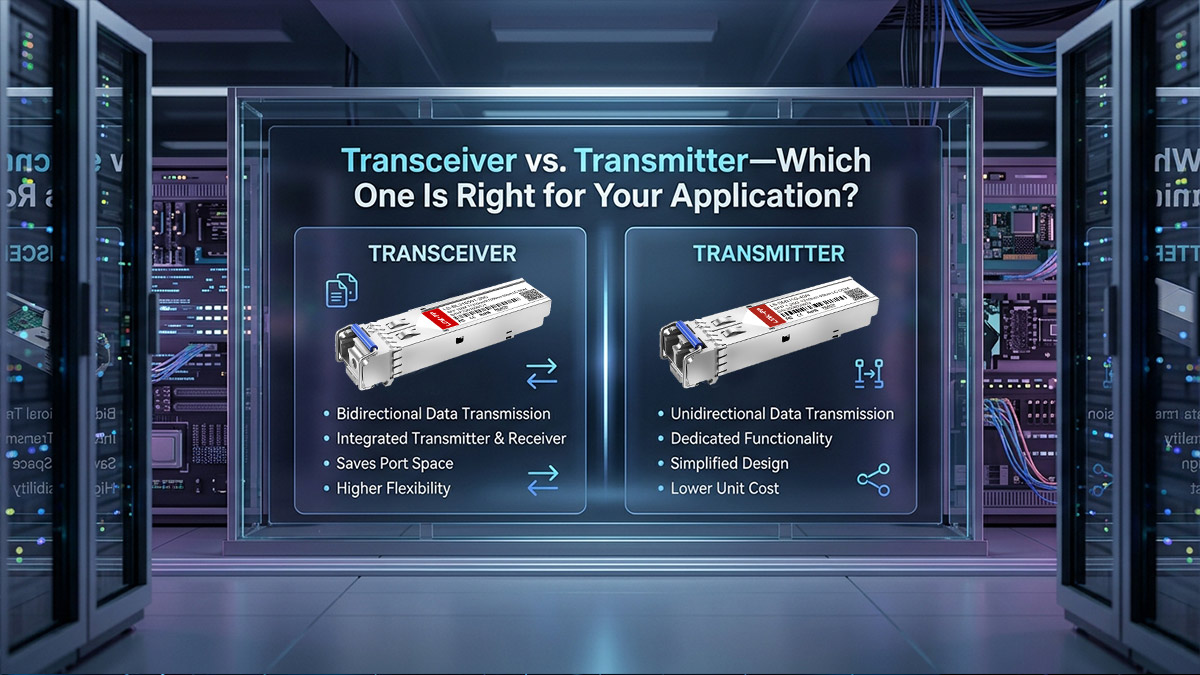
Procuring the wrong physical layer hardware will immediately halt a network deployment. To avoid wasted CAPEX and ensure seamless infrastructure scaling, network architects and IT buyers must evaluate their specific use cases against the following selection criteria.
How to Choose Between a Transceiver and a Transmitter
1. Selection Based on Application Requirements
Analyze the directionality of your data. Enterprise data centers, campus LANs, and Wi-Fi access points inherently require Full-Duplex communication to function; therefore, transceivers are mandatory. Conversely, remote telemetry sensors, security camera feeds, and live sports broadcasting (SDI-over-fiber) operate in Simplex mode. In these scenarios, a standalone transmitter eliminates the cost of unnecessary receiving circuitry.
2. Network and Communication Standards
Standardization drives cost down. Transceivers are strictly governed by IEEE 802.3 Ethernet standards and Multi-Source Agreements (MSAs), making them highly commoditized, interchangeable, and inexpensive. Standalone AV or industrial transmitters are often proprietary. If you build a network using proprietary transmitters, you are locking your procurement cycle to a single vendor's pricing model.
3. Distance, Speed, and Performance Requirements
Both devices can utilize high-end lasers (like DFB or EML) to push signals over 100 kilometers. However, if physical fiber strands are scarce, replacing standard dual-fiber transceivers with BiDi (Bi-Directional) transceivers allows you to double your network capacity over a single strand of glass, vastly outperforming the infrastructure efficiency of a simplex transmitter setup.
4. Future Scalability Considerations
Transceivers offer superior lifecycle scalability. If a network link needs to be upgraded from 10G to 25G, an IT engineer simply hot-swaps the SFP module. Upgrading a standalone transmitter system usually involves unmounting the entire hardware chassis, replacing proprietary power supplies, and installing an entirely new unit.
Recommended Selection Strategy
For forward-looking IT procurement, the strategic move is convergence. Many enterprises are abandoning expensive, proprietary standalone AV transmitters in favor of AV-over-IP. By encoding video streams into standard IP packets, organizations can leverage their existing Ethernet switches and use ultra-low-cost, standardized IT transceivers to route all voice, data, and video traffic across a single, unified infrastructure.
Next Steps for Network and Telecom Buyers
If your architecture dictates a two-way, IP-based network, your operational stability relies entirely on the quality of your optical transceivers. Sourcing modules that guarantee 100% MSA compliance, precise EEPROM vendor coding (to bypass OEM lock-in), and rigorous thermal testing is critical to avoiding network downtime.
To streamline your procurement cycle and secure enterprise-grade hardware at highly competitive price points, explore the comprehensive catalog of rigorously tested optical networking modules at the LINK-PP Official Store for SFP Transceivers.