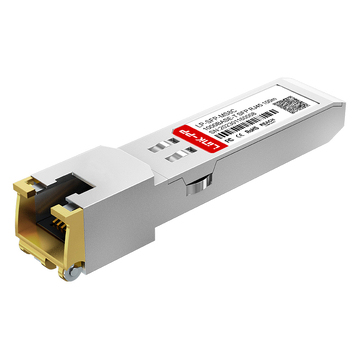
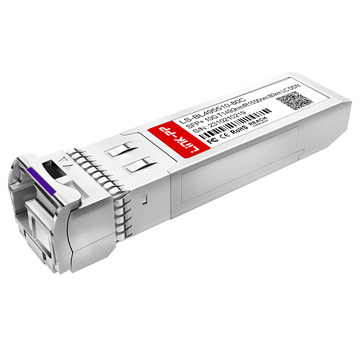
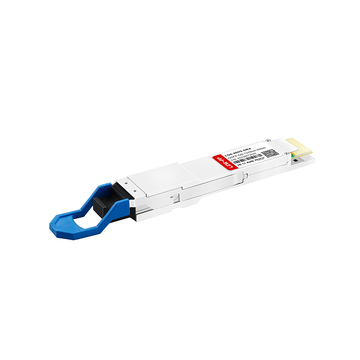
An SFP EEPROM is a 256-byte non-volatile memory chip inside a network transceiver that communicates module identity and diagnostic capabilities to a host switch via an I2C bus. Network engineers program these EEPROMs with specific OEM hex codes to bypass "unsupported transceiver" errors, ensuring multi-vendor interoperability and reducing optical hardware CapEx by up to 80%.

In enterprise data centers and ISP networks, managing optical transceivers often feels like navigating a maze of artificial hardware restrictions. While the physical hardware of a standard 10G, 40G, or 100G optical module is strictly governed by Multi-Source Agreement (MSA) standards—specifically the SFF-8472 specification—major Original Equipment Manufacturers (OEMs) like Cisco, Juniper, and Arista frequently implement proprietary software checks.
During the port initialization phase, the switch operating system reads the module's EEPROM. If the embedded cryptographic signature or vendor string fails to match the OEM's predefined whitelist, the switch rejects the optic, typically triggering an err-disable state or a "faulty module" system log. This mechanism is designed for one primary purpose: network vendor lock-in.
However, because the underlying EEPROM architecture is universally standardized, this lock-in can be systematically bypassed. This guide provides a deep technical analysis of SFP EEPROM logic. We will map the standard 256-byte memory structure, demonstrate how to extract and read I2C data using tools like Linux ethtool, and establish an actionable procurement framework for reprogramming generic SFP modules to achieve seamless, multi-vendor network stability.
🟣 What is an SFP EEPROM and How Does It Work?
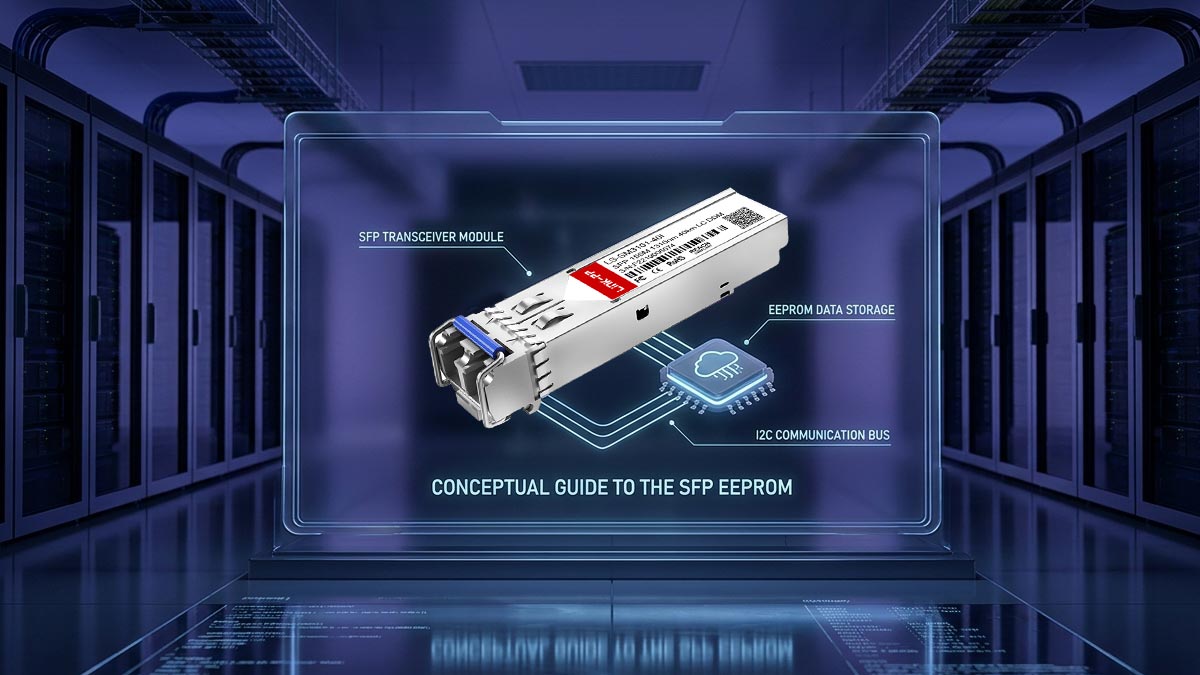
An SFP EEPROM (Electrically Erasable Programmable Read-Only Memory) is a non-volatile memory chip located on the transceiver's PCB. It stores critical identity, compatibility, and optical telemetry data. The host switch queries this chip via an I2C interface to verify the module's specifications and authorize the port connection.
The Physical Layer: I2C and the 24C02 Chip
At the hardware level, the SFP EEPROM is typically a standard 2Kbit memory IC (such as the 24C02 series). Its primary function is to act as the transceiver's digital passport. When an SFP module is inserted into a chassis, the switch does not immediately activate the laser. Instead, the switch's ASIC queries the EEPROM data via a 2-wire serial interface—universally known as an I2C (Inter-Integrated Circuit) bus—typically operating at a clock speed of 100 kHz.
Without a functioning EEPROM, the switch has no mechanism to determine the transceiver's wavelength, link reach, or power requirements, resulting in an immediate port fault or an unrecognized hardware error.
The SFF-8472 Standard and the 256-Byte Memory Map
To ensure global interoperability, the networking industry relies on the SFF-8472 MSA specification. This standard dictates a strict, standardized 256-byte memory map that all optical transceivers must follow. The switch accesses this data using two distinct I2C base addresses: A0h and A2h.
| I2C Address | Data Block Type | Key Parameters Stored |
|---|---|---|
| A0h (1010000X) | Module Identity Block (Static) |
|
| A2h (1010001X) | Diagnostic Data Block (Dynamic) |
|
The Module Identity Block (Address A0h) is the critical section for multi-vendor interoperability. It contains the static string values that the switch operating system parses during port initialization. Conversely, the Diagnostic Data Block (Address A2h) is utilized only if the module supports Digital Diagnostics Monitoring Interface (DDMI), providing engineers with real-time physical layer visibility.
🟣 How SFP EEPROM Affects Multi-Vendor Interoperability
Why do generic SFPs fail in OEM switches?
Multi-vendor interoperability fails because OEM switch operating systems actively scan the SFP EEPROM's A0h memory address for proprietary vendor strings and encrypted signatures. Even if a generic transceiver strictly follows MSA physical standards, the switch will disable the port if the EEPROM vendor coding does not match the OEM's programmed whitelist.
The SFP MSA Standard: The Universal Transceiver Language
To understand the root cause of interoperability issues, it is essential to distinguish between physical hardware and embedded software. The physical and electrical characteristics of optical transceivers are governed by the Multi-Source Agreement (MSA)—a collaborative framework established by competing manufacturers to ensure baseline compatibility.
Under MSA specifications (such as SFF-8074i for physical dimensions and SFF-8472 for diagnostic monitoring), the optical sub-assemblies (TOSA/ROSA), laser drivers, and I2C communication protocols are standardized. Consequently, a generic 10GBASE-LR module manufactured by an independent fab and a premium-branded OEM module are practically identical at the hardware level. They both transmit light at a 1310nm wavelength, support a 10km link budget, and speak the exact same base I2C language.
Why OEMs Use EEPROM for Vendor Lock-In
If the hardware is identical, why do two modules with the exact same speed and reach behave differently across different hardware platforms? The discrepancy lies entirely in vendor coding within the EEPROM.
Major network equipment manufacturers (OEMs like Cisco, HPE, and Juniper) design their switch firmware to expect specific module identification data. When an SFP is inserted, the switch OS (such as Cisco IOS-XE or Juniper Junos) executes a strict verification sequence:
- Module Identification (Bytes 20-35 & 37-52): The switch reads the A0h memory block to verify the Vendor Name and Vendor PN (Part Number). If an HPE switch reads "Generic" instead of "HP", it flags the module.
- Firmware Expectations & Cryptographic Signatures (Bytes 96-127): Advanced OEM switches go beyond simple text strings. They utilize the vendor-specific bytes in the EEPROM to store proprietary, encrypted hash keys. The switch calculates a checksum; if the hash fails, the authentication fails.
- Artificial Port Disabling: Upon authentication failure, the switch purposefully interrupts the transceiver's TX (Transmit) function or places the port into an err-disable state, generating an "unsupported transceiver" log.
| OEM Justification for EEPROM Lock-In | The Reality for Network Engineering |
|---|---|
| Quality Control & Stability: OEMs argue that restricting compatibility ensures that only thoroughly tested, thermally validated optics are used, protecting the switch hardware and upholding SLA guarantees. | Margin Protection: The primary function of EEPROM vendor coding is commercial. It allows OEMs to mark up MSA-standard optical hardware by 300% to 1000%, forcing enterprise buyers into a closed hardware ecosystem. |
Ultimately, EEPROM programming is not a reflection of a transceiver's optical quality, but rather a digital gatekeeping mechanism. Modifying this EEPROM code is the industry-standard method for bypassing these artificial restrictions and restoring true MSA interoperability.
🟣 Common SFP EEPROM Error Messages and What They Mean
How do you interpret SFP EEPROM errors?
When a switch rejects an optical module, syslog messages isolate the root cause. "Unsupported transceiver" errors indicate the switch successfully read the EEPROM but rejected the vendor coding (software lock-in). Conversely, "Faulty EEPROM" or missing DOM telemetry indicates a corrupted memory map, physical I2C bus damage, or a lack of SFF-8472 diagnostic support (hardware failure).
During the port initialization phase, the switch's operating system relies entirely on the EEPROM data to bring the physical layer online. When this process fails, the switch generates specific system logs. For network engineers, accurately interpreting these logs is the first step in determining whether you are facing an artificial vendor restriction or a genuine hardware fault.
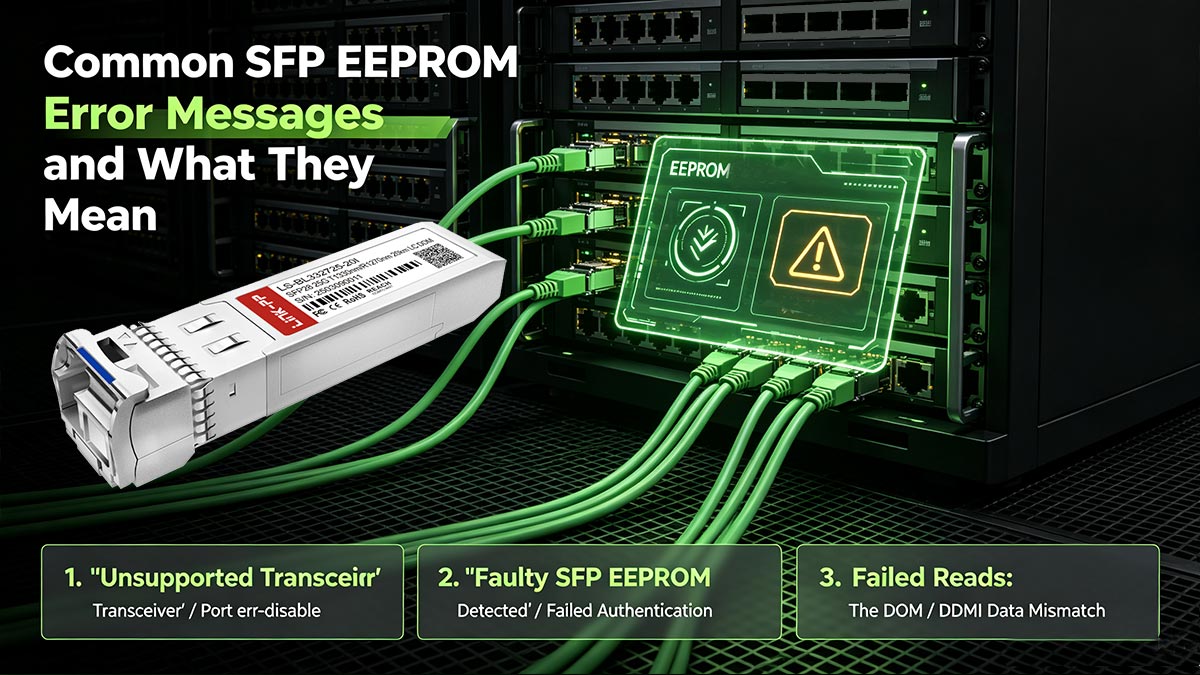
1. "Unsupported Transceiver" / Port err-disable
This is the most frequent error encountered in enterprise environments, particularly within Cisco, Aruba, and Juniper ecosystems. Common syslog outputs include %PHY-4-UNSUPPORTED_TRANSCEIVER or %GBIC_SECURITY_CRYPT-4-VN_DATA_CRC_ERROR.
- The Technical Reality: The transceiver hardware is perfectly functional. The switch's I2C bus successfully accessed the A0h address and read the module's specifications.
- The Root Cause: The vendor string (Bytes 20-35) or the proprietary cryptographic hash (Bytes 96-127) did not match the OEM's internal whitelist.
- The Result: The switch administratively shuts down the interface, placing it into an err-disable state. The link will not pass traffic until the port is reset or the EEPROM is flashed with an accepted vendor code.
2. "Faulty SFP EEPROM Detected" / Failed Authentication
Unlike an unsupported warning, a "faulty EEPROM" or "unrecognized module" log typically points to a low-level communication failure between the switch ASIC and the module's memory chip.
- The Technical Reality: The switch attempted to read the 256-byte memory map but received garbled hex data, a failed checksum, or no response at all.
- The Root Cause: This is usually a hardware-layer issue. It can be caused by physical damage to the module's I2C pins (SDA/SCL), electrical shorting, or a completely blank/corrupted 24C02 EEPROM chip resulting from a failed reprogramming attempt.
- The Result: The transceiver is entirely dead to the switch. It requires a complete hex code re-flash using an external SFP programmer, or physical replacement.
3. Failed Reads: The DOM / DDMI Data Mismatch
Occasionally, engineers encounter a scenario where the physical link is "UP" and successfully passing Layer 2/Layer 3 traffic, but the switch CLI or management UI displays "N/A" or throws errors regarding optical telemetry (TX/RX power, temperature).
- The Technical Reality: The switch successfully read the static Identity Block (A0h) and authorized the connection. However, the real-time Diagnostic Data Block (A2h) read failed.
- The Root Cause: Either the optical module is built to an older MSA standard (SFF-8074i) that physically lacks Digital Optical Monitoring (DOM) capabilities, or the EEPROM's internal addressing for the A2h block is corrupted.
- The Result: Traffic flows normally, but network monitoring platforms (like SolarWinds or PRTG) cannot pull SNMP data for optical health thresholds, creating blind spots in infrastructure management.
| Error Symptom | EEPROM Read Status | Primary Diagnosis |
|---|---|---|
| err-disable / Unsupported | Read Successful (A0h) | Software Lock-in. Vendor code mismatch. |
| Faulty / Unrecognized | Read Failed / Corrupted | Hardware Fault. Corrupted memory or broken I2C bus. |
| Link UP, but No DOM Data | A0h Success / A2h Failed | Non-DDMI compliant module, or A2h block corruption. |
🟣 How to Read and Program an SFP EEPROM
Engineers read SFP EEPROM data using switch CLI commands, Linux utilities like ethtool -m, or hardware I2C interfaces to extract the 256-byte hex dump. Programming requires a dedicated SFP EEPROM coder or microcontroller to write a specific OEM vendor signature into the module's A0h memory block, bypassing switch software restrictions.
Before attempting to flash or modify a generic SFP module, network engineers must first validate the existing memory map. Because switch operating systems generally restrict write-access to transceiver memory to prevent accidental bricking, reading can be done via software, but programming requires physical hardware intervention.
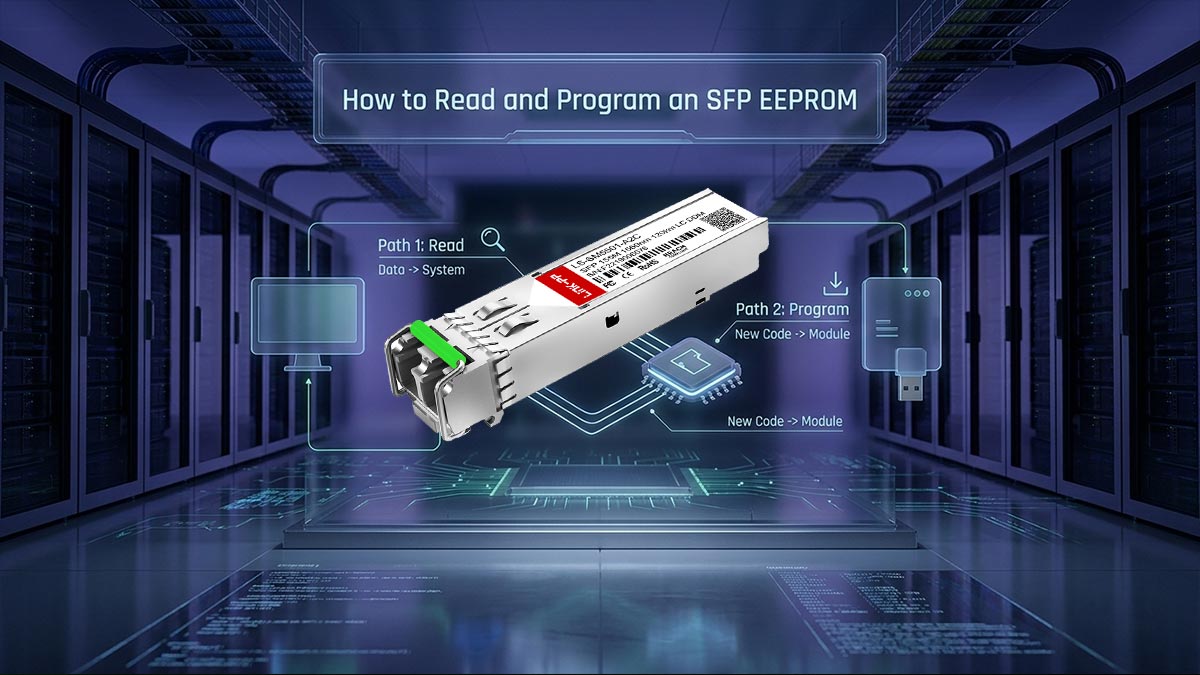
1. Software Extraction: Switch CLI Tools
Most enterprise-grade switches possess built-in diagnostic tools that read the I2C bus and decode the raw hex data into human-readable formats. While these commands do not allow you to alter the EEPROM, they are the first line of defense for verifying vendor coding and DOM telemetry.
- Cisco IOS/IOS-XE: Executing show interfaces transceiver detail displays the decoded SFF-8472 metrics (optical power, temperature). To view the deeper EEPROM identity block, engineers use show idprom interface [interface_id] to reveal the specific vendor string the switch is authenticating against.
- Juniper Junos: The command show interfaces diagnostics optics [interface_id] provides a similar decoded output of the A0h and A2h memory blocks.
2. OS-Level Extraction: Linux ethtool
For data center servers, SmartNICs, or advanced homelab environments running Linux, the OS interacts more directly with the hardware layer. The ethtool utility is the most powerful software method for reading SFP EEPROM data without proprietary switch software.
By running the command ethtool -m [interface_name] (or ethtool --dump-module-eeprom), Linux queries the I2C bus directly. This outputs the translated module specifications alongside the raw hexadecimal dump. This hex dump is exactly what engineers capture and save as a .bin file to clone the signature of a working OEM optic.
3. Hardware I2C Access: The Programming Layer
To actually program (flash) an SFP EEPROM, you must physically interface with the transceiver's printed circuit board using a master I2C device. The physical I2C pinout on an SFP module utilizes specific gold contacts: Pin 4 (SDA - Serial Data), Pin 5 (SCL - Serial Clock), Pin 15 (VccR - Power), and Pin 20 (VeeT - Ground).
| Commercial SFP Programmers | DIY / Open-Source Microcontrollers |
|---|---|
| Methodology: Devices like the FS Box or SFPTotal act as plug-and-play USB interfaces. They connect to cloud databases containing thousands of validated OEM hex codes. Best For: Enterprise IT procurement teams and MSPs who need fast, reliable, and standardized flashing without manual hex editing. |
Methodology: Utilizing a Raspberry Pi or Arduino wired directly to an SFP cage. Engineers use Linux utilities like i2c-tools (specifically i2cdump and i2cset) to manually push binary files to the 0x50 (A0h) address. Best For: Network research, homelabs, and deep-level hardware diagnostics. |
Technical Warning: Programming is only successful if the generic SFP module is "unlocked." Many low-cost or OEM-branded transceivers feature write-protected EEPROMs, which require a specific 4-byte hardware password sent over the I2C bus before the memory will accept new data.
🟣 SFP EEPROM Programming, Reprogramming, and Vendor Coding
Enterprises reprogram SFP EEPROMs to overwrite generic module identity blocks with proprietary OEM hex codes. Using a commercial SFP coding tool, IT teams can flash blank MSA-standard optics on-demand. This is a strategic procurement workaround that consolidates multi-vendor optical inventory into a single SKU, bypassing vendor lock-in and drastically reducing network CapEx.

The Mechanics of Vendor Coding: What a Programming Tool Actually Does
Reprogramming an SFP module is the process of altering the hexadecimal values within the A0h memory address to precisely mimic the cryptographic signature and vendor string of a premium OEM optic. Because manually editing binary files using a hex editor is prone to human error—specifically regarding the required checksum recalculations (Byte 63 CC_BASE and Byte 95 CC_EXT)—industry professionals rely on automated hardware.
A commercial SFP EEPROM programmer (often designed as a compact USB interface box) acts as the bridge between the transceiver's I2C bus and a management workstation. The standard workflow for these tools is highly streamlined:
- Interface Connection: The generic, unlocked SFP is inserted into the programmer's cage.
- Cloud-Based Hex Retrieval: The accompanying software connects to a maintained database of validated OEM codes. The engineer selects the target switch operating system (e.g., Arista EOS, Cisco NX-OS, or Juniper Junos).
- Automated Flashing: The tool sends the necessary write-protect bypass password, overwrites the A0h block with the target OEM's signature, recalculates the checksums, and locks the memory. The generic optic is now instantly recognized by the target switch as a native module.
Reprogramming as an IT Procurement Strategy
While altering EEPROM data requires deep technical understanding at the hardware level, in modern enterprise IT, reprogramming is rarely executed as a core networking or troubleshooting task. Instead, it is utilized as a highly effective procurement and inventory management strategy.
Data centers and Managed Service Providers (MSPs) operating multi-vendor environments face a significant logistical challenge: stocking spare optics. A traditional procurement model requires purchasing and storing separate, expensive SKUs for every switch brand in the network (e.g., hoarding separate 10GBASE-LR modules for Cisco, HP, and Extreme Networks), tying up massive amounts of IT budget in dormant inventory.
| Procurement Metric | Traditional OEM Sourcing | In-House EEPROM Programming Strategy |
|---|---|---|
| Inventory Complexity | High. Requires maintaining separate SKUs for every switch brand on the network. | Minimal. Requires stocking only one "blank" generic MSA-standard SKU. |
| Deployment Agility | Slow. Subject to OEM lead times and supply chain shortages. | Instant. Optics are flashed on-demand for whatever switch requires a replacement. |
| Capital Expenditure (CapEx) | Maximum cost. OEMs charge premium markups for proprietary coding. | Optimized. Organizations pay the baseline hardware cost for generic optics. |
By purchasing high-quality, MSA-compliant "blank" optics and pairing them with an SFP EEPROM programmer, procurement managers effectively decouple the physical optical hardware from the restrictive software layer. This shifts the power back to the enterprise, ensuring maximum network flexibility and minimizing unnecessary overhead.
🟣 Common Questions About SFP EEPROM Programming
1. Can you bypass a Cisco unsupported transceiver error without programming?
Yes, but with significant caveats. In Cisco IOS and NX-OS environments, engineers can input hidden commands such as service unsupported-transceiver followed by no errdisable detect cause gbic-invalid. This forces the switch to ignore the vendor string mismatch and bring the port up.
However, this is a software-layer band-aid. It is not officially supported by Cisco TAC, may trigger warning logs, and is frequently patched or disabled in newer OS updates. Modifying the EEPROM at the hardware layer is the only permanent, reliable method to ensure the switch natively accepts the optic.
2. Is it legal to alter SFP hex codes?
Absolutely. The physical transceiver is governed by the open MSA standard, and altering the embedded EEPROM data to make standard hardware function in a closed ecosystem is completely legal. It is widely practiced by data centers globally to avoid monopolistic OEM pricing. Note: While legal, using third-party optics may impact the official SLA or technical support from your switch manufacturer if a network fault is directly traced to the physical transceiver layer.
3. What happens if I flash the wrong code?
Flashing an SFP EEPROM is generally a non-destructive process. If you inadvertently flash a Juniper hex code onto a module intended for an HPE switch, the HPE switch will simply read the A0h block, reject the signature, and place the port into an err-disable state. As long as the transceiver's I2C bus is functional and the EEPROM is not permanently write-protected, you can simply place the module back into your programmer and overwrite it with the correct code.
🟣 Best Practices for Stable Multi-Vendor Deployments
How do you deploy third-party optics safely?
A stable multi-vendor optical deployment requires verifying switch OS compatibility, validating physical link status and A2h DOM telemetry in a lab environment prior to production, consolidating spare inventory to generic SKUs, and sourcing MSA-compliant hardware from reputable manufacturers to guarantee physical layer integrity.

Decoupling your optical hardware from OEM software restrictions provides massive CapEx savings, but it requires a disciplined deployment framework to maintain enterprise-grade network stability. Follow these core engineering best practices:
1. Switch OS Compatibility Checks
Switch manufacturers frequently update their operating systems (e.g., migrating from older IOS to IOS-XE or updating Arista EOS). Occasionally, these updates introduce stricter cryptographic hash checks designed to reject previously working third-party hex codes. Always verify that your SFP programmer’s cloud database contains validated codes for your specific target OS version before executing a mass deployment.
2. Lab Testing and DOM Validation
Never deploy a newly flashed generic SFP directly into a production core switch. Establish a staging environment to verify two critical parameters:
- Layer 1 State: Ensure the port comes UP cleanly without triggering syslog warnings.
- Telemetry Verification: Run the appropriate CLI command (e.g., show interface transceiver detail) to confirm the switch can successfully read the A2h Diagnostic Data Block. If TX/RX optical power levels read "N/A", the EEPROM checksums may have been calculated incorrectly during the flash.
3. Inventory and Spare Consolidation
Transition away from the traditional, fragmented sparing model. Standardize your optical inventory by maintaining a stockpile of high-quality "blank" (unlocked) generic optics alongside a commercial programming tool. This allows your IT team to deploy modules on-the-fly, reducing inventory holding costs and eliminating the risk of being caught without the correct OEM-specific spare during a hardware failure.
4. Source Reliable Hardware
EEPROM programming only solves the software compatibility issue; it does not improve the physical quality of the transceiver. The underlying optical sub-assemblies (lasers and photodiodes) must be engineered to exacting MSA tolerances to prevent bit errors and thermal failures.
When executing a multi-vendor strategy, the quality of your generic optics is paramount. Sourcing pre-coded or unlocked MSA-compliant transceivers from trusted industry manufacturers like the LINK-PP Official Store ensures you receive rigorously tested, highly reliable optical hardware that seamlessly integrates into your programmable network architecture.