In modern enterprise IT architecture, data centers are no longer isolated facilities but part of distributed systems that require continuous synchronization of storage, applications, and services. This shift has made Data Center Interconnect (DCI) an essential foundation for ensuring business continuity, disaster recovery readiness, and workload mobility. Within this environment, optical transceivers play a key role in maintaining stable, low latency communication between geographically or campus-close data centers.
Against this background, Brocade E1MG-SX-OM emerges as a widely adopted short-reach 1G SFP optical module designed for Fibre Channel and Ethernet connectivity over multimode fiber. It is commonly deployed in Brocade switching ecosystems where predictable performance and interoperability are required. Its relevance in DCI scenarios comes from its ability to support reliable short-distance optical links, which are critical for storage area network (SAN) communication and inter-data center replication within controlled ranges.
This article provides a structured technical overview of Brocade E1MG-SX-OM in the context of Data Center Interconnect applications. It covers its functional role, technical characteristics, deployment scenarios, performance considerations, and ecosystem compatibility. By examining these aspects, the content aims to help you understand how this optical module fits into modern and legacy data center architectures, and how it supports stable interconnect strategies in evolving network environments.
☀️ Brocade E1MG-SX-OM Overview in Data Center Interconnects
Brocade E1MG-SX-OM is a short-reach SFP optical transceiver used in Data Center Interconnect (DCI) to deliver stable, low-latency connectivity over multimode fiber for SAN and Ethernet environments.
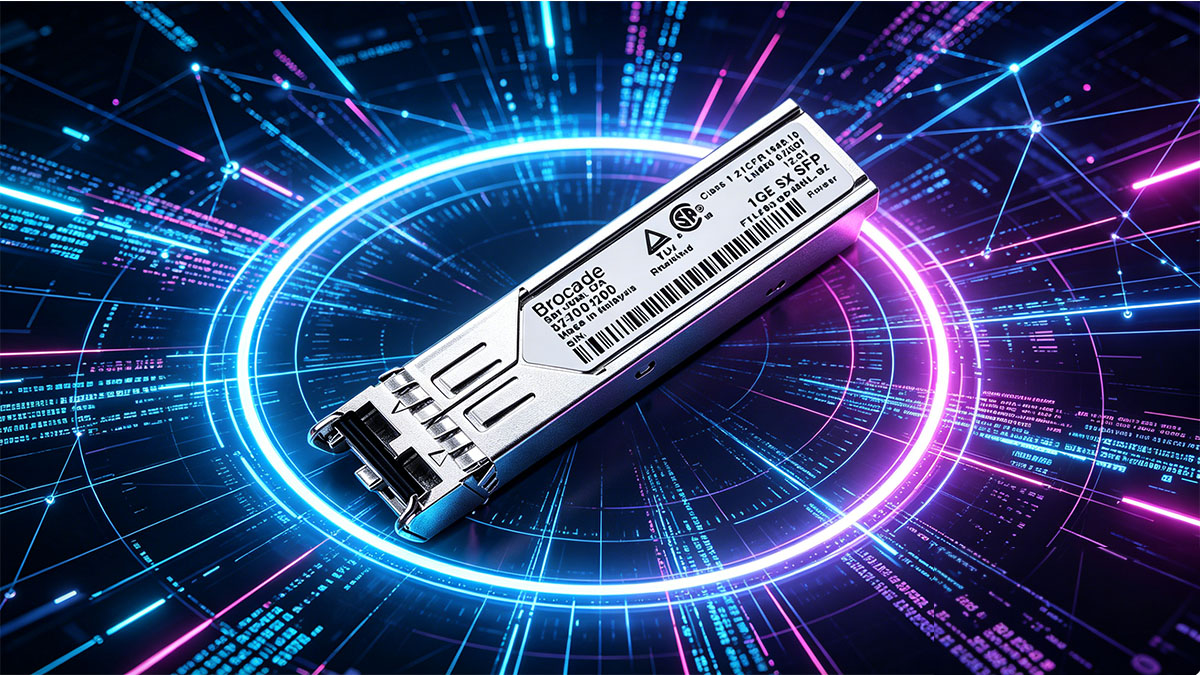
What is Brocade E1MG-SX-OM
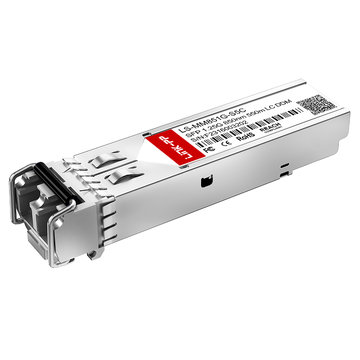
Brocade E1MG-SX-OM is an 850nm multimode fiber optic SFP module designed for short-distance optical transmission in Fibre Channel and Ethernet networks, primarily within or between nearby data centers.
To clearly position its capabilities, the module can be understood through the following technical dimensions:
| Parameter | Specification | Practical Impact |
|---|---|---|
| Form Factor | SFP | Fits standard switch ports |
| Wavelength | 850nm | Optimized for short-range MMF |
| Fiber Support | OM1–OM4 MMF | Flexible cabling compatibility |
| Distance Range | Up to ~550m (OM4) | Suitable for campus DCI |
These specifications indicate that the module is optimized for predictable performance rather than long-distance transmission.
From a deployment perspective, it is most effective in controlled environments where fiber quality and distance are well-managed, such as intra-building or campus-level interconnects.
Core Function in Enterprise Networks
Brocade E1MG-SX-OM primarily enables reliable data transmission between switches and storage systems, ensuring stable SAN and Ethernet communication in enterprise networks.
Its core functions can be broken down into several operational roles:
- Storage connectivity
- Connects servers to storage arrays within Fibre Channel SANs
- Supports consistent data flow for high IOPS workloads
- Switch interconnection
- Enables switch-to-switch links within Brocade fabrics
- Maintains fabric stability and low frame loss
- Rack and row-level networking
- Provides short-range optical links inside data halls
- Supports high-density port deployments
These roles highlight that the module operates at the physical layer but directly impacts higher-layer performance, especially in storage-driven environments.
In practice, its value is reflected in maintaining deterministic behavior, which is critical for applications such as database transactions and real-time data processing.
Relevance to Data Center Interconnect (DCI)
Brocade E1MG-SX-OM is relevant to DCI in short-range scenarios where nearby data centers require stable, low-latency interconnection for storage and application synchronization.
Its role in DCI can be structured across key application scenarios:
- Campus-level interconnect
- Connects data centers within the same geographic campus
- Supports direct fiber links without complex transport layers
- Storage replication support
- Enables synchronous replication between SAN fabrics
- Ensures data consistency across sites
- High-availability architectures
- Used in redundant link design (active/active or active/standby)
- Reduces risk of single-point failure in interconnect paths
- Bandwidth controlled environments
- Matches moderate bandwidth needs of legacy SAN systems
- Avoids over-provisioning in short-distance links
These scenarios demonstrate that the module is not intended for large-scale metro or long-haul DCI, but rather for precise, short-distance interconnect use cases.
In hybrid infrastructures, it often acts as a bridge between legacy Fibre Channel environments and evolving data center architectures, allowing organizations to maintain operational continuity while planning future upgrades.
☀️ Technical Specifications and Architecture
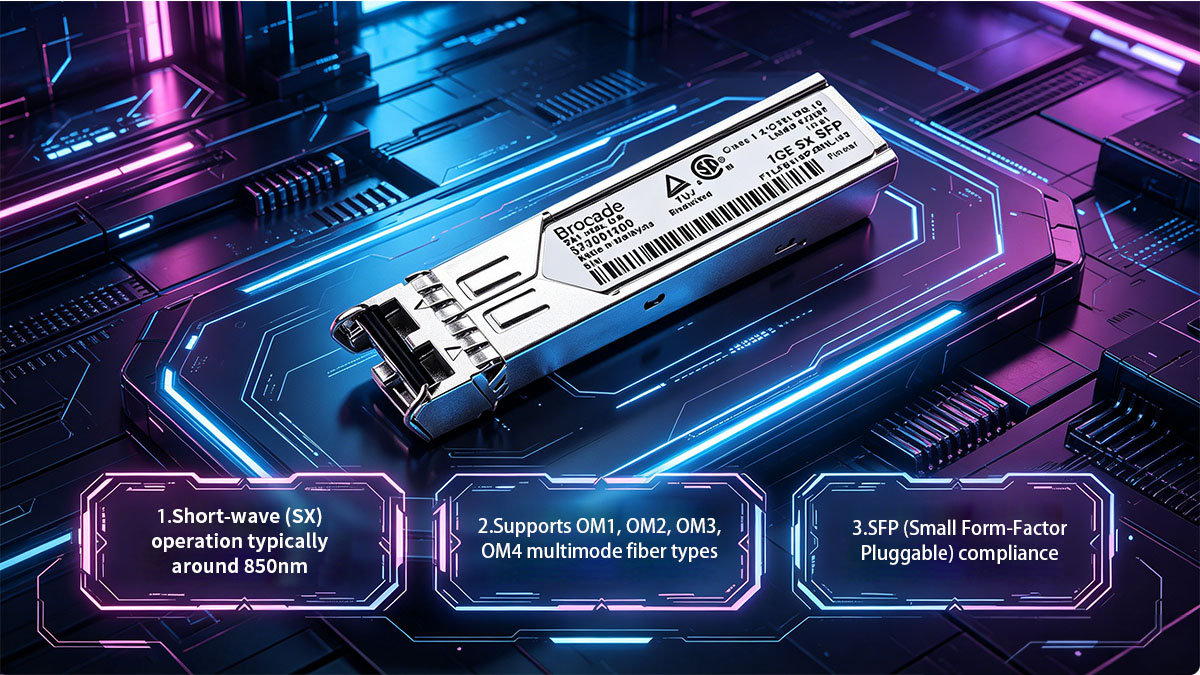
Brocade E1MG-SX-OM is built for short-range, high-stability optical transmission using multimode fiber, with a focus on predictable performance, low power consumption, and seamless integration into SFP-based switching environments.
Optical Characteristics and Wavelength
Brocade E1MG-SX-OM operates at 850nm and is optimized for multimode fiber, ensuring efficient signal transmission over short distances with minimal dispersion.
The optical behavior of the module can be understood through the following key characteristics:
- Short-wavelength transmission
- Uses 850nm VCSEL based optics
- Designed for high efficiency in multimode fiber cores
- Signal propagation properties
- Lower attenuation over short distances compared to long-wave MMF use
- Sensitive to modal dispersion in lower-grade fibers
- Stability factors
- Performs best in controlled environments with consistent fiber quality
- Less tolerant of poor connector conditions or contamination
These characteristics explain why the module is highly effective for intra-data center links but requires proper fiber management to maintain signal integrity.
Distance and Fiber Compatibility
Brocade E1MG-SX-OM supports multiple multimode fiber standards, with achievable distance varying based on fiber grade and quality.
The relationship between fiber type and transmission distance is summarized below:
| Fiber Type | Core Size | Typical Distance | Use Case |
|---|---|---|---|
| OM1 | 62.5µm | ~275m | Legacy infrastructure |
| OM2 | 50µm | ~300m | Basic MMF deployments |
| OM3 | 50µm (laser-optimized) | ~500m | Modern data centers |
| OM4 | 50µm (enhanced) | ~550m | High-performance MMF |
This variation shows that higher-grade fibers (OM3/OM4) significantly improve transmission distance and signal quality.
When designing DCI links, selecting the appropriate fiber type is critical to avoid signal degradation and ensure consistent performance across all links.
Form Factor and Interface Standards
Brocade E1MG-SX-OM follows the fiber SFP standard, allowing it to be deployed across a wide range of compatible switching platforms with hot-swappable flexibility.
Its interface characteristics include:
- Physical design
- Compact SFP form factor for high port density
- Enables efficient use of switch front-panel space
- Interface compatibility
- Supports Fibre Channel and Ethernet interfaces (depending on switch configuration)
- Designed specifically for Brocade ecosystem integration
- Operational flexibility
- Hot-pluggable without interrupting system operation
- Simplifies maintenance and scaling
These features make it suitable for environments where uptime and modular scalability are critical.
Power and Thermal Efficiency
Brocade E1MG-SX-OM is designed with low power consumption and stable thermal characteristics, supporting dense deployments in modern data centers.
Key efficiency aspects include:
- Power profile
- Typically low power draw compared to higher-speed optics
- Reduces overall switch energy consumption
- Thermal behavior
- Generates less heat, supporting high-density port usage
- Maintains stable operation within standard data center temperature ranges
- Deployment impact
- Minimizes cooling requirements in large-scale SAN environments
- Contributes to overall infrastructure efficiency
These efficiency characteristics are particularly important in DCI scenarios where multiple links are deployed in parallel, and cumulative power and heat can become a limiting factor.
Overall, the architecture of Brocade E1MG-SX-OM reflects a balance between performance, compatibility, and efficiency, making it well-suited for short-range interconnect use cases within and between data centers.
☀️ Deployment in Data Center Interconnect Scenarios
Brocade E1MG-SX-OM is primarily deployed in short-range DCI scenarios to provide stable, low-latency optical links for storage and switch interconnection within campus or adjacent data centers.
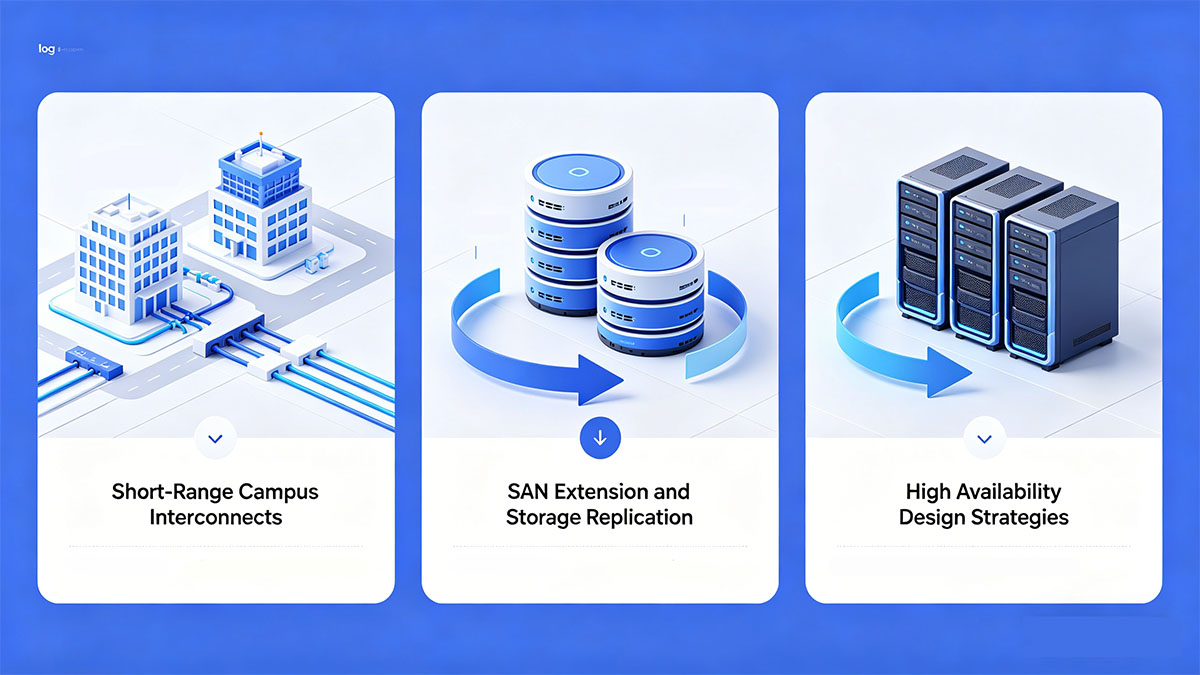
Short-Range Campus Interconnects
Brocade E1MG-SX-OM is well-suited for connecting data centers within the same campus, where distances fall within multimode fiber limits and require predictable performance.
Typical deployment characteristics include:
- Physical layout conditions
- Data centers located in adjacent buildings or within the same facility
- Fiber runs typically under 550m depending on OM grade
- Network design approach
- Direct fiber connections without intermediate optical transport systems
- Simplified architecture with fewer conversion layers
- Performance expectations
- Low latency due to short optical paths
- Stable throughput for east-west traffic
These deployments benefit from reduced complexity and lower operational overhead compared to long-haul DCI solutions.
In practice, this scenario is common in enterprise campuses, financial institutions, and large-scale private data center environments.
SAN Extension and Storage Replication
Brocade E1MG-SX-OM plays a critical role in extending SAN fabrics across data centers, enabling reliable storage replication for business continuity.
Its role in SAN extension can be structured as follows:
- Replication modes supported
- Synchronous replication for zero or near-zero data loss
- Asynchronous replication for longer distance tolerance within limits
- Data flow characteristics
- High sensitivity to latency and packet loss
- Requires consistent link stability for replication accuracy
- Infrastructure requirements
- Dedicated Fibre Channel links between SAN switches
- Clean optical paths with minimal signal degradation
To clarify how different replication types relate to link requirements:
| Replication Type | Latency Sensitivity | Distance Suitability | DCI Requirement |
|---|---|---|---|
| Synchronous | Very high | Short range | Stable, low-latency link |
| Asynchronous | Moderate | Short to medium | Flexible performance tolerance |
This highlights that Brocade E1MG-SX-OM is particularly aligned with synchronous replication scenarios where latency and stability are critical.
As a result, it is often used in environments that require strict data consistency, such as financial systems and transactional databases.
High Availability Design Strategies
Brocade E1MG-SX-OM supports high availability (HA) architectures in DCI by enabling redundant and resilient optical link designs.
Key HA strategies include:
- Link redundancy
- Dual-link or multi-link configurations between sites
- Protection against single fiber or port failure
- Path diversity
- Routing fibers through different physical paths
- Reduces risk of simultaneous link disruption
- Fabric-level resilience
- Multi-pathing within Fibre Channel SANs
- Automatic failover between active paths
- Load distribution
- Balancing traffic across multiple optical links
- Preventing congestion on single paths
These strategies ensure continuous operation even in the presence of component failures.
In DCI environments, combining Brocade E1MG-SX-OM with redundant design patterns significantly improves service availability and reduces downtime risk.
Overall, its deployment flexibility and compatibility with established SAN architectures make it a practical choice for building resilient short-range interconnect solutions.
☀️ Performance Considerations and Optimization
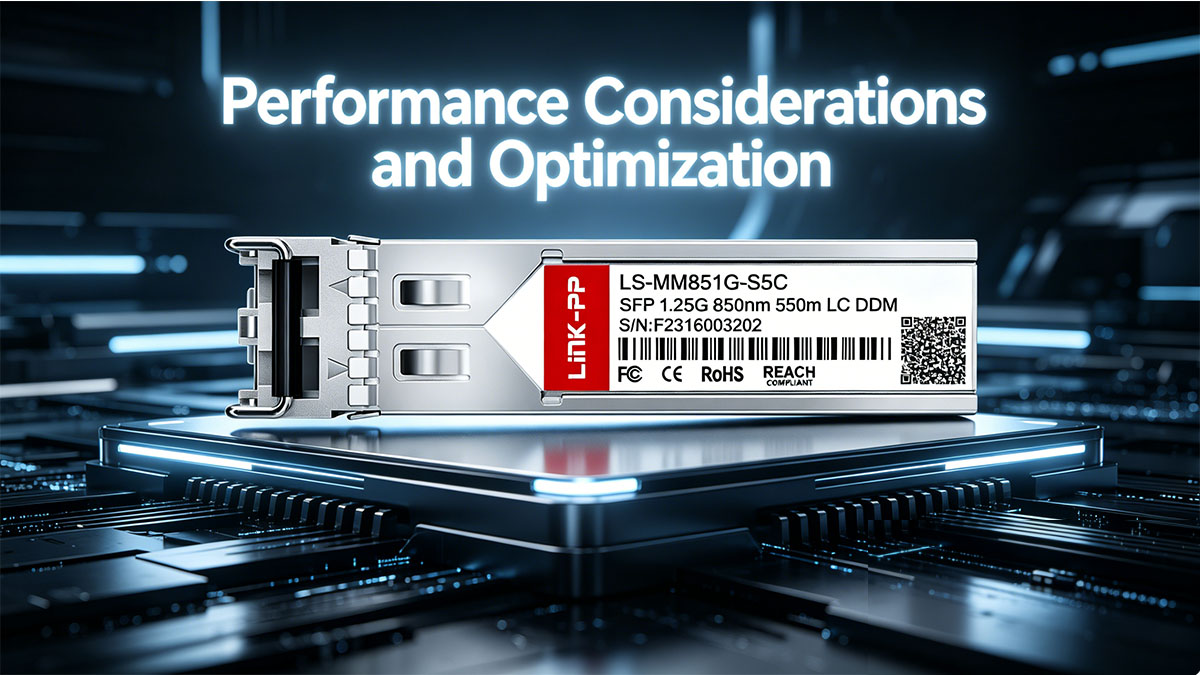
Brocade E1MG-SX-OM performance in DCI depends on latency control, efficient bandwidth usage, and maintaining strong signal integrity across multimode fiber links.
Latency Behavior in DCI Environments
Brocade E1MG-SX-OM introduces minimal transmission delay, making it suitable for latency-sensitive DCI workloads such as synchronous storage replication.
Key factors influencing latency include:
- Physical distance
- Shorter fiber length directly reduces propagation delay
- Typical campus links maintain microsecond-level latency
- Optical conversion overhead
- Minimal processing within SFP modules
- No complex signal regeneration for short-range optics
- Network design impact
- Fewer intermediate devices reduce cumulative latency
- Direct switch-to-switch links improve response time
These characteristics make the module well-aligned with workloads that require deterministic latency behavior.
In practice, latency optimization is achieved more through topology design than the SFP transceiver itself, but stable optics like this module ensure consistent baseline performance.
Bandwidth Utilization Efficiency
Brocade E1MG-SX-OM supports efficient bandwidth usage when properly matched with switch capabilities and traffic patterns in SAN and Ethernet environments.
Bandwidth efficiency can be optimized through the following approaches:
- Capacity alignment
- Match transceiver speed with switch port configuration
- Avoid underutilization or oversubscription
- Traffic segmentation
- Separate replication, backup, and application traffic where possible
- Reduce congestion on critical links
- Link aggregation
- Combine multiple optical links for higher effective throughput
- Improve utilization and provide redundancy
- Flow control mechanisms
- Use Fibre Channel buffer credits effectively
- Prevent frame loss in high-load scenarios
To illustrate how configuration choices impact utilization:
| Configuration Strategy | Bandwidth Efficiency | Risk Level | Typical Use Case |
|---|---|---|---|
| Single link | Moderate | Higher congestion risk | Small deployments |
| Link aggregation | High | Lower congestion risk | Medium-scale DCI |
| Segmented traffic | High | Controlled load distribution | Enterprise SAN |
These strategies demonstrate that achieving high efficiency requires coordination between physical links and logical traffic design.
Signal Integrity and Link Budget
Maintaining signal integrity is essential for ensuring stable performance of Brocade E1MG-SX-OM in DCI environments.
Key factors affecting link quality include:
- Fiber attenuation
- Signal loss increases with distance and connector count
- Higher-grade fiber reduces attenuation
- Connector and cleanliness
- Dust or contamination can significantly degrade signal quality
- Regular inspection and cleaning are required
- Modal dispersion
- More pronounced in lower-grade multimode fibers (OM1/OM2)
- Can limit effective transmission distance
- Link budget management
- Ensures transmitted power remains within receiver sensitivity range
- Prevents errors and link instability
A simplified view of link budget considerations:
| Factor | Impact on Signal | Optimization Method |
|---|---|---|
| Fiber quality | Affects attenuation | Use OM3/OM4 fiber |
| Connector condition | Causes signal loss | Clean and inspect regularly |
| Distance | Reduces signal strength | Keep within supported range |
| Patch panels | Adds insertion loss | Minimize unnecessary connections |
These factors collectively determine whether a link can maintain error-free transmission.
In DCI deployments, careful planning of the optical path—combined with proper maintenance practices—ensures that Brocade E1MG-SX-OM delivers consistent and reliable performance over time.
☀️ Compatibility and Ecosystem Integration
Brocade E1MG-SX-OM is designed for seamless integration within Brocade Fibre Channel ecosystems while maintaining standards-based compatibility for stable operation in mixed-vendor environments.
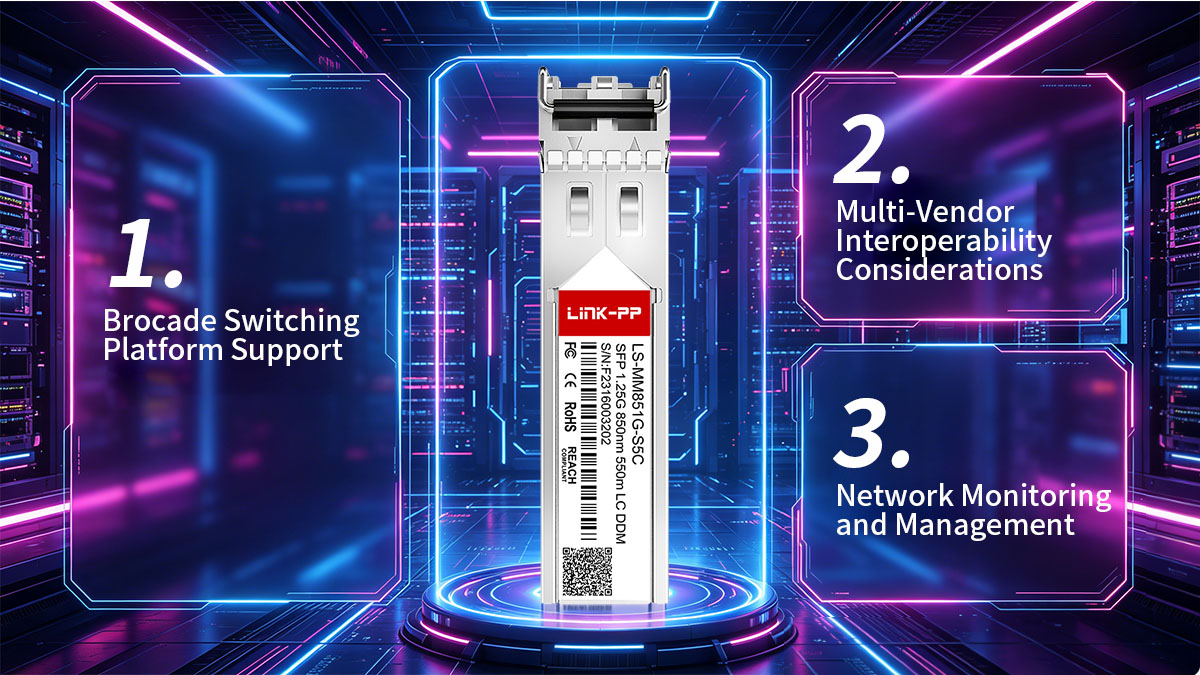
Brocade Switching Platform Support
Brocade E1MG-SX-OM is optimized for Brocade switches, ensuring consistent performance, full compatibility, and predictable behavior within Fibre Channel fabrics.
Its integration within Brocade environments can be understood through the following aspects:
- Native compatibility
- Fully supported by Brocade Fibre Channel switches
- No firmware mismatch or interoperability issues within the ecosystem
- Fabric stability
- Maintains consistent link initialization and synchronization
- Supports deterministic behavior required for SAN operations
- Management integration
- Recognized by Brocade management tools for monitoring and diagnostics
- Enables visibility into link status and optical parameters
To clarify its role within the ecosystem:
| Integration Aspect | Behavior | Operational Benefit |
|---|---|---|
| Switch compatibility | Native support | Simplified deployment |
| Fabric interaction | Stable link behavior | Reduced errors |
| Monitoring support | Full visibility | Easier troubleshooting |
These characteristics make it a reliable choice for organizations operating Brocade-centric SAN infrastructures.
In practice, this tight integration reduces deployment complexity and minimizes the risk of unexpected compatibility issues.
Multi-Vendor Interoperability Considerations
Brocade E1MG-SX-OM can operate in mixed-vendor environments, but interoperability depends on adherence to standards and proper configuration.
Key considerations include:
- Standards compliance
- Based on SFP and optical interface standards
- Supports interoperability at the physical layer
- Vendor-specific restrictions
- Some switches enforce transceiver validation (vendor locking)
- May require firmware compatibility or approved module lists
- Performance consistency
- Differences in switch implementations can affect link negotiation
- Requires validation testing in heterogeneous environments
- Risk mitigation strategies
- Use standardized configurations across devices
- Validate compatibility before production deployment
To better understand interoperability scenarios:
| Environment Type | Compatibility Level | Key Requirement |
|---|---|---|
| Brocade-only | High | Native support |
| Mixed Fibre Channel | Moderate | Standards alignment |
| Mixed Ethernet | Variable | Vendor validation |
These factors highlight that while interoperability is possible, it requires careful planning and testing.
In DCI environments where multiple vendors are involved, ensuring consistent behavior across all components is critical for maintaining link reliability.
Network Monitoring and Management
Brocade E1MG-SX-OM supports optical monitoring and diagnostics, enabling administrators to track performance and maintain link health in DCI deployments.
Its monitoring capabilities typically include:
- Optical diagnostics
- Real-time monitoring of transmit and receive power
- Detection of abnormal signal conditions
- Link status tracking
- Identification of link up/down events
- Monitoring of error rates and frame loss
- Integration with management platforms
- Visibility through SAN management tools
- Centralized monitoring across multiple switches
- Proactive maintenance
- Early detection of degradation trends
- Enables preventive action before link failure
These capabilities are essential for maintaining stable DCI operations, where undetected optical issues can impact replication and application performance.
In large-scale environments, combining Brocade E1MG-SX-OM with centralized monitoring tools helps ensure consistent performance, faster troubleshooting, and improved operational efficiency.
☀️ Best Practices for Deployment
Brocade E1MG-SX-OM deployment is most effective when fiber quality, installation practices, and ongoing maintenance are carefully managed to ensure stable short-range optical performance.
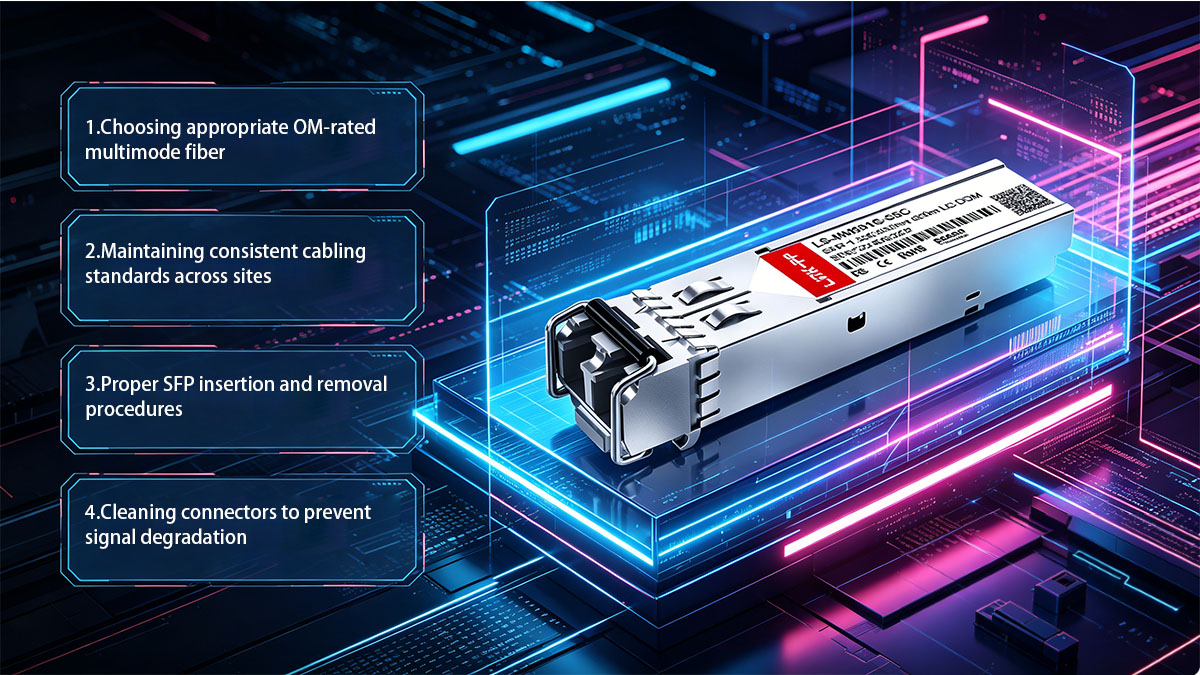
Fiber Infrastructure Selection
Choosing the right multimode fiber is critical to achieving expected distance, signal quality, and long-term reliability in DCI environments.
Key selection criteria include:
- Fiber grade selection
- OM3 or OM4 recommended for modern data centers
- OM1/OM2 suitable only for legacy environments with shorter distances
- Distance planning
- Match fiber type with required link length
- Avoid operating near maximum distance thresholds
- Cabling consistency
- Use the same fiber grade across the entire link
- Prevent mismatched segments that introduce signal loss
- Scalability considerations
- Prefer higher-grade fiber for future upgrades
- Reduce need for re-cabling during expansion
To clarify how fiber choice impacts deployment:
| Fiber Type | Recommended Use | Distance Stability | Future Readiness |
|---|---|---|---|
| OM1/OM2 | Legacy systems | Limited | Low |
| OM3 | Standard deployments | Stable | Moderate |
| OM4 | High-performance environments | Highly stable | High |
Selecting appropriate fiber infrastructure ensures that Brocade E1MG-SX-OM operates within optimal parameters and minimizes performance risks.
Installation and Handling Guidelines
Proper installation directly affects optical performance, as physical handling errors can introduce signal degradation or link instability.
Best practices during installation include:
- Module handling
- Insert and remove SFP transceiver modules carefully to avoid port damage
- Ensure proper seating in the switch interface
- Connector cleanliness
- Clean fiber connectors before insertion
- Use inspection tools to detect contamination
- Cable management
- Avoid excessive bending or तनाव on fiber cables
- Maintain proper bend radius to prevent signal loss
- Labeling and documentation
- Clearly label fiber links and ports
- Maintain accurate connection records for troubleshooting
These practices reduce the likelihood of physical-layer issues that can affect link performance.
In DCI deployments, where multiple links operate simultaneously, consistent installation standards are essential for maintaining uniform performance across all connections.
Troubleshooting Common Issues
Effective troubleshooting ensures quick resolution of link issues and minimizes downtime in DCI environments.
Common problems and their diagnostic approaches include:
- Link not coming up
- Verify transceiver compatibility with the switch
- Check fiber polarity and correct TX/RX alignment
- Intermittent link failures
- Inspect connectors for contamination or damage
- Check for loose connections or unstable ports
- High error rates
- Measure optical power levels
- Identify excessive attenuation or poor-quality fiber
- Reduced performance
- Analyze bandwidth utilization and congestion
- Confirm proper configuration of SAN or Ethernet settings
A structured troubleshooting approach can be summarized as follows:
| Issue Type | Likely Cause | Recommended Action |
|---|---|---|
| Link down | Polarity or compatibility | Verify connections |
| Flapping link | Dirty connectors | Clean and inspect |
| High errors | Signal attenuation | Check fiber quality |
| Low throughput | Congestion/configuration | Optimize traffic |
Applying these methods helps isolate root causes efficiently.
In practice, combining proper installation, regular inspection, and structured troubleshooting ensures that Brocade E1MG-SX-OM maintains reliable performance throughout its lifecycle in Data Center Interconnect deployments.
☀️ Advantages and Limitations in Modern Data Centers
Brocade E1MG-SX-OM provides reliable, cost-efficient short-range connectivity for SAN and Ethernet environments, but it is limited by distance and scalability compared to newer high-speed optical technologies.

Strengths in Legacy SAN Environments
Brocade E1MG-SX-OM is highly effective in established Fibre Channel environments where stability, compatibility, and predictable performance are more critical than bandwidth expansion.
Its strengths can be structured as follows:
- Proven reliability
- Designed for stable operation in Fibre Channel SANs
- Consistent performance under continuous workloads
- Ecosystem compatibility
- Fully aligned with Brocade switching platforms
- Minimizes integration and configuration complexity
- Efficient use of existing infrastructure
- Leverages installed multimode fiber (OM1–OM4)
- Avoids large-scale cabling replacement
- Cost and operational efficiency
- Lower power consumption compared to higher-speed optics
- Reduced cooling and energy requirements
To summarize its advantages in legacy environments:
| Advantage Area | Impact | Practical Benefit |
|---|---|---|
| Compatibility | High | Seamless deployment |
| Stability | High | Reliable SAN operation |
| Infrastructure reuse | Strong | Lower upgrade cost |
| Power efficiency | Moderate | Reduced operational load |
These strengths explain why the module remains widely used in environments where infrastructure stability is prioritized over rapid modernization.
Limitations in High-Speed Architectures
Brocade E1MG-SX-OM faces clear limitations in modern data centers that demand higher bandwidth, longer reach, and greater scalability.
Key constraints include:
- Bandwidth limitations
- Lower data rates compared to SFP+ 10G, SFP28 25G, or QSFP modules (QSFP+ 40G, QSFP28 100G,)
- Not suitable for high-throughput spine-leaf architectures
- Distance constraints
- Restricted to short-range multimode fiber links
- Cannot support metro or long-haul DCI scenarios
- Scalability challenges
- Limited ability to scale with growing traffic demands
- Requires multiple parallel links to increase capacity
- Technology evolution gap
- Lacks support for newer protocols and higher-speed standards
- May not align with cloud-scale infrastructure requirements
A comparison with newer optical technologies highlights these gaps:
| Feature | E1MG-SX-OM | Modern Optics (10G+) |
|---|---|---|
| Bandwidth | Low | High |
| Distance | Short | Medium to long |
| Scalability | Limited | High |
| Use Case | Legacy SAN/DCI | Cloud/DCI backbone |
These limitations indicate that while the module is reliable, it is not designed for future high-performance network architectures.
Migration Considerations
Brocade E1MG-SX-OM can still play a role during infrastructure transition, acting as a bridge between legacy systems and modern optical networks.
Migration strategies typically include:
- Phased upgrade approach
- Retain existing SFP-based links while upgrading core layers
- Gradually introduce higher-speed optics
- Hybrid architecture design
- Combine legacy Fibre Channel with newer Ethernet-based solutions
- Maintain interoperability during transition
- Selective replacement
- Upgrade only bandwidth-critical links first
- Preserve stable links where performance is sufficient
- Risk management
- Avoid large-scale disruption by incremental changes
- Validate compatibility at each stage
To outline typical migration paths:
| Strategy | Scope | Risk Level | Use Case |
|---|---|---|---|
| Full replacement | Entire network | High | Major upgrades |
| Phased upgrade | Partial layers | Moderate | Enterprise transition |
| Hybrid deployment | Mixed technologies | Low | Gradual evolution |
These approaches allow organizations to balance performance improvement with operational continuity.
In modern data centers, Brocade E1MG-SX-OM remains valuable where stability and compatibility are required, but long-term strategies often involve transitioning toward higher-speed optical solutions to meet evolving DCI demands.
☀️ Conclusion
Brocade E1MG-SX-OM is a reliable short-reach optical module for Data Center Interconnect scenarios, particularly in Fibre Channel SAN environments where stability and compatibility are more important than high-speed scalability.
This article highlights several essential points:
- Designed for short-distance multimode fiber links in campus or intra-data center environments
- Supports stable SAN extension and storage replication with low latency
- Fully compatible with Brocade switching ecosystems, ensuring predictable performance
- Performance is closely tied to fiber quality, link design, and proper installation practices
- Limited in bandwidth and distance compared to newer optical technologies
In practical deployments, Brocade E1MG-SX-OM continues to provide value by enabling consistent and low-risk interconnect solutions, especially in legacy or hybrid infrastructures. It allows organizations to maintain operational continuity while incrementally evolving their network architecture.
For those planning deployments or evaluating compatible optical modules, sourcing reliable and well-tested transceivers is equally important as design considerations. Platforms such as LINK-PP Official Store can serve as a reference point for understanding compatible options and ensuring alignment with existing network environments. By combining proper product selection with structured deployment strategies, organizations can achieve stable and efficient DCI performance while preparing for future upgrades.