

























As enterprise networks and data center infrastructures continue to evolve toward higher bandwidth requirements, 10GbE connectivity has become a critical foundation for efficient and reliable data transmission. For short-distance network links, organizations increasingly require solutions that combine high-speed performance, low latency, simple deployment, and reduced power consumption while maintaining stable connectivity.
SFP-H10GB-CUxM is a passive SFP+ Direct Attach Copper (DAC) cable designed to address these short-range 10G connectivity requirements. By combining SFP+ connectors with copper twinax cable technology, it provides a practical connection option for server-to-switch, switch-to-switch, and storage networking environments where optical solutions may not be necessary.
This article offers a detailed overview of SFP-H10GB-CUxM, including its design characteristics, technical specifications, transmission principles, applications, and compatibility considerations. Readers will learn:
- The key features and construction of SFP-H10GB-CUxM as a 10G SFP+ DAC cable
- The technical parameters that affect performance and deployment decisions
- The common application scenarios and compatibility factors for network integration
By exploring these aspects, network engineers and IT professionals can better understand the role of SFP-H10GB-CUxM in modern 10GbE infrastructure and evaluate its suitability for specific short-distance connectivity requirements.
🧾 SFP-H10GB-CUxM Overview
SFP-H10GB-CUxM is a 10G SFP+ Direct Attach Copper (DAC) cable designed for short-distance, high-speed data transmission between network devices equipped with SFP+ ports. It provides a simple and efficient connectivity solution by combining SFP+ connectors with a passive copper cable assembly, making it suitable for data centers, enterprise networks, and storage environments where low latency and power efficiency are important.
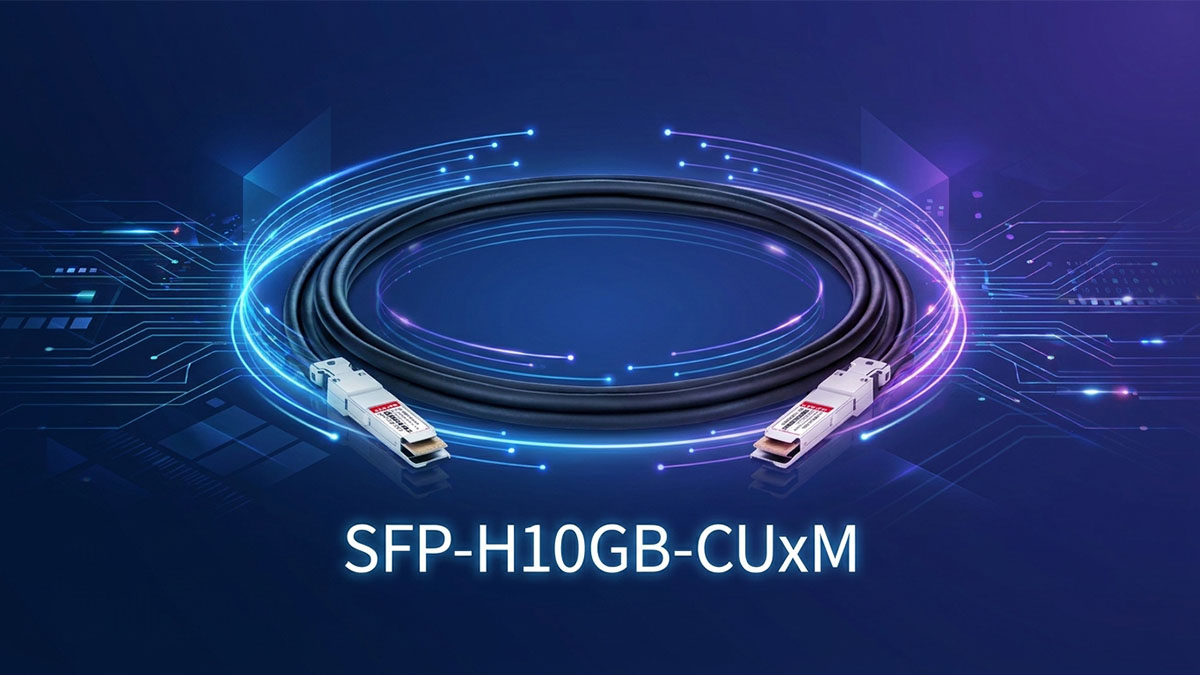
What Is SFP-H10GB-CUxM?
SFP-H10GB-CUxM refers to a family of SFP+ to SFP+ passive copper cables that support 10Gbps Ethernet connections. The "xM" suffix represents the cable length in meters, allowing different versions to be selected based on deployment distance requirements. For example, SFP-H10GB-CU1M indicates a 1-meter cable, SFP-H10GB-CU3M represents a 3-meter cable, and SFP-H10GB-CU5M refers to a 5-meter cable.
The main characteristics of SFP-H10GB-CUxM include:
- Designed for 10GbE connectivity through SFP+ interfaces
- Uses passive twinax copper cable technology for direct electrical signal transmission
- Integrates two SFP+ connectors with a fixed-length copper cable assembly
- Available in different cable lengths to support various short-range deployment scenarios
- Provides a plug-and-play connection method without separate optical modules and fiber patch cables
Because SFP-H10GB-CUxM uses a direct copper connection, it is mainly optimized for short-distance links within the same rack or between adjacent network equipment. This design helps reduce installation complexity while maintaining reliable 10G network performance.
Key Characteristics of SFP-H10GB-CUxM
SFP-H10GB-CUxM is characterized by its passive copper architecture, flexible length options, and efficient transmission performance, making it a common choice for short-range 10GbE connections. Its design focuses on reducing power consumption and simplifying network deployment compared with fiber-based alternatives.
The primary characteristics of SFP-H10GB-CUxM include:
- Passive copper transmission: The cable transmits electrical signals directly through copper conductors without requiring optical conversion components.
- Multiple length options: The CUxM naming format allows users to identify and select the appropriate cable length according to physical installation requirements.
- Low power consumption: The passive DAC structure generally requires less power than active optical connectivity solutions.
- Low latency performance: Direct electrical transmission minimizes additional signal processing during data communication.
- High-density deployment support: The compact SFP+ form factor helps optimize cable management in crowded network racks.
These characteristics make SFP-H10GB-CUxM particularly suitable for environments that require reliable 10G connections over limited distances, such as server racks, top-of-rack switching architectures, and storage networking systems.
SFP-H10GB-CUxM Cable Design and Construction
The cable structure of SFP-H10GB-CUxM is designed to provide stable signal transmission while simplifying installation in high-density network environments. It consists of two SFP+ connectors connected by a shielded twinax copper cable, with the cable length determined by the specific CUxM variant.
The main construction elements include:
- SFP+ connectors on both ends for direct connection to compatible switches, servers, or storage devices
- Shielded twinax copper cable designed for high-speed electrical signal transmission
- Fixed cable lengths such as 1-meter, 3-meter, and 5-meter versions to match different rack layouts
- Integrated assembly that reduces the need for separate cable and transceiver selection
The fixed-length design of SFP-H10GB-CUxM helps simplify network installation and improves cable organization. However, selecting the appropriate length is important because excessive cable slack can affect rack management, while insufficient length may limit deployment flexibility. For this reason, the CUxM length specification plays an important role when planning 10G short-distance network connections.
🧾 SFP-H10GB-CUxM Technical Specifications
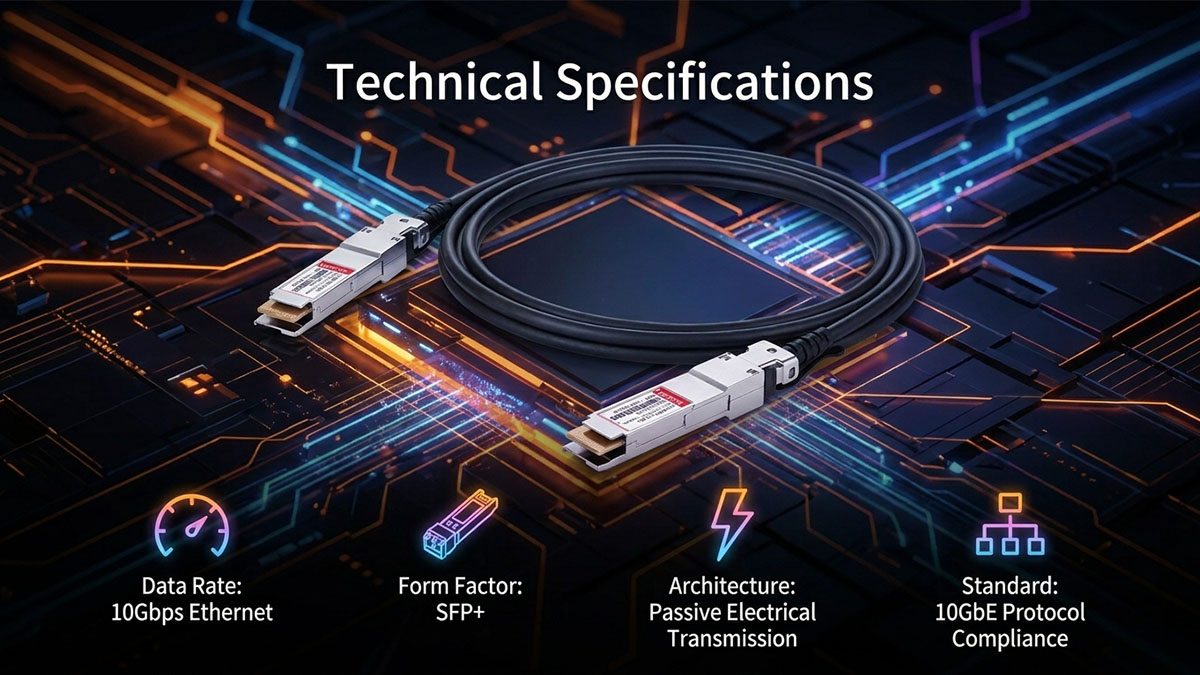
SFP-H10GB-CUxM technical specifications define its 10G transmission capability, passive copper architecture, electrical characteristics, and physical design parameters. These specifications determine how the cable performs in short-distance SFP+ network connections and whether it can meet the requirements of specific data center and enterprise deployments.
Data Rate and Transmission Performance
SFP-H10GB-CUxM is designed for 10GbE short-range connectivity, providing a 10Gbps data transmission rate through a passive copper cable assembly. Its performance is optimized for direct connections between SFP+ ports, where low latency and stable electrical signal transmission are required.
The key transmission-related specifications of SFP-H10GB-CUxM include:
| Parameter | Specification |
|---|---|
| Network Interface | SFP+ to SFP+ Direct Attach Copper |
| Data Rate | 10Gbps |
| Signaling Rate | 10.3125GBd |
| Cable Type | Passive Twinax Copper Cable |
| Differential Impedance | 100Ω |
| Transmission Application | 10GBASE Ethernet, 10G Fibre Channel |
These parameters allow SFP-H10GB-CUxM to support high-speed data exchange between compatible switches, servers, and storage devices. The passive DAC design avoids optical-to-electrical conversion, helping maintain low transmission latency for short-distance connections.
Electrical Characteristics
The electrical specifications of SFP-H10GB-CUxM are designed to ensure reliable signal transmission through copper conductors while maintaining compatibility with SFP+ host interfaces. Unlike optical modules that rely on laser transmitters and receivers, this passive cable assembly transfers electrical signals directly between connected devices.
The main electrical characteristics include:
- 3.3V single power supply interface
- AC-coupled input and output design
- 100Ω differential impedance for signal integrity
- Enhanced EMI design to reduce electromagnetic interference
- Low power consumption compared with active optical connectivity solutions
These electrical characteristics help SFP-H10GB-CUxM maintain stable communication in high-density rack environments where multiple high-speed connections operate simultaneously.
Mechanical and Environmental Specifications
The mechanical design of SFP-H10GB-CUxM focuses on installation flexibility, cable management efficiency, and reliable operation in controlled networking environments. The "xM" designation represents different cable lengths, allowing users to select the appropriate version based on physical deployment requirements.
Common SFP-H10GB-CUxM length options include:
| Model Example | Cable Length | Typical Deployment Scenario |
|---|---|---|
| SFP-H10GB-CU1M | 1m | Server-to-switch connections within the same rack |
| SFP-H10GB-CU3M | 3m | Rack-level equipment interconnections |
| SFP-H10GB-CU5M | 5m | Short-distance connections between adjacent racks |
The cable construction generally uses shielded twinax copper with integrated SFP+ connectors on both ends. Different cable lengths may use different wire gauges to maintain signal performance, with shorter cables commonly using thinner conductors and longer cables requiring larger gauge designs.
Environmental specifications typically include:
- Operating temperature range suitable for standard data center environments
- Storage temperature tolerance for transportation and inventory management
- RoHS-compliant materials for environmentally responsible deployment
These mechanical and environmental features make SFP-H10GB-CUxM suitable for indoor networking applications where cable distance requirements remain within DAC limitations.
Standards and Protocol Compatibility
SFP-H10GB-CUxM follows industry standards for SFP+ Direct Attach Copper connectivity, enabling interoperability with compatible 10GbE networking equipment. Proper standards compliance ensures that the cable can communicate correctly with supported switches, servers, and network adapters.
The main compatibility standards and protocols include:
- IEEE 802.3ae 10 Gigabit Ethernet support
- SFP+ MSA interface compliance
- SFF-8431 electrical specification compliance
- SFF-8432 mechanical specification compliance
- 10G Fibre Channel support in compatible environments
These standards help define the electrical interface, connector structure, and communication requirements of SFP-H10GB-CUxM. However, practical deployment still requires verifying whether the cable coding and firmware requirements are accepted by the specific network equipment being used.
🧾 How SFP-H10GB-CUxM Works in 10G Network Connections
SFP-H10GB-CUxM works by transmitting electrical signals directly between two network devices equipped with SFP+ ports through a passive copper cable assembly. Instead of converting electrical signals into optical signals and transmitting them through fiber, it provides a direct copper-based connection path that reduces complexity, power consumption, and latency in short-distance 10G network deployments.

Signal Transmission Process
SFP-H10GB-CUxM enables 10GbE communication through a straightforward electrical transmission process. The connected network devices generate and process high-speed data signals, while the passive DAC cable transfers these signals through copper conductors without active signal amplification inside the cable assembly.
The signal transmission process includes the following steps:
- Data signal generation
- A network device, such as a switch, server, or network adapter, generates 10GbE electrical signals through its SFP+ port.
- The host device prepares the data stream according to supported Ethernet or Fibre Channel protocols.
- Electrical signal transmission through copper conductors
- The signal travels through the twinax copper cable inside SFP-H10GB-CUxM.
- The shielded copper structure helps maintain signal integrity and reduce electromagnetic interference during transmission.
- Signal reception and processing
- The receiving SFP+ interface captures the electrical signal from the cable.
- The connected device processes the incoming data and forwards it through the network architecture.
Because SFP-H10GB-CUxM uses a passive design, there are no optical lasers, photodiodes, or signal amplification components inside the cable assembly. This direct transmission method helps achieve low latency and lower power consumption for short-range connections.
Connection Architecture
SFP-H10GB-CUxM is mainly used for point-to-point 10G connections where both devices are located within a limited physical distance. The integrated SFP+ connectors allow direct connection between compatible network equipment without additional fiber patch cables or separate transceiver modules.
Common SFP-H10GB-CUxM connection architectures include:
| Connection Type | Typical Deployment | Main Benefit |
|---|---|---|
| Switch-to-server | Server racks and top-of-rack switching environments | Provides direct 10G connectivity with low latency |
| Switch-to-switch | Rack-level or adjacent switch interconnections | Simplifies short-distance network expansion |
| Storage-to-switch | Storage networking environments | Supports high-speed data transfer with reduced complexity |
These connection scenarios demonstrate why SFP-H10GB-CUxM is widely used in data center and enterprise environments where devices are positioned close to each other. Its fixed-length cable design, including options such as CU1M, CU3M, and CU5M, allows network engineers to select a suitable cable length based on rack layout and equipment spacing.
🧾 SFP-H10GB-CUxM Applications in Modern Networks
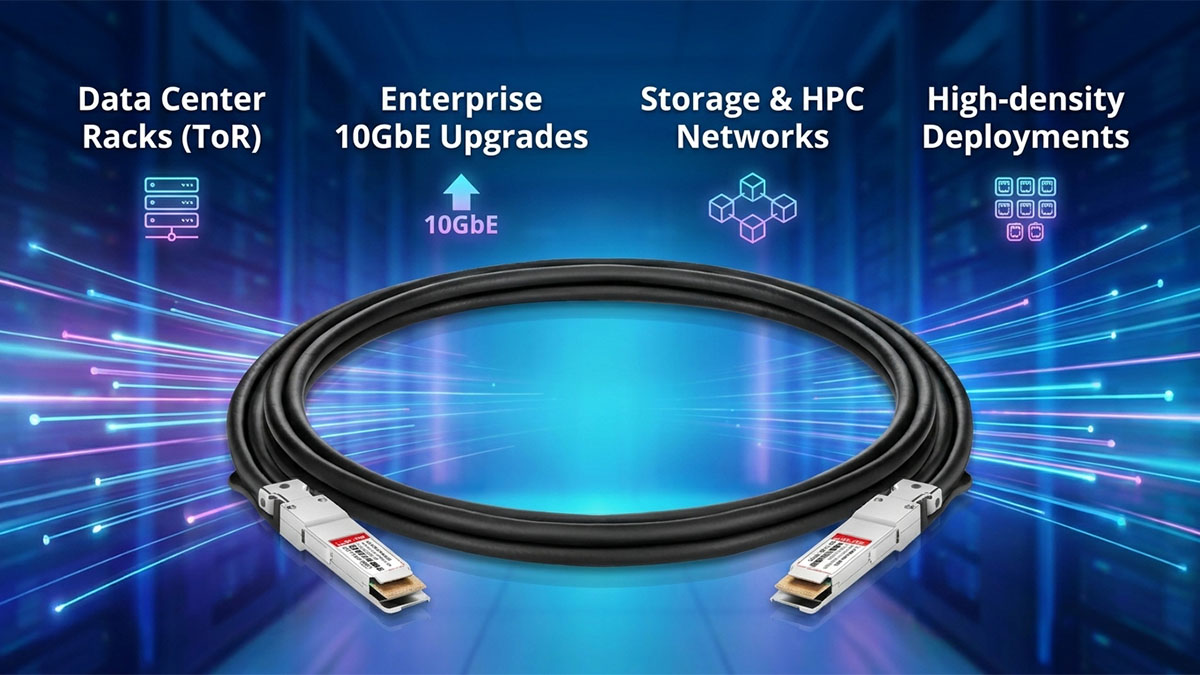
SFP-H10GB-CUxM is primarily used in short-distance 10GbE network environments where high-speed connectivity, low latency, and simplified cable deployment are required. Its passive SFP+ DAC design makes it especially suitable for data centers, enterprise server rooms, and storage networks that rely on direct connections between nearby devices.
Data Center Rack Connections
SFP-H10GB-CUxM is widely deployed in data center rack environments because it provides an efficient solution for connecting servers, switches, and storage systems located within a limited physical area. The integrated SFP+ connectors eliminate the need for separate optical modules and fiber patch cables, helping simplify rack-level installation.
Common data center applications include:
- Server-to-top-of-rack (ToR) switch connections
- Connects servers equipped with SFP+ network adapters to ToR switches
- Supports high-bandwidth data exchange for virtualization, cloud workloads, and enterprise applications
- Helps reduce cable complexity inside server cabinets
- Rack-level switch interconnections
- Provides direct links between switches positioned in the same rack or adjacent racks
- Supports high-density network architectures requiring multiple 10G connections
- Enables efficient cable management in space-constrained environments
- Storage system connectivity
- Connects storage servers and network switches in storage environments
- Supports applications requiring consistent throughput and low communication latency
The availability of different cable lengths, such as SFP-H10GB-CU1M, SFP-H10GB-CU3M, and SFP-H10GB-CU5M, allows network engineers to select suitable options according to rack layout and equipment spacing.
Enterprise Network Infrastructure
SFP-H10GB-CUxM is also suitable for enterprise networks that require reliable 10G connections between nearby networking devices. It helps organizations upgrade internal network links while maintaining a simple physical infrastructure.
Typical enterprise deployment scenarios include:
- Switch-to-switch connections
- Connects aggregation switches, access switches, or distribution devices located within short distances
- Provides a direct 10G uplink option without additional optical components
- Server room connectivity
- Links application servers, network appliances, and switches in enterprise equipment rooms
- Supports bandwidth-intensive workloads such as database access and internal data exchange
- Network equipment consolidation
- Helps simplify connections in environments where multiple SFP+ devices are installed in close proximity
- Reduces the number of individual components required for short-range links
For enterprise environments, SFP-H10GB-CUxM is most effective when network devices are positioned within DAC transmission limits. It is generally selected for internal connections rather than long-distance building-to-building or campus links.
Storage and High-Performance Computing Networks
SFP-H10GB-CUxM is commonly applied in storage and high-performance computing environments where low latency and stable high-speed communication are important. Passive DAC cables are used for short-reach connections in storage area networks (SAN), network attached storage (NAS), and high-density computing infrastructures.
The main application scenarios include:
| Application Scenario | Connection Example | Key Benefit |
|---|---|---|
| Storage Area Network (SAN) | Storage server to switch | Provides reliable 10G data transfer with low latency |
| High-performance computing cluster | Compute node to switch | Supports high-speed interconnects for intensive workloads |
| Network Attached Storage (NAS) | Storage device to network switch | Simplifies short-distance bandwidth expansion |
These applications benefit from the passive copper architecture of SFP-H10GB-CUxM because it provides direct electrical transmission without optical conversion. This helps reduce power requirements while maintaining efficient communication between closely located devices.
🧾 SFP-H10GB-CUxM Compatibility Considerations
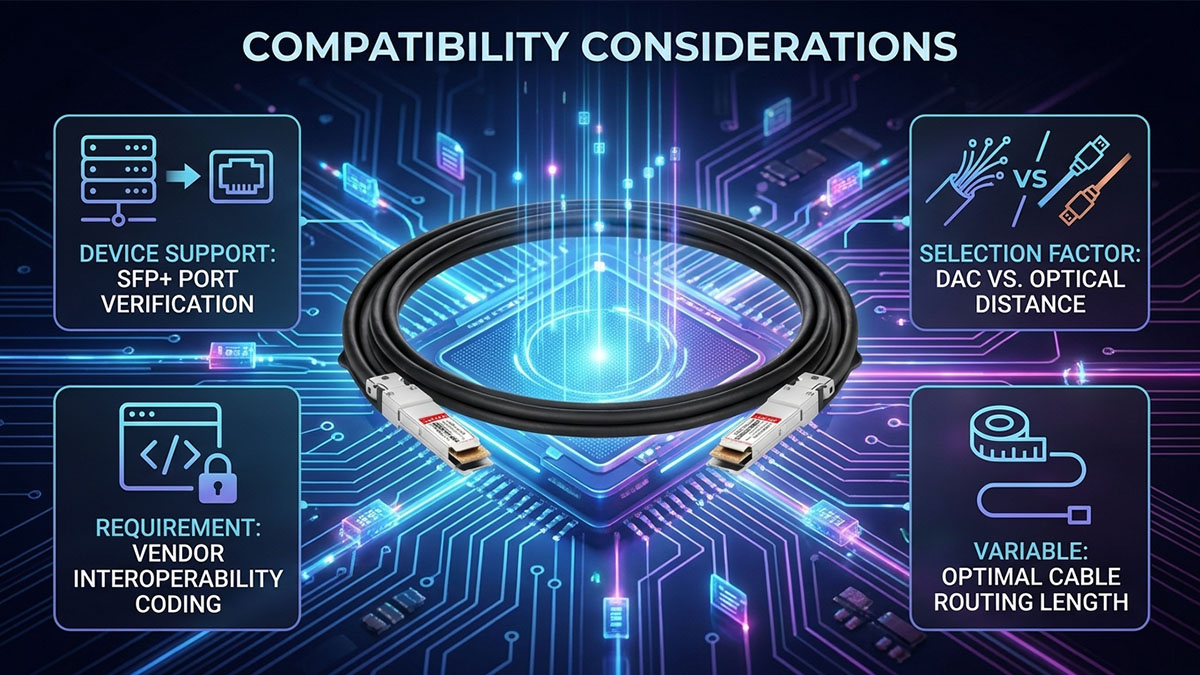
SFP-H10GB-CUxM compatibility is mainly determined by SFP+ port support, device interoperability, cable coding, and deployment requirements. Although it follows common SFP+ DAC standards, successful operation depends on whether the connected switches, servers, and network adapters recognize and support the specific cable configuration.
Device Compatibility Factors
SFP-H10GB-CUxM requires compatible SFP+ interfaces on both ends of the connection because it is designed as a direct SFP+ to SFP+ passive copper cable assembly. Before deployment, network administrators should verify that the connected devices support 10G SFP+ DAC connections and can properly identify the cable module.
The main device compatibility factors include:
- SFP+ port availability
- Both connected devices must provide compatible SFP+ ports.
- The ports should support 10GbE or compatible 10G Fibre Channel applications depending on the network environment.
- Vendor compatibility requirements
- Some network equipment platforms apply vendor-specific cable recognition policies.
- The SFP-H10GB-CUxM cable coding should match the requirements of the connected switches, servers, or adapters.
- Firmware and system recognition
- Network devices may verify cable identification information stored in the cable EEPROM.
- Unsupported or unrecognized cables may require compatible coding options to establish a stable link.
- Host-side support
- Network interface cards (NICs), switches, and storage controllers should support passive DAC operation.
- Host devices may need appropriate configuration settings to enable third-party or compatible DAC cables.
Because SFP-H10GB-CUxM is a passive cable without active signal amplification, device-side electrical compatibility plays an important role in achieving reliable communication.
SFP-H10GB-CUxM vs Optical SFP+ Modules
SFP-H10GB-CUxM and optical SFP+ modules both provide 10G connectivity, but they are designed for different deployment environments. The main difference is the transmission medium: SFP-H10GB-CUxM uses passive copper, while optical solutions rely on fiber and optical conversion components.
The following comparison highlights their key differences:
| Feature | SFP-H10GB-CUxM DAC | Optical SFP+ Module |
|---|---|---|
| Transmission Medium | Passive twinax copper cable | Fiber optic cable |
| Typical Distance | Short-range connections | Medium to long-distance links |
| Power Consumption | Lower due to passive design | Higher due to optical components |
| Installation Method | Integrated cable assembly | Separate module and fiber cable |
| Common Applications | Rack-level connections | Data center, campus, and longer links |
SFP-H10GB-CUxM is generally preferred for short-distance connections where devices are located close together, while optical SFP+ solutions are more suitable when greater transmission distance, flexible routing, or reduced cable weight is required.
Cable Length Selection Guidelines
Selecting the correct SFP-H10GB-CUxM cable length is an important part of compatibility planning because passive DAC cables are optimized for limited-distance applications. The "xM" suffix identifies the cable length in meters, such as CU1M, CU3M, and CU5M versions.
When selecting the appropriate cable length, consider the following factors:
- Physical distance between devices
- Choose a cable length that matches the actual connection path between SFP+ ports.
- Avoid excessive cable slack that can affect rack organization.
- Rack layout and cable routing
- Shorter cables are suitable for devices installed within the same rack.
- Longer DAC options can support connections between nearby equipment positions.
- Future network adjustments
- Consider possible equipment relocation or rack modifications.
- Select a length that provides sufficient flexibility without creating unnecessary cable congestion.
For example, SFP-H10GB-CU1M is commonly used for short server-to-switch connections, while SFP-H10GB-CU3M or SFP-H10GB-CU5M versions provide additional flexibility for larger rack layouts.
🧾 Advantages and Limitations of SFP-H10GB-CUxM
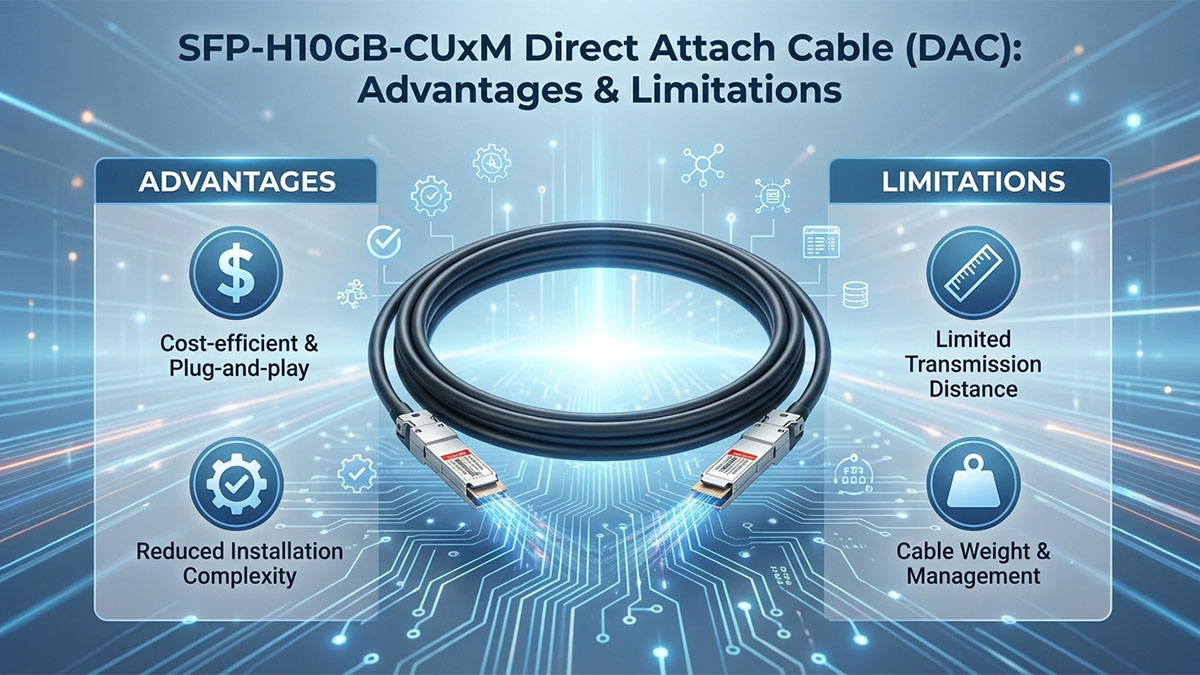
SFP-H10GB-CUxM provides an efficient 10G connectivity option for short-distance network deployments by combining low power consumption, low latency transmission, and simplified installation. However, its passive copper design also introduces limitations related to transmission distance, cable flexibility, and deployment environments. Understanding both advantages and limitations helps network professionals determine whether SFP-H10GB-CUxM is suitable for specific 10GbE applications.
Advantages of SFP-H10GB-CUxM
SFP-H10GB-CUxM offers several benefits for short-range 10G network connections, especially in data center and rack-level environments where devices are physically close together. Its passive DAC architecture eliminates the need for optical conversion components, resulting in a simple and efficient connectivity solution.
The main advantages of SFP-H10GB-CUxM include:
- Low power consumption
- The passive copper design does not require optical transmitters, receivers, or active signal processing components.
- It consumes significantly less power compared with many optical connectivity solutions, helping reduce energy usage in high-density deployments.
- Low latency transmission
- Direct electrical signal transmission reduces additional conversion processes.
- It is suitable for applications requiring fast communication between nearby devices, such as server-to-switch and storage-to-switch connections.
- Simplified installation
- SFP-H10GB-CUxM integrates SFP+ connectors and copper cable into a single assembly.
- Network engineers can deploy the cable without separately selecting optical modules and fiber patch cables.
- Cost-efficient short-distance connectivity
- The integrated DAC design reduces the number of required components for 10G connections.
- It provides a practical alternative for rack-level deployments where fiber infrastructure is unnecessary.
- Flexible length selection
- The CUxM naming format allows different cable lengths to match various physical layouts.
- Options such as CU1M, CU3M, and CU5M help support different rack configurations and equipment spacing requirements.
These advantages make SFP-H10GB-CUxM a suitable choice for environments that prioritize efficient 10G connectivity, simple deployment, and reliable short-range communication.
Limitations of SFP-H10GB-CUxM
Although SFP-H10GB-CUxM performs well in short-distance applications, its passive copper structure also creates certain deployment limitations. The main restrictions are related to transmission distance, physical characteristics, and network expansion flexibility.
The key limitations of SFP-H10GB-CUxM include:
- Limited transmission distance
- Passive DAC cables are designed primarily for short-reach connections.
- They are generally suitable for in-rack or adjacent-rack deployments rather than long-distance network links.
- Reduced installation flexibility
- Unlike fiber cables, copper DAC cables have fixed lengths and limited routing flexibility.
- Longer cable paths across large facilities may require optical solutions instead.
- Cable thickness and weight considerations
- Copper twinax cables can be thicker and heavier than fiber cables.
- High-density deployments with many DAC connections may require careful cable management planning.
- Environmental limitations
- Copper-based solutions may be more sensitive to electromagnetic interference compared with properly deployed fiber connections.
- They are mainly intended for controlled indoor networking environments.
- Limited scalability for future expansion
- As network layouts grow and connection distances increase, passive DAC solutions may not provide sufficient flexibility.
- Larger infrastructures may require optical transceivers for longer reach and broader deployment options.
These limitations do not reduce the value of SFP-H10GB-CUxM for its intended applications. Instead, they highlight the importance of matching the cable solution with the network distance, physical layout, and future expansion requirements.
🧾 How to Evaluate SFP-H10GB-CUxM Before Deployment
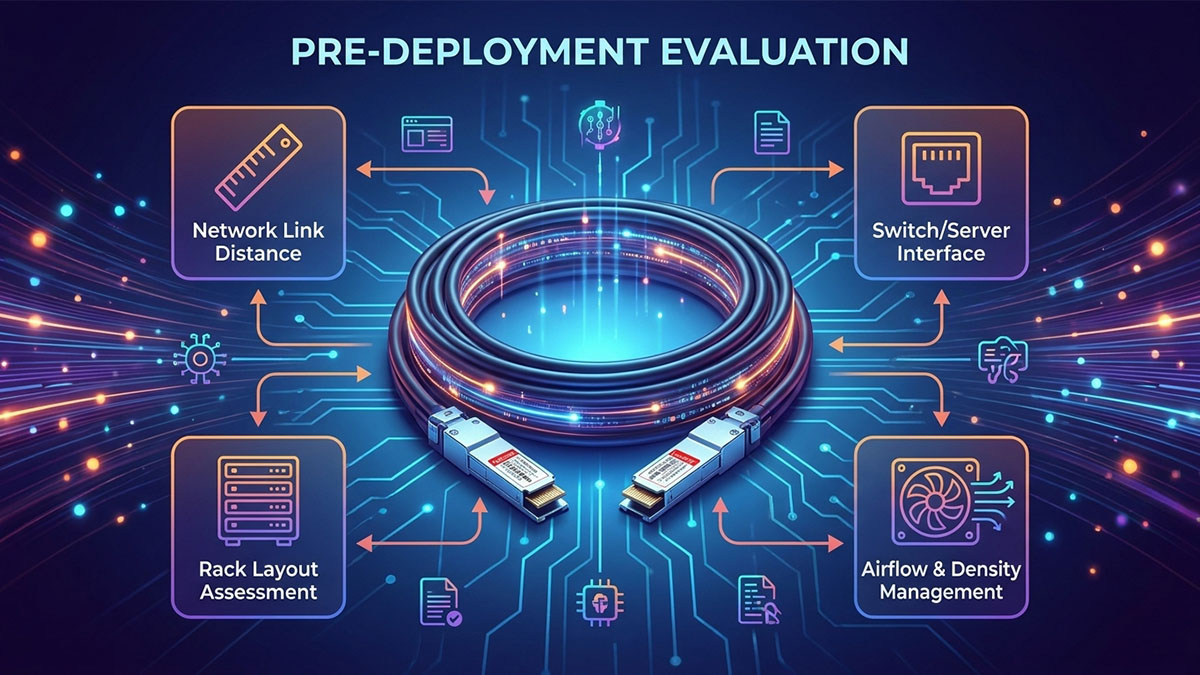
Evaluating SFP-H10GB-CUxM before deployment helps ensure that the cable solution matches network performance requirements, device compatibility conditions, and physical installation environments. Since SFP-H10GB-CUxM is a passive 10G SFP+ Direct Attach Copper cable designed for short-range connections, network engineers should consider transmission distance, equipment support, and cable routing requirements before integrating it into a 10GbE infrastructure.
Assess Network Distance Requirements
SFP-H10GB-CUxM should first be evaluated based on the physical distance between connected devices because passive DAC cables are designed for short-reach applications rather than extended network links. Selecting an appropriate cable length ensures stable signal transmission while avoiding unnecessary cable management issues.
When assessing distance requirements, consider the following factors:
- Confirm the connection distance
- Measure the actual cable path between two SFP+ ports.
- Select a suitable SFP-H10GB-CUxM length, such as CU1M, CU3M, or CU5M, according to the installation layout.
- Match the cable length with deployment location
- Shorter cables are suitable for server-to-switch connections within the same rack.
- Longer versions provide additional flexibility for connections between nearby equipment positions.
- Avoid excessive cable length
- Unnecessary cable slack can increase rack congestion.
- Proper cable length selection helps maintain better airflow and easier maintenance access.
The "xM" designation in SFP-H10GB-CUxM identifies the cable length in meters, allowing engineers to select different versions according to deployment requirements. Passive twinax versions are commonly available in lengths such as 1m, 3m, and 5m for short-distance 10G connections.
Verify Equipment Compatibility
Device compatibility is one of the most important evaluation factors before deploying SFP-H10GB-CUxM. Although it follows SFP+ DAC industry specifications, the cable must be recognized and supported by the connected network devices, including switches, servers, and network adapters.
The main compatibility checks include:
- Check SFP+ port support
- Verify that both connected devices provide compatible SFP+ interfaces.
- Confirm support for 10GbE or related supported protocols.
- Review vendor compatibility requirements
- Some networking platforms use cable identification and vendor coding mechanisms.
- Ensure that the SFP-H10GB-CUxM coding is compatible with the target hardware.
- Confirm firmware and configuration support
- Check whether network devices require specific firmware versions for DAC recognition.
- Verify that unsupported cable warnings will not prevent normal operation.
- Evaluate host-side compatibility
- Confirm support from switches, servers, storage controllers, or NIC adapters.
- Ensure that the connected devices can properly negotiate the 10G link.
Because SFP-H10GB-CUxM is a passive copper cable without internal signal amplification, the host devices play an important role in maintaining signal integrity and establishing a stable connection.
Consider Installation Environment
The physical installation environment directly affects the practicality and reliability of SFP-H10GB-CUxM deployments. Since DAC cables use copper twinax construction, they are most suitable for controlled indoor environments such as data center racks and enterprise equipment rooms.
Before deployment, evaluate the following installation conditions:
- Rack layout and cable organization
- Ensure the cable length matches the distance between devices.
- Plan cable routing to avoid excessive bending or cable congestion.
- Airflow and thermal management
- High-density racks require organized cable placement to maintain proper airflow.
- Avoid blocking ventilation areas with poorly managed copper cable bundles.
- Cable bending and handling requirements
- Follow manufacturer recommendations for cable handling.
- Avoid sharp bends that may affect cable performance or physical durability.
- Future expansion planning
- Consider whether the current rack layout may change.
- Evaluate whether a passive DAC solution will continue to meet future distance requirements.
A well-planned installation environment allows SFP-H10GB-CUxM to deliver reliable 10G connectivity while maintaining efficient rack management.
🧾 Conclusion
SFP-H10GB-CUxM is a practical 10G SFP+ Direct Attach Copper solution designed for short-distance network connections that require high-speed transmission, low latency, and simplified deployment. With its passive twinax copper design, integrated SFP+ connectors, and flexible cable length options such as CU1M, CU3M, and CU5M, it provides an efficient connectivity choice for data centers, enterprise networks, and storage environments.
The key points of SFP-H10GB-CUxM can be summarized as follows:
- Supports 10Gbps data transmission through SFP+ interfaces for short-range network links
- Uses passive copper technology to reduce power consumption and deployment complexity
- Provides low-latency connectivity for server, switch, and storage interconnections
- Offers different cable lengths to match various rack layouts and installation requirements
- Requires careful evaluation of device compatibility, transmission distance, and physical deployment conditions
For organizations planning or upgrading 10GbE infrastructure, selecting a suitable SFP+ DAC cable requires balancing performance requirements, network architecture, and future scalability. Exploring reliable compatible connectivity solutions from the LINK-PP Official Store can help network professionals identify appropriate SFP-H10GB-CUxM options and related networking components for efficient short-distance deployments.