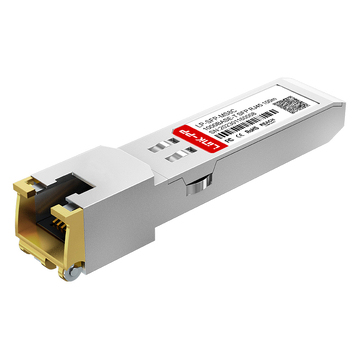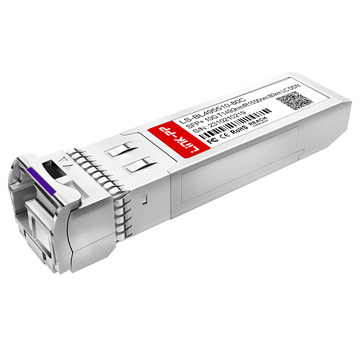





























1000BASE-ZX is a long-reach Gigabit fiber SFP module designed for single-mode fiber links up to 70km–80km, making it ideal for networks that need reliable 1Gbps connectivity over extremely long distances.
Unlike standard Gigabit SFP options such as LX or EX, 1000BASE-ZX operates at 1550nm and offers a much higher optical budget, enabling stable transmission across metro, campus, and carrier-scale networks.
In practical deployments, 1000BASE-ZX is commonly used where fiber paths are long, signal attenuation is high, or intermediate regeneration is not feasible. Although it is not an official IEEE standard, it has become a widely accepted industry implementation supported by most enterprise and service provider networking equipment.
This guide explains what 1000BASE-ZX is, how it works, how far it can transmit, how it compares with other Gigabit SFP types, and when it is the right choice for your network, helping you quickly determine whether a long-reach Gigabit SFP is necessary for your specific deployment scenario.
? What Is 1000BASE-ZX?
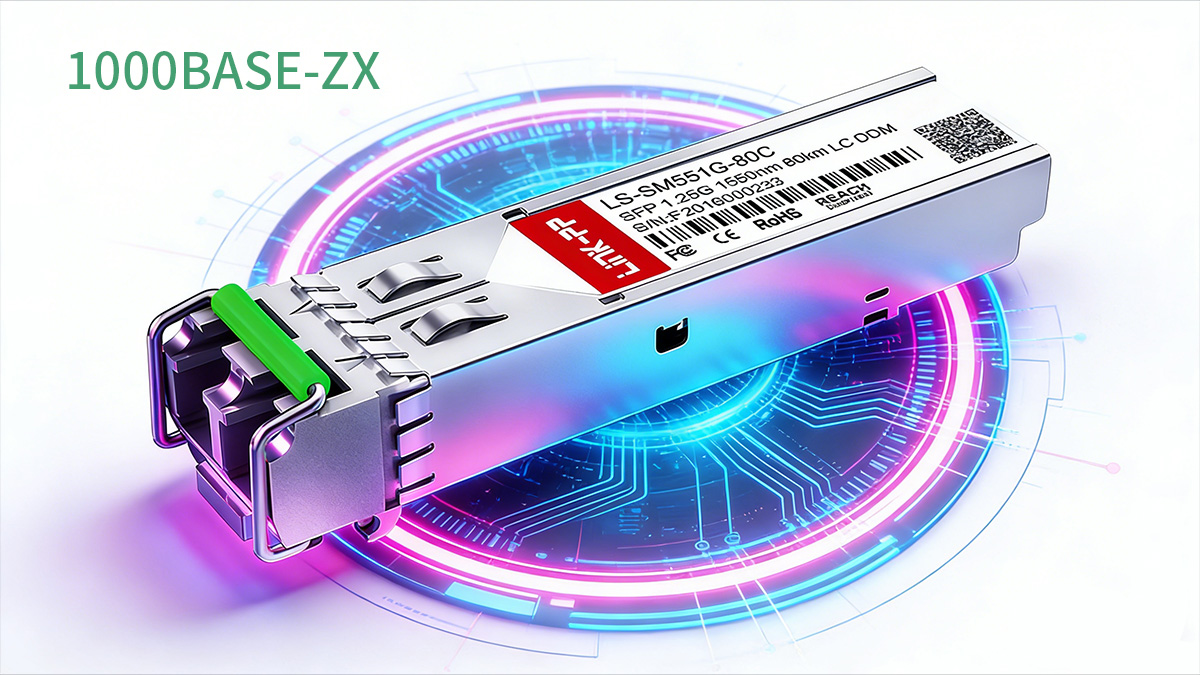
1000BASE-ZX is a non-IEEE Gigabit optical transceiver designed for ultra-long-distance transmission over single-mode fiber, typically reaching 70km to 80km at 1Gbps. It extends far beyond the limits of standard Gigabit SFP types by using a higher optical budget and a 1550nm wavelength, making it suitable for long-haul fiber links.
Unlike standardized options such as 1000BASE-LX, 1000BASE-ZX is an industry-adopted implementation rather than an official IEEE standard. Despite this, it is widely supported by enterprise switches, routers, and optical platforms due to its practical value in long-distance networking.
Is 1000BASE-ZX an IEEE Standard?
No, 1000BASE-ZX is not defined by the IEEE 802.3 standard, but it is a widely accepted de facto specification in the networking industry.
The IEEE Gigabit Ethernet standards officially define LX (1310nm) and SX (850nm), while ZX was developed by vendors to meet real-world requirements for longer transmission distances without increasing link speed.
Key implications of its non-standard status include:
-
Interoperability is based on optical characteristics rather than formal certification
-
Most major vendors support ZX-compatible SFPs
-
Compatibility depends on wavelength, power budget, and fiber type rather than branding
In practice, 1000BASE-ZX behaves consistently across compliant devices as long as optical specifications are matched correctly.
What Does “ZX” Mean in 1000BASE-ZX?
“ZX” refers to extended-reach Gigabit Ethernet using a 1550nm wavelength, optimized for long-distance transmission over single-mode fiber. While the naming is not formally standardized, “Z” has traditionally been used to indicate long-haul or extended distance optics in fiber networking.
Compared to other Gigabit Ethernet variants:
| Variant | Wavelength | Typical Reach | Fiber Type |
|---|---|---|---|
| 1000BASE-SX | 850nm | Up to 550m | Multimode |
| 1000BASE-LX | 1310nm | Up to 10km | Single-mode |
| 1000BASE-ZX | 1550nm | 70km–80km | Single-mode |
This extended reach is achieved through a higher optical power budget rather than changes in data rate, which remains fixed at 1Gbps.
How 1000BASE-ZX Differs From Standard Gigabit Ethernet
The primary difference between 1000BASE-ZX and standard Gigabit Ethernet SFPs lies in transmission distance and optical power, not speed.
While all Gigabit SFP operate at 1Gbps, 1000BASE-ZX is designed for scenarios where fiber attenuation, splices, and long paths would exceed the limits of LX or EX modules.
Key technical distinctions include:
-
Much higher transmit power
-
Greater link budget tolerance
-
Increased need for optical attenuation on short links
Because of this, 1000BASE-ZX is typically deployed only when long-reach capability is essential, rather than as a general-purpose Gigabit SFP.
? How Does a 1000BASE-ZX SFP Module Work?
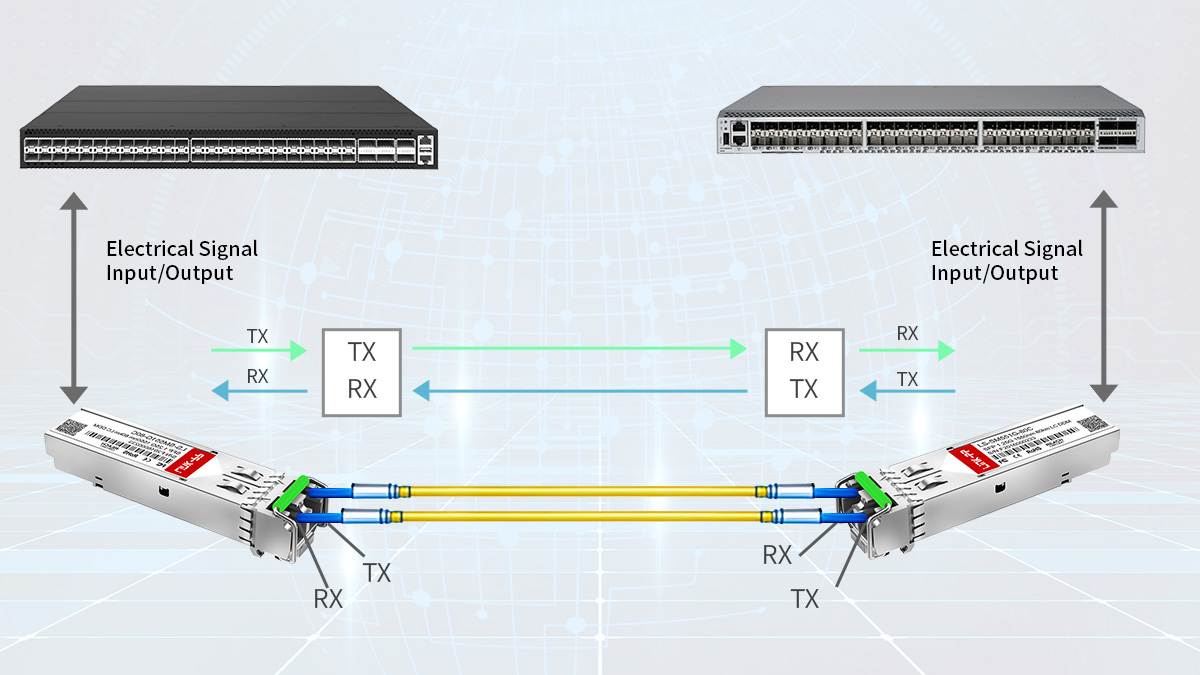
A 1000BASE-ZX SFP module transmits Gigabit Ethernet signals over long distances by using a 1550nm laser and a high optical power budget optimized for single-mode fiber. Its working principle focuses on overcoming fiber attenuation rather than increasing data rate, allowing stable 1Gbps transmission across tens of kilometers.
Unlike short- and mid-range Gigabit SFPs, a ZX module is engineered to maintain signal integrity over long fiber paths that include splices, connectors, and natural attenuation losses.
Operating Wavelength and Optical Transmission
1000BASE-ZX operates at 1550nm, a wavelength with the lowest attenuation in single-mode fiber, making it ideal for long-haul transmission.
At 1550nm, fiber loss is significantly lower compared to 1310nm or 850nm, which allows the optical signal to travel farther before falling below the receiver sensitivity threshold.
| Parameter | 1000BASE-ZX | 1000BASE-LX |
|---|---|---|
| Operating wavelength | 1550nm | 1310nm |
| Typical fiber loss | Lower | Moderate |
| Long-distance suitability | Excellent | Limited |
This wavelength choice is the fundamental reason why 1000BASE-ZX can support transmission distances well beyond standard Gigabit Ethernet optics.
Optical Power Budget and Long-Reach Capability
The long reach of 1000BASE-ZX is achieved through a significantly higher optical power budget rather than protocol-level changes.
A higher optical budget means the difference between transmit output power and receiver sensitivity is large enough to tolerate long fiber lengths, connector losses, and splicing attenuation.
| Specification | Typical ZX Range | Impact |
|---|---|---|
| Transmit power | Higher than LX | Extends reach |
| Receiver sensitivity | Very high | Improves stability |
| Optical budget | Large | Supports long fiber paths |
Because of this high power output, 1000BASE-ZX modules can sometimes overload receivers on short links, which is why attenuation may be required in certain deployments.
Why Single-Mode Fiber Is Required
1000BASE-ZX is designed exclusively for single-mode fiber because multimode fiber cannot reliably support 1550nm transmission over long distances.
Single-mode fiber allows light to propagate in a single path, minimizing modal dispersion and signal distortion. This characteristic is critical for maintaining signal quality over 70km or more.
Key reasons single-mode fiber is mandatory:
-
Minimal dispersion at long distances
-
Lower attenuation at 1550nm
-
Stable signal propagation for high optical power
Using multimode fiber with 1000BASE-ZX is not recommended and can result in severe signal degradation or link failure.
Signal Reception and Error Control
At the receiving end, the 1000BASE-ZX SFP converts the optical signal back into electrical Gigabit Ethernet while maintaining low bit error rates across long distances.
The module relies on:
-
High-sensitivity photodiodes
-
Automatic gain control
-
Built-in error tolerance mechanisms
These features ensure reliable data delivery even when the signal has experienced significant attenuation over long fiber runs.
? Transmission Distance of 1000BASE-ZX
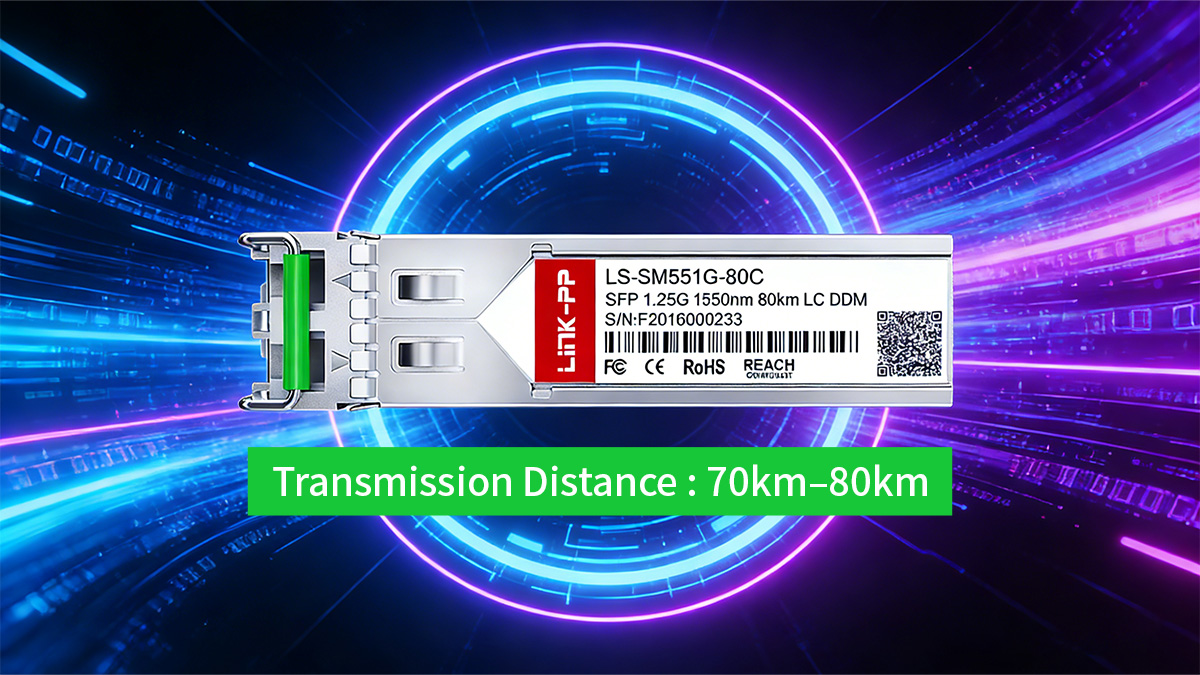
1000BASE-ZX typically supports transmission distances of 70km to 80km over single-mode fiber, making it one of the longest-reach Gigabit Ethernet SFP options available. However, the actual achievable distance depends on optical budget, fiber conditions, and link design rather than a fixed maximum value.
In real-world networks, ZX links may operate reliably at shorter or longer distances depending on loss factors and deployment quality.
Typical Reach in Real-World Deployments
Under standard conditions, most 1000BASE-ZX SFP modules are engineered for link budgets that comfortably support 70km or more. This range accounts for normal fiber attenuation, connector loss, and splicing.
| Parameter | Typical Value | Notes |
|---|---|---|
| Nominal reach | 70km–80km | Vendor-dependent |
| Fiber type | Single-mode (OS2) | Required |
| Operating wavelength | 1550nm | Low attenuation |
While some manufacturers specify “up to 80km,” network designers should always validate the link budget rather than relying solely on nominal distance ratings.
Factors That Affect Actual Transmission Distance
The maximum distance of a 1000BASE-ZX link is determined by cumulative optical losses along the fiber path. Even with a high-power transmitter, excessive loss can reduce signal quality below acceptable levels.
Key factors include:
-
Fiber attenuation caused by distance and fiber quality
-
Connector losses at patch panels and distribution frames
-
Splice losses along long-haul routes
-
Optical dispersion in aging or lower-grade fiber
A well-designed link with minimal connectors and high-quality fiber may outperform its nominal distance rating, while poorly managed cabling can significantly reduce reach.
When Optical Attenuators Are Required
Because 1000BASE-ZX transmits at high optical power, attenuation may be required when the fiber link is short or loss is very low.
Without attenuation, the receiver may experience optical overload, leading to unstable links or intermittent errors.
Common scenarios where attenuators are used:
-
Fiber links significantly shorter than the rated reach
-
Direct point-to-point connections with minimal loss
-
Lab testing or temporary deployments
| Link condition | Risk | Recommended action |
|---|---|---|
| Short-distance SMF | Receiver overload | Add inline attenuator |
| Long-distance SMF | Signal loss | No attenuation needed |
| Mixed-loss environment | Unstable performance | Measure link budget |
Proper link planning ensures that the received optical power stays within the supported operating range of the SFP module.
Can 1000BASE-ZX Exceed Its Rated Distance?
In controlled environments, 1000BASE-ZX can sometimes exceed its nominal distance rating if total link loss remains within the optical budget.
However, exceeding vendor specifications introduces operational risk and is not recommended for production networks unless thoroughly tested.
For mission-critical links, designing within rated parameters ensures long-term stability and predictable performance.
? Fiber and Connector Requirements
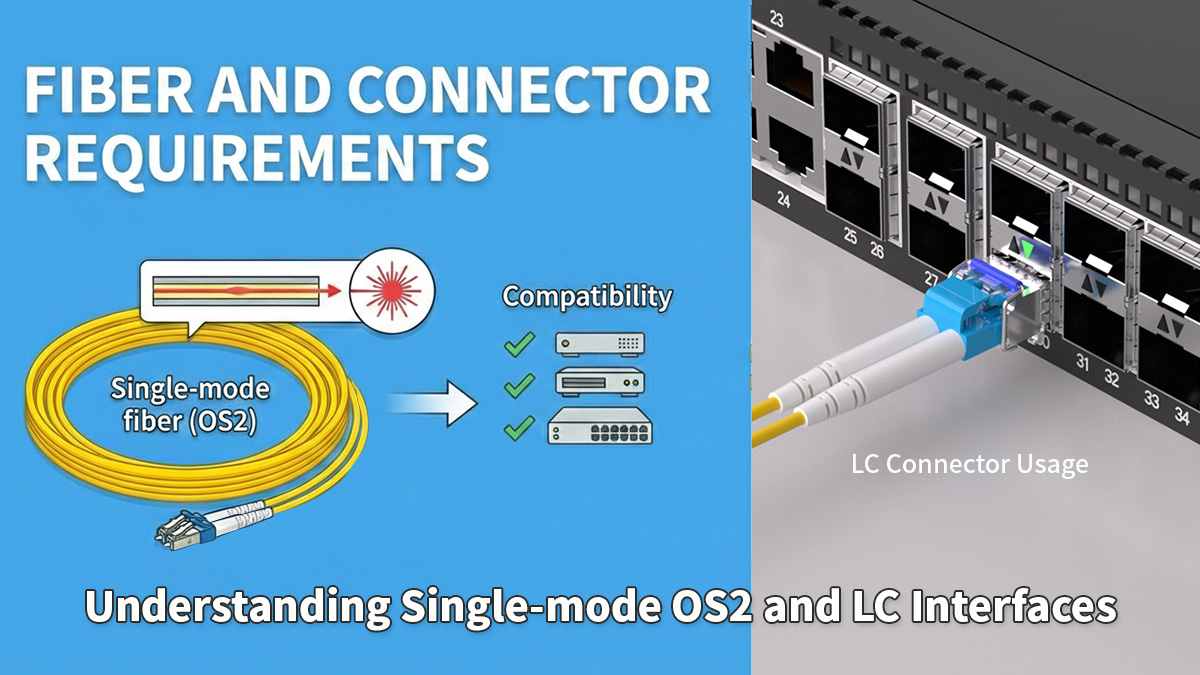
1000BASE-ZX requires single-mode fiber and LC connectors to support stable long-distance transmission at 1550nm. Any deviation from these requirements—such as using multimode fiber or incompatible connectors—can severely limit performance or cause link failure.
Because ZX is designed for ultra-long reach, fiber quality and connector consistency are especially critical.
Supported Fiber Types for 1000BASE-ZX
1000BASE-ZX is designed exclusively for single-mode fiber, typically OS2, to achieve long transmission distances with low attenuation.
| Fiber type | Core size | Compatibility | Notes |
|---|---|---|---|
| OS2 single-mode | 9/125µm | Supported | Recommended for long reach |
| OS1 single-mode | 9/125µm | Limited | Shorter reach possible |
| Multimode (OM1–OM5) | 50/62.5µm | Not supported | Severe loss at 1550nm |
Single-mode fiber minimizes modal dispersion and attenuation at 1550nm, which is essential for maintaining signal integrity over tens of kilometers.
Why Multimode Fiber Is Not Suitable
Multimode fiber cannot reliably support 1000BASE-ZX because it is not optimized for 1550nm transmission or long-distance propagation.
Key limitations of multimode fiber include:
-
High attenuation at 1550nm
-
Significant modal dispersion
-
Inability to handle high optical power over distance
Even in short links, using multimode fiber with ZX optics can result in unstable performance or complete link failure.
Connector Types and Interface Considerations
Most 1000BASE-ZX SFP modules use LC connectors, which provide low insertion loss and high density for long-distance fiber links.
| Connector type | Usage with ZX | Reason |
|---|---|---|
| LC | Standard | Low loss, compact |
| SC | Rare | Larger form factor |
| MPO | Not used | Not applicable to 1G ZX |
Using clean, well-polished LC connectors is critical, as even small insertion losses can impact long-reach links.
Fiber Quality and Installation Best Practices
Long-distance ZX links are more sensitive to fiber quality and installation than short-reach Gigabit connections.
Recommended practices include:
-
Use low-loss OS2 fiber with documented attenuation
-
Minimize the number of connectors and splices
-
Ensure proper fiber cleaning before connection
-
Validate links with optical power measurements
Following these practices helps ensure that 1000BASE-ZX performs reliably across its full rated distance.
? 1000BASE-ZX vs LX vs EX: Key Differences
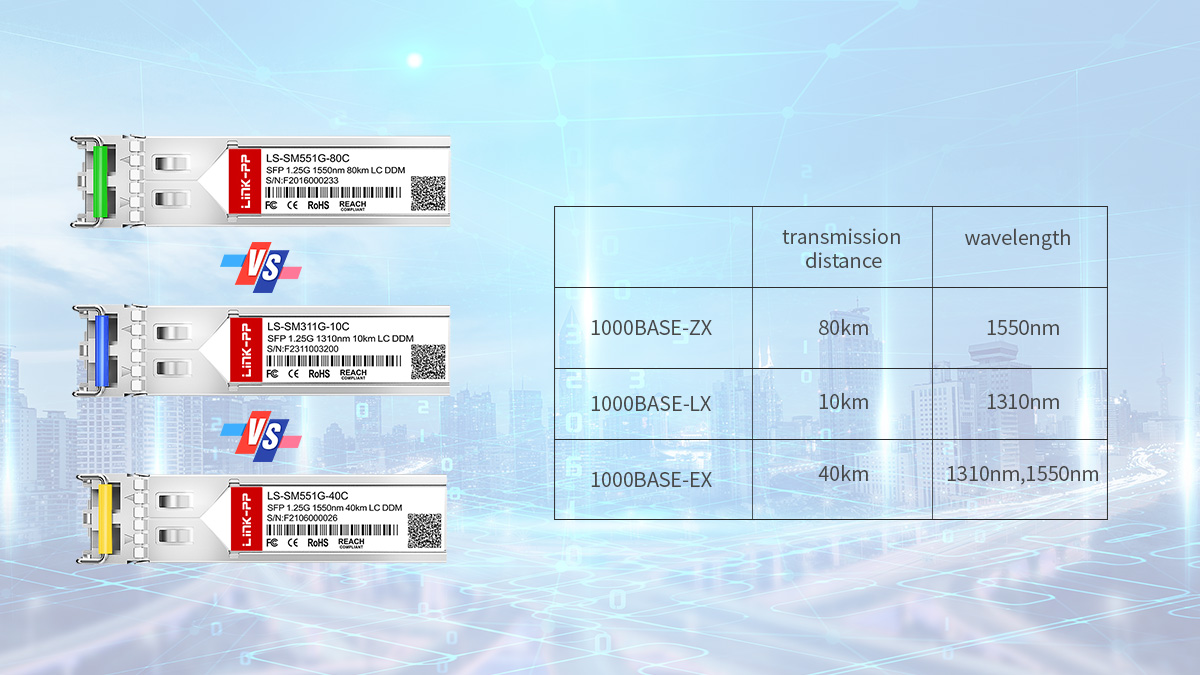
The key difference between 1000BASE-ZX, LX, and EX lies in transmission distance and optical budget, not data rate. All three operate at 1Gbps, but they are designed for very different fiber reach requirements, making correct selection critical for network stability and cost efficiency.
Core Technical Differences at a Glance
ZX is optimized for ultra-long distances, EX covers mid-to-long range links, while LX is intended for standard single-mode deployments.
| Standard | Wavelength | Typical Reach | Primary Use Case |
|---|---|---|---|
| 1000BASE-LX | 1310nm | Up to 10km | Short-to-mid SMF links |
| 1000BASE-EX | 1310nm | ~40km | Extended campus or metro |
| 1000BASE-ZX | 1550nm | 70km–80km | Ultra-long SMF links |
This comparison shows that distance capability scales primarily with optical budget and wavelength, rather than changes in Ethernet signaling.
Optical Budget and Deployment Impact
As transmission distance increases, optical budget becomes the defining factor rather than fiber type or connector choice.
-
LX SFP offers limited margin for attenuation and is best suited for clean, short SMF paths
-
EX SFP provides higher output power for moderate long-distance links
-
ZX SFP delivers the largest optical budget, tolerating significant fiber loss
Because ZX modules transmit at much higher power levels, they may require optical attenuation in short-distance scenarios—something rarely needed with LX or EX.
Cost and Network Design Considerations
Choosing a longer-reach module than necessary increases cost and operational complexity without performance benefits.
Key decision points include:
-
If the link is under 10km, LX is usually sufficient
-
For 10km–40km, EX offers a balanced solution
-
Beyond 40km, ZX becomes the practical choice
Over-specifying reach can lead to unnecessary expense and receiver overload risks, while under-specifying can cause link instability or failure.
Compatibility Considerations Between ZX, LX, and EX
ZX, LX, and EX are not directly interchangeable unless optical characteristics are properly matched on both ends of the link.
Important rules to follow:
-
Both ends should use the same wavelength class
-
Optical power levels must fall within receiver tolerance
-
Mixing ZX with LX or EX is generally not recommended
Proper module pairing ensures predictable performance and avoids hard-to-diagnose link issues.
? Common Use Cases for 1000BASE-ZX SFP
1000BASE-ZX SFP modules are primarily used in network scenarios where 1Gbps connectivity must be maintained over very long distances without intermediate signal regeneration. They are chosen not for speed, but for their ability to deliver stable Gigabit Ethernet across challenging fiber environments.
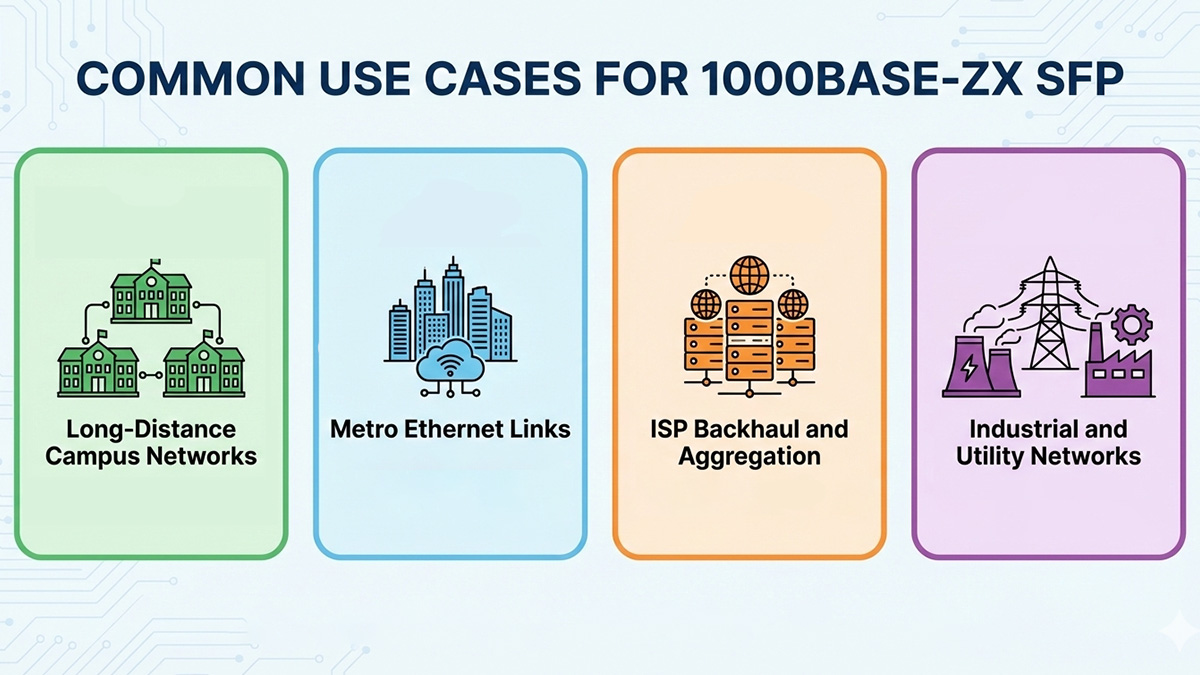
Long-Distance Campus and Enterprise Networks
ZX optics are commonly deployed to connect geographically separated buildings within large campuses or enterprise environments.
Typical scenarios include:
-
University or corporate campuses with dispersed facilities
-
Industrial parks with long underground fiber routes
-
Government or utility networks spanning large areas
In these environments, ZX eliminates the need for additional switches or repeaters between sites.
Metro Ethernet and Service Provider Access Links
Service providers use 1000BASE-ZX to extend Gigabit Ethernet services across metropolitan fiber networks.
ZX is well-suited for:
-
Customer access links over long metro loops
-
Aggregation points without local power availability
-
Cost-effective Gigabit services over existing SMF
Its high optical budget allows reliable operation even when fiber paths include multiple splices and patch panels.
ISP Backhaul and Network Aggregation
ZX modules are often used for low-to-moderate bandwidth backhaul where fiber distance, not throughput, is the primary constraint.
Common use cases include:
-
Remote access node backhaul
-
Legacy infrastructure upgrades
-
Redundant or backup network paths
In these scenarios, 1000BASE-ZX offers a practical balance between reach and cost compared to higher-speed optics.
Industrial, Utility, and Transportation Networks
Industrial and utility networks rely on 1000BASE-ZX for long-distance fiber links in harsh or remote environments.
ZX is frequently deployed in:
-
Power substations and grid monitoring
-
Railway signaling and control systems
-
Oil, gas, and pipeline monitoring networks
These applications value long reach and reliability over raw bandwidth, making ZX an ideal choice.
When 1000BASE-ZX Is Not the Right Choice
Despite its advantages, 1000BASE-ZX is not suitable for every Gigabit Ethernet deployment.
Avoid using ZX when:
-
Fiber distance is short and attenuation is low
-
Lower-cost LX or EX modules meet the distance requirement
-
Receiver overload risks cannot be mitigated
Choosing the correct reach class ensures optimal performance and avoids unnecessary complexity.
? Compatibility and Interoperability Considerations
SFP 1G ZX modules are generally interoperable across different vendors as long as optical specifications—such as wavelength, transmit power, and receiver sensitivity—are properly matched. Unlike protocol-level incompatibilities, most ZX issues arise from optical mismatches rather than Ethernet signaling.
Because ZX is not an IEEE-defined standard, compatibility must be evaluated more carefully than with standardized Gigabit optics.
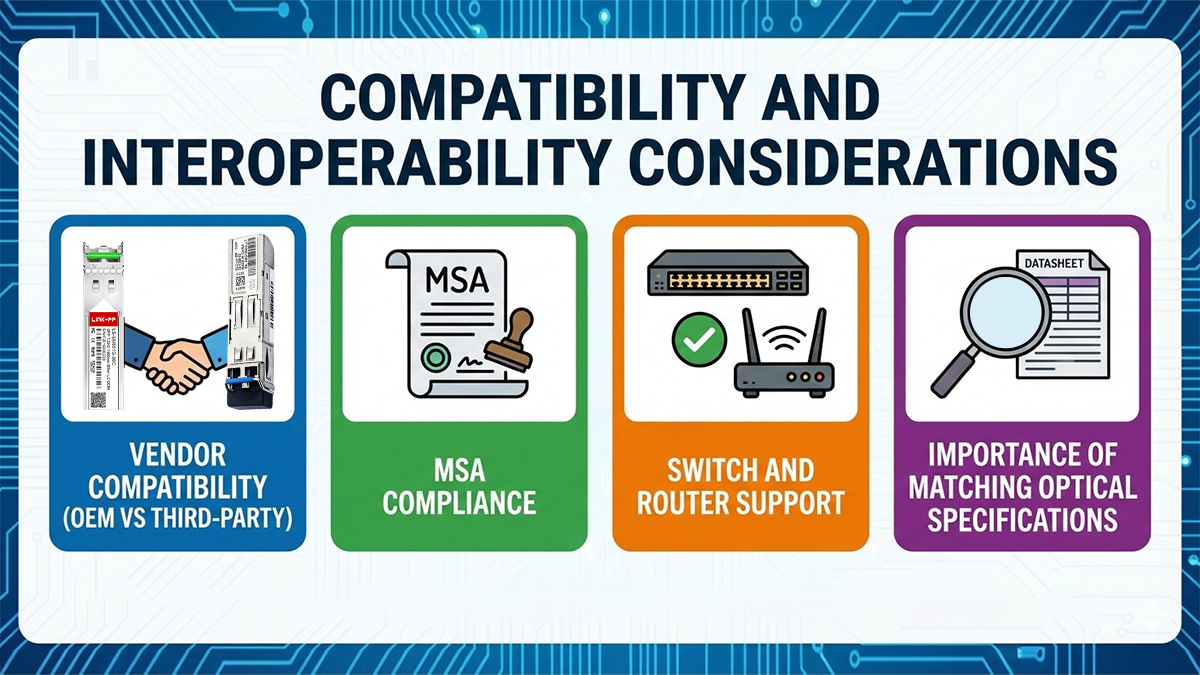
Vendor and Platform Compatibility
Most enterprise switches and routers support 1000BASE-ZX SFPs, but compatibility depends on hardware recognition and optical tolerance rather than branding alone.
Key points to consider:
-
Some platforms enforce vendor coding or EEPROM checks
-
Others accept third-party ZX modules if electrical and optical specs align
-
Firmware versions may affect module recognition
In practice, many networks successfully deploy ZX optics across mixed-vendor environments after basic compatibility validation.
OEM vs Third-Party 1000BASE-ZX Modules
From a functional perspective, OEM and third-party 1000BASE-ZX modules behave similarly when they adhere to MSA-compliant optical parameters.
| Aspect | OEM Modules | Third-Party Modules |
|---|---|---|
| Optical specs | Vendor-defined | MSA-aligned |
| Interoperability | Platform-optimized | Broad compatibility |
| Cost efficiency | Higher | Lower |
The primary difference lies in platform support policies rather than transmission performance.
Cross-Connection Between Different ZX Modules
ZX modules from different vendors can usually interoperate if both sides use the same wavelength and compatible optical power levels.
Critical requirements include:
-
Matching 1550nm wavelength
-
Compatible transmit and receive power ranges
-
Proper fiber type and connector quality
Mixing ZX with LX or EX modules is not recommended, as wavelength and optical budgets differ significantly.
Optical Power Matching and Link Stability
Ensuring that received optical power stays within the supported operating range is essential for stable ZX links.
Common interoperability issues arise when:
-
High-power ZX transmitters overload receivers
-
Attenuation is insufficient on short links
-
Fiber loss is uneven across the link
Verifying optical power levels during deployment helps prevent intermittent errors and long-term reliability issues.
Best Practices for Ensuring Interoperability
A small amount of validation during design and installation can prevent most compatibility issues with 1000BASE-ZX.
Recommended practices:
-
Check platform support lists and firmware versions
-
Validate optical specifications on both ends
-
Test links with power meters when possible
-
Avoid mixing different reach classes
These steps ensure predictable performance even in multi-vendor environments.
? Advantages and Limitations of 1000BASE-ZX
1000BASE-ZX offers unmatched transmission distance for Gigabit Ethernet, but its high optical power and cost make it suitable only for specific long-reach scenarios. Understanding both its strengths and limitations is essential for proper network design.
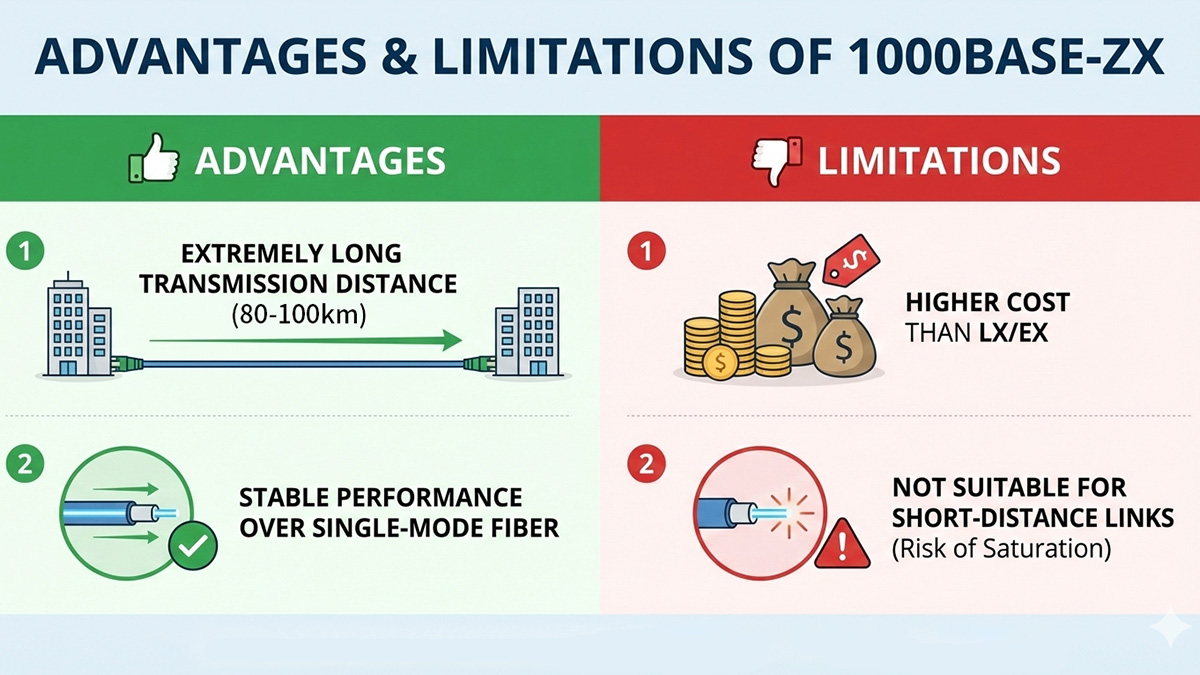
Advantages of 1000BASE-ZX
The primary advantage of 1000BASE-ZX is its ability to deliver stable 1Gbps connectivity over extremely long distances without intermediate equipment.
Key benefits include:
-
Ultra-long reach up to 70km–80km over single-mode fiber
-
High optical budget that tolerates fiber loss, splices, and connectors
-
Reliable performance in metro, campus, and industrial networks
-
Simple architecture without the need for repeaters or regenerators
These advantages make ZX a practical solution when distance, not bandwidth, is the main challenge.
Limitations of 1000BASE-ZX
Despite its reach, 1000BASE-ZX introduces constraints that must be carefully managed.
Common limitations include:
-
Higher cost compared to LX and EX modules
-
Receiver overload risk on short or low-loss links
-
Strict fiber requirements, limited to single-mode fiber
-
Non-IEEE status, requiring additional compatibility validation
Overlooking these factors can lead to unnecessary expense or unstable link behavior.
Trade-Offs Compared to Other Gigabit SFPs
ZX should be chosen only when its long-reach capability is truly required.
| Aspect | ZX | LX / EX |
|---|---|---|
| Maximum reach | Very long | Short to moderate |
| Optical power | Very high | Moderate |
| Deployment flexibility | Lower | Higher |
| Cost efficiency | Distance-driven | General-purpose |
For most enterprise links, LX or EX provides sufficient reach with lower complexity, while ZX is reserved for edge cases where distance constraints dominate.
When the Limitations Outweigh the Benefits
Using 1000BASE-ZX in short-distance environments often creates more problems than it solves.
Avoid ZX when:
-
Fiber runs are well within LX or EX limits
-
Attenuation control is not feasible
-
Budget constraints outweigh reach requirements
Selecting the correct reach class ensures both performance and operational simplicity.
? How to Choose the Right 1000BASE-ZX SFP
Choosing the right 1000BASE-ZX SFP depends on actual link distance, optical loss, and platform compatibility rather than simply selecting the longest-reach module available. A correct choice ensures stable performance without unnecessary cost or operational risk.
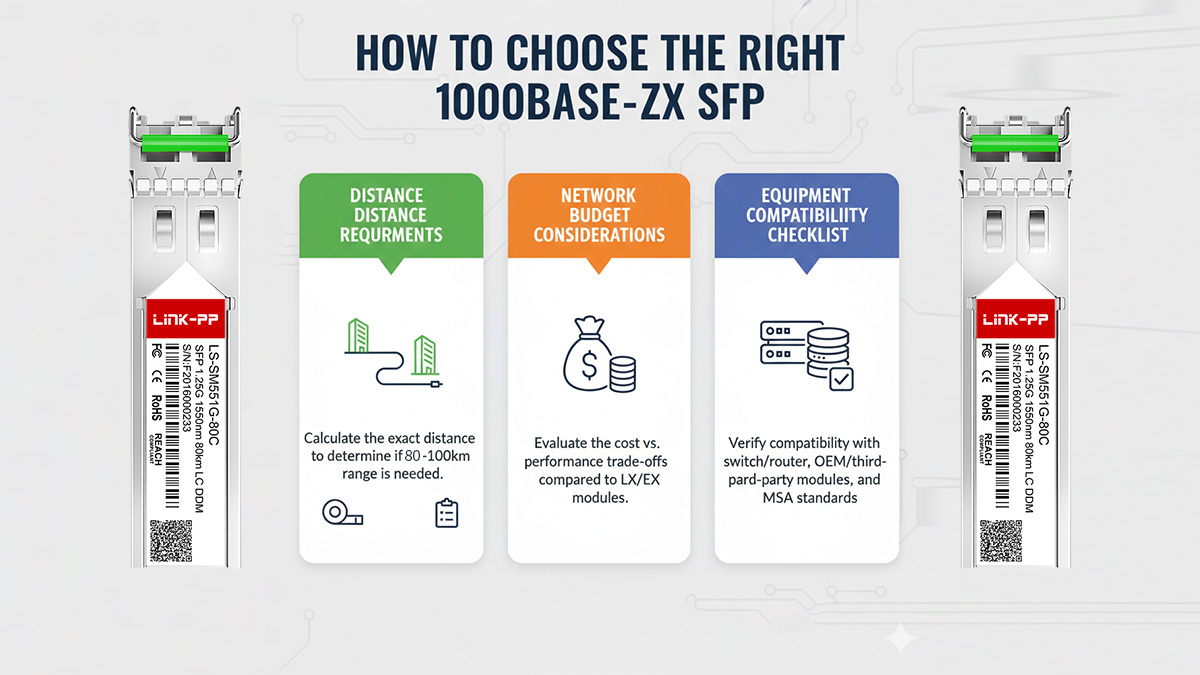
Step 1: Confirm Whether ZX Is Truly Required
1000BASE-ZX should only be selected when the fiber link exceeds the practical limits of LX or EX.
Use ZX when:
-
Link distance is beyond 40km
-
Fiber paths include multiple splices or high attenuation
-
Intermediate equipment cannot be installed
If the link is well within these limits, a lower-reach module is usually a better choice.
Step 2: Evaluate Optical Link Budget
The optical budget must be sufficient to cover total link loss while keeping received power within the supported range.
Key loss components to account for:
-
Fiber attenuation based on distance
-
Connector and splice losses
-
Patch panel and distribution frame losses
| Link element | Typical loss | Design impact |
|---|---|---|
| SMF attenuation | Distance-dependent | Primary factor |
| Connector loss | Per connection | Accumulative |
| Splice loss | Per splice | Often overlooked |
Accurate budget calculation prevents both signal loss and receiver overload.
Step 3: Check Platform and Vendor Compatibility
Platform support is as important as optical performance when selecting a ZX SFP.
Verification steps include:
-
Confirm switch or router SFP support
-
Check firmware or software restrictions
-
Validate third-party module acceptance
Ensuring compatibility upfront avoids deployment delays and unexpected link failures.
Step 4: Plan for Attenuation When Necessary
High-power ZX optics may require attenuation in short or low-loss links.
Consider attenuators if:
-
Fiber distance is significantly below ZX’s rated reach
-
Received optical power exceeds receiver specifications
-
Testing shows unstable or intermittent link behavior
Proper attenuation stabilizes the link without sacrificing reach capability.
Step 5: Balance Cost and Long-Term Network Design
ZX modules should align with long-term network plans, not just immediate requirements.
Design considerations include:
-
Future bandwidth upgrades
-
Redundancy and backup paths
-
Operational simplicity
Selecting the correct ZX specification ensures the network remains scalable and maintainable.
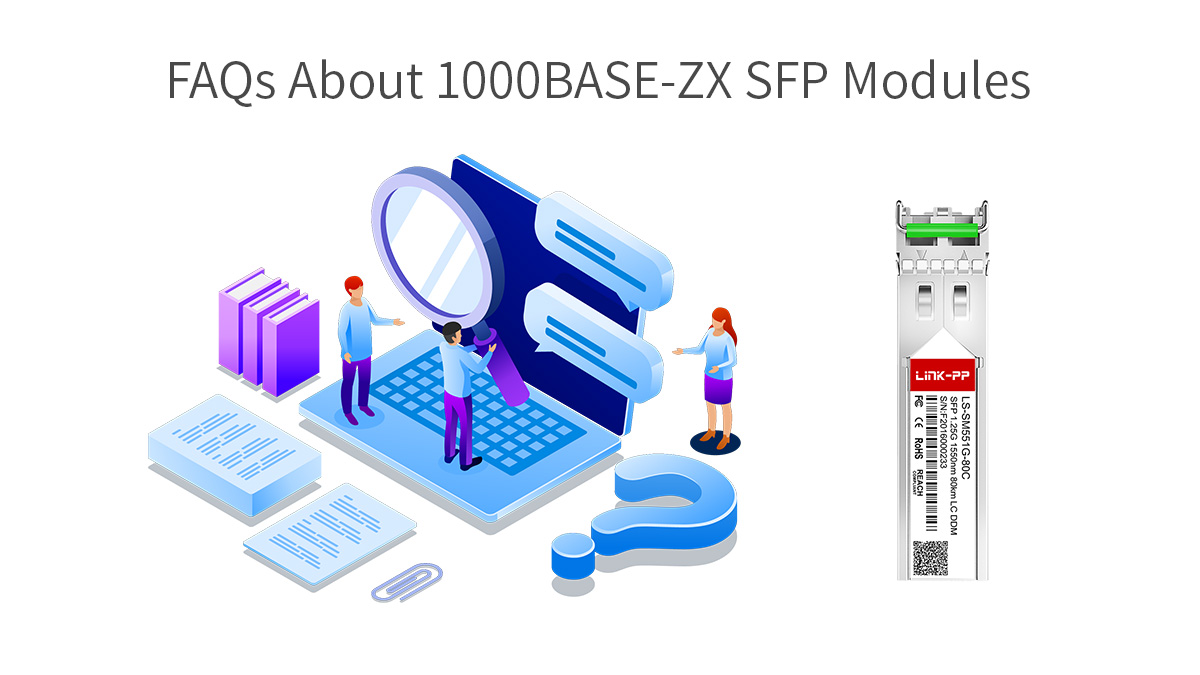
? FAQs About 1000BASE-ZX SFP Modules
1. Is 1000BASE-ZX backward compatible with 1000BASE-LX or EX?
No, 1000BASE-ZX is not backward compatible with LX or EX modules due to different wavelengths and optical power levels.
ZX operates at 1550nm with a much higher optical budget, while LX and EX typically use 1310nm. Mixing them on the same link can result in no link or unstable performance.
2. Can 1000BASE-ZX work over shorter distances?
Yes, 1000BASE-ZX can operate over short distances, but optical attenuation may be required.
Because ZX modules transmit at high optical power, short or low-loss fiber links can overload the receiver. In such cases, inline attenuators are commonly used to keep received power within the supported range.
3. Does 1000BASE-ZX require single-mode fiber?
Yes, 1000BASE-ZX requires single-mode fiber to function correctly.
Multimode fiber is not designed for 1550nm transmission and cannot support the long-distance, high-power characteristics of ZX optics. Using multimode fiber can lead to severe signal degradation or link failure.
4. Is 1000BASE-ZX an official IEEE standard?
No, 1000BASE-ZX is not defined by the IEEE 802.3 standard, but it is widely adopted as an industry-standard implementation.
Despite its non-IEEE status, ZX is broadly supported by enterprise and service provider equipment due to its practical value in long-reach Gigabit networking.
5. When should I choose 1000BASE-ZX instead of higher-speed optics?
1000BASE-ZX is appropriate when distance is the primary constraint and 1Gbps bandwidth is sufficient.
For long links that do not require 10Gbps or higher speeds, ZX offers a cost-effective and power-efficient alternative to higher-speed long-haul optics.
6. Is 1000BASE-ZX still relevant today?
Yes, 1000BASE-ZX remains relevant in networks where legacy infrastructure or long-distance fiber limits bandwidth upgrades.
It is commonly used in industrial, utility, and metro networks where reliability and reach are more important than maximum throughput.
? Conclusion: When 1000BASE-ZX Is the Right Gigabit SFP Choice
1000BASE-ZX is the right Gigabit SFP choice when your network requires reliable 1Gbps connectivity across ultra-long single-mode fiber links where standard LX or EX modules are no longer sufficient. By operating at 1550nm with a high optical budget, it enables stable transmission over 70km–80km without intermediate regeneration, making it especially valuable for campus backbones, metro networks, industrial systems, and service provider infrastructure.
At the same time, ZX is not a general-purpose optic. Its higher cost, stronger transmit power, and stricter deployment requirements mean it should be selected only after confirming distance, optical loss, and platform compatibility. When properly designed, however, a 1000BASE-ZX link delivers long-term stability and operational simplicity that shorter-reach alternatives cannot provide.
For networks that truly require long-reach Gigabit Ethernet, choosing a well-matched, standards-aligned 1000BASE-ZX SFP is critical. If you are evaluating ZX modules for real-world deployment, you can explore reliable, compatibility-tested 1000BASE-ZX solutions at the LINK-PP Official Store, where specifications, platform support, and deployment scenarios are clearly defined to support confident selection.