As fiber broadband demand continues to grow, network operators, enterprises, and advanced home users are seeking more efficient ways to deliver high-speed connectivity without adding unnecessary hardware. With the adoption of XGS-PON technology, compact optical access devices have become increasingly important for supporting symmetrical10Gbps services while simplifying network deployment. Among these innovations, the XGSPON ONU Stick has emerged as a practical solution for integrating fiber access directly into compatible networking equipment.
Unlike traditional optical network terminals (ONTs), an XGSPON ONU Stick combines passive optical network functionality into a compact pluggable module. This design allows routers, switches, gateways, and other devices equipped with compatible interfaces to connect directly to an XGS-PON network, reducing equipment footprint and streamlining installations. As more organizations modernize their fiber infrastructure, understanding how these modules operate, where they are used, and what compatibility factors should be considered has become increasingly valuable.
This guide explains the essential aspects of an XGSPON ONU Stick, including:
- What an XGSPON ONU Stick is and how it works
- Its key features and technical specifications
- Typical deployment scenarios and practical applications
- Compatibility requirements with OLTs and host devices
- Advantages, limitations, and selection considerations
By the end of this article, you will have a clear understanding of whether an XGSPON ONU Stick is suitable for your network environment and how it can support modern fiber access deployments.
✅ What Is an XGSPON ONU Stick?
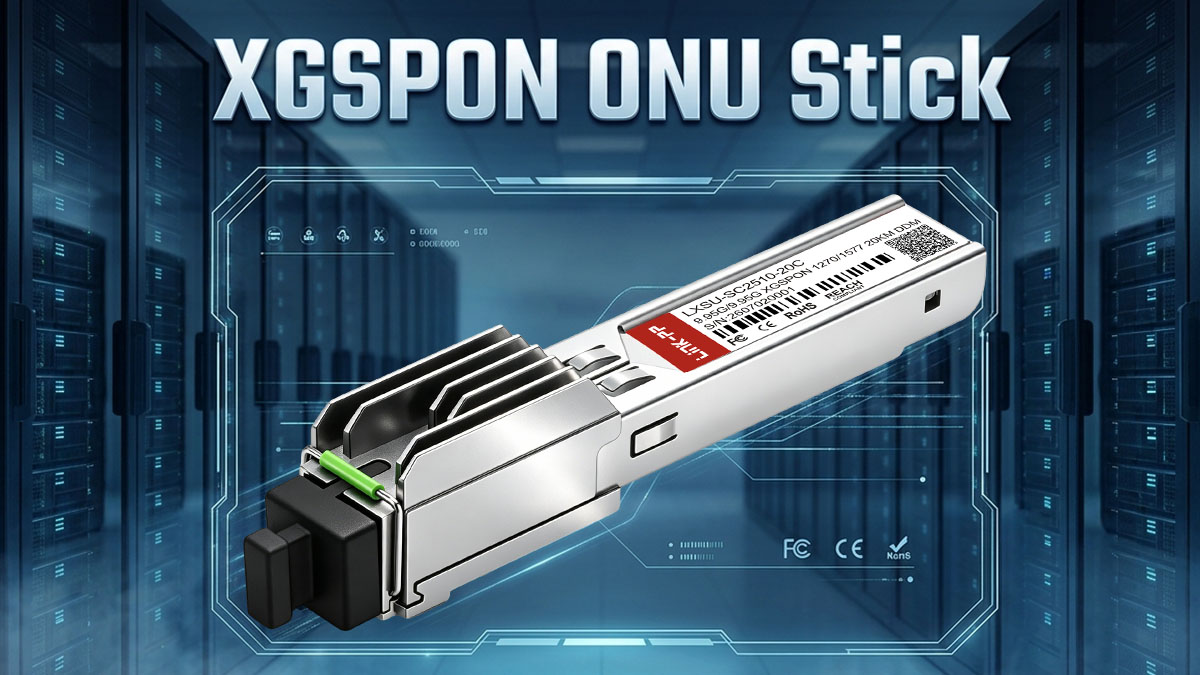
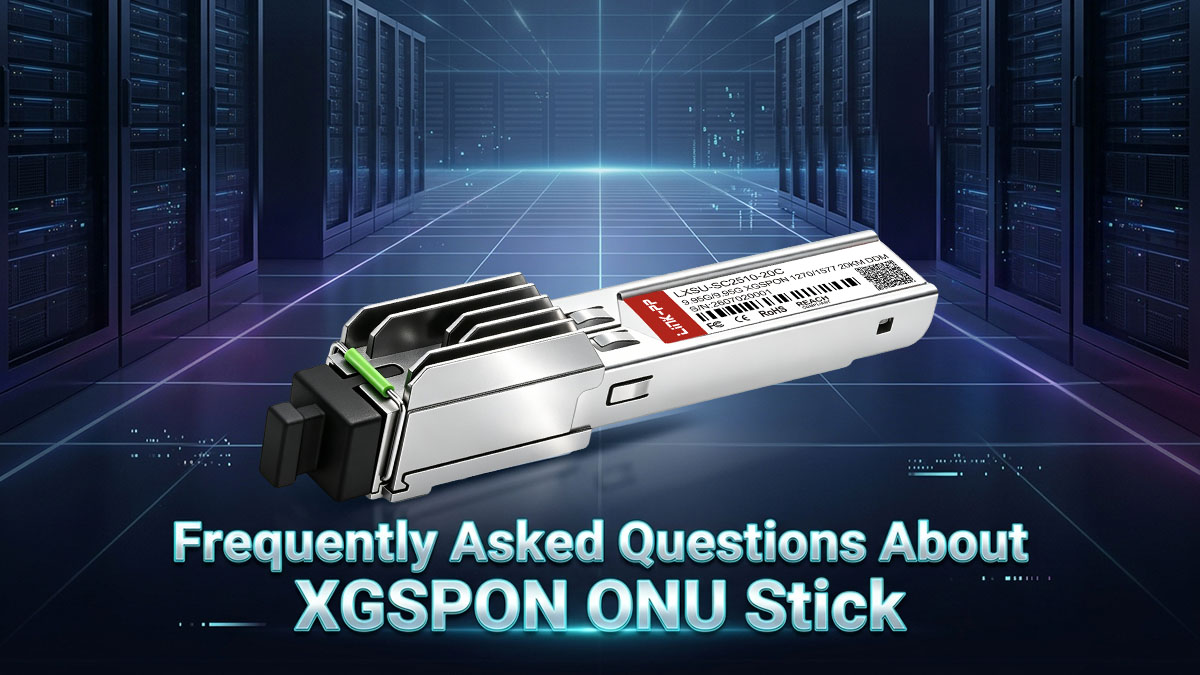
An XGSPON ONU Stick is a compact pluggable optical network unit (ONU) that integrates XGS-PON access capabilities into an SFP+ or similar module form factor. Instead of relying on a standalone optical network terminal (ONT), it enables compatible routers, switches, gateways, or customer premises equipment (CPE) to connect directly to an XGS-PON network. This approach reduces hardware complexity while providing symmetrical10Gbps fiber connectivity for modern broadband deployments.
What Does "ONU Stick" Mean?
An ONU Stick is a miniature ONU packaged as a pluggable optical module rather than a separate desktop device. It performs the same fundamental role as a conventional ONU—terminating the passive optical network and converting optical signals into Ethernet traffic—but occupies only a single module slot within a compatible host device.
Karakteristik utamanya meliputi:
- Integrates ONU functionality into a compact pluggable module.
- Fits compatible SFP+ or vendor-specific ONU module slots.
- Eliminates the need for a separate external ONT in many deployment scenarios.
- Receives power directly from the host device, reducing cable clutter.
- Supports centralized management alongside existing network infrastructure.
Because the ONU electronics, optical transceiver, and management functions are integrated into a single module, installation becomes simpler while maintaining the functionality required for high-speed fiber access.
How XGS-PON Technology Works
XGS-PON is a next-generation passive optical network technology that delivers symmetrical10Gbps downstream and upstream bandwidth over a shared optical distribution network. The XGSPON ONU Stick acts as the customer-side endpoint, communicating with an Optical Line Terminal (OLT) through passive optical splitters and single-mode fiber.
The basic communication process includes:
- The OLT broadcasts downstream optical traffic to multiple ONUs.
- Passive optical splitters distribute the optical signal without requiring electrical power.
- Each ONU Stick identifies and processes only the data intended for its assigned subscriber.
- During upstream transmission, multiple ONUs share the fiber using Time Division Multiple Access (TDMA), preventing transmission conflicts.
- The ONU converts optical signals into Ethernet frames that are forwarded to the connected networking device.
This architecture allows service providers to deliver high-capacity broadband services while minimizing the amount of active equipment deployed in the outside plant.
XGSPON ONU Stick vs Traditional ONT
Although both devices provide subscriber access to an XGS-PON network, they differ significantly in their physical design, installation method, and deployment flexibility. An ONU Stick is intended for integration into compatible networking equipment, whereas a traditional ONT operates as an independent customer-premises device.
| Fitur |
XGSPON ONU Stick |
Traditional ONT |
| Form Factor |
Pluggable SFP+/compact module |
Standalone desktop or wall-mounted unit |
| Instalasi |
Inserts into a compatible host device |
Membutuhkan instalasi terpisah |
| Sumber daya |
Powered by the host equipment |
Adaptor daya eksternal |
| Antarmuka Ethernet |
Uses the host device's network ports |
Port Ethernet bawaan |
| Jejak Peralatan |
Sangat kompak |
Jejak fisik yang lebih besar |
| Fleksibilitas Penerapan |
High for integrated network devices |
Suitable for general residential installations |
Choosing between these two options largely depends on the network architecture and equipment already in use. For environments where compatible routers, gateways, or switches are available, an XGSPON ONU Stick can simplify deployment and reduce the number of standalone devices without sacrificing XGS-PON functionality.
✅ Key Features of an XGSPON ONU Stick
An XGSPON ONU Stick combines high-speed fiber access, a compact hardware design, and intelligent management capabilities within a single pluggable module. Compared with conventional standalone ONTs, it offers greater deployment flexibility while supporting the performance and reliability required for modern XGS-PON networks.

High-Speed Symmetrical10Gbps Connectivity
One of the defining characteristics of an XGSPON ONU Stick is its ability to deliver symmetrical10Gbps bandwidth over an XGS-PON network. This balanced upstream and downstream performance supports bandwidth-intensive applications while preparing networks for future service growth.
Its high-speed connectivity provides several advantages:
- Supports symmetrical10Gbps downstream and upstream transmission.
- Delivers sufficient bandwidth for multiple concurrent users and devices.
- Reduces latency for real-time applications such as video conferencing and cloud services.
- Handles bandwidth-intensive workloads, including4K/8K streaming, virtualization, and large file transfers.
- Provides a scalable foundation for next-generation fiber broadband services.
As network traffic continues to increase, symmetrical bandwidth helps maintain consistent performance across residential, enterprise, and campus environments without creating upstream bottlenecks.
Compact Pluggable Design
Unlike traditional ONTs that require separate enclosures and power supplies, an XGSPON ONU Stick integrates optical access into a compact pluggable module. This design simplifies deployment while reducing the amount of hardware installed at the customer premises.
Manfaat desain utama meliputi:
- Occupies only a single compatible SFP+ or ONU module slot.
- Eliminates the need for an external ONU or ONT in many deployments.
- Simplifies cable management by reducing additional Ethernet and power connections.
- Enables quick installation and module replacement.
- Helps conserve rack and desktop space in equipment rooms.
The compact form factor is particularly valuable in enterprise, carrier, and edge networking environments where equipment density and efficient space utilization are important considerations.
Integrated Management Functions
Beyond providing optical connectivity, an XGSPON ONU Stick includes management features that allow network operators to monitor, configure, and maintain services remotely. These capabilities improve operational efficiency throughout the module's lifecycle.
Common management functions include:
- OMCI-based remote configuration and provisioning.
- Automatic ONU registration with supported OLT platforms.
- Remote firmware upgrade capabilities.
- Performance monitoring and operational status reporting.
- Alarm generation and fault diagnostics.
- Optical signal monitoring for easier troubleshooting.
Centralized management reduces maintenance effort and allows administrators to perform many operational tasks without requiring on-site intervention.
Konsumsi Daya Rendah
Power efficiency is another important advantage of an XGSPON ONU Stick. By integrating optical transmission, ONU processing, and management functions into a single module, it typically consumes less power than a standalone optical access device.
Its energy-efficient design offers several benefits:
- Lower overall power consumption compared with separate ONT deployments.
- Reduced heat generation through optimized hardware integration.
- Power supplied directly by the host device, eliminating an external adapter.
- Improved energy efficiency for large-scale deployments.
- Supports continuous operation with appropriate thermal management.
Although power requirements vary by manufacturer and feature set, proper airflow and adequate cooling within the host equipment help ensure reliable long-term operation, particularly in high-density network installations.
✅ Technical Specifications of an XGSPON ONU Stick
An XGSPON ONU Stick is designed according to XGS-PON standards and integrates optical, electrical, and management components into a compact pluggable module. While exact specifications may vary by vendor, most devices follow a consistent technical framework to ensure interoperability with OLT platforms and host networking equipment.

Spesifikasi Optik
The optical subsystem defines how the XGSPON ONU Stick transmits and receives data over the passive optical network. These parameters are critical for ensuring stable communication with the OLT and maintaining signal integrity over distance.
Typical optical characteristics include:
- Downstream wavelength around1577nm
- Upstream wavelength around1270nm
- Support for XGS-PON optical budget classes (e.g., N1/N2 class depending on deployment)
- Single-mode fiber compatibility (ITU-T G.652 standard fiber commonly used)
- SC/UPC or vendor-specific optical interface integration (via internal fiber coupling)
- Transmission distance typically up to20km depending on split ratio and optical budget
These optical parameters ensure the ONU Stick can operate efficiently in standard FTTH passive optical distribution networks while maintaining stable performance under varying network conditions.
| Parameter |
Nilai khas |
Deskripsi |
| Panjang Gelombang Hilir |
1577nm |
Optical signal from OLT to ONU |
| Panjang Gelombang Hulu |
1270nm |
Optical signal from ONU to OLT |
| fiber Jenis |
Mode tunggal (G.652) |
Standard FTTH fiber infrastructure |
| Jarak Maks |
Up to20km |
Depends on optical budget and splitter ratio |
| Optical Budget Class |
N1 / N2 |
Defines link loss tolerance |
After reviewing these optical parameters, it becomes clear that the XGSPON ONU Stick is designed for long-reach, high-capacity fiber access environments while maintaining compatibility with existing passive optical infrastructure.
Spesifikasi Kelistrikan dan Antarmuka
The electrical interface defines how the XGSPON ONU Stick communicates with the host device and how it is powered. Since it is a pluggable module, integration into networking equipment is a key design requirement.
Karakteristik kelistrikan utama meliputi:
- SFP+ or vendor-defined pluggable module interface
- High-speed Ethernet data output (commonly10GbE interface mapping via host system)
- Power supply provided directly by host device (typically3.3V rail)
- EEPROM-based module identification and configuration storage
- Digital Diagnostic Monitoring (DDM) support for real-time status tracking
- Low-latency electrical signal conversion between optical and Ethernet domains
These electrical specifications allow the ONU Stick to function as a seamless extension of the host networking device, eliminating the need for external ONT hardware while maintaining full XGS-PON functionality.
Spesifikasi Lingkungan
Environmental stability is essential for ensuring reliable long-term operation, especially in dense deployment scenarios such as telecom cabinets or enterprise network racks.
Typical environmental specifications include:
- Operating temperature range:0°C to70°C (industrial-grade variants may extend beyond this range)
- Storage temperature range:-40°C to85°C
- Operating humidity tolerance:5% to95% non-condensing
- Thermal design optimized for host device airflow
- High reliability with extended MTBF (Mean Time Between Failures) targets
These environmental parameters ensure that the XGSPON ONU Stick can operate reliably across a wide range of deployment conditions, from residential access networks to enterprise-grade infrastructure.
Together, these technical specifications define the performance boundaries and deployment suitability of the XGSPON ONU Stick, ensuring it can meet the demands of modern high-speed fiber access networks while maintaining interoperability and operational stability.
✅ How an XGSPON ONU Stick Works in an FTTH Network
An XGSPON ONU Stick operates as the customer-side termination point in a Fiber-to-the-Home (FTTH) XGS-PON architecture. Its main role is to receive optical signals from the service provider’s Optical Line Terminal (OLT), convert them into Ethernet data, and forward them to the connected host device. This process enables high-speed broadband delivery over a shared passive optical network.

End-to-End Network Architecture
The FTTH network structure for an XGSPON ONU Stick is built on a simple but highly efficient passive optical distribution model. In this setup, the ONU Stick works as the final endpoint of the optical path, ensuring seamless connectivity between the subscriber and the service provider.
A typical architecture includes:
- Optical Line Terminal (OLT) located at the service provider’s central office
- Passive optical splitter distributing signals to multiple users
- Single-mode fiber distribution network connecting the infrastructure
- XGSPON ONU Stick installed inside a compatible host device
- Customer networking equipment such as routers or switches
This structure eliminates the need for active electronics in the outside plant, reducing operational complexity while maintaining high scalability.
Proses Registrasi dan Otentikasi
Before an XGSPON ONU Stick can transmit or receive user data, it must complete a registration and authentication process with the OLT. This ensures that only authorized devices gain access to the network and that each subscriber is correctly identified.
Proses umumnya meliputi:
- The ONU Stick powers on through the host device
- It sends an initial discovery signal to the OLT
- The OLT identifies the ONU using serial number or logical ID
- Authentication is performed based on service provider policies
- OMCI configuration is downloaded to the ONU Stick
- Service profiles and bandwidth allocations are applied
Once registration is completed, the ONU Stick becomes an active and managed participant in the XGS-PON network. This process ensures secure access control while enabling automated provisioning for large-scale deployments.
Data Transmission Workflow
After successful authentication, the XGSPON ONU Stick begins normal data transmission by handling both downstream and upstream traffic within the shared fiber network. This bidirectional communication is carefully scheduled to avoid conflicts between multiple users on the same optical distribution network.
The data flow works as follows:
- Downstream traffic is broadcast from the OLT to all connected ONUs
- Each ONU Stick filters and processes only its assigned data frames
- Upstream traffic is transmitted in time slots using TDMA scheduling
- The OLT coordinates upstream transmission timing to prevent collisions
- Optical signals are converted into Ethernet frames at the ONU level
- Data is forwarded directly to the host device’s network interface
This transmission mechanism ensures efficient bandwidth sharing across multiple users while maintaining stable and predictable performance. The ONU Stick plays a critical role in maintaining synchronization and ensuring that data is accurately delivered between the optical layer and the Ethernet layer.
✅ Common Applications of XGSPON ONU Sticks
An XGSPON ONU Stick is widely used in modern fiber access scenarios where high-speed connectivity, compact deployment, and flexible integration are required. Its pluggable design makes it suitable for environments ranging from residential broadband access to enterprise and industrial networking.

Residential FTTH Deployments
In residential Fiber-to-the-Home environments, an XGSPON ONU Stick is used to deliver high-speed internet directly to customer premises through compatible routers or gateways. It replaces traditional standalone ONTs and simplifies the overall installation.
Typical residential use cases include:
- High-speed home broadband access with symmetrical10Gbps capability
- Direct integration into Wi-Fi routers with SFP+ ONU support
- Support for multiple devices including smart TVs, PCs, and IoT systems
- Reduced equipment clutter by eliminating separate ONT devices
- Simplified installation for fiber service providers and end users
This deployment model is especially valuable in modern smart homes where high bandwidth and low latency are required for streaming, gaming, and cloud-based applications.
Akses Jaringan Perusahaan
In enterprise environments, XGSPON ONU Sticks are used to provide high-capacity fiber uplinks for branch offices, edge switches, and SD-WAN gateways. They help organizations integrate XGS-PON connectivity directly into their existing network infrastructure.
Key enterprise applications include:
- High-speed internet connectivity for office branches
- Integration with enterprise routers and managed switches
- Support for SD-WAN and cloud-based enterprise applications
- Secure and scalable fiber access for distributed offices
- Reduced hardware footprint in network closets and racks
Compared with traditional ONTs, the ONU Stick offers better integration flexibility, allowing enterprises to centralize network management while maintaining high-performance fiber access across multiple locations.
Campus and Education Networks
Educational institutions such as universities, colleges, and research campuses often require scalable, high-density network solutions. XGSPON ONU Sticks support these environments by enabling high-speed access in dormitories, classrooms, and research labs.
Aplikasi umum meliputi:
- High-bandwidth connectivity for student dormitories
- Reliable network access for online learning platforms
- Support for research computing and data-heavy applications
- Centralized network management across campus infrastructure
- Scalable deployment for large user populations
The compact form factor and centralized management capabilities make ONU Sticks particularly suitable for large campuses where consistent performance and simplified maintenance are essential.
Industrial and Smart City Deployments
In industrial environments and smart city infrastructure, XGSPON ONU Sticks are used to support edge connectivity for monitoring systems, IoT devices, and distributed control networks. Their reliability and integration flexibility make them suitable for harsh and large-scale deployments.
Kasus penggunaan yang umum meliputi:
- Surveillance systems and IP camera backhaul
- Industrial IoT gateways and sensor networks
- Sistem manajemen lalu lintas yang cerdas
- Utility monitoring and control infrastructure
- Edge computing nodes requiring high-speed uplinks
These deployments benefit from the ONU Stick’s ability to provide stable fiber connectivity in compact form, reducing the need for bulky networking hardware at remote or distributed sites.
✅ Compatibility Considerations
An XGSPON ONU Stick does not operate as a standalone device; its performance and usability depend heavily on compatibility with the surrounding network ecosystem. This includes the OLT platform, host device hardware, and software or firmware environment. Understanding these factors is essential to ensure stable deployment and full feature support.

Kompatibilitas OLT
Compatibility with the Optical Line Terminal (OLT) is the most critical requirement for any XGSPON ONU Stick deployment. Since XGS-PON implementations can vary between vendors, not all ONU Sticks are universally interoperable across all OLT systems.
Pertimbangan utama meliputi:
- Support for ITU-T XGS-PON standards compliance
- Vendor interoperability between ONU Stick and OLT platforms
- Matching OMCI (ONU Management and Control Interface) versions
- Authentication mechanisms such as SN-based or LOID-based registration
- Supported service profiles including bandwidth allocation rules
When OLT compatibility is properly aligned, the ONU Stick can automatically register, receive configuration parameters, and operate within the defined service policies without manual intervention. However, mismatched implementations may result in limited functionality or registration failure.
Host Device Compatibility
The XGSPON ONU Stick must also be compatible with the physical and electrical interface of the host device, such as routers, switches, or gateways. Since it functions as a pluggable module, the host device plays an active role in powering and communicating with the ONU.
Faktor-faktor kompatibilitas penting meliputi:
- Availability of a supported SFP+ or ONU-specific module slot
- Electrical interface alignment (commonly3.3V power supply design)
- Firmware support for recognizing ONU Stick modules
- Ability to map ONU traffic into standard Ethernet interfaces
- Thermal design and airflow capacity for heat dissipation
If the host device does not explicitly support ONU Stick modules, the device may fail to recognize the module or may not provide correct management access. In many cases, vendor-specific firmware is required to enable full functionality.
Software and Firmware Support
Beyond hardware compatibility, software and firmware play a major role in ensuring the XGSPON ONU Stick operates correctly within the network environment. These elements determine how the device is configured, managed, and updated over time.
Pertimbangan penting terkait perangkat lunak meliputi:
- Firmware version alignment between ONU Stick and OLT
- Support for remote management protocols such as OMCI
- Ability to perform remote firmware upgrades
- Integration with network monitoring and diagnostics systems
- Vendor-specific configuration tools or management interfaces
Proper firmware synchronization ensures stable performance and reduces the risk of interoperability issues. In large-scale deployments, maintaining consistent firmware versions across OLT and ONU devices is especially important for operational stability and long-term maintainability.
✅ Advantages and Limitations of XGSPON ONU Sticks
An XGSPON ONU Stick offers a modern approach to fiber access by integrating ONU functionality into a compact pluggable module. While it brings significant deployment and operational benefits, it also introduces certain constraints that must be considered before adoption.

Keuntungan Utama
The primary value of an XGSPON ONU Stick lies in its ability to simplify network architecture while maintaining high-speed XGS-PON performance. It is especially attractive in environments where space efficiency and flexible integration are priorities.
Keuntungan utama meliputi:
- Compact integration design: Combines ONU and optical transceiver functions into a single pluggable module
- Mengurangi jejak perangkat keras: Eliminates the need for separate ONT devices and external power adapters
- Penyebaran yang disederhanakan: Enables plug-and-play installation in compatible host devices
- High-speed symmetrical connectivity: Supports up to10Gbps upstream and downstream performance
- Manajemen jaringan terpusat: Allows remote provisioning and monitoring through OLT systems
- Flexible network integration: Works with routers, switches, and gateways that support ONU modules
These advantages make the ONU Stick particularly effective in scenarios where minimizing physical infrastructure is important while maintaining high-performance fiber connectivity.
Keterbatasan Potensial
Despite its advantages, an XGSPON ONU Stick also has limitations that can affect deployment decisions, particularly in heterogeneous network environments or non-standardized infrastructure.
Batasan utama meliputi:
- Compatibility dependency: Requires strict alignment with supported OLT platforms and host devices
- Kendala termal: Compact form factor can lead to heat accumulation in high-density environments
- Limited physical interfaces: Lacks additional Ethernet or voice ports found in traditional ONTs
- Vendor-specific implementations: Some features may only work within specific ecosystems
- Firmware sensitivity: Performance and stability depend heavily on correct firmware versions
| Aspek |
Keuntungan |
batasan |
| Form Factor |
Extremely compact and pluggable |
Kemampuan ekspansi terbatas |
| Penyebaran |
Easy integration into host devices |
Requires compatible hardware |
| Pengelolaan |
Centralized via OLT |
Vendor-specific configuration required |
| Desain Termal |
Efficient for low-power operation |
Heat buildup in dense installations |
From an operational perspective, these limitations do not outweigh the benefits in properly designed XGS-PON environments, but they do require careful planning during network design and equipment selection.
✅ Frequently Asked Questions About XGSPON ONU Stick
What is an XGSPON ONU Stick used for?
An XGSPON ONU Stick is used to terminate an XGS-PON fiber connection and convert optical signals into Ethernet data directly inside a compatible networking device. It enables high-speed fiber access without requiring a separate external ONT.
Is an XGSPON ONU Stick the same as an ONT?
No. A traditional ONT is a standalone device with built-in ports, while an ONU Stick is a pluggable module that works inside routers or switches. Both serve the same network function but differ in form factor and integration method.
Can an XGSPON ONU Stick be used in any router?
No. It only works with routers or network devices that explicitly support ONU Stick or compatible SFP+ ONU modules. Without proper hardware and firmware support, the device may not function correctly.
What speed does an XGSPON ONU Stick support?
Most XGSPON ONU Sticks support symmetrical10Gbps upstream and downstream transmission, depending on the OLT configuration and optical budget of the network.
Does an XGSPON ONU Stick require external power?
No. It is powered directly by the host device through the module slot, eliminating the need for a separate power adapter.
What affects the performance of an XGSPON ONU Stick?
Performance is mainly influenced by OLT compatibility, fiber quality, optical budget, firmware version, and thermal conditions inside the host device.
Kesimpulan
The XGSPON ONU Stick represents a compact and efficient way to deliver next-generation XGS-PON fiber access directly through compatible networking equipment. By integrating ONU functionality into a pluggable module, it simplifies deployment, reduces hardware complexity, and enables symmetrical10Gbps connectivity for residential, enterprise, and industrial networks.
Across its design, technical characteristics, and application scenarios, several key points stand out:
- It combines optical termination and Ethernet conversion in a single pluggable form factor
- It supports high-speed symmetrical fiber access suitable for modern broadband demands
- It relies on strict compatibility with OLT platforms and host devices for stable operation
- It is widely used in FTTH, enterprise edge, campus, and smart infrastructure environments
- Its compact design improves deployment efficiency while introducing thermal and compatibility considerations
As fiber networks continue to evolve toward higher bandwidth and lower latency, understanding how XGSPON ONU Stick technology fits into the overall access architecture becomes increasingly important for network planning and optimization.
For those evaluating deployment options or exploring compatible optical solutions, the LINK-PP Toko Resmi provides detailed product information and a range of optical networking modules designed to support modern XGS-PON and high-speed fiber access scenarios, helping users better align hardware selection with real-world network requirements.