As modern cloud traffic and data demands surge, legacy 10G Top-of-Rack deployments are facing severe bandwidth bottlenecks. Upgrading enterprise core networks to 40G or 100G is no longer optional, yet traditional migrations require replacing existing duplex LC fiber with expensive MPO/MTP cabling. This leaves network administrators facing a frustrating dilemma: how to scale fabric capacity without suffering massive network downtime and astronomical re-cabling costs.
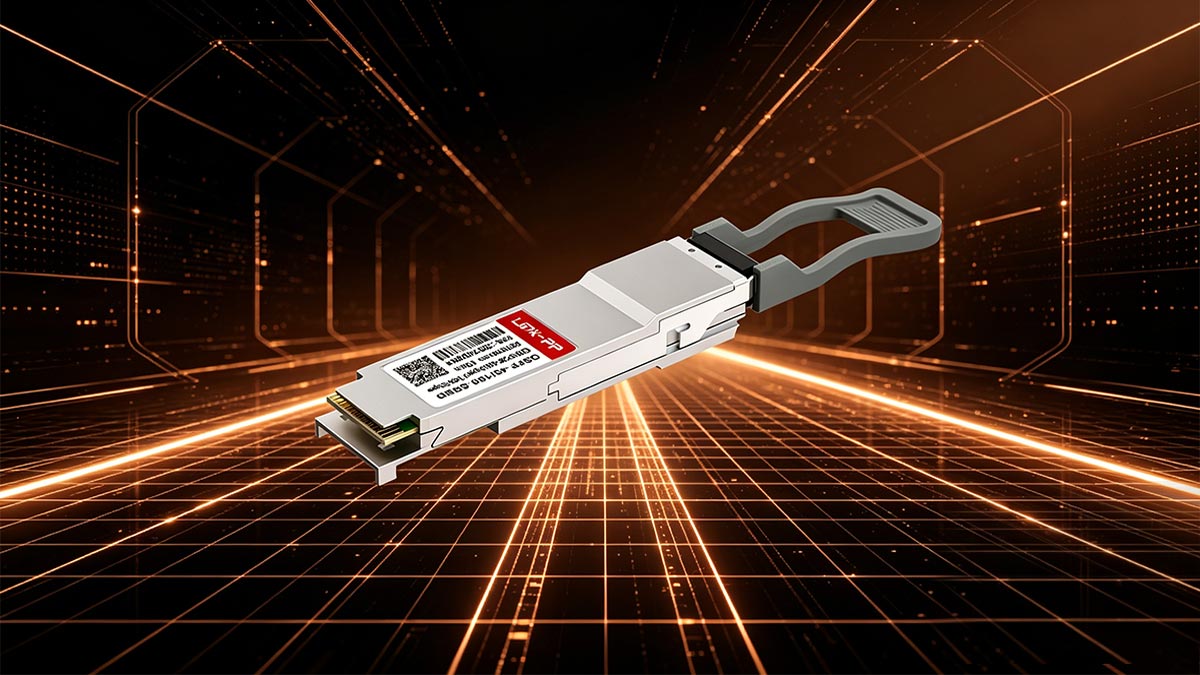
To break this gridlock, data centers are turning to the Cisco QSFP-40/100-SRBD transceiver as the ultimate migration bridge. This innovative dual-rate technology allows operators to seamlessly upgrade links from 10G up to 100G while completely reusing their existing 10G duplex LC multi-mode fiber infrastructure. By avoiding physical layer disruptions and eliminating new cabling expenses, it provides a future-proof, cost-effective path for spine-leaf architecture scaling.
⭐ Understanding the Role of QSFP-40/100-SRBD in Modern Data Center Evolution
The rapid growth of cloud computing and data-heavy applications is forcing data centers to re-evaluate their underlying network architecture. Transitioning from legacy speeds to high-density thresholds requires a strategic approach that balances performance upgrades with operational continuity. The QSFP-40/100-SRBD transceiver serves as a critical catalyst in this evolution, enabling a smooth hardware progression without forcing a complete overhaul of existing physical assets.
Resolving Bandwidth Bottlenecks in Legacy 10G Top-of-Rack Deployments
Traditional data centers heavily rely on 10G Top-of-Rack (ToR) switches to handle server traffic and basic upstream aggregation links. However, the exponential rise in virtualized workloads and data volume has pushed these 10G connections to their absolute limits, causing severe network congestion. This structural lag slows down overall application performance and creates frustrating bottlenecks during peak operational hours.
Deploying the QSFP-40/100-SRBD directly targets this issue by instantly multiplying the available data highways. It allows operators to swap out saturated 10G interfaces for high-speed 40G or 100G links using the exact same physical space. This immediate bandwidth injection clears out traffic jams at the rack level and restores optimal data flow across the entire facility.
Accelerating Leaf-Spine Fabric Scaling without Network Downtime
Modern data centers are rapidly shifting toward high-performance leaf-spine architectures to ensure predictable, low-latency communication between servers. Scaling this specific type of fabric usually requires complex configurations and scheduled maintenance windows that can disrupt daily operations. For most businesses, taking vital network paths offline to upgrade links is a massive financial and operational risk.
The unique dual-rate flexibility of the QSFP-40/100-SRBD eliminates these costly maintenance disruptions entirely. Network engineers can scale up fabric capacity dynamically by transitioning ports from 40G to 100G modes on the fly. This seamless upgrade capability ensures that the leaf-spine fabric grows smoothly alongside business demands without a single second of network downtime.
Adapting Enterprise Core Networks to Modern Cloud-Scale Traffic Demands
Enterprise core networks are facing an unprecedented surge in east-west traffic, driven by modern cloud-scale applications, big data analytics, and real-time AI workloads. Older enterprise frameworks were simply not engineered to handle this massive, continuous volume of data traveling across internal servers. Without a massive structural upgrade, core networks risk becoming permanent choke points for enterprise operations.
Integrating the QSFP-40/100-SRBD into the enterprise core allows organizations to adapt effortlessly to these modern traffic patterns. The transceiver provides the raw data throughput required by cloud-scale applications while maintaining strict stability across core switches. This allows standard enterprise networks to easily mimic the agility, speed, and high-capacity performance of massive public cloud providers.
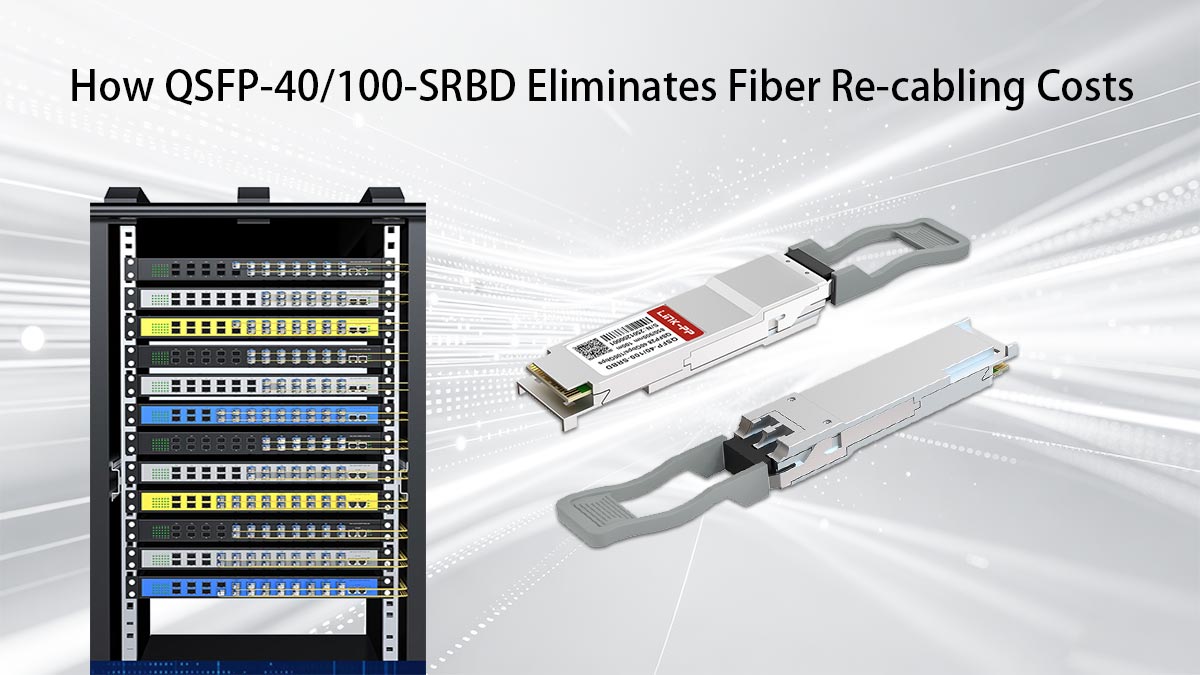
⭐ How QSFP-40/100-SRBD Eliminates Fiber Re-cabling Costs
The greatest hidden expense in any major network speed upgrade is almost always the physical cabling infrastructure. Standard migration paths frequently force data centers to rip out their older wiring to support higher data rates. The QSFP-40/100-SRBD transceiver completely rewrites this economic equation by extracting maximum value from existing hardware assets.
Leveraging Existing 10G Duplex LC MMF Infrastructure
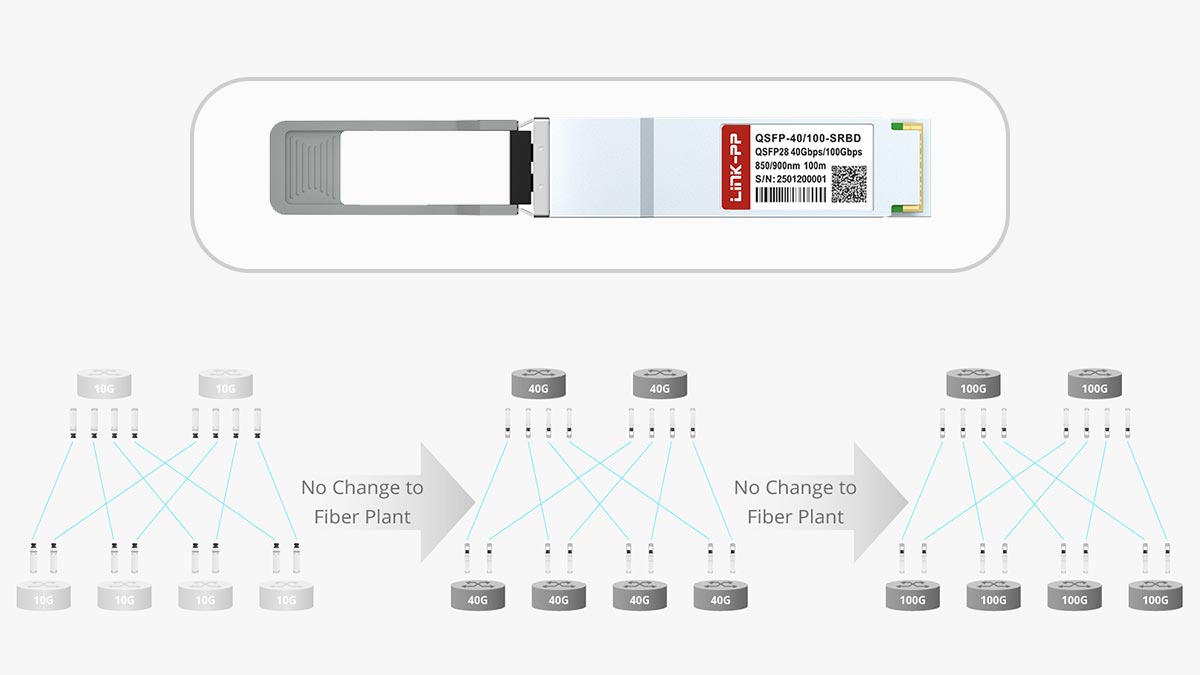
Most legacy 10G networks rely heavily on standard duplex LC multi-mode fiber (MMF) patches, which use two separate fibers to transmit and receive data. Upgrading to higher speeds traditionally renders these old fiber strands completely obsolete. This module solves that issue by using bidirectional (BiDi) technology to send and receive data simultaneously over the exact same two strands.
The following points highlight the clear operational benefits of using this existing infrastructure:
- Zero fiber waste: Keeps older OM3 and OM4 cables in active service.
- Instant speed boosts: Reuses 10G patch panels to achieve up to 100G speeds.
- Familiar handling: Eliminates the need to train technicians on new fiber types.
Avoiding the Expensive Shift to MPO/MTP Cabling
Standard 40G and 100G optical transceivers usually require complex MPO/MTP parallel cabling, which uses 8 or 12 fibers instead of just two. Purchasing these specialized cables and high-density patch panels requires a massive upfront capital investment. By opting for a bidirectional dual-rate solution, data centers can bypass this entire capital expenditure completely.
This strategic choice delivers several major financial and structural advantages across the facility:
- Saved capital: Avoids the high cost of buying premium bulk MPO hardware.
- No patch panel upgrades: Keeps existing rack enclosures and cable trays intact.
- Reduced tray congestion: Prevents thick, heavy cable bundles from clogging pathways.
Minimizing Physical Layer Disruptions During Upgrades
Ripping out old fiber and running new cables through walls and ceilings creates massive physical chaos on the data center floor. Technicians must manually trace paths, pull new glass, and re-test every single link, which significantly elevates the risk of accidental human error. This specialized transceiver minimizes this mess by keeping the upgrade strictly confined to the switch ports themselves.
The physical layer upgrade process remains entirely streamlined due to several key factors:
- Hot-swappable installation: Plugs directly into switch ports without moving existing cables.
- Zero cable pulling: Eliminates physical work inside crowded ceilings or raised floors.
- Reduced error rates: Prevents accidental cable damage during complex fiber migration phases.
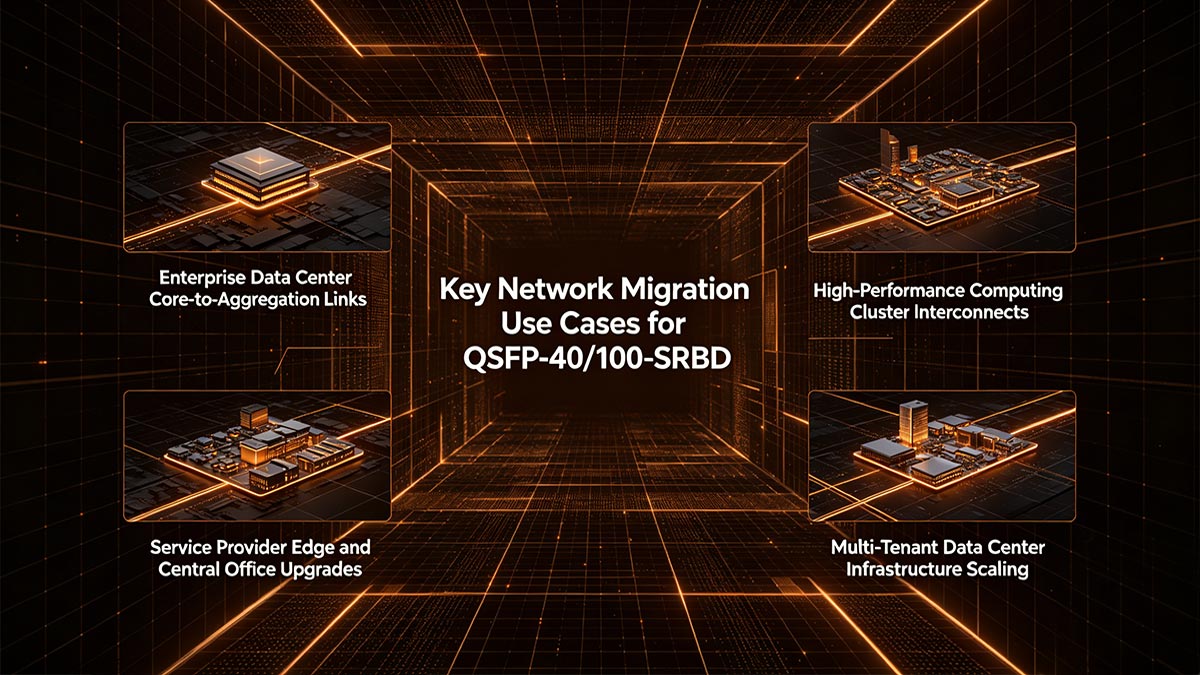
⭐ Key Network Migration Use Cases for QSFP-40/100-SRBD
The journey of network migration looks different for every organization, but the ultimate goal remains the same: achieving higher speeds with minimal cost and disruption. As data demands grow, various sectors must find efficient ways to transition their legacy systems toward next-generation performance. The QSFP-40/100-SRBD transceiver serves as a universal tool, simplifying migration paths across several distinct network environments.
Enterprise Data Center Core-to-Aggregation Links
Migrating the core-to-aggregation links in an enterprise data center is often a highly stressful task for IT departments. These vital pathways carry the bulk of corporate data, making any network migration attempt highly sensitive to downtime. Traditional speed upgrades usually require pulling new cable types, which stalls daily business operations and strains corporate budgets.
By utilizing this transceiver, enterprise teams can execute a phased network migration with complete confidence. Network engineers can instantly upgrade core links from 10G to 40G or 100G while keeping their existing duplex LC fiber patch panels in place. This seamless transition protects previous hardware investments and allows corporate networks to handle modern traffic loads without facing disruptive maintenance windows.
High-Performance Computing (HPC) Cluster Interconnects
High-Performance Computing (HPC) networks must constantly migrate to faster speeds to keep up with massive research and data analysis demands. The migration of cluster interconnects requires a solution that delivers ultra-low latency and maximum data throughput across thousands of connected nodes. However, migrating an entire cluster at once can be financially impossible and operationally overwhelming for research facilities.
The QSFP-40/100-SRBD allows HPC operators to implement a highly successful, step-by-step migration strategy. Technicians can upgrade the interconnect speeds of specific high-priority server clusters while leaving other sections running at lower speeds. This flexible, localized migration approach keeps the overall computing cluster online while systematically boosting data transfer rates where they are needed most.
Service Provider Edge and Central Office Upgrades
Service providers are under constant pressure to migrate their edge networks to higher bandwidth capacities to support growing customer demands. Telecom central offices often feature tightly packed racks and crowded cable trays, making a physical cable migration incredibly difficult. Running new fiber paths through these historic facilities is both physically challenging and financially restrictive.
This specialized transceiver simplifies the service provider migration path by working directly with the duplex LC fiber lines already installed. Telecom operators can effortlessly migrate their edge aggregation points to 40G or 100G speeds to eliminate local traffic bottlenecks. This allows service providers to complete their network migration ahead of schedule while avoiding expensive construction inside their central hubs.
Multi-Tenant Data Center (MTDC) Infrastructure Scaling
Multi-Tenant Data Centers (MTDCs) must frequently assist their clients with network migration requests as tenant businesses expand. Because different tenants migrate their systems at different times, the hosting facility must remain highly adaptable and responsive. Forcing a physical fiber replacement for every tenant upgrade slows down service delivery and cuts into provider profit margins.
Integrating this transceiver into the MTDC framework allows operators to offer instant migration paths over existing customer cross-connects. Tenants can smoothly transition from legacy 10G services up to 100G speeds without waiting for new cables to be installed. This rapid migration capability gives MTDCs a strong competitive edge, allowing them to fulfill customer upgrade requests in minutes rather than days.
⭐ Implementing QSFP-40/100-SRBD in Spine-Leaf Architectures
Modern data center networks rely heavily on spine-leaf topologies to deliver high-performance, non-blocking interconnectivity. Successfully deploying hardware within this framework requires careful optimization of both physical and logical network layers. Utilizing the QSFP-40/100-SRBD transceiver allows operators to efficiently build and scale these fabrics while protecting structural investment.
Upgrading Downlink Server Connections to Leaf Switches
Downlink connections between individual high-performance servers and Top-of-Rack leaf switches are facing massive capacity strains. As modern application servers adopt multi-core processors and dense virtualization, legacy 10G downlinks quickly become saturated. Upgrading these dense server-facing connections traditionally meant buying expensive new network interface cards and entirely new patch cables.
Integrating this dual-rate transceiver into leaf switch ports simplifies the entire server downlink upgrade path. Data centers can boost individual server connections to 40G or 100G while continuing to use their existing duplex LC fiber patch cords. This targeted approach dramatically increases the data delivery speed directly to the application layer without driving up server rack hardware expenses.
Optimizing Leaf-to-Spine 40G/100G Uplinks
The backbone of any fabric architecture is the critical aggregation link connecting individual leaf switches to the central spine layer. These leaf-to-spine uplinks carry aggregated traffic from multiple servers, making massive bandwidth absolutely essential to prevent network wide choking. When server downlinks are upgraded, these upstream highways must immediately scale up to prevent major performance drops.
Deploying the QSFP-40/100-SRBD at the uplink layer provides an incredibly smooth, scalable path for expanding fabric capacity. Network operators can initialize these crucial links at 40G speeds and then smoothly upgrade them to 100G as the cluster grows. This ensures that the core fabric backbone remains perfectly optimized and capable of handling intense heavy traffic loads between switch tiers.
Supporting Predictable East-West Traffic Patterns
Modern cloud applications generate massive amounts of east-west traffic, which flows horizontally between different servers inside the data center. Unlike traditional north-south internet traffic, horizontal data exchanges require constant, low-latency pathways across the entire leaf-spine switch matrix. Any delay or imbalance in these horizontal paths can severely hurt the performance of clustered databases and big data applications.
The bidirectional technology of this transceiver is purpose-built to sustain these intense, predictable horizontal data demands. It establishes dedicated, high-speed optical lanes that keep data moving rapidly between leaf and spine switches without creating congestion. This consistent throughput guarantees that critical server-to-server communications remain fast, stable, and completely lag-free.
⭐ Dual-Rate Flexibility: Deploying QSFP-40/100-SRBD at 40G vs. 100G
One of the standout advantages of this optical module is its unique capability to operate at two distinct hardware speeds. This dual-rate capability allows organizations to design a flexible, multi-stage migration timeline that fits their specific budget and resource availability. By eliminating the need to choose between short-term fixes and long-term goals, it acts as a perfect architectural bridge.
Configuring the Transceiver for Phase 1: 40G Operations
During the initial phase of network modernization, many data centers only require a moderate boost in overall throughput. In these scenarios, the QSFP-40/100-SRBD can be configured to run strictly in 40G mode on compatible switch ports.
This initial setup provides a safe, highly stable environment that immediately relieves legacy congestion points. It allows operations teams to test the new optics thoroughly while keeping the network running at a reliable, well-supported speed threshold.
Seamless Transitioning to Phase 2: Upgrading Ports to 100G Mode
When data demands eventually surge and outgrow the initial 40G allocation, transitioning to the next tier is remarkably simple. Network administrators can change the port speed to 100G mode via standard software commands without touching the physical hardware.
The transceiver automatically adjusts its internal optical lanes to accommodate the massive jump in throughput. This software-driven upgrade capability completely eliminates the need for expensive physical swap-outs or manual labor on the data center floor.
Managing Mixed-Speed Environments Safely
In large-scale data networks, upgrading every single switch and rack simultaneously is often completely impossible. This reality creates complex mixed-speed environments where 40G links must safely coexist right alongside next-generation 100G paths.
The dual-rate flexibility of this transceiver ensures that these varying speeds do not cause operational conflicts or communication errors. Its built-in auto-negotiation features allow different switch generations to communicate flawlessly, keeping data moving across the entire enterprise safely.
Future-Proofing Port Investment for Next-Gen Switches
Purchasing high-performance enterprise switches represents a massive financial commitment that organizations must protect for years to come. Installing single-speed optics often restricts hardware longevity and forces premature replacement cycles when requirements change.
By standardizing on this dual-rate optics transceiver, companies effectively future-proof their network port investments against upcoming technological shifts. The underlying hardware remains highly relevant and fully capable, even as older infrastructure components are systematically phased out around it.
⭐ Technical Specifications and Reach Solutions of QSFP-40/100-SRBD
Evaluating the underlying hardware engineering and performance metrics is essential for ensuring a successful high-speed migration. The QSFP-40/100-SRBD is built on highly sophisticated optical engineering designed to maximize transmission efficiency over existing glass. Understanding these core technical details guarantees that the selected optics align perfectly with the physical layer constraints of the data center.
Analyzing Optical Link Budgets and Wavelengths
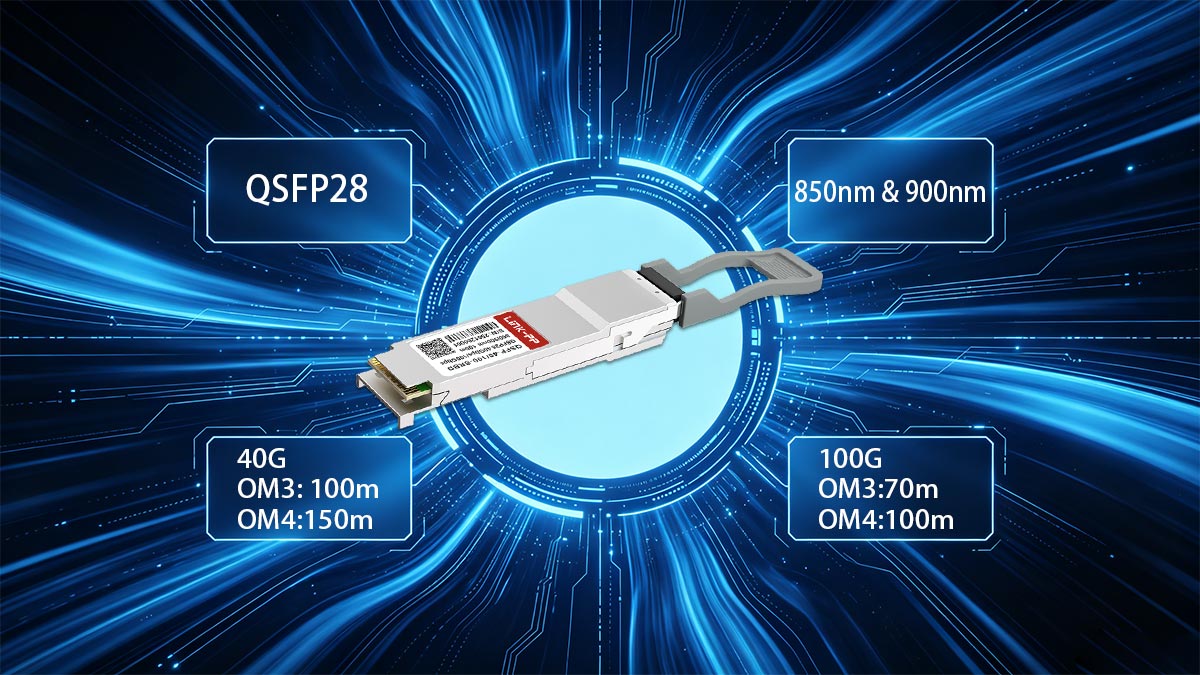
This specialized transceiver utilizes bidirectional (BiDi) optical technology to transmit two independent channels over a single fiber strand. It operates by sending data simultaneously on two different wavelengths, specifically 850nm and 900nm. This precise dual-wavelength design ensures that transmit and receive signals never interfere with one another on the same cable.
By maintaining a healthy optical link budget, the transceiver ensures crisp and accurate signal delivery across short-reach pathways during a 10G to 100G migration. This clever engineering allows data center operators to double their fiber capacity without experiencing any light degradation. Ultimately, this clean signaling provides a highly reliable foundation for high-speed network communication.
Maximum Distance Limits Over OM3 and OM4 Fiber
The overall reach of a 10G to 100G network migration depends heavily on the grade of multi-mode fiber running through the building. Premium laser-optimized cables allow the optical signal to travel significantly further without suffering from severe modal dispersion or light degradation. Understanding these distance boundaries helps network engineers design reliable cable runs between switch racks.
The following table outlines the exact physical reach limitations over legacy cables based on fiber type and configured operating speed:
| Fiber Type | 40G Mode Maximum Reach | 100G Mode Maximum Reach |
| OM3 MMF | Up to 100m | Up to 70m |
| OM4 MMF | Up to 150m | Up to 100m |
These specific metrics confirm that the majority of existing multi-mode data center footprints can easily support a 100G upgrade without running new cables.
Power Consumption and Thermal Efficiency in High-Density Chassis
Deploying hundreds of high-speed transceivers inside a dense enterprise switch chassis can create massive amounts of heat and strain the power grid. Managing this thermal output is absolutely vital to prevent switch components from overheating and causing unexpected system resets. High thermal efficiency ensures that upgrading to 100G does not compromise the lifespan of expensive core hardware.
The QSFP-40/100-SRBD is specifically engineered for low power consumption, typically drawing less than 3.5W per port. This low energy footprint helps keep data center cooling costs manageable while maintaining maximum stability inside packed network racks. By minimizing heat output, this optic provides a sustainable and efficient solution for long-term network growth.
Bit Error Rate and Forward Error Correction Requirements
Operating at high transmission speeds like 100G naturally increases the risk of minor signal distortions and packet loss over older cables. To ensure flawless data integrity during a migration, the network relies on robust error-checking mechanisms at the physical layer. Without proper error handling, random noise on older fiber runs could severely degrade application performance.
This transceiver works in tandem with host-side Forward Error Correction (FEC) algorithms to identify and fix transmission anomalies instantly. Utilizing FEC allows the connection to maintain a highly stable Bit Error Rate (BER), ensuring a completely clean data pathway. This structural safeguards ensure that high-speed traffic remains smooth and error-free even across older cable infrastructures.
⭐ Step-by-Step Deployment Guide Using QSFP-40/100-SRBD
Executing a successful hardware deployment requires a structured approach to ensure everything integrates smoothly. Following a clear, sequential installation methodology minimizes operational risks and shortens maintenance windows. This practical walkthrough outlines the exact procedures needed to get your dual-rate optics running flawlessly.
Pre-Migration Auditing of Existing Duplex LC Patch Panels
Before inserting any new hardware, you must verify the health and quality of your current physical layer. Older 10G fiber lines might suffer from hidden bend damage, excessive dust contamination, or high signal loss at patch panel junctions.
Technicians should focus on completing the following pre-installation checklists:
- Inspect fiber endpoints: Use a fiber scope to check for dust.
- Clean all connectors: Use specialized click-cleaners on LC tips.
- Measure optical loss: Run basic attenuation tests across the links.
- Verify cable types: Confirm the lines are either OM3 or OM4.
Hot-Swapping Procedures and Port Configuration Commands
Cisco hardware fully supports hot-swapping, allowing you to install transceivers without shutting down the parent switch. However, ports must still be configured via software commands to negotiate the correct operational speeds.
The physical insertion and software setup should follow these standard steps:
- Insert the module: Gently push the optic until it clicks into place.
- Remove dust caps: Pull the protective covers right before cabling.
- Connect LC fiber: Plug the duplex patch cord into the transceiver.
- Set port speed: Apply the "speed 40000" or "speed 100000" command.
Verifying Link Aggregation and Optical Signal Integrity
Once the physical connections are secure, you must verify that the logical layer is stable and error-free. Checking the live optical power levels helps ensure that the light signals fall within acceptable engineering budgets.
Engineers should utilize these simple diagnostic steps to verify link health:
- Check port status: Run "show interface status" to confirm it is up.
- Monitor light levels: Use "show interface transceiver details" for power stats.
- Verify EtherChannel: Check link aggregation groups with "show port-channel summary".
- Look for errors: Monitor input and output counters for packet drops.
Common Troubleshooting Steps for Link-Down Events
Even with careful planning, unexpected link-down events can occasionally occur during a major speed migration. Most of these initialization issues stem from minor configuration mismatches or physical connection misalignments.
If a link fails to come online, follow these basic troubleshooting actions:
- Roll back speeds: Drop the port from 100G down to 40G to test.
- Flip the fiber: Swap the transmit and receive fibers at one end.
- Verify FEC status: Check if Forward Error Correction is enabled properly.
- Swap out optics: Replace the transceiver to isolate potential hardware faults.
⭐ Key Takeaways on Solving 10G to 100G Migration via QSFP-40/100-SRBD
Navigating a 10G to 100G network migration no longer requires choosing between massive re-cabling expenses and structural downtime. The QSFP-40/100-SRBD transceiver serves as the perfect bridge, allowing data centers to achieve next-generation speeds while fully preserving their existing duplex LC multi-mode fiber infrastructure. With its unique dual-rate flexibility and excellent power efficiency, this innovative technology provides a seamless, future-proof upgrade path for modern leaf-spine fabrics.
Ready to eliminate your bandwidth bottlenecks and optimize your data center infrastructure without the high cost of new cables? Visit the LINK-PP Official Store today to explore our high-quality, fully compatible optical transceivers and secure the reliable hardware your network needs to scale effortlessly.