



































The PAN-SFP-CG is a 1G copper SFP module designed for Gigabit Ethernet transmission over standard RJ-45 cabling. It enables stable and cost-effective network connectivity in scenarios where short-distance links and existing copper infrastructure are preferred. As network environments continue to evolve, modules like PAN-SFP-CG remain widely used for their simplicity, flexibility, and ease of deployment.
In practical applications, the PAN-SFP-CG is commonly deployed in enterprise networks, data centers, and security appliances to support reliable 1Gbps connections. Its design focuses on consistent performance, low power consumption, and compatibility with Palo Alto Networks devices, making it a practical choice for extending network ports without requiring fiber-based solutions.
⌛ PAN-SFP-CG Overview and Key Features
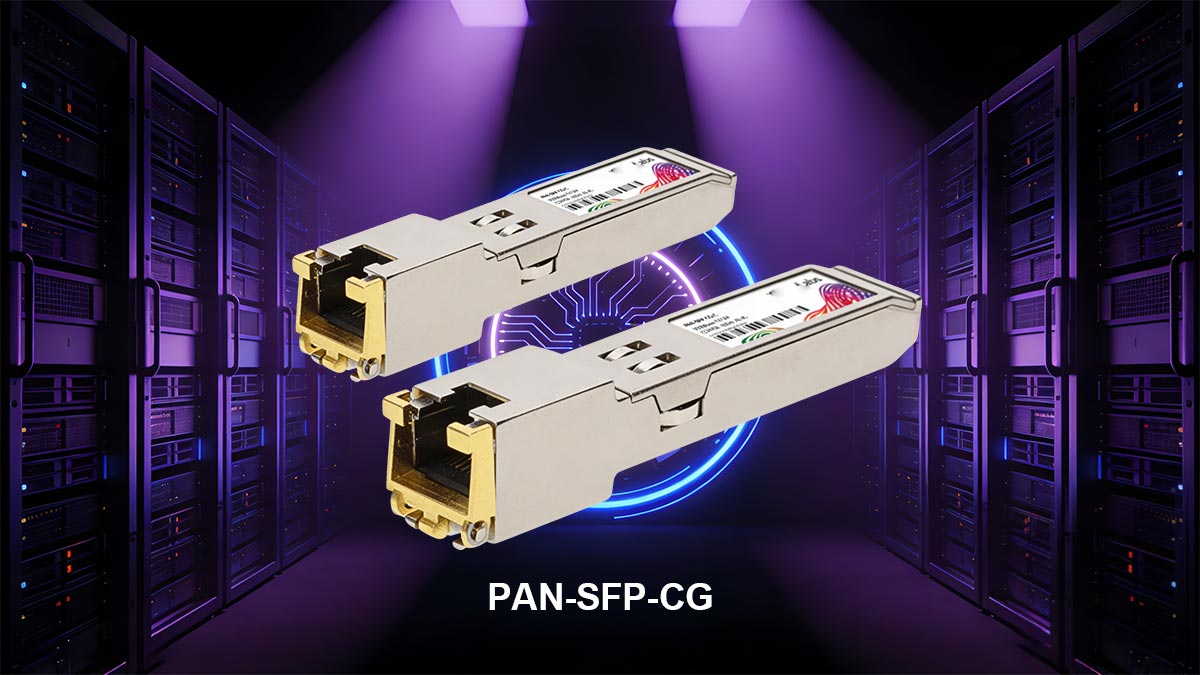
The PAN-SFP-CG is a copper SFP transceiver module developed to deliver reliable Gigabit Ethernet connectivity over standard Cat5e or Cat6 cabling. Designed for seamless interoperability with Palo Alto Networks firewalls and switches, it enables flexible network deployment, cost-effective scaling, and dependable short-range connections.
What is the PAN-SFP-CG Module
The PAN-SFP-CG is a 1000BASE-T copper SFP transceiver that provides electrical connectivity through an RJ-45 interface. Unlike optical SFP modules, it does not require fiber cabling, making it an ideal solution for environments that prioritize convenience, low cost, and simplified management. By converting Gigabit Ethernet signals directly over copper, it ensures stable data delivery across common enterprise network infrastructures.
Physically compact and compliant with the Multi-Source Agreement (MSA) standards, the PAN-SFP-CG fits into standard SFP ports found on most Palo Alto Networks hardware platforms. The module’s plug-and-play design allows engineers to perform quick link expansions or hardware replacements without disrupting active connections, enhancing network flexibility and uptime efficiency.
Core Functionalities and Use Cases
The primary function of the PAN-SFP-CG is to enable 1Gbps Ethernet connectivity between network devices such as firewalls, switches, and routers. It supports distances of up to 100 meters, making it ideal for intra-rack, inter-rack, and office network connections.
In real-world deployments, it is widely used in enterprise LANs, branch offices, and data centers where copper infrastructure is already in place. It is also a practical solution for extending network ports on Palo Alto Networks devices without requiring fiber transceivers.
Key Performance Advantages
One of the key strengths of the PAN-SFP-CG is its electrical signal optimization and low latency characteristics. It provides consistent throughput across standard copper channels, with strong resilience to electromagnetic interference (EMI). The module’s built-in signal conditioning circuitry helps preserve link quality, ensuring stable data transmission even in noisy or power-dense network environments.
Another notable advantage is its energy efficiency and compatibility versatility. The PAN-SFP-CG operates at low power levels, reducing heat generation and enhancing power efficiency across densely populated switch or firewall ports. Its broad compatibility with multiple Palo Alto Networks models and adherence to IEEE 802.3ab standards make it a dependable, long-term choice for enterprise networks requiring stable and predictable 1G copper connectivity.
⌛ PAN-SFP-CG Technical Specifications
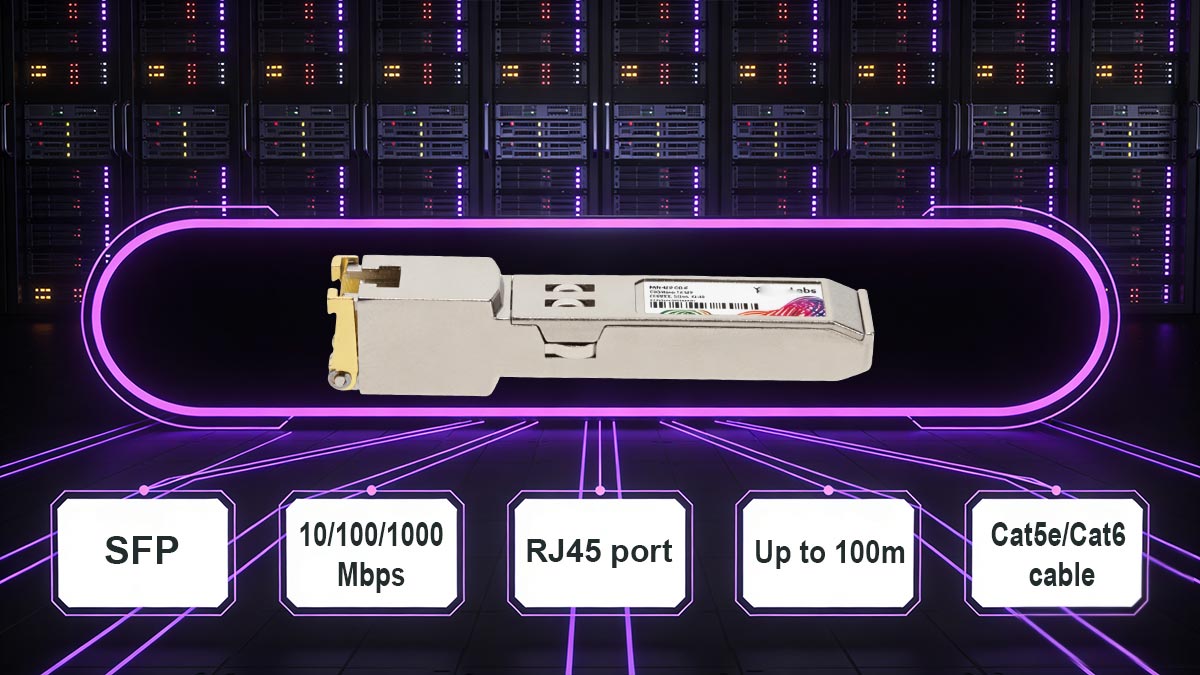
The PAN-SFP-CG module follows the standard SFP architecture used for 1G Ethernet copper connections. It is designed to provide high link reliability and low latency over standard twisted-pair copper cabling, supporting seamless integration across Palo Alto Networks appliances. Built according to IEEE 802.3ab 1000BASE-T requirements, the module enables auto-negotiation for speed and duplex settings, simplifying installation and management. Its low power consumption and compact form factor make it suitable for dense networking environments where energy efficiency and consistent performance are key priorities.
The table below summarizes the core technical specifications of the PAN-SFP-CG module:
| Specification | Details |
| Form Factor | SFP |
| Interface Type | RJ-45 (Copper, 1000BASE-T) |
| Data Rate | 1Gbps |
| Cable Type | Cat5e, Cat6, or higher |
| Maximum Transmission Distance | Up to 100m |
| Auto-Negotiation | 10/100/1000Mbps supported |
| Power Supply Voltage | 3.3 V |
| Standard Compliance | IEEE 802.3ab, SFP MSA |
Form Factor and Physical Dimensions
The PAN-SFP-CG adopts the standard SFP form factor, ensuring plug-and-play compatibility with any SFP-compliant slot on Palo Alto Networks firewalls, switches, and other compatible devices. Its compact metallic enclosure minimizes electromagnetic interference and enhances thermal dissipation, allowing stable operation even in high-density port configurations.
Physically, the module measures approximately 56.5mm (L) × 13.4mm (W) × 8.5mm (H), in line with MSA specifications. This uniform design ensures effortless installation, removal, and replacement during maintenance without disrupting adjacent modules, supporting operational continuity in live environments.
Data Rate and Bandwidth Capabilities
The PAN-SFP-CG supports data transfer speeds of up to 1Gbps, providing a full Gigabit Ethernet throughput over copper cabling. It automatically negotiates 10/100/1000Mbps based on the capabilities of connected devices, which increases integration flexibility and ensures backward compatibility with legacy hardware.
Its internal electronic circuitry is optimized for low-latency data paths, maintaining stable throughput under heavy network load conditions. This makes it particularly reliable for real-time or latency-sensitive applications such as network security monitoring and high bandwidth data exchange within enterprise infrastructures.
Cable Type and Transmission Distance
As a copper SFP transceiver, the PAN-SFP-CG transmits data using electrical signals over Category 5e (Cat5e), Category 6 (Cat6), or higher-rated twisted-pair copper cables. These standard Ethernet cables provide the physical medium for reliable Gigabit connectivity in most enterprise environments. The module fully complies with IEEE 802.3ab 1000BASE-T specifications for copper transmission.
The PAN-SFP-CG supports a maximum transmission distance of 100m when using Cat5e or better cabling, making it ideal for intra-building or data center connections. Performance remains optimal across the full distance range, with no degradation in link stability or throughput when proper cable quality and installation practices are followed.
⌛ PAN-SFP-CG Electrical Performance Characteristics
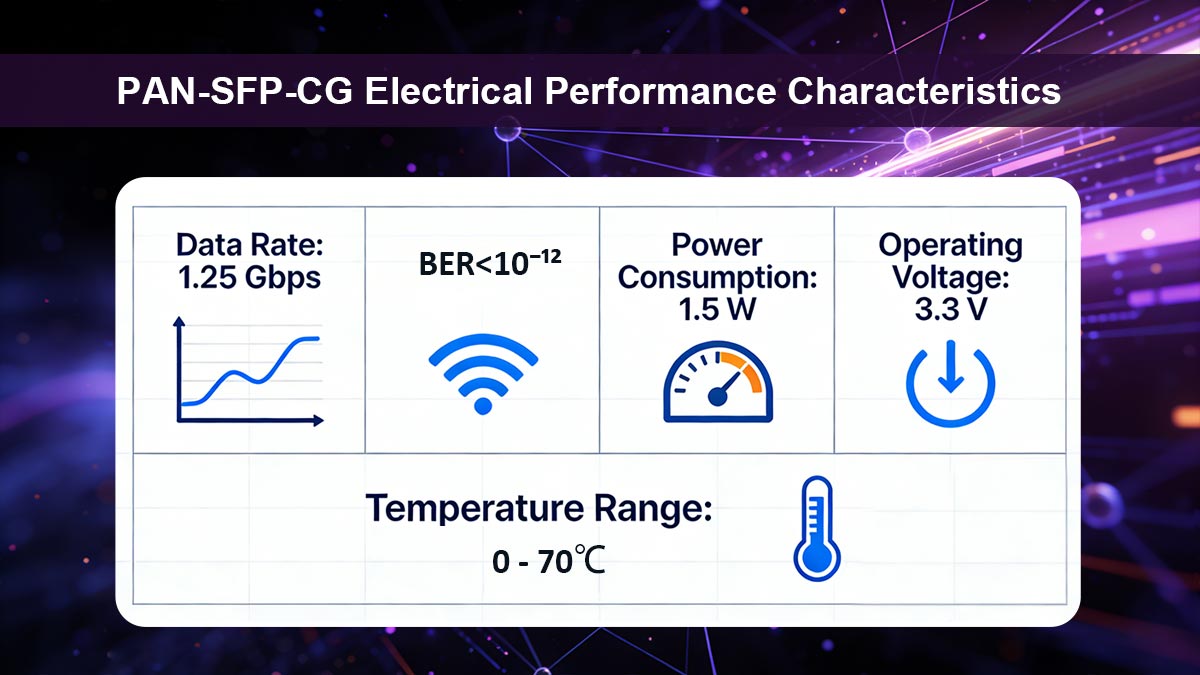
Although the PAN-SFP-CG is a copper-based module rather than a traditional optical transceiver, it still exhibits performance characteristics analogous to optical modules in terms of signal transmission and reception. These characteristics are defined by electrical signaling over copper media rather than light-based transmission. Understanding these parameters helps ensure stable link performance and proper network planning.
Electrical Transmitter Specifications
Since the PAN-SFP-CG is a 1000BASE-T copper module, it does not use a laser or optical transmitter. Instead, it relies on electrical signal transmission over twisted-pair cabling, following IEEE 802.3ab standards. The “transmitter” function is implemented through integrated PHY circuitry that converts digital signals into electrical waveforms suitable for copper transmission.
This electrical transmission mechanism uses PAM-5 encoding to deliver 1Gbps data rates over four wire pairs. The design ensures efficient signal propagation while minimizing crosstalk and interference, allowing consistent performance across standard Ethernet cabling.
Receiver Sensitivity and Performance
Traditional optical receiver sensitivity (measured in dBm) does not apply to the PAN-SFP-CG, as it receives electrical signals directly from copper cables rather than converting light to electricity via photodiodes. The module's receiver relies on adaptive equalization and digital signal processing (DSP) to maintain signal integrity across varying cable lengths and noise conditions. This compensates for attenuation and crosstalk inherent in twisted-pair media.
Performance is characterized by robust bit error rate (BER) handling below 10⁻¹², matching fiber SFP standards through advanced copper-specific receiver algorithms. The receiver dynamically adjusts to maintain link stability up to the full 100-meter specification, providing consistent Gigabit throughput without optical-related factors like overload or saturation.
Signal Quality and Loss Metrics
For copper transmission, signal quality is measured through return loss, insertion loss, and crosstalk parameters rather than optical dB metrics. The PAN-SFP-CG maintains return loss >12dB across 1-100MHz and NEXT (Near-End Crosstalk) performance exceeding IEEE 802.3ab limits, ensuring minimal signal degradation over the full cable length. These metrics guarantee clean Gigabit Ethernet signals free from excessive attenuation or interference.
Loss compensation is handled by the module's built-in equalizer and echo cancellation, which dynamically corrects for cable-induced impairments. This results in near-lossless performance equivalent to short-reach optical links, with total link budget optimized for 100m of Cat5e cabling while preserving data integrity in noisy environments.
⌛ PAN-SFP-CG Electrical Interface Details
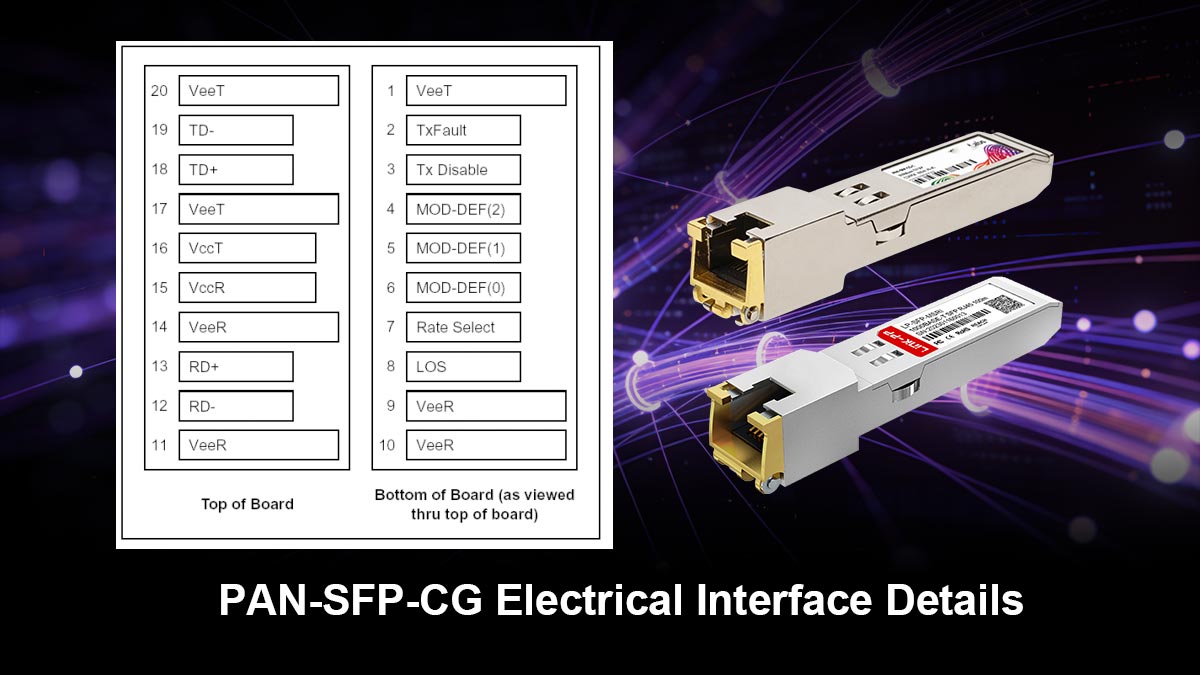
The PAN-SFP-CG implements a standards-based electrical interface defined by the SFP MSA and IEEE 802.3ab specifications. It bridges the host system’s serial interface with a copper PHY that performs full 1000BASE-T signal processing. The following details the signaling architecture, pin-level behavior, and electrical constraints required for stable operation in enterprise environments.
Electrical Signaling Standards
The PAN-SFP-CG converts the host-side SERDES interface (typically 1Gbps serial data stream) into 1000BASE-T compliant signals using an integrated PHY. On the line side, it follows IEEE 802.3ab and uses 4D-PAM5 encoding, transmitting 5-level signals simultaneously across four twisted pairs at 125MBaud.
The module supports auto-negotiation and master/slave configuration, which are essential for clock synchronization in Gigabit Ethernet over copper. It also implements echo cancellation, NEXT/FEXT cancellation, and adaptive equalization, which are mandatory for full-duplex operation over UTP cabling.
Interface Pin Configuration
The PAN-SFP-CG uses the standard 20-pin SFP edge connector, with defined electrical roles per SFP MSA. Key pins include:
- VccT / VccR (Pins 15, 16): 3.3V power supply rails.
- TX_FAULT (Pin 2): Not typically used in copper modules but reserved.
- TX_DISABLE (Pin 3): Allows the host to disable the transmitter (logic high = disable).
- MOD_DEF[0:2] (Pins 4–6): I2C interface for EEPROM (DDM/ID data).
- LOS (Pin 8): Often unused or repurposed in copper modules.
Unlike fiber optic SFP module, the TX/RX differential pairs are internally connected to the PHY rather than exposed as optical signals. The host communicates with the module via a low-voltage differential signaling (LVDS) or CML interface, depending on platform design.
Voltage and Current Requirements
The PAN-SFP-CG operates from a single 3.3V supply, with a typical tolerance of ±5% (3.135V to 3.465V). Internally, the module uses multiple voltage domains generated via onboard regulators to support PHY, DSP, and analog front-end circuits.
Current consumption is significantly higher than optical SFPs due to the integrated copper PHY, typically ranging from 320 mA to 375 mA, with peak values approaching ~1W power dissipation. This increased power draw is mainly due to DSP processing, echo cancellation, and line driving over 100m copper links.
EMI and Signal Integrity Considerations
Because 1000BASE-T operates over unshielded twisted pair (UTP), the PAN-SFP-CG must strictly control EMI emissions. The module design includes common-mode chokes, integrated magnetics, and shielding structures within the RJ-45 interface to meet FCC/CE Class A/B limits.
Signal integrity is maintained through adaptive equalization and digital signal processing (DSP) that compensates for cable attenuation, impedance mismatch, and reflections. The PHY continuously adjusts parameters such as gain and timing to maintain low bit error rates (BER ≤ 10⁻¹²), even under worst-case cable conditions (100m Cat5e with high crosstalk).
⌛ PAN-SFP-CG Compatibility with Palo Alto Networks Devices
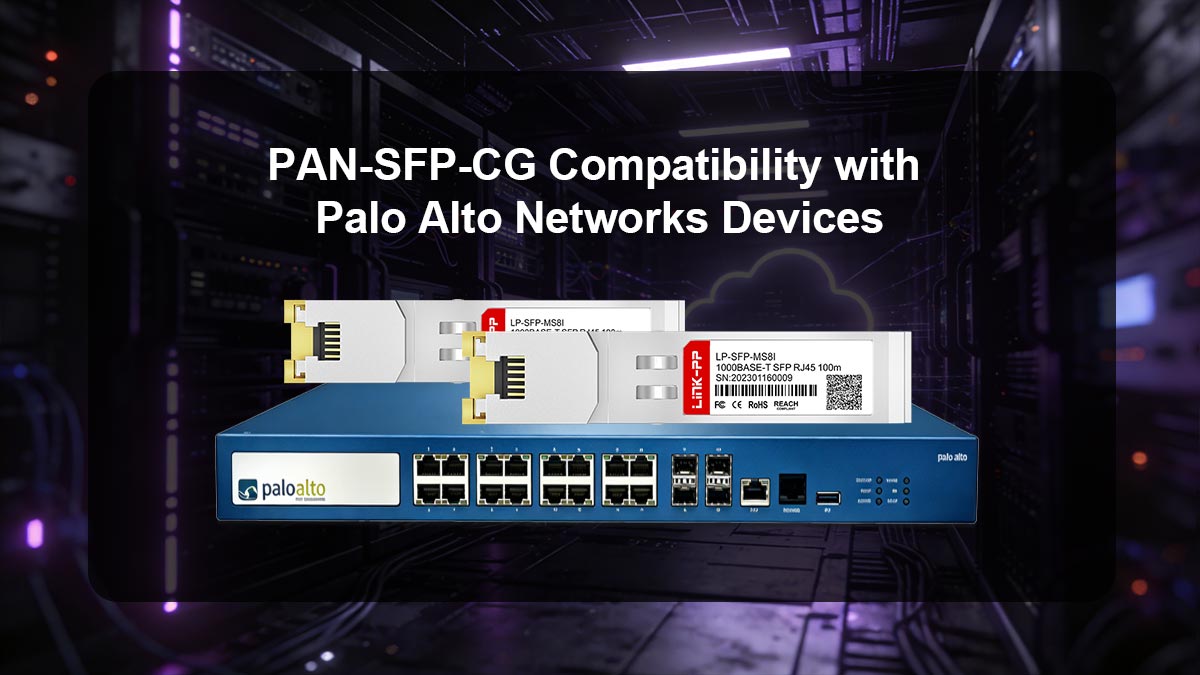
The PAN-SFP-CG module is specifically designed to ensure seamless interoperability with Palo Alto Networks hardware platforms. Its compatibility depends on both hardware support (SFP ports) and software validation within PAN-OS. Understanding supported devices and system requirements is essential to avoid link issues and ensure stable deployment.
Supported Firewall Models
The PAN-SFP-CG is compatible with a wide range of Palo Alto Networks firewall appliances that provide SFP-based Gigabit Ethernet ports. Typical supported models include:
- PA-220 / PA-220R / PA-220C (entry-level platforms with SFP uplinks)
- PA-800 Series (PA-820, PA-850)
- PA-3000 Series (PA-3020, PA-3050, PA-3060)
- PA-3200 Series (PA-3220, PA-3250, PA-3260)
- PA-5200 Series (PA-5220, PA-5250, PA-5260)
Compatibility depends on the presence of 1G SFP ports that support copper transceivers. Some higher-end platforms may prioritize SFP+ 10G ports, which are not always backward-compatible with 1G copper modules.
Compatibility with PAN Switches and Platforms
In addition to firewalls, the PAN-SFP-CG can be used with Palo Alto Networks switching platforms (such as those integrated with Prisma Access or CN-Series environments) where SFP ports support 1000BASE-T modules.
However, compatibility is not always universal across all platforms. Key considerations include:
- Whether the SFP port explicitly supports copper (1000BASE-T) modules.
- Power budget limitations per port (copper SFPs consume more power than optical).
- Platform-specific restrictions on supported SFP types.
It is recommended to verify compatibility with official Palo Alto Networks hardware documentation for each platform.
Firmware and OS Requirements
The PAN-SFP-CG requires support from the device operating system, typically PAN-OS, to be properly recognized and initialized. Most modern PAN-OS versions include built-in support for certified transceivers, but behavior may vary depending on version and device model.
Key requirements include:
- Running a supported PAN-OS version (generally PAN-OS 8.x or later).
- Ensuring the system recognizes the module via EEPROM (I2C interface).
- Verifying that no compatibility warnings or “unsupported transceiver” messages are triggered.
In some cases, older firmware versions may not fully support certain modules, requiring upgrades for proper functionality.
Vendor Validation and Certification
Palo Alto Networks typically validates and certifies specific transceivers, including the PAN-SFP-CG, to ensure guaranteed compatibility and performance. OEM-certified modules are tested for interoperability, power compliance, and long-term stability within supported platforms.
When using third-party PAN-SFP-CG compatible modules, considerations include:
- Whether the module is coded/programmed for Palo Alto compatibility.
- Risk of system warnings or port shutdown behavior.
- Lack of official vendor support in case of issues.
For production environments, it is generally recommended to use vendor-validated or fully compatible transceivers (like LINK-PP LP-SFP-TMRI 10/100/1000BASE-T copper SFP) to minimize operational risks and ensure consistent network performance.
⌛ PAN-SFP-CG Compliance and Certification Standards
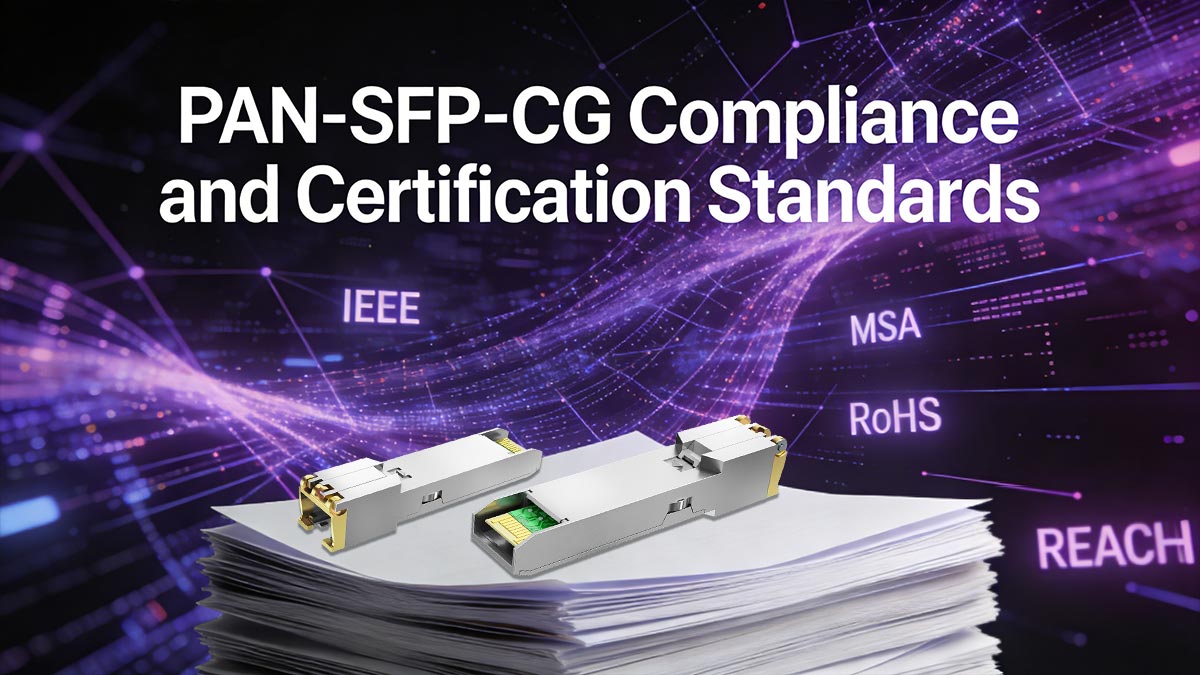
The PAN-SFP-CG is designed to meet a range of industry standards and regulatory requirements to ensure interoperability, safety, and environmental responsibility. Compliance with these standards guarantees that the module can operate reliably within global network infrastructures. It also ensures that the product meets legal and operational requirements across different regions and deployment scenarios.
Industry Standards Compliance (IEEE, MSA)
The PAN-SFP-CG adheres to widely recognized networking and transceiver standards, ensuring interoperability with compliant devices and systems:
- IEEE 802.3ab (1000BASE-T): Defines Gigabit Ethernet transmission over copper twisted-pair cabling, including signaling, encoding (PAM-5), and link performance requirements.
- SFP Multi-Source Agreement (MSA): Specifies mechanical dimensions, electrical interfaces, and EEPROM structure, ensuring compatibility across SFP ports from different vendors.
- Auto-Negotiation Standards (IEEE 802.3 Clause 28 & 40): Supports link speed negotiation and master/slave configuration for stable Gigabit Ethernet operation.
Compliance with these standards ensures that the module can seamlessly integrate into multi-vendor environments without requiring proprietary configurations.
Safety and Regulatory Certifications
To meet global safety and electromagnetic compatibility (EMC) requirements, the PAN-SFP-CG is designed in accordance with the following certifications:
- FCC (Part 15, Class A/B): Ensures the module meets electromagnetic emission limits for commercial and residential environments.
- CE Marking (EN 55032 / EN 55035): Confirms compliance with European EMC and safety directives.
- UL / IEC 62368-1: Covers electrical safety requirements for ICT equipment, ensuring protection against hazards such as electrical shock and fire.
These certifications demonstrate that the module can be safely deployed in enterprise and data center environments worldwide.
Environmental Compliance (RoHS, REACH)
The PAN-SFP-CG is manufactured in accordance with environmental regulations aimed at reducing hazardous substances and ensuring sustainability:
- RoHS (Restriction of Hazardous Substances): Limits the use of substances such as lead (Pb), mercury (Hg), cadmium (Cd), and other hazardous materials in electronic components.
- REACH (Registration, Evaluation, Authorization, and Restriction of Chemicals): Ensures that chemical substances used in the product are properly evaluated and controlled for environmental and human safety.
These compliance measures help organizations meet environmental policies and regulatory obligations.
Quality Assurance Processes
The PAN-SFP-CG undergoes strict quality control and validation processes throughout manufacturing and testing to ensure consistent performance:
- Functional Testing: Each module is tested for link establishment, data transmission, and interoperability with compatible devices.
- Electrical and Signal Integrity Testing: Verifies compliance with IEEE specifications, including BER (Bit Error Rate) and signal stability under varying conditions.
- Environmental and Reliability Testing: Includes temperature cycling, vibration, and aging tests to ensure long-term durability.
- EEPROM Programming and Verification: Ensures correct vendor coding and compatibility with Palo Alto Networks devices.
These quality assurance procedures ensure that every module delivered meets performance expectations and operates reliably in production environments.
⌛ PAN-SFP-CG Installation and Configuration Guidelines
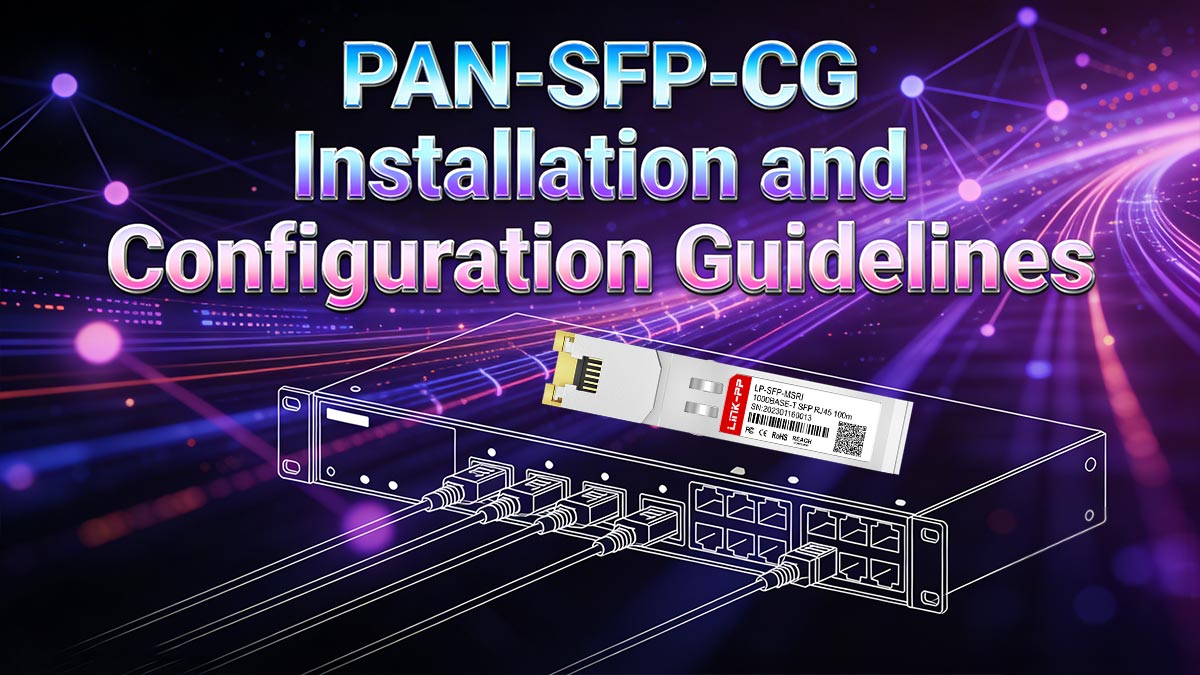
Proper installation and configuration of the PAN-SFP-CG are essential to ensure stable link performance and avoid common connectivity issues. While the module supports plug-and-play operation, following best practices helps guarantee compatibility with Palo Alto Networks devices. Below are the essential steps and considerations for deployment and ongoing operation.
Physical Installation Steps
Before installation, ensure the device is powered on and the SFP port is enabled. Remove any protective dust caps from both the module and the RJ-45 cable to prevent contamination or poor contact. Insert the PAN-SFP-CG firmly into the SFP slot until it clicks into place, ensuring proper alignment with the connector.
After insertion, connect a compatible Ethernet cable (Cat5e or higher) to the RJ-45 port. Verify that the link LED on the device indicates an active connection. Avoid excessive force during insertion or removal, and use the module latch mechanism when disconnecting to prevent damage to the port.
Software and Firmware Configuration
In most cases, the PAN-SFP-CG is automatically recognized by the device without manual configuration. The host system reads the module EEPROM via the I2C interface and initializes the port accordingly. However, it is important to verify that the interface is enabled and configured with the correct speed and duplex settings.
On Palo Alto Networks devices, administrators can use CLI or web interface commands to confirm module detection and link status (e.g., checking interface status or system logs). Running a supported PAN-OS version ensures proper module recognition and avoids compatibility warnings.
Troubleshooting and Diagnostics
If the link does not come up, first verify physical connections, including cable type, length, and connector integrity. Ensure the cable meets Cat5e/Cat6 standards and does not exceed the 100-meter limit. Testing with a known-good cable or port can help isolate the issue.
Additional diagnostics include checking system logs for transceiver warnings, verifying that the module is properly seated, and confirming that the port supports 1000BASE-T copper SFP modules. In some cases, rebooting the device or reseating the module may resolve initialization issues.
⌛ Summary of PAN-SFP-CG Module Specs and Compatibility Insights
The PAN-SFP-CG is a practical and reliable 1G copper SFP module designed for short-distance Gigabit Ethernet connectivity in enterprise networks. Throughout this article, we have covered its key specifications, electrical performance characteristics, interface details, and compatibility with Palo Alto Networks devices. Its support for 1000BASE-T standards, RJ-45 connectivity, and up to 100-meter transmission distance makes it a cost-effective and flexible solution for extending network interfaces using existing copper infrastructure.
In addition, understanding its compliance with industry standards, proper installation practices, and device compatibility requirements helps ensure stable operation and minimizes deployment risks. Whether used in firewalls, switches, or other network platforms, the PAN-SFP-CG delivers consistent performance when deployed correctly within supported environments.
For organizations looking to source reliable and fully compatible PAN-SFP-CG modules, choosing a trusted supplier is essential. You can explore high-quality transceiver module options and ensure dependable performance by visiting the LINK-PP Official Store.







