





























In modern data center and enterprise networking, bandwidth demand continues to grow rapidly due to cloud computing, virtualization, AI workloads, and high-speed storage systems. As traffic density increases, traditional 10G links are no longer sufficient to handle the rising data flow efficiently. This shift has accelerated the adoption of 25Gbps Ethernet technologies, where compact, high-performance interfaces play a critical role in maintaining scalable and cost-efficient infrastructure.
Among these interfaces, the SFP28 port has become a widely deployed solution for 25G connectivity. It is designed to deliver higher throughput within the same physical footprint as earlier SFP transceivers, making it a natural upgrade path for existing network architectures. However, while the SFP28 form factor is well understood, its real-world performance behavior—such as latency, signal integrity, power efficiency, and compatibility—varies significantly depending on deployment conditions and hardware design.
This article takes a deep dive into SFP28 port performance from a practical and technical perspective. It will break down key performance metrics, examine factors that influence transmission quality, compare SFP28 with other common interfaces, and explore optimization strategies used in real network environments. The goal is to provide a clear and structured understanding of how SFP28 ports perform under different conditions, helping network engineers and IT decision-makers make more informed design and deployment choices.
💮 What Is an SFP28 Port? Understanding the Basics
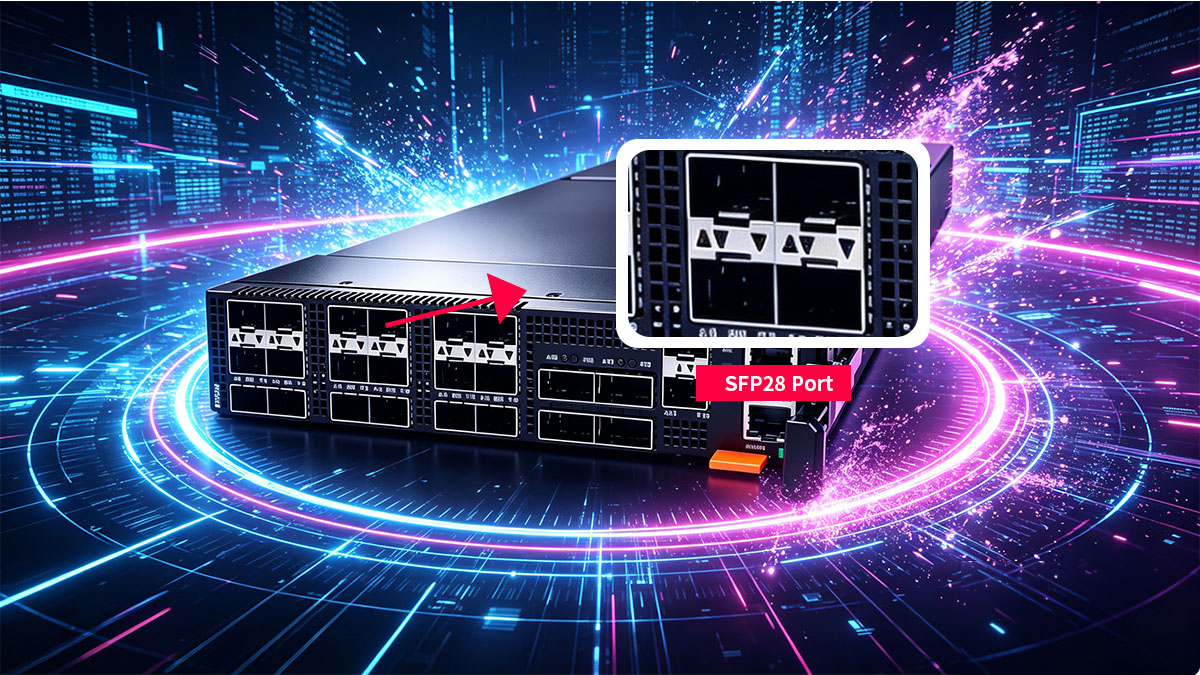
An SFP28 port is a 25Gbps small form-factor pluggable interface designed for high-speed Ethernet connectivity in modern data center and enterprise networks. It is essentially an evolution of the SFP+ 10G standard, maintaining the same physical form factor while significantly increasing bandwidth to support 25G per lane transmission. This makes it a direct and efficient upgrade path for networks transitioning from 10G to other high-speed transceivers architectures without requiring major hardware redesign.
Definition and Technical Overview
An SFP28 port is a hot-pluggable interface used to connect SFP28 optical transceivers or DAC/AOC cables, enabling 25Gbps Ethernet transmission over short or long distances depending on the media type. It uses a single electrical lane operating at 25.78125Gbps, typically based on NRZ (Non-Return-to-Zero) signaling, which ensures compatibility with existing high-speed Ethernet encoding schemes.
To better understand how SFP28 compares with related standards, the following table summarizes key technical differences:
Before reviewing the comparison, it is important to note that these interfaces are often deployed in similar physical environments, but their performance targets and use cases differ significantly.
| Interface Type | Data Rate | Lane Structure | Typical Use Case |
|---|---|---|---|
| SFP+ | 10Gbps | 1 lane | Legacy 10G Ethernet |
| SFP28 | 25Gbps | 1 lane | Modern 25G access/leaf layer |
| QSFP28 | 100Gbps | 4 lanes | Aggregation / spine layer |
After reviewing the table, it becomes clear that SFP28 serves as a balanced middle layer between legacy 10G systems and high-density 100G aggregation networks. Its single-lane design allows higher port density while maintaining lower complexity compared to multi-lane QSFP based solutions.
Common Use Cases of SFP28 Ports
SFP28 ports are primarily deployed in environments where higher bandwidth per connection is required without sacrificing port density or power efficiency. They are widely used in leaf-spine data center architectures, where top-of-rack switches connect to servers at 25G speeds to reduce oversubscription and improve east-west traffic flow.
In addition to data center switching, SFP28 interfaces are also commonly found in high-performance computing clusters and cloud infrastructure platforms. These environments rely on low-latency, high-throughput interconnects to support distributed computing workloads, storage replication, and large-scale virtualization.
Typical deployment scenarios include:
- Leaf layer switch connections to servers in modern data centers
- High-density virtualization clusters requiring low-latency communication
- Storage networks (SAN) where 25G links improve throughput efficiency
- Cloud service provider backbone access layers for scalable bandwidth expansion
After reviewing these scenarios, it is clear that SFP28 ports are not limited to a single application domain. Instead, they act as a versatile connectivity layer that supports both performance-driven computing and scalable network design.
💮 Key Performance Metrics of SFP28 Ports
SFP28 port performance is defined by a set of measurable technical metrics that determine how effectively 25Gbps traffic is transmitted across a network. These metrics are not independent; instead, they interact with each other to influence overall link stability, efficiency, and scalability. Understanding these core parameters is essential for evaluating real-world SFP28 performance in data center and enterprise deployments.
Data Rate and Throughput
The primary performance characteristic of an SFP28 port is its 25Gbps line rate, which represents the raw signaling speed of the interface. However, the usable throughput is slightly lower due to encoding overhead and protocol framing. In most Ethernet implementations, 64b/66b encoding is used to maintain synchronization while minimizing overhead, resulting in high transmission efficiency.
Before examining typical throughput behavior, it is useful to compare theoretical and practical values under standard Ethernet conditions:
| Metric Type | Value | Description |
|---|---|---|
| Line Rate | 25.78125Gbps | Physical signaling rate |
| Ethernet Payload | ~24.9Gbps | Effective usable bandwidth |
| Encoding Scheme | 64b/66b | Low-overhead data encoding |
After reviewing the table, it becomes clear that SFP28 delivers very high efficiency, with only minimal bandwidth loss between raw signaling and usable data. This efficiency is one of the key reasons why 25G has become a standard replacement for 10G in modern architectures.
From a performance perspective, sustained throughput stability is more important than peak speed. In real deployments, factors such as switch ASIC capacity, buffer design, and traffic patterns determine whether the port can consistently maintain near-line-rate performance under load.
Latency and Signal Integrity
Latency in an SFP28 port is extremely low, typically measured in nanoseconds at the physical layer. However, end-to-end latency is influenced by additional factors such as switch processing, queueing, and network congestion. As a result, while the port itself introduces minimal delay, overall system design plays a much larger role in perceived performance.
Signal integrity is equally critical for maintaining stable 25G transmission. At higher speeds, even minor degradation in electrical or optical signals can result in increased retransmissions or link instability.
Key factors affecting latency and signal quality include:
- PCB trace design and impedance matching within the switch hardware
- Quality and type of DAC, AOC, or optical transceiver used
- Distance and attenuation characteristics of the transmission medium
- Electromagnetic interference in high-density rack environments
After considering these factors, it becomes clear that SFP28 performance is not only defined by speed, but also by the stability of signal transmission across physical and electrical layers.
Power Consumption and Thermal Performance
SFP28 ports are designed to balance high bandwidth with relatively low power consumption, making them suitable for high-density deployments. Power usage varies depending on whether the interface is using DAC, optical transceiver modules, or active optical cables, but it generally remains efficient compared to older multi-lane architectures.
The following table summarizes typical power characteristics across different SFP28 media types:
| Media Type | Typical Power Consumption | Heat Output | Deployment Impact |
|---|---|---|---|
| DAC Cable | Very Low (passive) | Minimal | Short-reach, low cost |
| AOC Cable | Low to Medium | Moderate | Flexible medium-range links |
| Optical | Medium | Higher | Long-distance, high reliability |
After reviewing the table, it is evident that DAC solutions provide the best power efficiency, while optical modules offer greater flexibility at the cost of increased power and thermal output. In high-density switches, thermal management becomes a key design consideration, as cumulative heat from multiple SFP28 ports can impact system stability.
Bit Error Rate (BER) and Reliability
Bit Error Rate (BER) is a critical metric used to measure transmission reliability in SFP28 networks. It represents the probability of bit errors occurring during data transmission. In high-quality 25G systems, BER is typically extremely low, often improved further through Forward Error Correction (FEC) mechanisms.
Before interpreting BER performance, it is important to understand the role of error correction:
- RS-FEC (Reed-Solomon Forward Error Correction) improves resilience at higher speeds
- Base-R FEC provides lighter correction with lower latency overhead
- Without FEC, stricter signal quality requirements are necessary
After considering these mechanisms, SFP28 links can maintain stable performance even in electrically noisy or long-reach scenarios. However, improper configuration or poor-quality optics can significantly increase BER, leading to packet loss and retransmissions that degrade overall network efficiency.
In practical terms, maintaining low BER is essential for ensuring that SFP28 ports deliver consistent high-speed performance under real-world traffic conditions, especially in cloud and storage-intensive environments.
💮 Factors Affecting SFP28 Port Performance
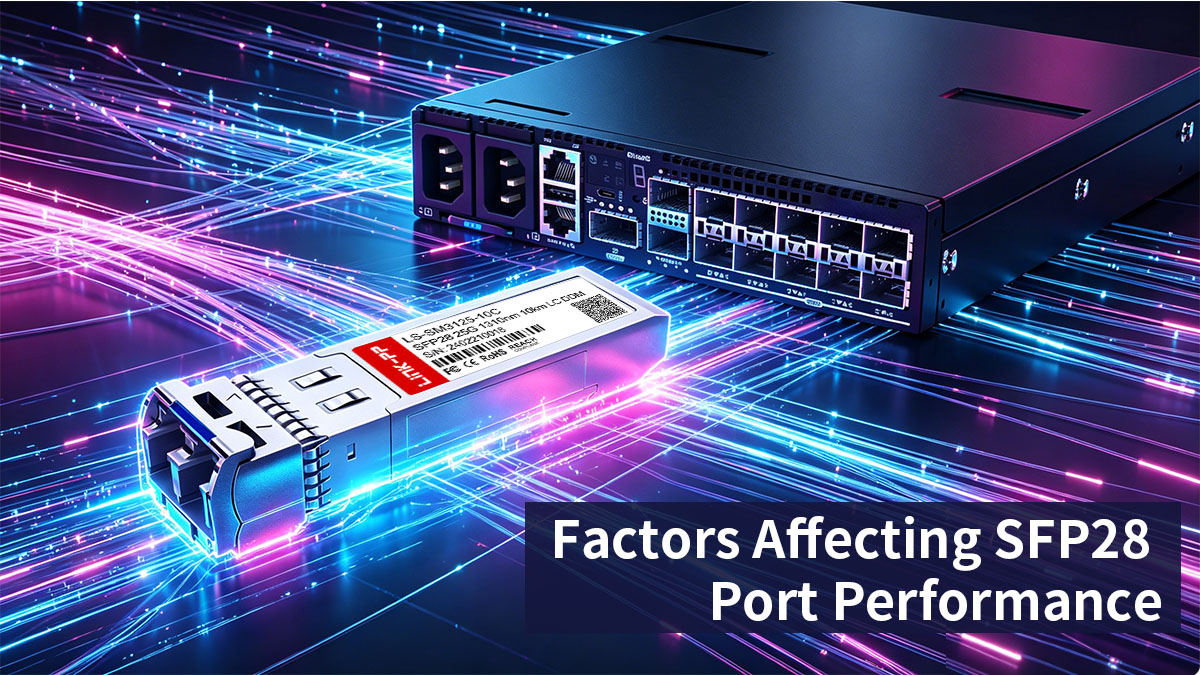
SFP28 port performance is not determined by the port specification alone. In real deployments, multiple physical, electrical, and configuration-related factors interact to influence signal quality, throughput stability, and overall link reliability. Understanding these factors is essential for diagnosing performance bottlenecks and designing stable 25G networks.
Cable Type and Transmission Distance
The type of transmission medium is one of the most direct factors affecting SFP28 performance. Different media types introduce different levels of attenuation, latency, and signal integrity constraints, which directly impact achievable distance and stability.
Before comparing media types, it is important to understand that each option is optimized for a specific deployment range and cost-performance balance.
| Media Type | Typical Reach | Signal Characteristics | Best Use Scenario |
|---|---|---|---|
| DAC (Direct Attach Copper) | Up to 3–5m | Electrical signal, very low latency | Rack-to-rack short connections |
| AOC (Active Optical Cable) | Up to 30–100m | Optical signal with integrated optics | Medium-range intra-data center links |
| Optical Transceiver | Up to 10km+ | Full optical transmission | Campus or metro connectivity |
After reviewing the table, it is clear that shorter, electrical-based DAC solutions deliver the lowest latency and cost, while optical transceivers provide the greatest reach and flexibility. However, as distance increases, signal attenuation and optical power budget become critical constraints that directly affect SFP28 performance stability.
Hardware Compatibility and Switch Design
SFP28 performance is also heavily influenced by the underlying hardware architecture of the switch or server platform. Even when using identical transceivers, differences in ASIC design, port layout, and firmware optimization can lead to measurable performance variations.
Key hardware-related factors include:
- Switch ASIC throughput capacity and buffering design
- Port lane mapping and internal switching fabric efficiency
- Compatibility between vendor-coded transceivers and host devices
- Firmware optimization for 25G auto-negotiation and FEC handling
After considering these elements, it becomes evident that SFP28 performance is not purely a transceiver characteristic, but a system-level outcome. Poorly optimized switch hardware may introduce congestion, increased latency, or even link instability under sustained load.
Environmental Conditions
Environmental conditions play a more important role in high-density 25G deployments than many operators initially expect. As port density increases, even small environmental variations can accumulate into significant performance degradation.
Typical environmental factors include:
- Operating temperature inside network equipment racks
- Humidity levels affecting optical connector stability
- Electromagnetic interference (EMI) from adjacent high-power devices
- Airflow design and cooling efficiency within the data center
After examining these factors, it becomes clear that thermal stability is particularly critical. Elevated temperatures can increase bit error rates and reduce optical module lifespan, while insufficient cooling can lead to thermal throttling or link instability in extreme cases.
Firmware and Configuration Settings
Beyond physical infrastructure, SFP28 performance is strongly influenced by software-level configuration. Many performance issues in 25G networks are not hardware failures, but rather misconfigured settings that affect how the port handles traffic and error correction.
Important configuration elements include:
- FEC mode selection (RS-FEC vs Base-R FEC)
- Auto-negotiation settings for 25G link establishment
- Interface speed and duplex configuration consistency
- QoS and buffer tuning for congestion-heavy environments
After reviewing these settings, it is clear that Forward Error Correction configuration has the most direct impact on link stability. Enabling or disabling FEC incorrectly can result in increased packet loss, reduced throughput, or even link flapping under marginal signal conditions.
In practical deployments, achieving optimal SFP28 performance requires alignment between hardware capability, environmental stability, and correct firmware configuration. When these elements are properly balanced, 25G links can operate at near line-rate performance with high reliability even under demanding workloads.
💮 Comparing SFP28 Port Performance with Other Interfaces
SFP28 port performance is best understood when evaluated against adjacent Ethernet interface standards. In real network design, SFP28 does not exist in isolation; it sits between legacy 10G systems and higher-density 100G architectures. Comparing these interfaces helps clarify where SFP28 delivers the most value in terms of bandwidth efficiency, latency behavior, and deployment flexibility.
SFP28 vs SFP+ (10G)
SFP28 provides a direct performance upgrade over SFP+ by increasing per-lane bandwidth from 10Gbps to 25Gbps while maintaining the same physical form factor. This allows network operators to significantly increase throughput without changing switch port density or redesigning infrastructure layouts.
Before examining the differences, it is important to highlight that both interfaces are widely used in similar top-of-rack and access-layer scenarios, making their performance gap especially impactful in upgrade decisions.
| Feature | SFP+ | SFP28 |
|---|---|---|
| Data Rate | 10Gbps | 25Gbps |
| Encoding | 64b/66b | 64b/66b |
| Port Density Impact | Lower throughput per port | 2.5× higher throughput |
| Power Efficiency | Moderate | Improved per Gbps efficiency |
After reviewing the comparison, it becomes clear that SFP28 significantly improves bandwidth efficiency without increasing physical complexity. This makes it particularly suitable for organizations seeking incremental upgrades from 10G to 25G without major architectural changes.
From a performance perspective, SFP28 also reduces network oversubscription in leaf-layer designs, enabling more balanced east-west traffic flow in modern data centers.
SFP28 vs QSFP28 (100G)
While SFP28 focuses on single-lane 25G transmission, QSFP28 operates at 100G using four aggregated 25G lanes. This fundamental difference affects not only bandwidth, but also port density, cabling complexity, and scalability strategy.
Before analyzing the trade-offs, it is important to recognize that these interfaces are often deployed together in hierarchical network designs, with SFP28 at the access layer and QSFP28 at the aggregation or spine layer.
| Feature | SFP28 | QSFP28 |
|---|---|---|
| Total Bandwidth | 25Gbps | 100Gbps |
| Lane Structure | 1×25G | 4×25G |
| Port Density | Higher | Lower per port |
| Typical Layer | Access / Leaf | Spine / Aggregation |
After reviewing the table, it becomes clear that SFP28 prioritizes density and simplicity, while QSFP28 prioritizes aggregate throughput. In practice, SFP28 enables finer-grained bandwidth allocation at the edge, whereas QSFP28 consolidates traffic at higher tiers.
This separation of roles helps optimize cost efficiency and performance balance across multi-tier network architectures.
SFP28 vs Emerging 50G/100G PAM4 Technologies
As network speeds continue to evolve, newer interfaces such as 50G SFP56 and PAM4 based 100G systems are emerging. These technologies increase bandwidth by using more advanced modulation techniques rather than relying solely on higher symbol rates.
Before comparing these technologies, it is important to note that SFP28 is based on NRZ signaling, which is simpler and generally more robust than PAM4 in noisy environments.
| Feature | SFP28 (NRZ) | 50G/100G PAM4 |
|---|---|---|
| Modulation | NRZ | PAM4 |
| Complexity | Lower | Higher |
| Signal Sensitivity | Lower | Higher |
| Bandwidth Efficiency | Moderate | High |
After reviewing the comparison, it is evident that PAM4-based systems achieve higher data density but introduce increased complexity and stricter signal integrity requirements. In contrast, SFP28 offers a more stable and mature solution with predictable performance characteristics.
From an operational standpoint, many networks continue to rely on SFP28 because it provides a balanced combination of performance, reliability, and cost-effectiveness, especially in environments where stability is prioritized over maximum theoretical bandwidth.
💮 How to Optimize SFP28 Port Performance
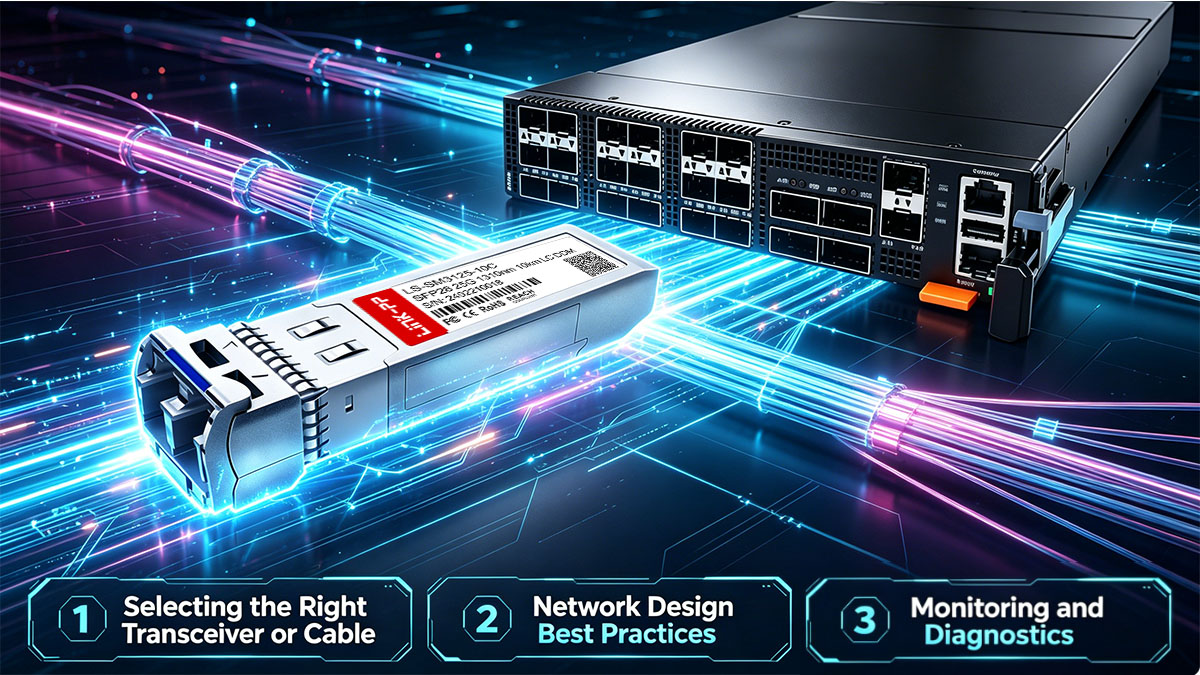
Optimizing SFP28 port performance is essential for ensuring stable 25Gbps operation in real-world networks. While the interface itself is designed for high-speed transmission, actual performance depends heavily on component selection, network design, and operational tuning. Proper optimization helps reduce packet loss, improve latency consistency, and maintain near line-rate throughput under sustained load.
Selecting the Right Transceiver or Cable
The most fundamental step in optimizing SFP28 performance is choosing the appropriate transmission medium for the specific deployment scenario. Different transceivers and cables vary significantly in signal integrity, reach, and power efficiency, which directly impacts link stability.
Before comparing options, it is important to align the selection with distance requirements and environmental constraints.
| Option | Typical Reach | Performance Characteristics | Best Fit Scenario |
|---|---|---|---|
| DAC Cable | 1–5m | Lowest latency, minimal power loss | In-rack server-to-switch connections |
| AOC Cable | 10–100m | Balanced flexibility and signal stability | Cross-rack data center links |
| Optical Transceiver | 300m–10km+ | High reliability, scalable reach | Campus and metro interconnects |
After reviewing the table, it becomes clear that no single option is universally optimal. Instead, performance optimization depends on matching the medium to the physical topology. Using DAC in short-reach environments minimizes latency, while optical solutions ensure stability over longer distances where electrical signaling would degrade.
Network Design Best Practices
Network architecture has a direct impact on how efficiently SFP28 ports operate under load. Even high-quality hardware can underperform if the topology introduces congestion or uneven traffic distribution.
To achieve stable 25G performance, several design principles are commonly applied:
- Implement leaf-spine topology to reduce oversubscription
- Balance uplink and downlink bandwidth ratios carefully
- Avoid mixing different speed tiers within the same critical traffic path
- Ensure consistent 25G adoption across access-layer devices
After considering these design choices, it becomes clear that oversubscription is one of the most common causes of degraded SFP28 performance. A well-balanced topology ensures that 25G links are fully utilized without becoming bottlenecks in east-west traffic flows.
Monitoring and Diagnostics
Continuous monitoring is critical for maintaining optimal SFP28 performance over time. Without visibility into link behavior, issues such as rising error rates or signal degradation may go unnoticed until they impact application performance.
Key monitoring capabilities include:
- Digital Optical Monitoring (DOM/DDM) for real-time optical power levels
- Link error counters to track retransmissions and CRC errors
- Throughput monitoring at interface and switch levels
- Latency and jitter measurement in high-performance environments
After reviewing these tools, it becomes clear that optical power monitoring is especially valuable for detecting early-stage degradation. Gradual signal loss often precedes link failure, making proactive diagnostics essential for preventing downtime.
Thermal and Power Management
Thermal conditions directly influence SFP28 stability, particularly in high-density deployments where multiple 25G ports operate simultaneously. Excess heat can increase bit error rates and reduce overall system reliability.
To maintain stable performance, several thermal management strategies are commonly applied:
- Ensure sufficient front-to-back airflow in switch chassis
- Avoid blocking ventilation paths in rack designs
- Distribute high-power modules evenly across ports
- Monitor internal temperature sensors regularly
After considering these practices, it is evident that thermal imbalance is often an overlooked factor in performance degradation. Even if individual modules operate within specifications, cumulative heat in dense environments can negatively affect signal quality across multiple ports.
💮 Common Performance Issues and Troubleshooting
SFP28 port performance issues in real networks are often not caused by a single failure point. Instead, they typically result from a combination of signal degradation, configuration mismatches, or environmental constraints. Understanding common failure patterns helps isolate problems quickly and restore stable 25Gbps operation with minimal downtime.
Link Instability and Packet Loss
Link instability and packet loss are among the most frequently observed issues in SFP28 deployments. These symptoms usually indicate problems at the physical layer, where signal quality is insufficient to maintain a stable connection.
Before identifying root causes, it is important to recognize typical symptoms:
- Intermittent link up/down events
- Increased CRC or frame error counters
- Sudden drops in throughput under load
After observing these behaviors, the next step is to isolate potential causes:
- Poor-quality or incompatible DAC/AOC/optical modules
- Dirty or damaged fiber connectors causing signal attenuation
- Mismatched transceiver vendors or firmware incompatibility
- Excessive cable length beyond specification limits
Once these factors are checked, most instability issues can be resolved by replacing or re-seating the physical media and verifying compatibility between both ends of the link.
High Latency or Reduced Throughput
High latency or reduced throughput in SFP28 networks often indicates issues beyond the physical layer. In many cases, the port itself is functioning correctly, but traffic handling or configuration errors are limiting effective performance.
Before diagnosing, it is important to distinguish between physical latency and application-level delay. SFP28 hardware introduces minimal latency, so performance degradation is usually system-related.
Common causes include:
- Incorrect or mismatched FEC configuration between endpoints
- Oversubscription in switch uplinks leading to congestion
- Buffer exhaustion during traffic bursts
- QoS misconfiguration affecting traffic prioritization
After reviewing these causes, it becomes clear that congestion and buffering behavior are often the primary contributors. In high-density 25G environments, even minor imbalances in traffic distribution can result in measurable performance degradation.
Overheating and Module Failure
Thermal issues are a critical but often underestimated factor affecting SFP28 port stability. High-density deployments can generate significant heat, especially when multiple optical modules operate simultaneously under sustained load.
Before identifying failure conditions, typical indicators include:
- Sudden link degradation after prolonged operation
- Reduced optical signal strength reported via DOM/DDM
- Unexpected module resets or shutdowns
Key contributing factors include:
- Insufficient airflow within switch chassis
- High ambient temperature in rack environments
- Dense port utilization without thermal balancing
- Accumulated dust or blocked ventilation paths
After considering these factors, it becomes clear that thermal stress does not always cause immediate failure. Instead, it often leads to gradual performance degradation, increasing error rates before eventual link instability occurs.
💮 Conclusion
SFP28 port performance plays a central role in modern 25Gbps Ethernet networks, directly impacting throughput efficiency, latency stability, and overall data center scalability. As discussed throughout this article, the SFP28 port is not only a bandwidth upgrade from SFP+, but also a critical enabler for balanced leaf-spine architectures, high-density server connectivity, and AI-driven workloads where predictable 25G performance is essential. When properly deployed, SFP28 delivers a strong combination of speed, efficiency, and operational stability across diverse network environments.
Key Takeaways
A clear understanding of SFP28 performance helps ensure better design decisions and more reliable network operations. The most important takeaways can be summarized as follows:
- SFP28 provides 25Gbps per-lane performance with high efficiency and low latency characteristics
- Real-world performance is influenced by cable type, hardware compatibility, environment, and configuration settings
- Optimization requires a balanced approach combining proper media selection, network design, and FEC tuning
- Common issues such as packet loss, instability, and overheating are typically preventable with correct deployment practices
- SFP28 remains a long-term foundational technology for 25G access-layer connectivity despite emerging higher-speed standards
Final Perspective and Next Step
As network demands continue to grow, ensuring stable and efficient SFP28 port performance becomes increasingly important for maintaining scalable infrastructure. Selecting reliable transceivers, optimizing system configuration, and following best deployment practices are key to achieving consistent 25G network performance in real-world conditions.
For high-quality optical connectivity solutions and SFP28-compatible modules designed for stable performance and long-term reliability, you can explore the LINK-PP Official Store for more technical options tailored to modern data center needs.