In modern enterprise and data center networks, optical transceivers play a critical role in ensuring high-speed and stable data transmission. Among the most widely deployed options, SFP-based modules using different wavelengths have become a foundational part of fiber connectivity. As bandwidth demand continues to grow, selecting the right optical module is increasingly important for balancing performance, distance, and infrastructure cost.
Among the most frequently compared options are SFP 850nm and 1310nm modules, which differ significantly in wavelength behavior, transmission media compatibility, and deployment scenarios. While both are used in Ethernet and fiber networks, they serve different roles depending on whether the focus is short-range multimode connectivity or longer-range single-mode transmission. Understanding these differences is essential for making informed network design decisions.
This article explains the key differences and practical implications of SFP 850 vs 1310nm modules and helps clarify their use cases in real-world networks, including:
- Core technical principles behind 850nm and 1310nm wavelengths
- Performance differences in transmission distance and fiber compatibility
- Deployment scenarios across data centers, enterprise networks, and telecom environments
- Cost, power, and infrastructure considerations for each module type
By the end of this guide, you will have a clear and practical understanding of how to choose the most suitable optical module for their specific networking requirements and deployment conditions.
🔘 Understanding SFP 850 and 1310nm Optical Modules
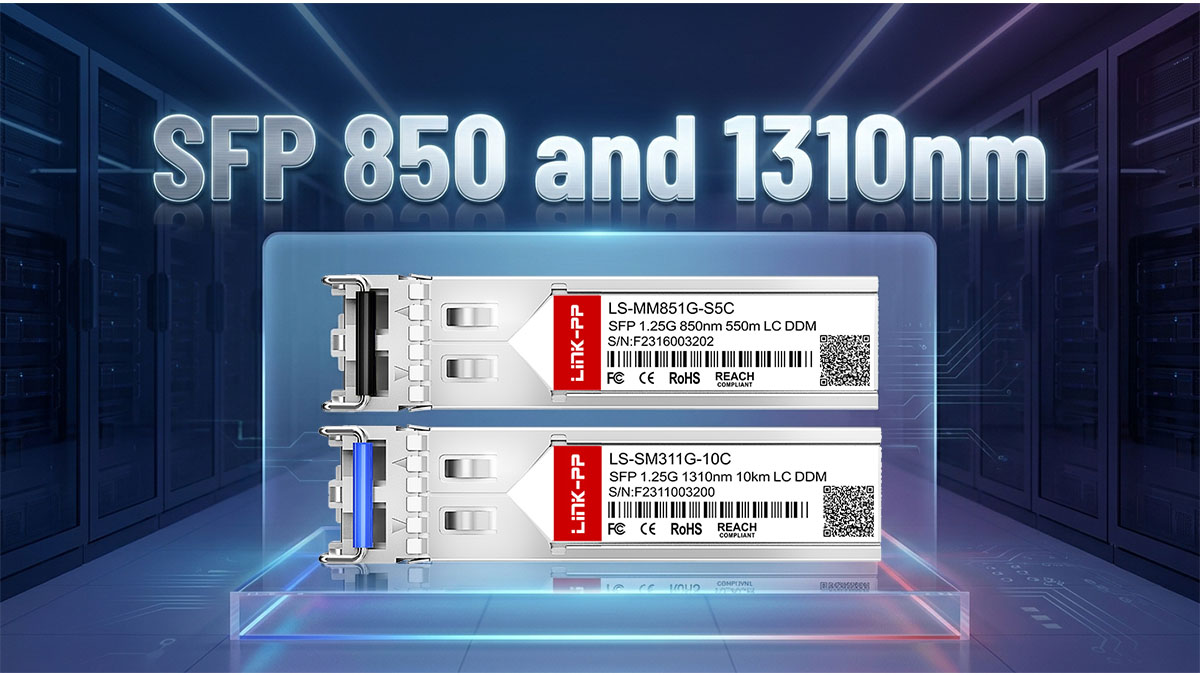
SFP 850nm and 1310nm optical modules are two of the most commonly used transceiver types in modern fiber-optic networks, and they are primarily distinguished by their operating wavelength and intended transmission environment. In general, SFP 850 modules are optimized for short-reach multimode fiber connections, while 1310nm modules are designed for longer-distance transmission, typically over single-mode fiber. Understanding how these two optical types differ is essential for selecting the right solution for performance, distance, and infrastructure compatibility in Ethernet and data communication networks.
What Is an SFP 850 Module?
An SFP 850 module is an optical transceiver that operates at an 850nm wavelength and is widely used for short-range data transmission over multimode fiber (MMF). It is one of the most common choices in data center and enterprise switching environments where high-density, low-cost, short-distance connectivity is required.
This module type is typically built using VCSEL (Vertical Cavity Surface Emitting Laser) technology, which provides efficient performance for short optical paths. It is commonly associated with standards such as 1000BASE-SX, 10GBASE-SR, and 25G SR, depending on the data rate.
Key characteristics of SFP 850 modules include:
- Optimized for multimode fiber (OM1, OM2, OM3, OM4)
- Common in short-reach connections such as rack-to-rack links
- Lower power consumption compared to long-reach optics
- High-density deployment suitability in data centers
- Cost-efficient for short-distance network design
These characteristics make SFP 850 modules a preferred choice for environments where fiber runs are relatively short and high port density is required. In such cases, they provide a balance of performance and operational efficiency without the need for long-range optical budgets.
What Is a 1310nm Optical Module?
A 1310nm optical module is a transceiver designed for medium to long-distance optical communication and is most commonly associated with single-mode fiber (SMF) transmission. Compared to 850nm optics, it is engineered to support significantly lower attenuation over longer distances, making it suitable for campus, metro, and carrier-grade networks.
In practice, 1310nm modules are often used in standards such as 1000BASE-LX and 10GBASE-LR. However, in some controlled multimode scenarios, 1310nm optics may also operate over multimode fiber with limitations, though this is not their primary deployment model.
Key characteristics of 1310nm modules include:
- Primarily designed for single-mode fiber (OS2)
- Supports significantly longer transmission distances
- Uses laser technologies such as FP or DFB lasers
- Suitable for campus backbone and metro links
- Better signal stability over extended fiber runs
Due to these properties, 1310nm modules are widely used in network segments where distance exceeds the practical limits of multimode fiber. Their ability to maintain signal integrity over long spans makes them essential for inter-building connectivity and telecom infrastructure.
Why Wavelength Selection Matters
The choice between 850nm and 1310nm is not just a technical detail—it directly affects network architecture, performance stability, and infrastructure scalability. Wavelength determines how light behaves in fiber, including attenuation, dispersion, and overall transmission efficiency.
Understanding wavelength selection helps ensure that:
- The optical link budget is correctly matched to the deployment distance
- Fiber type (multimode or single-mode) is properly aligned with transceiver design
- Signal degradation risks are minimized over long cable runs
- Network expansion paths remain cost-effective and technically feasible
Ultimately, selecting the correct wavelength ensures that optical networks operate reliably while avoiding unnecessary upgrades or performance bottlenecks caused by mismatched transceiver and fiber combinations.
🔘 Core Technical Differences Between SFP 850 and 1310nm Modules
SFP 850nm and 1310nm modules differ not only in wavelength, but also in their optical behavior, transmission capability, and system design requirements. These differences directly determine how each module performs in real network environments, especially in terms of distance, fiber compatibility, and signal integrity. Understanding these technical distinctions is essential for designing stable and scalable optical networks.
Transmission Distance Comparison
The most fundamental difference between SFP 850nm and 1310nm modules is their supported transmission distance. In practical deployments, 850nm optics are optimized for short-range communication, while 1310nm optics are designed for significantly longer reach over fiber links.
Typical transmission characteristics include:
- SFP 850nm modules are generally used for short-reach links, commonly within a single data center or building
- 1310nm modules support medium to long-distance connections, including inter-building and campus-level links
- Multimode fiber used with 850nm optics introduces higher modal dispersion over distance, limiting reach
- Single-mode fiber used with 1310nm optics significantly reduces attenuation and enables longer transmission
To provide a clearer technical comparison, the typical distance ranges can be summarized as follows:
| Module Type | Wavelength | Fiber Type | Typical Maximum Distance |
|---|---|---|---|
| SFP 850nm | 850nm | Multimode (OM3/OM4) | Up to ~300m–400m |
| SFP 1310nm | 1310nm | Single-mode (OS2) | Up to ~10km or more |
These distance differences make 850nm optics ideal for intra-rack or intra-data center links, while 1310nm modules are better suited for campus backbones and long-haul connections where physical separation is greater.
Fiber Type Compatibility
Fiber compatibility is another key distinction between 850nm and 1310nm optical modules, as each wavelength is optimized for a specific transmission medium. Using the correct fiber type is critical for maintaining signal quality and ensuring reliable communication.
Key compatibility characteristics include:
- SFP 850nm modules are designed specifically for multimode fiber (OM1 to OM4)
- 1310nm modules are primarily designed for single-mode fiber (OS2)
- Multimode fiber supports multiple light propagation paths, which is suitable for short-range 850nm transmission
- Single-mode fiber supports a single light path, reducing distortion and enabling longer distances for 1310nm transmission
In some special cases:
- 1310nm modules can operate over multimode fiber using mode conditioning techniques, but performance is limited and not recommended for standard deployment
- Mixing incompatible fiber types and wavelengths can result in significant signal loss or link failure
Proper fiber selection ensures that optical signals maintain integrity throughout the transmission path and prevents unnecessary troubleshooting or performance degradation in live networks.
Optical Power and Signal Attenuation
Optical power levels and attenuation behavior also differ significantly between 850nm and 1310nm modules, affecting how far and how reliably signals can travel.
Key technical considerations include:
- 850nm signals experience higher modal dispersion in multimode fiber, which limits distance
- 1310nm signals experience lower attenuation in single-mode fiber, supporting longer transmission
- Link budget requirements are more stringent for 850nm deployments over extended distances
- 1310nm systems generally provide higher optical power margins for long-haul stability
From a practical perspective:
- SFP 850nm links are more sensitive to distance and fiber quality variations
- 1310nm links are more stable over long distances due to reduced signal degradation
- Proper optical budget planning is essential in both cases to avoid packet loss or link instability
These differences in attenuation behavior directly influence network design decisions, especially in environments where reliability and distance scalability are critical factors.
Laser Technology Differences
The underlying laser technology used in SFP 850nm and 1310nm modules also contributes to their performance differences, cost structure, and deployment scenarios.
Key distinctions include:
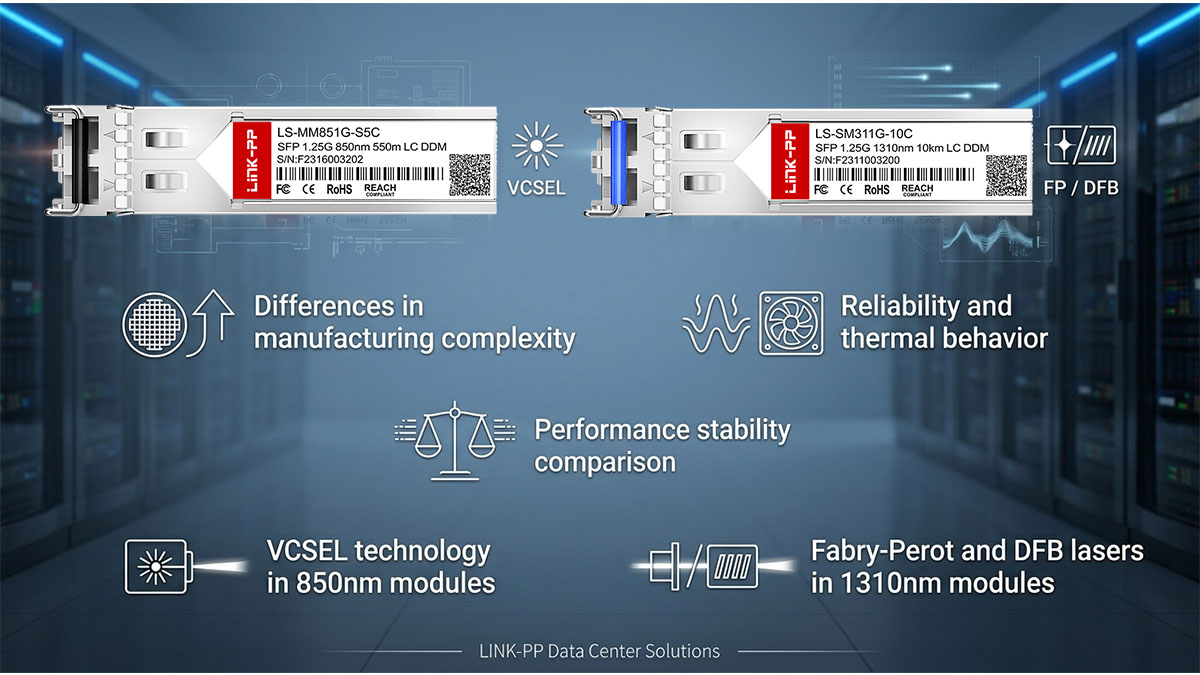
- SFP 850nm modules typically use VCSEL (Vertical Cavity Surface Emitting Laser) technology
- Efficient for short-distance transmission
- Lower manufacturing cost
- Suitable for high-density deployments
- 1310nm modules typically use FP (Fabry-Perot) or DFB (Distributed Feedback) lasers
- More precise wavelength control
- Better performance over longer distances
- Higher complexity and cost compared to VCSEL
In practical terms:
- VCSEL-based 850nm optics are optimized for scalability and density in data centers
- DFB-based 1310nm optics are optimized for stability and long-distance signal integrity
- Laser choice directly impacts power efficiency, thermal behavior, and overall link reliability
These technological differences explain why 850nm modules dominate short-range high-density environments, while 1310nm modules are preferred for backbone and long-distance optical networks.
SFP 850 vs. 1310nm Comparison Table
A direct side-by-side comparison helps clarify the key technical and operational differences between SFP 850nm and 1310nm optical modules. The table below summarizes the most important parameters used in real network design decisions.
| Parameter | SFP 850nm Module | SFP 1310nm Module |
|---|---|---|
| Wavelength | 850nm | 1310nm |
| Primary Fiber Type | Multimode fiber (OM1/OM2/OM3/OM4) | Single-mode fiber (OS2) |
| Typical Transmission Distance | Up to ~300m–400m (depends on fiber grade) | Up to ~10km or more |
| Laser Technology | VCSEL | FP / DFB laser |
| Signal Attenuation | Higher in multimode environments over distance | Lower in single-mode fiber |
| Power Consumption | Lower | Higher |
| Deployment Focus | Data centers, short-reach links | Campus, metro, long-reach backbone |
| Infrastructure Cost | Lower initial cabling cost | Higher initial fiber cost, better scalability |
| Density Suitability | Very high-density switching environments | Moderate-density, backbone-oriented |
| Upgrade Flexibility | Limited for long-distance scaling | Strong long-distance scalability |
This comparison highlights that 850nm modules are optimized for short-range, high-density environments, while 1310nm modules are designed for long-distance and scalable optical network architectures.
🔘 Comparing Performance in Real Network Environments
SFP 850nm and 1310nm optical modules behave very differently once deployed in real network environments, especially when factors such as distance, density, power consumption, and topology come into play. While both support high-speed Ethernet connectivity, their optimal use cases diverge significantly depending on whether the network prioritizes short-reach efficiency or long-distance stability.

Data Center Interconnect Applications
In data center environments, SFP 850nm modules are widely used due to their efficiency in short-reach, high-density scenarios. Their performance characteristics align well with modern leaf-spine architectures where most connections remain within a limited physical range.
Key performance observations include:
- SFP 850nm modules perform optimally in intra-data center links such as rack-to-rack or row-to-row connections
- Low latency and high port density make them suitable for switching fabrics and aggregation layers
- VCSEL-based design supports efficient parallel deployments across large switch arrays
- Multimode fiber infrastructure reduces installation complexity in structured cabling systems
In contrast, 1310nm modules are less commonly used inside dense data center racks but may appear in extended data center campuses where buildings are physically separated. Their longer reach makes them suitable for inter-building connections where multimode fiber becomes impractical.
Enterprise Campus Network Deployments
Enterprise campus networks introduce a broader range of distances compared to data centers, often spanning multiple buildings, floors, or geographically distributed sites. In this environment, both 850nm and 1310nm modules can play important but distinct roles.
Typical deployment patterns include:
- SFP 850nm modules used for short-range connections within a single building or wiring closet
- 1310nm modules used for building-to-building backbone links over single-mode fiber
- Mixed optical strategies depending on campus size and infrastructure maturity
Key performance differences in this scenario:
- 850nm modules provide cost-effective connectivity for localized network segments
- 1310nm modules offer stable performance over longer campus distances without signal degradation
- Single-mode fiber infrastructure supports future scalability for higher-speed upgrades
As campus networks evolve toward higher bandwidth demands, 1310nm-based backbones are increasingly preferred for long-term scalability, while 850nm remains effective for localized distribution layers.
Telecom and Metro Access Networks
In telecom and metro access environments, 1310nm optical modules are the dominant choice due to their ability to maintain signal integrity over long distances. These networks require stable, predictable performance across tens of kilometers, which exceeds the practical limits of multimode fiber systems.
Key characteristics include:
- 1310nm modules are widely used in metro aggregation and access layer links
- Single-mode fiber infrastructure enables low-loss transmission over long spans
- DFB laser technology supports high signal stability in carrier-grade environments
- Integration with CWDM/DWDM systems allows scalable wavelength multiplexing
In contrast, SFP 850nm modules are rarely used in telecom backbone applications because multimode fiber cannot support the required distances or signal stability.
Industrial and Harsh Environment Deployments
Industrial environments present additional challenges such as vibration, temperature variation, and electromagnetic interference, all of which can impact optical network performance. In these scenarios, both 850nm and 1310nm modules may be used depending on distance and infrastructure design.
Key deployment considerations include:
- 850nm modules are typically used for short-range industrial Ethernet connections within facilities
- 1310nm modules are used when industrial sites span larger geographic areas or require inter-building connectivity
- Fiber-based communication reduces EMI susceptibility compared to copper-based alternatives
Performance-related observations:
- 850nm modules provide stable short-range performance but are limited by distance constraints
- 1310nm modules offer greater resilience over long industrial links due to lower attenuation
- Proper enclosure design and temperature management are critical for both types
In industrial automation systems, selecting between 850nm and 1310nm optics often depends more on physical layout and distance requirements than on data rate alone.
🔘 SFP 850 vs. 1310nm Cost and Infrastructure Analysis
Cost and infrastructure planning are often decisive factors when selecting between SFP 850nm and 1310nm optical modules. Beyond raw performance, organizations must evaluate not only the module price itself but also the supporting fiber infrastructure, long-term scalability, and operational efficiency. The two wavelength types create very different cost structures across the network lifecycle.
Module Cost Comparison
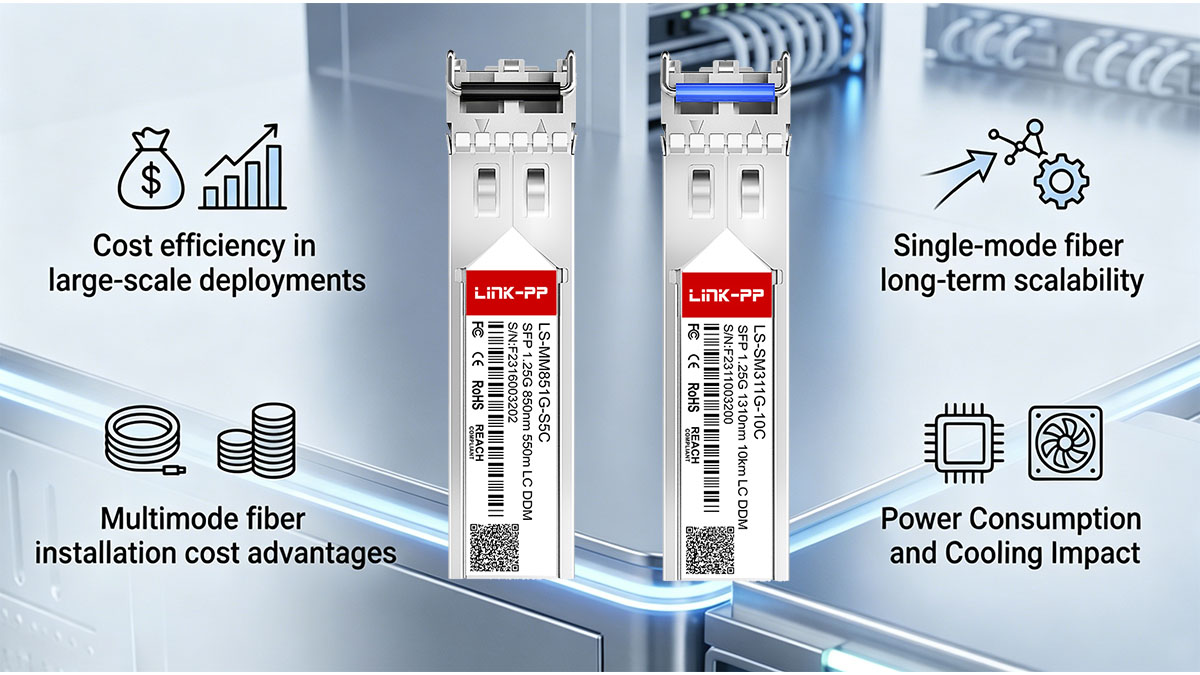
SFP 850nm and 1310nm modules differ in cost primarily due to laser technology, transmission capability, and manufacturing complexity. In general, 850nm modules are more economical for short-range applications, while 1310nm modules tend to carry higher unit costs due to their long-reach design requirements.
Key cost characteristics include:
- SFP 850nm modules typically use VCSEL technology, which is simpler and more cost-efficient to produce
- 1310nm modules often rely on FP or DFB lasers, increasing production complexity and cost
- Short-reach design reduces optical power requirements, further lowering 850nm module cost structure
- Long-reach stability requirements increase calibration and component precision for 1310nm optics
Fiber Infrastructure Investment
The underlying fiber infrastructure plays an even more significant role in total deployment cost than the optical modules themselves. SFP 850nm and 1310nm solutions require fundamentally different cabling approaches, which directly impacts installation complexity and long-term scalability.
Key infrastructure considerations include:
- SFP 850nm modules rely on multimode fiber (OM3/OM4), which is generally cheaper and easier to install in structured environments
- 1310nm modules require single-mode fiber (OS2), which has higher initial installation cost but offers superior long-term scalability
- Multimode fiber is typically used for short-distance intra-building connectivity
- Single-mode fiber is preferred for inter-building, campus, and metro-scale networks
Cost structure implications:
- Multimode deployments reduce initial cabling costs and simplify installation in data centers
- Single-mode deployments require higher upfront investment but reduce the need for future infrastructure replacement
- Migration from multimode to single-mode often involves significant re-cabling effort and operational disruption
In long-term network planning, single-mode fiber infrastructure is often considered more future-proof, especially as bandwidth requirements continue to increase beyond current 10G and 25G standards.
Power Consumption and Cooling Impact
Power efficiency and thermal management are increasingly important in modern network design, particularly in high-density switching environments. SFP 850nm and 1310nm modules exhibit different power and cooling characteristics that can influence operational costs over time.
Key differences include:
- SFP 850nm modules generally consume less power due to shorter transmission distances and VCSEL efficiency
- 1310nm modules require higher optical power output, which can increase energy consumption per port
- High-density 850nm deployments benefit from reduced thermal load in switch environments
- 1310nm modules may require more careful thermal management in long-reach deployments
Operational implications:
- Data centers using 850nm optics can achieve better port density with lower cooling overhead
- 1310nm deployments may incur slightly higher energy costs but provide extended reach capabilities that eliminate intermediate equipment
- Power efficiency differences become more significant at scale in large switching fabrics
In modern infrastructure planning, even small per-module power differences can translate into substantial operational cost variations when multiplied across thousands of ports.
🔘 How to Choose the Right Optical Module for Your Network
Selecting between SFP 850nm and 1310nm optical modules depends on how your network is physically structured, how far signals must travel, and how much long-term scalability is required. In practice, the decision is less about which module is "better" and more about which one aligns correctly with fiber type, distance requirements, and infrastructure strategy.
When SFP 850 Is the Better Choice
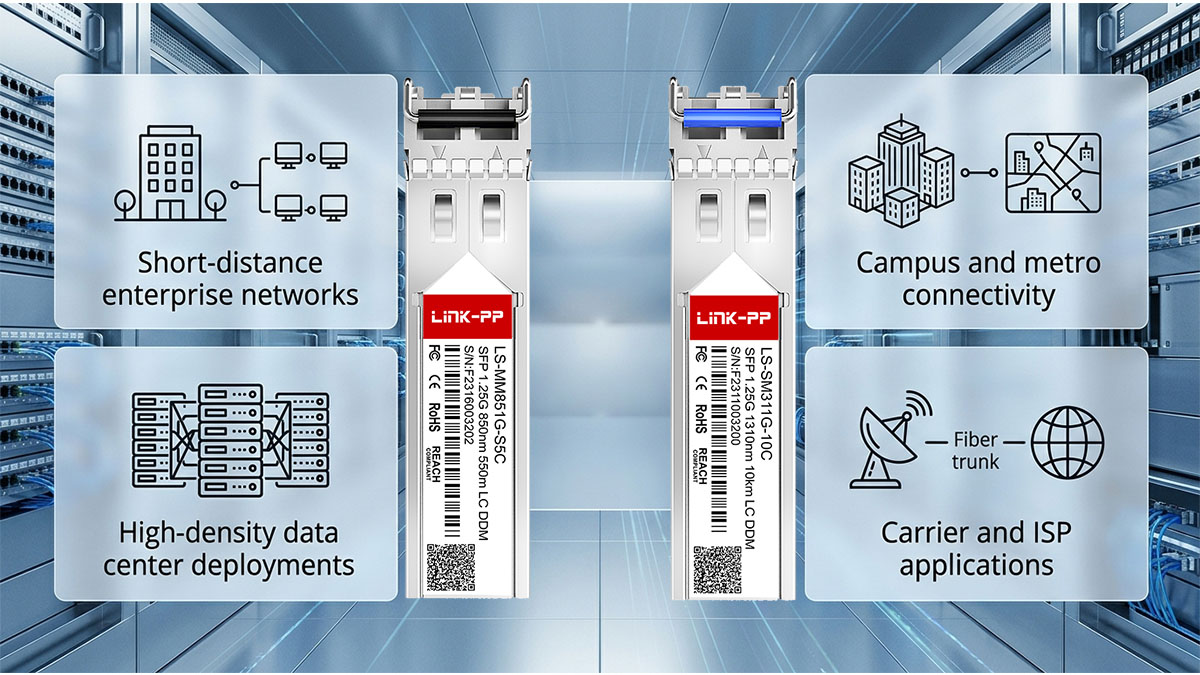
SFP 850nm modules are best suited for short-range, high-density environments where multimode fiber is already deployed or preferred for cost efficiency. Their performance is optimized for intra-building connectivity where distances remain relatively limited.
Typical scenarios where 850nm is appropriate include:
- Data center rack-to-rack or switch-to-server connections
- High-density leaf-spine switching architectures
- Short-distance links within a single building or wiring closet
- Environments using existing OM3 or OM4 multimode fiber infrastructure
Key decision factors include:
- Short transmission distance requirements (typically under a few hundred meters)
- Need for high port density and efficient space utilization
- Preference for lower-cost fiber installation and simpler cabling
- Focus on minimizing power consumption per port in large-scale deployments
In these environments, 850nm optics deliver a practical balance of performance and cost efficiency, especially where long-range transmission is not required.
When 1310nm Modules Are the Better Choice
1310nm optical modules are the preferred option when network links must extend beyond the practical limits of multimode fiber. They are designed for single-mode fiber environments where long-distance transmission and signal stability are critical.
Common use cases include:
- Campus backbone connections between buildings
- Metro aggregation and distribution networks
- ISP and telecom backbone infrastructure
- Long-distance enterprise interconnects across distributed sites
Key selection considerations include:
- Transmission distances extending from kilometers to tens of kilometers
- Requirement for stable performance over long fiber spans
- Future scalability for higher-speed upgrades and network expansion
- Deployment in environments where single-mode fiber is standard or planned
1310nm modules provide a long-term scalable foundation, especially in networks that are expected to grow geographically or increase bandwidth demand over time.
Future Trends in Optical Module Deployments
Optical networking is evolving rapidly, driven by increasing bandwidth demand from cloud computing, AI workloads, and distributed data center architectures. As a result, both 850nm and 1310nm modules are adapting to new performance expectations and deployment models.
Key trends shaping future deployments include:
- Gradual shift toward higher-speed optics such as 25G, 100G, and beyond
- Increased adoption of single-mode fiber for new infrastructure builds
- Continued use of 850nm optics in high-density short-reach data center environments
- Growing importance of energy efficiency and port density optimization
- Integration of more advanced optical monitoring and diagnostics features
In modern network planning, there is a clear directional split: 850nm continues to dominate short-range data center connectivity, while 1310nm increasingly defines scalable backbone and inter-site architectures.
Choosing the right optical module today therefore also means preparing for how the network will evolve in the next stage of bandwidth and infrastructure growth.
🔘 FAQs About SFP 850 and 1310nm Modules
What is the main difference between SFP 850 and 1310nm modules?
SFP 850nm modules are designed for short-distance transmission over multimode fiber, while 1310nm modules are built for longer-distance communication over single-mode fiber.
Can SFP 850nm modules be used for long-distance connections?
No. SFP 850nm modules are limited by multimode fiber dispersion and are typically used only for short-range links within data centers or buildings.
Why does 1310nm support longer transmission distances?
1310nm light experiences lower attenuation in single-mode fiber, allowing signals to travel farther with less degradation compared to 850nm transmission.
Are 850nm modules faster than 1310nm modules?
No. Data rate depends on the Ethernet standard (such as 10G or 25G), not the wavelength. Both can support similar speeds depending on module type.
Which fiber type is required for 850nm optics?
850nm modules are designed for multimode fiber such as OM3 and OM4, which support short-reach, high-density connections.
Which module is better for future scalability?
1310nm modules are generally better for scalability because single-mode fiber supports longer distances and easier network expansion.
🔘 Conclusion
The comparison between SFP 850 and 1310nm optical modules shows that each wavelength is optimized for a distinct networking role rather than direct competition. SFP 850nm is best suited for short-reach multimode fiber environments, while 1310nm is designed for long-distance single-mode transmission, offering greater scalability and reach. Understanding SFP 850 vs 1310nm differences is essential for building efficient, stable, and future-ready optical networks that align performance with infrastructure design.
To simplify the decision-making process, the most important points can be summarized as follows:
- SFP 850nm is optimized for short-distance, high-density data center connectivity
- 1310nm modules are designed for long-distance, campus, and metro network links
- Fiber type is a key determinant: multimode for 850nm, single-mode for 1310nm
- 850nm solutions prioritize cost efficiency and port density
- 1310nm solutions prioritize reach, stability, and scalability
- Network architecture and distance requirements are the primary selection drivers
Selecting the right optical module should always be based on real deployment needs, including transmission distance, fiber infrastructure, and future scalability requirements. A well-matched wavelength choice helps ensure stable performance, reduce long-term upgrade complexity, and improve overall network efficiency.
For reliable and compatible optical connectivity solutions across different network environments, LINK-PP Official Store provides a wide range of transceiver modules designed to support diverse deployment scenarios, from high-density data centers to long-distance backbone networks, helping ensure consistent performance across evolving optical infrastructures.