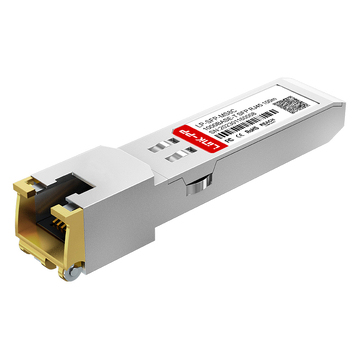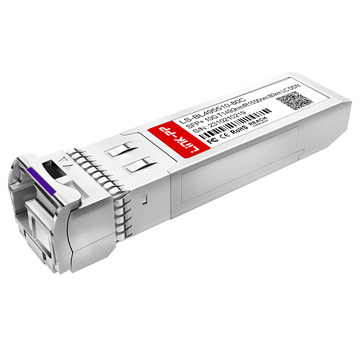
As broadband demand continues to increase across enterprise, industrial, and telecom environments, network operators are under pressure to extend high-speed connectivity without completely replacing existing copper infrastructure. In many last mile access scenarios, deploying full fiber connectivity remains expensive or operationally challenging, especially in older buildings, rural areas, and distributed edge networks.
An SFP VDSL modem provides a practical way to bridge Ethernet and VDSL transmission within a compact SFP form factor. By combining DSL technology with standard networking equipment, these modules help extend broadband services over existing twisted-pair cabling while simplifying deployment architectures. They are widely used in FTTC networks, enterprise branch connectivity, industrial communication systems, and broadband access extensions.
This article explores several important aspects of SFP VDSL modem technology, including:
-
VDSL transmission principles and standards
-
SFP VDSL modem architecture and interfaces
-
Broadband and last mile deployment scenarios
-
Performance, compatibility, and distance limitations
-
Network management and deployment considerations
Understanding these technical and operational factors can help network engineers and service providers design more flexible and efficient broadband access networks using existing copper infrastructure.
📧 What Is an SFP VDSL Modem?
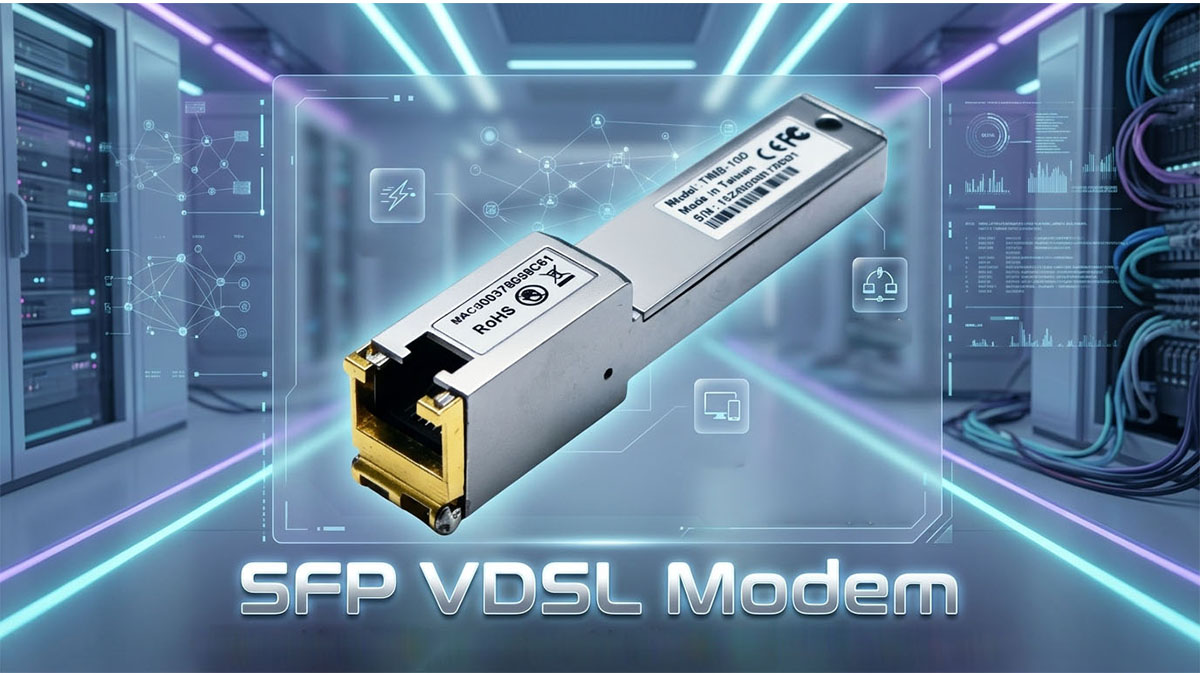
An SFP VDSL modem is a compact networking module that integrates VDSL transmission technology into a standard Small Form-factor Pluggable (SFP) interface. It enables Ethernet devices such as switches, routers, and industrial gateways to transmit broadband data over existing copper telephone lines, making it highly useful for last mile access and Ethernet extension applications.
Definition and Core Functionality
At its core, an SFP VDSL modem acts as an Ethernet-to-VDSL conversion module. It converts Ethernet frames from a network switch or router into VDSL signals that can travel across twisted-pair copper cabling.
The primary functions of an SFP VDSL modem include:
- Converting Ethernet traffic into VDSL transmission signals
- Extending broadband connectivity over copper infrastructure
- Supporting point-to-point Ethernet extension
- Enabling last mile network access in fiber-copper hybrid environments
- Integrating DSL connectivity directly into managed networking platforms
This compact architecture makes SFP VDSL solutions particularly valuable in environments where existing copper wiring must remain in service while still supporting modern broadband requirements.
Key Components Inside an SFP VDSL Modem
Although externally similar to a standard optical SFP transceiver, an SFP VDSL modem contains several specialized processing components designed for DSL communication and signal management.
Key internal components typically include:
- VDSL or VDSL2 chipset for modulation and demodulation
- DSP engine for signal processing and noise handling
- Ethernet PHY interface for network communication
- Copper line interface for twisted-pair connectivity
- Embedded firmware for synchronization and line management
- Power regulation circuitry for stable operation
- Thermal management components for heat dissipation
These integrated hardware elements allow the module to maintain stable broadband transmission across varying copper line conditions and deployment environments.
In industrial or telecom deployments, chipset quality and DSP efficiency can significantly influence line stability, achievable transmission distance, and overall throughput performance.
How SFP VDSL Technology Differs from Traditional DSL Modems
SFP VDSL technology differs from conventional external DSL modems mainly in terms of integration, deployment flexibility, and network architecture efficiency. Instead of requiring a separate modem appliance, the VDSL conversion process occurs directly inside the networking device.
Compared with traditional DSL modem deployments, SFP VDSL modules provide several advantages:
- Reduced cabling complexity
- Lower rack space consumption
- Simplified edge network installations
- Easier integration with managed switches and routers
- Centralized monitoring through networking platforms
- Faster deployment in distributed network environments
The following table highlights several major differences between traditional DSL modems and SFP VDSL modem solutions.
Feature Traditional DSL Modem SFP VDSL Modem Form Factor External standalone device Compact SFP module Installation Method Separate hardware deployment Installed directly into SFP slot Network Integration Limited Integrated with switches and routers Space Requirements Higher Lower Deployment Flexibility Moderate High Cable Management More complex Simplified Typical Applications Residential broadband Enterprise and industrial access networks
Because of these advantages, SFP VDSL modems are increasingly used in enterprise broadband extension, industrial Ethernet deployments, telecom edge infrastructure, and hybrid fiber-copper access networks where flexibility and infrastructure reuse are important priorities.
📧 Understanding VDSL Technology in Broadband Networks
VDSL technology is the foundation that enables SFP VDSL modems to deliver high-speed broadband over copper lines, and its evolution defines how far and how fast data can travel in last mile access networks. In practical terms, VDSL (Very-high-bit-rate Digital Subscriber Line) is designed to significantly improve bandwidth compared to earlier DSL generations while still relying on existing twisted-pair infrastructure.
In modern broadband architectures, VDSL plays a critical role in bridging fiber backbones with copper-based subscriber loops. This makes it especially relevant in FTTC (Fiber to the Curb/Cabinet) and hybrid access deployments where full fiber replacement is not yet feasible.
Evolution from ADSL to VDSL and VDSL2
VDSL evolved as a performance upgrade over ADSL to support much higher data rates and better suitability for short-distance broadband delivery in last mile networks. Its primary improvement is the ability to significantly increase downstream and upstream bandwidth by using a broader frequency spectrum.
To understand how VDSL compares with earlier DSL technologies, it is important to look at key performance differences:
| Technology | Max Downstream Speed | Typical Reach | Deployment Focus |
|---|---|---|---|
| ADSL | Up to ~24 Mbps | Long distance (up to several km) | Residential broadband |
| VDSL | Up to ~52 Mbps | Short to medium distance | Urban broadband access |
| VDSL2 | Up to ~100–300 Mbps (profile dependent) | Short distance (<1–1.5 km) | FTTC, last mile, enterprise access |
This comparison shows that VDSL2 is optimized for high-speed delivery over shorter copper loops, which is exactly the scenario where SFP VDSL modems are typically deployed in access network edge devices.
Frequency Spectrum and Transmission Principles
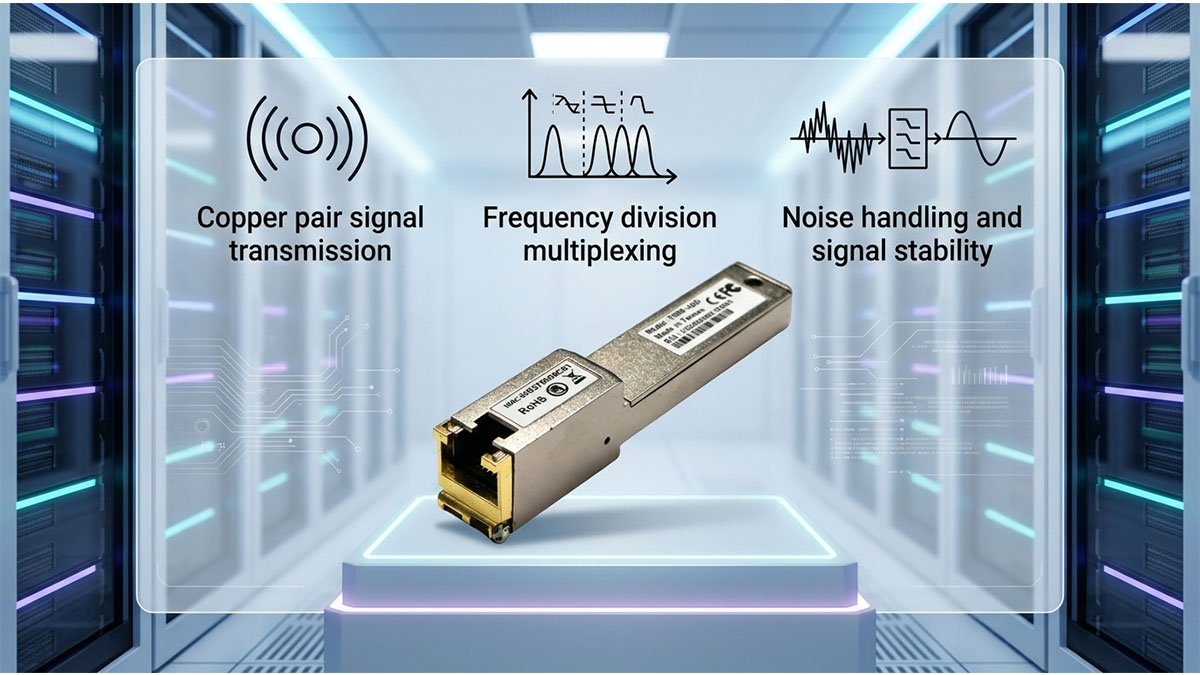
VDSL technology achieves higher performance by expanding the usable frequency spectrum over copper pairs, enabling more data to be transmitted simultaneously. It relies on advanced modulation techniques such as DMT (Discrete Multi-Tone) to divide the signal into multiple sub-channels.
In practical network environments, several transmission principles directly influence performance:
- Higher frequency bands enable greater bandwidth but reduce transmission distance
- Signal quality depends heavily on copper line condition and shielding quality
- Crosstalk between adjacent pairs can reduce effective throughput
- Noise mitigation and error correction mechanisms are essential for stability
- Distance attenuation increases significantly as frequency rises
These factors explain why VDSL performance is highly sensitive to deployment conditions, especially in dense urban cabling environments or older infrastructure systems.
VDSL Profiles and Standards
VDSL performance is defined by standardized profiles that determine bandwidth, frequency usage, and transmission behavior across different network scenarios. These profiles ensure interoperability between equipment and help network engineers design predictable access networks.
Common VDSL2 profiles are widely used in broadband deployments, each optimized for different bandwidth and distance trade-offs:
| VDSL2 Profile | Frequency Band | Typical Use Case | Performance Focus |
|---|---|---|---|
| 17a | Up to 17 MHz | General FTTC deployments | Balanced speed and distance |
| 30a | Up to 30 MHz | High-speed short loops | Higher bandwidth |
| 35b (Supervectoring) | Up to 35 MHz | Very high-speed urban access | Maximum throughput over short distance |
These profiles allow operators to tailor broadband delivery depending on loop length and copper quality. In SFP VDSL modem deployments, profile selection is a key configuration factor because it directly impacts achievable throughput and service stability.
📧 Why SFP VDSL Modems Are Important for Last Mile Access
SFP VDSL modems play a critical role in modern last mile access networks because they enable broadband services to reach end users without requiring full fiber deployment to every endpoint. In many real-world infrastructures, the last mile remains the most expensive and operationally complex segment of the network, and VDSL-based SFP solutions provide a practical way to bridge that gap using existing copper lines.
Extending Broadband Over Existing Copper Infrastructure
The primary value of SFP VDSL modems in last mile networks is their ability to reuse installed copper telephone wiring to deliver modern broadband speeds. This approach significantly reduces the need for disruptive civil construction work associated with fiber rollout.
This reuse of copper infrastructure is especially important in environments where full fiber replacement is not immediately feasible. Key benefits include:
- Leveraging existing twisted-pair telephone lines for data transmission
- Reducing civil engineering and installation costs
- Minimizing service disruption during network upgrades
- Enabling incremental migration from copper to fiber-based architectures
- Supporting broadband delivery in legacy buildings and older urban areas
These advantages make SFP VDSL solutions particularly effective in transitional network environments where operators must balance performance improvements with infrastructure constraints.
Supporting Remote and Hard-to-Reach Locations
In many broadband deployment scenarios, reaching remote or physically challenging locations is one of the biggest barriers to network expansion. SFP VDSL modems help overcome this limitation by extending connectivity over longer copper loops where fiber installation may be impractical or cost-prohibitive.
Typical deployment environments include:
- Rural or semi-rural buildings located far from fiber nodes
- Industrial facilities with distributed equipment across large areas
- Campus environments with multiple legacy structures
- Transportation infrastructure such as tunnels or roadside cabinets
- Temporary or rapidly deployed network extensions
In these scenarios, VDSL-based SFP modules provide a stable and efficient way to deliver broadband services without requiring extensive infrastructure redesign. However, performance is still influenced by loop length and copper quality, which must be considered during planning.
Bridging Fiber and Copper Networks
One of the most important roles of SFP VDSL modems is their ability to function as a bridge between high-speed fiber backbones and copper-based access networks. This hybrid approach is widely used in modern FTTC (Fiber to the Cabinet) architectures.
In a typical deployment model, fiber is used to connect core and aggregation layers, while VDSL over copper is used for the final distribution segment. This creates a cost-effective and scalable architecture with several key characteristics:
- Fiber provides high-capacity backbone connectivity to distribution points
- VDSL extends access connectivity from cabinets to end locations
- Ethernet switches with SFP slots integrate both media types seamlessly
- Network operators can upgrade sections incrementally without full replacement
- Service continuity is maintained during migration phases
This hybrid design is particularly valuable in urban and suburban environments where full fiber rollout may take years to complete. SFP VDSL modems allow operators to modernize network access layers while maintaining compatibility with existing infrastructure.
Overall, the ability to bridge fiber and copper networks makes SFP VDSL technology a strategic component in last mile broadband evolution, especially in mixed-infrastructure environments where flexibility and cost efficiency are essential.
📧 SFP VDSL Modem Architecture and Technical Design
The architecture of an SFP VDSL modem is designed to integrate complex DSL signal processing into a compact, pluggable form factor while still meeting the electrical and thermal constraints of SFP-based networking systems. In practical deployment, this architecture enables Ethernet devices such as switches and routers to directly interface with copper-based VDSL lines without external modem hardware.
Ethernet-to-VDSL Signal Conversion Process
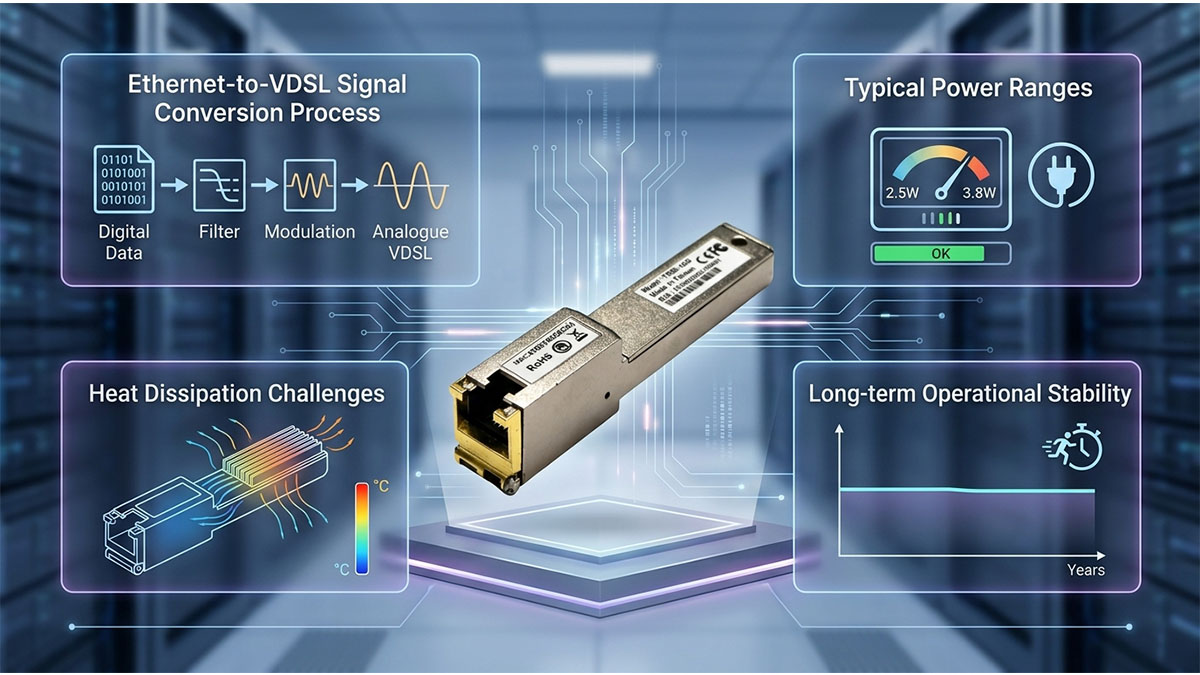
The core function of an SFP VDSL modem is real-time conversion between Ethernet frames and VDSL transmission signals. This process occurs across multiple processing stages that ensure data integrity and synchronization over copper lines.
The typical signal flow includes:
- Ethernet frame reception from the host switch or router via SFP interface
- Frame buffering and protocol handling within embedded processing logic
- DSL encapsulation and segmentation into transmission units
- Modulation using DMT (Discrete Multi-Tone) for copper transmission
- Signal transmission over twisted-pair copper lines
- Reverse demodulation and frame reconstruction at the remote endpoint
Each stage must operate with minimal latency to ensure stable broadband performance, especially in last mile environments where line quality may vary significantly.
This conversion process is what allows SFP VDSL modules to behave as transparent broadband extension interfaces while still supporting Ethernet-based network architectures.
Interface Types and Connector Options
SFP VDSL modems are designed to fit within standard SFP slots, but they rely on copper-based subscriber interfaces for VDSL transmission. This dual-interface structure is essential for bridging modern Ethernet systems with legacy copper infrastructure.
Common interface elements include:
- SFP electrical interface for host device connectivity
- RJ11 or RJ45 connectors for copper pair VDSL transmission
- Single-pair or multi-pair wiring configurations depending on deployment model
- Standardized impedance matching for stable signal propagation
- Shielded connectors to reduce electromagnetic interference
The compatibility between SFP host devices and copper line interfaces is critical, as mismatches in wiring quality or connector standards can directly impact signal stability and achievable bandwidth.
Power Consumption and Thermal Considerations
Due to the compact nature of the SFP form factor, power efficiency and thermal control are major constraints in SFP VDSL modem design. Unlike standalone DSL modems with larger enclosures and active cooling options, SFP modules must rely on passive heat dissipation through the host device.
Key thermal and power design considerations include:
- Strict power budgets typically within SFP port limits
- Efficient DSP and chipset design to reduce processing overhead
- Heat dissipation through metal casing and chassis conduction
- Temperature-sensitive performance adjustments for stability
- Reduced power modes during low traffic conditions
In high-density switch environments, multiple SFP VDSL modules operating simultaneously can generate cumulative heat loads. Therefore, proper chassis ventilation and port spacing become important factors in maintaining long-term operational stability.
📧 Performance Characteristics of SFP VDSL Modems
The performance of an SFP VDSL modem is primarily defined by how efficiently it can transmit broadband data over copper lines while maintaining stability under real-world network conditions. Unlike fiber-based optics, VDSL performance is highly dependent on loop length, copper quality, interference levels, and the selected VDSL profile, which makes deployment conditions just as important as hardware specifications.
Bandwidth and Throughput Capabilities
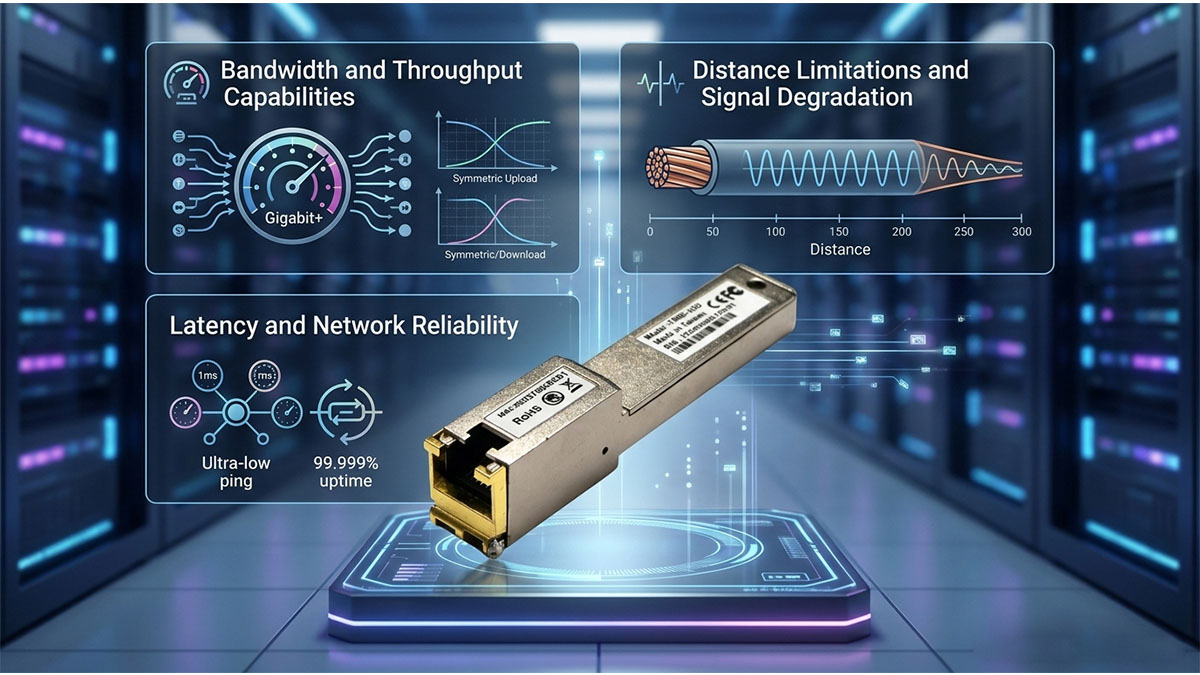
SFP VDSL modems support a wide range of throughput levels depending on the VDSL2 profile, copper condition, and line distance. In ideal short-loop scenarios, they can deliver broadband speeds suitable for enterprise and access network applications, but real-world performance often varies significantly.
Key factors influencing throughput include:
- VDSL2 profile selection (e.g., 17a, 30a, 35b)
- Copper loop length between endpoints
- Wire gauge and cable aging condition
- Crosstalk from adjacent pairs in dense cable bundles
- Noise levels from industrial or urban environments
- Quality of DSP-based signal processing
As a general observation, shorter copper loops consistently deliver higher and more stable throughput, while longer distances result in gradual bandwidth reduction due to signal attenuation. This makes SFP VDSL modems particularly effective in FTTC and building access scenarios rather than long-distance rural loops.
Distance Limitations and Signal Degradation
Distance is one of the most important constraints in VDSL-based systems, and it directly determines achievable data rates. As signal frequency increases to support higher bandwidth, attenuation over copper lines becomes more pronounced, limiting effective transmission distance.
In real-world deployments, performance typically follows these patterns:
- Short loops deliver high-speed broadband with minimal degradation
- Medium-distance loops maintain moderate speeds with stable connectivity
- Long copper runs experience significant bandwidth reduction and higher error rates
Several physical and environmental factors contribute to signal degradation:
- Copper quality and conductor purity
- Aging or corroded wiring infrastructure
- Poor cable shielding or grounding practices
- External electromagnetic interference sources
- Connector and splice quality along the loop
Because of these variables, network engineers often conduct line qualification tests before deployment to ensure the copper infrastructure can support the intended service level.
Latency and Network Reliability
In addition to throughput, latency and reliability are key performance indicators for SFP VDSL modems, especially in enterprise and industrial applications where consistent response time is critical.
VDSL systems generally introduce slightly higher latency than fiber due to signal processing and error correction mechanisms, but remain suitable for most broadband applications.
Important reliability and latency factors include:
- DSL signal modulation and demodulation processing time
- Interleaving depth and error correction configuration
- Line noise and retransmission frequency
- Stability of copper loop conditions over time
- Firmware and DSP optimization quality
To improve stability, VDSL systems often use forward error correction (FEC) and interleaving techniques, which help maintain data integrity but can introduce minor latency increases. In return, these mechanisms significantly reduce packet loss and improve overall service reliability.
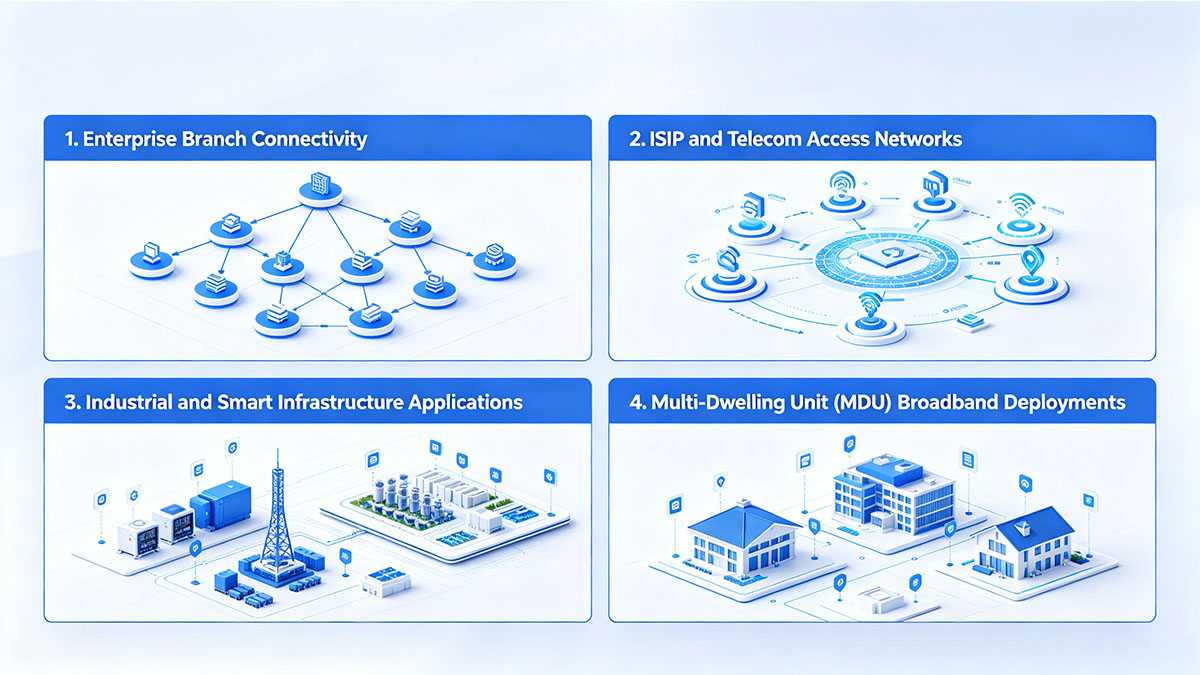
📧 Common Deployment Scenarios for SFP VDSL Modems
SFP VDSL modems are most valuable in network environments where operators need to extend broadband connectivity over existing copper infrastructure while keeping deployment complexity low. In real-world applications, they are widely used in last mile access, enterprise edge connectivity, and hybrid fiber-copper architectures where full fiber rollout is not yet practical.
Enterprise Branch Connectivity
In enterprise environments, SFP VDSL modems are commonly used to connect branch offices or remote buildings back to a central network without requiring dedicated fiber links. This approach is particularly useful in campuses or corporate sites where copper cabling already exists between buildings.
Typical enterprise use cases include:
- Connecting branch offices to a central data center via copper loops
- Extending LAN connectivity across separate buildings on a campus
- Supporting temporary or rapidly deployed network expansions
- Providing backup connectivity paths alongside primary fiber links
- Integrating legacy wiring into modern Ethernet-based infrastructure
This deployment model is especially effective when organizations want to maintain operational continuity while gradually upgrading to fiber-based interconnects.
ISP and Telecom Access Networks
In service provider environments, SFP VDSL modems are frequently deployed as part of broadband access architectures, particularly in Fiber to the Cabinet (FTTC) or hybrid access networks. In these setups, fiber is extended to a distribution node, while VDSL is used for the final copper segment to subscribers.
Common ISP applications include:
- Broadband aggregation at street cabinets or access nodes
- Extending DSL services from DSLAM-equipped infrastructure
- Delivering tiered broadband services to residential users
- Supporting mixed copper and fiber subscriber environments
- Upgrading legacy DSL networks without full infrastructure replacement
This approach allows operators to increase broadband coverage and speed while optimizing capital expenditure on fiber rollout.
Industrial and Smart Infrastructure Applications
In industrial and smart infrastructure environments, SFP VDSL modems are used to connect distributed systems where Ethernet over copper is more practical than fiber due to physical constraints or environmental conditions.
Key application areas include:
- Factory automation and control systems across large facilities
- Transportation infrastructure such as railways, tunnels, and roadside systems
- Smart city deployments including surveillance and sensor networks
- Utility infrastructure such as power distribution and water management systems
- Remote monitoring systems in harsh or geographically dispersed environments
These deployments benefit from VDSL's ability to maintain stable connectivity over existing copper wiring, even in environments where fiber installation may be difficult or cost-prohibitive.
Multi-Dwelling Unit (MDU) Broadband Deployments
In residential and commercial building environments, SFP VDSL modems are often used to deliver broadband services within multi-dwelling units (MDUs) where internal copper wiring already exists. This allows service providers to offer high-speed connectivity without rewiring entire buildings.
Typical MDU deployment scenarios include:
- Apartment buildings using existing telephone wiring for broadband distribution
- Hotel or hospitality networks providing room-level connectivity
- Office complexes with shared internal copper infrastructure
- Retrofit broadband upgrades in older buildings
- Centralized network distribution from a building access point
This model is particularly effective for reducing installation time while still delivering competitive broadband performance to multiple end users.
📧 SFP VDSL Modem Compatibility and Interoperability
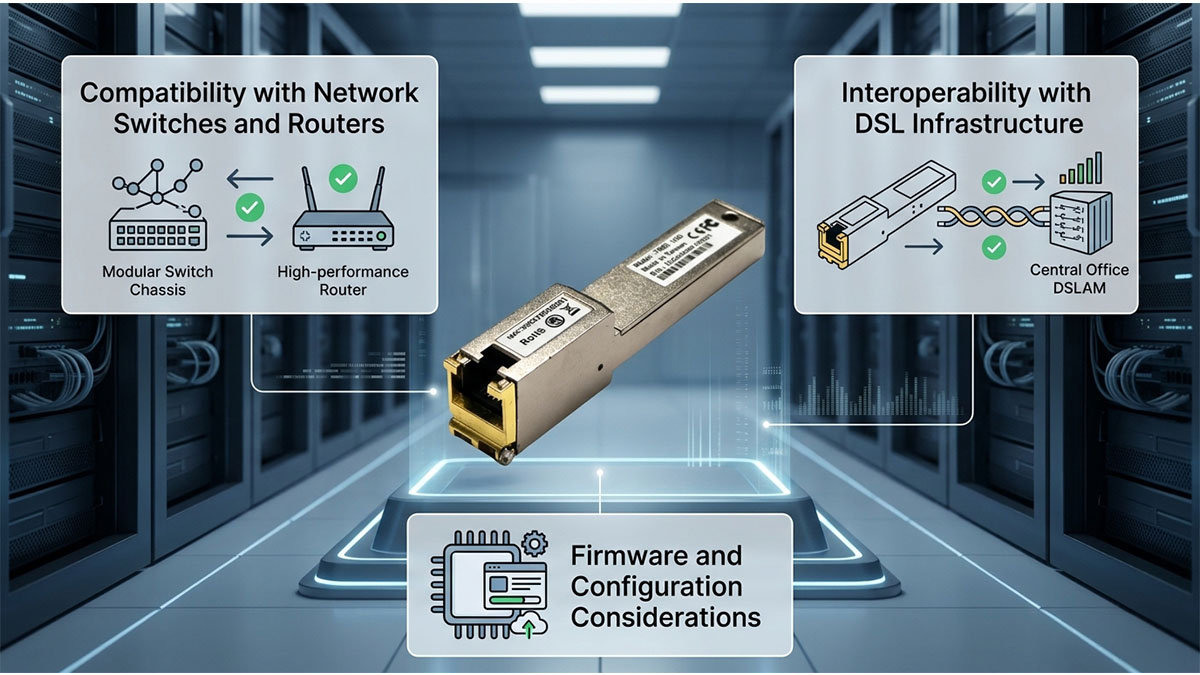
SFP VDSL modem deployments are highly dependent on compatibility across multiple layers of the network, including the host device, copper infrastructure, and DSL-based access equipment. In practical environments, interoperability determines whether a module can operate stably inside different switch platforms and maintain consistent performance across mixed-vendor network architectures.
Compatibility with Network Switches and Routers
SFP VDSL modems must be supported at both the physical and logical levels by the host device. While they physically fit into standard SFP slots, not all switches or routers are designed to recognize or properly manage DSL-based SFP modules.
Key compatibility considerations include:
- SFP slot electrical support for non-optical modules
- Device firmware recognition of DSL-based transceivers
- Management interface support for VDSL parameters
- Power budget allocation per SFP port
- Vendor-specific compatibility restrictions or whitelists
In enterprise deployments, managed switches with open SFP support are typically preferred because they allow better integration, monitoring, and configuration control. In contrast, devices with strict transceiver validation may limit interoperability with third-party VDSL modules.
Proper compatibility ensures stable link negotiation, accurate diagnostics, and predictable performance across all connected endpoints.
Interoperability with DSL Infrastructure
Beyond host device compatibility, SFP VDSL modems must also interoperate effectively with existing DSL infrastructure, including DSLAMs, copper loops, and remote termination equipment. This is particularly important in telecom and ISP environments where mixed-generation networks are common.
Important interoperability factors include:
- Support for matching VDSL2 profiles between endpoints
- Compatibility with DSLAM vendor implementations
- Consistent line encoding and modulation standards
- Support for Annex A, B, or regional DSL variants
- Synchronization stability across heterogeneous equipment
In real deployments, mismatches in profile configuration or vendor-specific DSL implementations can lead to reduced throughput, unstable synchronization, or complete link failure. For this reason, alignment of both ends of the copper link is a critical deployment step.
Firmware and Configuration Considerations
Firmware plays a key role in ensuring that SFP VDSL modems operate correctly within different network environments. Unlike passive optical modules, these devices rely on embedded software to manage signal processing, line training, and network behavior.
Key configuration elements include:
- VDSL profile selection and tuning parameters
- Line training and synchronization settings
- VLAN tagging and Ethernet framing support
- Quality of Service (QoS) prioritization rules
- Remote management and diagnostic capabilities
In managed networks, centralized configuration through switches or network controllers can simplify large-scale deployments. However, inconsistent firmware versions across devices may lead to performance variations or interoperability issues.
📧 Security and Network Management Considerations
SFP VDSL modem deployments introduce a mix of Ethernet-based and DSL-based access layers, which means security and management must be addressed across both copper transmission and IP networking domains. In last mile and enterprise environments, maintaining visibility, controlling access, and ensuring stable operations are just as important as raw transmission performance.
Network Isolation and Traffic Segmentation
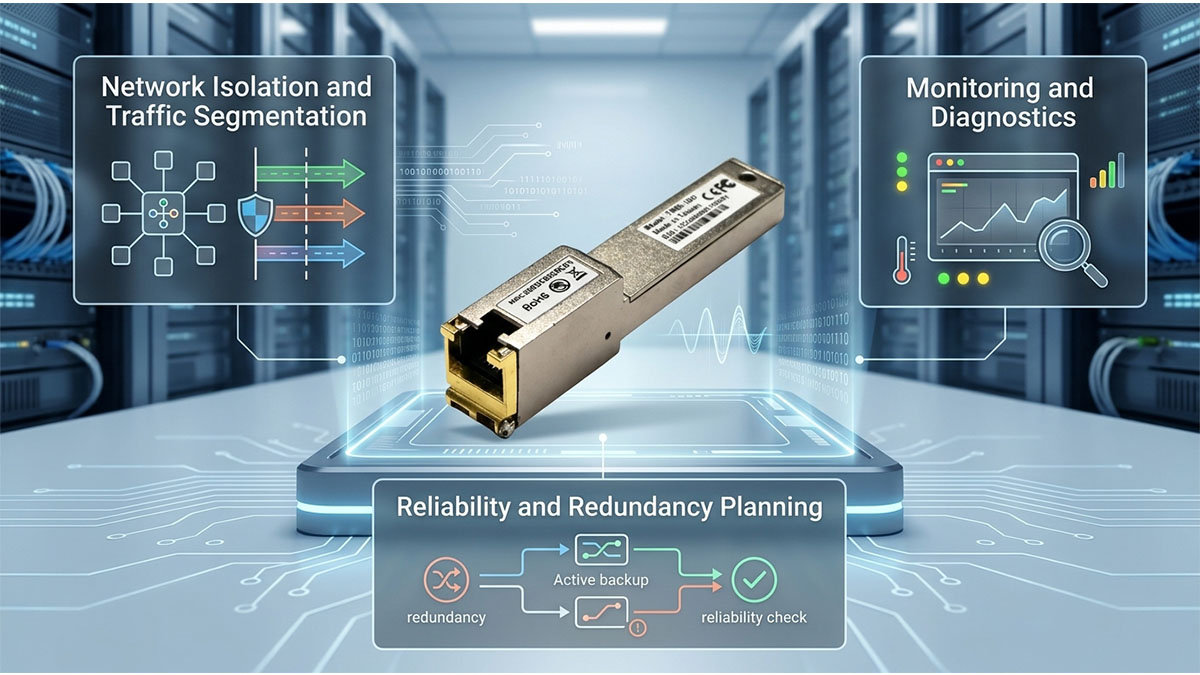
In SFP VDSL-based networks, isolating traffic between different users, services, or departments is essential to maintain security and predictable performance. Since copper-based last mile links may carry shared or multi-tenant traffic, proper segmentation reduces risk and improves manageability.
Key mechanisms used for isolation include:
- VLAN-based segmentation for separating logical networks
- Port-based access control on managed switches
- Service-level separation between broadband users and enterprise traffic
- Tagging and filtering of Ethernet frames at the aggregation layer
- Access control policies applied at the SFP interface level
This segmentation approach ensures that traffic flowing over shared copper infrastructure remains logically isolated, reducing the risk of unauthorized access or cross-network interference.
Monitoring and Diagnostics
Effective management of SFP VDSL modem networks depends heavily on continuous monitoring and diagnostic capabilities. Since VDSL performance can fluctuate based on line conditions, real-time visibility is essential for maintaining service quality.
Common monitoring and diagnostic functions include:
- Line synchronization status and signal quality metrics
- Signal-to-noise ratio (SNR) tracking
- Error rate and retransmission statistics
- Loop length estimation and attenuation reporting
- Real-time throughput monitoring
- Link stability and uptime analysis
These metrics allow network operators to quickly identify degraded copper lines, interference issues, or configuration mismatches. In managed environments, SNMP-based monitoring systems are often used to integrate these diagnostics into centralized network management platforms.
Reliability and Redundancy Planning
Because SFP VDSL modems often operate in last mile or edge environments, they must be supported by redundancy and failover strategies to ensure continuous connectivity. Copper-based links are inherently more sensitive to environmental and physical disruptions compared to fiber, making resilience planning especially important.
Common reliability strategies include:
- Redundant uplinks from aggregation switches to core networks
- Backup fiber paths alongside VDSL copper connections
- Automatic failover mechanisms at routing or switching layers
- Load balancing across multiple access links where supported
- Dual-homed network designs for critical enterprise branches
In addition, environmental factors such as temperature variation, humidity, and cable aging can impact long-term stability. Proper installation practices and periodic maintenance help mitigate these risks and extend operational lifespan.
📧 Deployment Best Practices for SFP VDSL Networks
Successful SFP VDSL network deployment depends on careful planning of copper infrastructure, link performance expectations, and environmental conditions. Unlike fiber-based systems, VDSL performance is highly sensitive to physical line quality and installation details, which means deployment decisions directly affect long-term stability and achievable bandwidth.
Evaluating Existing Copper Infrastructure
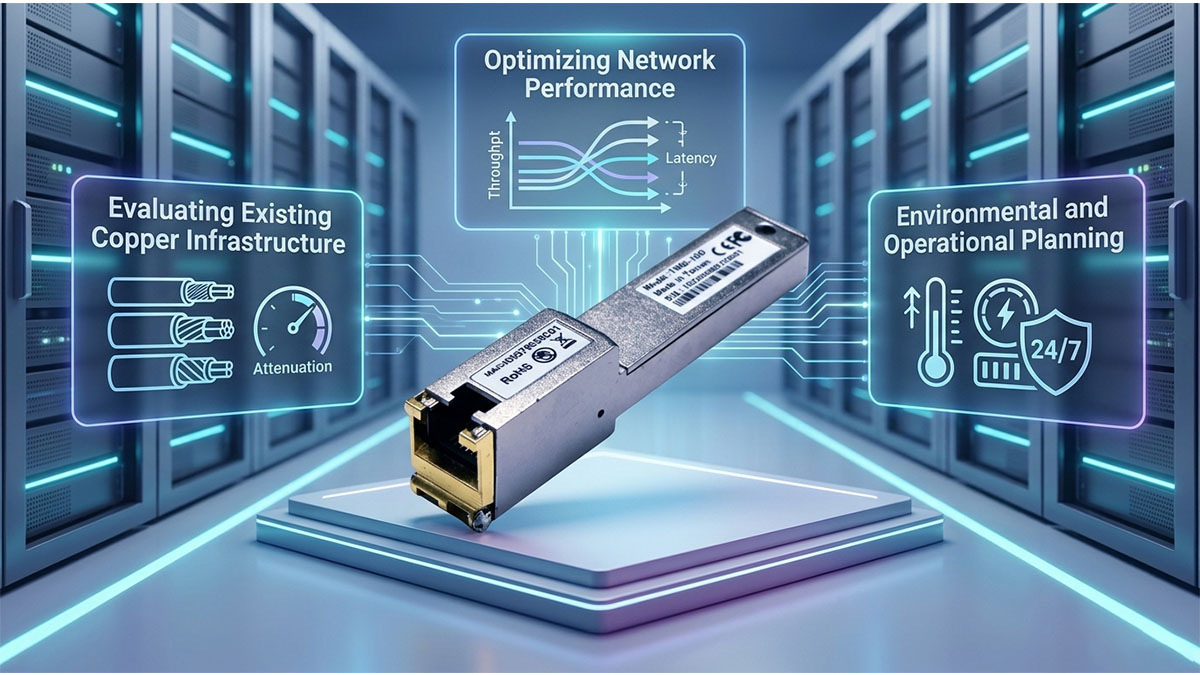
Before deploying SFP VDSL modems, the condition of the existing copper network must be thoroughly assessed. Since VDSL relies on twisted-pair transmission, any degradation in wiring quality can significantly reduce performance or cause unstable links.
Key evaluation steps include:
- Testing loop continuity and detecting open or short circuits
- Measuring line attenuation and signal loss characteristics
- Identifying bridge taps, splices, or non-standard wiring paths
- Checking cable age, insulation condition, and corrosion risks
- Assessing electromagnetic interference sources in the environment
This assessment helps determine whether existing copper lines can support target bandwidth levels or require remediation before deployment. In many cases, line qualification is the most important step in ensuring predictable VDSL performance.
Optimizing Network Performance
Once infrastructure is validated, optimizing network configuration becomes essential to achieve stable throughput and minimize signal degradation. Because VDSL performance varies with distance and noise, careful tuning is often required at both physical and logical layers.
Common optimization practices include:
- Selecting appropriate VDSL2 profiles based on loop length
- Minimizing copper loop distance between endpoints where possible
- Ensuring proper grounding and shielding of copper cables
- Reducing cable bundling density to limit crosstalk
- Applying traffic prioritization for latency-sensitive applications
These measures help stabilize synchronization rates and reduce retransmission events, particularly in environments with mixed cable quality or high electromagnetic interference.
Environmental and Operational Planning
Environmental conditions play a significant role in the long-term reliability of SFP VDSL deployments, especially since these modules are often installed in edge switches, cabinets, or industrial enclosures without active cooling.
Key environmental considerations include:
- Maintaining appropriate operating temperature ranges for SFP modules
- Ensuring adequate airflow within network equipment chassis
- Protecting copper cabling from moisture, corrosion, and physical damage
- Avoiding proximity to high-power electrical equipment or interference sources
- Planning for seasonal or location-based temperature fluctuations
Operational planning also includes maintenance strategies such as periodic line testing, firmware updates, and performance monitoring to detect early signs of degradation.
📧 Conclusion
SFP VDSL modem technology plays a strategic role in modern broadband and last mile access networks by enabling high-speed Ethernet extension over existing copper infrastructure. By combining VDSL2 transmission principles with compact SFP integration, it allows operators to extend connectivity in a cost-efficient and flexible way without immediate full fiber replacement. In practical deployments, sfp vdsl modem solutions bridge the gap between legacy DSL networks and modern Ethernet-based architectures, supporting hybrid fiber-copper broadband evolution, enterprise edge connectivity, and ISP access network modernization.
The value of SFP VDSL modem deployments can be summarized through several core technical and operational insights:
- Extends broadband access over existing copper lines using VDSL2 technology
- Enables direct integration into switches and routers via SFP interfaces
- Supports last mile connectivity in FTTC, enterprise, and MDU environments
- Performance is highly dependent on loop length, copper quality, and VDSL profiles
- Requires careful planning for compatibility, firmware alignment, and network design
- Combines fiber backhaul with copper-based access for hybrid network architectures
These points highlight how SFP-based DSL integration remains a practical solution in transitional broadband infrastructures where full fiber deployment is still in progress.
As broadband networks continue evolving toward higher capacity and lower latency, SFP VDSL solutions remain an important tool for extending service reach while optimizing existing infrastructure investments. For network engineers, service providers, and system integrators, selecting reliable and compatible modules is essential to ensure stable long-term performance in real-world deployments.
To explore more access network solutions, transceiver technologies, and compatible SFP modules designed for broadband and last mile applications, you can refer to the LINK-PP Official Store, where a wide range of networking components is available to support scalable and hybrid network architectures.