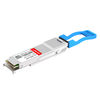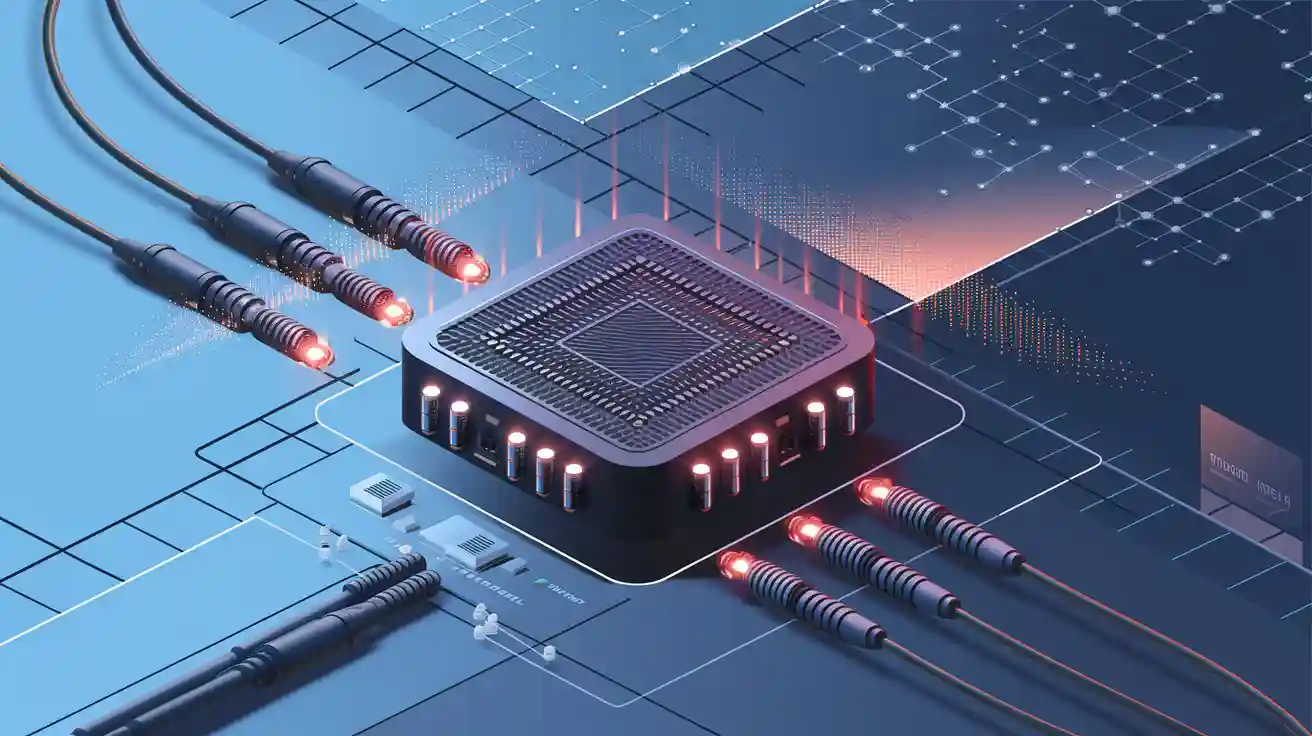
As data center bandwidth demand continues to grow, 400G optical module has become a key technology for supporting high-capacity network infrastructure. Among the most widely deployed options, 400G FR4 and 400G DR4 are two standards frequently used in modern cloud and hyperscale environments. Although both deliver a total transmission rate of 400Gbps, they differ significantly in fiber architecture, transmission distance, connector type, and deployment scenarios.
In practical network design, choosing between FR4 vs DR4 is not simply a matter of speed. The decision often depends on factors such as existing cabling infrastructure, link distance requirements, and the density of data center switching fabrics. For example, FR4 modules typically use duplex single-mode fiber with wavelength multiplexing, while DR4 modules rely on parallel single-mode fiber links designed for high-density short-reach connections.
Understanding these differences is important for network architects, data center operators, and engineers planning 400G optical interconnects. This guide explains how 400GBASE-FR4 and 400GBASE-DR4 work, compares their technical characteristics, and outlines the scenarios where each option is most suitable. By the end of the article, you will have a clearer view of how these two 400G optical standards fit into modern data center networking.
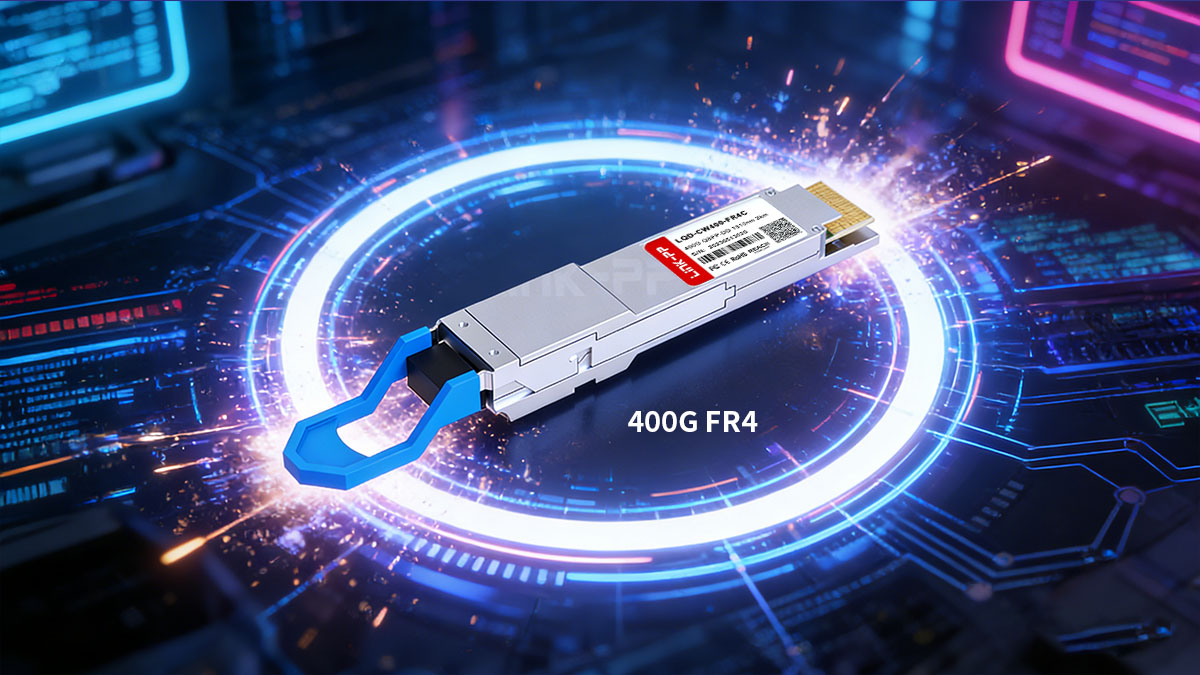
✅ What Is a 400G FR4 Optical Module?
A 400G FR4 optical module is a type of Ethernet transceiver designed for high-speed data transmission over single-mode fiber with a reach of up to 2km. It implements the 400GBASE-FR4 standard defined by IEEE 802.3 and uses wavelength division multiplexing to transmit four optical lanes over a duplex fiber pair. This architecture allows FR4 modules to deliver 400Gbps throughput while maintaining a relatively simple two-fiber cabling structure.
Because it combines longer reach with standard LC duplex fiber connectivity, 400G FR4 is commonly used for data center interconnects, campus networks, and medium-distance links within large cloud infrastructures.
Definition and Standard Overview
The 400GBASE-FR4 standard defines how 400Gbps Ethernet signals are transmitted using four optical wavelengths on single-mode fiber. Instead of using multiple parallel fibers, FR4 multiplexes four lanes onto a single pair of fibers through CWDM technology.
| Parameter |
400G FR4 Specification |
| Ethernet standard |
400GBASE-FR4 |
| IEEE specification |
IEEE 802.3bs |
| Optical lanes |
4 wavelengths |
| Transmission medium |
Duplex single-mode fiber |
This design reduces the number of required fibers compared with parallel-optics standards. As a result, FR4 modules are often easier to integrate into networks that already use traditional LC-based fiber infrastructure.
Technical Characteristics of FR4
A 400G FR4 module achieves 400Gbps throughput by transmitting four optical channels, each operating at 100Gbps PAM4 signaling. These channels are combined using coarse wavelength division multiplexing (CWDM) before transmission over a duplex fiber pair.
| Feature |
Specification |
| Total data rate |
400Gbps |
| Signaling technology |
PAM4 |
| Maximum reach |
Up to 2km |
| Connector type |
LC duplex |
Several technical aspects make FR4 optics suitable for medium-range optical links:
- Uses four CWDM wavelengths around the 1310nm region
- Requires only two fibers for bidirectional transmission
- Supports deployment in QSFP-DD and OSFP form factors
- Provides longer reach compared with short-range parallel standards
These characteristics allow FR4 to balance high capacity with relatively simple fiber management.
Typical Deployment Scenarios
400G FR4 modules are primarily deployed in environments where longer reach is required but fiber infrastructure must remain efficient.
Common use cases include:
- Data center interconnect (DCI) within large campuses
- Inter-building links across enterprise or hyperscale facilities
- Leaf-to-spine connections spanning multiple data halls
- Cloud and hyperscale networks requiring moderate-distance optical links
Compared with short-reach solutions, FR4 offers greater flexibility when network segments extend beyond a single data hall or require connections across different buildings within a campus environment.
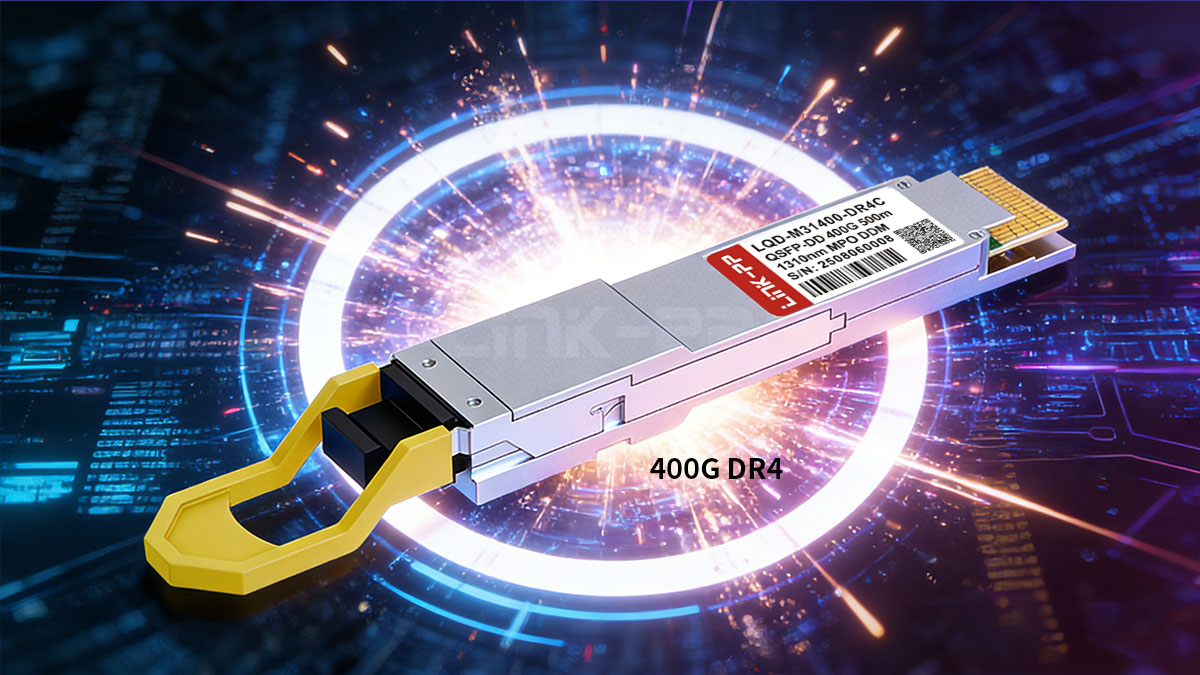
✅ What Is a 400G DR4 Optical Module?
A 400G DR4 optical module is a high-speed Ethernet transceiver designed for short-reach data center connections using parallel single-mode fiber. It follows the 400GBASE-DR4 specification defined in IEEE 802.3 and transmits four independent optical lanes in parallel, each carrying 100Gbps PAM4 signals. These lanes are distributed across multiple fibers, allowing the module to deliver a total throughput of 400Gbps with very low latency and high port density.
Because it uses a parallel fiber architecture rather than wavelength multiplexing, DR4 transceiver is commonly deployed in high-density data center environments where large numbers of short-distance links are required. Typical link distances reach up to 500m, which makes DR4 particularly suitable for intra-data-center switching fabrics.
Definition and Standard Overview
The 400GBASE-DR4 standard specifies a 400Gbps Ethernet interface that uses four parallel optical channels over single-mode fiber. Each channel carries 100Gbps PAM4 signaling and operates independently, with the module transmitting and receiving signals through multiple fibers in an MPO-12 connector.
| Parameter |
400G DR4 Specification |
| Ethernet standard |
400GBASE-DR4 |
| IEEE specification |
IEEE 802.3bs |
| Optical lanes |
4 parallel lanes |
| Transmission medium |
Parallel single-mode fiber |
This architecture removes the need for wavelength multiplexing components and instead relies on multiple fibers to transmit the optical lanes simultaneously.
Technical Characteristics of DR4
A 400G DR4 module uses four optical transmitters and four receivers operating in parallel. Each lane carries a 100Gbps PAM4 signal, and the total bandwidth is aggregated to reach 400Gbps.
| Feature |
Specification |
| Total data rate |
400Gbps |
| Signaling technology |
PAM4 |
| Maximum reach |
Up to 500m |
| Connector type |
MPO-12 |
Several technical characteristics define the DR4 architecture:
- Uses parallel optics with four transmit and four receive fibers
- Typically operates around the 1310nm wavelength range
- Requires MPO-12 structured cabling systems
- Designed for high-density switching environments
Because each optical lane travels through a separate fiber, DR4 systems rely on structured parallel cabling rather than wavelength multiplexing.
Typical Deployment Scenarios
400G DR4 transceiver is widely used in short-distance optical links inside modern data centers. Their parallel fiber design allows high port density and efficient connectivity between switches and compute resources.
Common deployment scenarios include:
- Intra-data-center connections within a single data hall
- Spine-to-leaf switching architectures
- AI and high-performance computing clusters
- Hyperscale cloud infrastructure networks
In these environments, the majority of optical links are relatively short, and the ability to deploy large numbers of parallel connections makes DR4 a practical solution for scaling 400Gbps networking capacity.
✅ FR4 vs DR4: Key Technical Differences
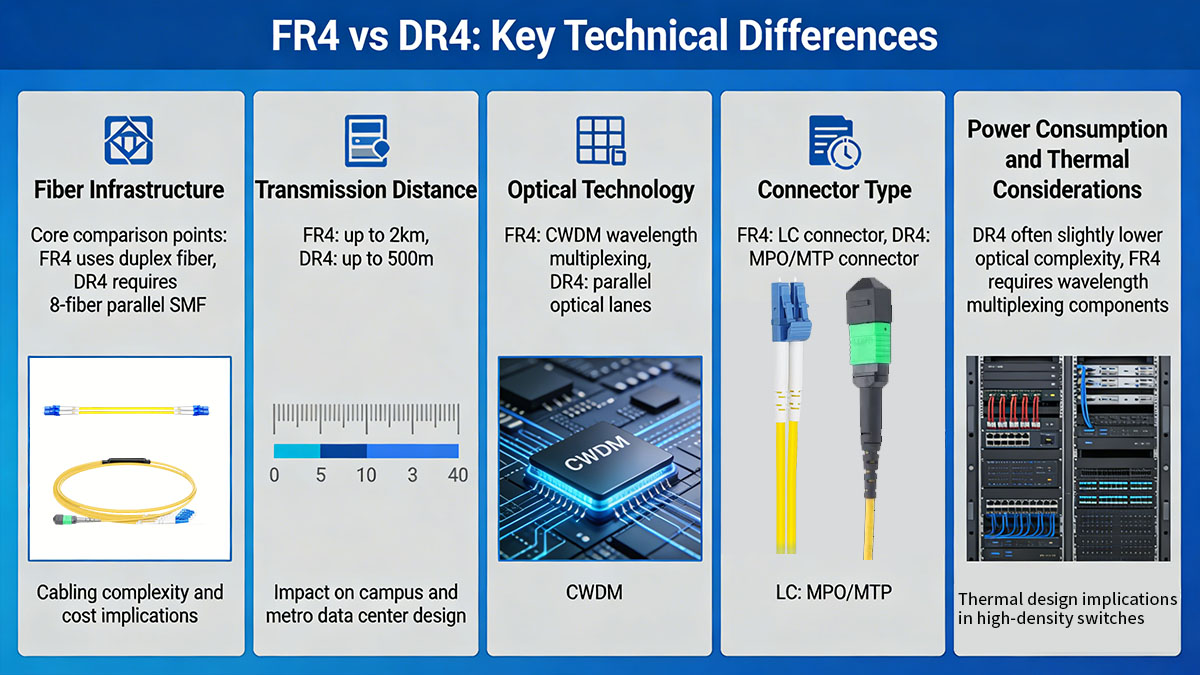
The main differences between FR4 and DR4 lie in fiber architecture, transmission distance, optical technology, and connector type. While both modules support a total data rate of 400Gbps, they are designed for different network environments and cabling infrastructures. FR4 focuses on longer reach using wavelength multiplexing over duplex fiber, whereas DR4 is optimized for short-distance, high-density links using parallel fibers.
Fiber Infrastructure
FR4 and DR4 use different fiber architectures, which directly affects cabling complexity and deployment flexibility. FR4 relies on a duplex fiber pair, while DR4 requires multiple parallel fibers.
| Feature |
QSFP-DD FR4 |
QSFP-DD DR4 |
| Fiber type |
Duplex single-mode fiber |
Parallel single-mode fiber |
| Fiber count |
2 fibers |
8 fibers (4 Tx + 4 Rx) |
| Cabling structure |
Standard LC fiber |
MPO structured cabling |
Because FR4 only requires two fibers, it integrates easily into networks that already use LC duplex fiber. DR4, in contrast, requires MPO-based structured cabling with multiple fibers to support parallel transmission.
Transmission Distance
The supported transmission distance is one of the most important differences between the two module types. FR4 supports longer links, while DR4 is intended for short-reach connections.
| Module type |
Maximum reach |
Typical application distance |
| FR4 |
Up to 2km |
Campus or inter-building links |
| DR4 |
Up to 500m |
Intra-data-center links |
This difference makes FR4 more suitable for connecting separate data halls or buildings, while DR4 is commonly used for high-speed switching inside the same data center facility.
Optical Technology
FR4 and DR4 also differ in how they transmit multiple optical channels to achieve 400Gbps throughput.
| Technology aspect |
FR4 |
DR4 |
| Optical method |
CWDM wavelength multiplexing |
Parallel optical lanes |
| Number of lanes |
4 wavelengths |
4 electrical/optical lanes |
| Transmission approach |
Multiple wavelengths over two fibers |
Multiple fibers carrying separate lanes |
FR4 combines four optical wavelengths onto a single fiber pair using CWDM technology. DR4 instead transmits each lane through its own fiber, which simplifies optical design but increases fiber requirements.
Connector Type
The connector design reflects the underlying fiber architecture used by each module.
| Connector aspect |
FR4 |
DR4 |
| Connector type |
LC duplex |
MPO-12 |
| Fiber interface |
Two-fiber connection |
Multi-fiber connection |
| Cabling compatibility |
Traditional duplex fiber |
Parallel fiber infrastructure |
LC connectors used by FR4 modules are common in many existing fiber networks, making upgrades relatively straightforward. DR4 modules require MPO connectors, which are typically deployed in structured high-density data center cabling systems.
Power Consumption and Thermal Considerations
Power consumption can vary depending on vendor implementation, but there are architectural factors that influence thermal design.
| Factor |
FR4 |
DR4 |
| Optical complexity |
Higher due to wavelength multiplexing |
Lower multiplexing complexity |
| Fiber usage |
Lower fiber count |
Higher fiber count |
| Typical deployment |
Medium-distance links |
Short-range high-density links |
FR4 modules include wavelength multiplexing and demultiplexing components, which add optical complexity. DR4 modules rely on parallel optics instead, which can simplify the optical path but requires more fibers in the cabling system.
Overall, these differences explain why FR4 and DR4 are often used in complementary roles within large-scale data center networks.
✅ FR4 vs DR4: Side-by-Side Comparison Table
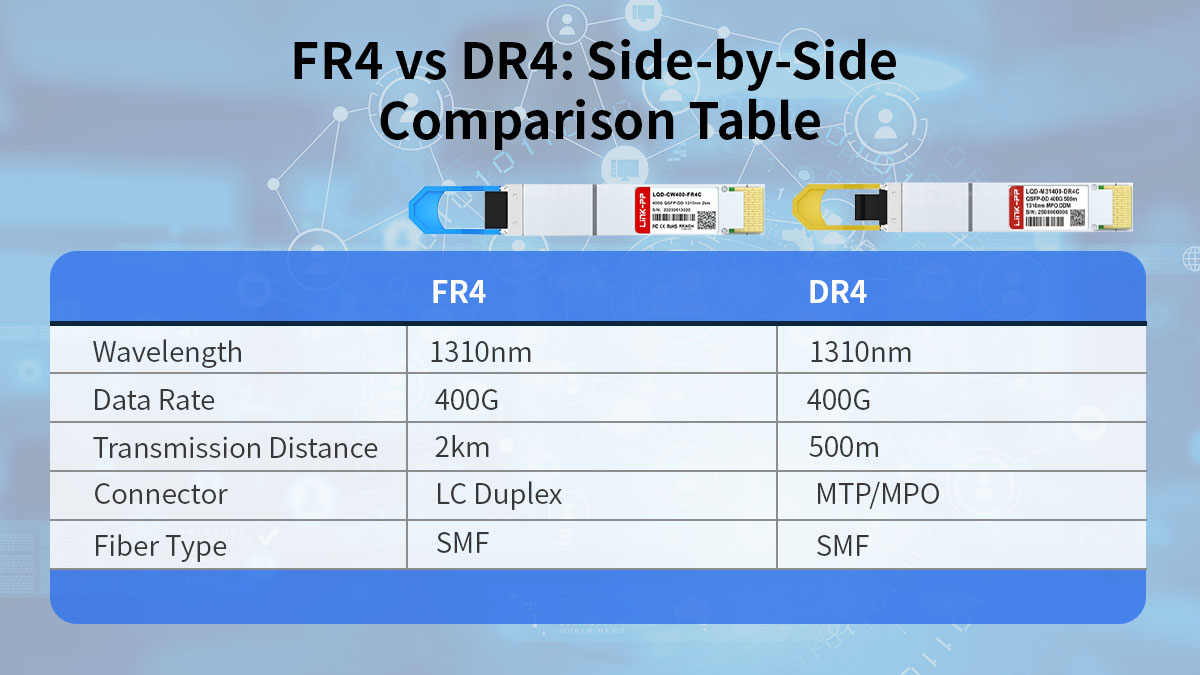
FR4 and DR4 differ mainly in fiber architecture, transmission distance, connector type, and typical deployment environments. The following comparison table summarizes the most relevant technical parameters to help quickly distinguish the two 400G optical standards.
Quick Technical Comparison
The table below highlights the core differences between 400GBASE-FR4 and 400GBASE-DR4 modules.
| Parameter |
400G FR4 |
400G DR4 |
| Ethernet standard |
400GBASE-FR4 |
400GBASE-DR4 |
| Fiber type |
Duplex single-mode fiber |
Parallel single-mode fiber |
| Connector type |
LC duplex |
MPO-12 |
| Maximum reach |
Up to 2km |
Up to 500m |
| Optical technology |
CWDM wavelength multiplexing |
Parallel optical lanes |
| Typical deployment |
Inter-building / campus links |
Intra-data-center connections |
From a deployment perspective, the most visible difference is the cabling architecture. FR4 transmits four wavelengths over a duplex fiber pair, which reduces fiber count and works well with existing LC infrastructure. DR4 uses multiple parallel fibers, which increases fiber usage but enables highly scalable high-density switching inside data centers.
When planning network upgrades, engineers typically evaluate three key factors:
- required link distance
- existing fiber infrastructure (LC vs MPO)
- density requirements within switching fabrics
These considerations help determine whether FR4 or DR4 better fits the design of a 400G network environment.
✅ Cabling Architecture Differences Between FR4 and DR4
The cabling architecture used by FR4 and DR4 differs primarily in fiber count and connector design. FR4 relies on a duplex fiber structure that uses two fibers for bidirectional transmission, while DR4 uses a parallel fiber architecture that distributes optical lanes across multiple fibers. These differences influence cabling complexity, scalability, and compatibility with existing infrastructure.
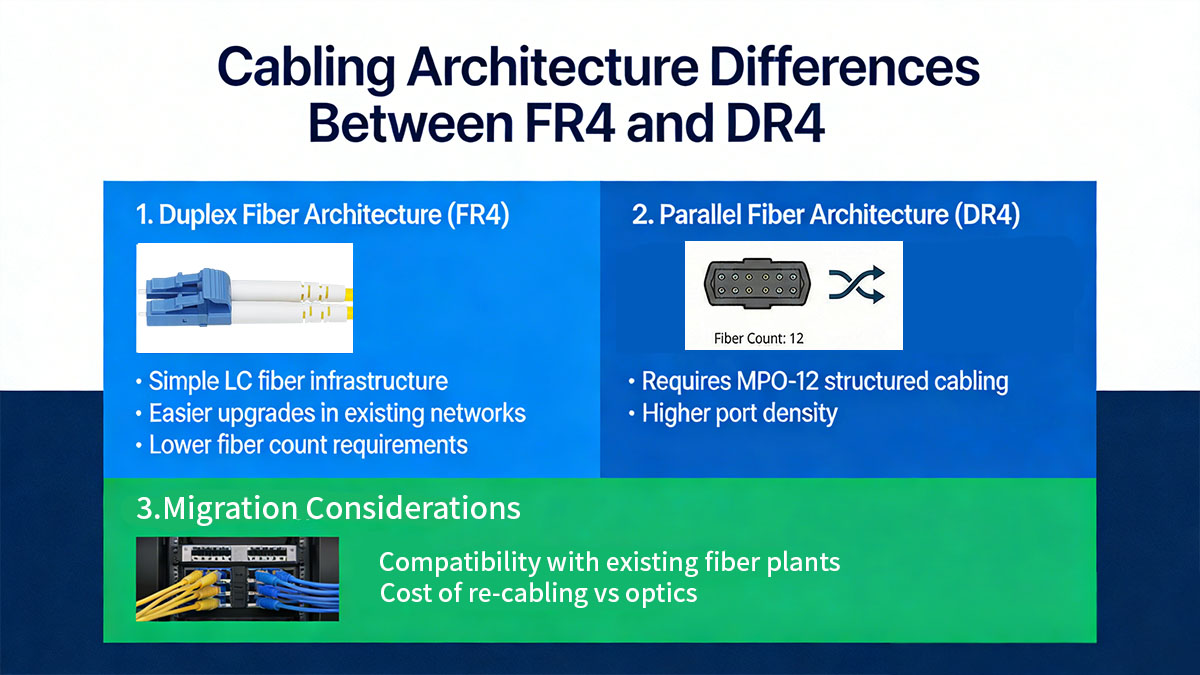
Duplex Fiber Architecture (FR4)
FR4 transceiver use wavelength multiplexing to transmit multiple optical lanes over a single fiber pair. This design allows four wavelengths to travel through two fibers, making the cabling structure relatively simple compared with parallel optical systems.
| Cabling aspect |
FR4 implementation |
| Fiber structure |
Duplex single-mode fiber |
| Fiber count |
2 fibers (Tx/Rx) |
| Connector type |
LC duplex |
| Cabling compatibility |
Standard LC fiber infrastructure |
Because only two fibers are required, FR4 can be integrated into many existing fiber networks without significant cabling changes. This is particularly useful in environments where LC duplex cabling is already widely deployed.
Additional advantages of duplex fiber architecture include:
- lower fiber consumption compared with parallel optics
- simpler cable management in medium-scale deployments
- easier compatibility with traditional patch panels and fiber trays
These characteristics make FR4 practical for connections between buildings or across different areas of a large data center campus.
Parallel Fiber Architecture (DR4)
DR4 optics use a parallel optical transmission approach in which each optical lane travels through a separate fiber. To support four transmit and four receive channels, the module typically uses an MPO-12 connector with eight active fibers.
| Cabling aspect |
DR4 implementation |
| Fiber structure |
Parallel single-mode fiber |
| Active fibers |
8 fibers (4 Tx + 4 Rx) |
| Connector type |
MPO-12 |
| Cabling system |
Structured MPO cabling |
Parallel fiber architecture is designed for environments where very high port density is required. Large data centers often deploy structured MPO cabling systems that allow multiple high-speed links to be organized and scaled efficiently.
Key characteristics of DR4 cabling include:
- support for high-density switching fabrics
- compatibility with MPO-based structured cabling systems
- efficient deployment for large-scale hyperscale environments
Although this approach increases fiber count compared with duplex systems, it enables flexible breakout configurations and large numbers of short-distance connections.
Migration Considerations
When deciding between FR4 and DR4, the existing cabling infrastructure is often a critical factor. Networks built around LC duplex fiber may find FR4 easier to deploy, while environments already using MPO structured cabling may prefer DR4.
| Migration factor |
FR4 impact |
DR4 impact |
| Existing LC fiber plant |
Easy integration |
May require new cabling |
| Existing MPO cabling |
Less common usage |
Direct compatibility |
| Fiber utilization |
Lower fiber count |
Higher fiber count |
For network planners, evaluating current cabling topology, available fiber resources, and future scalability requirements can help determine which optical architecture fits the overall data center design.
✅ FR4 vs DR4: How to Choose
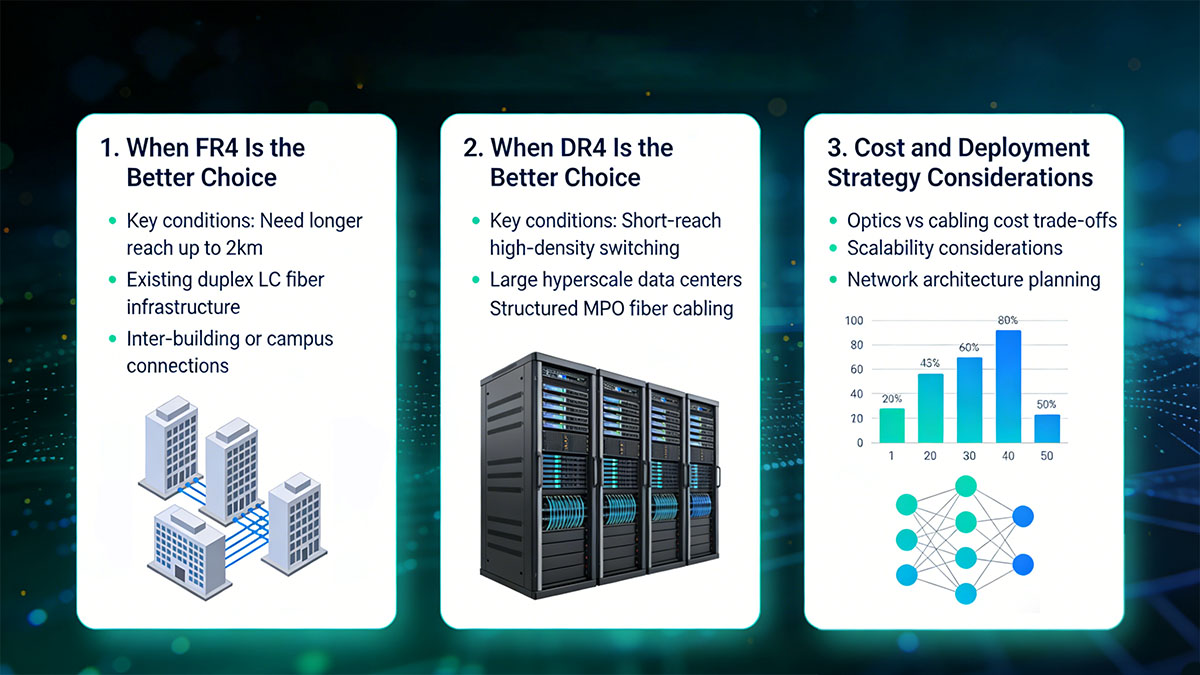
Choosing between FR4 and DR4 mainly depends on link distance, existing cabling infrastructure, and the scale of the data center environment. FR4 is typically selected for medium-distance links where duplex fiber is preferred, while DR4 is more suitable for high-density short-range connections inside large data centers.
When FR4 Is the Better Choice
FR4 modules are generally preferred when longer transmission distances are required or when the network already uses duplex LC fiber infrastructure. Because FR4 uses wavelength multiplexing over two fibers, it can support longer links without increasing fiber count.
| Scenario factor |
FR4 suitability |
| Link distance requirement |
Up to 2km |
| Existing fiber infrastructure |
LC duplex fiber |
| Network layout |
Campus or inter-building links |
| Fiber availability |
Limited fiber resources |
FR4 is commonly selected in the following situations:
- connecting different data halls within a large campus
- inter-building links between facilities
- upgrading networks that already rely on LC duplex fiber
- environments where minimizing fiber count is important
In these scenarios, FR4 offers a practical balance between high bandwidth and efficient fiber utilization.
When DR4 Is the Better Choice
DR4 modules are designed primarily for short-distance, high-density optical connections within a single data center environment. Their parallel fiber architecture aligns well with structured MPO cabling systems often used in hyperscale facilities.
| Scenario factor |
DR4 suitability |
| Link distance requirement |
Up to 500m |
| Fiber infrastructure |
MPO structured cabling |
| Deployment scale |
Hyperscale or large data centers |
| Port density needs |
Very high |
Typical scenarios where DR4 is preferred include:
- spine-to-leaf switching connections
- high-performance computing clusters
- AI and GPU training infrastructure
- large-scale cloud data center fabrics
In these environments, most optical links are relatively short, and structured MPO cabling allows thousands of high-speed connections to be deployed efficiently.
Cost and Deployment Strategy Considerations
In many network designs, the choice between FR4 and DR4 is not determined by optics alone. Cabling cost, infrastructure compatibility, and future scalability also influence the decision.
| Consideration |
FR4 impact |
DR4 impact |
| Fiber consumption |
Lower |
Higher |
| Cabling complexity |
Simpler |
More structured |
| Scalability in large fabrics |
Moderate |
High |
For networks with existing LC duplex infrastructure, FR4 can simplify upgrades to 400Gbps without major cabling changes. In contrast, hyperscale environments that already rely on MPO structured cabling often benefit from DR4's parallel architecture for large-scale deployments.
✅ Future Trends: The Evolution of 400G and Beyond
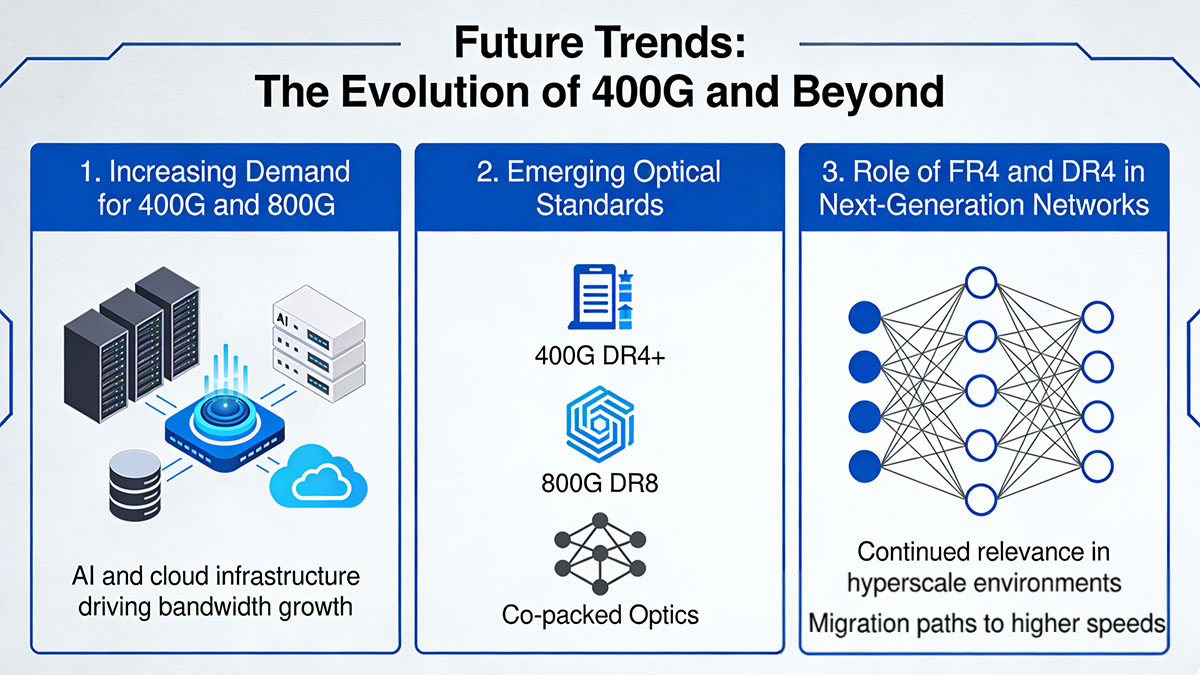
The rapid expansion of cloud computing, artificial intelligence workloads, and hyperscale data centers is driving continuous growth in network bandwidth demand. While 400G Ethernet has become a key building block of modern data center networks, the industry is already preparing for higher speeds and more efficient optical interconnect technologies. In this evolution, both FR4 and DR4 architectures continue to play important roles as part of broader optical ecosystem development.
Increasing Demand for 400G and 800G
Bandwidth requirements in data centers are increasing as workloads such as AI training, distributed storage, and large-scale cloud services generate massive east–west traffic. To address this demand, network operators are rapidly adopting 400G optical links and planning migrations toward 800G infrastructure.
| Technology generation |
Typical interface examples |
Primary use cases |
| 400G Transceiver |
FR4, DR4 |
Current data center backbone links |
| 800G Transceiver |
DR8, FR8 |
Next-generation hyperscale networks |
| Beyond 800G |
Emerging standards |
Future AI and cloud infrastructure |
As the transition progresses, 400G solutions will continue to serve as a foundation for many data center deployments, particularly in environments where existing infrastructure is designed around these standards.
Emerging Optical Standards
To support higher bandwidth and longer transmission distances, the optical networking industry is developing several new interface standards. These technologies aim to improve efficiency, reduce power consumption, and support larger switching fabrics.
Examples of emerging standards include:
- 400G DR4+ for extended short-reach applications
- 800G DR8 designed for high-density parallel optical links
- 800G FR8 using wavelength multiplexing for longer reach connections
- advancements in coherent optics for data center interconnect
Many of these standards build upon the same architectural principles used by FR4 and DR4, such as wavelength multiplexing or parallel fiber transmission.
Role of FR4 and DR4 in Next-Generation Networks
Despite the emergence of faster interfaces, FR4 and DR4 will remain widely used in many data center networks for years. Their deployment models align well with common infrastructure designs, allowing them to coexist with newer technologies as networks evolve.
Several factors support their continued relevance:
- large installed base of 400G switching platforms
- compatibility with existing LC and MPO cabling systems
- cost efficiency for established network architectures
- practical balance between performance, reach, and scalability
In many environments, the transition to higher speeds will occur gradually. As a result, FR4 and DR4 modules are expected to remain important components of modern optical networking while serving as stepping stones toward future high-capacity data center interconnect technologies.
✅ FAQs About FR4 vs DR4
What is the main difference between FR4 and DR4 optical modules?
FR4 uses wavelength multiplexing over duplex single-mode fiber, while DR4 transmits parallel optical lanes across multiple fibers. This results in different connector types, fiber counts, and transmission distances.
Can FR4 and DR4 modules connect directly to each other?
No. FR4 and DR4 use different optical architectures and connector types, so they cannot interoperate directly. A compatible optical interface or appropriate conversion solution is required.
Why does DR4 require an MPO connector?
DR4 transmits four optical lanes in parallel and requires separate fibers for transmitting and receiving signals. The MPO connector supports multiple fibers within a single interface, making it suitable for parallel optical transmission.
Is FR4 more suitable for longer-distance 400G links?
Yes. FR4 supports transmission distances of up to 2km over single-mode fiber, which makes it suitable for campus connections and links between data center buildings.
Does DR4 use more fibers than FR4?
Yes. FR4 typically uses two fibers for duplex transmission, while DR4 commonly requires eight active fibers for four transmit and four receive channels.
Which module is more common inside hyperscale data centers?
DR4 is commonly used inside hyperscale data centers because its parallel fiber architecture supports high-density switching and short-distance optical connections.
✅ Conclusion
FR4 and DR4 are two important 400G optics standards designed for different network architectures. FR4 focuses on longer reach using wavelength multiplexing over duplex single-mode fiber, making it suitable for campus networks, inter-building connections, and environments that rely on LC-based fiber infrastructure. DR4, on the other hand, is optimized for short-distance, high-density data center connections through parallel fiber transmission and MPO cabling.
When evaluating FR4 vs DR4, network planners typically consider three key factors: required transmission distance, existing fiber infrastructure, and the scale of the switching environment. FR4 can simplify deployment where duplex fiber is already available, while DR4 aligns well with structured MPO cabling systems used in hyperscale data centers. Understanding these differences helps ensure that the selected optical module fits both current network requirements and long-term scalability goals.
For organizations planning 400G network deployments or upgrades, choosing reliable and standards-compliant optical transceivers is essential. The LINK-PP Official Store provides a wide range of 400G optical modules, including FR4 and DR4 solutions designed for modern data center and cloud networking environments. Exploring available options can help network engineers identify the most suitable interfaces for their specific infrastructure and performance needs.