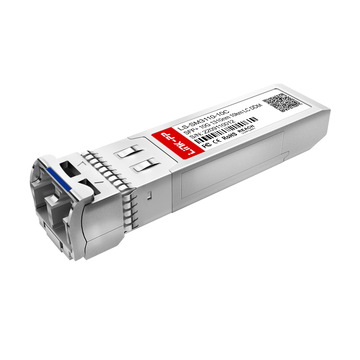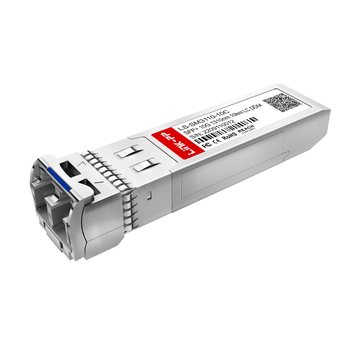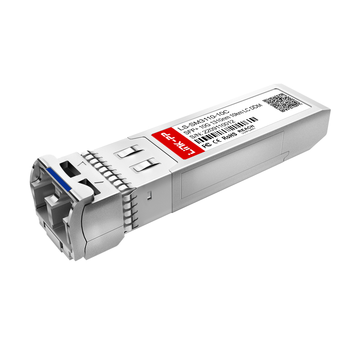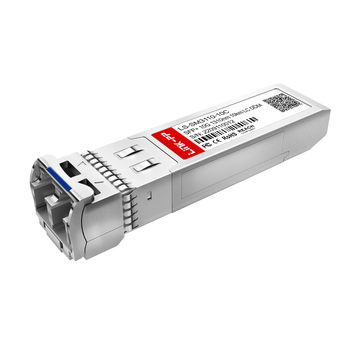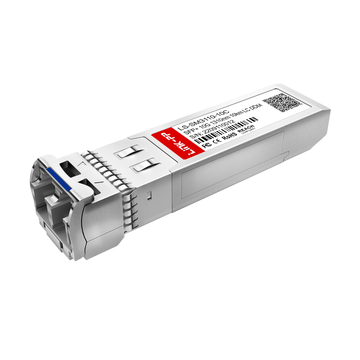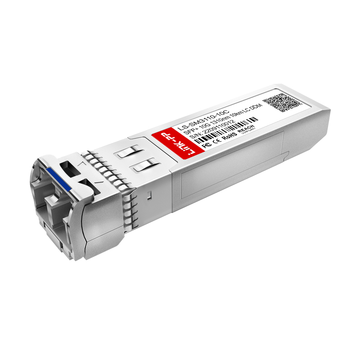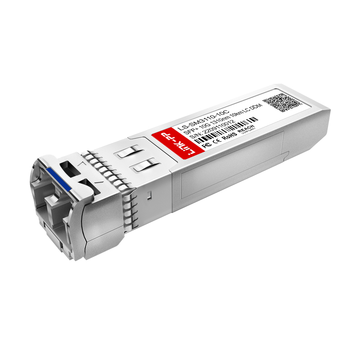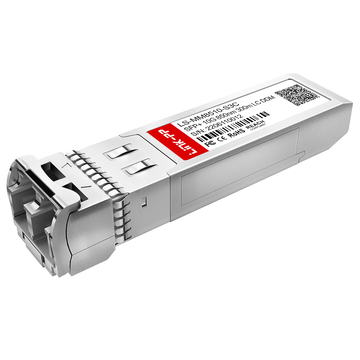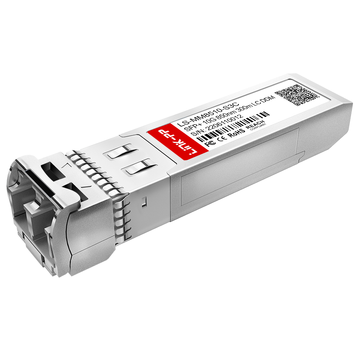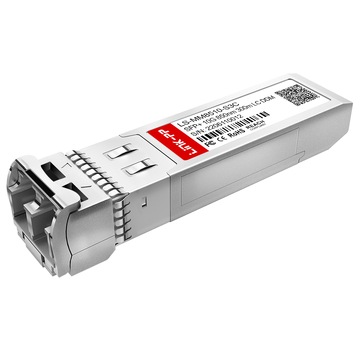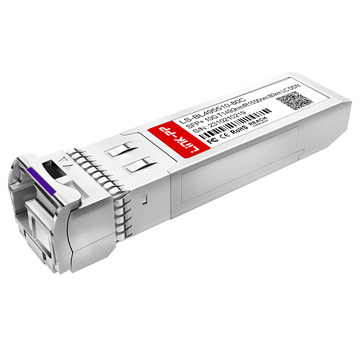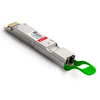






























10GbE optical transceivers are widely used in enterprise networks, data centers, and campus infrastructures to support high-speed fiber connectivity. Among the common long-wavelength 10G SFP+ modules, 10GBASE-LR and 10GBASE-LRM are two standards that often cause confusion because they share similar wavelengths but serve different fiber environments and transmission distances. Understanding the differences between them is essential when planning fiber links or upgrading existing network infrastructure.
The key distinction between SFP 10G LR and SFP 10G LRM lies in the type of fiber they support and the distance they are designed to cover. 10G LR modules are built for long-distance transmission over single-mode fiber, while 10G LRM modules are designed to operate on multimode fiber, particularly in environments where legacy cabling is still in use. These differences affect link performance, deployment scenarios, and long-term network scalability.
This article compares SFP 10G LR vs SFP 10G LRM in terms of technical specifications, transmission characteristics, fiber compatibility, and typical use cases. By examining how each module works and where it is commonly deployed, network engineers and IT planners can better determine which option fits their infrastructure requirements.
🐚Overview of 10G SFP+ Optical Transceivers
10G SFP+ optical transceivers are pluggable transceivers designed to deliver 10Gbps Ethernet connectivity over fiber or copper links. They are widely used in switches, routers, and network interface cards to provide flexible and scalable high-speed connections. By selecting the appropriate optical standard—such as LR, LRM, or SR—network designers can match the module to the required transmission distance, fiber type, and deployment environment.
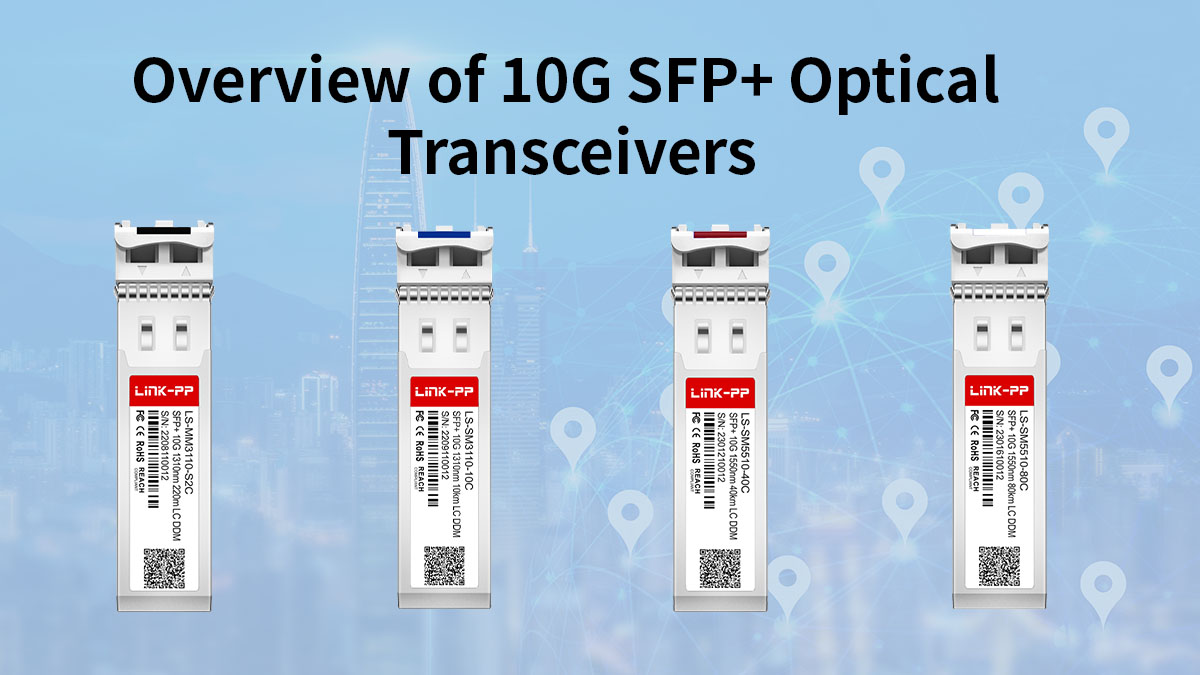
What Is 10G SFP+ Module
A 10G SFP+ module is a compact, hot swappable transceiver that supports 10Gbps data transmission. It follows the SFP+ (Small Form-factor Pluggable Plus) standard and is commonly used in 10 Gigabit Ethernet networks.
| Feature | Description |
|---|---|
| Form factor | Small Form-factor Pluggable Plus (SFP+) |
| Data rate | Up to 10Gbps |
| Interface | LC duplex (most optical modules) |
| Deployment | Switches, routers, servers, and NICs |
Compared with earlier optical modules, SFP+ devices offer a smaller footprint and lower power consumption while maintaining high performance. Because they are hot-pluggable, network administrators can replace or upgrade modules without shutting down the system.
In modern networks, SFP+ modules are often used to connect access switches to aggregation switches, link servers to top-of-rack switches, or build high-speed backbone connections.
Why Different 10G Optical Standards Exist
Different 10G optical standards were created to support various network environments, especially in terms of fiber type and transmission distance. Since network infrastructures vary widely—from short in-rack links to multi-kilometer campus connections—no single optical specification can cover all scenarios efficiently.
Several factors drive the development of different 10G optical variants:
- Transmission distance requirements
Short links inside data centers may only require tens of meters, while campus networks may need several kilometers. - Fiber type compatibility
Some environments use single-mode fiber (SMF) for long-distance communication, while others rely on multimode fiber (MMF) installed in older buildings. - Cost and infrastructure reuse
Certain standards are designed to work with existing cabling systems to avoid costly fiber replacement. - Network evolution
As Ethernet technology advances, new standards emerge to improve efficiency, reach, and compatibility.
Because of these factors, multiple 10G SFP+ optical standards exist today, including SR, LR, ER, and LRM. Each standard targets specific network conditions, which is why understanding the differences between them—particularly 10G LR vs 10G LRM—is important when designing or upgrading fiber networks.
🐚What Is SFP 10G LR (10GBASE-LR)
10GBASE-LR is a long-reach optical standard designed for 10Gbps transmission over single-mode fiber (SMF). SFP 10G LR modules typically operate at 1310nm and support transmission distances of up to 10km, making them widely used for campus networks, metro access links, and inter-building connections.
Compared with short-reach multimode optics, 10G LR module is optimized for longer fiber spans and lower signal attenuation. This makes them one of the most commonly deployed 10G SFP+ transceivers in backbone and aggregation layers of enterprise networks.
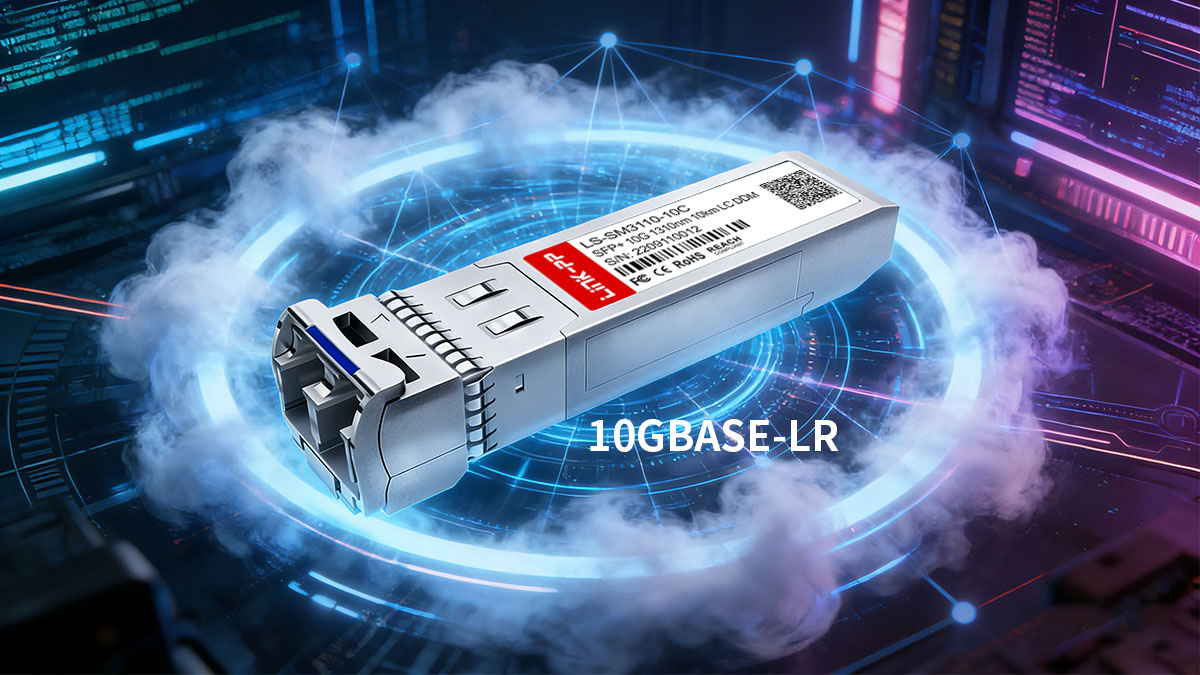
Technical Specifications of 10G LR
The key characteristics of a 10GBASE-LR SFP+ module define how it performs in long-distance optical links. These specifications focus on wavelength, supported fiber type, and link distance.
| Parameter | 10GBASE-LR Specification |
|---|---|
| Wavelength | 1310nm |
| Fiber type | Single-mode fiber (SMF) |
| Maximum distance | Up to 10km |
| Connector type | LC duplex |
These specifications allow 10G LR modules to transmit optical signals over much longer distances than multimode standards such as SR or LRM. Single-mode fiber has a smaller core diameter, which reduces modal dispersion and enables more stable signal propagation over kilometers of fiber.
In practical deployments, the actual link distance can vary depending on factors such as fiber quality, connector loss, and patch panel attenuation.
How 10G LR Works in Optical Networks
10GBASE-LR sfp module transmit optical signals using 1310nm distributed feedback (DFB) lasers, which are well suited for long-distance communication over single-mode fiber. The optical signal travels through the fiber with minimal dispersion and attenuation compared with multimode transmission.
In a typical optical link:
- The transmitting module converts electrical signals from the switch into optical signals using a laser source.
- The optical signal travels through the single-mode fiber link.
- The receiving module converts the optical signal back into an electrical signal for the network device.
Because single-mode fiber maintains a single light propagation path, signal distortion is significantly reduced. This allows 10G LR modules to maintain stable transmission across long distances without requiring complex signal compensation technologies.
Common Deployment Scenarios
10GBASE-LR is commonly used in network environments where longer fiber runs and stable long-distance performance are required.
Typical deployment scenarios include:
- Campus backbone networks
Connecting core switches across large campus environments. - Inter-building connections
Linking network equipment between buildings within the same organization. - Metropolitan access networks
Supporting access links between enterprise networks and metro infrastructure. - Data center interconnect within campus areas
Connecting separate data center facilities located several kilometers apart.
These scenarios benefit from the long reach and reliability of single-mode fiber, making SFP 10G LR modules a standard choice for medium- to long-distance 10GbE connectivity.
🐚What Is SFP 10G LRM (10GBASE-LRM)
10GBASE-LRM is a 10 Gigabit Ethernet optical standard designed for transmission over multimode fiber (MMF), particularly in environments where legacy fiber infrastructure is still in use. SFP 10G LRM modules operate at 1310nm and support transmission distances of up to 220m on multimode fiber, making them suitable for enterprise networks that rely on older fiber types such as OM1 or OM2.
Unlike many short-reach multimode optics, 10G LRM was specifically developed to extend the usability of installed multimode cabling. By incorporating signal compensation technologies, these modules can maintain stable performance even on legacy fiber systems that were not originally optimized for 10Gbps Ethernet.
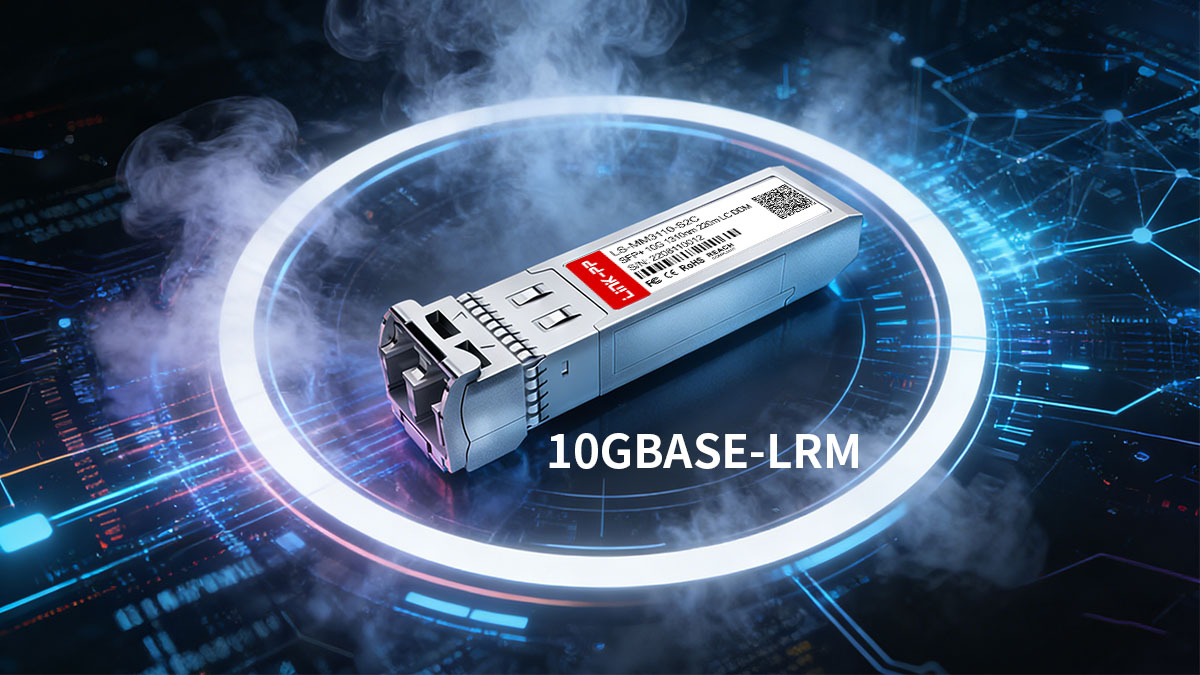
Technical Specifications of 10G LRM
The main specifications of a 10GBASE-LRM module define its operating wavelength, supported fiber types, and transmission distance within multimode environments.
| Parameter | 10GBASE-LRM Specification |
|---|---|
| Wavelength | 1310nm |
| Fiber type | Multimode fiber (MMF) |
| Maximum distance | Up to 220m |
| Connector type | LC duplex |
Because multimode fiber typically introduces more modal dispersion than single-mode fiber, the transmission distance of LRM module is significantly shorter than long-reach standards such as LR. However, the design allows many existing multimode installations to support 10GbE without requiring immediate fiber replacement.
The Technology Behind LRM Modules
10GBASE-LRM sfp module relies on electronic dispersion compensation (EDC) to maintain signal integrity over multimode fiber. Multimode fibers, especially older OM1 and OM2 types, can introduce modal dispersion that distorts optical signals at high data rates.
EDC technology works by processing the received electrical signal to correct distortions caused by dispersion. This allows the receiver to reconstruct the original signal even when the optical waveform has been degraded during transmission.
In practical terms, the signal flow typically follows these steps:
- The transmitter converts the electrical signal from the network device into an optical signal using a 1310nm laser.
- The optical signal travels through multimode fiber where dispersion may occur.
- The receiver applies electronic dispersion compensation to restore signal quality before converting it back to an electrical signal.
This compensation capability is what allows LRM transceiver to operate over multimode fiber types that were originally designed for lower-speed Ethernet standards.
Typical Deployment Environments
10GBASE-LRM modules are most commonly deployed in networks where existing multimode cabling must be reused. These environments often prioritize compatibility with installed infrastructure rather than maximum transmission distance.
Common deployment scenarios include:
- Enterprise networks with legacy OM1 or OM2 multimode fiber
- Data centers that have older multimode cabling systems
- Equipment rooms where fiber replacement would be costly or disruptive
- Gradual upgrades from Gigabit Ethernet to 10 Gigabit Ethernet
In these cases, 10G LRM modules provide a practical way to introduce 10Gbps connectivity while continuing to use existing multimode fiber links.
🐚SFP 10G LR vs SFP 10G LRM: Key Differences
SFP 10G LR and SFP 10G LRM differ mainly in fiber compatibility, transmission distance, and the technologies used to maintain signal integrity. LR transceiver is designed for long-distance transmission over single-mode fiber, while LRM modules are optimized for shorter links over multimode fiber, particularly in networks that rely on older cabling infrastructure.
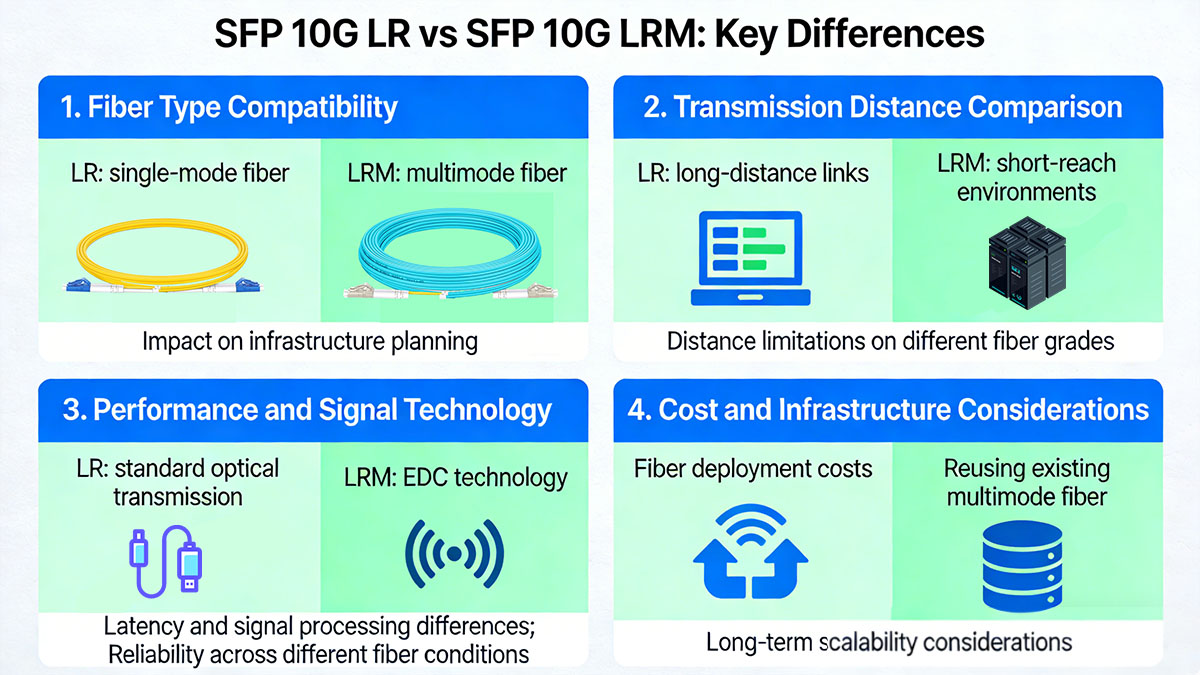
Understanding these differences helps network engineers select the appropriate module based on fiber type, link distance, and long-term infrastructure planning.
Fiber Type Compatibility
The most fundamental difference between 10G LR and 10G LRM is the type of fiber each module is designed to operate on. LR modules are built for single-mode fiber links, while LRM optics is intended for multimode fiber environments.
| Module Type | Supported Fiber | Typical Use |
|---|---|---|
| 10GBASE-LR | Single-mode fiber (SMF) | Long-distance links |
| 10GBASE-LRM | Multimode fiber (MMF) | Legacy multimode infrastructure |
Single-mode fiber supports a single light propagation path, which reduces optical dispersion and enables stable long-distance transmission. Multimode fiber has a larger core diameter and supports multiple light paths, which makes it suitable for shorter distances but introduces more modal dispersion at higher data rates.
Because of these characteristics, selecting the correct module usually begins with identifying the type of fiber already deployed in the network.
Transmission Distance Comparison
Another major difference lies in the maximum transmission distance each module can support.
| Optical Standard | Fiber Type | Maximum Distance |
|---|---|---|
| 10GBASE-LR | Single-mode fiber | Up to 10km |
| 10GBASE-LRM | Multimode fiber | Up to 220m |
The longer reach of LR modules comes from the properties of single-mode fiber, which minimizes signal dispersion and attenuation. LRM modules, while shorter in reach, enable 10Gbps transmission on multimode fibers that were not originally designed for such high speeds.
In many enterprise networks, this distinction determines whether a module is used for building-to-building connections or for shorter internal links.
Performance and Signal Technology
The two standards also differ in how they maintain signal integrity during transmission.
- LR modules rely on stable optical transmission through single-mode fiber, which naturally reduces modal dispersion.
- LRM modules incorporate electronic dispersion compensation (EDC) to correct signal distortion caused by multimode fiber characteristics.
- LR links generally involve simpler signal processing because the optical medium is optimized for long-distance transmission.
- LRM links rely more heavily on receiver-side signal processing to maintain data integrity.
Because of this difference, LR modules are typically preferred for new fiber deployments, while LRM modules are often used when existing multimode cabling must be retained.
Cost and Infrastructure Considerations
Infrastructure planning is another factor that influences the choice between LR and LRM modules. The decision often depends on whether the network is built with single-mode or multimode fiber.
Several considerations typically influence this decision:
- Existing fiber infrastructure in buildings or data centers
- Cost of replacing multimode fiber with single-mode fiber
- Required transmission distance between network devices
- Long-term scalability of the network architecture
Networks designed for long-distance connectivity or future expansion often favor single-mode fiber and LR modules. In contrast, environments with established multimode cabling may adopt LRM modules to support 10GbE while continuing to use their existing fiber systems.
🐚LR vs LRM: Quick Comparison Table
10GBASE-LR and 10GBASE-LRM differ in several core parameters, including supported fiber type, transmission distance, and typical deployment environments. The following table summarizes the main technical differences to provide a quick reference when comparing the two optical standards.
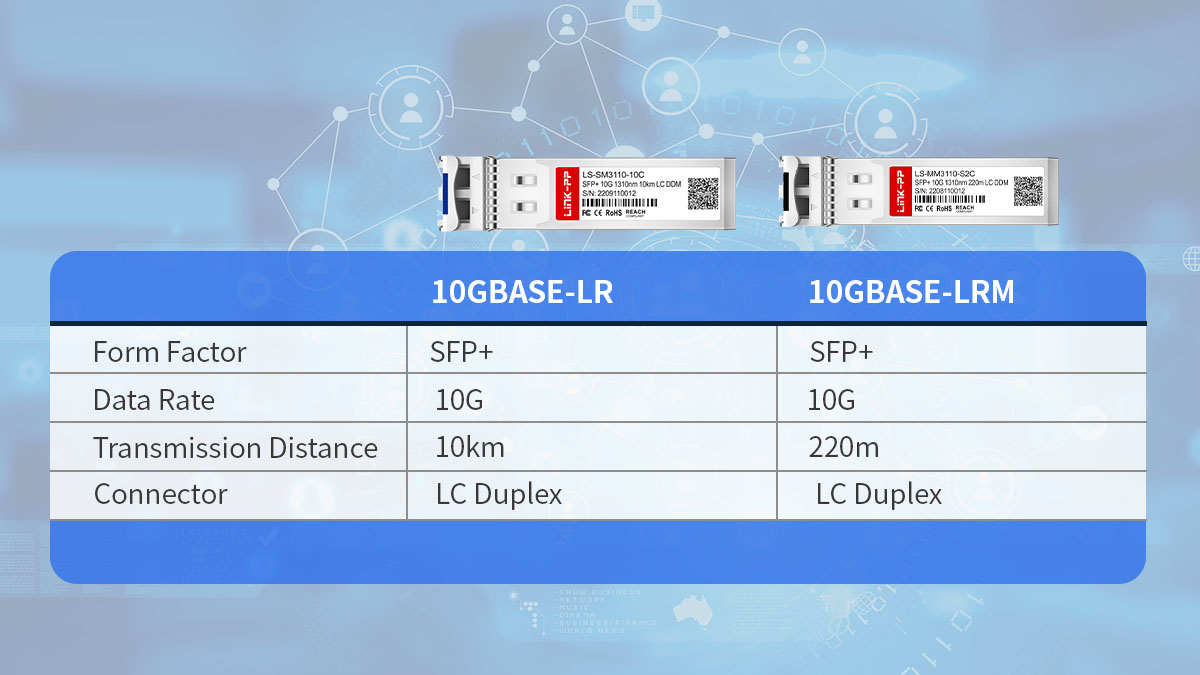
Technical Parameter Comparison
The table below highlights the most relevant characteristics of LR and LRM modules used in 10GbE networks.
| Parameter | SFP+ LR | SFP+ LRM |
|---|---|---|
| Operating wavelength | 1310nm | 1310nm |
| Supported fiber | Single-mode fiber (SMF) | Multimode fiber (MMF) |
| Maximum transmission distance | Up to 10km | Up to 220m |
| Signal technology | Standard optical transmission | Electronic dispersion compensation (EDC) |
| Typical deployment | Campus links, metro access, inter-building connections | Enterprise networks using legacy multimode fiber |
Although both modules operate at the same wavelength, they are designed for different fiber infrastructures. LR modules are intended for longer-distance connections over single-mode fiber, while LRM modules allow 10GbE transmission over shorter multimode fiber links.
In network design, this comparison helps quickly determine which module is suitable based on the available fiber type and the required link distance.
🐚When Should You Choose 10G LR
10GBASE-LR is typically selected when a network requires long-distance 10Gbps transmission over single-mode fiber. It is widely used in environments where link distances exceed the limits of multimode optics or where networks are designed with single-mode infrastructure for long-term scalability.
In practice, LR modules are commonly deployed in backbone connections, inter-building links, and other scenarios where stable long-distance optical transmission is required.
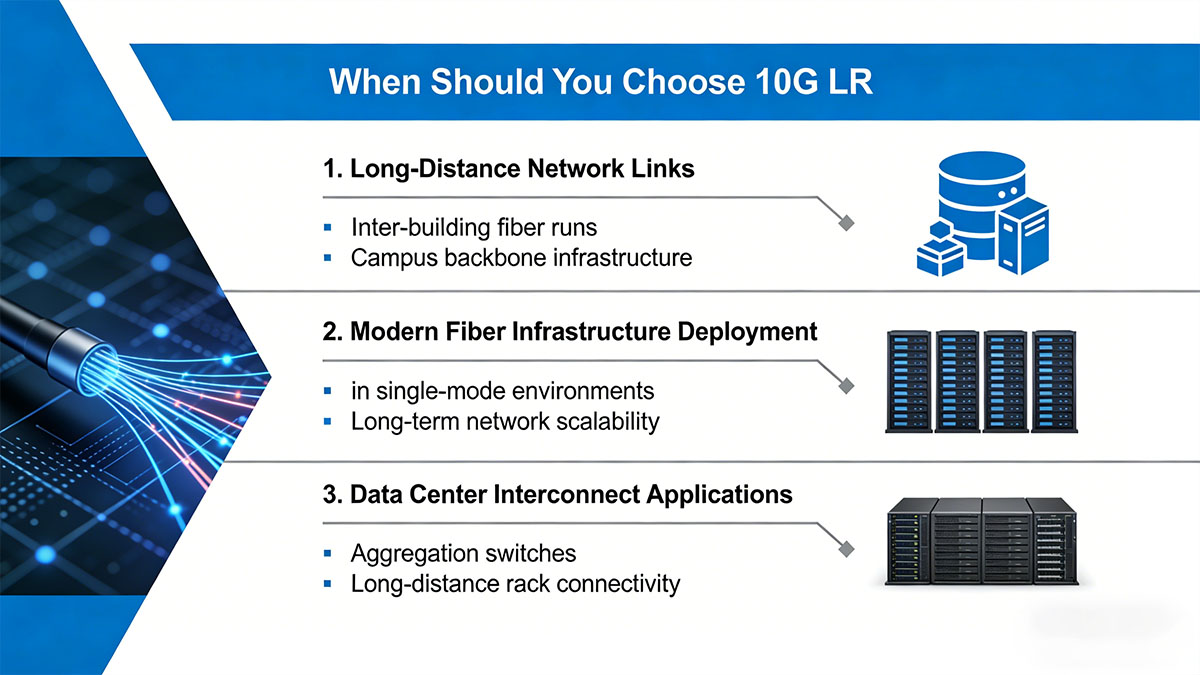
Long-Distance Network Links
10G LR modules are well suited for links that extend across large physical areas. When network devices are separated by hundreds of meters or several kilometers, single-mode fiber combined with LR optics provides reliable performance.
Typical long-distance use cases include:
- Campus network backbone connections between core switches
- Fiber links connecting multiple buildings within an organization
- Metropolitan access links between enterprise sites and service provider infrastructure
- Aggregation links connecting distributed network segments
These deployments benefit from the long transmission reach of LR modules, which can support distances of up to 10km under standard conditions.
Modern Fiber Infrastructure
10G LR sfp is often chosen when the network infrastructure is based on single-mode fiber. Many modern enterprise and campus networks deploy single-mode cabling because it supports longer distances and future network upgrades.
Advantages of deploying LR modules in single-mode environments include:
- Support for long-distance links without additional signal processing
- Lower dispersion compared with multimode transmission
- Greater flexibility for expanding network coverage
- Compatibility with higher-speed optical technologies used in modern networks
Because single-mode fiber is widely used in large-scale network deployments, LR modules are commonly integrated into core and aggregation layers.
Data Center Interconnect Applications
10GB LR SFP can also be used in data center environments, particularly when connections extend beyond the typical range of short-reach multimode optics.
Examples of these scenarios include:
- Connecting data centers located in different buildings within the same campus
- Linking aggregation switches across large data center facilities
- Establishing fiber connections between network rooms or equipment zones
- Supporting interconnect links that require stable performance over longer fiber runs
In these cases, the combination of single-mode fiber and LR optics provides a reliable solution for maintaining high-speed connectivity across extended distances.
🐚When Should You Choose 10G LRM
10GBASE-LRM is typically chosen when a network needs to support 10Gbps transmission over existing multimode fiber infrastructure. It is particularly useful in environments where replacing legacy cabling is impractical or costly. By using electronic dispersion compensation, LRM modules allow older multimode fibers to continue operating at higher data rates.
This makes 10G LRM a practical option for organizations upgrading from lower-speed Ethernet while maintaining their installed fiber systems.
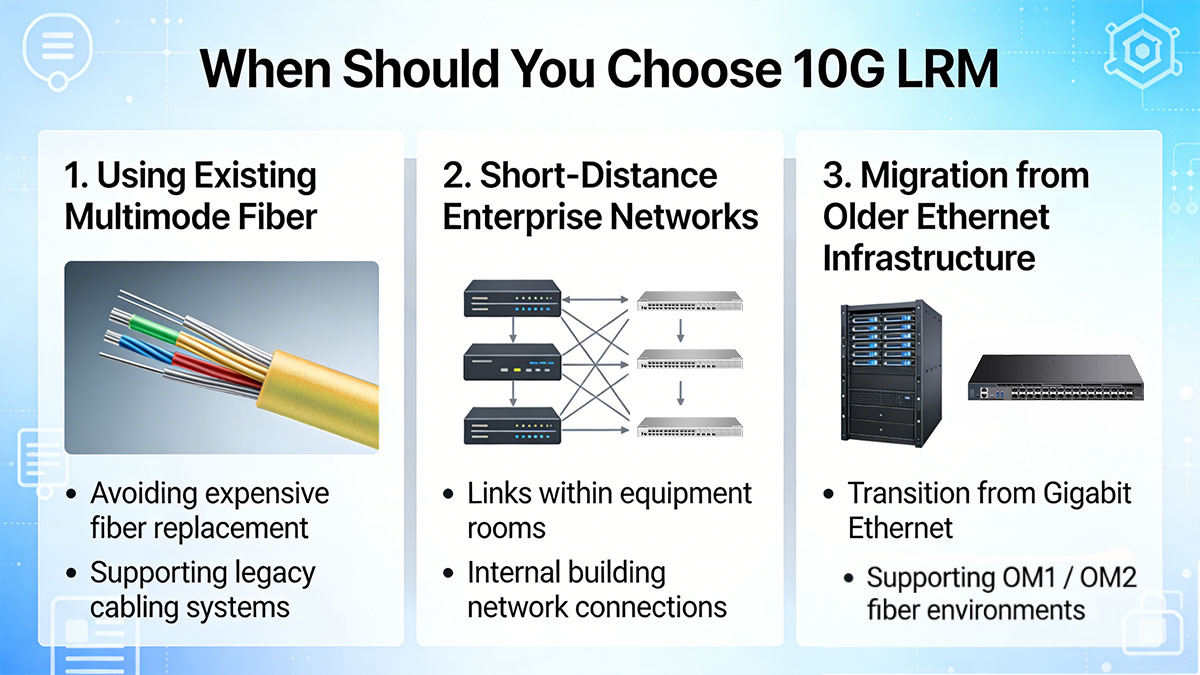
Using Existing Multimode Fiber
One of the most common reasons to select 10G LRM is to reuse installed multimode fiber, especially older OM1 or OM2 cabling that may not fully support other 10GbE multimode standards.
| Fiber Type | Typical Support with 10G LRM | Common Environment |
|---|---|---|
| OM1 multimode fiber | Up to about 220m | Older enterprise buildings |
| OM2 multimode fiber | Up to about 220m | Legacy campus cabling |
| OM3 / OM4 multimode fiber | Supported but not commonly preferred | Modern data centers |
By supporting legacy fiber types, LRM modules allow organizations to extend the life of their cabling infrastructure. This can significantly reduce the cost and disruption associated with replacing fiber across large buildings or campuses.
Short-Distance Enterprise Networks
10G LRM modules are suitable for environments where transmission distances fall within the typical limits of multimode fiber links. Many enterprise networks operate within these shorter ranges, particularly inside buildings.
Typical scenarios include:
- Connections between switches within the same equipment room
- Fiber links between network closets on different floors
- Backbone links inside office buildings
- Short interconnections across campus facilities
In these situations, LRM modules can provide reliable 10Gbps connectivity without requiring new single-mode cabling.
Migration from Older Ethernet Infrastructure
Another scenario where LRM modules are often deployed is during network upgrades from older Ethernet technologies. Many organizations originally installed multimode fiber for Gigabit Ethernet or earlier standards.
LRM modules support gradual upgrades by enabling higher-speed transmission over the same fiber plant.
Common migration scenarios include:
- Upgrading from Gigabit Ethernet backbone links to 10GbE
- Expanding network capacity in buildings with legacy fiber systems
- Introducing 10GbE switches while maintaining existing cabling
- Extending the operational life of installed multimode infrastructure
In these cases, 10G LRM helps bridge the gap between older fiber deployments and newer network performance requirements.
🐚Deployment Considerations for LR and LRM Modules
Before deploying 10G LR or 10G LRM modules, it is important to evaluate several technical factors such as fiber compatibility, transmission distance, and hardware interoperability. These considerations help ensure stable link performance and prevent issues related to signal loss or unsupported configurations.
Careful planning during deployment can also reduce troubleshooting time and improve long-term network reliability.
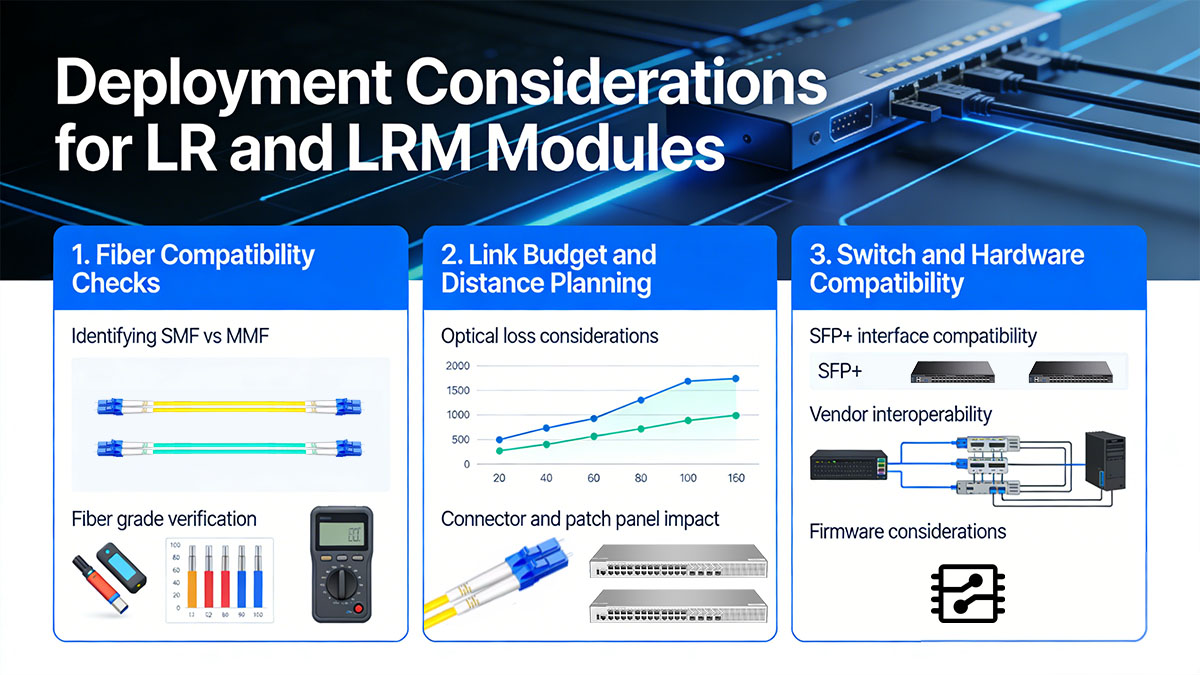
Fiber Compatibility Checks
The first step in selecting between LR and LRM modules is confirming the type of fiber installed in the network. Because the two standards are designed for different fiber infrastructures, using the wrong module type can lead to link failures or unstable connections.
| Fiber Type | Compatible Module | Typical Use |
|---|---|---|
| Single-mode fiber (SMF) | 10GBASE-LR | Long-distance links |
| Multimode fiber (MMF) | 10GBASE-LRM | Legacy multimode environments |
| OM3 / OM4 multimode fiber | Often paired with SR optics instead of LRM | Modern data centers |
Network administrators typically verify fiber type through infrastructure documentation, cable labeling, or fiber testing tools. Ensuring the correct module for the fiber medium is a fundamental step in reliable optical network deployment.
Link Budget and Distance Planning
Optical link performance depends on the total loss across the fiber path. Even when a module supports a certain maximum distance, the actual link may be limited by attenuation from connectors, patch panels, or splicing points.
Key factors that affect link budget include:
- Fiber length between devices
- Connector insertion loss
- Patch panel connections
- Splice points in the fiber path
- Fiber quality and installation condition
For longer LR links, cumulative loss across multiple connectors can reduce the effective transmission range. In multimode LRM deployments, dispersion and signal quality may also affect link stability, especially on older fiber types.
Evaluating these factors during the planning stage helps ensure that the optical link remains within the supported operating range of the transceiver.
Switch and Hardware Compatibility
In addition to fiber considerations, network hardware compatibility should also be verified before deploying optical modules. Most modern switches support standard SFP+ interfaces, but compatibility can vary depending on vendor firmware and hardware design.
Several checks are commonly performed during deployment:
- Confirm that the switch port supports SFP+ 10Gbps modules
- Verify that both ends of the link use compatible optical standards
- Ensure the switch firmware supports the installed transceiver type
- Confirm interoperability when mixing modules from different vendors
For stable operation, both ends of an optical link should use the same standard—for example, LR to LR or LRM to LRM. Matching the optical type ensures consistent signal characteristics and proper communication between devices.
By verifying fiber infrastructure, link budget conditions, and hardware compatibility, network engineers can deploy LR and LRM modules more reliably across a variety of network environments.
🐚Future Trends: Is 10G LRM Still Relevant
10GBASE-LRM was originally introduced to extend the usability of legacy multimode fiber in early 10GbE deployments. While the standard remains technically valid, its role in modern networks has gradually declined as newer fiber standards and optical technologies have become more widely adopted.
Today, many network designs prioritize simplified architectures and higher-speed upgrades, which has influenced how often LRM modules are deployed.
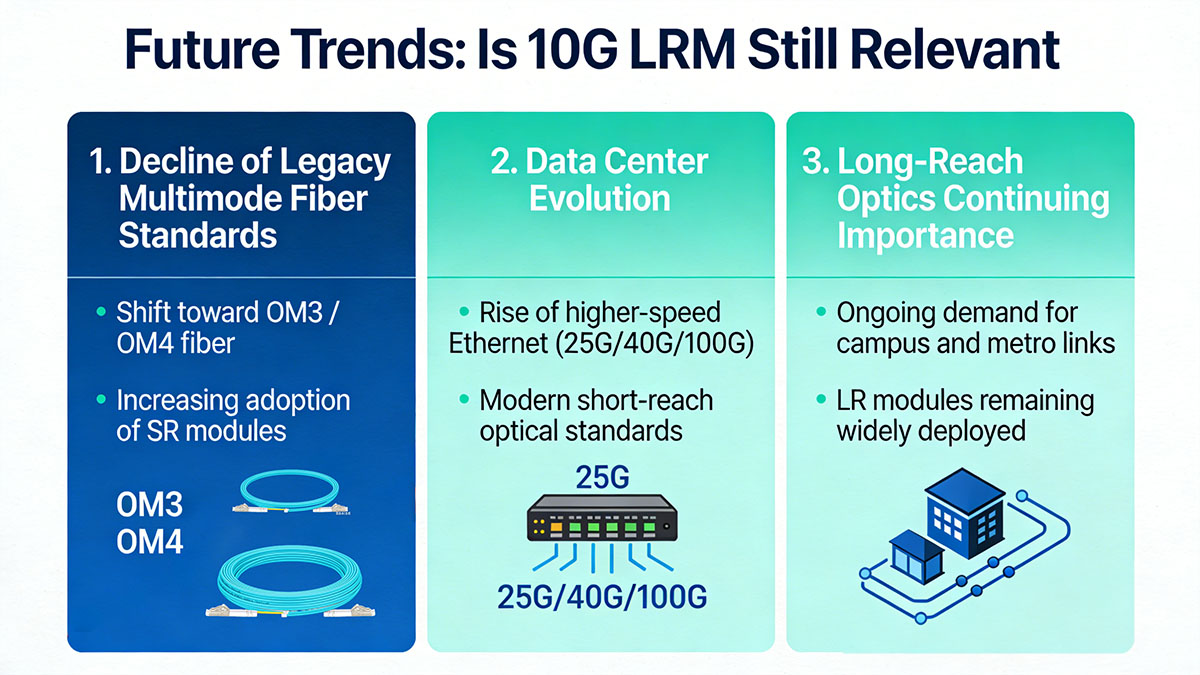
Decline of Legacy Multimode Fiber Standards
One of the main reasons for the reduced use of 10G LRM is the gradual phase-out of older multimode fiber types such as OM1 and OM2. These fibers were common in enterprise buildings installed before high-speed Ethernet became widespread.
| Fiber Type | Typical Era of Deployment | Current Usage Trend |
|---|---|---|
| OM1 | Early enterprise networks | Gradually declining |
| OM2 | Legacy campus infrastructure | Decreasing adoption |
| OM3 / OM4 | Modern data centers | Widely used |
Modern data centers and new enterprise installations typically use OM3 or OM4 multimode fiber, which supports higher-speed standards more efficiently. In these environments, short-reach optical modules designed specifically for high-performance multimode fiber are often preferred.
As a result, the original purpose of LRM—supporting legacy multimode fiber—has become less common in newly built infrastructures.
Data Center Evolution
Data center networking has evolved significantly since the introduction of 10GbE. Many organizations now deploy higher-speed Ethernet technologies to support increasing bandwidth demands.
Common upgrades include:
- Transition from 10GbE to 25GbE server connections
- Deployment of 40GbE and 100GbE aggregation links
- Increased use of parallel optics and advanced multimode standards
- Greater reliance on structured fiber architectures in large data centers
These developments have reduced the reliance on optical standards designed primarily for legacy cabling systems.
Long-Reach Optics Continuing Importance
While LRM usage is gradually declining, long-reach optics such as LR continue to play an important role in many networks. Single-mode fiber remains the preferred medium for long-distance communication in campus networks, metropolitan access, and large enterprise infrastructures.
Several factors contribute to the continued relevance of LR modules:
- Support for longer transmission distances
- Compatibility with widely deployed single-mode fiber infrastructure
- Flexibility for future network expansion
- Stable optical performance across extended links
Because of these characteristics, LR modules remain a common choice in many 10GbE deployments even as network speeds continue to increase.
Overall, 10G LRM still has a place in environments where legacy multimode fiber must be maintained, but newer deployments increasingly favor standards that align with modern fiber infrastructure and higher-speed network architectures.
🐚FAQs About SFP 10G LR vs SFP 10G LRM
What is the main difference between 10G LR and 10G LRM?
The main difference is the fiber type and transmission distance.
10G LR operates over single-mode fiber and supports distances up to 10km, while 10G LRM is designed for multimode fiber and typically supports links up to about 220m.
Can 10G LR modules be used with multimode fiber?
10G LR modules are designed for single-mode fiber and generally should not be used on multimode fiber links. Using them with multimode fiber can cause signal distortion and unstable link performance unless special mode conditioning patch cables are used.
Why does 10G LRM use electronic dispersion compensation?
10G LRM uses electronic dispersion compensation to correct signal distortion caused by multimode fiber. This technology helps maintain signal quality when transmitting 10Gbps data over older multimode fibers such as OM1 or OM2.
Are 10G LR and 10G LRM compatible with each other?
No. Both ends of an optical link must use the same standard. A 10G LR module must connect to another LR module, and a 10G LRM module must connect to another LRM module for the link to function correctly.
Is 10G LRM still used in modern networks?
10G LRM is mainly used in networks that still rely on legacy multimode fiber infrastructure. Newer network deployments more commonly use other optical standards that align with modern fiber types and higher-speed Ethernet upgrades.
How do you choose between LR and LRM for a 10GbE link?
The decision usually depends on three factors:
- The type of fiber installed in the network
- The required transmission distance
- Whether the infrastructure is legacy or newly deployed
Single-mode fiber environments typically use LR modules, while multimode environments with older cabling may use LRM modules.
🐚Conclusion
SFP 10G LR and SFP 10G LRM are both designed for 10GbE networks, but they serve different infrastructure requirements. LR modules operate over single-mode fiber and support transmission distances up to 10km, making them suitable for campus networks, inter-building links, and other long-distance connections. In contrast, LRM modules are intended for shorter links over multimode fiber, particularly in environments where legacy cabling systems are still in place.
When choosing between these two optical standards, the most important factors are the type of fiber already deployed, the required link distance, and the long-term network architecture. Single-mode environments typically benefit from the stability and scalability of LR modules, while networks that rely on existing multimode fiber may use LRM modules to support 10Gbps upgrades without replacing their cabling infrastructure.
For organizations planning 10GbE deployments or evaluating compatible optical modules, reviewing technical specifications and interoperability requirements is essential. More information about compatible SFP+ optical modules and deployment options can be found through the LINK-PP Official Store, which provides a range of solutions designed for enterprise networks, data centers, and campus connectivity scenarios.