As modern data centers and enterprise networks continue to scale, the demand for high-speed, cost-efficient cabling infrastructure has never been greater. Organizations are constantly balancing performance requirements with budget constraints, especially when deploying short-reach, high-bandwidth connections within buildings or campus environments.
Among the various optical solutions available today, 850 nm multimode fiber has emerged as one of the most widely adopted technologies for short-distance data transmission. Its combination of affordability, compatibility with common transceiver, and reliable performance makes it a preferred choice for many network architects.
Understanding how 850 nm multimode fiber works — and what factors influence its cost — is essential for building a scalable and budget-conscious cabling infrastructure. This article begins by exploring the fundamental principles behind this technology.
? Understanding 850 nm Multimode Fiber Fundamentals
850 nm multimode fiber is designed for short-reach optical links where high bandwidth and cost efficiency matter most — especially inside buildings and data centers. It uses a larger core that allows multiple light paths (modes), making alignment easier and connectors more forgiving. The 850nm wavelength is widely used because it matches mature, cost-effective optical components commonly found in the SR transceivers.
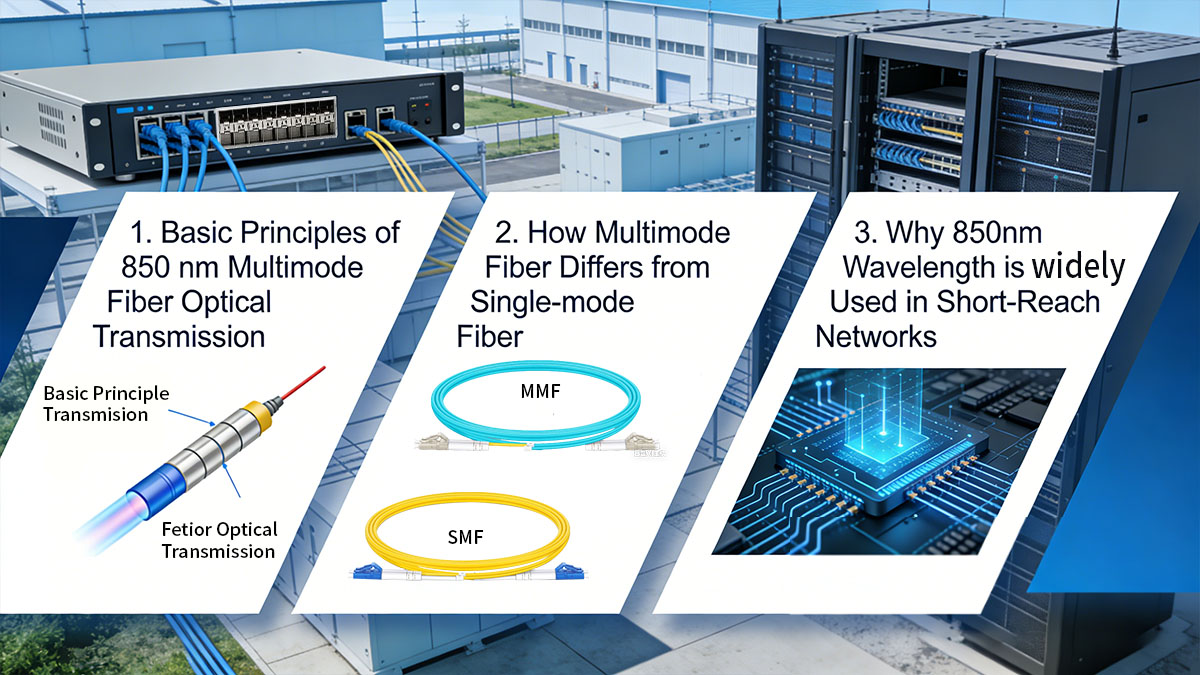
Basic Principles of 850 nm Multimode Fiber Optical Transmission
Multimode fiber guides light through a relatively large core (commonly 50/125µm in modern deployments), allowing the light to travel in multiple modes. In practice, this design makes coupling light into the fiber easier — especially when paired with Short-range optics — helping keep total link costs lower for high-density environments like equipment rooms and data halls.
However, multiple modes also introduce modal dispersion: different light paths arrive at slightly different times. This dispersion limits the maximum distance at higher data rates. To manage it, modern multimode grades (OM3/OM4/OM5) use optimized core and refractive index profiles, enabling much higher effective bandwidth than older multimode types.
From an infrastructure standpoint, the key takeaway is simple: 850 nm multimode fiber is optimized for high-speed, short-distance links where you want predictable performance without paying the premium of long-reach optics and tighter alignment requirements.
How Multimode Fiber Differs from Single-mode Fiber
When budgeting, “multimode vs single-mode” is rarely just about fiber cable price. It’s a system choice that affects optics cost, installation tolerance, and the realistic reach you can achieve at a given speed.
Multimode fiber (MMF) uses a larger core and is typically paired with 850nm short-range optical transceiver modules. This makes connectors and alignment more forgiving, and SR transceivers are often more cost-effective for short distances. Single-mode fiber (SMF) uses a much smaller core (around 9µm), carries essentially one mode of light, and supports far longer distances — but usually requires different optics (commonly 1310nm or 1550nm) that can increase hardware costs.
Below is a practical comparison you can use as a quick planning reference:
| Feature |
Multimode Fiber |
Single-mode Fiber |
| Core Diameter |
50µm or 62.5µm |
9µm |
| Light Source |
VCSEL laser or LED |
DFB or FP Laser |
| Wavelength |
Commonly 850nm |
Commonly 1310nm / 1550nm |
| Typical Range |
33m to 550m |
10km to 100+ km |
| Use Case |
Data centers, LANs, short-reach links |
Long-haul and metropolitan networks |
| Budget Impact Drivers |
Often lower optics cost for short reach; simpler deployment |
Often higher optics cost; better long-term reach flexibility |
In summary, multimode fiber is ideal for shorter connections where cost and ease of installation take priority, while single-mode fiber is better suited for longer transmission distances that require maximum signal integrity.
Why 850nm Wavelength is Widely Used in Short-Reach Networks
The 850nm wavelength has become the standard for multimode fiber systems primarily due to its cost-performance advantages. Optical components designed for this wavelength, particularly VCSEL-based transceivers, are significantly more affordable than their longer-wavelength counterparts.
Additionally, 850nm systems are highly compatible with widely used multimode fiber types such as OM3, OM4, and OM5, which are optimized for laser-based transmission. This compatibility ensures reliable high-speed performance for applications like 10G, 25G, 40G, and even 100G Ethernet over short distances.
Another key reason for its popularity is the balance it offers between performance and infrastructure cost. For most intra-building and data center interconnects, the distance limitations of 850 nm multimode fiber are not a constraint, making it a practical and economical choice.
Overall, the widespread adoption of 850 nm multimode fiber is driven by its ability to deliver high bandwidth at a lower total cost of ownership, especially in short-reach network environments.
? What Drives 850 nm Multimode Fiber Infrastructure Costs
At a high level, the cost of an 850 nm multimode fiber deployment isn’t just “the cable.” Your final budget is shaped by four connected layers: the fiber grade you buy, the connectivity you standardize on, the labor and site conditions required to install it, and the active hardware (fiber transceivers and switches) that must match the cabling design. Understanding these cost drivers upfront helps you avoid surprises like re-termination work, incompatible optics, or expensive change orders mid-project.
Fiber Cable Types and Their Price Differences
The type of 850nm multimode fiber cable selected has a direct impact on infrastructure costs. Different fiber grades — such as OM2, OM3, OM4, and OM5 — vary in price due to differences in bandwidth performance, manufacturing complexity, and intended use cases.
Lower-grade fibers like OM2 are generally less expensive but offer limited bandwidth and shorter transmission distances. In contrast, higher-grade fibers such as OM4 and OM5 support higher data rates and longer distances, making them more suitable for modern high-speed networks, albeit at a higher upfront cost.
Additionally, cable construction plays a role in pricing. For example:
- Loose-tube cables (used in outdoor environments) tend to be more robust and slightly more expensive.
- Tight-buffered cables (common in indoor installations) are easier to handle and install, often reducing labor costs.
Choosing the right cable type involves balancing performance requirements with environmental conditions and budget constraints.
Connector Types and Termination Costs
Connectors and termination methods are another significant contributor to overall costs. The choice of connector type affects both material expenses and installation complexity.
Common connector types include:
- LC connectors: Compact, widely used in high-density environments.
- SC connectors: Larger but still common in legacy systems.
- MPO/MTP connectors: Used for high-speed parallel optics (e.g., QSFP+ 40G/QSFP28 100G).
MPO/MTP connectors, while more expensive, enable higher fiber density and faster deployment in data centers. However, they also require more precise alignment and specialized installation expertise.
Termination methods also influence costs:
- Pre-terminated cables: Higher upfront cost but reduce installation time and labor.
- Field termination: Lower material cost but more labor-intensive and prone to variability.
Ultimately, the decision between connector types and termination approaches depends on deployment scale, required density, and available technical expertise.
Installation Labor and Infrastructure Preparation
Labor costs often represent a substantial portion of the total fiber deployment budget. These costs vary depending on installation complexity, site conditions, and required infrastructure preparation.
Key factors influencing labor costs include:
- Cable routing complexity: Running fiber through ceilings, conduits, or underground pathways increases time and effort.
- Site readiness: Existing infrastructure (e.g., trays, ducts, pathways) can significantly reduce installation costs.
- Project scale: Larger deployments may benefit from economies of scale but require more coordination.
Infrastructure preparation — such as installing cable trays, racks, or conduits — can add considerable expense if not already in place. Additionally, compliance with building codes and safety standards may introduce extra requirements and costs.
Network Hardware Compatibility Costs
The compatibility between fiber infrastructure and active network hardware is another critical cost factor. While 850 nm multimode fiber supports a wide range of devices, not all hardware is equally cost-effective.
For example, the SR fiber SFP designed for 850 nm multimode fiber is typically much more affordable than the LR optics used with single-mode fiber. This is one of the main reasons multimode fiber is favored in short-distance deployments.
However, costs can increase if:
- Existing equipment is not compatible with multimode fiber.
- Upgrades are required to support higher data rates (e.g., QSFP+ 40G or QSFP28 100G or QSFP-DD 400G).
- Specialized modules (e.g., BiDi SFP like Cisco SFP-10G-BX80D-I or SWDM SFP like Cisco QSFP-40G-SR-BD) are needed for specific applications.
In addition, port density and switch compatibility can influence hardware costs, especially in high-performance data center environments. Careful alignment between fiber infrastructure and network equipment ensures cost efficiency while avoiding unnecessary upgrades or compatibility issues.
? Transceiver and Hardware Costs Associated with 850 nm Multimode Fiber
In any optical cabling project, the cost of transceiver modules and related active hardware typically represents one of the largest portions of the overall network expenditure. For networks operating with 850 nm multimode fiber, the associated hardware is generally less expensive than that required for single-mode systems, largely due to the use of cost-efficient VCSEL laser sources and the shorter link distances supported by multimode optics.
Compared with the fiber cabling itself, optical transceivers, patch panels, and switches containing optical ports often account for 30–50% of total infrastructure costs in enterprise or data center environments. Therefore, choosing the right 850 nm multimode SFP modules can yield significant savings without compromising network reliability or bandwidth.
Common Optical Transceivers Using 850 nm Multimode Fiber
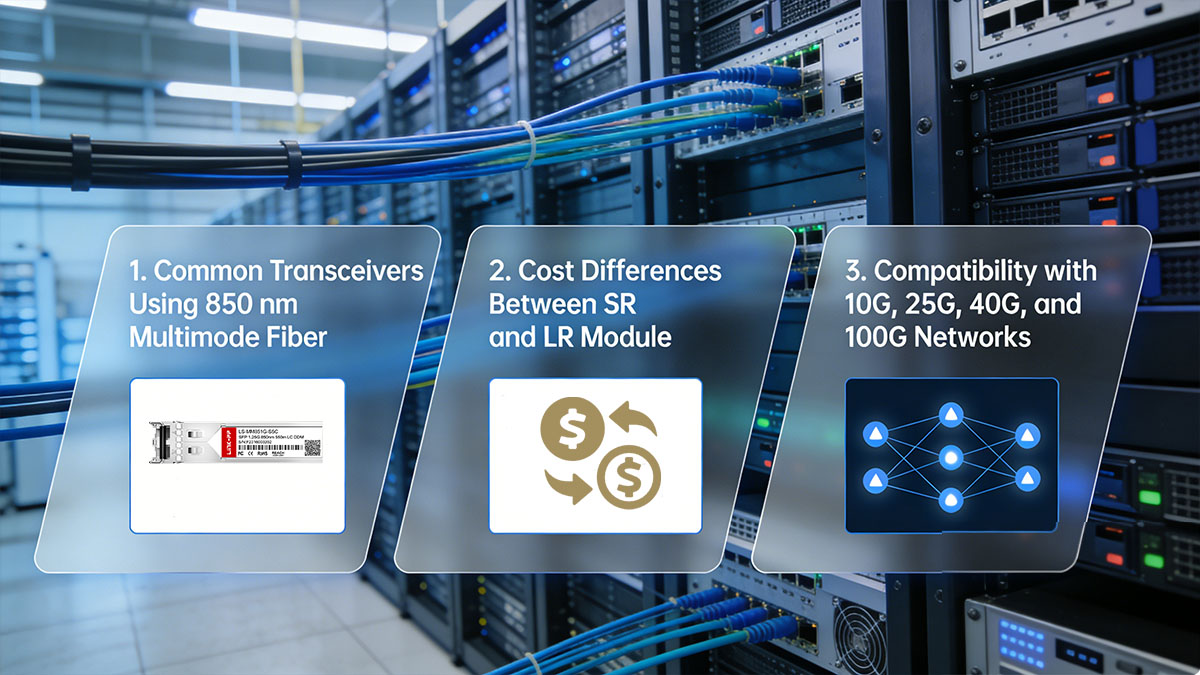
850 nm multimode fiber relies primarily on short-range transceiver modules, which are optimized for high throughput transmission over short distances. The most widely used standards include 10GBASE-SR(SFP+ 10G), 25GBASE-SR(SFP28 25G), 40GBASE-SR4(QSFP+ 40G), and 100GBASE-SR4(QSFP28 100G).
SR modules use VCSEL light sources that are inexpensive to manufacture, energy-efficient, and highly reliable for intra-building or intra-data-center links. Typical transmission distances for 10G links are as follows:
- Up to 300 meters on OM3 fiber.
- Up to 550 meters on OM4 fiber.
- Around 33-82 meters on older OM1 and OM2 fiber.
These reach capacities make SR transceivers well-suited for top-of-rack (ToR), end-of-row (EoR), and campus backbone applications. Their modular design allows straightforward scalability as switching and server architectures evolve.
Cost Differences Between SR and LR Module
The primary cost contrast between Short-Range (SR) and Long-Range (LR) modules stems from their optical design and performance targets. SR modules, based on 850 nm VCSEL laser technology, are engineered for short-reach links using multimode fiber. Their simpler construction, lower power consumption, and relaxed optical alignment requirements make them significantly more affordable and easier to deploy in high-density network environments.
LR modules, by comparison, are designed for single-mode fiber and longer transmission distances, requiring advanced laser types such as DFB or EML to maintain signal quality. These modules must deliver higher optical power and tighter wavelength stability, which increases both manufacturing complexity and operating costs. They also demand cleaner installation conditions and stricter maintenance standards.
From a budgeting perspective, SR optics provide a more cost-effective and energy-efficient solution for short-range cabling scenarios, while LR modules are justified only in cases where extended reach or inter-building connections are required. Choosing between them typically involves balancing immediate cost savings against network reach, uptime requirements, and long-term scalability.
Compatibility with 10G, 25G, 40G, and 100G Networks
The evolution of Ethernet technology has consistently increased bandwidth demand, and 850 nm multimode fiber solutions have adapted effectively to meet these increments. SR modules are available across all common Ethernet speeds — from 10G up to emerging 100G short-reach standards.
10G and 25G Ethernet: These form the backbone of most enterprise access and aggregation layers. Their SR transceivers are highly cost-efficient, backward-compatible across equipment vendors, and widely available.
40G and 100G Ethernet: These speeds rely on parallel optics, usually using MPO/MTP connectors with four or eight fiber pairs. Although cabling costs increase, transceiver costs remain lower than their LR counterparts, making them ideal for short inter-switch or intra-room connections.
From a scalability perspective, multimode SR optics provide a smooth transition path between generations. Organizations can upgrade from 10G to 25G or 40G networks via modular switches without entirely overhauling their physical cabling infrastructure — only the transceiver modules need replacement. This incremental upgradeability reduces project downtime and minimizes capital expenditure when migrating to higher speeds.
? Estimating Installation Costs for 850 nm Multimode Fiber Cabling
Estimating installation costs for 850 nm multimode fiber cabling requires a detailed understanding of both design complexity and on-site execution factors. Beyond material costs, expenses are heavily influenced by infrastructure conditions, labor intensity, and compliance requirements. A well-planned installation strategy helps avoid budget overruns while ensuring long-term network performance.

Structured Cabling Design Requirements
Structured cabling design plays a critical role in determining overall installation costs. This includes planning cable pathways, determining optimal fiber counts, and ensuring compliance with standards such as TIA/EIA and ISO/IEC. More complex environments — such as data centers or multi-floor enterprise buildings — require detailed layouts, redundancy planning, and proper labeling systems, all of which increase design and engineering costs. Additionally, incorporating scalability for future upgrades (e.g., higher bandwidth needs) may require higher-grade fiber (like OM4 or OM5), which also impacts initial investment.
Cable Routing and Physical Infrastructure Costs
Cable routing is one of the most variable cost components in fiber installation. Costs depend on the physical environment, such as whether cables are installed in existing conduits, raised floors, ceilings, or underground ducts. Challenging environments — like retrofitting older buildings or navigating congested pathways — can significantly increase labor and material costs. Infrastructure elements such as cable trays, conduits, racks, and patch panels must also be considered. Outdoor installations or long-distance campus deployments may require additional protection measures, such as armored cables or trenching, further raising expenses.
Splicing, Testing, and Certification Expenses
Splicing, testing, and certification are essential to ensure the reliable performance of 850 nm multimode fiber networks. Fusion splicing or mechanical splicing introduces additional labor and equipment costs, especially for large-scale deployments. After installation, comprehensive testing — such as insertion loss testing, OTDR (Optical Time Domain Reflectometer) analysis, and end-to-end link validation — is required to verify compliance with performance standards. Certification documentation is often necessary for warranty and compliance purposes, adding both time and cost.
? Distance and Performance Limits of 850 nm Multimode Fiber
850 nm multimode fiber is widely used for short-reach, high-speed data transmission, but its performance is inherently limited by distance and modal dispersion. Understanding these limits is essential for designing cost-efficient networks that meet both current and future bandwidth requirements. Proper planning ensures that performance constraints do not lead to unexpected upgrades or redesign costs.
Typical Transmission Distances for Different Fiber Types
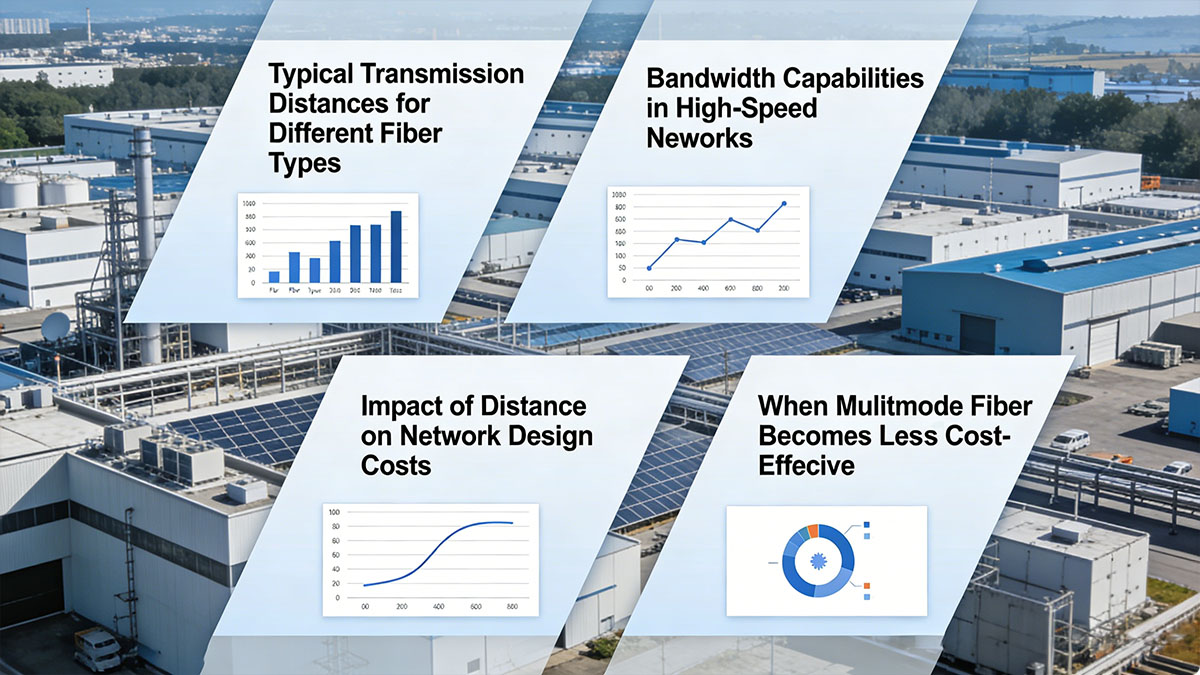
Different 850 nm multimode fiber types (OM1, OM2, OM3, OM4, and OM5) support varying transmission distances. For example, OM1 and OM2 fibers are typically limited to shorter distances (around 33–82 meters for 10G), while OM3 and OM4 fibers can support up to 300m and 550m respectively for 10G Ethernet. At higher speeds, such as 40G or 100G, the supported distances decrease significantly, often to 100–150 meters depending on the fiber grade. Choosing the appropriate fiber type is critical to balancing performance needs with budget constraints.
Bandwidth Capabilities in High-Speed Networks
850 nm multimode fiber is optimized for high bandwidth over short distances, making it ideal for data centers and enterprise networks. Laser-optimized fibers like OM3 and OM4 support high data rates such as 10G, 25G, 40G, and even 100G through parallel optics technologies. However, bandwidth performance is affected by modal dispersion, which limits how far high-speed signals can travel without degradation. As data rates increase, stricter requirements on fiber quality and installation precision become necessary to maintain signal integrity.
Impact of Distance on Network Design Costs
Distance directly impacts both performance and cost in multimode fiber deployments. Longer distances may require higher-grade fiber (e.g., OM4 instead of OM3) or additional hardware such as repeaters or switches to maintain signal quality. This increases both capital expenditure (CapEx) and operational complexity. In some cases, exceeding the practical distance limits of multimode fiber may force a transition to single-mode fiber, which has higher initial costs but better long-distance scalability. Therefore, accurately estimating link distances during the design phase is essential for cost optimization.
When Multimode Fiber Becomes Less Cost-Effective
While 850 nm multimode fiber is generally more cost-effective for short distances due to lower transceiver costs, it becomes less economical as distance and bandwidth requirements grow. For links extending beyond 500m or requiring future upgrades to higher speeds, the limitations of multimode fiber may lead to higher long-term costs. Single-mode fiber, despite higher initial transceiver expenses, often provides better scalability and lower total cost of ownership for longer distances. As a result, network planners must evaluate both current needs and future expansion when deciding between multimode and single-mode solutions.
? Budget Planning for Large-Scale 850 nm Multimode Fiber Deployments
Scaling 850 nm multimode fiber networks across large facilities or campuses requires precise financial planning and forward-looking design. A structured budgeting approach helps prevent project delays, control unexpected expenses, and ensure your investment continues to support higher data rates in the years ahead.
Creating a Comprehensive Cabling Budget Plan
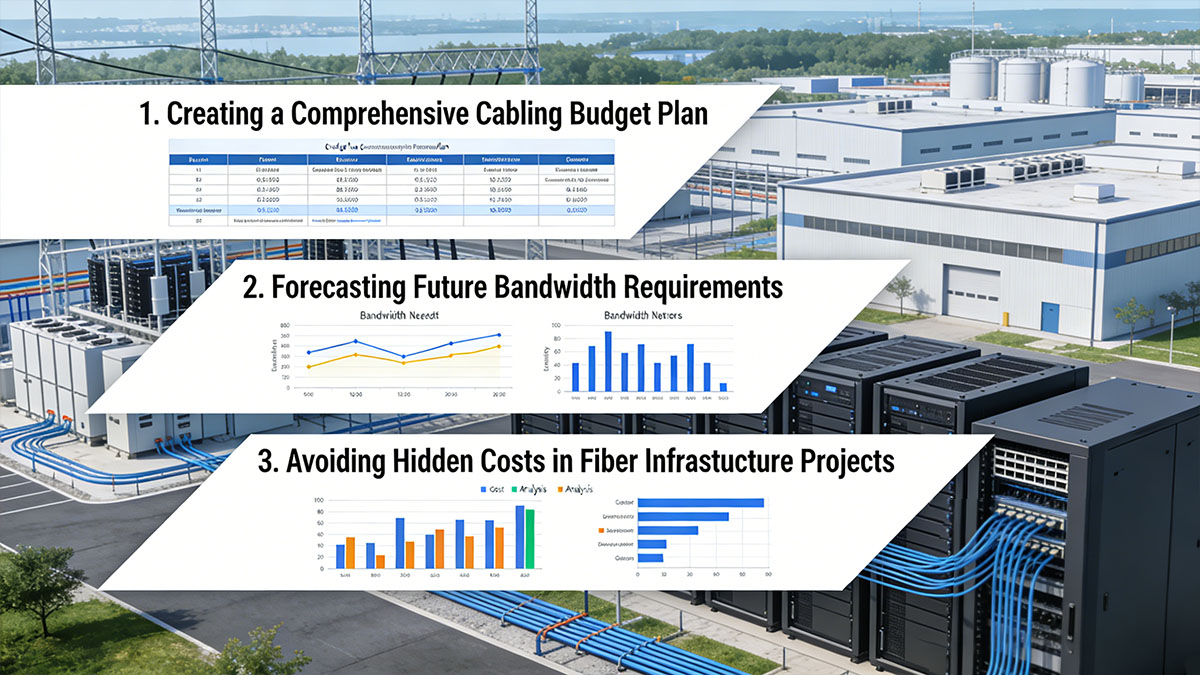
An effective cabling budget combines material, labor, and hardware estimates into one cohesive roadmap. Start by mapping out network topologies, expected connection points, and redundancy zones. Factor in multimode fiber types (OM3, OM4, or OM5), SFP transceiver compatibility, and installation labor rates for each facility type. Including a 10–15% contingency reserve ensures flexibility against unforeseen design or construction changes. Using cost-tracking software or centralized project management tools also helps align procurement and installation teams on both timelines and budgets.
Forecasting Future Bandwidth Requirements
Fiber infrastructure decisions made today should accommodate tomorrow’s performance demands. When budgeting for large-scale deployments, consider the projected adoption of higher-speed interfaces such as 100G, 200G, or 400G Ethernet. Planning for OM4 or OM5 cabling and the high-quality SR transceiver may require a larger initial investment, but reduces long-term upgrade costs. Align capacity forecasts with the organization’s digital transformation goals — data growth, virtualization, and AI workloads are major factors influencing bandwidth needs.
Avoiding Hidden Costs in Fiber Infrastructure Projects
Hidden costs can derail an otherwise accurate budget plan. Common oversights include additional patch panels, extended patch cords, power and cooling modifications, or post-deployment testing services. Delays due to incomplete documentation or unplanned reroutes can also add significant labor hours. To mitigate risk, require vendor transparency on testing, certification, and warranty terms, and schedule regular audits throughout project execution to ensure accountability.
? Conclusion: Planning a Cost-Effective 850 nm Multimode Fiber Infrastructure
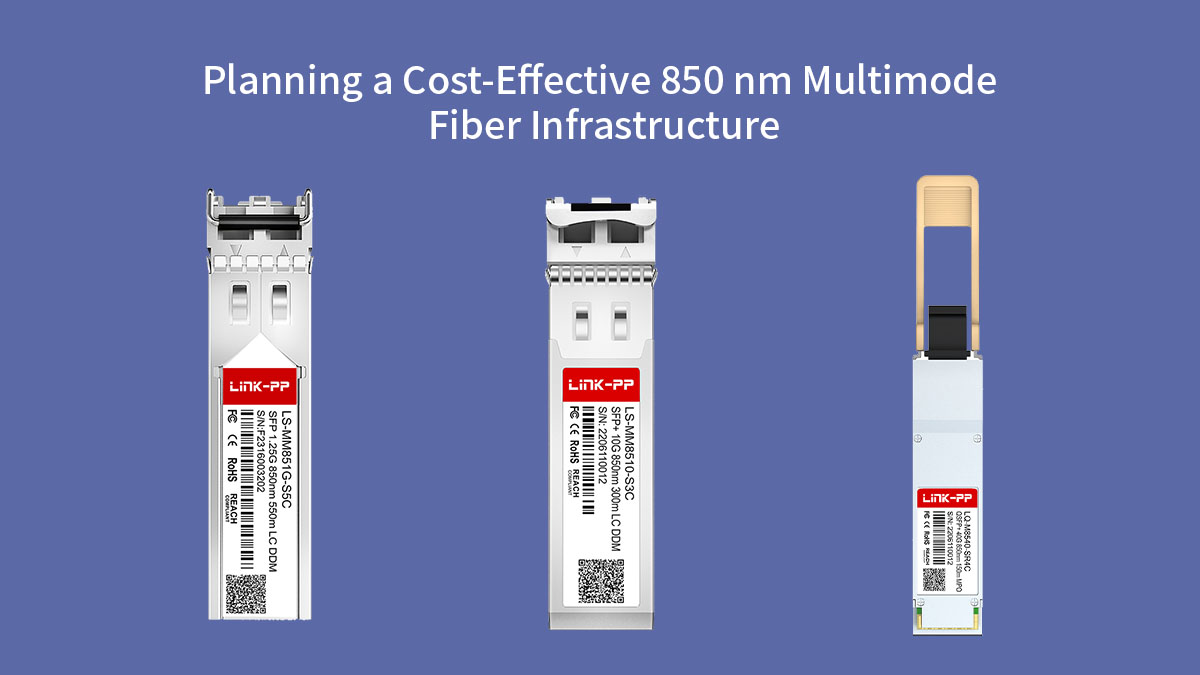
Designing a cost-effective 850 nm multimode fiber infrastructure requires a holistic approach that considers performance requirements, distance limitations, hardware compatibility, and long-term scalability. From understanding the fundamentals to evaluating installation and operational costs, each decision plays a critical role in shaping the overall budget and network efficiency.
While multimode fiber remains an excellent choice for short-reach, high-speed applications, careful planning is essential to maximize its value and avoid unnecessary expenses. By aligning infrastructure design with both current needs and future growth, organizations can build reliable, high-performance networks without overspending.
If you're looking for high-quality fiber optic SFP module solutions tailored to your deployment needs, explore the LINK-PP Official Store to find reliable optical transceivers and technical support for your network infrastructure.