As modern enterprise networks evolve to handle massive data volumes and cloud-based workloads, the demand for faster yet cost-efficient network links continues to rise. While fiber optic SFP Module often dominates discussions about 10-Gigabit connectivity, many organizations still rely heavily on copper infrastructure for flexibility and affordability.
This is where copper SFP transceiver becomes invaluable. Among them, the Cisco SFP 10G Base T stands out as a solution that bridges next-generation 10G performance with the practicality of existing Ethernet cabling — delivering speed, stability, and seamless integration within Cisco-based environments.
? What Is Cisco SFP 10G Base T

The Cisco SFP 10G Base T module, typically identified by the model number SFP-10G-T-X, is a hot-swappable copper SFP+ transceiver module engineered by Cisco to deliver 10-Gigabit Ethernet over twisted-pair copper cabling. It transforms any compatible SFP+ port into an RJ45 interface, eliminating the need for costly fiber runs or media converters while maintaining full 10 Gbps performance. Designed specifically for Cisco switches and routers, this SFP+ 10G copper module ensures plug-and-play integration within Cisco ecosystems.
Overview of 10GBASE-T Technology
10GBASE-T is the standard for transmitting 10-Gigabit Ethernet over unshielded or shielded twisted-pair copper cabling. It is defined by the IEEE 802.3an standard. A key characteristic of this technology is its sophisticated digital signal processing (DSP) which is necessary to achieve 10Gbps speeds over copper while managing crosstalk and signal degradation.
This complexity results in higher power consumption and latency compared to optical modules or DAC solutions. To reach the maximum distance of 30m at 10Gbps, 10GBASE-T requires at least Category 6a (Cat6a) or Category 7 (Cat7) cabling, which is specifically designed to handle higher frequencies and reduce interference.
Key Features of Cisco SFP 10G Base T Modules
Cisco SFP 10G Base T modules come with a specific set of features and capabilities designed for seamless integration into Cisco ecosystems:
- Multi-Rate Support: A standout feature is its versatility in supporting multiple data rates. It is not limited to just 10Gbps; it can also automatically negotiate and operate at 1Gbps and 100Mbps. This backward compatibility allows for gradual network upgrades and connectivity with older legacy devices.
- Cabling and Reach: The module's reach is dependent on the data rate and cable quality. For 10Gbps operation, it supports distances up to 30 meters over Cat6a or Cat7 cabling. When operating at 1Gbps or 100Mbps, it can achieve the standard 100-meter distance over Cat5e or better cabling, providing significant deployment flexibility.
- Cisco Specific Features: As a genuine Cisco module, it contains Cisco-coded firmware. This ensures it is immediately recognized by Cisco switches and routers, enabling full functionality, management, and monitoring through Cisco's IOS. It adheres to strict Cisco quality and compatibility standards, guaranteeing optimal performance and reliability within a Cisco network.
- Form Factor and Connector: It uses the standard SFP+ form factor and a durable RJ-45 connector, making it hot-swappable and easy to install in compatible SFP+ ports.
- Power Consumption: The Cisco SFP-10G-T-X has a maximum power consumption of 2.5W when operating at 10Gbps over a 30-meter link. This higher power envelope is a key consideration for deployment, as it may limit the number of modules that can be used in a single switch chassis.
? Cisco SFP 10G Base T vs. Third-Party 10G RJ45: Key Differences

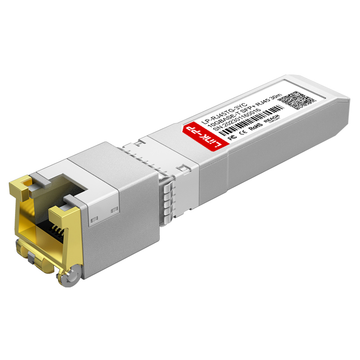
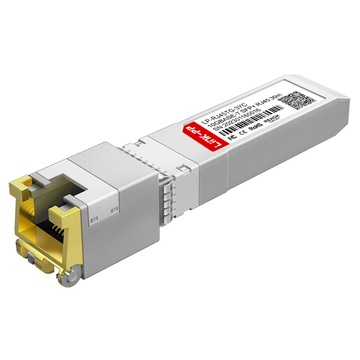
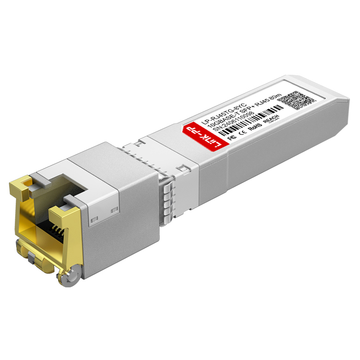
When comparing Cisco SFP 10G Base T module with third-party 10G RJ45 options such as the LINK-PP LP-RJ45TG-3YC compatible 10GBase-T SFP+ transceiver, the choice often comes down to brand reliability, firmware integration, and long-term support. Cisco modules are known for guaranteed compatibility and firmware assurance, whereas high-quality third-party alternatives can deliver comparable performance at a lower cost if properly validated.
The comparison table below provides an overview of their core differences.
| Comparison Aspect | Cisco SFP 10G Base T |
Third-Party 10G RJ45 (e.g., LINK-PP LP-RJ45TG-3YC) |
| Brand Certification | Official Cisco-branded with full IOS validation | SFP+ MSA-compliant with Cisco-compatible coding |
| Hardware Chipset | Cisco-validated DSP and components | Industry-standard chipsets (e.g., from Broadcom, Marvell) |
| Firmware | Cisco-coded firmware with native IOS integration | Require programming for Cisco compatibility |
| Reliability & QA | Enterprise-grade testing and full warranty | Verified through rigorously quality testing, and backed by a 1-3 year warranty. |
Brand Certification and Compatibility
Cisco SFP 10G Base T modules carry official Cisco branding and undergo rigorous certification processes, ensuring they pass IOS detection mechanisms without triggering warnings or port shutdowns. This level of compatibility is guaranteed across Cisco’s extensive switch and router lineup.
In contrast, third-party modules like the LINK-PP LP-RJ45TG-3YC SFP+ RJ45 transceiver are engineered to MSA standards and coded to emulate Cisco behavior, delivering plug-and-play compatibility in the majority of cases. While some lesser-known third-party options may occasionally produce minor alerts, reputable models maintain excellent interoperability without compromising core functionality.
Hardware and Chipset Differences
The internal hardware of a Cisco SFP 10G Base T module is engineered specifically for Cisco's switching platforms. Cisco often works closely with chipset manufacturers to develop customized or optimized components that ensure seamless integration with Cisco's hardware and software.
In contrast, third-party modules like the LINK-PP LP-RJ45TG-3YC typically utilize off-the-shelf chipsets from major manufacturers such as Broadcom or Marvell. These are proven, industry-standard components capable of delivering excellent performance. Reputable third-party vendors select high-quality chipsets and design their circuit boards to meet or exceed MSA specifications.
Firmware and Vendor Lock-in
Cisco embeds proprietary firmware that enables seamless authentication with IOS/XE software, preventing any “unsupported transceiver” messages and allowing full access to advanced diagnostics.
Third-party modules intentionally omit this vendor-specific lock-in, relying instead on standard EEPROM coding to satisfy compatibility checks. This design choice gives network teams greater flexibility to mix vendors or migrate platforms without firmware restrictions, while still supporting the same 10Gbps speeds and auto-negotiation features.
Reliability and Quality Assurance
Cisco applies stringent enterprise-grade quality assurance, including extended burn-in testing, full lifecycle support, and direct Technical Assistance Center (TAC) coverage. Reputable third-party manufacturers like LINK-PP follow similarly rigorous production standards and perform detailed validation procedures such as Optical Spectrum Test, Eye Pattern Test, Bit Error Rate (BER) Test, and Temperature Test to ensure signal integrity and long-term stability.
As a result, LINK-PP 10G RJ45 modules often achieve reliability that matches Cisco’s in real-world deployments. While quality can vary across the broader third-party market, well-established suppliers consistently deliver modules that perform on par with the official Cisco offering for the vast majority of enterprise and data center applications.
? Performance Comparison of Cisco SFP 10G Base T and Third-Party 10G RJ45
In direct performance testing, the Cisco SFP 10G Base T and reputable third-party 10G RJ45 modules deliver nearly identical results across key metrics, thanks to their shared adherence to the 10GBASE-T standard. Both achieve full line-rate throughput over copper cabling while maintaining low packet loss and stable operation.

Data Throughput and Latency
Both the Cisco SFP 10G Base T and high-quality third-party modules sustain true 10Gbps bidirectional throughput with zero packet drops under full load when paired with proper Cat6A or Cat7 cabling. Latency remains virtually identical because both rely on the same 10GBASE-T encoding, PAM-16 modulation, and forward error correction — typically adding only ~2.6 microseconds of processing delay compared with optical transceiver alternatives.
Signal Stability Over Copper Cabling
Signal integrity is governed by the 10GBASE-T standard rather than the brand of the transceiver. Both Cisco and reputable third-party modules incorporate advanced DSP engines with adaptive equalization and powerful FEC, delivering rock-solid performance over full 30-meter Cat6A runs with bit-error rates below 10⁻¹². Cisco’s module benefits from factory-optimized tuning for its own platforms, yet modules such as the LINK-PP LP-RJ45TG-3YC SFP+ copper module achieve equivalent stability through closely matched DSP algorithms.
Power Consumption Differences
Cisco rates its SFP 10G Base T modules at a maximum of 2.5W when operating at 10Gbps over 30m, contributing to lower overall switch heat and power budgets. Reputable third-party alternatives like the LINK-PP LP-RJ45TG-3YC are even more power-efficient, consuming ≤2.3W under identical operating conditions. This lower power draw potentially reduces thermal output and can ease cooling requirements in high-density deployments, making third-party modules an attractive option for power-conscious network environments.
Maximum Transmission Distance
Both solutions are engineered for the same reach: up to 30m at full 10 Gbps over Cat6A or better cabling, and up to 100m when auto-negotiated to 1Gbps or 100Mbps. This limitation stems from the physical constraints of the SFP+ form factor and 10GBASE-T power envelope rather than brand-specific engineering. Consequently, the Cisco SFP 10G Base T and LINK-PP LP-RJ45TG-3YC 10G RJ45 transceiver offer identical distance capabilities, allowing organizations to standardize on either without redesigning cable runs.
? Cisco SFP 10G Base T vs. Third-Party 10G RJ45: Cost Comparison
When comparing Cisco SFP 10G Base T modules with third-party 10G RJ45 transceivers, cost is often one of the most decisive factors. Cisco-branded modules typically come at a premium due to brand assurance, official support, and strict quality control, while third-party options are significantly more affordable. However, the total cost of ownership can vary depending on deployment scale, support needs, and operational risks.

Initial Purchase Price Differences
Cisco SFP-10G-T modules often cost considerably more — sometimes two to four times the price of third-party 10G Rj45 compatible alternatives. This price gap reflects brand assurance, Cisco certification, firmware validation, and dedicated support. In contrast, third-party compatible transceivers are competitively priced, making them attractive for budget-conscious buyers or large-scale rollouts where upfront savings are critical.
Long-Term Operational Costs
Cisco SFP modules integrate seamlessly with Smart Net Total Care support, ensuring that if a failure occurs, replacement and troubleshooting are covered under existing service contracts. However, reputable third-party suppliers like LINK-PP have narrowed this gap by offering their own warranties and technical support.
While some uncertified, low-quality optics may lead to hidden costs through network downtime or incompatibility after IOS updates, established third-party brands invest in quality control to ensure their modules perform reliably over time, minimizing operational risks.
Cost Efficiency for Large Deployments
For extensive rollouts across data centers or enterprise access layers, cost efficiency becomes a determining factor. A deployment of hundreds of 10G connections can yield substantial savings when using quality third-party 10G SFP+ RJ45 modules like the Cisco SFP-10G-T-80 Compatible LINK-PP 10GBASE-T SFP+ without sacrificing network performance.
Cisco SFP 10G Base T modules, however, remain ideal where uninterrupted vendor support and standardized compliance outweigh the potential savings. The right balance depends on the organization’s scale, budget, and tolerance for manual oversight.
? Cisco SFP 10G Base T Compatibility with Cisco Switches
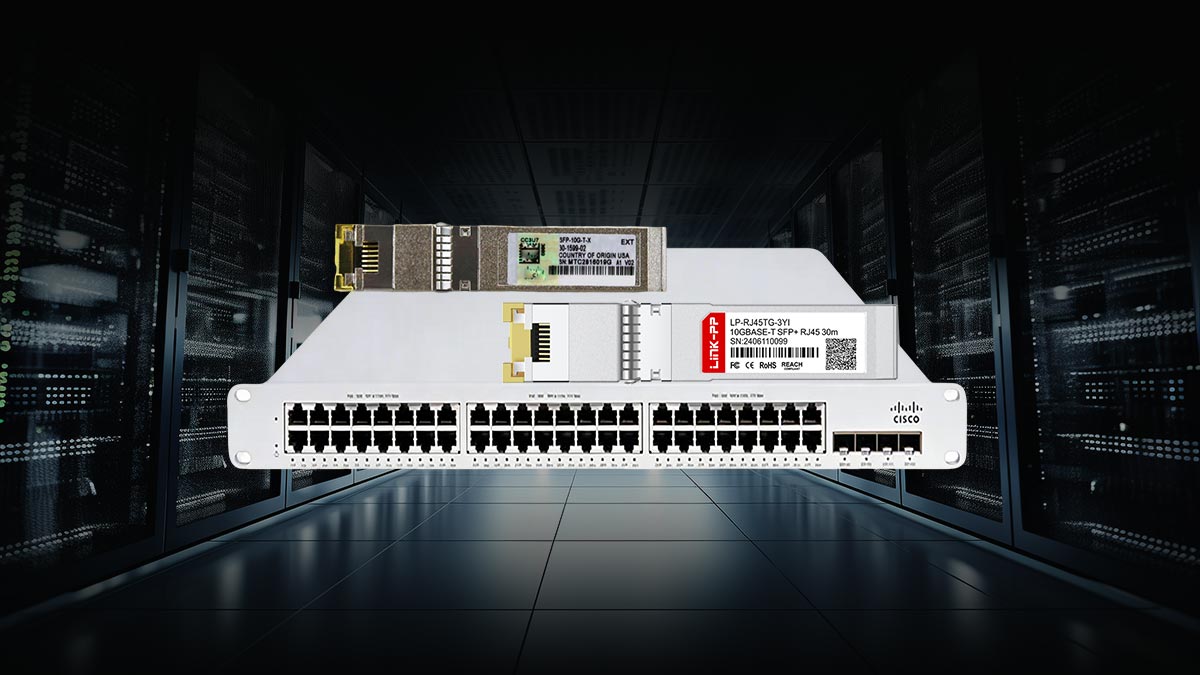
Compatibility and seamless integration are critical when deploying transceivers in Cisco-based infrastructure. Cisco SFP+ 10G BASE-T modules guarantee full plug‑and‑play operation across supported hardware, while verified third-party compatible alternatives like the LINK‑PP LP‑RJ45TG‑3YC often achieve similar results with minimal configuration. The degree of compatibility ultimately depends on the switch model, firmware version, and vendor support for open‑transceiver recognition.
Supported Cisco Switch Models
Cisco SFP 10G Base T module is natively supported on numerous Cisco platforms, including Catalyst 3850/9300/9500 series, Nexus 3000/5000/9000, and selected Meraki MS models. These switches automatically calibrate power draw, temperature thresholds, and signal integrity when a genuine Cisco transceiver is detected. Quality third-party RJ45 SFP+ transceivers can usually operate on the same models once compatibility confirmation is performed.
IOS Detection and Authentication Mechanisms
Cisco switches use an internal EEPROM-based authentication process to verify vendor identity during module insertion. Cisco-branded transceivers pass verification seamlessly. Third-party modules may trigger warnings such as “Unsupported Transceiver Detected.” However, this is primarily a protective measure rather than a hard block, and most LINK‑PP and similar third-party SFP modules can function after enabling the service unsupported-transceiver command or equivalent configuration.
Using Third-Party Modules on Cisco Devices
Despite these authentication barriers, it is entirely possible to use third-party modules effectively in Cisco environments. Reputable manufacturers like LINK-PP program their transceivers to be "Cisco-coded," meaning they emulate the correct data strings to satisfy basic switch recognition.
To suppress error messages and allow the interface to function, network administrators typically need to enter the global configuration command service unsupported-transceiver. While this command acknowledges that the hardware is not officially supported by Cisco TAC (Technical Assistance Center), it enables the LINK-PP module to operate, providing a cost-effective connectivity solution for networks where internal IT staff manage troubleshooting.
Common Compatibility Issues and Fixes
Occasional issues may include modules failing to initialize after firmware updates, link instability under high temperature, or vendor lockout errors. These can typically be resolved by updating the switch IOS version, reseating the transceiver, or reissuing an enable command for third-party operation.
For mission-critical production networks, using official Cisco SFPs still provides a safety margin through guaranteed support and synchronized system updates; for cost-optimized environments, reputable third-party models perform comparably with minimal administrative oversight.
? When to Choose Cisco SFP 10G Base T Instead of Third-Party Modules
Cisco SFP 10G BASE T modules generally prioritize predictable interoperability, validated behavior across Cisco platforms, and eligibility for full Cisco TAC support. Third-party 10G RJ45 modules can work well, but they introduce more variables around platform recognition, firmware behavior, and support boundaries — especially in tightly controlled enterprise environments.

Mission-Critical Enterprise Networks
- Core/aggregation uptime priority: In environments where a single unstable 10G copper link can ripple into service degradation, OEM optics help keep link behavior consistent. This is especially important for uplinks between access and distribution, critical server connections, or infrastructure services that must remain stable 24/7.
- Lower variance under sustained load: 10GBASE-T over SFP+ is more power/thermal sensitive than many fiber SFP modules. Cisco modules are typically validated to run reliably under longer periods of high utilization, which can reduce intermittent issues that only show up during peak traffic.
- More predictable negotiation and error handling: In mission-critical networks, “it works most of the time” is not acceptable. Cisco optics are less likely to show inconsistent auto-negotiation behavior, strange link flaps, or sporadic CRC/FCS errors that are difficult to reproduce.
- Better fit for dense, warm chassis environments: When many copper transceivers are installed in a compact switch (especially top-of-rack or access switches), thermal headroom becomes a real factor. Cisco optics are typically designed and tested for platform-specific thermal characteristics, which can reduce heat-related instability.
Strict Vendor Compliance Requirements
- Approved BOM / procurement rules: Many regulated industries require OEM components to meet internal governance. Cisco optics simplify compliance because the part number, sourcing, and vendor certification align with typical audit expectations.
- Audit and documentation friendliness: If you need to demonstrate “known-good components” to internal auditors or customers, OEM optics reduce documentation burden. You avoid having to justify third-party qualification processes or exceptions.
- Lower policy friction in change management: Vendor compliance often intersects with change approval. Using Cisco transceivers makes approvals easier because stakeholders see fewer unknowns in the bill of materials.
- Consistent standards across teams and regions: Large organizations often struggle with inconsistent transceiver sourcing. OEM optics make it easier to enforce a standard that different sites can follow without compatibility surprises.
Scenarios Requiring Full Cisco Support
- Cleaner TAC escalation path: When you open a Cisco case, support workflows often eliminate variables early. With OEM optics, you avoid delays where you’re asked to reproduce the issue with Cisco-branded modules before deeper analysis continues.
- More confidence during IOS/IOS XE upgrades: Some networks upgrade frequently due to feature rollouts or security patches. OEM optics reduce the chance that an upgrade introduces new transceiver-related warnings, restrictions, or unexpected behavior.
- Simplified RMA and accountability: If the optics might be part of the fault domain, Cisco parts provide clearer accountability and replacement options. This is important when you want a single vendor responsible for the end-to-end hardware stack.
Security and Firmware Integrity Concerns
- Better alignment with platform identity checks: Cisco devices may log transceiver identification details and can treat unknown modules differently depending on platform/software behavior. Cisco optics typically match expected identification/DOM reporting behavior more consistently.
- Reduced risk of unexpected firmware behavior: Third-party modules can vary by chipset and coding practices. In secure environments, minimizing “unknown firmware variables” is valuable — even if performance appears identical on day one.
- More predictable behavior after security hardening: Security teams sometimes lock down device settings and logging. OEM optics reduce the chance that hardening policies or monitoring baselines trigger false alarms related to transceiver identity, DOM fields, or compliance reporting.
? When Third-Party Alternatives Can Replace Cisco SFP 10G Base T
Third-party 10G RJ45 SFP+ modules can be a practical substitute when your priority is cost efficiency, and you can tolerate a higher need for validation testing. Compared with Cisco-branded transceivers, reputable third-party options often deliver similar baseline link performance for common access and edge use cases — provided you confirm switch compatibility, firmware behavior, and thermal/power constraints in advance.

Cost-Sensitive Network Deployments
For rollouts with many ports (campus access aggregation, edge servers, or branch deployments), transceiver cost can dominate the budget. Third-party modules often make 10GBASE-T feasible where OEM pricing would force compromises (fewer 10G uplinks, delayed upgrades, or mixed-speed designs). If you have a strong internal test process and can standardize on a reliable third-party vendor, the ROI can be compelling.
Multi-Vendor Infrastructure Environments
In networks that already run multiple switch vendors — or where optics are treated as interchangeable consumables — third-party modules can simplify inventory and reduce dependence on a single OEM supply chain. This is particularly useful for organizations that want a consistent transceiver strategy across different platforms and regions. The key is to ensure each module is correctly coded/compatible for the target devices and that your operations team is comfortable troubleshooting without relying solely on Cisco’s supported-parts stance.
Testing Labs and Development Networks
Labs, staging environments, and development networks are ideal for third-party optics because the risk of a rare compatibility edge case is acceptable — and learning is valuable. Third-party modules let you simulate production port density at a fraction of the cost, keep spare inventory on hand, and iterate faster. They also help you validate whether specific Cisco switch models, IOS versions, and copper cable types behave consistently before committing to production standards.
Small and Medium Business Use Cases
SMBs often value straightforward connectivity and cost control over “maximum vendor alignment,” especially when they have limited on-site spares and limited appetite for expensive OEM optics. Third-party modules can work well for typical SMB patterns: short copper runs, moderate port counts, and stable configurations that don’t change frequently. The best fit is usually where you can: (1) standardize on a known-good model, (2) keep a few spare modules, and (3) validate behavior after any switch OS upgrade or hardware refresh.
? Final Verdict: Cisco SFP 10G Base T vs. Third-Party 10G RJ45

Cisco SFP 10G Base T modules are the ideal choice for organizations that prioritize guaranteed compatibility, stable performance, and full Cisco TAC support, especially in mission-critical or highly regulated environments. They ensure seamless integration with Cisco switches and reduce operational risks during upgrades or troubleshooting.
However, reputable third-party 10G RJ45 options like LINK-PP offer comparable 10G performance, lower power consumption, and significantly reduced costs, making them a strong alternative for large-scale deployments, SMBs, and multi-vendor networks. When properly tested and sourced from trusted vendors, they can deliver excellent reliability for most real-world applications.
In practice, many networks benefit from a hybrid strategy, using Cisco modules in critical layers while deploying cost-effective third-party transceivers at the edge. To explore reliable and budget-friendly copper transceiver solutions, visit the LINK-PP Official Store for high-quality 10G RJ45 SFP+ modules tailored to your network needs.