



































An SFP-DD (Small Form-factor Pluggable Double Density) transceiver is a high-speed optical module governed by the SFP-DD Multi-Source Agreement (MSA). By adding a second row of electrical contacts, it doubles the electrical lanes of a standard SFP from one to two. Utilizing PAM4 modulation, it supports data rates of 100G (2x50G) and scales to 200G (2x100G). Crucially, SFP-DD host ports maintain strict backward compatibility with legacy SFP, SFP+, and SFP28 modules.
As enterprise data centers and 5G telecommunications networks transition from 25G to 100G at the server access layer, network architects face a stringent hardware bottleneck: physical port density. Traditional 100G form factors, such as QSFP28, are physically wider, limiting standard 1RU (Rack Unit) switches to 32 or 36 ports. To achieve maximum throughput without compromising physical footprint or stranding legacy infrastructure, the networking industry introduced the SFP Double Density (SFP-DD) standard.
Governed by the SFP-DD MSA—a collaborative consortium of leading networking hardware manufacturers—the SFP-DD form factor solves the density dilemma. It allows engineers to pack up to 48 ports of 100G capacity into a standard 1RU switch, effectively bridging the gap between legacy 10G/25G deployments and next-generation high-density edge computing.
In this comprehensive technical guide, we will break down the SFP-DD transceiver standards. We will explore its underlying electrical lane architecture, analyze its thermal management constraints, and provide a definitive comparison against competing standards like DSFP and QSFP28 to help you make data-driven procurement decisions for your network upgrades.
⭐ What Is a Double Density SFP-DD Transceiver?
An SFP-DD transceiver is a networking module that upgrades standard SFP connections by doubling their data capacity. The term "double density" refers to the addition of a second row of electrical contacts within the exact same physical footprint. The standard was designed to solve the port-density problem in data centers, allowing architects to achieve 100G speeds per port while fitting a maximum of 48 ports into a standard 1RU switch faceplate.

Defining SFP-DD in Plain English
To understand SFP-DD, we must first look at its predecessor. The standard SFP (Small Form-factor Pluggable) has been the foundational building block of enterprise networking for decades, supporting data rates from 1G (SFP) up to 25G (SFP28) using a single electrical lane.
In plain English, an SFP-DD transceiver is the evolutionary successor to these legacy modules. (Micro-definition: A transceiver is a highly engineered component that plugs into a network switch or server, converting electrical data signals into optical light signals for transmission over fiber optic cables.) While an SFP-DD module looks virtually identical to a standard SFP module from the outside, its internal interface has been fundamentally redesigned to support next-generation bandwidth requirements.
Explain Why "Double Density" Matters
The concept of "double density" is the core engineering breakthrough of the SFP-DD Multi-Source Agreement (MSA). It matters because it directly correlates to how much data a single physical port can process.
- Single Lane vs. Dual Lane: A traditional SFP module utilizes a single row of electrical contacts (one transmission lane and one receiving lane). The SFP Double Density module features a two-row receptacle connector. This creates a two-lane electrical interface.
- Bandwidth Multiplication: By combining two lanes of 50 Gbps traffic—utilizing advanced PAM4 (Pulse Amplitude Modulation 4-level) signaling—the module achieves an aggregated data rate of 100 Gbps.
Ultimately, the "double density" architecture allows network engineers to double the throughput of a single switch port without increasing the physical dimensions of the module.
Clarifying the Problem the SFP-DD Standard Solves
The SFP-DD standard was engineered to solve two specific, high-stakes hardware challenges faced by data center architects:
1. The Front-Panel Real Estate Bottleneck
Historically, upgrading a server connection to 100G required transitioning to the QSFP28 (Quad Small Form-factor Pluggable) standard. Because QSFP28 relies on four lanes (4x 25G), the module itself is physically wider. Consequently, hardware manufacturers can only fit 32 or 36 QSFP28 ports across the front panel of a standard 1RU (Rack Unit) switch. The SFP-DD standard solves this by enabling up to 48 ports of 100G in that exact same 1RU space, drastically increasing the total switching capacity per rack.
2. The Stranded Infrastructure Dilemma
When data centers upgrade core switches to new form factors (like QSFP), they often lose the ability to natively plug in older, single-lane cables without using cumbersome adapters. The SFP-DD host port was designed specifically to solve this interoperability problem. An SFP-DD port can seamlessly accept both new 100G SFP-DD modules and legacy 10G/25G SFP modules, ensuring zero stranded investments during phased network upgrades.
⭐ SFP-DD Double Density Standards Explained
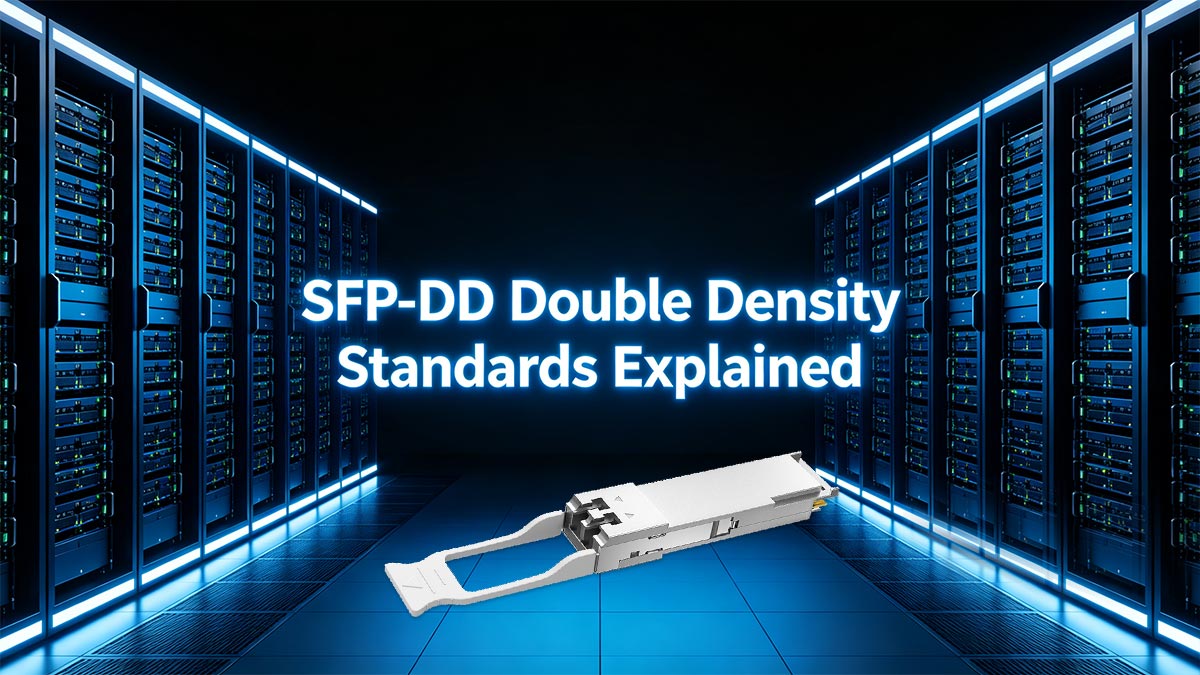
The SFP-DD standard, defined by the SFP-DD Multi-Source Agreement (MSA), specifies a two-lane electrical interface that doubles the bandwidth of a standard SFP module. Utilizing PAM4 signaling, it currently supports 100 Gbps (2x 50G) and is designed to scale up to 200 Gbps (2x 100G). The standard dictates the mechanical design of the module, host cage, and two-row connector, strategically positioning it as the premier high-density interface for Top-of-Rack (ToR) switches and edge computing environments.
SFP Double Density Architecture and Maximum Data Rates
The fundamental architecture of the SFP-DD transceiver is built upon maximizing throughput over a minimal physical footprint. To achieve this, the SFP-DD MSA shifted away from traditional single-lane architectures and adopted a dual-lane approach. By aligning with broader industry standards like IEEE 802.3cd (50G per lane) and IEEE 802.3ck (100G per lane), the SFP-DD form factor guarantees interoperability across the networking hardware ecosystem.
Here is a breakdown of the SFP-DD data rate evolution:
| Standard / Generation | Lane Configuration | Signaling Technology | Aggregated Data Rate |
|---|---|---|---|
| SFP-DD 100G | 2 Lanes x 50G | PAM4 | 100 Gbps |
| SFP-DD 200G (Emerging) | 2 Lanes x 100G | PAM4 | 200 Gbps |
Electrical Lane Structure and Signaling Basics
To understand how SFP-DD achieves these speeds, we must examine its electrical signaling. Legacy modules (like 10G SFP+) rely on NRZ (Non-Return-to-Zero) signaling, which transmits one bit of data per signal clock cycle.
SFP-DD standardizes the use of PAM4 (Pulse Amplitude Modulation 4-level). (Micro-definition: PAM4 is a modulation scheme that uses four distinct voltage levels to transmit two bits of data per clock cycle, effectively doubling the bandwidth of NRZ without increasing the baud rate.) By running two parallel electrical lanes, each processing 50 Gbps via PAM4 signaling, the SFP-DD module efficiently delivers 100 Gbps of total throughput with manageable signal integrity.
Module, Cage, and Connector Concepts
The mechanical engineering of the SFP-DD standard is a marvel of precision. To double the density while maintaining backward compatibility, the MSA redesigned the physical interface:
- The Two-Row Connector: The SFP-DD host board connector features two rows of electrical contacts.
- The Recessed Module Pads: The SFP-DD transceiver module contains a corresponding double row of contact pads. The second row of pads is slightly recessed. When inserted, the primary row engages first, followed by the secondary row. This staggered design prevents electrical shorting during hot-swapping.
- Cage Design: The SFP-DD cage is mechanically identical in width to a standard SFP cage. However, it incorporates specialized shielding for electromagnetic interference (EMI) and accommodates advanced riding heat sinks to dissipate the increased thermal load generated by the dual-lane PAM4 DSP (Digital Signal Processor).
How the Standard Fits into the Broader Optical Ecosystem
In the modern data center architecture, form factors must align with specific network tiers. The SFP-DD standard is not meant to replace high-capacity core routing optics; rather, it occupies a highly specific, strategic position in the ecosystem.
While 8-lane modules like QSFP-DD (400G/800G) and OSFP dominate the Spine and Core layers of the network, SFP-DD is the definitive standard for the Access Layer. It serves as the high-density pipeline connecting top-of-rack (ToR) switches directly to 100G server Network Interface Cards (NICs), as well as serving edge routing deployments in 5G fronthaul where rack space is severely restricted.
⭐ Backward Compatibility Standard: Will SFP-DD Work with SFP+ and SFP28?
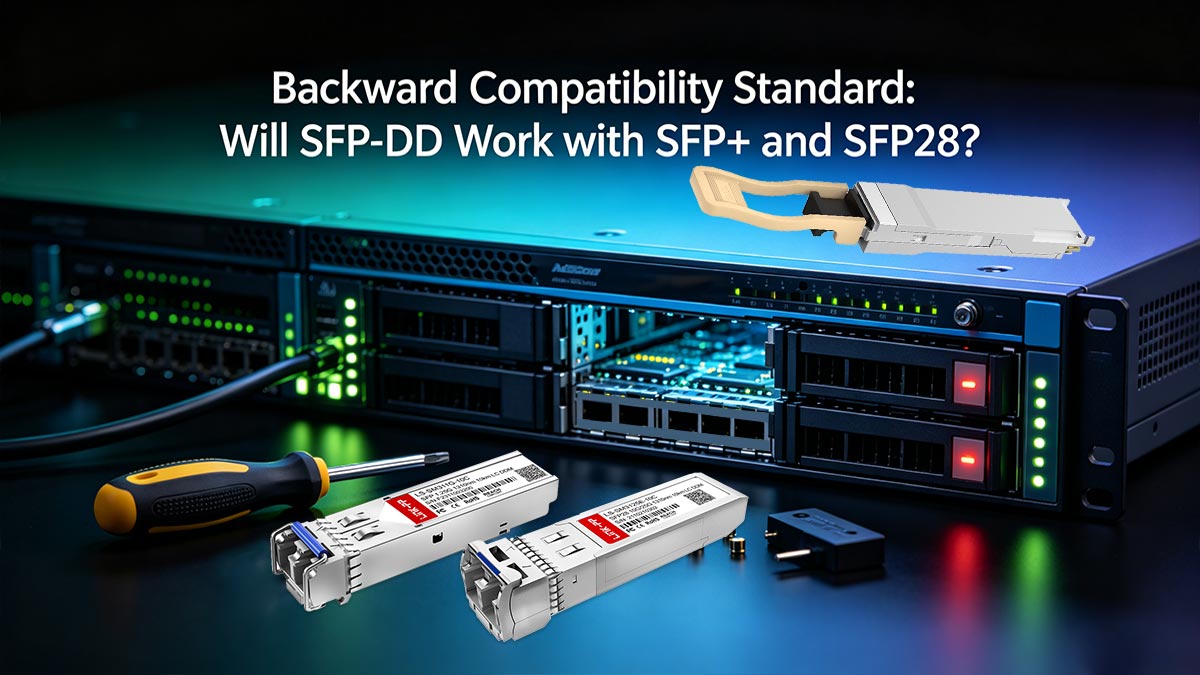
Yes, an SFP-DD host port is fully backward compatible with legacy SFP, SFP+, and SFP28 modules. Because the SFP-DD switch receptacle features a unique two-row connector, a legacy single-lane transceiver will naturally engage only with the first row of electrical contacts. The network switch will automatically detect the legacy module and operate it at its native speed (e.g., 10G or 25G) without requiring physical adapters.
The Mechanics of SFP-DD Backward Compatibility
The ability to support legacy optics was a foundational requirement when the SFP-DD Multi-Source Agreement (MSA) was drafted. Unlike competing form factors that force a hard transition, SFP-DD relies on a brilliant mechanical and electrical compromise to ensure interoperability.
Here is exactly how the backward compatibility works at the hardware level:
- Physical Engagement: The host board connector inside an SFP-DD switch port has two rows of pins. When you insert a legacy SFP28 (25G) or SFP+ (10G) module, its single row of contact pads slides in and connects exclusively to the primary (front) row of pins inside the cage. The secondary (recessed) row of pins remains untouched.
- Auto-Negotiation and EEPROM: Once inserted, the switch’s ASIC (Application-Specific Integrated Circuit) reads the legacy module's EEPROM data via the I2C management interface. The switch immediately recognizes that it is a single-lane module.
- Modulation Adjustment: The switch port dynamically shifts its electrical signaling. Instead of transmitting 50G PAM4 across two lanes, it reverts to transmitting 25G or 10G NRZ (Non-Return-to-Zero) across the single active lane, ensuring perfect signal integrity.
The "Forward Compatibility" Limitation
While discussing backward compatibility, it is critical to clarify a common point of confusion among hardware procurement teams: backward compatibility is strictly one-way.
(Micro-definition: Forward compatibility refers to the ability of older hardware to accept and utilize newer technology.)
You cannot plug a new 100G SFP-DD transceiver into a legacy SFP28 or SFP+ switch port and expect it to function. While the SFP-DD module will physically slide into the legacy cage, the older host port lacks the secondary row of electrical pins required to read the double-density module. Furthermore, legacy ports cannot supply the necessary power (up to 3.5W) or process the dual-lane PAM4 signaling required by the SFP-DD standard.
Strategic Advantages for Brownfield Network Upgrades
In enterprise networking, a "brownfield deployment" refers to upgrading an existing network rather than building a new one from scratch. The backward compatibility of the SFP-DD standard makes it the ultimate tool for brownfield data center upgrades.
Consider a Top-of-Rack (ToR) switch replacement scenario. A network architect can deploy a new 48-port SFP-DD switch today. They can immediately plug in their existing inventory of 25G SFP28 Direct Attach Copper (DAC) cables and optical transceivers to support their current servers. Then, over the next three to five years, as servers are individually upgraded to 100G Network Interface Cards (NICs), the architect can hot-swap the 25G optics for 100G SFP-DD modules on a port-by-port basis. This phased migration eliminates the need for a massive, disruptive "rip-and-replace" CAPEX event.
⭐ The 100G Standards War: SFP-DD vs. DSFP vs. QSFP28
The choice depends on density and legacy support. QSFP28 is the established 4-lane 100G standard, but its larger size limits switch port density (max 36 ports per 1RU). SFP-DD and DSFP are both 2-lane, high-density alternatives that allow up to 48 ports per 1RU. However, SFP-DD features full mechanical backward compatibility with legacy SFP modules, whereas DSFP lacks this interoperability. Therefore, SFP-DD is superior for phased enterprise upgrades, while DSFP is often favored in hyperscale environments prioritizing raw cost reduction.
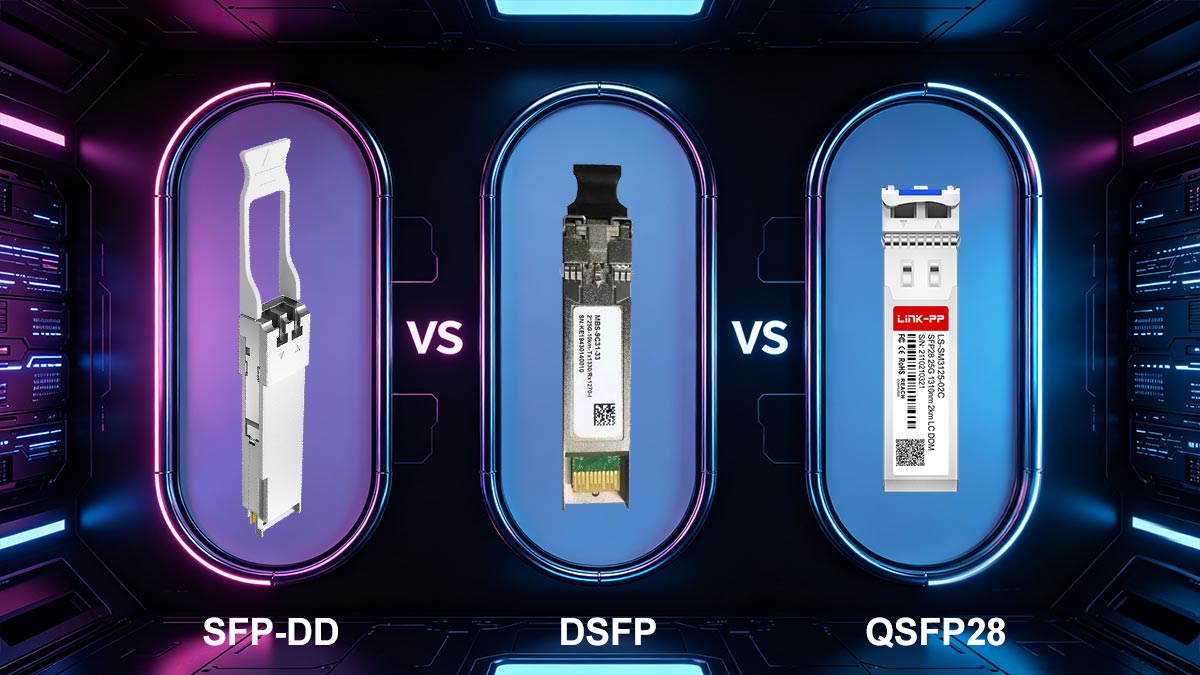
As the networking industry races to deliver 100G bandwidth to individual servers and edge devices, a fierce standardization battle has emerged. Network architects must evaluate three primary form factors: the legacy heavyweight (QSFP28), the high-density challenger (SFP-DD), and the budget-focused alternative (DSFP).
Understanding the technical differences and trade-offs between these three standards is critical for future-proofing your network architecture.
SFP-DD vs. QSFP28: The Density Dilemma
The QSFP28 (Quad Small Form-factor Pluggable) has been the undisputed king of 100G optics for years. It utilizes a 4-lane electrical interface, transmitting 4x 25G NRZ to achieve 100G. However, its architecture presents a severe physical limitation.
Because it requires four electrical lanes, the QSFP28 module is physically wider than an SFP module. When designing a standard 1RU (Rack Unit) network switch, hardware manufacturers can only fit a maximum of 32 or 36 QSFP28 ports across the front panel.
The SFP-DD Advantage: SFP-DD leverages PAM4 modulation to achieve 100G using only two lanes (2x 50G), all within the narrow physical footprint of a standard SFP. This allows manufacturers to squeeze up to 48 ports into a 1RU switch. For data center architects, this translates to a 33% to 50% increase in switching capacity per rack, drastically reducing the physical footprint and power overhead required for Top-of-Rack (ToR) deployments.
SFP-DD vs. DSFP: The Battle of the 2-Lane Optics
While SFP-DD solves the density issue of QSFP28, it faces direct competition from another 2-lane standard: DSFP (Dual Small Form-factor Pluggable). Both SFP-DD and DSFP aim to do the exact same thing—deliver 100G (2x 50G PAM4) in an SFP-sized footprint. The war between them comes down to mechanical design and market strategy.
| Feature | SFP-DD | DSFP |
|---|---|---|
| Electrical Lanes | 2 | 2 |
| Connector Design | Two-row recessed contacts | Single-row, high-density contacts |
| Backward Compatibility | Yes (Native support for SFP/SFP+/SFP28) | No (Requires specialized adapters) |
| Primary Target Market | Enterprise, Telecom, Edge (Brownfield) | Hyperscalers, AI Clusters (Greenfield) |
The Verdict on SFP-DD vs. DSFP:
The DSFP standard achieves its dual-lane architecture by cramming more pins into a single row, rather than adopting SFP-DD's two-row approach. This makes DSFP modules slightly simpler and cheaper to manufacture. However, this design breaks backward compatibility. If you plug a legacy SFP28 module into a DSFP port, the pin alignment will not match.
Therefore, clear lines have been drawn in the market. Hyperscalers building massive, brand-new "greenfield" data centers—where legacy compatibility is irrelevant—often lean toward DSFP for volume cost savings. Conversely, enterprise data centers, telecom operators, and edge networking environments that rely heavily on phased upgrades and legacy interoperability overwhelmingly adopt the SFP-DD standard.
⭐ Thermal Management Standards: Cooling the SFP Double Density SFP-DD Module
How does the SFP-DD standard manage heat?
Processing 100G via PAM4 modulation generates significant thermal output. The SFP-DD MSA addresses this by defining strict thermal power classes, officially supporting a power envelope of up to 3.5 Watts (Class 3) per module. To cool the SFP Double Density architecture, hardware manufacturers utilize integrated riding heat sinks on the host cage, specialized Thermal Interface Materials (TIM), and optimized front-to-back chassis airflow to prevent thermal throttling in dense 48-port switch configurations.
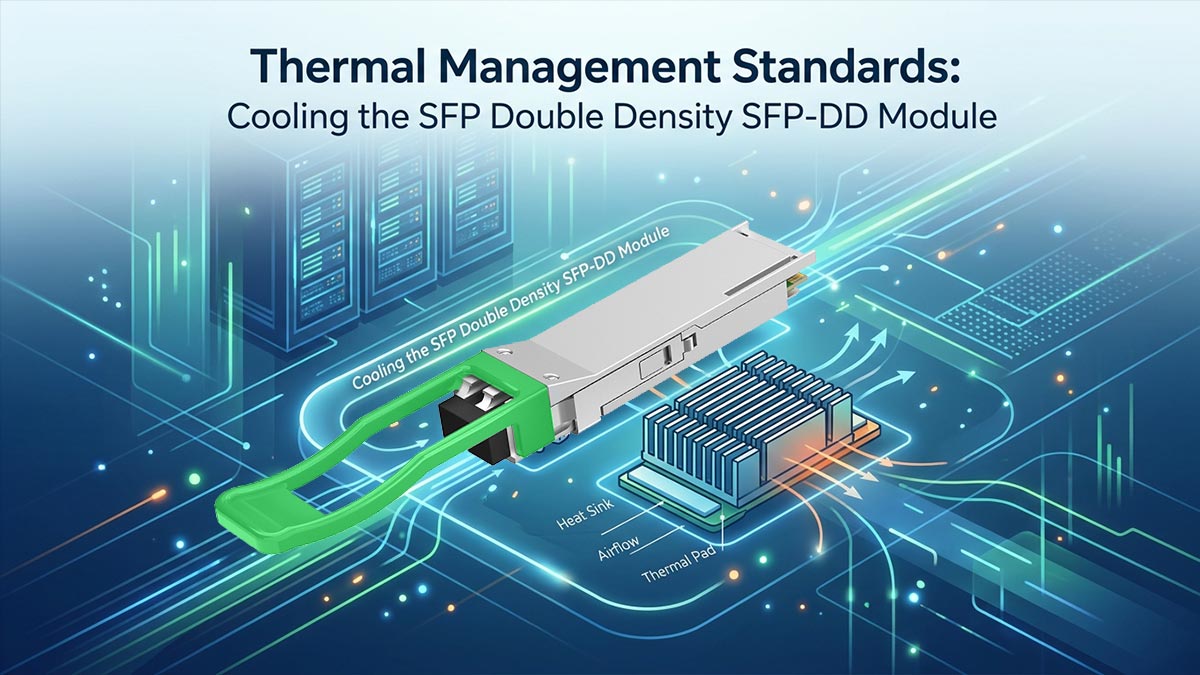
One of the most heavily scrutinized engineering hurdles in optical networking is thermal dissipation. As data rates scale, the electrical components inside the transceiver—specifically the Digital Signal Processors (DSPs) required for PAM4 modulation—consume more power and generate substantially more heat.
The Thermal Physics Challenge of 100G in a Small Form Factor
To understand the thermal challenge of the SFP-DD standard, we must look at the math behind high-density switching. A legacy 10G SFP+ module typically consumes around 1 Watt of power. A 25G SFP28 module consumes roughly 1.5 to 2 Watts.
By contrast, an active 100G SFP-DD transceiver consumes up to 3.5 Watts. If a network architect deploys a fully populated 1RU network switch with 48 SFP-DD ports, the transceivers alone generate up to 168 Watts of concentrated heat strictly at the front panel of the switch. Failure to effectively dissipate this heat leads to thermal throttling, increased Bit Error Rates (BER), and premature hardware failure.
SFP-DD MSA Power Classes
To ensure interoperability and safe operating temperatures across different OEM hardware, the SFP-DD Multi-Source Agreement (MSA) strictly defines power consumption tiers. Switch manufacturers must design their cooling systems to support these specific classes:
- Class 1: Up to 1.0W (Typically used for legacy 1G/10G backward compatibility)
- Class 2: Up to 1.5W (Typically used for 25G SFP28 modules)
- Class 3: Up to 3.5W (The standard target for 100G SFP-DD optical modules and Active Optical Cables)
- Class 4: Up to 5.0W (An emerging specification designed to accommodate power-hungry 200G modules or coherent optics, requiring specialized high-performance switch cooling)
Mechanical Cooling Innovations: The Host Cage and Heat Sinks
Because the physical dimensions of the SFP-DD module cannot be enlarged without breaking backward compatibility, the burden of thermal management falls largely on the host switch hardware. The SFP-DD standard specifies several mechanical cooling innovations:
1. Integrated Riding Heat Sinks
The SFP-DD host cage (the metal receptacle soldered to the switch's motherboard) is designed with a spring-loaded "riding" heat sink. When an SFP-DD module is inserted, the heat sink presses firmly against the top metallic casing of the transceiver. This creates a direct thermal bridge, pulling heat away from the module's internal DSP and laser components.
2. Front-to-Back Airflow Optimization
The MSA defines precise venting hole patterns for the SFP-DD cage. High-velocity fans inside the network chassis pull cold air from the cold aisle, through the perforated switch faceplate, over the transceiver cages, and out through the hot aisle exhaust. The geometry of the SFP-DD cage is mathematically optimized to minimize air resistance.
3. Thermal Interface Materials (TIM)
To maximize heat transfer between the module and the riding heat sink, manufacturers apply advanced Thermal Interface Materials. These highly conductive pads eliminate microscopic air gaps between the metal surfaces, ensuring that the module remains within its safe operating temperature range (typically 0°C to 70°C for commercial-grade optics).
⭐ FAQ About SFP-DD Transceiver Standards
This section addresses the most common questions network engineers and procurement teams ask when evaluating the SFP-DD standard, focusing on speed capabilities, backward compatibility rules, and deployment strategies compared to legacy QSFP formats.
What speed does SFP-DD support?
The SFP-DD standard is currently engineered to support an aggregated data rate of 100 Gbps. It achieves this by utilizing a two-lane electrical interface, with each lane transmitting 50 Gbps via PAM4 (Pulse Amplitude Modulation 4-level) signaling.
Looking toward the future, the SFP-DD Multi-Source Agreement (MSA) roadmap is designed to scale. As signaling technology advances to 100 Gbps per lane (aligning with IEEE 802.3ck standards), the SFP-DD form factor will seamlessly support 200 Gbps (2x 100G), providing a clear upgrade path without requiring a change in the physical port design.
Can SFP-DD work with older SFP ports?
This is a critical distinction that requires a clear "one-way" rule.
No, you cannot plug a new SFP-DD module into an older SFP+ or SFP28 port. An older switch port only has a single row of electrical pins and lacks the physical architecture and power delivery (up to 3.5W) required to operate a double-density module.
However, the reverse is true: You can plug older SFP+ (10G) or SFP28 (25G) modules into a new SFP-DD switch port. The SFP-DD port is designed with a two-row connector that natively accepts single-lane legacy modules, automatically negotiating down to their native speeds. This makes upgrading your switch hardware highly flexible.
When should you choose SFP-DD instead of QSFP?
You should choose SFP-DD over QSFP28 (the traditional 4-lane 100G standard) in three specific deployment scenarios:
- When Maximizing Port Density: If you are deploying Top-of-Rack (ToR) switches and need to connect 40 to 48 servers at 100G speeds, SFP-DD is the only standard that allows 48 ports in a single 1RU space. QSFP28 maxes out at 32 or 36 ports.
- During Phased Brownfield Upgrades: If your network currently relies heavily on 25G (SFP28) server connections and you want to upgrade your core switches today while waiting to upgrade your server NICs later, SFP-DD allows you to reuse your existing 25G cables without buying adapters.
- In Space-Constrained Edge Environments: For 5G fronthaul deployments, telecom cell towers, and edge data centers where physical rack space is strictly limited, the compact footprint of the SFP-DD standard is vastly superior to the wider QSFP format.
⭐ Future Outlook: Should You Adopt the SFP-DD Module?
For enterprise data centers, 5G telecom operators, and edge networking environments, adopting the SFP-DD standard is highly recommended. It is the optimal choice for high-density 100G upgrades because it uniquely preserves your existing legacy 10G/25G infrastructure. While hyperscale facilities building entirely new (greenfield) networks might leverage DSFP for raw cost reduction, SFP-DD remains the undisputed leader for backward compatibility, thermal reliability, and phased brownfield deployments.

The Roadmap to 200G and Beyond
When evaluating networking hardware, hardware lifespan and future-proofing are just as important as immediate performance gains. The SFP-DD Multi-Source Agreement (MSA) was intentionally designed with a forward-looking trajectory.
As the networking industry finalizes the transition to 100G per lane electrical signaling (driven by standards like IEEE 802.3ck), the SFP-DD form factor is already mechanically prepared. Because it features two physical lanes, upgrading a network from 100G (2x 50G PAM4) to 200G (2x 100G PAM4) will not require a redesign of the switch faceplate or the physical port footprint. Adopting SFP-DD today effectively secures your Top-of-Rack (ToR) architecture for the next decade of bandwidth scaling.
Strategic Adoption Checklist
To summarize the strategic value of the SFP Double Density standard, network architects should mandate SFP-DD in their procurement documents if their deployment matches any of the following criteria:
- High-Density Requirements: You require more than 36 ports of 100G capacity within a single 1RU switch chassis.
- Phased Migration Strategies: You plan to upgrade core/aggregation switches now, but need to continue supporting legacy SFP28 (25G) server NICs until a future refresh cycle.
- Harsh/Constrained Environments: You are deploying 5G fronthaul equipment or edge computing nodes where physical space, thermal management, and power consumption are strictly limited.
Sourcing Reliable SFP-DD Infrastructure
Transitioning to a high-density 100G architecture requires precision engineering. Because SFP-DD modules operate at higher thermal envelopes (up to 3.5W) and rely on complex PAM4 Digital Signal Processors, utilizing generic or non-compliant optics can lead to severe thermal throttling and unacceptable Bit Error Rates (BER).
As you map out your network migration strategy, securing MSA-compliant, thermally optimized transceivers is critical to maintaining continuous uptime. Whether you are scaling a localized edge deployment or overhauling your enterprise ToR switches, you can explore a comprehensive, rigorously tested portfolio of high-performance optical networking solutions at the LINK-PP Official Store. By sourcing directly from a proven manufacturer, procurement teams ensure their SFP-DD infrastructure meets the stringent signal integrity and thermal class standards required for the next generation of data transmission.







