










As fiber broadband continues to expand, service providers are facing increasing demands for higher bandwidth, lower latency, and more scalable access networks. Fiber-to-the-Home (FTTH), enterprise connectivity, and mobile network expansion have made Passive Optical Network (PON) technology a fundamental part of modern telecommunications infrastructure. At the center of these networks is the Optical Line Terminal (OLT), which connects service provider networks to multiple subscribers through optical fiber.
An OLT does more than transmit and receive optical signals. It manages ONU connections, allocates bandwidth, controls upstream communication, and provides centralized network management. Its performance also depends on the PON technology, optical interfaces, transceiver specifications, and optical distribution network. Understanding these elements is essential when designing, upgrading, or maintaining a reliable fiber access network.
This guide explains the key aspects of OLT equipment and its role in PON deployments, including:
-
OLT architecture, components, and working principles.
-
Differences between GPON, EPON, XG-PON, and XGS-PON.
-
OLT optical modules, wavelengths, form factors, and optical classes.
-
Practical considerations for selecting compatible OLT SFP transceivers.
-
Common deployment scenarios and troubleshooting methods.
Whether you are planning a new FTTH network or upgrading existing fiber infrastructure, understanding these fundamentals will help you make better technical decisions.
What Is an OLT (Optical Line Terminal)?
An Optical Line Terminal (OLT) is a central-office device that manages optical communication between a service provider's core network and multiple subscriber-side Optical Network Units (ONUs) or Optical Network Terminals (ONTs). It serves as the central control and aggregation point in a Passive Optical Network (PON), distributing downstream traffic and coordinating upstream transmissions.
In a typical fiber access network, the OLT connects to the optical distribution network through PON ports. Passive optical splitters then distribute signals to multiple subscribers without requiring powered switching equipment in the outside plant.
Definition and Primary Purpose of an OLT
An OLT provides the optical access interface between a telecommunications provider's network and end users. It converts upstream electrical data into optical signals and processes optical signals received from subscriber-side equipment.
Its primary functions include:
-
Optical signal transmission: Sends downstream optical signals through PON ports to multiple ONUs.
-
Traffic aggregation: Collects upstream traffic from subscribers and forwards it to the provider's aggregation or core network.
-
Bandwidth management: Allocates transmission opportunities and manages upstream bandwidth.
-
Subscriber management: Handles ONU registration, authentication, configuration, and monitoring.
-
Quality of Service (QoS): Prioritizes different traffic types according to configured service policies.
-
Network supervision: Monitors optical interfaces, port status, alarms, and performance indicators.
An OLT is commonly installed in a central office, data center, telecom equipment room, or remote access location. Depending on network capacity requirements, it can be deployed as a modular chassis-based system or a compact fixed-configuration device.
For service providers, the OLT is essential because it allows one centralized platform to serve many subscribers while maintaining individual service configurations and network visibility.
OLT vs. ONU vs. ONT: Understanding the Differences
OLT, ONU, and ONT are three closely related terms in fiber access networks, but they refer to equipment installed at different network locations and performing different functions.
-
OLT (Optical Line Terminal): Located at the service provider side. It manages PON communication, aggregates subscriber traffic, and connects the access network to upstream infrastructure.
-
ONU (Optical Network Unit): Located closer to subscribers, often in buildings, cabinets, or customer premises. It converts optical access signals into interfaces suitable for local distribution.
-
ONT (Optical Network Terminal): A subscriber-side terminal, usually installed inside a home or business. It provides end-user interfaces such as Ethernet, Wi-Fi, telephone, or other service connections.
The term ONU is often used as a general category, while ONT commonly refers to a customer-facing implementation. Their exact distinction can vary depending on the PON standard and equipment manufacturer.
The following table summarizes their main differences.
| Device | Network Location | Primary Function | Typical Interfaces |
|---|---|---|---|
| OLT | Central office or provider site | Controls PON and aggregates subscriber traffic | PON, Ethernet uplink |
| ONU | Distribution point or customer premises | Terminates optical access and distributes services | PON, Ethernet |
| ONT | Home or business premises | Provides end-user network connectivity | PON, Ethernet, Wi-Fi, POTS |
Understanding these roles is particularly important when selecting optical transceivers. OLT and ONU optical modules operate in opposite transmission directions, so their wavelength specifications must be checked carefully.
Key Components of an OLT
An OLT consists of several hardware and software components that work together to manage optical access services. The exact architecture depends on whether the equipment uses a modular chassis or a fixed configuration.
The main components generally include:
-
Control and management board: Handles system control, configuration, monitoring, and communication between internal hardware modules.
-
PON service boards: Provide GPON, EPON, XG-PON, or XGS-PON access interfaces for subscriber connections.
-
Uplink boards: Connect the OLT to aggregation switches, routers, or core network infrastructure through Ethernet interfaces.
-
Power supply units: Provide stable power to the system, often with redundant power options in carrier-grade equipment.
-
Cooling system: Maintains appropriate operating temperatures for optical modules and electronic components.
-
Optical transceiver interfaces: Provide the optical transmission and reception functions required for PON communication.
Some OLT platforms integrate optical interfaces directly into service boards, while others use pluggable optical modules. This distinction affects maintenance, port expansion, and module compatibility.
For network engineers, understanding the OLT hardware architecture is the first step toward evaluating its capacity, scalability, and optical interface requirements.
How Does an OLT Work in a PON Network?
An OLT works by coordinating bidirectional optical communication between the service provider and multiple subscribers over a shared passive optical distribution network. It transmits downstream data to ONUs and controls upstream transmissions to prevent multiple subscriber devices from transmitting simultaneously over the same shared channel.
A typical PON architecture uses a point-to-multipoint topology, allowing one OLT PON port to serve multiple ONUs through passive optical splitters.
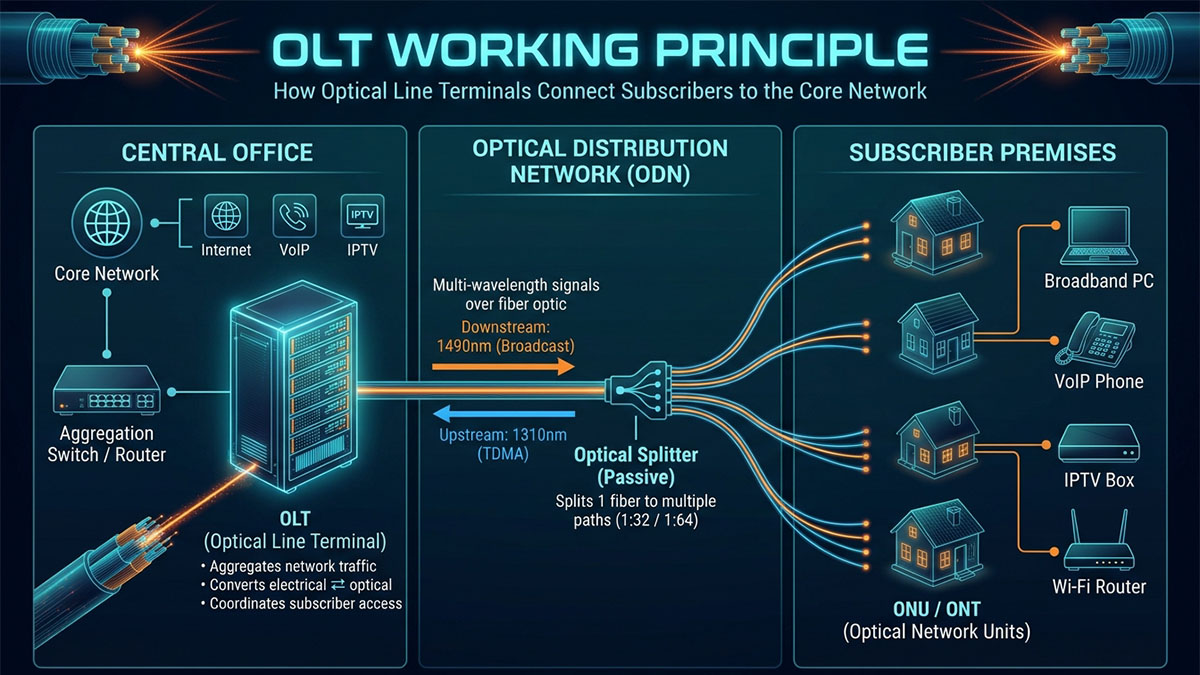
OLT-to-ONU Communication Architecture
A standard PON network consists of three main sections: the OLT, the Optical Distribution Network (ODN), and subscriber-side ONUs or ONTs.
The basic connection structure is:
OLT → Feeder Fiber → Passive Optical Splitter → Distribution Fiber → ONU/ONT
Each component has a specific function:
-
OLT: Generates downstream optical signals and manages upstream communication.
-
Feeder fiber: Carries optical signals from the OLT to the distribution point.
-
Passive optical splitter: Divides optical signals among multiple subscriber connections.
-
Distribution fiber: Connects the splitter to individual subscriber locations.
-
ONU/ONT: Receives downstream signals and transmits upstream data.
Unlike active Ethernet access networks, a traditional PON uses passive optical splitters in the outside plant. These splitters do not require electrical power, reducing the need for powered field equipment.
Common splitter configurations include 1:8, 1:16, 1:32, and 1:64. The appropriate split ratio depends on the available optical budget, subscriber density, bandwidth requirements, and network design.
A higher split ratio allows one PON port to serve more subscribers, but it also introduces greater insertion loss and increases the importance of optical power planning.
Downstream and Upstream Data Transmission
OLT communication operates in two directions: downstream transmission from the OLT to subscribers and upstream transmission from subscribers back to the OLT.
These directions use different wavelengths and transmission-control mechanisms in conventional single-fiber GPON and XGS-PON systems.
Downstream transmission
-
The OLT sends optical signals through the feeder fiber.
-
The passive splitter distributes the signal to connected ONUs.
-
Each ONU identifies and processes the data intended for its assigned services.
-
Traffic is delivered to connected customer devices through Ethernet, Wi-Fi, or other interfaces.
Because the downstream signal is shared across the PON, logical addressing and encryption mechanisms help ensure that subscribers receive their appropriate traffic.
Upstream transmission
Upstream communication requires more precise coordination because multiple ONUs share the same optical channel.
The OLT uses Time Division Multiple Access (TDMA) to assign transmission opportunities to individual ONUs. Each ONU transmits within its allocated time slot, reducing the risk of optical signal collisions.
The process generally involves:
-
The OLT measures and manages the ranging information of connected ONUs.
-
ONUs receive transmission timing and bandwidth assignments.
-
The OLT schedules upstream transmission opportunities.
-
ONUs send data in their assigned time slots.
-
The OLT receives and processes the upstream burst signals.
Dynamic Bandwidth Allocation (DBA) allows the OLT to adjust upstream bandwidth assignments according to traffic demand and configured service policies.
Burst-mode reception is also important because the OLT must receive optical signals from different ONUs with varying transmission distances and power levels.
How an OLT Manages and Monitors ONUs
An OLT provides centralized management of subscriber-side devices, allowing service providers to configure and monitor large numbers of ONUs from a single network platform.
Its management functions typically include:
-
ONU registration: Detects and registers ONUs connected to PON ports.
-
Authentication: Uses serial numbers, passwords, or other supported identification methods to authorize subscriber devices.
-
Remote configuration: Applies service profiles, VLAN settings, bandwidth policies, and interface parameters.
-
Bandwidth scheduling: Uses DBA and traffic management policies to allocate upstream resources.
-
Performance monitoring: Tracks optical power, traffic statistics, alarms, and interface status when supported.
-
Fault management: Identifies connection failures, abnormal optical levels, and service interruptions.
The ONT Management and Control Interface (OMCI), standardized in ITU-T G.988, is commonly used for remote management and configuration of ONTs in GPON and related PON environments.
However, the exact management functions depend on the PON standard, OLT platform, ONU implementation, and vendor interoperability.
Centralized OLT management makes PON networks easier to operate at scale, particularly in FTTH deployments with thousands of subscribers.
What Are the Different Types of OLT Technologies?
OLT technologies are primarily classified according to the Passive Optical Network standards they support. The most common technologies include GPON, EPON, XG-PON, and XGS-PON, which differ in transmission rates, wavelengths, optical budgets, and network applications.
Choosing the appropriate PON technology depends on current bandwidth requirements, existing fiber infrastructure, subscriber density, and future network expansion plans.
GPON OLT (Gigabit Passive Optical Network)
A GPON OLT operates according to the ITU-T G.984 series of recommendations and is widely deployed in residential broadband and enterprise fiber access networks.
GPON supports asymmetric transmission, providing a higher downstream rate than upstream rate in its commonly deployed configuration.
Its main technical characteristics include:
-
Downstream line rate: 2.48832Gbps.
-
Upstream line rate: 1.24416Gbps.
-
Downstream wavelength: 1490nm.
-
Upstream wavelength: 1310nm.
-
Common optical classes: B+ and C+.
-
Typical maximum fiber distance: Up to 20km in conventional GPON deployments, depending on the system design.
GPON OLTs are commonly used for:
-
Residential FTTH broadband.
-
Multi-dwelling unit (MDU) connectivity.
-
Small and medium-sized business access.
-
Voice, video, and data service delivery.
GPON remains attractive to service providers because of its established ecosystem, broad equipment availability, and ability to support large subscriber populations over existing single-mode fiber infrastructure.
EPON OLT (Ethernet Passive Optical Network)
An EPON OLT follows the IEEE 802.3ah Ethernet Passive Optical Network standard, using Ethernet-based communication over a passive optical distribution network.
Unlike GPON, which uses the ITU-T PON framework, EPON integrates more directly with Ethernet networking concepts.
Common EPON characteristics include:
-
Nominal downstream physical line rate: 1.25Gbps.
-
Nominal upstream physical line rate: 1.25Gbps.
-
Typical Ethernet service rate: Approximately 1Gbps in each direction.
-
Common downstream wavelength: 1490nm.
-
Common upstream wavelength: 1310nm.
-
Typical deployment: Residential broadband and Ethernet access.
The distinction between the 1.25Gbps physical line rate and the approximately 1Gbps Ethernet service rate is important because EPON uses 8B/10B encoding, which introduces line-coding overhead.
EPON is commonly deployed in networks where Ethernet integration, existing equipment ecosystems, and straightforward service provisioning are priorities.
Its main advantages include:
-
Ethernet-oriented architecture.
-
Relatively simple integration with Ethernet access networks.
-
Support for point-to-multipoint fiber connectivity.
-
Flexible bandwidth allocation for subscriber services.
XG-PON OLT and XGS-PON OLT
XG-PON and XGS-PON are next-generation PON technologies designed to support higher bandwidth requirements than traditional GPON.
Both operate in the 10G PON family, but they differ in upstream and downstream transmission rates.
XG-PON
XG-PON is defined by the ITU-T G.987 series and provides asymmetric 10G-class transmission.
Its main characteristics include:
-
Downstream line rate: 9.95328Gbps.
-
Upstream line rate: 2.48832Gbps.
-
Downstream wavelength: Approximately 1577nm.
-
Upstream wavelength: Approximately 1270nm.
-
Optical classes: N1, N2, E1, and E2.
XGS-PON
XGS-PON follows ITU-T G.9807.1 and provides symmetrical 10G transmission, making it suitable for applications requiring high upstream and downstream bandwidth.
Its main characteristics include:
-
Downstream line rate: 9.95328Gbps.
-
Upstream line rate: 9.95328Gbps.
-
Downstream wavelength: Approximately 1577nm.
-
Upstream wavelength: Approximately 1270nm.
-
Optical classes: N1, N2, E1, and E2.
The standard also defines an optional wavelength set for coexistence with GPON wavelength arrangements. Therefore, the actual wavelength plan should be checked against the deployed system design.
XGS-PON is particularly suitable for:
-
High-speed residential broadband.
-
Enterprise symmetrical connectivity.
-
Mobile backhaul.
-
High-capacity fiber access networks.
-
Service providers upgrading from GPON infrastructure.
Its symmetrical bandwidth makes XGS-PON a practical option for applications involving cloud services, video conferencing, large data transfers, and bandwidth-intensive business operations.
GPON vs. EPON vs. XG-PON vs. XGS-PON
The main differences between GPON, EPON, XG-PON, and XGS-PON involve their standards, transmission rates, wavelength plans, and intended applications.
The following comparison provides a quick overview.
| Technology | Standard | Downstream Rate | Upstream Rate | Typical Wavelength (DS/US) |
|---|---|---|---|---|
| GPON | ITU-T G.984 | 2.488Gbps | 1.244Gbps | 1490nm/1310nm |
| EPON | IEEE 802.3ah | 1.25Gbps line rate | 1.25Gbps line rate | 1490nm/1310nm |
| XG-PON | ITU-T G.987 | 9.953Gbps | 2.488Gbps | 1577nm/1270nm |
| XGS-PON | ITU-T G.9807.1 | 9.953Gbps | 9.953Gbps | 1577nm/1270nm |
Although these technologies share similar point-to-multipoint architectures, they are not automatically interchangeable. OLT and ONU equipment must support the same PON technology or an explicitly supported coexistence configuration.
For network upgrades, service providers should also consider whether existing optical distribution networks can support the new wavelength plan and optical power requirements.
In some deployments, WDM coexistence elements allow GPON and XGS-PON signals to operate over shared fiber infrastructure, reducing the need for a completely new optical distribution network.
OLT Optical Modules: Types, Specifications, and Functions
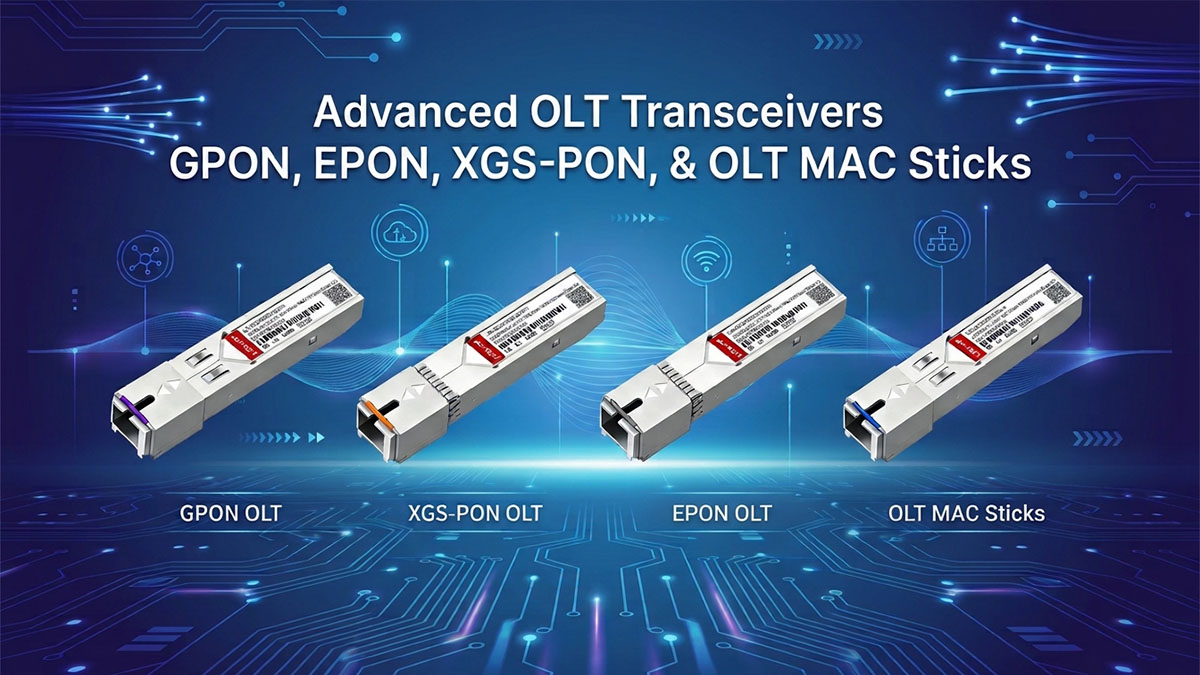
OLT optical modules provide the optical interfaces required for communication between OLT equipment and the passive optical distribution network. Selecting the correct module requires matching its PON standard, wavelength, transmission rate, optical class, connector, and host compatibility with the network design.
Different PON technologies use different optical specifications, so an OLT SFP transceiver designed for GPON cannot automatically replace an XGS-PON optical interface.
Common Types of OLT Optical Modules
OLT optical modules can be classified by PON technology, form factor, and functional architecture.
Common types include:
-
GPON OLT SFP: Supports GPON communication and typically operates with 1490nm downstream transmission and 1310nm upstream reception at the OLT.
-
EPON OLT SFP: Provides optical interfaces for Ethernet-based EPON networks.
-
XG-PON OLT optical modules: Support asymmetric 10G PON transmission.
-
XGS-PON OLT optical modules: Support symmetrical 10G upstream and downstream communication.
-
Combo PON modules: Support multiple PON technologies through integrated optical and wavelength-management designs.
Another important distinction is the difference between a conventional optical transceiver and an integrated PON MAC SFP stick.
A conventional pluggable transceiver primarily provides optical-to-electrical and electrical-to-optical conversion. The host equipment handles the PON MAC and associated control functions.
An integrated PON MAC SFP stick includes additional PON MAC functionality within the module itself. This architecture can allow compatible Ethernet equipment to provide PON access functions without relying on a traditional OLT service-board architecture.
However, an integrated PON MAC module is not universally compatible with every SFP host. The host must support the required electrical interface, power characteristics, management functions, and data handling behavior.
Key Optical Specifications of OLT Transceivers
The technical specifications of an OLT optical module determine whether it can operate correctly within a specific PON system.
Before selecting an OLT SFP or SFP+ module, engineers should evaluate the following parameters.
1. Form factor
-
SFP is commonly used for GPON and EPON interfaces.
-
SFP+ is commonly used for 10G-class optical interfaces, including XG-PON and XGS-PON implementations.
-
Integrated PON MAC sticks may use an SFP form factor while supporting functions beyond conventional optical conversion.
The physical form factor alone does not guarantee PON compatibility.
2. Wavelength
The OLT and ONU transmit and receive at different wavelengths.
For conventional GPON:
-
OLT downstream transmission: 1490nm.
-
OLT upstream reception: 1310nm.
-
ONU upstream transmission: 1310nm.
-
ONU downstream reception: 1490nm.
For conventional XGS-PON:
-
OLT downstream transmission: Approximately 1577nm.
-
OLT upstream reception: Approximately 1270nm.
-
ONU upstream transmission: Approximately 1270nm.
-
ONU downstream reception: Approximately 1577nm.
These wavelength differences allow bidirectional communication over a shared single-mode fiber.
3. Data rate
The optical module must support the nominal transmission rates required by the PON standard.
For example, a GPON OLT interface typically supports 2.488Gbps downstream and 1.244Gbps upstream, while an XGS-PON interface supports approximately 9.953Gbps in both directions.
4. Optical transmit power and receiver sensitivity
These parameters determine the optical power available for transmission and the minimum signal level that the receiver can reliably detect.
They are essential for calculating the optical link budget.
5. Transmission distance
OLT optical modules may be specified for 20km or other reach configurations. However, the actual supported reach depends on the complete optical path, including fiber attenuation, splitter loss, connector loss, and optical class.
6. Connector type
Common PON optical connector types include:
-
SC/UPC.
-
SC/APC.
These connector types have different end-face geometries and must not be directly mated together. The connector type should match the installed fiber infrastructure.
7. Temperature range and digital diagnostics
Operating temperature and DDM/DOM support are also important.
-
Commercial-temperature modules are suitable for controlled equipment environments.
-
Industrial-temperature modules are designed for wider operating temperature ranges.
-
DDM/DOM provides diagnostic information such as temperature, supply voltage, transmit power, and received optical power when supported.
OLT Optical Classes and Power Budget
An optical class defines the allowable optical path loss between the OLT and ONU interfaces. It is one of the most important factors when selecting PON optical modules because it determines how much attenuation the network can tolerate while maintaining reliable communication.
Common GPON and XGS-PON optical classes include the following.
| PON Technology | Optical Class | Nominal Maximum Optical Path Loss |
|---|---|---|
| GPON | B+ | 28dB |
| GPON | C+ | 32dB |
| XGS-PON | N1 | 29dB |
| XGS-PON | N2 | 31dB |
| XGS-PON | E1 | 33dB |
| XGS-PON | E2 | 35dB |
These values represent the nominal maximum optical path loss associated with each class under the relevant standard. They should not be interpreted as guaranteed reach distances for every network configuration.
The actual link budget depends on the optical transmitter, receiver sensitivity, receiver overload limit, and other system parameters.
To evaluate an OLT-to-ONU optical link, engineers should account for:
-
Fiber attenuation across the total fiber length.
-
Passive splitter insertion loss.
-
Connector insertion loss.
-
Fusion splice loss.
-
Additional losses from WDM filters and other optical components.
-
Engineering margin for aging, repairs, and environmental changes.
A simplified optical link-loss calculation is:
Total Optical Loss = Fiber Loss + Splitter Loss + Connector Loss + Splice Loss + Other Passive Component Losses
For example, a network using a 1:32 splitter will generally experience greater splitter loss than one using a 1:8 splitter. The selected optical class must therefore provide sufficient margin for the actual distribution architecture.
It is also important to distinguish between the OLT transmitter's output power and the ONU receiver's sensitivity. A higher optical class does not automatically mean better performance in every situation. Excessive received power can also exceed the receiver's overload limit.
For reliable operation, both ends of the PON link must meet the applicable optical interface requirements.
LINK-PP OLT Optical Module Solutions
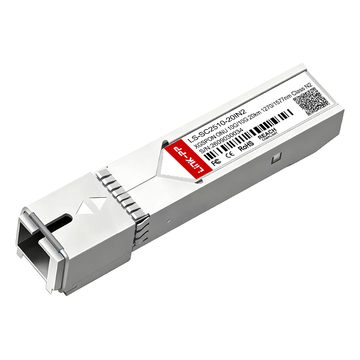
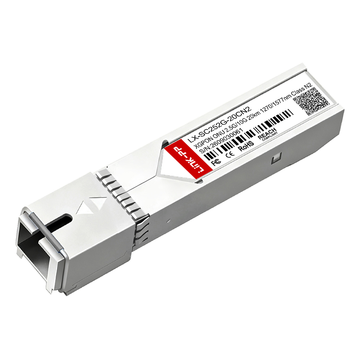
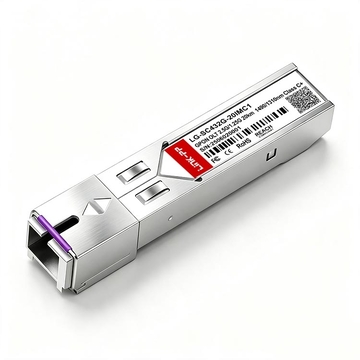
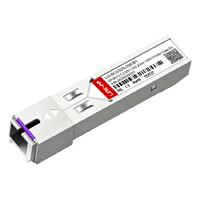
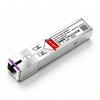
At LINK-PP, we provide GPON optical module solutions for fiber access applications, including integrated GPON OLT SFP sticks and complementary ONU SFP transceivers.
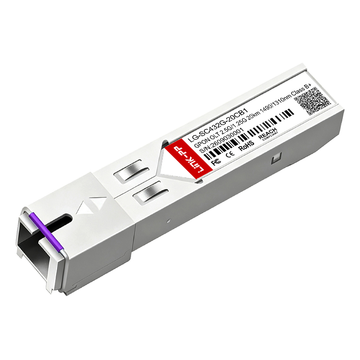
One example is the LG-SC432G-20IB1 GPON OLT SFP, designed for GPON access networks downstream transmission architecture.
Its main specifications include:
| Parameter | LG-SC432G-20IB1 |
|---|---|
| PON Standard | GPON |
| Form Factor | SFP |
| Optical Class | B+ |
| Downstream Rate | 2.488Gbps |
| Upstream Rate | 1.244Gbps |
| OLT TX/RX Wavelength | 1490nm/1310nm |
| Maximum Distance | 20km |
| Connector | SC/UPC |
| Fiber Type | Single-Mode Fiber |
| Operating Temperature | -40 to 85°C |
| DDM/DOM | Supported |
| Management | OMCI support |
For subscriber-side connectivity, LINK-PP also offers the LG-SC341G-20IB1 GPON ONU SFP Class B+.
Its specifications include:
-
GPON Class B+.
-
1.244Gbps upstream and 2.488Gbps downstream.
-
1310nm-Tx/1490nm-Rx.
-
20km maximum specified transmission distance.
-
Simplex SC/APC connector.
-
Single-mode fiber.
-
Industrial operating temperature of -40 to 85°C.
-
DDM/DOM support.
The OLT and ONU modules have opposite wavelength directions, reflecting their different positions in the PON network. Their optical interfaces and supported link budgets must be evaluated together rather than selected independently.
Our product range is intended to support different fiber access requirements through:
-
Multiple PON optical specifications.
-
Different optical classes and transmission characteristics.
-
Industrial-temperature module options.
-
Standardized interfaces and documented technical specifications.
-
Compatibility-oriented module selection for supported equipment platforms.
For detailed specifications, refer to the and the LINK-PP PON SFP product page.
How to Choose the Right OLT Optical Module?
Choosing the right OLT optical module requires more than matching the SFP form factor. Engineers must verify the PON standard, host equipment compatibility, optical wavelength, power budget, transmission distance, and physical interface to ensure reliable operation.
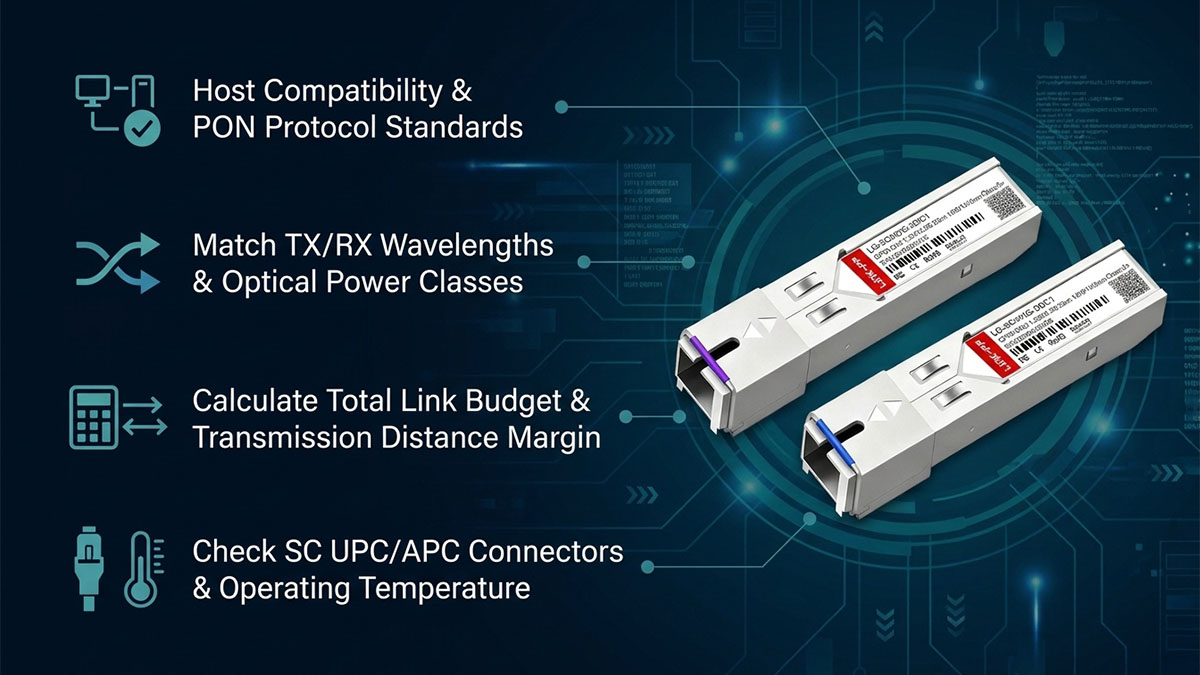
The following considerations provide a practical selection process for GPON, EPON, XG-PON, and XGS-PON deployments.
Confirm OLT Equipment and PON Protocol Compatibility
The first step is to identify the OLT equipment and the PON technology supported by its optical interfaces.
Before selecting an optical module, check:
-
OLT manufacturer and exact equipment model.
-
Supported PON standards, such as GPON, EPON, XG-PON, or XGS-PON.
-
Supported optical module form factors.
-
Electrical interface and host-side requirements.
-
Vendor coding and module recognition requirements.
-
Firmware and software compatibility.
-
Whether the platform supports conventional transceivers or integrated PON MAC modules.
A module with the correct physical dimensions may still fail to operate if its electrical interface or functional architecture is incompatible with the host.
This is particularly important for integrated GPON OLT SFP sticks, which require appropriate host support for their PON MAC functionality.
Match Wavelength and Optical Class
Wavelength and optical class must match the intended PON architecture.
For example, a GPON OLT module typically transmits at 1490nm and receives at 1310nm, while a GPON ONU module transmits at 1310nm and receives at 1490nm.
Engineers should verify:
-
Downstream and upstream wavelength assignments.
-
OLT and ONU optical interface specifications.
-
Supported GPON or XGS-PON optical classes.
-
Transmit power and receiver sensitivity.
-
Minimum and maximum optical path loss.
-
Compatibility with existing WDM coexistence equipment, if applicable.
An incorrect wavelength configuration can prevent the optical link from operating even when the module fits physically.
Similarly, an optical class mismatch may cause insufficient link margin or an interface specification violation. The complete OLT-to-ONU optical path should be evaluated against the relevant standard.
Evaluate Transmission Distance and Optical Link Budget
Transmission distance and optical budget are closely related, but they are not interchangeable specifications.
A module advertised for 20km does not guarantee that every 20km PON deployment will work. The actual reach depends on the total optical loss and the applicable system constraints.
A practical link-budget assessment should include:
-
Measure or estimate the total fiber length.
-
Calculate fiber attenuation at the relevant operating wavelengths.
-
Determine passive splitter insertion loss.
-
Include connector and splice losses.
-
Account for WDM filters and other optical components.
-
Compare the calculated loss with the supported optical class.
-
Reserve sufficient engineering margin.
For example, a long fiber route with a high split ratio may exceed the available optical budget even if the OLT transceiver is specified for a nominal 20km reach.
Conversely, a short network with a high-power optical interface may require attention to receiver overload limits or minimum optical path loss requirements.
A complete optical power calculation is therefore more reliable than selecting a module based only on its advertised transmission distance.
Check Connector Type and Operating Environment
Physical interface requirements are another important part of OLT module selection.
Before installation, confirm the following:
-
Connector: Verify whether the optical interface requires SC/UPC or SC/APC.
-
Fiber type: Confirm compatibility with single-mode fiber.
-
Temperature range: Select commercial or industrial temperature specifications according to the installation environment.
-
Digital diagnostics: Check whether DDM/DOM is supported and whether the host can read diagnostic information.
-
Mechanical compatibility: Confirm the module dimensions, latch mechanism, and port requirements.
-
Power and electrical interface: Ensure the host supplies the required electrical and power conditions.
SC/APC and SC/UPC connectors should not be directly connected because their end-face geometries differ. Appropriate matching connectors and adapters are necessary to maintain optical performance and prevent connector damage.
Industrial-temperature modules can be useful in telecom cabinets, outdoor equipment enclosures, and other environments where temperatures fluctuate more widely.
By checking these specifications before deployment, network engineers can reduce compatibility problems and avoid unnecessary equipment replacement.
Common OLT Deployment Applications and Network Scenarios
OLT equipment is widely deployed in fiber access networks, including residential broadband, enterprise connectivity, mobile backhaul, and multi-dwelling unit infrastructure. Its ability to manage multiple subscribers over shared fiber makes it suitable for different network scales and service requirements.
The choice of PON technology depends on the required bandwidth, subscriber density, existing infrastructure, and operational objectives.
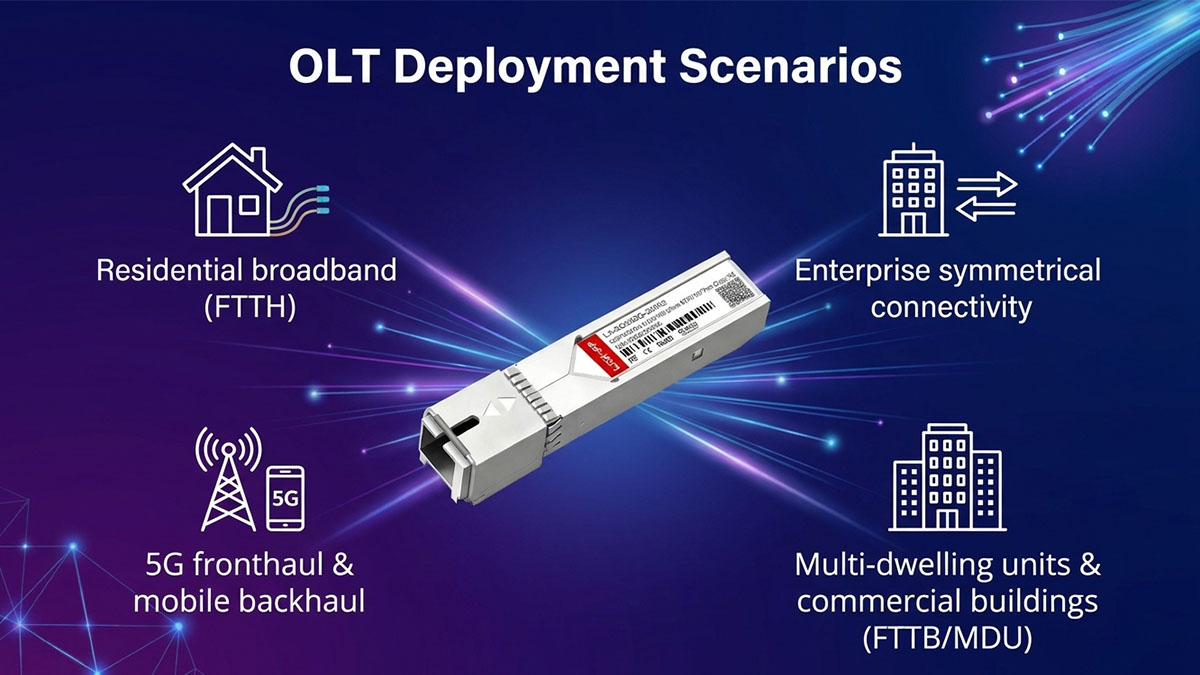
Fiber-to-the-Home (FTTH) Networks
FTTH is one of the most common applications of OLT equipment. In an FTTH network, the OLT connects the service provider's access infrastructure to residential ONUs or ONTs through passive optical splitters.
A typical FTTH deployment includes:
-
An OLT installed at a central office or access site.
-
Feeder fiber connecting the OLT to an optical distribution point.
-
Passive splitters distributing optical signals.
-
Distribution fiber connecting individual homes.
-
ONTs providing Ethernet, Wi-Fi, and other subscriber services.
GPON remains widely used in residential broadband because it offers an established access architecture and supports multiple subscribers through a shared fiber infrastructure.
For networks requiring higher bandwidth, XGS-PON provides symmetrical 10G-class transmission and can support higher-speed residential broadband packages.
The main benefits of OLT-based FTTH include:
-
High-capacity fiber connectivity.
-
Centralized subscriber management.
-
Reduced reliance on powered equipment in the outside plant.
-
Flexible subscriber expansion through splitter-based distribution.
-
Support for different bandwidth and service profiles.
Enterprise Fiber Access and Business Connectivity
Enterprise networks often require more predictable bandwidth, reliable connectivity, and support for multiple business applications.
OLT-based fiber access can provide connectivity for:
-
Corporate offices.
-
Business parks.
-
Commercial buildings.
-
Educational institutions.
-
Cloud service access.
-
Managed enterprise network services.
XGS-PON is particularly relevant when symmetrical bandwidth is required for cloud applications, video conferencing, remote collaboration, and large data transfers.
Compared with traditional residential access, enterprise deployments may require more carefully defined service-level agreements, bandwidth allocation policies, and traffic prioritization.
The OLT can help service providers manage these requirements through subscriber profiles, VLAN configuration, QoS policies, and centralized monitoring.
5G Fronthaul and Mobile Backhaul
Mobile networks require high-capacity fiber connectivity to connect radio access equipment with aggregation and core network infrastructure.
PON technology can support selected mobile backhaul and fronthaul-related architectures, depending on latency, synchronization, bandwidth, and functional split requirements.
Potential applications include:
-
Fiber connectivity between distributed mobile sites and aggregation locations.
-
Mobile backhaul for cellular base stations.
-
Enterprise and small-cell access networks.
-
Selected 4G and 5G transport scenarios.
XGS-PON offers symmetrical bandwidth that can support certain mobile transport applications. However, not every PON architecture is suitable for every 5G fronthaul deployment.
Engineers must evaluate latency, timing synchronization, jitter, traffic prioritization, and available capacity before selecting a PON-based mobile transport solution.
The OLT's scheduling capabilities and optical interface specifications are particularly important in these scenarios.
FTTB and Multi-Dwelling Unit Deployments
Fiber-to-the-Building (FTTB) networks use OLT equipment to connect multiple apartments, offices, or business units through a shared optical distribution network.
In a typical MDU deployment:
-
The OLT connects to the building through feeder fiber.
-
Passive splitters distribute optical signals to different floors or distribution points.
-
ONUs are installed in communication rooms or subscriber locations.
-
Ethernet connections deliver services to individual apartments or offices.
This approach can reduce the amount of dedicated feeder fiber required compared with separate point-to-point connections for every subscriber.
Important design considerations include:
-
Number of subscribers per building.
-
Splitter placement and split ratio.
-
Fiber routing and installation constraints.
-
Available optical power budget.
-
Bandwidth allocation among subscribers.
-
Future expansion requirements.
GPON can be suitable for many existing MDU deployments, while XGS-PON can support higher-capacity access where demand for symmetrical bandwidth is increasing.
Common OLT Problems and Troubleshooting Tips
Common OLT problems include ONU registration failures, low optical power, module incompatibility, and upstream or downstream performance issues. These problems can often be traced to incorrect optical specifications, fiber connection faults, configuration errors, or insufficient network capacity.
A systematic troubleshooting process should examine the physical optical link first, followed by module compatibility, PON configuration, and traffic performance.
OLT Cannot Detect or Register an ONU
When an OLT cannot detect or register an ONU, the issue may originate from the optical connection, authentication settings, PON configuration, or equipment compatibility.
Start troubleshooting with the following checks:
-
Verify that the fiber patch cords are connected to the correct OLT and ONU ports.
-
Inspect and clean optical connector end faces.
-
Confirm that the ONU supports the same PON technology as the OLT.
-
Check ONU serial number registration and authentication settings.
-
Verify the PON port configuration.
-
Measure the received optical power at the relevant interfaces.
-
Review OLT alarms, event logs, and ONU registration records.
For GPON networks, ensure that the OLT and ONU operate within the required wavelength and optical interface specifications.
If the physical optical connection is healthy but registration still fails, investigate the ONU authentication process, service profiles, and firmware compatibility.
Low Optical Power or Unstable PON Connections
Low optical power can cause intermittent connections, ONU disconnections, and degraded PON performance.
Common causes include:
-
Dirty optical connector end faces.
-
Excessive fiber bending.
-
Damaged or poorly installed fiber.
-
High splitter insertion loss.
-
Excessive connector or splice loss.
-
Incorrect optical class selection.
-
Excessive transmission distance.
A practical troubleshooting procedure includes:
-
Inspect and clean all accessible optical connectors.
-
Check the fiber route for sharp bends or visible damage.
-
Measure optical power at the OLT and ONU interfaces where accessible.
-
Compare the measured values with the module's specified transmit and receive ranges.
-
Review splitter loss and total ODN attenuation.
-
Recalculate the optical link budget if the measured power remains outside the expected range.
It is important to distinguish between insufficient received power and excessive received power. Both conditions can affect optical receiver performance.
For stable operation, the received optical power must remain within the supported receiver sensitivity and overload limits.
OLT Optical Module Compatibility Issues
An OLT may fail to recognize an optical module or establish a PON link when the module does not meet the host equipment's requirements.
Typical causes include:
-
Incorrect form factor.
-
Unsupported vendor coding.
-
Incompatible electrical interface.
-
Incorrect PON protocol.
-
Wavelength mismatch.
-
Unsupported optical class.
-
Incompatible integrated PON MAC functionality.
-
Firmware or software restrictions.
To identify the problem:
-
Check the OLT's supported optical module list.
-
Verify the exact equipment model and firmware version.
-
Compare the module's specifications with the host requirements.
-
Confirm the upstream and downstream wavelength assignments.
-
Check whether the platform supports the module's management and diagnostic functions.
-
Review module alarms and DDM/DOM information when available.
A module that physically fits the OLT port is not necessarily functionally compatible.
When evaluating replacement modules, use the equipment manufacturer's specifications and the module supplier's compatibility information rather than relying solely on matching part numbers or physical dimensions.
Bandwidth and Performance Problems
When subscribers experience slow speeds or inconsistent network performance, the issue may involve bandwidth allocation, PON port utilization, traffic congestion, or upstream capacity.
Common troubleshooting areas include:
-
DBA configuration: Check whether upstream bandwidth allocation matches subscriber service profiles.
-
PON port utilization: Review the number of connected subscribers and total traffic demand.
-
QoS policies: Verify that traffic prioritization and service classifications are configured correctly.
-
Uplink congestion: Check whether aggregation or uplink interfaces have sufficient capacity.
-
Optical errors: Investigate abnormal optical levels, packet errors, and interface alarms.
-
Subscriber equipment: Confirm that ONU Ethernet ports and customer-side devices support the expected data rates.
A PON network shares available bandwidth among multiple subscribers, so the actual throughput experienced by an individual user depends on traffic demand, service configuration, and network capacity.
If utilization consistently approaches available capacity, the service provider may need to adjust bandwidth policies, redistribute subscribers, upgrade uplink capacity, or migrate selected access segments to higher-capacity PON technology.
Conclusion
An OLT (Optical Line Terminal) is the central component of a modern Passive Optical Network, connecting service provider infrastructure with multiple ONUs and ONTs through optical fiber. From GPON and EPON to XG-PON and XGS-PON, different OLT technologies provide varying bandwidth capabilities, optical interfaces, and deployment options for residential, enterprise, and mobile access networks.
Selecting the right OLT equipment and optical modules requires attention to more than transmission speed. PON protocol compatibility, wavelength, optical class, link budget, connector type, and host equipment requirements all affect network reliability.
Key points to remember:
-
OLT equipment manages downstream transmission, upstream scheduling, and ONU connectivity.
-
GPON, EPON, XG-PON, and XGS-PON differ in standards, data rates, and wavelength plans.
-
OLT and ONU optical modules use opposite transmit and receive wavelength directions.
-
Optical class and total ODN loss determine whether a PON link can operate reliably.
-
Host compatibility must be verified, especially for integrated PON MAC SFP modules.
-
Regular optical power monitoring and systematic troubleshooting help maintain network performance.
At LINK-PP, we provide fiber optic transceiver solutions for different access network requirements, including GPON OLT SFP and ONU SFP modules. Our technical team can help identify suitable alternatives based on original optical module part numbers, equipment models, and required specifications.
Visit the LINK-PP Official Store to explore compatible optical modules. You can use our Compatibility Tool to identify suitable alternatives to original transceivers and request a quotation for your project. Meanwhile, we offer a 15-day no-reason return or exchange policy. If a product has a confirmed quality issue, LINK-PP covers the return shipping cost.