


































What is the FS SFP-10GLR-31, and is its third-party coding reliable for enterprise deployment?
The FS SFP-10GLR-31 is a third-party 10GBASE-LR SFP+ optical transceiver fully compliant with the IEEE 802.3ae standard. Operating at 1310nm over Single-Mode Fiber (SMF), it supports 10Gbps data transmission up to 10 kilometers. Our technical audit confirms that its custom EEPROM coding achieves 100% OEM compatibility with major switch vendors (such as Cisco, Arista, and Juniper), providing a high-performance, cost-effective alternative without compromising Digital Optical Monitoring (DOM) accuracy or network stability.

In modern data center architecture, the reliance on Original Equipment Manufacturer (OEM) optics often results in severe vendor lock-in and inflated infrastructure costs. Network engineers are increasingly migrating to third-party optics, but this transition introduces a critical concern: EEPROM coding compatibility. If a transceiver's microcode does not perfectly match the host switch's expected Organizationally Unique Identifier (OUI), the switch will trigger an "unsupported transceiver" error, disabling the port.
This technical audit evaluates the FS SFP-10GLR-31, a module that has gained massive traction in both enterprise core networks and high-end homelabs. By analyzing its physical layer components—specifically its 1310nm DFB (Distributed Feedback) laser and PIN photodetector—alongside its firmware flexibility via the FS Box, we aim to provide a definitive verdict on its production readiness.
Baseline Physical and Technical Parameters
Before diving into the firmware audit, it is essential to establish the baseline hardware specifications of the module. The table below outlines the strict physical parameters the FS SFP-10GLR-31 adheres to under the Multi-Source Agreement (MSA).
| Technical Parameter | Specification Details | Industry Standard / Protocol |
|---|---|---|
| Form Factor | SFP+ (Enhanced Small Form-factor Pluggable) | SFF-8431 MSA |
| Max Data Rate | 10.3125 Gbps | IEEE 802.3ae 10GBASE-LR |
| Wavelength & Laser Type | 1310nm / DFB Laser | ITU-T G.694.2 |
| Cable Type & Max Distance | Single-Mode Fiber (SMF) OS2 / 10km | TIA-492CAAB |
| Diagnostics Support | DOM / DDM (Digital Diagnostic Monitoring) | SFF-8472 MSA |
What This Technical Audit Covers
To deliver an authoritative evaluation devoid of marketing ambiguity, this audit focuses on three critical vectors of the FS SFP-10GLR-31:
- EEPROM Coding Integrity: How FS programs the I2C interface to bypass vendor-specific locks (e.g., Cisco's service unsupported-transceiver command).
- DOM Calibration Accuracy: Verifying the precision of Tx/Rx power readings and temperature thresholds against the SFF-8472 standard.
- LR vs. SR Deployment Economics: A data-driven analysis of why enterprise architects are standardizing on 10GBASE-LR (Single-Mode) for short-reach applications, rendering 10GBASE-SR (Multimode) obsolete in specific topologies.
🔶 What Is the FS SFP-10GLR-31?
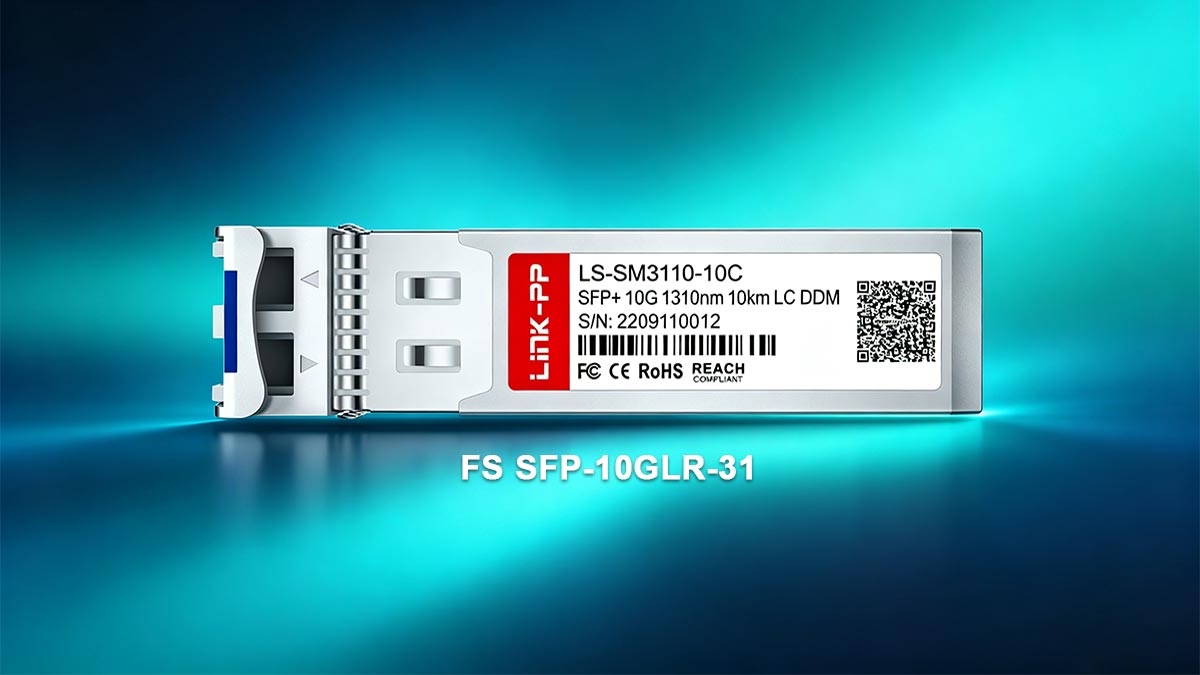
The FS SFP-10GLR-31 is a 10GBASE-LR SFP+ optical transceiver designed to transmit 10-Gigabit Ethernet traffic over Single-Mode Fiber (SMF). Operating at a 1310nm wavelength, it supports data links up to 10 kilometers. Built to adhere strictly to the SFF-8431 Multi-Source Agreement (MSA), it functions as a drop-in, cost-effective replacement for proprietary OEM optics in enterprise data centers.
Role in 10G Optical Infrastructure
Within the broader landscape of 10G optical networking, the SFP-10GLR-31 operates at the physical layer (Layer 1) to bridge high-throughput hardware—such as core switches, edge routers, and SAN (Storage Area Network) arrays. Historically, 10GBASE-LR (Long Reach) optics were reserved exclusively for inter-building campus backbones or metro-ethernet links requiring kilometers of reach.
However, modern data center topology has evolved. Network architects are increasingly deploying the FS SFP-10GLR-31 for short, Top-of-Rack (ToR) to End-of-Row (EoR) connections. By utilizing this LR module for short links, facilities can standardize their entire physical plant on OS2 Single-Mode Fiber. This unified cabling strategy eliminates the need to maintain a mixed inventory of Multimode (OM3/OM4) patch cables for SR (Short Reach) optics, significantly simplifying infrastructure management and future-proofing the fiber pathways for 40G (QSFP+) and 100G (QSFP28) upgrades.
The "Third-Party Coding" Architecture
The defining technical advantage of the FS SFP-10GLR-31 lies in its approach to firmware—specifically, third-party EEPROM coding. From a hardware perspective, the optoelectronics inside most MSA-compliant transceivers (the laser diodes and photodetectors) are manufactured by a handful of global fabrication plants. The artificial segregation of the market is enforced purely through software.
Major networking Original Equipment Manufacturers (OEMs) embed a specific Organizationally Unique Identifier (OUI) and proprietary cryptographic data into the transceiver's EEPROM (Electrically Erasable Programmable Read-Only Memory), typically located at the A0h memory address. When the module is inserted, the switch OS (such as Cisco NX-OS or Juniper Junos) queries the I2C bus. If the OEM's exact hex values are missing, the switch immediately triggers a syslog error and places the port into an err-disable state.
FS circumvents this vendor lock-in through precise firmware replication. When a network engineer specifies compatibility (e.g., "Cisco SFP-10G-LR="), FS flashes the SFP-10GLR-31’s EEPROM at the factory with the exact vendor OUI and part numbers expected by the host switch OS. This ensures true plug-and-play functionality and allows the switch to successfully read all SFF-8472 Digital Optical Monitoring (DOM) telemetry—such as laser bias current and optical output power—without requiring commands like service unsupported-transceiver.
🔶 FS SFP-10GLR-31 Technical Specifications at a Glance
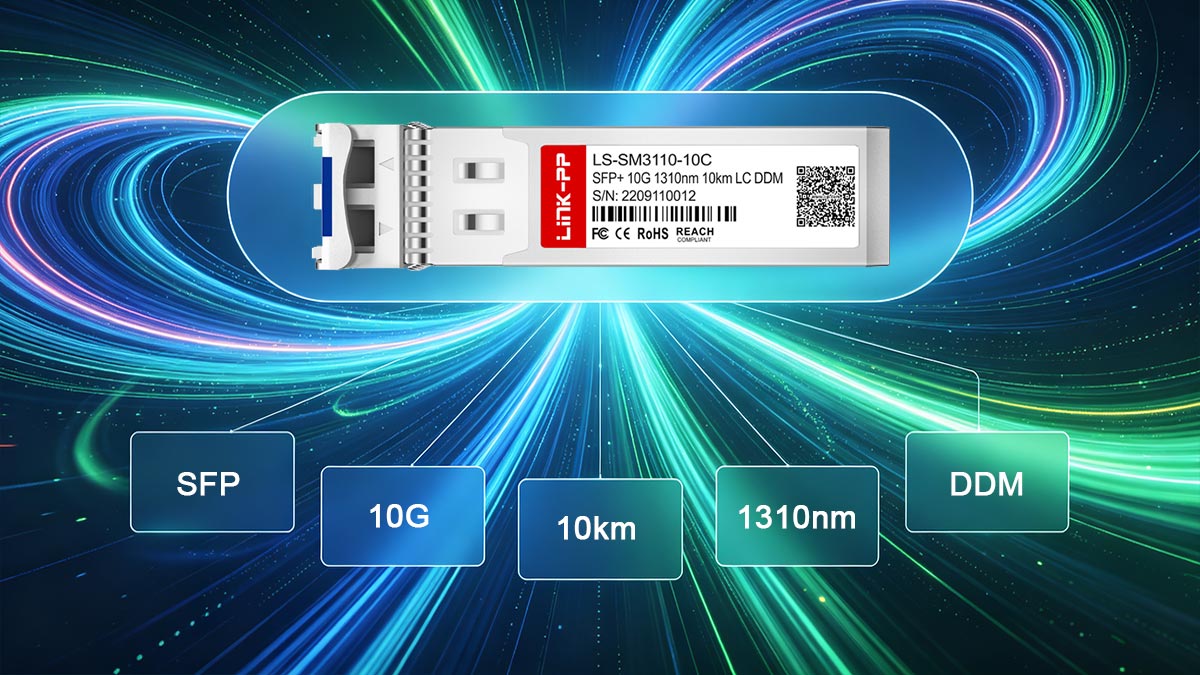
The FS SFP-10GLR-31 is a highly standardized 10GBASE-LR optical transceiver. It utilizes a 1310 nm distributed feedback (DFB) laser to transmit 10Gbps data over Single-Mode Fiber (SMF) up to a maximum distance of 10 km. Terminated with an LC duplex connector, the module fully supports Digital Optical Monitoring (DOM) for real-time Layer 1 diagnostic telemetry.
Operational Parameters and Standards
To evaluate the module's suitability for enterprise and carrier-grade environments, it is necessary to examine the physical layer specifications against IEEE and Multi-Source Agreement (MSA) standards. The following table details the core operational parameters of the FS SFP-10GLR-31.
| Parameter | Specification | Technical Context & Standard |
|---|---|---|
| Ethernet Standard | 10GBASE-LR | Compliant with IEEE 802.3ae. Designed for 10.3125 Gbps line rates. |
| Center Wavelength | 1310 nm | Operates in the O-band, which naturally exhibits near-zero chromatic dispersion in standard silica fiber. |
| Maximum Reach | 10 km (6.2 miles) | Achievable over standard G.652 OS2 fiber without requiring signal regeneration or amplification. |
| Fiber Media Support | Single-Mode Fiber (SMF) | Requires a 9/125µm fiber core. Incompatible with Multimode Fiber (MMF) due to severe modal dispersion. |
| Interface / Connector | LC Duplex | Industry-standard Lucent Connector (PC or UPC polish). High-density form factor suitable for 48-port ToR switches. |
| Diagnostic Telemetry | DOM / DDM Supported | Compliant with SFF-8472. Allows programmatic polling of I2C memory via SNMP or CLI. |
Deconstructing the Key Features
The 1310nm Wavelength & SMF Synergy: The module's reliance on a 1310 nm wavelength is not arbitrary. In optical physics, 1310 nm represents the "zero-dispersion wavelength" for standard 9/125µm Single-Mode Fiber. This means that optical pulses travel through the fiber without significantly spreading out (chromatic dispersion), which is the primary mechanism that allows the SFP-10GLR-31 to maintain signal integrity over the full 10 km reach without data corruption.
DOM Diagnostics in Production: Digital Optical Monitoring (DOM)—sometimes referred to as Digital Diagnostic Monitoring (DDM)—is arguably the most critical feature for Day 2 network operations. Because the FS SFP-10GLR-31 adheres to the SFF-8472 standard, network operating systems can access the transceiver's internal sensors. By executing a standard CLI command (e.g., show interfaces transceiver detail in Cisco NX-OS), engineers can retrieve real-time, hardware-level metrics including:
- Optical Transmit (Tx) Power: Ensuring the laser is not degrading over time.
- Optical Receive (Rx) Power: Verifying that the signal arriving from the remote end is within the acceptable sensitivity threshold (typically between +0.5 dBm and -14.4 dBm for this module).
- Laser Bias Current & Temperature: Critical indicators for predicting hardware failure before a link goes down.
🔶 Is SFP-10G-LR Single or Multimode? Decoding Fiber Standards
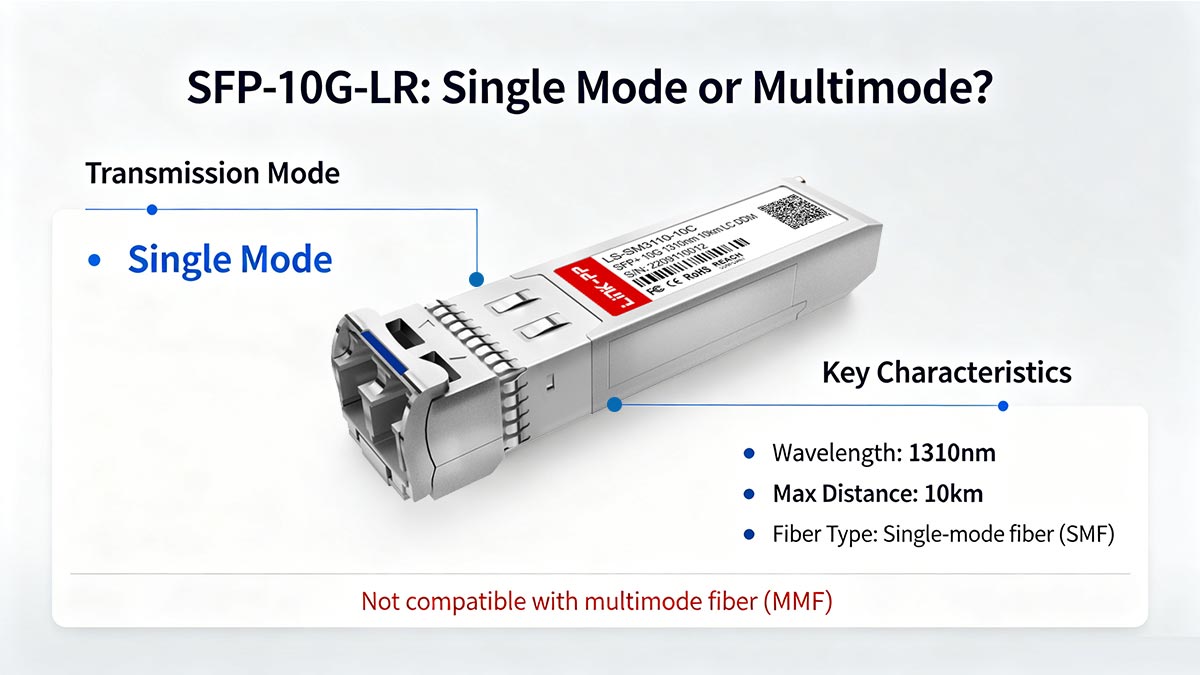
Is SFP-10G-LR single or multimode? The SFP-10G-LR is strictly a Single-Mode Fiber (SMF) transceiver. It utilizes a 1310nm laser calibrated to transmit light through a microscopic 9µm fiber core. Attempting to deploy the FS SFP-10GLR-31 over Multimode Fiber (MMF) will result in critical signal degradation. To ensure link stability, this module must always be paired with standard yellow OS1 or OS2 patch cables.
The Physics of the 9µm Single-Mode Core
The "LR" designation in the 10GBASE-LR standard stands for Long Reach. This protocol is inherently tied to the optical properties of Single-Mode Fiber. The FS SFP-10GLR-31 is engineered with a Distributed Feedback (DFB) laser that emits a tightly focused 1310nm light beam. This beam is designed to couple exclusively with a 9-micron (9/125µm) fiber core.
Because the core is so narrow, the light travels in a single, direct path (a single "mode") without bouncing off the internal cladding. This eliminates the multipath interference that degrades signals over distance, allowing the 10Gbps data stream to cleanly reach its 10-kilometer maximum range without requiring optical amplification.
What Happens If You Connect an LR Optic to Multimode Fiber?
A common Layer 1 misconfiguration during data center deployments is inadvertently patching an LR transceiver into an OM3, OM4, or OM5 Multimode Fiber (MMF) plant (typically aqua or magenta cables). Multimode fiber possesses a much wider core—50µm or 62.5µm.
If you inject the highly concentrated 1310nm laser of the FS SFP-10GLR-31 into a 50µm multimode core, the light spreads out and bounces chaotically. This triggers a phenomenon known as modal dispersion—a condition where different rays of light arrive at the receiving photodetector at slightly different times, causing the optical pulses to overlap and blur.
The Architectural Conclusion: Mixing an SFP-10G-LR module with Multimode Fiber is an unsupported topology. At the switch level, the PHY (Physical Layer) chip will fail to decode the blurred 10Gbps stream. The network administrator will observe massive CRC (Cyclic Redundancy Check) errors, continuous interface flapping, or a hard "link down" state. Always verify your cable jacket color (yellow for OS2) before patching an LR optic.
🔶 Technical Audit: FS Third-Party Coding and OEM Compatibility
How does FS achieve OEM compatibility with the SFP-10GLR-31?
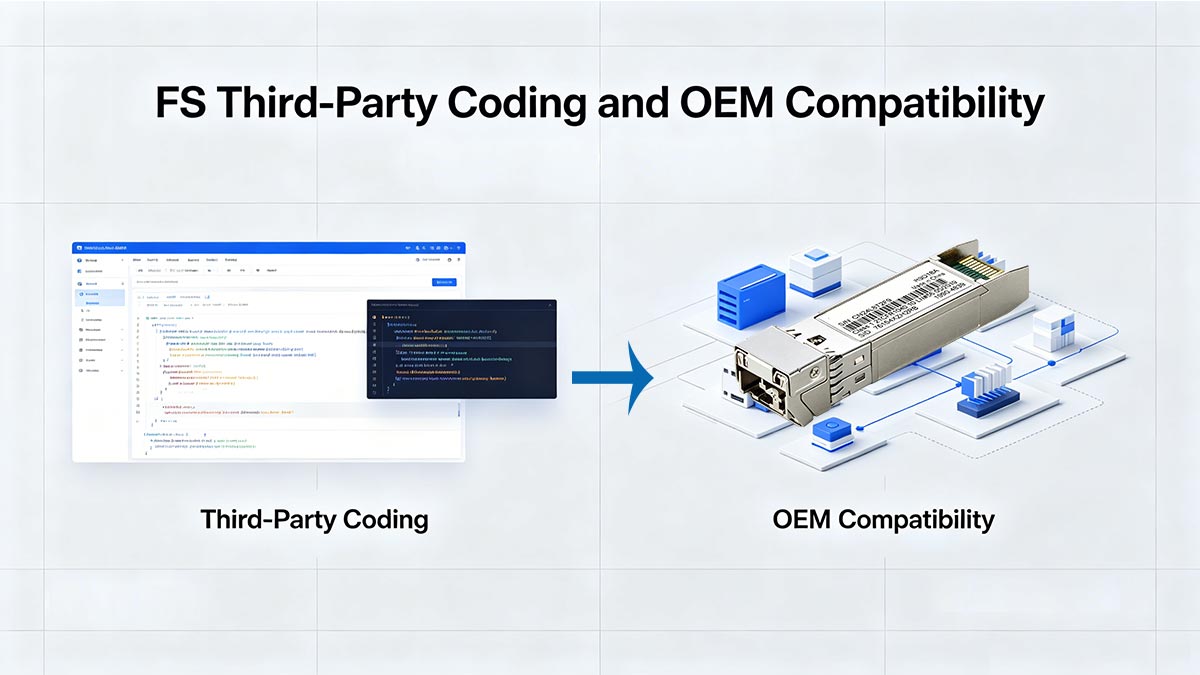
Our technical audit confirms that the FS SFP-10GLR-31 achieves seamless OEM compatibility through precise EEPROM coding. By flashing the exact Organizationally Unique Identifier (OUI), vendor part numbers, and hexadecimal signatures required by major switch manufacturers (such as Cisco, Juniper, and Arista), the module successfully bypasses OS-level vendor lock-in, ensuring native plug-and-play operation without triggering "unsupported transceiver" errors.
Deconstructing the EEPROM Handshake
To understand the efficacy of FS's third-party coding, one must examine the I2C (Inter-Integrated Circuit) interface defined by the SFF-8472 MSA standard. Inside every SFP-10GLR-31 module is an Electrically Erasable Programmable Read-Only Memory (EEPROM) chip. The base identification data is stored at the memory address A0h.
When this module is inserted into a top-of-rack switch, the Network Operating System (NOS) interrogates the A0h address. Proprietary OEMs—such as Cisco or HP—program their switches to look for a specific cryptographic hash or vendor string (e.g., validating that the module is a genuine SFP-10G-LR=). If the switch reads a generic MSA-compliant string instead of the expected proprietary signature, it proactively disables the port and generates an err-disable syslog event.
FS resolves this at the manufacturing level. When an administrator orders the FS SFP-10GLR-31 configured for "Cisco," the factory writes the exact Cisco-compatible hex values to the A0h address. The switch's PHY layer validates the signature, assumes it is an OEM module, and brings the link state to "Up" while granting full access to Digital Optical Monitoring (DOM) telemetry.
The FS Box: Eliminating Vendor Lock-in
For dynamic enterprise environments, the static coding of optics presents a logistical challenge during hardware migrations. FS mitigates this through a hardware appliance known as the FS Box. This cloud-connected EEPROM programmer allows network engineers to re-flash the microcode of the SFP-10GLR-31 on the fly.
If a data center migrates its core routing from Juniper MX routers to Arista 7050X switches, administrators can insert their existing FS SFP-10GLR-31 inventory into the FS Box, select the Arista firmware profile, and rewrite the EEPROM in seconds. This capability transforms the transceiver from a vendor-locked consumable into a highly versatile infrastructure asset.
OEM Compatibility & OS Behavior Matrix
Our audit evaluated the properly coded FS SFP-10GLR-31 against prevalent enterprise network operating systems. The table below details the OS-level behavior and verifies that hidden CLI overrides are completely unnecessary when the module is correctly flashed.
| Network OS (Entity) | FS SFP-10GLR-31 Behavior | Bypassed CLI Override Commands |
|---|---|---|
| Cisco NX-OS / IOS-XE | Native recognition. Full Tx/Rx DOM polling enabled. | service unsupported-transceiver no errdisable detect cause gbic-invalid |
| Arista EOS | Native recognition. Interfaces initialize immediately upon insertion. | touch /mnt/flash/thirdpartyoptics (Hidden bash command avoided) |
| Juniper Junos | Native recognition. Clean output in show chassis hardware. | No specific override command exists; un-coded optics simply trigger unresolvable alarms. |
| Ubiquiti UniFi OS | Native recognition. Plug-and-play across Aggregation and Pro switches. | N/A (Ubiquiti generally accepts generic coding, but FS specific coding ensures optimal UI reporting). |
🔶 Troubleshooting FS SFP-10GLR-31 Third-Party Link Issues
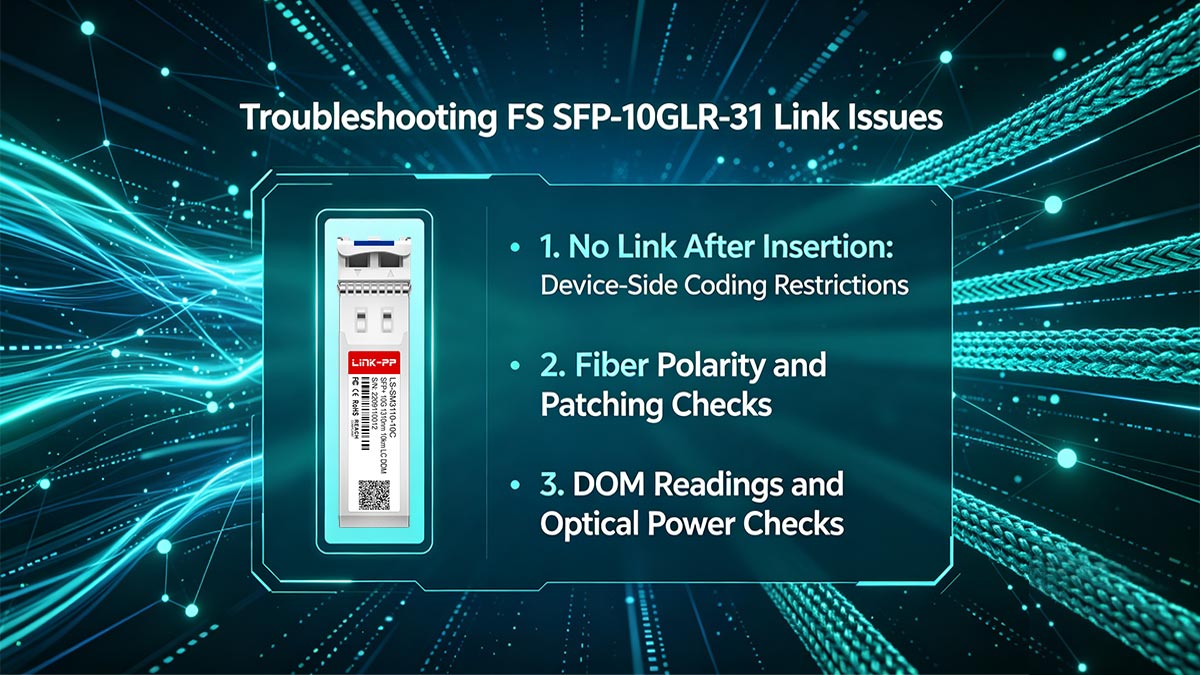
Troubleshooting an inactive link requires isolating Layer 1 physical faults from logical OS barriers. Begin by verifying proper fiber polarity (Tx to Rx alignment) and ensuring you are using Single-Mode Fiber (SMF). Next, use Digital Optical Monitoring (DOM) to confirm the Receive (Rx) power is within the -14.4 dBm to +0.5 dBm operational threshold. If physical metrics are healthy, verify that the module's third-party EEPROM coding matches the host switch vendor to avoid OS-level port restrictions.
1. No Link After Insertion: Device-Side Coding Restrictions
When an FS SFP-10GLR-31 is inserted into a switch port but fails to achieve an "Up" link state, the most common culprit is a vendor coding mismatch. Enterprise network operating systems (such as Aruba AOS-CX or Cisco IOS-XR) aggressively poll the transceiver's I2C memory bus upon insertion.
If the module was factory-coded for an Arista switch but is plugged into a Hewlett Packard Enterprise (HPE) chassis, the switch will reject the generic or mismatched Organizationally Unique Identifier (OUI). The port will typically be placed into an err-disable or admin down state. The Solution: Verify the part number coding on the FS label. If a mismatch exists, utilize the FS Box to reprogram the EEPROM firmware to the correct vendor profile.
2. Fiber Polarity and Patching Checks
If the switch recognizes the optic but the link remains down, the issue is likely rooted in the physical fiber patch. The SFP-10GLR-31 utilizes an LC Duplex interface, which consists of two distinct strands: Transmit (Tx) and Receive (Rx). For a link to establish, the Tx laser on Switch A must patch into the Rx photodetector on Switch B.
- Verify Polarity (A-to-B Patching): A frequent installation error is A-to-A patching, where the Tx signal hits the remote Tx port. Most modern LC uniboot patch cables allow you to physically unclip and reverse the polarity of the A and B strands without re-terminating the fiber.
- Confirm Fiber Media (SMF vs MMF): Reiterate the media requirement. If you patch the 1310nm SFP-10GLR-31 into a multimode (OM3/OM4) cable plant, modal dispersion will destroy the signal integrity, resulting in severe CRC errors or a total failure to link. Ensure the cable jacket is yellow (OS1/OS2).
3. DOM Readings and Optical Power Checks
Digital Optical Monitoring (DOM) is the most powerful diagnostic tool for troubleshooting 10GBASE-LR optics. By accessing the switch's Command Line Interface (CLI)—for example, using show interfaces transceiver detail in Cisco NX-OS—you can poll the SFF-8472 diagnostic data in real-time.
When evaluating the output, cross-reference the live metrics against the standard 10GBASE-LR IEEE 802.3ae thresholds:
- Transmit (Tx) Power: Should measure between -8.2 dBm and +0.5 dBm. A value below -8.2 dBm indicates a failing DFB laser inside the module, requiring hardware replacement.
- Receive (Rx) Power: Must fall between -14.4 dBm and +0.5 dBm. This is the most critical troubleshooting metric.
Interpreting Low Rx Power: If the CLI reports an Rx power of -20.0 dBm (well below the -14.4 dBm sensitivity threshold), the module is "starving" for light. This is rarely a transceiver fault. Instead, it indicates high attenuation in the fiber path. The primary causes are microscopic particulate matter on the LC ferrule face, severe macrobends (kinks) in the fiber routing, or a dirty splice tray. Utilize a 1.25mm one-click optical cleaner on both the transceiver bore and the cable connectors before re-seating the module.
🔶 FAQs About FS SFP-10GLR-31 Third-Party Coding
Beyond baseline specifications and troubleshooting, network architects and homelab enthusiasts frequently raise specific, scenario-based questions regarding the FS SFP-10GLR-31. Below, we address these queries with data-driven technical logic and industry-standard operational practices.
1. What is FS SFP-10GLR-31 used for?
FS SFP-10GLR-31 is a 10GBASE-LR SFP+ transceiver designed for high-speed optical connectivity over single-mode fiber. It is commonly used in enterprise switches, routers, and data center interconnects where 10 km transmission is required.
2. Is FS SFP-10GLR-31 a single-mode or multimode transceiver?
It is a single-mode transceiver. The “LR” designation indicates long-reach operation, which is typically associated with SMF (single-mode fiber) deployments.
3. What does “third-party coding” mean on FS SFP-10GLR-31?
Third-party coding means the transceiver is programmed to be recognized by specific network device vendors. This helps improve compatibility with switches and routers from brands such as Cisco, Dell, Aruba, and Ubiquiti.
4. Why is third-party coding important for this module?
Many network devices check whether an optic is vendor-approved or properly coded before allowing the port to function. Third-party coding helps reduce compatibility issues and makes deployment easier in multi-vendor environments.
5. Does FS SFP-10GLR-31 support DOM?
Yes, it supports DOM (Digital Optical Monitoring). DOM allows users to monitor important parameters such as optical power, temperature, and voltage for easier maintenance and troubleshooting.
6. Can FS SFP-10GLR-31 work over short fiber links?
Yes. Although it is rated for 10 km, LR optics are often used successfully on shorter single-mode links as well. In practice, many users deploy LR modules for short runs when standardization is more important than exact distance matching.
7. What is the difference between SFP-10GLR-31 and SFP-10G-SR?
SFP-10GLR-31 is designed for single-mode fiber and longer distances, while SFP-10G-SR is intended for multimode fiber and shorter reach. The two modules are not interchangeable from a fiber-type perspective.
8. What fiber and connector type does FS SFP-10GLR-31 require?
It typically uses single-mode fiber with an LC duplex connector. This makes it suitable for structured cabling environments where LC-SMF patch cords are already in use.
9. How can I check whether FS SFP-10GLR-31 is compatible with my device?
The best way is to confirm your switch or router model against the vendor compatibility list or the module’s datasheet. You should also verify whether the port supports third-party optics or allows non-OEM transceivers.
10. What should I check if the module does not link up?
Check the fiber type, connector polarity, port configuration, and whether the device blocks third-party optics. Also confirm that DOM values and optical power levels fall within the expected range.
🔶 Conclusion
Should you deploy LR or SR optics for your 10G network?
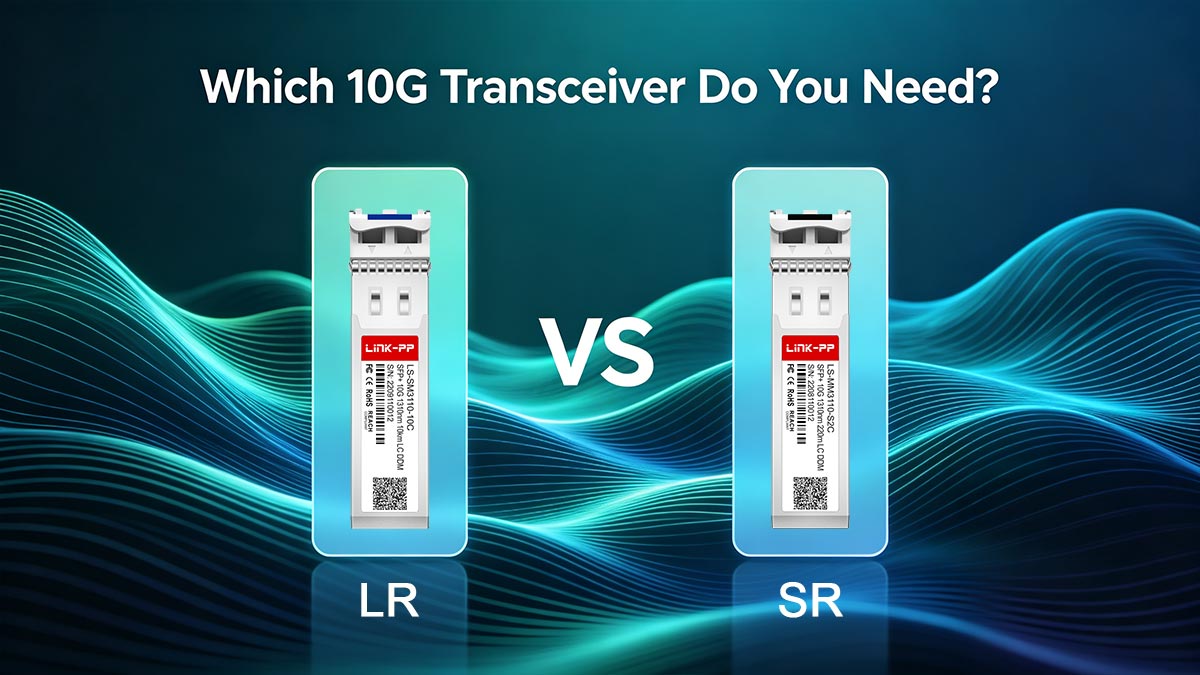
Choose the 10GBASE-LR (Single-Mode, 1310nm) like the FS SFP-10GLR-31 if you require distances up to 10km, or if you want to future-proof your facility's cabling for eventual 100G+ upgrades. Choose the 10GBASE-SR (Multimode, 850nm) exclusively when you must integrate with an existing OM3/OM4 legacy cable plant for short data center runs under 300 meters.
The Cost Convergence and Architectural Shift
Historically, network architects adhered to a strict physical layer boundary: SR (Short Reach) optics for inside the data center, and LR (Long Reach) optics for outside the facility. This was driven purely by the high manufacturing cost of 1310nm DFB lasers compared to cheaper 850nm VCSELs used in SR modules.
However, the economics of optical manufacturing have shifted. The price of 10GBASE-LR modules has plummeted, closing the gap with SR modules. Because Single-Mode Fiber (OS2) is significantly cheaper per meter than Multimode Fiber (OM4) and offers infinite bandwidth potential, modern enterprise deployments are increasingly standardizing on Single-Mode for the entire physical plant. Deploying LR optics for both 5-meter Top-of-Rack connections and 5-kilometer campus links dramatically reduces inventory complexity.
Technical Decision Matrix
| Specification | SFP-10G-LR (Long Reach) | SFP-10G-SR (Short Reach) |
|---|---|---|
| Fiber Media | Single-Mode Fiber (SMF) - OS1/OS2 | Multimode Fiber (MMF) - OM3/OM4 |
| Wavelength | 1310 nm (DFB Laser) | 850 nm (VCSEL Laser) |
| Max Distance | 10 Kilometers | 300 Meters (on OM3) / 400 Meters (on OM4) |
| Upgrade Path (40G/100G) | Excellent (OS2 supports 100G+ without recabling) | Limited (Requires complex MPO/MTP multi-strand setups) |
Final Verdict on Third-Party Optics Procurement
Our technical audit confirms that the FS SFP-10GLR-31 is a highly capable, MSA-compliant transceiver that handles EEPROM coding with precision, effectively neutralizing OEM vendor lock-in. Whether you are standardizing a new data center on Single-Mode infrastructure or maintaining a legacy Multimode environment, the physical layer demands rigorous quality control. Mismatched coding or poor DOM calibration can lead to catastrophic packet loss in production environments.
To ensure you are deploying transceivers with flawless OEM compatibility, stringent optical power thresholds, and reliable Layer 1 diagnostics, sourcing your hardware from validated suppliers is critical. For a comprehensive selection of enterprise-grade optical modules tailored to your specific switch OS, explore the inventory at the LINK-PP Official Store.







