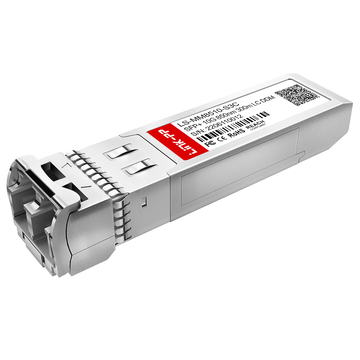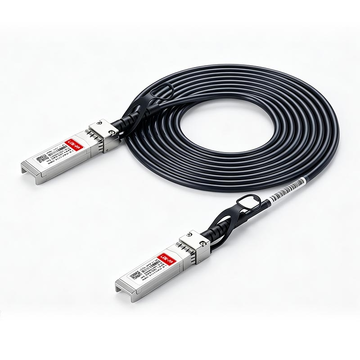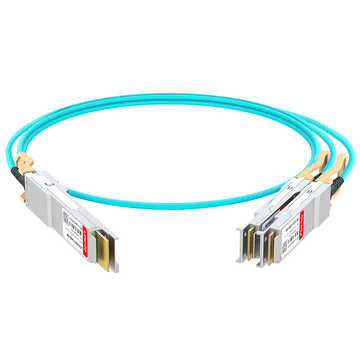
The Cisco SFP-10G-AOC1M is a high-performance 1-meter Active Optical Cable (AOC) designed for 10Gbps SFP+ data transmission. Unlike passive Direct Attach Copper (DAC) cables, the SFP-10G-AOC1M utilizes integrated optoelectronics to provide lighter, more flexible cabling with superior Electromagnetic Interference (EMI) immunity, making it the industry standard for top-of-rack (ToR) server-to-switch connectivity in high-density enterprise environments.
In modern data center architecture, the transition toward 10Gbps throughput mandates a balance between signal integrity and physical cable management. The SFP-10G-AOC1M serves as a pivotal component for network administrators aiming to reduce latency and power overhead within short-range links (typically under 10 meters). By integrating the transceiver module directly into the fiber assembly, the AOC eliminates the insertion loss common in traditional pluggable transceiver configurations (such as the SFP-10G-SR), ensuring consistent 10GBASE-SR performance across Cisco Catalyst and Nexus platforms.
Key Cisco SFP-10G-AOC1M Standards
Procuring the correct SFP-10G-AOC1M requires a strict adherence to hardware compliance standards. Below are the foundational parameters that dictate deployment success:
- Form Factor: SFP+ (Small Form-factor Pluggable Plus) compliant with SFF-8431 and SFF-8472.
- Data Rate: Full-duplex 10.3125 Gbps per channel.
- Reach: 1 meter (3.3 ft), optimized for inter-rack and intra-rack low-latency switching.
- Power Consumption: Generally < 1.0W per end, significantly lower than traditional long-reach optics.
- Compliance: IEEE 802.3ae (10GBASE-SR) and RoHS-6 lead-free standards.
For procurement professionals and network engineers, the primary challenge remains navigating the cost-to-reliability ratio. While official Cisco-branded optics provide guaranteed interoperability and technical support, MSA-compliant (Multi-Source Agreement) alternatives have matured significantly. In the following sections, we will analyze the technical trade-offs between OEM hardware and third-party solutions, providing actionable procurement criteria to ensure your network infrastructure meets both budget requirements and performance benchmarks.
🟣 What Is SFP-10G-AOC1M and How It Works
What is the functional mechanism of the SFP-10G-AOC1M?
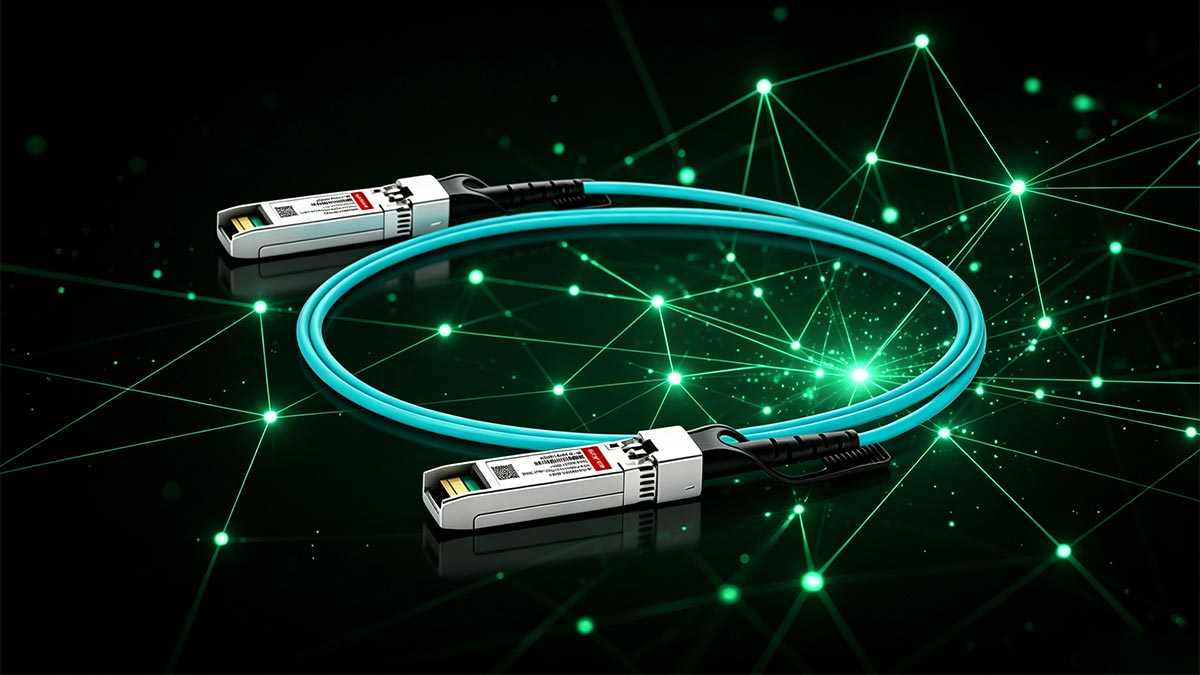
The SFP-10G-AOC1M is an integrated assembly combining SFP+ transceiver modules with a permanently attached multimode fiber optic cable. Unlike passive copper cables, it utilizes active electrical-to-optical conversion circuitry within the connector heads. This enables 10Gbps throughput at a 1-meter reach while maintaining high signal integrity and total immunity to electromagnetic interference (EMI), regardless of cable length or routing density.
Technical Profile and Operational Standards
The SFP-10G-AOC1M adheres to the SFF-8431 and SFF-8472 multi-source agreements (MSA), ensuring physical and electrical compatibility with standard SFP+ switch ports. Its operational characteristics are defined by the following specifications:
- Data Throughput: Rated for 10.3125 Gbps, conforming to the IEEE 802.3ae 10GBASE-SR standard.
- Physical Medium: OM3 or OM4 multimode fiber, pre-terminated to ensure zero insertion loss associated with connector mating.
- Signal Conversion: Active circuitry converts electrical signals from the switch port to optical signals for transmission across the fiber, reconverting at the opposite end.
- Power Efficiency: Operates at a typical power consumption of less than 1W per transceiver end, maintaining a minimal thermal footprint within high-density chassis.
Optimal Use Cases in Network Infrastructure
The selection of an Active Optical Cable over alternative interconnects is driven by specific physical and electrical requirements within the data center environment:
| Use Case | Benefit of SFP-10G-AOC1M |
|---|---|
| High-Density ToR Switching | Small cable diameter allows for improved airflow and easier cable management in congested racks. |
| EMI-Sensitive Environments | Fiber-based transmission provides total immunity to electromagnetic interference, unlike passive copper (DAC) cables. |
| Server-to-Switch Interconnects | Delivers ultra-low latency performance required for high-frequency trading and storage area networks (SAN). |
In high-density environments where cable runs are restricted to 1 meter, the primary differentiator between this AOC and passive Direct Attach Copper (DAC) is weight and bend radius. The SFP-10G-AOC1M offers superior flexibility, which is critical when navigating tight rack spaces or connecting switches where traditional heavy-gauge copper cabling may exert mechanical stress on the SFP+ cage. By centralizing the optoelectronics within the cable assembly, network engineers avoid the complexities of cleaning and inspecting modular fiber patch cables, effectively creating a "plug-and-play" deployment model that minimizes physical layer downtime.
🟣 AOC vs. DAC: Which Short-Reach Interconnect Delivers Better Procurement Value?
When should a network engineer prioritize an Active Optical Cable (AOC) over a Direct Attach Copper (DAC) cable?
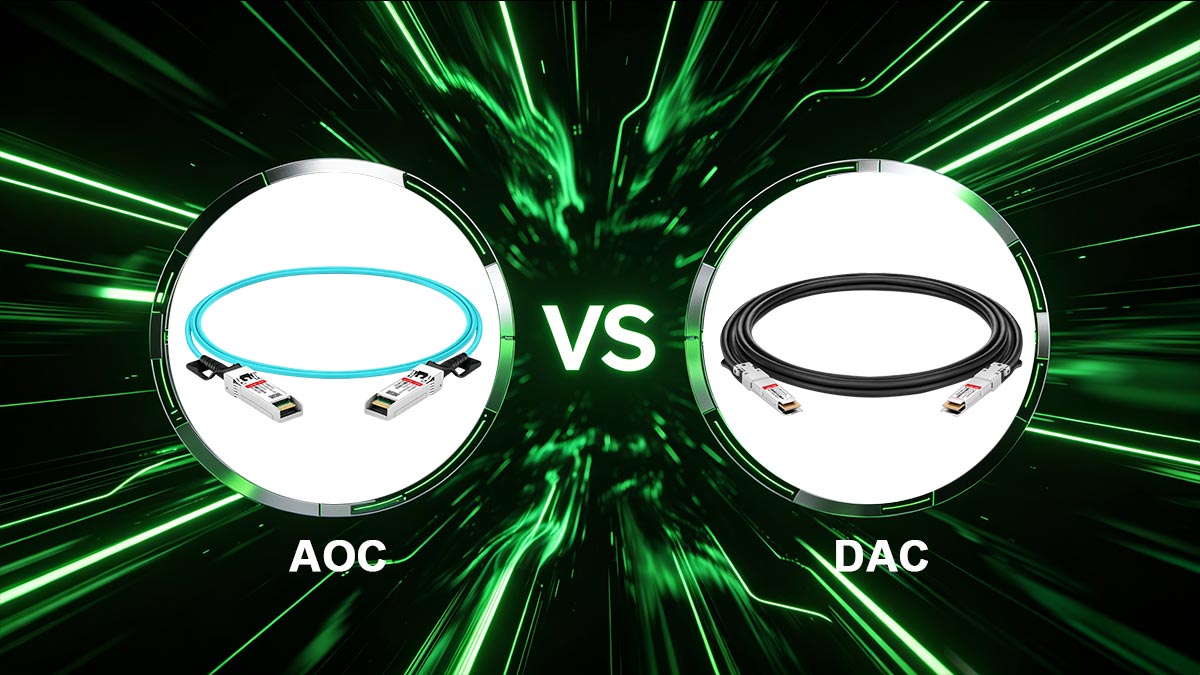
Choose an AOC (e.g., SFP-10G-AOC1M) when the installation environment demands immunity to electromagnetic interference (EMI), restricted cable weight, or superior cable flexibility. While passive DACs are the most cost-effective solution for short-reach, top-of-rack links, they are susceptible to signal degradation and heavy gauge constraints that AOCs effectively eliminate through active optical conversion.
Economic and Operational Cost Analysis
Procurement decisions between DAC and AOC are driven by the specific link budget and physical infrastructure constraints. Passive DACs utilize twinax copper cabling, which is significantly cheaper due to the lack of internal optoelectronics. However, as link distances approach the 1-meter threshold, the following cost and performance trade-offs become critical:
- Capital Expenditure (CapEx): Passive DACs represent the lowest cost-per-link. AOCs command a premium because each connector head incorporates a Transmit/Receive (T/R) optical sub-assembly.
- Operational Expenditure (OpEx): While DACs are passive and consume zero power at the cable level, AOCs require power to drive the active optical conversion circuitry. Though minimal (typically <1W per end), this can scale significantly across high-density switch fabrics.
Comparative Matrix: Interconnect Technology Performance
| Parameter |
Passive DAC (like the SFP-H10GB-CU7M) |
SFP-10G-AOC1M | SFP+ SR + Fiber |
|---|---|---|---|
| Distance | Short (< 7m) | Short/Medium (up to 100m) | Long (> 100m) |
| EMI Immunity | None (Copper-based) | High (Fiber-based) | Total |
| Weight/Flexibility | Heavy/Stiff | Light/Very Flexible | Light/Modular |
Strategic Selection Criteria: When to Choose AOC
Network architects must look beyond simple distance metrics when deciding on an interconnect. The SFP-10G-AOC1M is the preferred solution in the following high-performance scenarios:
- Signal Integrity in Dense Racks: Copper cables are prone to crosstalk and attenuation in high-density installations. The optical path in an AOC eliminates these electrical noise floor issues, ensuring sustained 10GBASE-SR link stability.
- Physical Layer Constraints: In legacy server racks with limited space for cable management, the thin diameter of fiber-optic cabling prevents the physical strain often placed on SFP+ ports by rigid, thick-gauge twinax copper.
- EMI Mitigation: When routing data links near power distribution units (PDUs) or high-current electrical cabling, the dielectric nature of optical fiber prevents the induction of electrical interference, protecting data frames from CRC (Cyclic Redundancy Check) errors.
Ultimately, while DAC remains the standard for cost-optimized intra-rack connectivity, the SFP-10G-AOC1M provides a refined, high-availability alternative. It bridges the gap between the low-cost passive copper and the complexity of individual modular SFP+ transceivers, offering a fixed, pre-validated transmission channel that simplifies the physical layer troubleshooting process.
🟣 Cisco SFP-10G-AOC1M Procurement Assurance: Avoiding Compatibility Risks
One of the most important factors when purchasing a Cisco-compatible SFP-10G-AOC1M is compatibility assurance. While pricing is often the primary consideration, an incompatible cable can quickly eliminate any upfront savings through deployment delays, troubleshooting costs, and replacement expenses.
For procurement teams, the goal is not simply finding the lowest-priced AOC, but securing a solution that works reliably within the existing network infrastructure.
Why Compatibility Impacts Procurement Costs
Cisco and many other networking vendors implement transceiver validation mechanisms that verify the identification information stored within an optical module or AOC cable. This process helps vendors maintain ecosystem control but can create challenges for organizations seeking lower-cost alternatives.
As a result, two products with identical optical specifications may deliver very different deployment experiences:
- Properly coded Cisco-compatible AOCs are recognized immediately by Cisco switches.
- Generic or incorrectly coded products may trigger compatibility warnings or fail to initialize entirely.
- Additional troubleshooting time can increase operational costs and delay project rollouts.
For buyers managing large-scale deployments, even a small compatibility failure rate can significantly affect project budgets.
OEM vs. Compatible AOC: Understanding the Real Cost Difference
A major reason organizations evaluate third-party SFP-10G-AOC1M alternatives is the substantial pricing gap between OEM and compatible products.
| Procurement Factor | Cisco OEM AOC | Cisco-Compatible AOC |
|---|---|---|
| Initial Purchase Price | Highest | Significantly Lower |
| Cisco Coding Validation | Native | Vendor-Programmed |
| Lead Time | May Vary | Often Shorter |
| Multi-Vendor Support | Limited | Often Available |
| Cost Efficiency for Large Projects | Lower | Higher |
For data center upgrades involving dozens or hundreds of links, the savings from compatible AOCs can be substantial. However, these savings are only realized when compatibility testing and coding quality are properly managed.
What Buyers Should Verify Before Purchasing
To reduce procurement risk, purchasing managers should evaluate suppliers beyond price alone.
Key questions to ask include:
- Is the SFP-10G-AOC1M specifically coded for Cisco platforms?
- Does the supplier provide compatibility testing reports?
- Is there a compatibility guarantee or replacement policy?
- Can the cable be recoded for future hardware migrations?
- What technical support is available if interoperability issues occur?
Reliable suppliers typically maintain coding laboratories and validate products across multiple Cisco switch families before shipment.
Reducing Total Cost of Ownership (TCO)
The lowest unit price is not always the lowest total cost. A slightly higher-priced compatible AOC from an established supplier may reduce:
- Deployment delays
- Replacement shipping costs
- Network downtime risks
- Engineering troubleshooting hours
- Future recertification expenses
For procurement teams focused on long-term ROI, compatibility assurance is often more valuable than marginal savings on the initial purchase order.
Procurement Recommendation
When sourcing Cisco SFP-10G-AOC1M cables, prioritize compatibility certification, supplier reputation, warranty coverage, and post-sales support alongside price. The most successful procurement strategies balance acquisition cost with deployment certainty, ensuring that savings from third-party optics are realized without introducing operational risk.
A Cisco-compatible SFP-10G-AOC1M from a reputable supplier can often deliver OEM-equivalent functionality at a significantly lower cost, making it an attractive option for organizations seeking to optimize both network performance and procurement budgets.
🟣 Cisco SFP-10G-AOC1M Procurement Strategies for Enterprise and Home Labs
How can organizations secure high-performance SFP-10G-AOC1M optics while optimizing budget?
Effective procurement requires shifting from brand-name reliance to vendor-qualified quality assurance. By vetting third-party suppliers through criteria like MSA compliance, TAA certification, and individual unit-testing reports, engineers can secure cables that match OEM performance metrics while significantly reducing capital expenditure. Avoid "junk" optics by prioritizing suppliers that offer verified compatibility for specific Cisco hardware IDs.
Quality Verification: Avoiding Latent Failures and CRC Errors
The prevalence of "junk" optics in the market often manifests as intermittent network performance degradation, specifically high CRC (Cyclic Redundancy Check) error rates. These errors indicate a high Bit Error Rate (BER) caused by substandard optical alignment or inferior active chipsets within the cable. To verify quality before deployment, implement these procurement standards:
- Unit Testing Reports: Reliable vendors provide test reports for every batch, detailing the optical power levels and signal-to-noise ratio (SNR) measurements recorded during factory burn-in.
- MSA Compliance: Ensure the manufacturer strictly adheres to the Multi-Source Agreement standards. Lack of compliance is the primary cause of firmware rejection and "unsupported" transceiver warnings.
- Physical Inspection Standards: High-quality AOCs feature precision-polished fiber ends. If you suspect an optic is failing, inspect the fiber tip with a digital microscope to detect scratches or contamination, which are common in low-cost, mass-produced cables.
Budgeting for Performance: The Third-Party Advantage
In enterprise networking, the "brand tax" associated with OEM-branded optics can increase infrastructure costs by several orders of magnitude. The strategy for optimizing budget while maintaining professional-grade stability involves focusing on Total Cost of Ownership (TCO) rather than unit price alone:
| Procurement Factor | Strategic Approach |
|---|---|
| Vendor Vetting | Select suppliers with documented labs and specific hardware compatibility guarantees for Cisco Nexus and Catalyst series. |
| Warranty Coverage | Prioritize vendors that offer a "lifetime" replacement policy for hardware defects, effectively de-risking the lower unit price. |
| Volume Validation | Deploy a small "pilot" batch of 3-5 units to monitor error statistics (show interface counters) before committing to a full rack-scale rollout. |
For home labs and secondary research environments, this procurement approach allows for the implementation of high-density 10Gbps fabrics that would otherwise be cost-prohibitive. By sourcing high-quality, generic alternatives, you redirect budget from basic connectivity toward core compute and storage hardware, all while maintaining a low-latency environment capable of enterprise-level throughput. The key is never to prioritize the absolute lowest price point, but rather the verified performance statistics that define professional networking reliability.
🟣 Avoiding Costly Procurement Mistakes: Common 10G Connection Pitfalls
Troubleshooting begins with validating the physical layer integrity, followed by firmware-level port verification. If a link fails to initialize, verify the port status via the CLI for transceiver recognition (DDM), ensure the switch port is forced to the appropriate 10Gbps speed—as auto-negotiation can occasionally fail on specific SFP+ interfaces—and conduct a physical inspection of the fiber connector tips for contamination.
Best Practices for Fiber-Optic Handling
Although an AOC is a closed assembly, the exposed fiber connector tips are highly susceptible to signal attenuation. Follow these handling protocols to ensure link stability:
- Dust Cap Discipline: Never remove the dust caps until the exact moment of installation. If a cable is removed from a port, re-apply the dust caps immediately to prevent airborne particle ingress.
- Zero-Contact Policy: Avoid touching the fiber end-faces with skin. Natural oils and microscopic debris can cause significant insertion loss and back-reflection, leading to CRC errors.
- Strain Relief: AOCs are lighter than copper, but they are not immune to stress. Ensure a sufficient bend radius (typically >30mm) is maintained at the connector exit to prevent micro-cracks in the fiber glass.
Systematic Troubleshooting Workflow
When an SFP-10G-AOC1M fails to establish a link, utilize the following hierarchy of verification:
| Verification Step | Diagnostic Focus |
|---|---|
| DOM/DDM Analysis | Use show interface transceiver detail to verify receive/transmit power. If power is below the threshold, the optic or cable is physically defective. |
| Speed Negotiation | 10G SFP+ ports often require explicit speed definition. Ensure the switch and server NIC are both set to speed 10000. |
| Firmware Validation | Check the system log (show logging) for "unsupported-transceiver" or "security error" messages indicating a vendor-coding mismatch. |
Pro-Tip: The "Plug and Play" Illusion vs. Firmware Reality
While marketing documentation often labels AOCs as "Plug and Play," the reality of enterprise networking is defined by strict firmware compatibility. A cable may be technically perfect (passing all electrical tests) but remain non-functional because the switch firmware refuses to initialize the port. Always perform a "dry run" validation in a lab environment before committing new cables to critical production infrastructure. If the port remains in an err-disable state, it is almost exclusively a firmware compatibility issue, not a hardware failure.
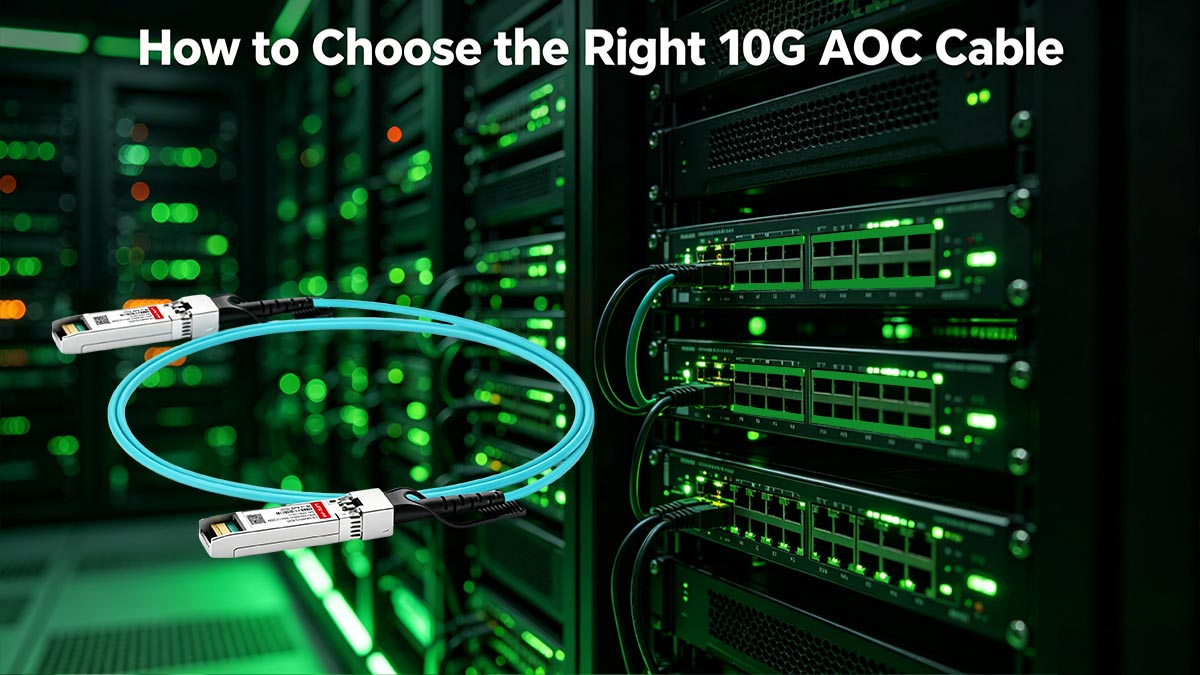
🟣 How to Choose the Right 10G AOC Cable: A Procurement Framework
Selection depends on a hierarchical evaluation: first, verify distance (use passive DAC for <5m, AOC/Fiber for >5m); second, confirm vendor coding requirements; third, calculate the Total Cost of Ownership (TCO) including warranty and reliability. When EMI isolation or cable density is a priority, the AOC is the mandatory choice, effectively bridging the performance gap between copper and modular fiber optics.
Step-by-Step Decision Framework
Use the following logic flow to determine the optimal cable type for your specific network topology:
- Distance Assessment: If the link is under 5 meters and rack congestion is low, a passive 10G DAC is the most cost-efficient solution. For distances exceeding 5 meters, or where cable flexibility is paramount, specify an AOC.
- Compatibility Validation: Confirm if your switch architecture enforces vendor-specific EEPROM locking. If locked, prioritize a "Cisco-coded" module from an MSA-compliant vendor that provides hardware-specific guarantees.
- Physical Environment: Evaluate EMI sources. If routing cables near power supplies or industrial equipment, bypass copper entirely in favor of the dielectric isolation provided by an AOC.
- Reliability vs. Budget: For mission-critical production environments, prioritize vendors that offer batch-specific test reports over the cheapest "generic" options to minimize long-term TCO and potential downtime.
The AOC vs. DAC Decision Rule
Engineers often face the "DAC or AOC" dilemma. Apply this rule of thumb to streamline your procurement process:
| Requirement | Recommended Technology |
|---|---|
| Shortest link (< 5m), zero power budget | Passive DAC |
| High density, tight bend radius needed | Active Optical Cable (AOC) |
| EMI/RFI prone environments | Active Optical Cable (AOC) |
| Scalable, long-distance modularity | SFP+ Transceiver + Fiber |
Ultimately, procurement is a balance of operational environment and fiscal responsibility. The SFP-10G-AOC1M represents a sweet spot in the data center market—providing the performance of fiber optics with the streamlined, "fixed-length" convenience of a DAC. By selecting based on the specific electrical and physical stressors of your infrastructure, you ensure that the physical layer remains the most stable foundation of your 10Gbps network.
🟣 FAQ About SFP-10G-AOC1M Procurement
1. Is Cisco SFP-10G-AOC1M still a cost-effective choice?
Yes. The SFP-10G-AOC1M remains a practical solution for short-range 10GbE connectivity in data centers, enterprise networks, and storage environments. Because it integrates transceivers and fiber into a single assembly, it often reduces installation complexity and deployment time compared with purchasing separate optics and patch cables. For organizations maintaining existing 10G infrastructure, it continues to offer a favorable balance of performance and procurement cost.
2. What is the typical price difference between OEM and compatible SFP-10G-AOC1M cables?
The price gap can be substantial. Genuine Cisco units typically command a significant premium, while qualified Cisco-compatible alternatives are often available at a fraction of the OEM cost. In large-scale deployments involving dozens or hundreds of links, compatible AOCs can generate considerable capital expenditure savings without sacrificing functionality when sourced from reputable suppliers.
3. Are Cisco-compatible SFP-10G-AOC1M cables reliable?
Quality varies by manufacturer. Reputable suppliers generally perform EEPROM programming, interoperability validation, and platform testing before shipment. Buyers should look for documented compatibility testing, warranty coverage, and replacement guarantees rather than focusing solely on the lowest price.
4. How can I verify compatibility before purchasing?
Request a compatibility list from the supplier and confirm support for your specific switch, router, server, or storage platform. Compatibility validation is particularly important in Cisco Nexus, Catalyst, and UCS environments, where firmware versions and hardware models may influence transceiver acceptance. Testing a small quantity before a large deployment is often the safest procurement strategy.
5. Should I buy an AOC or a DAC for short-distance 10G links?
The answer depends on deployment priorities. DAC cables usually offer the lowest acquisition cost for very short connections. However, AOCs provide advantages in cable management, weight reduction, airflow optimization, and EMI resistance. Many procurement teams choose AOCs for high-density racks where operational efficiency and long-term maintainability outweigh the modest increase in purchase price.
6. What warranty should buyers expect from a supplier?
Enterprise buyers should generally seek suppliers offering at least a multi-year warranty, with many leading compatible-optics vendors providing lifetime warranty coverage. Warranty terms can be an important indicator of supplier confidence and long-term support capability.
7. Can third-party SFP-10G-AOC1M cables affect vendor support?
Potentially. Many network administrators successfully deploy third-party optics in production environments, but hardware vendors may request OEM optics during troubleshooting of Layer 1 issues. Organizations operating under strict support agreements should review their maintenance contracts before standardizing on third-party optics. Community discussions frequently identify support policy—not technical performance—as the primary concern when using compatible transceivers.
8. What is the most important factor when evaluating SFP-10G-AOC1M suppliers?
Compatibility assurance is usually more important than the lowest unit price. Buyers should evaluate coding capability, quality control procedures, inventory availability, technical support responsiveness, warranty coverage, and delivery performance. A reliable supplier can significantly reduce deployment risk and lower the total cost of ownership (TCO) over the life of the network.
🟣 Cost Optimization Strategy for SFP-10G-AOC1M Procurement
Optimizing procurement involves shifting the focus from individual unit price (CapEx) to long-term lifecycle reliability. By leveraging bulk procurement models, standardizing on verified third-party MSA-compliant optics, and maintaining an "N+1" spare parts inventory, organizations can achieve enterprise-grade network availability at a fraction of the cost associated with restrictive OEM-exclusive hardware policies.
Bulk Procurement and Strategic Sourcing
For data center builds and campus-scale deployments, procurement should be aligned with project milestones rather than ad-hoc replacement. Bulk pricing logic relies on two factors: volume discounts from manufacturers and the reduction of shipping and logistics overhead. When purchasing SFP-10G-AOC1M units in bulk, demand batch-level certification. This ensures that the entire shipment meets the same signal integrity standards, preventing the integration of heterogeneous components that can complicate network-wide troubleshooting.
OEM vs. Third-Party: The Lifecycle Cost Calculus
The "Brand Tax" on OEM transceivers is often justified by the vendor as a guarantee of quality and support. However, from a lifecycle perspective, this can lead to inefficiencies. Modern MSA-compliant third-party providers have closed the reliability gap, offering products that undergo the same rigorous thermal and signal testing as OEM parts. When evaluating cost, consider:
- Warranty Terms: Compare the "Lifetime Warranty" claims. A vendor with a robust replacement process provides more value than a simple low-price point.
- Compatibility Guarantees: Ensure the supplier offers specific firmware coding that is verified for your switch series.
- Inventory Reliability: Reliable vendors, such as the LINK-PP for Compatible SFP Modules, maintain dedicated compatibility labs to test their optics against major switch platforms, mitigating the risk of firmware-level rejection upon installation.
Failure Management and Operational Continuity
The most expensive cost in networking is unplanned downtime. Instead of relying on a high-cost OEM brand to provide next-day support for failed modules, adopt a self-managed redundancy strategy. This involves:
| Strategy | Cost-Benefit |
|---|---|
| N+1 Spare Inventory | Maintaining an on-site surplus of 5–10% of total installed units eliminates dependency on vendor response times. |
| Compatibility Validation | Testing a sample batch from the LINK-PP Official Store against current switch firmware before large-scale deployment. |
| TCO Analysis | Factor in the reduced CapEx, which allows for increased investment in server compute or security infrastructure. |
By shifting to a verified third-party procurement model, network teams can break free from proprietary hardware lock-in while maintaining the rigorous technical standards required for 10Gbps environments. Whether you are scaling a production data center or building a high-performance home lab, sourcing your optics from a dedicated, compatibility-focused partner ensures that the physical layer of your network remains both resilient and budget-conscious.