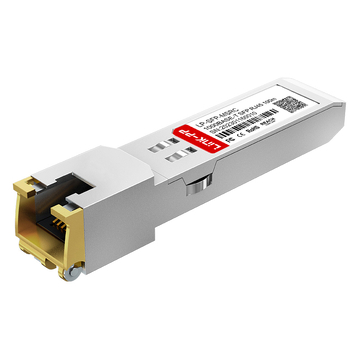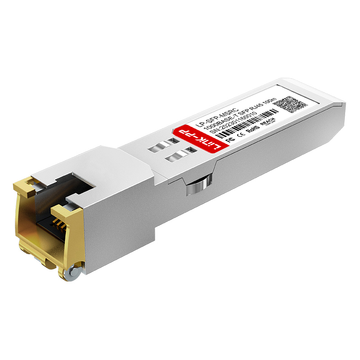
Enterprise network environments today increasingly rely on hybrid infrastructures where copper and fiber technologies coexist to balance performance, distance, and deployment flexibility. Within these environments, 1GbE copper SFP modules remain widely used, particularly in access-layer switching and branch connectivity scenarios where cost efficiency and simple RJ45-based cabling are preferred. As Fortinet continues to expand its presence in security-driven networking ecosystems, transceiver compatibility has become an important operational consideration for IT teams managing FortiGate firewalls and FortiSwitch deployments.
The Fortinet FN-TRAN-GC is a widely deployed 1000BASE-T RJ45 SFP module designed to deliver Gigabit Ethernet over standard copper cabling. Although it is engineered for use within Fortinet environments, real-world deployments often raise practical questions around cross-device recognition, firmware restrictions, and the feasibility of using compatible third-party alternatives in mixed-vendor infrastructures. These considerations are critical for organizations that prioritize scalability, procurement flexibility, and long-term operational efficiency.
This article provides a structured technical overview of the FN-TRAN-GC module and its surrounding ecosystem to help clarify key deployment and compatibility factors, including:
- Core specifications and typical enterprise use cases in access and aggregation layers
- Compatibility behavior across Fortinet devices and the impact of firmware and vendor coding
- Comparison between original modules and third-party compatible SFP modules
- Key technical considerations such as power consumption, thermal performance, and cabling requirements
- Common interoperability issues and practical validation methods for stable deployment
By examining these areas in detail, the following sections will help network engineers and infrastructure planners make more informed decisions when evaluating FN-TRAN-GC deployments and alternative options within Fortinet-based network environments.
🔔 What Is Fortinet FN-TRAN-GC?
The Fortinet FN-TRAN-GC is a 1GbE copper SFP transceiver designed to provide Gigabit Ethernet connectivity over standard RJ45 twisted-pair cabling. In practical terms, it enables Fortinet networking devices—such as FortiGate firewalls and FortiSwitch units—to connect directly to copper-based Ethernet infrastructure without requiring fiber optics. This makes it a convenient solution for access-layer networking where existing structured cabling is already deployed.
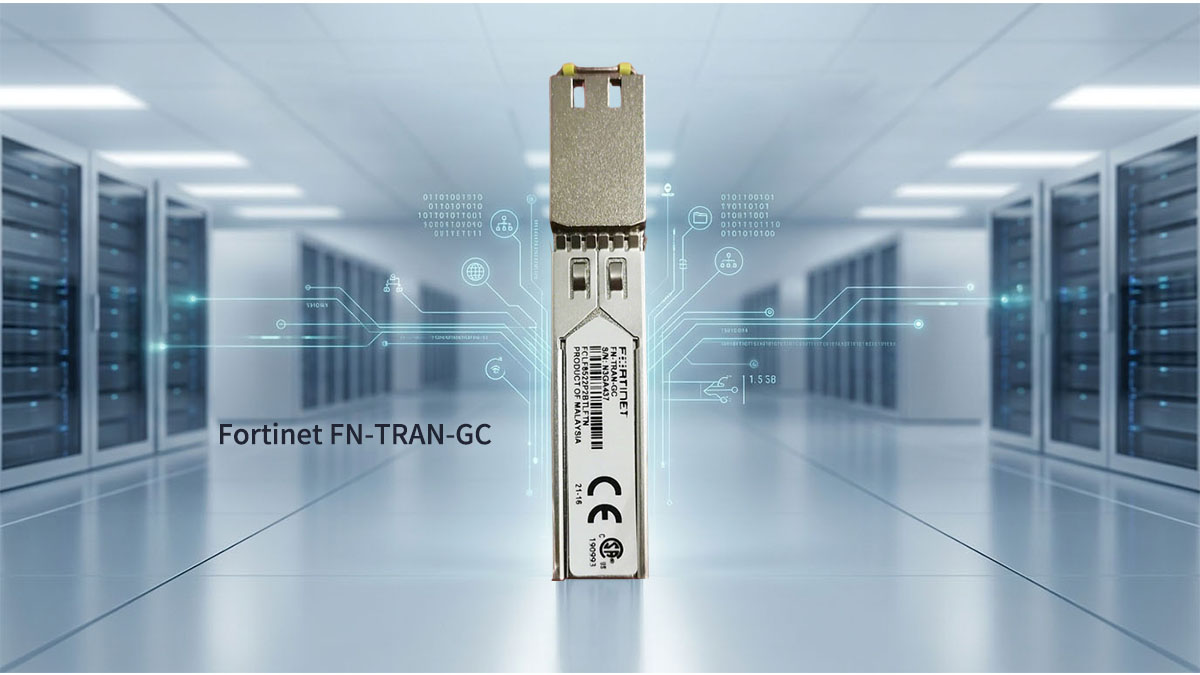
Overview of the FN-TRAN-GC Copper SFP Module
The FN-TRAN-GC is best understood as a bridge between SFP ports and traditional RJ45 Ethernet infrastructure. It is commonly used in environments where fiber is not required or where copper cabling is already established.
Key functional characteristics include:
- Conversion of SFP port signals into standard RJ45 Ethernet output
- Support for Gigabit Ethernet over twisted-pair cabling
- Compatibility with standard Cat5e/Cat6/Cat6a infrastructure
- Plug-and-play installation in supported Fortinet SFP ports
This design allows network administrators to extend switch or firewall connectivity without modifying existing copper cabling layouts, making it especially useful in enterprise access layers and branch deployments.
Key Technical Specifications
From a technical perspective, the FN-TRAN-GC operates within standard 1000BASE-T parameters but includes firmware coding tailored for Fortinet hardware recognition.
Core specifications typically include:
- Data rate: 1Gbps
- Interface: RJ45 copper via SFP form factor
- Cable type: Cat5e or higher
- Maximum reach: up to 100m
- Auto-negotiation: supported for speed and duplex adjustment
Unlike fiber SFP modules, copper-based transceivers like the FN-TRAN-GC generally consume more power and generate more heat, which is an important consideration in high-density switch environments.
Common Deployment Scenarios
The FN-TRAN-GC is widely deployed in enterprise environments where flexibility and cost-effective copper connectivity are required. It is particularly relevant in access-layer and edge network designs.
Typical use cases include:
- Connecting FortiGate firewalls to copper-based LAN switches
- Enabling uplinks between FortiSwitch access devices
- Supporting branch office connectivity where fiber is unavailable
- Temporary or hybrid network expansions during infrastructure transitions
In many cases, it is chosen for its simplicity—allowing network teams to leverage existing Ethernet cabling while still utilizing SFP-based switch architecture. This makes it a practical choice for mixed media environments where both fiber and copper must coexist efficiently.
🔔 Understanding Fortinet FN-TRAN-GC Compatibility
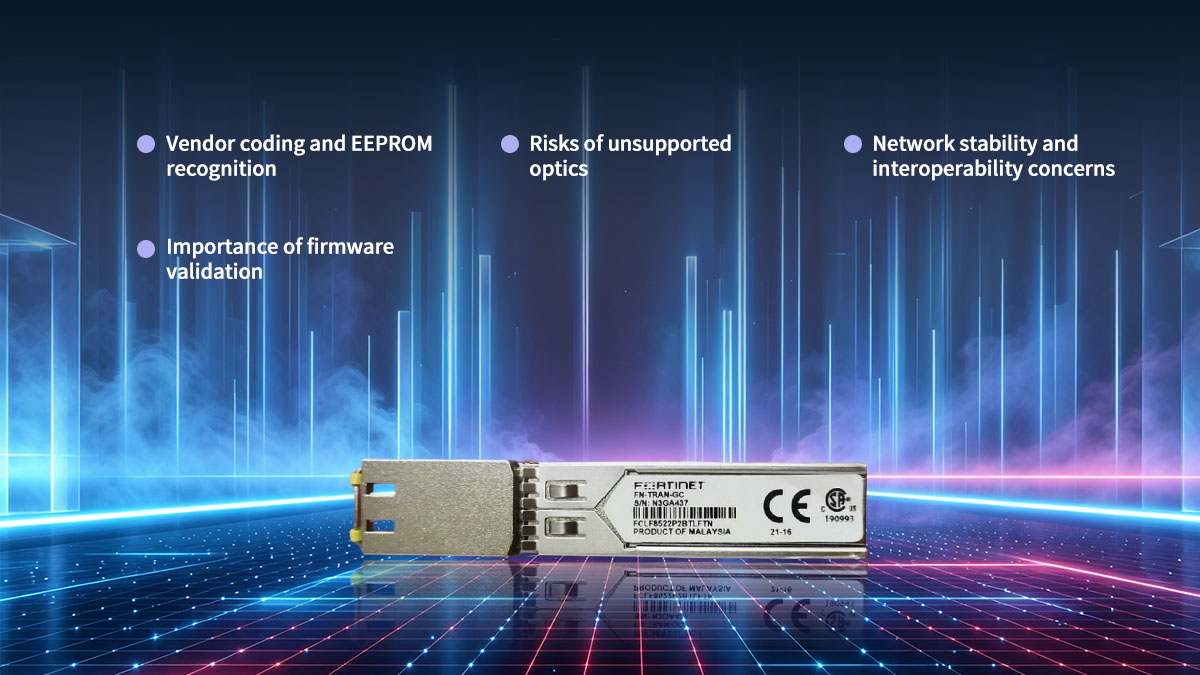
Compatibility is one of the most important factors when deploying the Fortinet FN-TRAN-GC in enterprise networks. Although the module is based on the standard 1000BASE-T SFP form factor, its real-world behavior is strongly influenced by Fortinet’s firmware validation and transceiver recognition mechanisms. In practical terms, compatibility determines whether the module will be fully accepted, partially supported, or blocked by the host device.
Why Compatibility Matters in Enterprise Networks
Compatibility plays a critical role because modern network devices actively verify installed transceivers before enabling full functionality. This is particularly relevant in Fortinet ecosystems where firmware validation is tightly integrated.
Key reasons compatibility is important include:
- Ensuring the transceiver is recognized correctly by FortiOS or FortiSwitchOS
- Avoiding “unsupported transceiver” warnings that may affect monitoring clarity
- Maintaining stable link negotiation without unexpected port shutdowns
- Preserving predictable performance in security-sensitive environments
In enterprise deployments, even a minor mismatch in module recognition can complicate troubleshooting and impact operational visibility across the network.
Devices Commonly Compatible with FN-TRAN-GC
The FN-TRAN-GC is primarily intended for use within Fortinet’s own hardware ecosystem, where compatibility is generally highest and most predictable.
It is commonly deployed with:
- FortiGate firewall series for WAN or LAN uplink connectivity
- FortiSwitch access and aggregation switches in enterprise LAN designs
- Integrated security appliances requiring copper uplinks
- Hybrid environments where Fortinet devices coexist with third-party switches
In these scenarios, the module typically performs as expected, provided that firmware versions and hardware revisions are aligned.
MSA Compliance and Its Role
While the FN-TRAN-GC follows the SFP Multi-Source Agreement (MSA) mechanical and electrical standards, MSA compliance alone does not guarantee full interoperability across all devices. This distinction is essential for understanding how compatibility works in practice.
Important aspects of MSA compliance include:
- Standardized SFP physical form factor for universal port fit
- Electrical signaling consistency across compliant devices
- Baseline support for Gigabit Ethernet transmission over copper
However, limitations still exist:
- Vendor-specific EEPROM coding may restrict recognition
- Firmware policies can override MSA-level compatibility
- Some devices may enforce strict whitelist validation
As a result, even MSA-compliant copper SFPs like FN-TRAN-GC may behave differently depending on the exact Fortinet hardware model and software version in use. This is why compatibility testing remains a necessary step in enterprise deployments rather than relying solely on standards compliance.
🔔 Technical Factors to Evaluate Before Choosing Alternatives
When evaluating alternatives to the Fortinet FN-TRAN-GC, the decision is not only about physical compatibility but also about ensuring stable long-term operation within Fortinet environments. Even though many 1000BASE-T SFP modules share similar standards, real-world performance can vary depending on firmware behavior, thermal design, and electrical efficiency. A structured technical evaluation helps reduce deployment risks and ensures consistent network performance.
Hardware and Firmware Compatibility
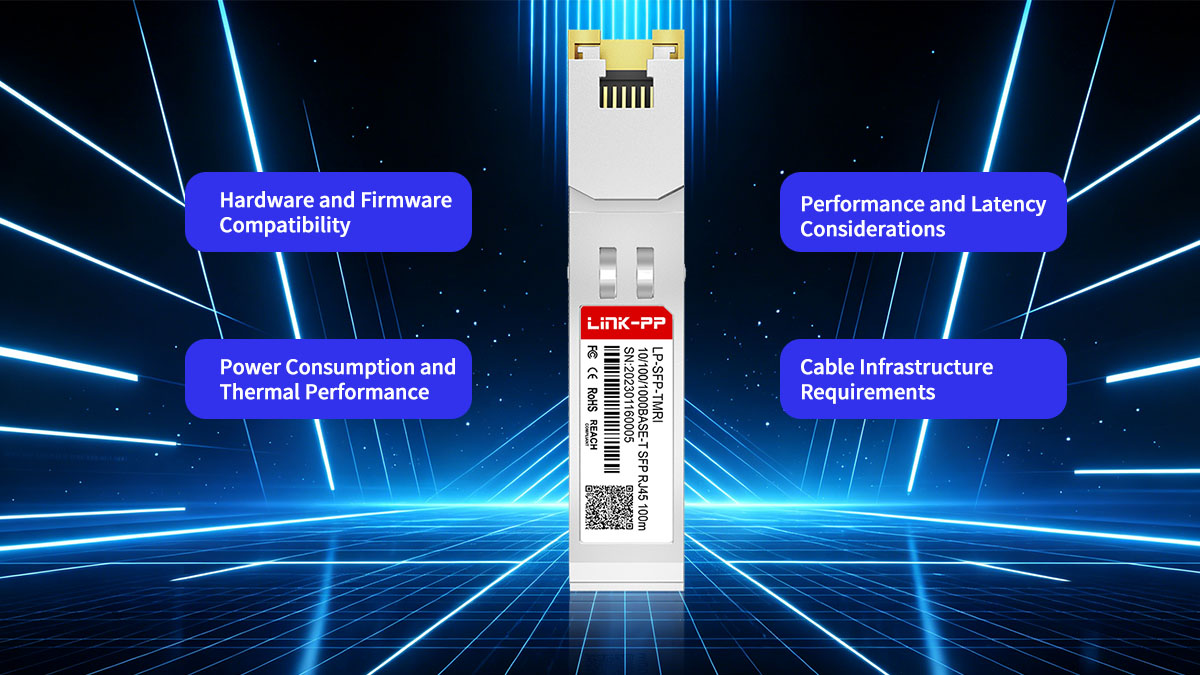
Hardware and firmware compatibility is the first and most critical factor when selecting an alternative module. Even if a transceiver follows the same SFP MSA standard, Fortinet devices may still apply vendor-specific identification rules.
Key considerations include:
- Whether the module is recognized without “unsupported transceiver” warnings
- Compatibility across different FortiOS or FortiSwitchOS versions
- EEPROM coding alignment with Fortinet vendor expectations
- Behavior after firmware upgrades or device reboots
In enterprise environments, firmware updates can change how transceivers are validated, making ongoing compatibility verification essential rather than a one-time check.
Power Consumption and Thermal Performance
Copper SFP modules like the FN-TRAN-GC inherently consume more power than fiber-based optics due to electrical signal conversion requirements. This makes thermal performance a key factor when considering alternatives.
Important aspects include:
- Power draw per module under full 1Gbps load
- Heat output in high-density switch deployments
- Impact on chassis airflow and cooling design
- Risk of thermal throttling or port instability in tightly packed environments
In scenarios where multiple RJ45 SFPs are used simultaneously, cumulative heat can become a limiting factor, especially in compact access switches.
Performance and Latency Considerations
While copper 1G SFP generally delivers similar throughput, subtle differences in signal processing and auto-negotiation behavior can influence stability.
Key performance factors include:
- Consistency of link establishment during negotiation
- Latency variation under sustained traffic loads
- Error rates on longer or lower-quality copper cabling
- Stability in duplex and speed fallback scenarios
Although differences are often minimal in ideal conditions, enterprise networks require predictable behavior under variable load, making testing essential before large-scale deployment.
Cable Infrastructure Requirements
Copper SFP modules depend heavily on the quality and condition of the underlying cabling infrastructure. Even the most compatible transceiver cannot compensate for poor physical media.
Important cabling considerations include:
- Recommended use of Cat5e or higher (Cat6/Cat6a preferred in enterprise environments)
- Maximum supported distance of approximately 100 meters
- Susceptibility to electromagnetic interference in industrial environments
- Cable termination quality and structured cabling standards
In many compatibility issues, the root cause is not the module itself but the physical layer conditions, making cabling validation a key part of the evaluation process.
By carefully analyzing these technical factors, organizations can make more informed decisions when selecting alternatives to FN-TRAN-GC, ensuring both compatibility and operational stability in Fortinet-based network infrastructures.
🔔 Comparing Original FN-TRAN-GC and Compatible Alternatives
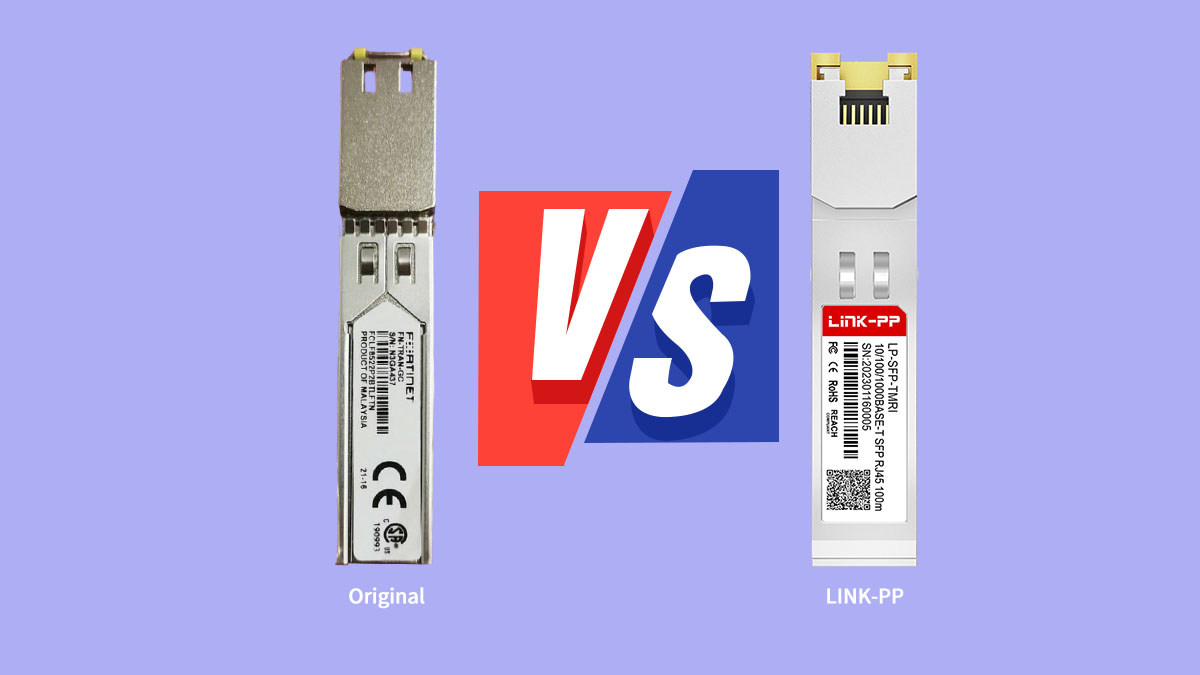
When comparing the original Fortinet FN-TRAN-GC with third-party compatible alternatives, the key difference is not the physical interface but the way each module interacts with Fortinet’s firmware and system validation logic. Both types typically support the same 1000BASE-T RJ45 SFP functionality, but their operational behavior can vary depending on coding, testing depth, and thermal design quality.
Original Fortinet Modules
The original FN-TRAN-GC module is designed specifically for Fortinet ecosystems, which means it is pre-validated for use with FortiGate and FortiSwitch devices. This tight integration reduces uncertainty during deployment and minimizes compatibility-related troubleshooting.
Key characteristics of original modules include:
- Native recognition by FortiOS and FortiSwitchOS without additional configuration
- Consistent behavior across firmware updates within supported device matrices
- Predictable thermal and power characteristics validated by Fortinet
- Alignment with Fortinet hardware lifecycle and support policies
Because of this integration, original modules are often preferred in environments where strict vendor standardization and minimal operational variance are required.
Third-Party Compatible Modules
Compatible alternatives (such as LINK-PP LP-SFP-MSRC) are designed to replicate FN-TRAN-GC functionality while offering broader sourcing flexibility and cross-platform usability. These modules follow SFP MSA standards but may differ in EEPROM coding and internal firmware behavior.
Key characteristics include:
- Compatibility with multiple vendor platforms beyond Fortinet
- Greater flexibility in procurement and inventory management
- Cost efficiency in large-scale deployments
- Variability in vendor coding quality and device recognition behavior
While many high-quality compatible modules perform reliably in Fortinet environments, consistency can vary between manufacturers, making validation testing an important step before large deployments.
Key Areas of Comparison
When evaluating original FN-TRAN-GC modules against compatible alternatives, it is useful to compare them across multiple operational dimensions rather than focusing only on interface-level specifications. This helps network engineers understand how each option behaves in real Fortinet deployments, especially under firmware validation and long-term operational conditions.
The comparison below highlights the most important technical and operational differences between the two options:
| Comparison Dimension | Original FN-TRAN-GC | Compatible Alternatives |
|---|---|---|
| Compatibility Reliability | Fully validated for Fortinet devices with consistent recognition across supported platforms | Generally compatible but may vary depending on vendor coding and firmware behavior |
| Firmware Interaction | Optimized for FortiOS and FortiSwitchOS with minimal risk of warnings or blocking | May trigger “unsupported transceiver” warnings depending on device and firmware version |
| Thermal Performance | Predictable and tested thermal profile within Fortinet specifications | Varies by manufacturer; some models may run slightly hotter under high-density use |
| Deployment Flexibility | Primarily optimized for Fortinet ecosystem usage | More flexible across multi-vendor environments and mixed infrastructures |
| Lifecycle Alignment | Aligned with Fortinet hardware support lifecycle and updates | Dependent on third-party vendor lifecycle and production consistency |
This comparison shows that while both options operate at the same 1GbE physical layer and deliver similar throughput performance, their operational behavior inside Fortinet-managed networks can differ significantly depending on validation depth and firmware enforcement.
🔔 Common Compatibility Challenges and How to Avoid Them
In real-world Fortinet deployments, compatibility issues with FN-TRAN-GC modules or their alternatives rarely come from the Ethernet standard itself. Instead, they usually originate from firmware validation rules, EEPROM identification mismatches, or environmental factors such as thermal stress and cabling quality. Understanding these challenges in advance helps reduce downtime and ensures more predictable network behavior.
Unsupported Transceiver Warnings
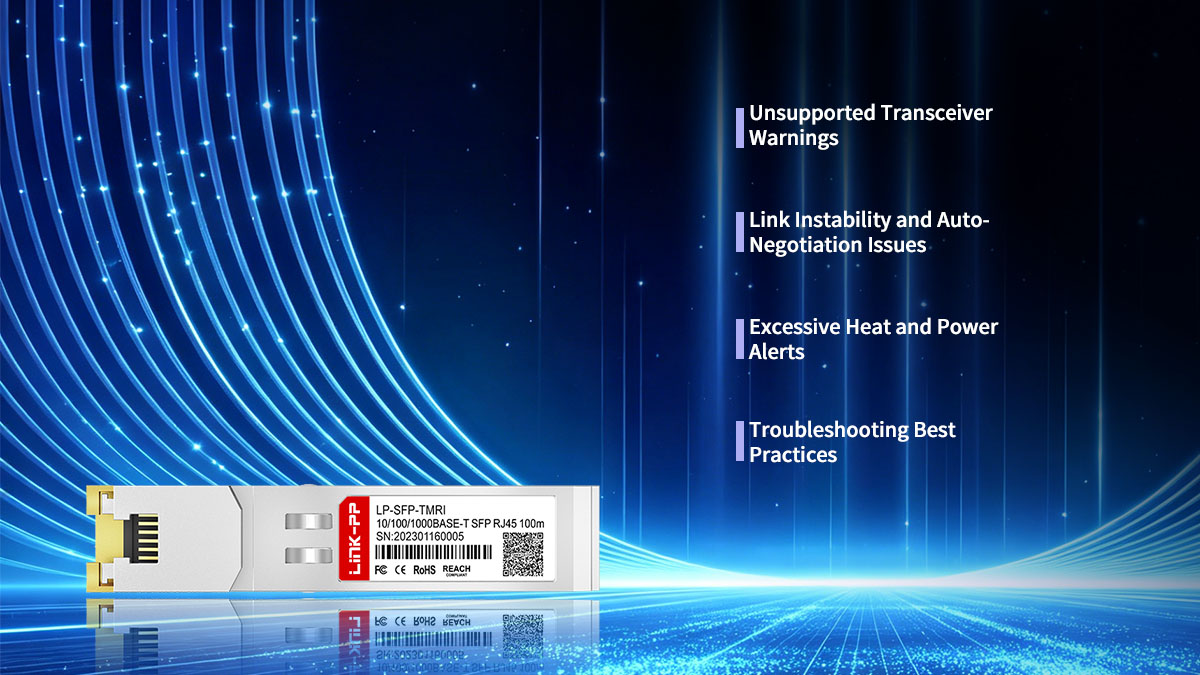
One of the most frequently encountered issues is the “unsupported transceiver” warning displayed on FortiGate or FortiSwitch interfaces. This does not always mean the module is non-functional, but it indicates that the device has not fully recognized or approved the transceiver.
Common causes include:
- Vendor-specific EEPROM coding not matching Fortinet expectations
- Firmware updates introducing stricter validation rules
- Use of non-original or improperly coded compatible modules
- Hardware model-specific transceiver restrictions
To avoid this issue, it is important to validate module compatibility against the exact Fortinet hardware model and firmware version before deployment. Regular firmware compatibility checks can also help prevent unexpected recognition changes.
Link Instability and Auto-Negotiation Issues
Another common challenge involves unstable links or inconsistent auto-negotiation behavior, which can lead to intermittent connectivity or speed mismatches.
Typical symptoms include:
- Frequent link up/down events
- Negotiation fallback to lower speeds (100Mbps or 10Mbps)
- Duplex mismatch leading to packet loss
- Delayed link establishment after reboot or cable reconnection
These issues are often caused by a combination of module firmware behavior and cabling quality. Ensuring high-quality Cat5e or Cat6 cabling and verifying port negotiation settings can significantly reduce instability.
Excessive Heat and Power Alerts
Copper SFP modules like FN-TRAN-GC consume more power than fiber optics, which can result in increased heat output, especially in dense switch environments.
Key risk factors include:
- High port density with multiple RJ45 SFPs installed
- Limited airflow in compact switch chassis
- High ambient temperature in equipment racks
- Variations in power efficiency among third-party modules
To mitigate thermal issues, it is recommended to monitor port temperatures regularly and ensure adequate airflow design within rack systems. In some cases, redistributing RJ45 SFP usage across multiple switches can also help reduce localized heat concentration.
Troubleshooting Best Practices
A structured troubleshooting approach can significantly reduce the time required to resolve compatibility-related issues in Fortinet environments.
Effective practices include:
- Verifying module compatibility against Fortinet documentation and firmware version
- Running port diagnostics to identify negotiation or physical layer issues
- Testing modules in a controlled lab environment before production deployment
- Monitoring system logs for transceiver-related warnings or errors
- Replacing or isolating suspect modules to confirm root cause
By proactively addressing these common challenges, network teams can maintain stable performance and reduce the operational risks associated with transceiver deployment in Fortinet-based infrastructures.
🔔 Best Practices for Deploying FN-TRAN-GC Alternatives
When deploying alternatives to the Fortinet FN-TRAN-GC, success depends less on raw technical capability and more on disciplined validation, standardization, and long-term operational planning. Although most 1000BASE-T SFP modules share the same physical interface, their behavior inside Fortinet environments can differ due to firmware validation and vendor-specific coding. A structured deployment approach helps ensure stability and predictability across the network.
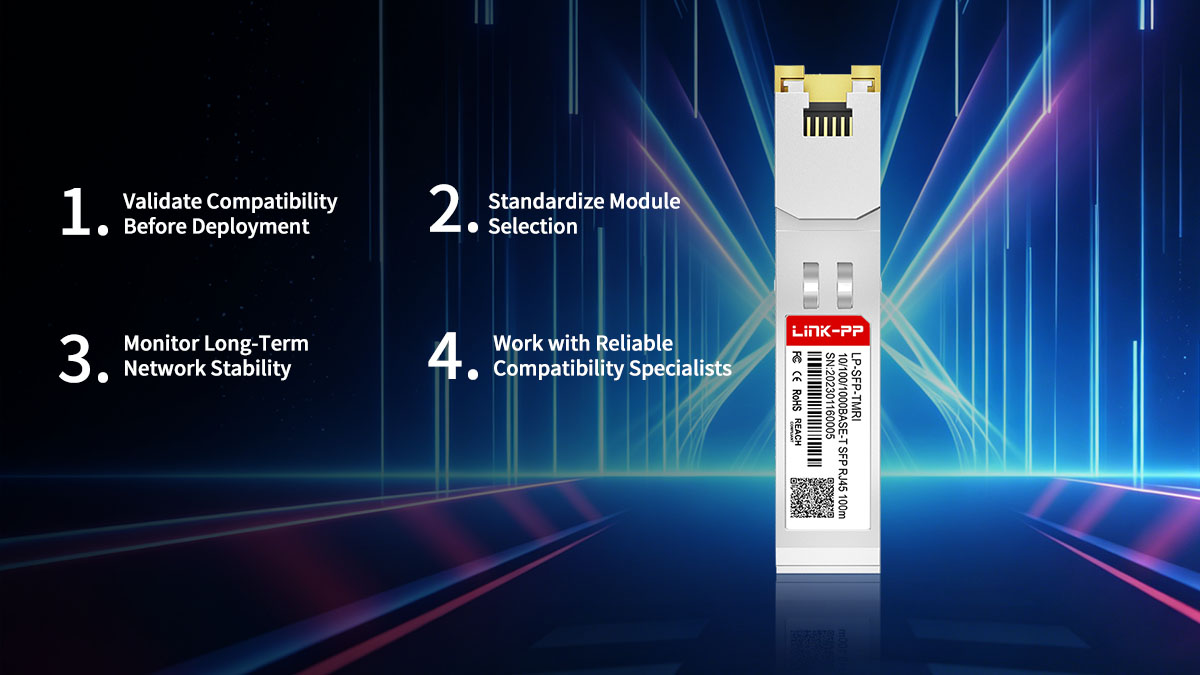
Validate Compatibility Before Deployment
The most important step is verifying compatibility in advance rather than reacting to issues after installation. Even modules that appear identical at the specification level may behave differently under Fortinet firmware enforcement.
Key validation practices include:
- Testing modules on the exact FortiGate or FortiSwitch model intended for production
- Confirming behavior across the current FortiOS or FortiSwitchOS version
- Checking for “unsupported transceiver” warnings during initial installation
- Performing link stability tests under real traffic conditions
A controlled lab test environment is highly recommended, especially for large-scale rollouts, as it allows issues to be identified before production impact occurs.
Standardize Module Selection
Consistency in module selection plays a major role in reducing operational complexity. Mixing different compatible vendors can increase variability in performance and troubleshooting difficulty.
Recommended standardization practices include:
- Using a single validated module type across similar device groups
- Maintaining a controlled inventory of approved transceivers
- Documenting approved models for future procurement consistency
- Avoiding ad-hoc replacement of modules without validation
Standardization simplifies maintenance operations and reduces uncertainty during upgrades or hardware replacements.
Monitor Long-Term Network Stability
Even after successful deployment, ongoing monitoring is essential to ensure long-term stability of FN-TRAN-GC alternatives in production environments. Compatibility behavior can sometimes change after firmware updates or configuration changes.
Key monitoring focus areas include:
- Port error counters such as CRC and frame drops
- Temperature readings on switch ports using copper SFPs
- Link flapping or negotiation inconsistencies
- Log entries related to transceiver recognition or warnings
Regular monitoring helps detect early signs of degradation and prevents small issues from escalating into service interruptions.
Work with Reliable Compatibility Specialists
The quality of compatible transceivers varies significantly between manufacturers, making supplier selection a critical factor in deployment success. Reliable vendors typically invest more in coding accuracy and validation testing.
Important evaluation criteria include:
- Consistent EEPROM coding aligned with Fortinet device expectations
- Multi-device and multi-firmware testing coverage
- Stable production quality across batches
- Technical support availability for troubleshooting assistance
- Long-term product lifecycle consistency
Choosing well-tested alternatives reduces operational uncertainty and improves deployment confidence in complex network environments.
🔔 Future Trends in Copper SFP Connectivity
Copper SFP technologies such as the Fortinet FN-TRAN-GC continue to play an important role in enterprise access networks, but their position is gradually evolving. As network speeds increase and fiber adoption expands, 1GbE RJ45 SFP modules are shifting from core connectivity components to transitional and edge-focused solutions. Despite this shift, copper-based SFPs remain relevant due to their compatibility with existing cabling infrastructure and cost-efficient deployment model.
Evolution of Hybrid Copper-Fiber Networks
Modern enterprise networks are increasingly built on hybrid architectures where fiber is used for backbone and aggregation layers, while copper remains dominant at the access layer. In this structure, copper SFP modules serve as bridging components that connect legacy RJ45 infrastructure to SFP-based switching platforms.
Key trends in this evolution include:
- Continued reliance on Cat5e/Cat6 infrastructure in access networks
- Fiber expansion in data center and high-bandwidth aggregation layers
- Use of copper SFPs as transitional connectivity solutions during upgrades
- Gradual migration toward higher-speed multi-gigabit and fiber uplinks
This hybrid approach allows organizations to extend the lifecycle of existing copper infrastructure while progressively adopting higher-performance fiber technologies.
Growth of Multi-Vendor Network Environments
As enterprise networks become more distributed and complex, multi-vendor interoperability is becoming a standard requirement rather than an exception. This trend directly impacts how copper SFP modules, including FN-TRAN-GC alternatives, are evaluated and deployed.
Important developments include:
- Increased use of standardized SFP MSA-based transceivers across vendors
- Greater demand for cross-platform compatibility in mixed infrastructure environments
- Expansion of third-party compatible module ecosystems
- Stronger focus on firmware-aware compatibility validation
In this context, compatibility testing and coding accuracy are becoming more critical than hardware form factor itself.
Emerging Alternatives to Traditional Copper SFPs
While 1GbE copper SFPs remain widely used, new technologies are gradually reshaping access-layer connectivity strategies. These alternatives aim to improve speed, reduce power consumption, and enhance scalability.
Key emerging directions include:
- Multi-gigabit RJ45 SFP modules supporting 2.5G and 5G speeds
- Increased adoption of fiber-based SFP and SFP+ solutions in access layers
- DAC (Direct Attach Copper) for short-range high-speed interconnects
- AOC (Active Optical Cable) solutions for simplified fiber deployment
These technologies are not direct replacements in all scenarios but are increasingly used in new deployments where higher bandwidth and energy efficiency are required.
Overall, copper SFP connectivity is transitioning rather than disappearing. Modules like FN-TRAN-GC continue to serve important roles in legacy integration and hybrid environments, while future network designs gradually shift toward higher-speed and more fiber-centric architectures.
🔔 Conclusion
The Fortinet FN-TRAN-GC remains a widely used 1GbE copper SFP module in enterprise networks, particularly in FortiGate and FortiSwitch environments where RJ45-based connectivity is still essential. Its value lies in enabling simple, flexible Gigabit Ethernet integration over existing copper cabling, especially within access-layer and branch deployments where fiber is not always required or immediately available.
Across the broader analysis of compatibility and alternatives, it becomes clear that performance at the physical layer is largely standardized under the 1000BASE-T specification. However, real-world deployment success is heavily influenced by firmware recognition behavior, EEPROM coding consistency, thermal characteristics, and overall validation quality. These factors often determine whether a module operates seamlessly or introduces operational warnings and instability in Fortinet-managed environments.
When evaluating alternatives, organizations typically need to balance several operational priorities:
- Ensuring stable recognition across FortiOS and FortiSwitchOS versions
- Maintaining predictable thermal and power performance in dense deployments
- Supporting multi-vendor flexibility in complex infrastructure environments
- Reducing long-term maintenance complexity through standardized module selection
In practice, both original FN-TRAN-GC modules and well-validated compatible alternatives can support reliable network operations when properly deployed and tested. The key difference lies not in throughput capability, but in deployment assurance, lifecycle consistency, and compatibility predictability across firmware updates.
For organizations looking to explore tested and interoperable Fortinet-compatible optical and copper transceiver solutions, the LINK-PP Official Store provides a range of enterprise-grade options designed for stable performance in multi-vendor networking environments.