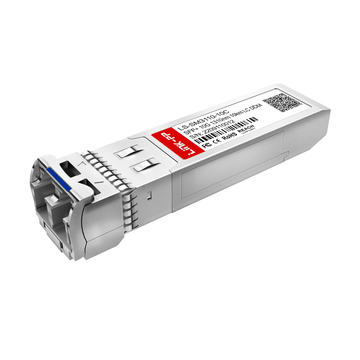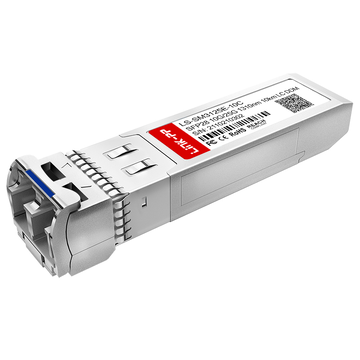
The Cisco SFP-10/25G-LR-S is a dual-rate SFP28 transceiver built for 10GbE and 25GbE links over single-mode fiber (SMF) up to 10 km. Cisco specifies 1310 nm optics and requires RS-FEC at 25G for full-reach operation. In practice, its price reflects more than the hardware itself: you are paying for Cisco validation, platform compatibility, and support expectations.
For network teams planning long-haul or campus-backbone deployments, this module is attractive because it can bridge 10G and 25G migration paths without forcing a full optics redesign. Cisco positions the SFP-10/25G-LR-S for enterprise, data center, and service-provider environments where SMF links need stable reach and predictable behavior. That makes the real buying question less about “What is the cheapest optic?” and more about total ROI across uptime, compatibility, and lifecycle cost.
This article breaks down the module from a procurement and engineering perspective: what it is, why the price sits at a premium, how it compares with SFP-10G-LR, and when a Cisco-compatible alternative can make better financial sense. For teams evaluating deployment economics, that distinction matters. Cisco also backs its pluggable modules with a 5-year limited hardware warranty, which is part of the value proposition behind the higher purchase price.
For buyers balancing performance, budget, and vendor lock-in, the goal is simple: choose the optic that delivers the lowest real cost per successful link, not just the lowest invoice price. For Cisco-compatible options, the LINK-PP Official Store can be a practical place to compare alternatives for the same deployment class.
🔴 What Is Cisco SFP-10/25G-LR-S?
Cisco SFP-10/25G-LR-S is a dual-rate SFP28 optical transceiver for 10GbE and 25GbE links over single-mode fiber (SMF) G.652. Cisco specifies a 10 km reach at both rates, a 1310 nm wavelength, and RS-FEC on the host port for 25G operation. In practical terms, it is a long-reach module built for backbone, campus, and data center links where one optic must support staged network upgrades.
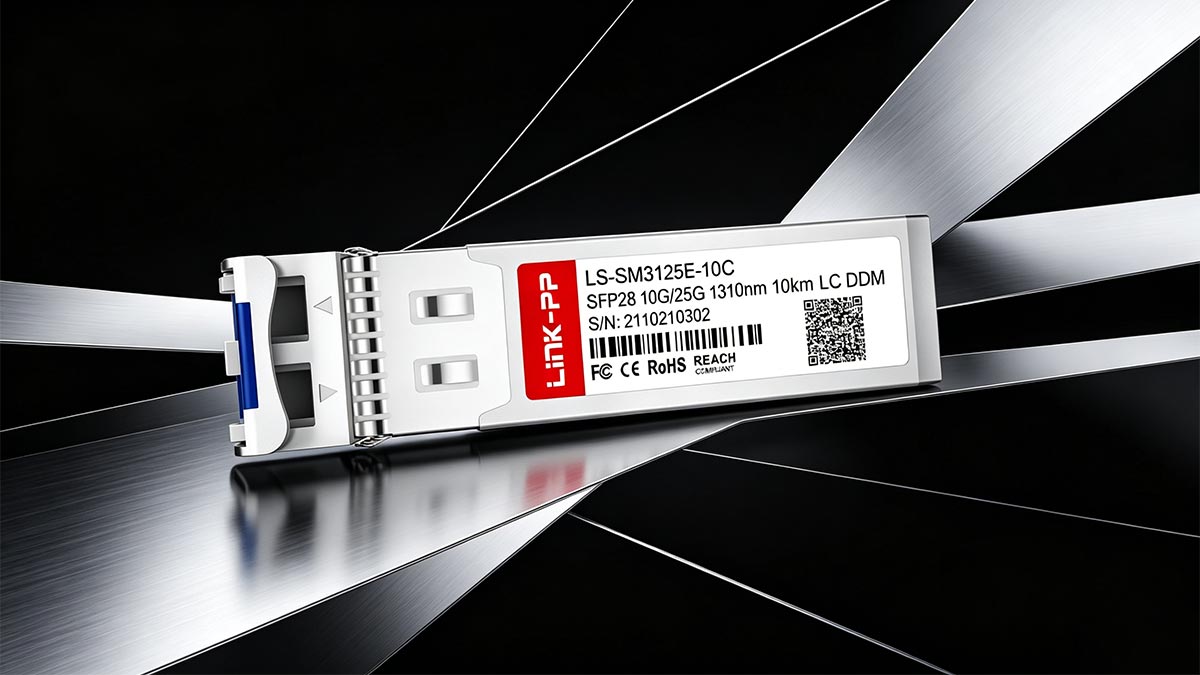
At a deployment level, this module is valuable because it reduces optics churn during migration. A network can run 10G today and move to 25G later without redesigning the SMF plant, provided the host platform supports the speed change and FEC behavior. Cisco positions the 10/25G LR family for enterprise and service-provider use cases where long-reach stability, platform compatibility, and predictable optics behavior matter more than the lowest unit price.
Dual-Rate 10G/25G Operation for Network Migration
The core value of SFP-10/25G-LR-S is its dual-rate capability, allowing the same optical module to support both 10GBASE-LR and 25GBASE-LR Ethernet. This reduces hardware replacement cycles during network scaling. In practice, operators deploy it in environments transitioning from legacy 10G uplinks to higher-density 25G architectures, especially in spine-leaf data center designs.
At 25G, the module relies on RS-FEC (Reed-Solomon Forward Error Correction) to maintain signal integrity over long distances. At 10G, it operates without FEC requirements, making it backward compatible with existing infrastructure.
Long-Reach SMF Design for 10 km Links
The module is optimized for single-mode fiber (G.652) and supports transmission distances up to 10 kilometers. This makes it suitable for:
- Data center interconnect (DCI) within metro areas
- Campus backbone aggregation
- Service provider edge-to-aggregation links
The 1310 nm wavelength is widely used in long-reach Ethernet optics due to its low attenuation characteristics in SMF, ensuring stable performance over extended distances.
SFP-10/25G-LR-S Technical Parameters
| Parameter | Specification |
|---|---|
| Product Type | SFP28 Optical Transceiver |
| Supported Rates | 10GbE / 25GbE (Dual-rate) |
| Ethernet Standards | 10GBASE-LR, 25GBASE-LR |
| Wavelength | 1310 nm |
| Fiber Type | Single-mode fiber (SMF, G.652) |
| Maximum Reach | Up to 10 km |
| Modulation | NRZ |
| FEC Requirement | RS-FEC required at 25G |
| Connector Type | LC Duplex |
| Operating Temperature | Commercial (0°C to 70°C typical range) |
| Digital Diagnostics | DOM (Digital Optical Monitoring) supported |
This combination of dual-rate flexibility, standardized Ethernet compatibility, and long-reach SMF design is what positions the SFP-10/25G-LR-S as a transitional optics solution rather than a single-generation transceiver.
🔴 Cisco SFP-10/25G-LR-S Price Analysis: OEM vs. Third-Party
Cisco SFP-10/25G-LR-S pricing is significantly higher than third-party alternatives because it includes validated interoperability with Cisco platforms, TAC support eligibility, and strict quality assurance under Cisco’s optics ecosystem. In contrast, third-party or compatible optics focus on cost efficiency while replicating the same optical specifications, often at 60–90% lower unit cost, but with varying levels of vendor support and platform certification confidence.
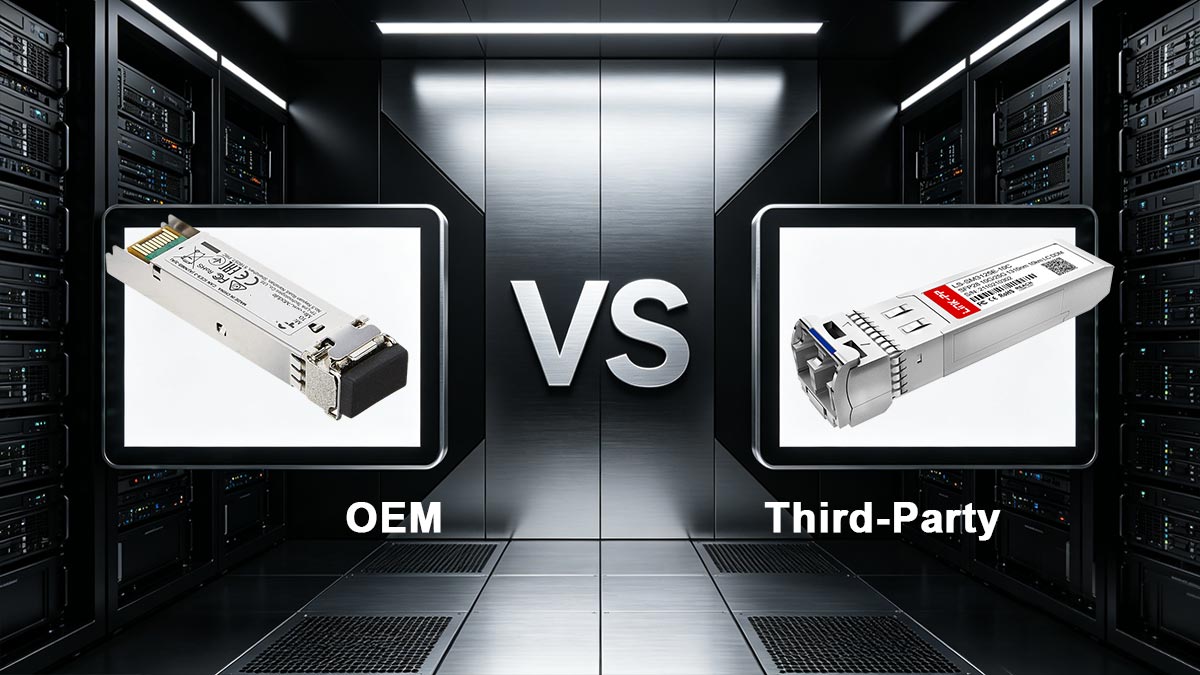
The price gap between Cisco OEM optics and third-party compatible transceivers is not primarily driven by physical hardware differences. The optical engine, wavelength (1310 nm), form factor (SFP28), and transmission reach (10 km over SMF) are often comparable at a hardware level. The divergence lies in system validation, lifecycle assurance, and support entitlement.
Why the "Cisco Tax" Exists: TAC Support and Reliability
Cisco’s pricing structure for optics such as the SFP-10/25G-LR-S is closely tied to its end-to-end support ecosystem rather than component cost alone.
Key drivers include:
- Cisco TAC eligibility: Only Cisco-certified optics guarantee full troubleshooting support within Cisco Technical Assistance Center workflows.
- Platform validation matrix: Cisco tests optics across Nexus, Catalyst, and service provider platforms to ensure deterministic behavior under load.
- Firmware and DOM integration: Deep compatibility with Cisco IOS-XE, NX-OS, and telemetry systems reduces operational uncertainty.
- Risk reduction premium: Enterprises often pay more to avoid intermittent link issues that are difficult to diagnose in high-density 25G environments.
From a procurement standpoint, this creates what operators commonly refer to as a “predictability premium” rather than a pure hardware markup.
The Rise of High-Quality Compatibles: ROI for Enterprise
Third-party compatible optics have matured significantly, especially in the 10G/25G long-reach SMF segment, where optical specifications are well standardized under IEEE Ethernet frameworks.
Modern compatible vendors now target:
- IEEE-aligned performance (e.g., 10GBASE-LR / 25GBASE-LR compliance)
- DOM (Digital Optical Monitoring) support parity
- Cross-platform coding for Cisco compatibility layers
- Extended warranty programs (typically 3–5 years)
The ROI advantage is straightforward:
- Cost reduction: Often 60–90% lower than OEM pricing
- Scalability: Large deployments (hundreds to thousands of ports) see exponential savings
- Operational flexibility: Easier multi-vendor sourcing strategies
However, trade-offs still exist:
- Some Cisco platforms may restrict or warn on non-coded optics
- TAC support may be limited or excluded in fault isolation scenarios
- Quality consistency varies more across suppliers
Practical Procurement Conclusion
In real-world deployments, enterprises typically adopt a hybrid optics strategy:
- Cisco OEM optics → mission-critical uplinks, TAC-sensitive environments
- High-quality compatibles → access layer, large-scale distribution, cost-sensitive expansion
This balanced model optimizes both network reliability and total cost of ownership (TCO), especially in long-haul 10G/25G migration architectures where optics volume becomes a major CapEx driver.
🔴 Cisco SFP-10/25G-LR-S vs. SFP-10G-LR: Which Offers Better ROI?
When comparing Cisco SFP-10/25G-LR-S and SFP-10G-LR, the key consideration is not just purchase price but long-term investment value.
The SFP-10G-LR is typically less expensive and well suited for networks that will remain at 10GbE throughout their lifecycle. For organizations with stable bandwidth requirements, it offers the lowest upfront cost.
The SFP-10/25G-LR-S, however, supports both 10GbE and 25GbE operation over the same 10 km single-mode fiber infrastructure. Although its initial price is higher, it can reduce future upgrade costs by eliminating the need to replace optics when migrating from 10G to 25G.
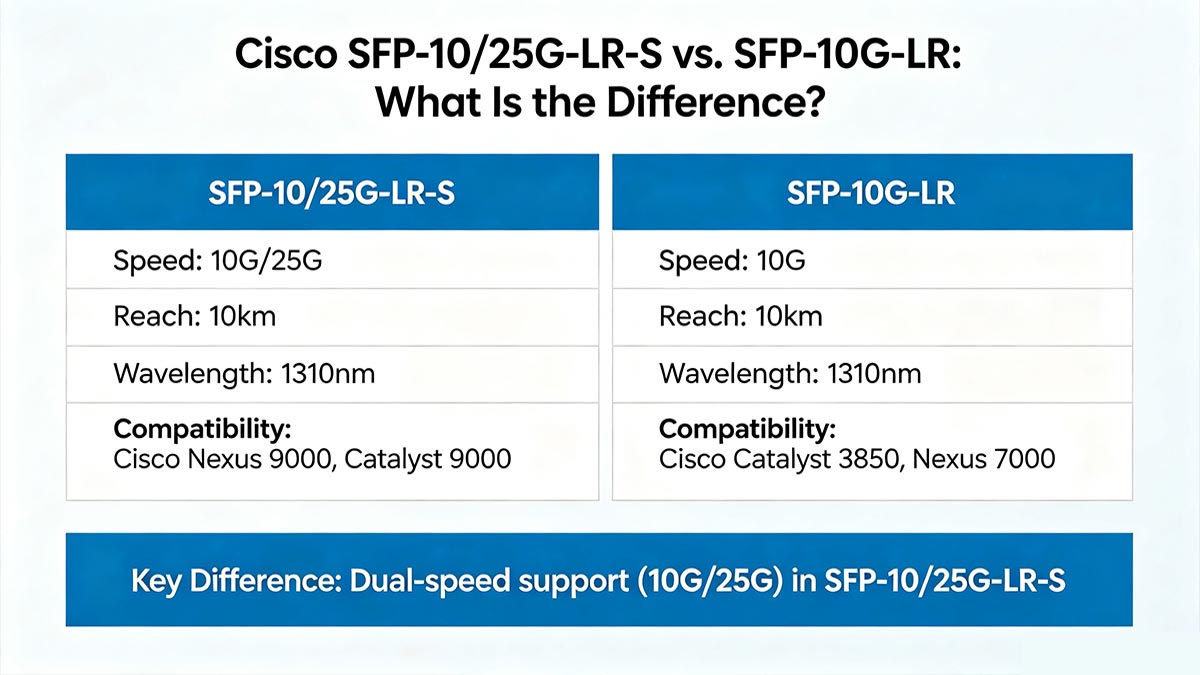
Cisco SFP-10G-LR vs. SFP-10/25G-LR-S Comparison Table
| Feature | SFP-10G-LR | SFP-10/25G-LR-S |
|---|---|---|
| Product Type | SFP+ Optical Transceiver | SFP28 Dual-Rate Transceiver |
| Supported Speeds | 10GbE only | 10GbE / 25GbE |
| Wavelength | 1310 nm | 1310 nm |
| Maximum Reach | Up to 10 km (SMF G.652) | Up to 10 km (SMF G.652) |
| FEC Requirement | Not required | RS-FEC required at 25G |
| Upgrade Path | None (fixed 10G) | 10G → 25G migration support |
| Typical Use Case | Legacy enterprise / fixed links | Data center evolution / spine-leaf |
| Infrastructure Flexibility | Low | High |
| Deployment Complexity | Low | Medium (requires FEC awareness) |
Cost and ROI Comparison
| Factor | SFP-10G-LR | SFP-10/25G-LR-S |
|---|---|---|
| Initial Cost | Lower | Higher |
| Supported Speeds | 10G Only | 10G / 25G |
| Upgrade Flexibility | Limited | High |
| Future Replacement Cost | Higher | Lower |
| Long-Term ROI | Good for Stable Networks | Better for Growing Networks |
Which Option Is More Cost-Effective?
For organizations that expect to remain at 10G throughout the lifecycle of the deployment, the Cisco SFP-10G-LR often provides the lowest total expenditure.
However, for enterprises, cloud providers, and data center operators with a roadmap toward 25G Ethernet, the Cisco SFP-10/25G-LR-S frequently delivers a lower total cost of ownership (TCO) despite its higher purchase price. The ability to support both 10G and 25G speeds on the same optical platform helps reduce future upgrade expenses and improves long-term return on investment.
Procurement Takeaway
If your network is expected to remain at 10G for the foreseeable future, the Cisco SFP-10G-LR is often the most economical choice.
If a 25G upgrade is likely within the next few years, the Cisco SFP-10/25G-LR-S can provide a better return on investment by extending the useful life of the optical infrastructure and reducing future migration expenses.
🔴 Cisco SFP-10/25G-LR-S Implementation and Troubleshooting
Implementing Cisco SFP-10/25G-LR-S requires correct port speed configuration, FEC alignment, and platform compatibility validation on Cisco Nexus or Catalyst switches. Most deployment issues arise not from the optic itself, but from mismatched speed/FEC settings at 25G or unsupported third-party optics in strict Cisco environments. Proper configuration ensures stable 10G operation and error-free 25G long-reach transmission over SMF.
Configuring Speed Settings on Nexus and Catalyst Switches
Correct configuration is critical because SFP-10/25G-LR-S behaves differently depending on whether it is operating at 10G or 25G mode.
In Cisco Nexus and Catalyst environments, key configuration considerations include:
- Manual or auto speed negotiation
- Set interface speed explicitly to 10G or 25G depending on deployment stage
- FEC configuration (critical at 25G)
- Enable RS-FEC (Reed-Solomon Forward Error Correction) on 25G links for long-reach stability
- Incorrect FEC settings often lead to link flapping or no link-up conditions
- Optics detection
- Cisco NX-OS may flag unsupported optics or restrict DOM reporting on non-certified modules
- Interface consistency
- Both ends of the link must match: same speed mode, fiber type (SMF), and FEC configuration
Typical real-world issue pattern:
- Link comes up at 10G successfully
- Fails or becomes unstable at 25G due to missing RS-FEC or incompatible switch configuration
This makes pre-deployment validation on Cisco platforms essential, especially in mixed-speed migration environments.
Overcoming TAC Challenges with Compatible Optics
One of the most practical considerations in Cisco optical deployments is how Technical Assistance Center (TAC) support behaves when third-party optics are used.
Key operational realities:
- Limited TAC troubleshooting depth
- Cisco TAC may request replacement with OEM optics before continuing diagnosis
- Isolation of hardware issues
- When compatible optics are used, TAC often treats them as a potential variable in fault isolation
- DOM visibility differences
- Some compatible modules provide partial or inconsistent Digital Optical Monitoring data in Cisco IOS-XE or NX-OS environments
- Platform-dependent acceptance
- Certain Cisco platforms enforce stricter validation policies for optics recognition
However, high-quality compatible optics can still be effectively used when:
- The network team maintains spare OEM optics for validation testing
- Deployment follows a standardized optics policy per layer (core vs access)
- Vendor compatibility matrices are pre-validated in lab environments
Operational best practice: Many enterprise networks adopt a hybrid support model, where Cisco OEM optics are used for mission-critical backbone links, while compatible optics are deployed in access or large-scale distribution layers to optimize cost efficiency without compromising overall network stability.
🔴 10G SFP vs. 25G SFP: Which Provides Better ROI?
When evaluating optical transceiver investments, the choice between a 10G SFP and a 25G-capable SFP28 is often a balance between upfront cost and long-term return on investment.
A 10G SFP+ module typically offers a lower purchase price, making it attractive for organizations with stable bandwidth requirements and no planned network upgrades. For fixed 10G environments, it remains a cost-effective solution.
A 25G SFP28 module, such as the Cisco SFP-10/25G-LR-S, requires a higher initial investment but delivers greater bandwidth efficiency and future scalability. By supporting both 10G and 25G operation, it allows organizations to upgrade network speeds without replacing existing optical infrastructure.
Line Rate and Bandwidth Efficiency
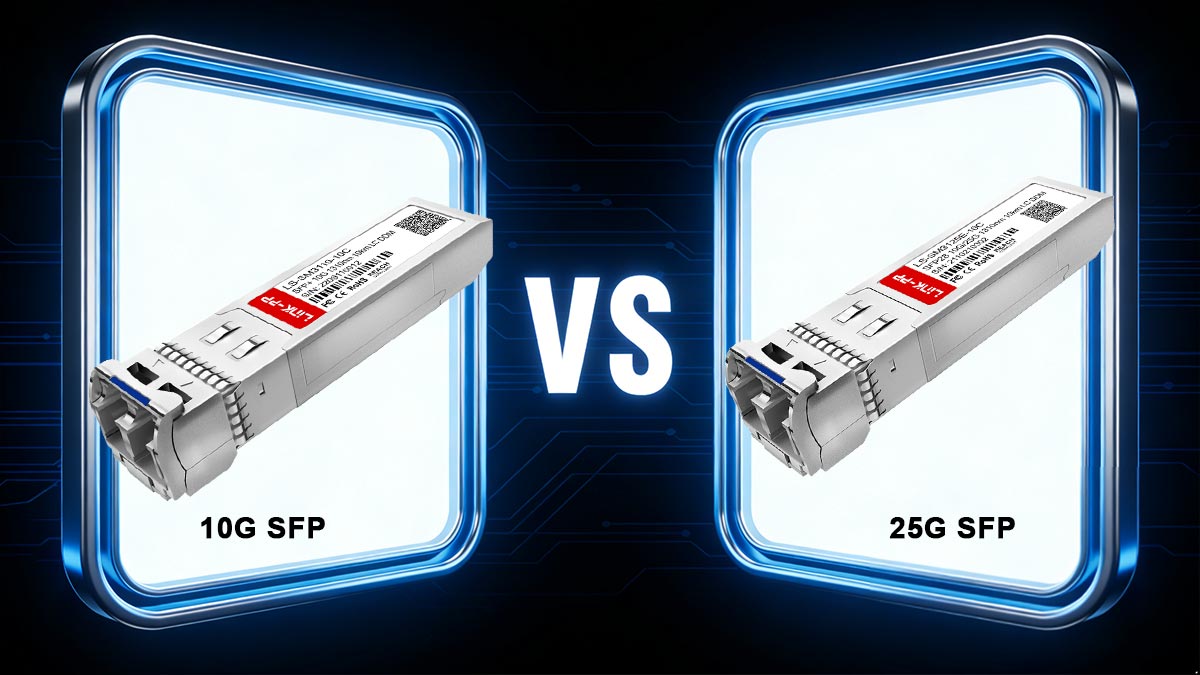
The primary difference between 10G and 25G optics is line rate capacity:
- 10G SFP+ (10GbE):
Fixed bandwidth, widely used in legacy enterprise and aggregation networks. Stable but limited for modern east-west traffic growth. - 25G SFP28 (25GbE):
2.5× higher throughput per port compared to 10G, designed for modern cloud-scale workloads and spine-leaf architectures.
In high-density environments, 25G reduces the number of physical links required for the same aggregate throughput, improving switch port efficiency and lowering cabling complexity.
Switch and Platform Support Requirements
Adoption is not only about optics—it depends heavily on the switching platform:
- 10G SFP+: Supported across older Catalyst, Nexus, and enterprise switches
- 25G SFP28: Requires newer generation platforms (e.g., Cisco Nexus 9K series and modern data center switches)
For dual-rate optics like SFP-10/25G-LR-S, the host must explicitly support:
- 25G port mode configuration
- RS-FEC (for long-reach stability at 25G)
Without correct platform support, the optic will fall back to 10G or fail to establish a link at 25G.
Fiber Requirements and Physical Layer Constraints
Both 10G and 25G long-reach optics typically use:
- Single-mode fiber (SMF, G.652)
- 1310 nm wavelength
- LC duplex connectors
- Up to 10 km reach (for LR-class optics)
However, 25G introduces stricter signal integrity requirements due to higher symbol rate. This is why FEC becomes mandatory in many 25G LR deployments, whereas 10G LR operates without it.
When a Dual-Rate Optic Makes Sense
A dual-rate optic (10G/25G) is not always necessary. It is most effective in:
- Data center migrations from 10G → 25G
- Environments with mixed-speed switching layers
- Backbone networks where future-proofing is required
- Operators aiming to standardize optics across multiple upgrade phases
It is less useful when:
- The network is permanently fixed at 10G
- No switch upgrade path is planned
- Cost minimization is the primary objective
Best-for Recommendation
- SFP-10G-LR: Best for stable, cost-optimized 10G enterprise networks with no near-term upgrade plans
- SFP-10/25G-LR-S: Best for scalable data center architectures requiring a controlled transition from 10G to 25G while maintaining 10 km SMF reach
In ROI terms, 25G optics reduce long-term port consumption and migration friction, while 10G optics minimize upfront CapEx in static environments.
🔴 FAQ: Cisco SFP-10/25G-LR-S Price and Compatibility
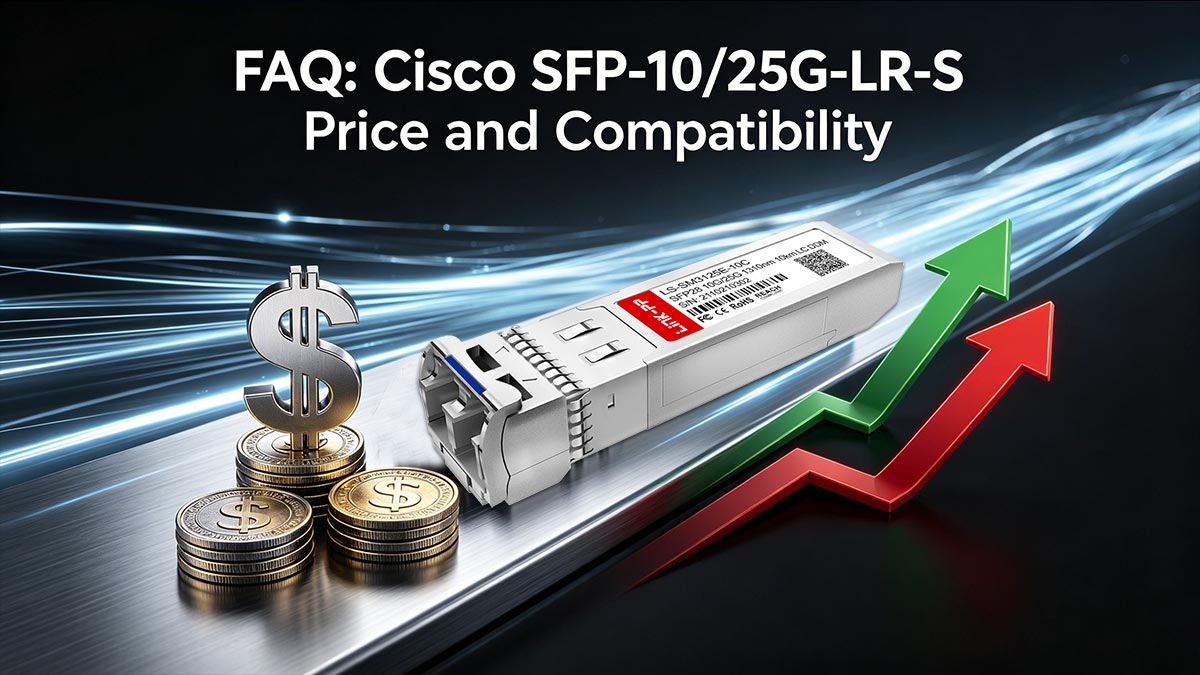
Q1. What is Cisco SFP-10/25G-LR-S?
Cisco SFP-10/25G-LR-S is a dual-rate SFP28 transceiver for 10GbE and 25GbE over single-mode fiber (SMF) G.652 with a reach of up to 10 km. Cisco states that it requires RS-FEC on the host ports for full-reach operation at 25G.
Q2. Why is Cisco SFP-10/25G-LR-S more expensive than third-party optics?
The premium comes from Cisco’s platform validation, support expectations, and warranty model rather than the basic optical form factor alone. Cisco optics are covered by its Limited 5-Year Hardware Warranty, while live listings show a Cisco-branded unit at $1,861.99 advertised on CDW compared with a compatible alternative at $558.99.
Q3. Does Cisco SFP-10/25G-LR-S work at both 10G and 25G?
Yes. Cisco positions the module as a dual-rate 10GE/25GE optic, which makes it useful for staged migrations where the same fiber plant must support both speeds. At 25G, the host must support RS-FEC for full-reach operation.
Q4. What fiber does Cisco SFP-10/25G-LR-S require?
It is designed for single-mode fiber (SMF) G.652 and is specified for 10 km operation. That makes it a long-reach option for campus backbone, metro edge, and data center interconnect links.
Q5. Is a Cisco-compatible optic a reasonable alternative?
Yes, for many cost-sensitive deployments. A compatible module can deliver the same basic reach and speed class at a much lower upfront price, but the trade-off is usually reduced Cisco-native support alignment and less certainty around platform acceptance in strict environments.
Q6. When should I choose the Cisco OEM version instead of a compatible one?
Choose the Cisco OEM module when supportability, standardization, and lowest operational risk matter more than purchase price, especially in environments where Cisco TAC workflows or strict procurement rules are important. Cisco’s warranty and official validation model are part of that value.
🔴 Final Verdict: Is the SFP-10/25G-LR-S the Right Investment?
Deciding whether to justify the Cisco SFP-10/25G-LR-S price premium often comes down to a strategic choice between immediate capital expenditure (CAPEX) and long-term operational peace of mind. In the current 2025–2026 networking landscape, this optic represents more than just a transceiver; it is a critical bridge to a 25G future.
The ROI of Standardization and Operational Simplicity
The primary return on investment (ROI) for the SFP-10/25G-LR-S is operational simplicity. By standardizing on a dual-rate module, your engineering team only needs to manage a single SKU for both 10G and 25G 10km links. This standardization offers several key benefits:
- Reduced Inventory Complexity: No more stocking separate 10G and 25G long-reach modules.
- Minimized Human Error: Eliminates the "wrong optic" mistakes that frequently occur during high-pressure maintenance windows when an engineer might grab an SFP+ for an SFP28 port.
- Future-Proofing: You can deploy these optics on 10G infrastructure today and unlock 25G speeds via software configuration when your core is ready—without a physical hardware swap.
Risk Mitigation vs. Initial Capital Expenditure
If your network supports mission-critical applications—such as high-frequency trading, healthcare systems, or core financial databases—the premium for Cisco OEM hardware is often viewed as an insurance policy. Having a genuine SFP-10/25G-LR-S ensures that Cisco TAC (Technical Assistance Center) support remains seamless and your hardware warranty stays ironclad.
However, the "Cisco Tax" can be substantial. For access-layer connectivity or massive data center expansions, the price gap between OEM and compatible modules is a major factor. Modern "S-Class" compatibles have closed the reliability gap, offering the same 10km reach and dual-rate performance at a fraction of the cost.
How to Choose the Right Path:
- Choose Cisco OEM if: You are building a core backbone where downtime costs thousands of dollars per minute and you require 100% "no-questions-asked" TAC support.
- Choose High-Quality Compatibles if: You are scaling a large-scale data center, looking to maximize your ROI, or need to stay within a strict budget without sacrificing technical performance.
Upgrade Your Network with Confidence
The Cisco SFP-10/25G-LR-S is an excellent investment for any organization navigating the transition to higher bandwidth. Whether you prioritize the safety of OEM hardware or the ROI of compatible modules, the dual-rate capability ensures your optical plant is ready for the demands of tomorrow.
For those looking to balance high-performance reliability with significant cost savings, sourcing from a manufacturer that understands the nuances of Cisco coding is essential. For industry-leading reliability and 100% guaranteed compatibility, visit the LINK-PP Official Store for Cisco compatible SFP Modules. Their SFP-10/25G-LR-S equivalents are engineered to meet rigorous 10km standards while providing the dual-rate flexibility your modern network demands.