
A BiDi SFP module is a bidirectional fiber optic transceiver that enables simultaneous transmit and receive over a single strand of single-mode fiber, instead of the traditional two-fiber setup. In practical network deployments, this makes BiDi SFP modules a highly effective solution for fiber-constrained environments, where reducing fiber usage directly lowers infrastructure cost and deployment complexity.
At a technical level, a BiDi SFP module achieves this by using two different wavelengths—one for transmission (TX) and one for reception (RX)—on the same fiber, based on WDM principles. Because each end of the link uses an opposite wavelength pair, BiDi SFP modules must always be deployed in matched pairs, a design choice that introduces both efficiency gains and specific planning considerations.
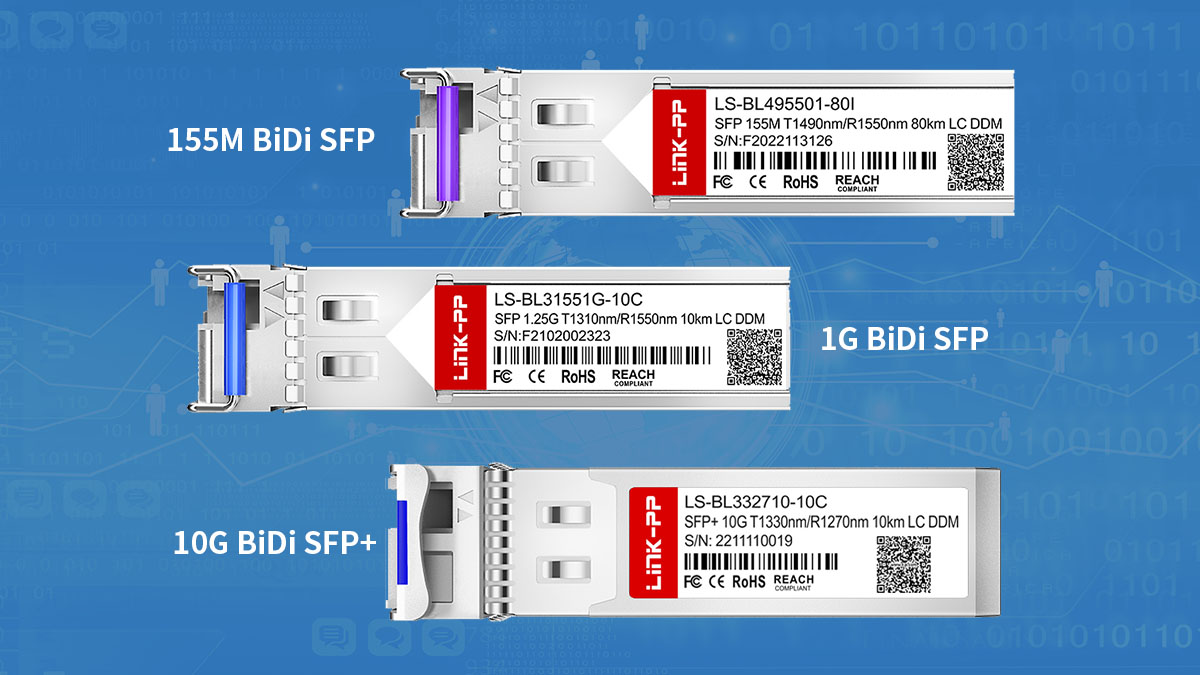
BiDi SFP modules are commonly available in multiple speed classes, including 155M BiDi SFP for legacy SONET/SDH networks, 1G BiDi SFP for Gigabit Ethernet, and 10G BiDi SFP+ for high-bandwidth enterprise and metro networks. This range allows BiDi technology to serve not only modern Ethernet infrastructure but also existing optical systems that remain operational in many industrial and telecom environments.
In this guide, we focus on how BiDi SFP modules work, the differences between 155M, 1G, and 10G BiDi SFP types, and the real-world trade-offs that determine when BiDi optics are the right choice—and when a traditional dual-fiber SFP design may be more appropriate.
✅ What Is a BiDi SFP Module?
A BiDi SFP module is a type of optical transceiver designed for bidirectional communication over a single optical fiber, most commonly single-mode fiber. Unlike conventional SFP modules that require two fibers—one dedicated to transmitting and the other to receiving—a BiDi SFP module consolidates both functions onto one fiber link, making it fundamentally more fiber-efficient by design.
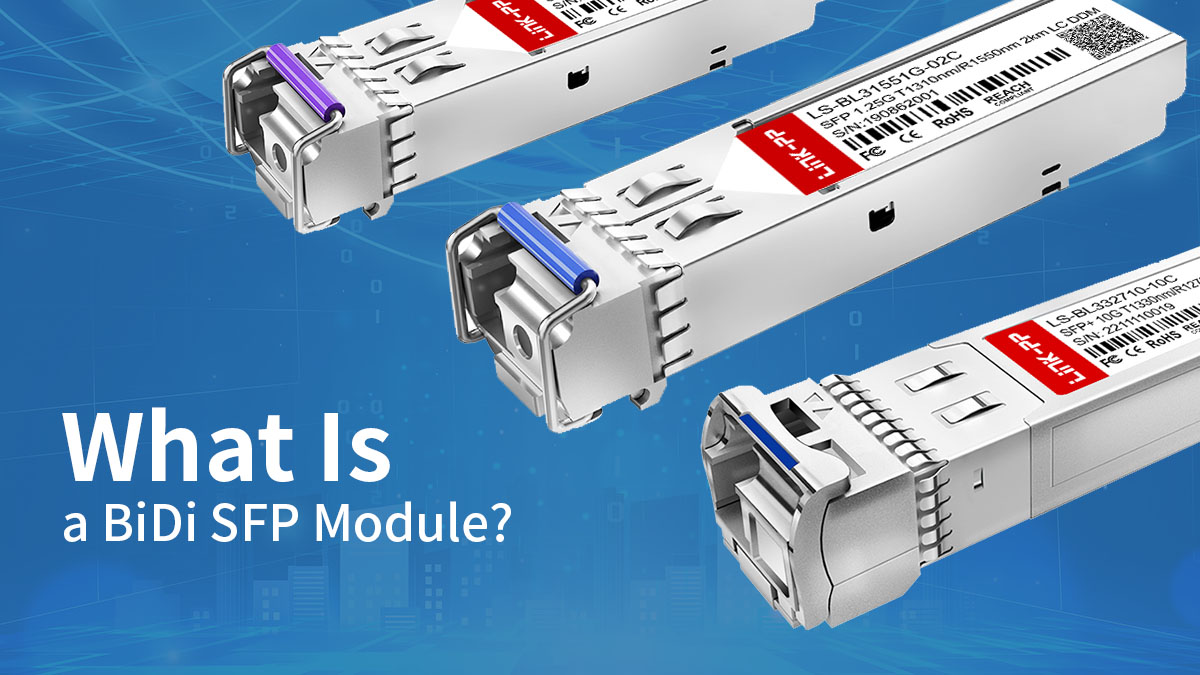
Meaning of “BiDi” (Bidirectional) in Fiber Optics
In fiber optics, “BiDi” stands for bidirectional transmission, which means data flows in both directions simultaneously on the same fiber strand. This is achieved by assigning different optical wavelengths to upstream and downstream traffic. Each BiDi SFP module is therefore configured with a fixed TX wavelength and a corresponding RX wavelength, allowing two endpoints to communicate without interference on a shared fiber path.
This bidirectional approach is not a software feature or protocol setting—it is an optical-layer design choice that directly affects how fibers, transceivers, and link planning are implemented.
Single-Fiber Transmission Concept
The single-fiber transmission model used by BiDi SFP modules relies on wavelength separation rather than physical separation. Instead of splitting transmit and receive signals across two fibers, a BiDi SFP uses:
Both signals travel through the same fiber core at the same time. As a result, each BiDi link requires two complementary modules, where the TX wavelength of one module matches the RX wavelength of the other, and vice versa. This pairing requirement is central to BiDi design and must be considered during deployment and inventory planning.
Common Data Rates of BiDi SFP Modules
BiDi SFP modules are available across multiple speed classes to support different generations of optical networks:
-
155M BiDi SFP
Used primarily in legacy SONET/SDH (OC-3/STM-1) systems and industrial networks that still operate at lower data rates.
-
1G BiDi SFP
Widely deployed in Gigabit Ethernet enterprise and access networks, offering a balance between performance and fiber efficiency.
-
10G BiDi SFP+
Designed for 10Gbps Ethernet applications in data centers, metro networks, and high-capacity enterprise backbones.
This range allows BiDi technology to remain relevant across both modern Ethernet infrastructure and long-standing optical systems.
Fiber Type Requirements
BiDi SFP modules are designed to operate over single-mode fiber (SMF). Single-mode fiber provides the optical characteristics required for precise wavelength separation and long-distance transmission. Multimode fiber does not support the wavelength stability or reach needed for BiDi operation and is therefore not suitable for BiDi SFP deployments.
Understanding these foundational characteristics is essential before evaluating how BiDi SFP modules work in practice and how they compare to traditional dual-fiber SFP solutions.
✅ How Does a BiDi SFP Module Work?
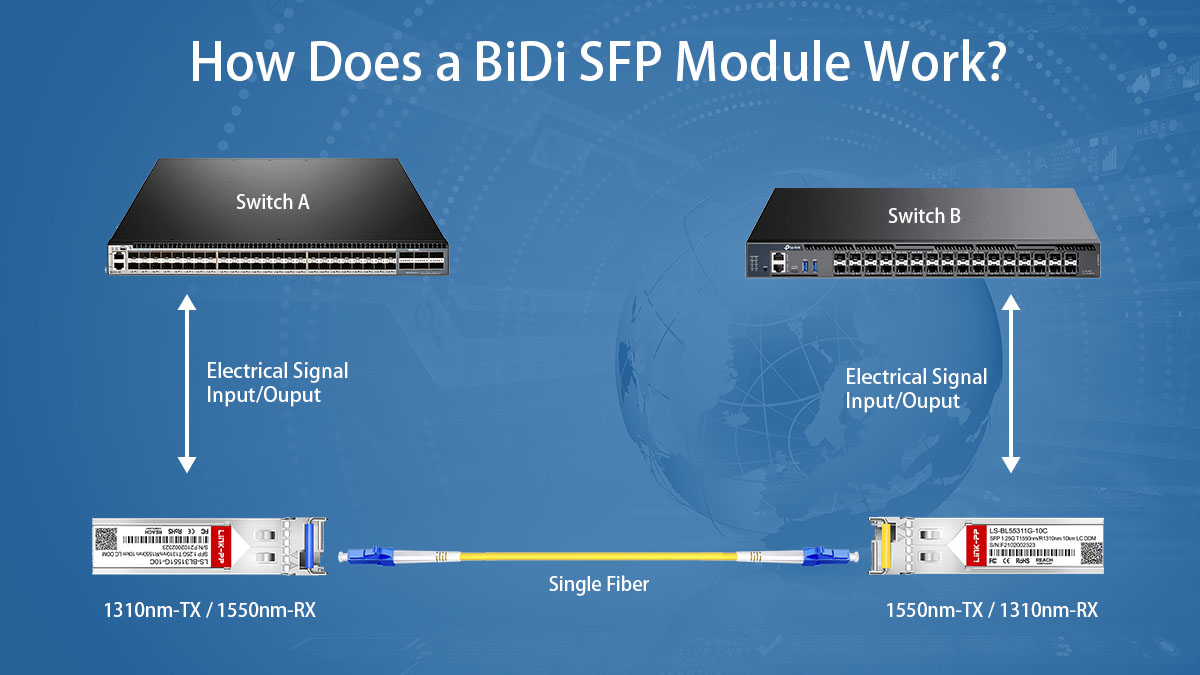
A BiDi SFP stransceiver works by separating transmit and receive signals using different optical wavelengths on the same single-mode fiber. Instead of relying on two physical fibers, BiDi technology uses wavelength-level separation to enable full-duplex communication, which is the core mechanism that makes single-fiber transmission possible.
WDM (Wavelength Division Multiplexing) Principle
At the optical layer, BiDi SFP modules are based on Wavelength Division Multiplexing (WDM). WDM allows multiple optical signals, each carried on a different wavelength, to coexist on a single fiber without interference.
Inside a BiDi SFP module, a built-in WDM filter (often implemented using thin-film filter technology) performs two critical functions:
This passive optical separation happens continuously and does not require any configuration at the network layer, making BiDi operation transparent to switches and routers.
Different TX and RX Wavelengths on a Single Fiber
Each BiDi SFP module is manufactured with a fixed wavelength pair:
For example, a module labeled TX1310nm / RX1550nm transmits data at 1310nm and receives data at 1550nm. Because both wavelengths travel simultaneously over the same fiber core, the module can send and receive data at the same time without signal collision.
This design eliminates the need for a second fiber but introduces strict wavelength planning requirements at both ends of the link.
Why BiDi SFP Modules Must Be Used in Matched Pairs
BiDi SFP modules must always be deployed in matched pairs because the TX wavelength of one module must align with the RX wavelength of the module at the opposite end.
Using the previous example:
If both ends use identical wavelength configurations, the link will fail because each side would transmit and listen on the same wavelength. This pairing dependency is a fundamental characteristic of BiDi optics and one of the key differences compared to dual-fiber SFP modules.
From an operational perspective, this means:
-
Proper labeling and inventory control are essential
-
Link planning must account for wavelength direction, not just distance and speed
Typical BiDi Wavelength Combinations
Common BiDi SFP wavelength pairs include:
These wavelength combinations are standardized enough to ensure interoperability but still require careful selection to ensure both ends of the fiber link are correctly matched.
Understanding how BiDi SFP modules work at the wavelength level is critical before comparing them to traditional dual-fiber SFP designs or evaluating their advantages and limitations in real-world networks.
✅ Main Types of BiDi SFP Modules
BiDi SFP modules are available in multiple speed classes to support different generations of optical networks. While the underlying bidirectional principle remains the same, data rate, wavelength design, and deployment scenarios vary significantly between 155M, 1G, and 10G BiDi SFP modules. Understanding these differences is essential for selecting the correct module for a specific network environment.
155M BiDi SFP Module
155M BiDi SFP modules, also referred to as OC-3 or STM-1 BiDi SFP, are designed for lower-speed optical transmission commonly found in legacy telecom and industrial networks. Although modern Ethernet networks have largely moved beyond this data rate, 155M BiDi optics remain relevant in many operational systems where infrastructure upgrades are limited or cost-sensitive.
Typical Applications
-
Legacy SONET / SDH transport networks
-
Industrial communication systems with long equipment lifecycles
-
Utility, transportation, and access networks still operating at STM-1 speeds
Wavelengths and Transmission Distances
155M BiDi SFP modules typically use well-separated wavelength pairs such as:
-
TX1310nm / RX1550nm
-
TX1550nm / RX1310nm
Common transmission distances include 20km and 40km, depending on optical budget and fiber quality. The lower data rate allows for relatively longer reach compared to higher-speed BiDi modules under similar conditions.
Backward Compatibility Considerations
In mixed-speed environments, 155M BiDi SFP modules are often deployed alongside newer Ethernet-based systems. While they are optically compatible with single-mode fiber infrastructure, they are not speed-compatible with 1G or 10G ports. Careful port planning and clear separation between legacy and Ethernet domains are required to avoid configuration and operational issues.
1G BiDi SFP Modules
1G BiDi SFP modules are the most widely deployed BiDi optics, particularly in Gigabit Ethernet enterprise and access networks. They offer a strong balance between bandwidth, fiber efficiency, and cost.
Typical Wavelengths
Common wavelength pairs for 1G BiDi SFP modules include:
-
TX1310nm / RX1550nm
-
TX1550nm / RX1310nm
These wavelength pairs are mature and broadly supported across network equipment vendors.
Transmission Distance Options
Standard distance options for 1G BiDi SFP modules include:
-
10km for short to mid-range links
-
20km for campus and metro access networks
-
40km for extended reach applications
This flexibility makes 1G BiDi SFP modules suitable for a wide range of fiber-limited deployments.
10G BiDi SFP+ Modules
10G BiDi SFP+ extend the bidirectional single-fiber concept to 10Gbps Ethernet, addressing higher bandwidth requirements in modern networks.
Use Cases
-
Enterprise backbone and aggregation layers
-
Data center interconnections where fiber availability is limited
-
Metro and access networks requiring higher throughput per fiber
To accommodate higher data rates, 10G BiDi SFP+ modules often use closer wavelength spacing, such as TX1270 / RX1330 and TX1330 / RX1270, which requires tighter optical control and higher-quality components.
Comparison with Standard 10G SFP+ Optics
Compared to traditional dual-fiber 10G SFP+ LR modules, 10G BiDi SFP+ optics:
-
Reduce fiber usage by 50%
-
Simplify fiber management in constrained environments
-
Require stricter wavelength pairing and inventory control
While they may introduce additional planning complexity, 10G BiDi SFP+ modules provide a clear advantage in networks where fiber scarcity is a limiting factor.
With these three BiDi SFP types—155M, 1G, and 10G—network designers can apply the same bidirectional principle across legacy and modern infrastructures, adapting BiDi technology to a wide range of operational requirements.
✅ BiDi SFP vs Dual-Fiber SFP: Key Differences
When choosing between a BiDi SFP module and a traditional dual-fiber SFP module, the decision is less about performance alone and more about fiber availability, operational complexity, and long-term scalability. Both solutions deliver full-duplex communication, but they do so using fundamentally different physical and optical designs.
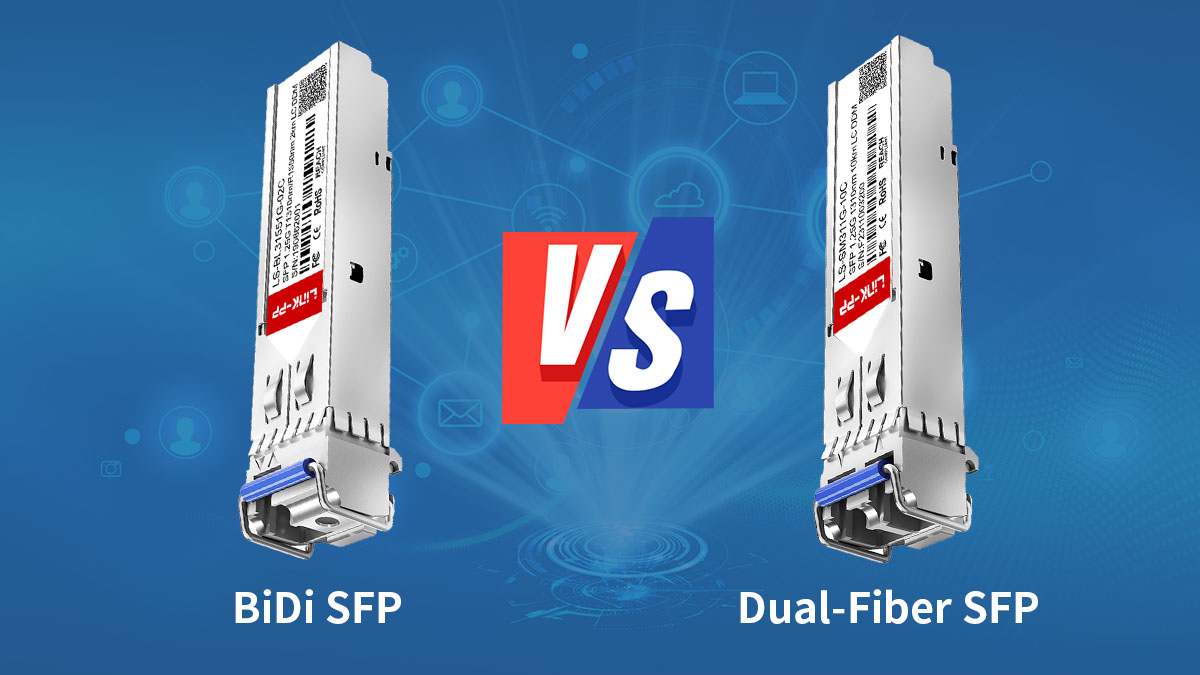
Core Differences at a Glance
| Aspect |
BiDi SFP Module |
Dual-Fiber SFP Module |
| Fiber usage |
Single fiber for TX and RX |
Two fibers (one TX, one RX) |
| Optical principle |
WDM-based wavelength separation |
Physical fiber separation |
| Required pairing |
Matched wavelength pairs |
Identical modules at both ends |
| Fiber efficiency |
High (50% fiber reduction) |
Lower |
| Deployment complexity |
Medium (wavelength planning required) |
Low |
Fiber Usage: Single Fiber vs Two Fibers
The most visible difference is fiber consumption.
In environments where fiber resources are limited or expensive to add—such as metropolitan networks or older buildings—BiDi SFP modules can effectively double usable fiber capacity without physical expansion.
Cost and Infrastructure Efficiency
From a total cost perspective, BiDi SFP modules often reduce infrastructure-related expenses, even if the module price itself is slightly higher in some cases.
As a result, BiDi SFP modules are frequently chosen in projects where fiber availability, not transceiver cost, is the primary constraint.
Deployment and Maintenance Considerations
BiDi SFP deployments require more careful planning than dual-fiber designs:
-
Each link must use correctly matched wavelength pairs
-
Inventory management must track two complementary module types
-
Clear labeling is critical to avoid mismatched installations
In contrast, dual-fiber SFP modules are largely plug-and-play, using identical optics on both ends of the link. This simplicity can reduce operational risk in environments with frequent moves, adds, and changes.
Network Flexibility and Scalability
In terms of scalability, both approaches have trade-offs:
-
BiDi SFP modules
-
Dual-fiber SFP modules
The optimal choice depends on whether your network is constrained by fiber availability or operational simplicity. Understanding this distinction is critical before evaluating the advantages and limitations of BiDi SFP modules in specific use cases.
✅ Advantages of Using BiDi SFP Modules
The primary value of a BiDi optical module lies not in higher speed or longer reach, but in how efficiently it uses existing fiber infrastructure. In networks where fiber resources are limited or costly to expand, BiDi SFP modules offer several practical advantages that directly impact deployment cost and operational efficiency.
Reduced Fiber Consumption
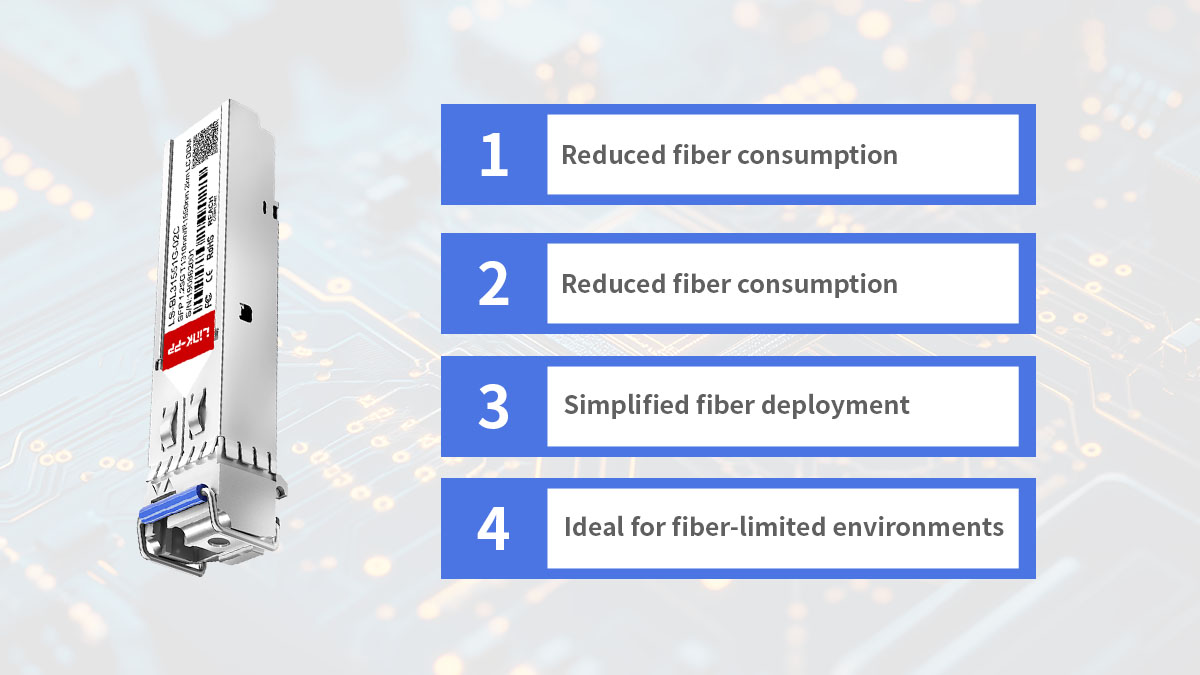
BiDi SFP modules reduce fiber usage by up to 50% by transmitting and receiving data over a single fiber strand. This immediately doubles the effective capacity of existing fiber plant without requiring new fiber installation.
For networks built on scarce or legacy fiber infrastructure, this efficiency can determine whether an upgrade is feasible at all.
Lower Cabling and Fiber Leasing Costs
By cutting the number of required fibers in half, BiDi SFP modules also reduce:
While the cost of a BiDi SFP module may be comparable to or slightly higher than a dual-fiber SFP, the total cost of ownership is often significantly lower when fiber-related expenses are considered.
Simplified Fiber Deployment
With fewer fibers to manage, BiDi SFP deployments simplify:
This simplification is especially valuable in high-density environments, where physical fiber management can quickly become a bottleneck for network expansion.
Ideal for Fiber-Limited Environments
BiDi SFP modules are particularly well suited for:
-
Metropolitan area networks with leased or scarce fiber
-
Enterprise campuses with limited dark fiber availability
-
Older buildings where new fiber installation is disruptive or impractical
In these scenarios, BiDi SFP modules provide a practical way to extend network capacity without changing the physical fiber footprint, making them an efficient and cost-effective optical solution.
✅ Limitations and Considerations of BiDi SFP Modules
While BiDi SFP modules offer clear advantages in fiber efficiency, they also introduce specific constraints that must be understood before deployment. These limitations are not flaws in the technology itself, but trade-offs inherent to single-fiber, wavelength-based transmission.
Strict Wavelength Pairing Requirements
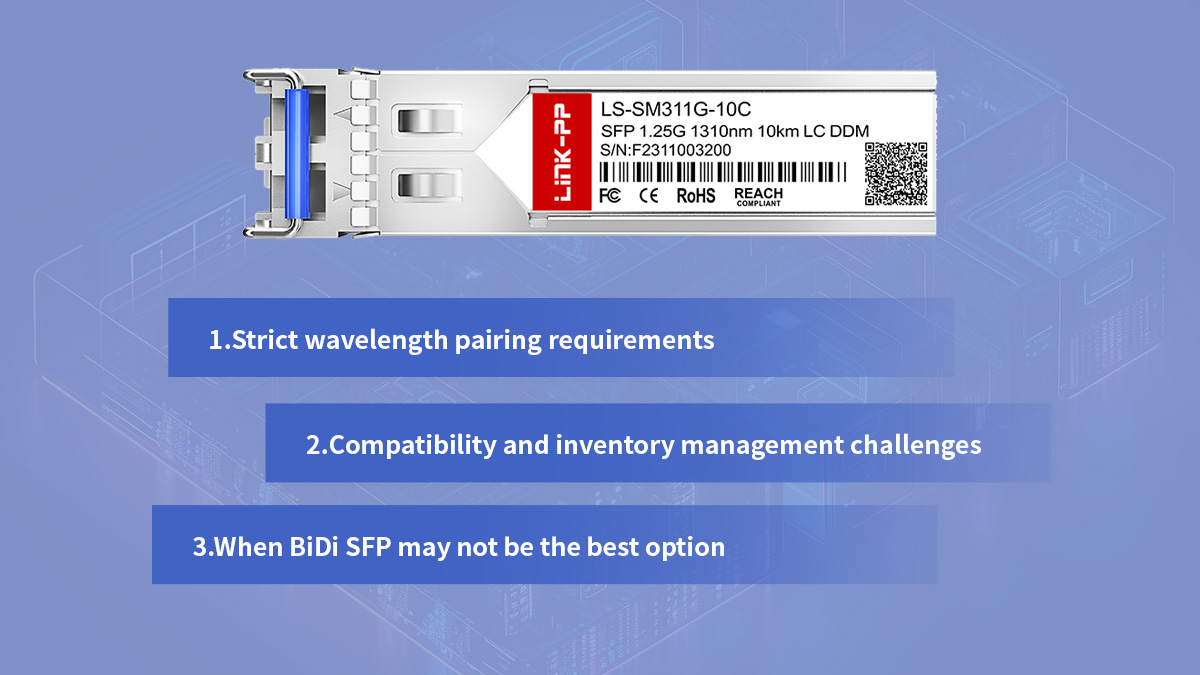
BiDi SFP modules must be used in matched wavelength pairs, where the TX wavelength of one module corresponds exactly to the RX wavelength of the module at the opposite end. Any mismatch will result in link failure.
This requirement has several practical implications:
-
Link planning must include wavelength direction, not just distance and speed
-
Field technicians must install the correct module at each end
-
Clear labeling and documentation are essential
In large networks, unmanaged wavelength pairing can quickly become a source of installation errors.
Compatibility and Inventory Management Challenges
Because BiDi SFP modules come in complementary wavelength pairs, inventory management is more complex than with standard dual-fiber SFPs.
Operational challenges include:
-
Maintaining balanced stock of both wavelength variants
-
Avoiding accidental deployment of identical wavelength modules on both ends
-
Verifying compatibility across different switch and router platforms
Although most modern network equipment supports BiDi SFP modules, vendor compatibility and firmware behavior should always be validated, especially in mixed-vendor environments.
When BiDi SFP May Not Be the Best Option
BiDi SFP modules are not always the optimal choice. In particular, they may be less suitable when:
-
Fiber availability is abundant and inexpensive
-
Operational simplicity is a higher priority than fiber efficiency
-
Networks require frequent reconfiguration or rapid redeployment of optics
In such cases, traditional dual-fiber SFP modules can offer greater flexibility and lower operational risk, even if they use more fiber.
Understanding these limitations ensures that BiDi SFP modules are deployed where they provide genuine value, rather than introducing unnecessary complexity into the network.
✅ Common Use Cases for BiDi SFP Modules
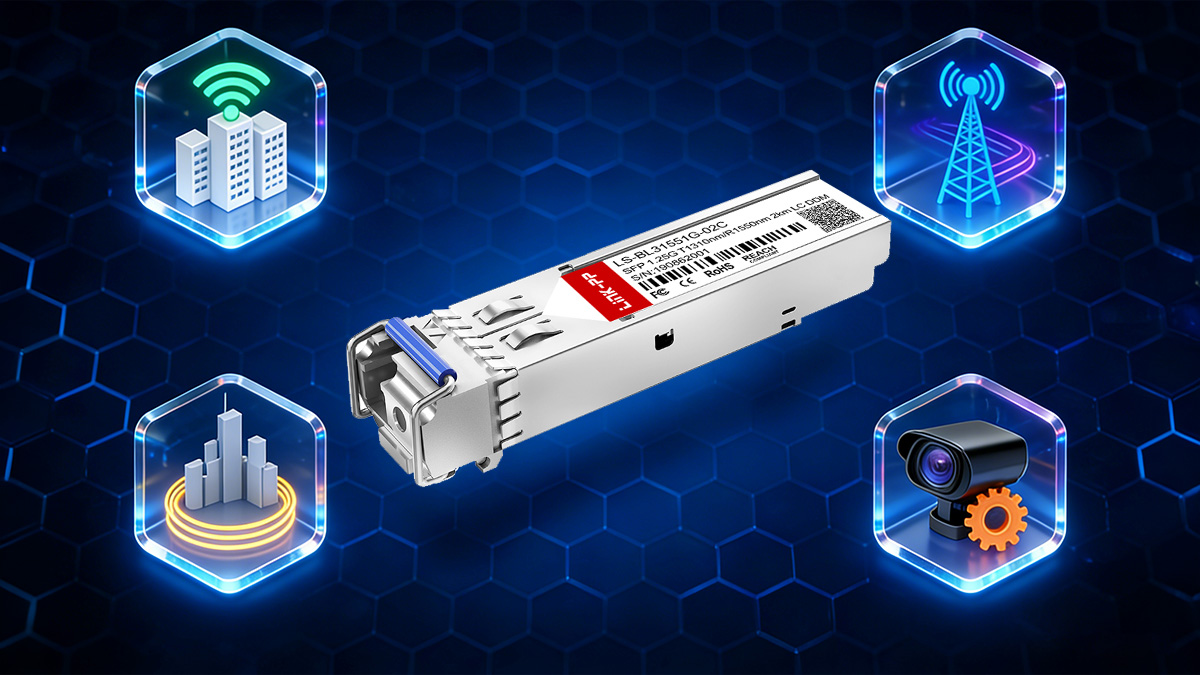
BiDi SFP modules are most effective in network environments where fiber availability is limited, costly, or difficult to expand. Their ability to deliver full-duplex communication over a single fiber makes them a practical choice across a wide range of enterprise, telecom, and industrial applications.
Enterprise Campus Networks
In enterprise campus networks, fiber infrastructure is often constrained by:
BiDi SFP modules allow network teams to reuse existing single-fiber links to connect access, aggregation, and core layers. This is particularly valuable during incremental upgrades, such as migrating from legacy systems to Gigabit or 10G Ethernet, without disrupting the physical cabling plant.
Metropolitan Area Networks (MAN)
Metropolitan area networks frequently rely on leased or shared fiber, where fiber count directly affects recurring operational costs. In these environments, BiDi SFP modules help:
-
Reduce the number of leased fiber strands
-
Maximize bandwidth per fiber
-
Lower long-term fiber leasing expenses
As a result, BiDi SFP modules are commonly deployed in city-scale networks connecting multiple sites, buildings, or data centers over limited fiber routes.
Telecom Access Networks
In telecom access and aggregation networks, BiDi SFP modules are used to:
-
Extend connectivity from central offices to access nodes
-
Support mixed-speed environments, including legacy 155M systems and modern Ethernet
-
Optimize fiber usage in last-mile and access segments
Their ability to operate over long distances on single-mode fiber makes them well suited for access-layer deployments where fiber resources are carefully managed.
Surveillance and Industrial Networks
Surveillance systems and industrial networks often operate in environments where:
-
Fiber infrastructure is minimal or fixed
-
Network upgrades must coexist with long equipment lifecycles
-
Reliability and simplicity are critical
BiDi SFP modules enable single-fiber links between cameras, control systems, and monitoring centers, reducing cabling complexity while maintaining reliable optical communication in challenging deployment scenarios.
Across these use cases, BiDi SFP modules consistently provide value where fiber efficiency outweighs the need for maximum operational flexibility, making them a strategic choice in fiber-constrained networks.
✅ Compatibility and Interoperability
Compatibility is a critical consideration when deploying BiDi SFP modules, as these optics operate at the physical layer but must still align with switch, router, and monitoring expectations. Understanding interoperability requirements helps ensure stable performance across different network platforms.
Compatibility with Major Switch and Router Brands
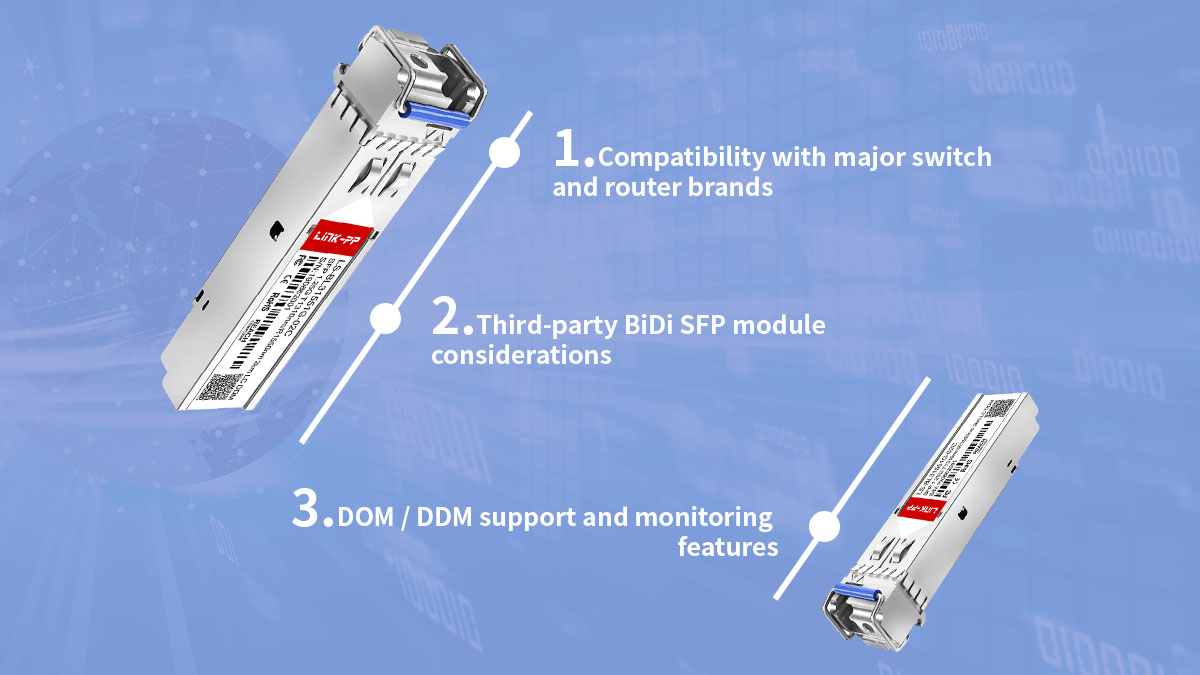
Most modern switches and routers from major vendors support BiDi SFP modules at the hardware level, provided the module meets the SFP MSA (Multi-Source Agreement) standards. From an optical perspective, BiDi SFP modules behave like standard SFP or SFP+ transceivers, making them broadly deployable across enterprise, telecom, and industrial equipment.
However, vendor-specific behaviors may affect deployment:
-
Some platforms enforce transceiver authentication
-
Firmware versions can influence optical recognition
-
Certain features may be restricted to vendor-branded optics
As a result, compatibility should always be validated on the target platform, especially in production networks.
Third-Party BiDi SFP Module Considerations
Third-party or compatible BiDi SFP modules are widely used as cost-effective alternatives to original vendor optics. When evaluating third-party BiDi SFP modules, key factors include:
-
Proper coding for the target switch or router
-
Compliance with optical power and wavelength specifications
-
Verified interoperability with specific hardware models
High-quality third-party BiDi SFP modules can deliver the same optical performance as branded modules, provided they are tested and correctly programmed for the intended environment.
DOM / DDM Support and Monitoring Features
Most BiDi SFP modules support DOM (Digital Optical Monitoring) or DDM (Digital Diagnostic Monitoring), enabling real-time visibility into optical parameters such as:
-
Transmit optical power
-
Receive optical power
-
Module temperature
-
Supply voltage
These monitoring features are especially important in BiDi deployments, where precise wavelength performance and optical power balance are critical to link stability. DOM/DDM data allows network operators to proactively identify degradation or mismatches before they impact service availability.
Ensuring compatibility at both the hardware and monitoring levels is essential for reliable BiDi SFP deployment, particularly in mixed-vendor or large-scale networks.
✅ FAQs About BiDi SFP Modules
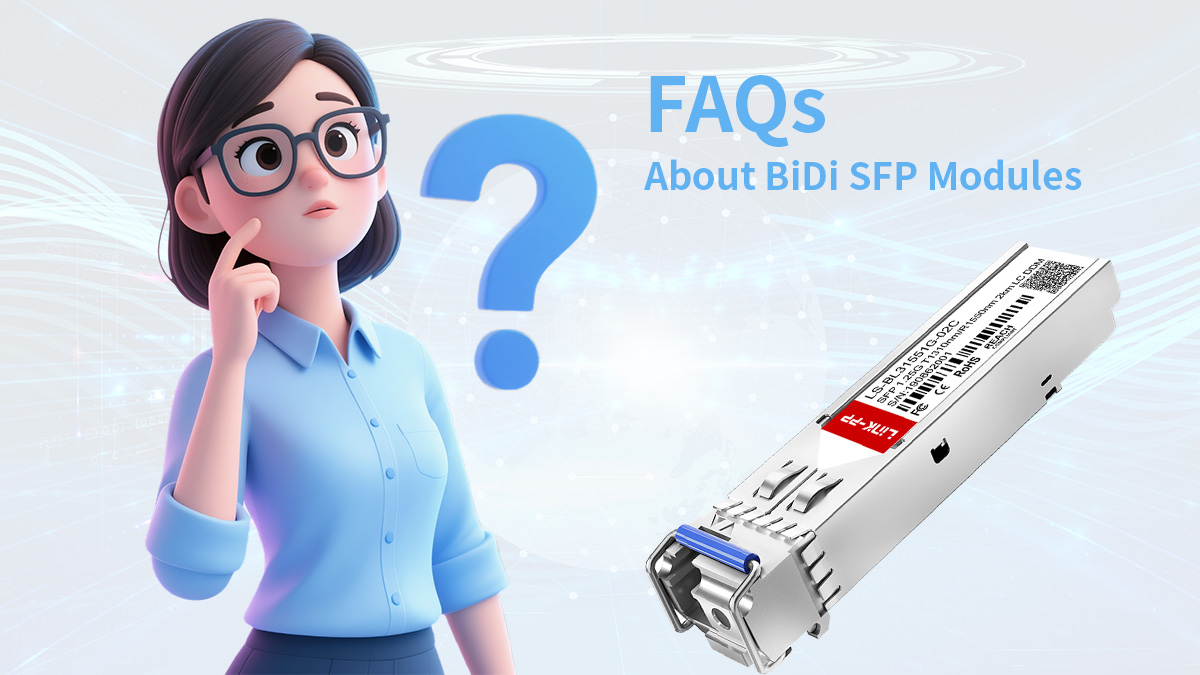
1. Can BiDi SFP modules be used in standard SFP ports?
Yes. They work in standard SFP or SFP+ ports that support the same data rate. Always check vendor transceiver policies before deployment.
2. Do both ends need the same BiDi SFP module?
No. BiDi links require complementary wavelength pairs, not identical modules. Mismatch of TX/RX wavelengths will cause link failure.
3. Can BiDi SFP modules work with multimode fiber?
No. BiDi SFP modules are designed for single-mode fiber only. Multimode fiber does not support BiDi operation.
4. Are BiDi SFP modules more expensive than regular SFPs?
It depends. Module prices are often similar. BiDi usually lowers total cost when fiber is limited or leased.
5. How do I choose the correct BiDi wavelength pair?
You must match the opposite wavelengths. TX on one end must equal RX on the other. Verify data rate, distance, and pairing before installation.
✅ Summary: Is a BiDi SFP Module Right for Your Network?
A BiDi SFP module is the right choice when you need full-duplex fiber connectivity while minimizing fiber usage, especially in environments where adding or leasing fiber is costly or impractical.
Key Takeaways
-
BiDi SFP modules enable bidirectional transmission over a single-mode fiber using paired wavelengths.
-
They are available across 155M, 1G, and 10G speeds, supporting both legacy and modern networks.
-
Their primary advantage is fiber efficiency, not higher bandwidth or extended reach.
-
Correct wavelength pairing and basic inventory control are essential for stable deployment.
When to Choose a BiDi SFP Module
-
Your network is fiber-limited or fiber-constrained
-
You want to reduce cabling, fiber leasing, or expansion costs
-
You need to upgrade capacity without changing existing fiber infrastructure
When a Dual-Fiber SFP May Be a Better Option
-
Fiber resources are abundant and inexpensive
-
Operational simplicity is more important than fiber optimization
-
You prefer identical optics on both ends of the link
Final Recommendation
For networks where fiber availability is the real bottleneck, BiDi SFP modules provide a practical and cost-effective optical solution.
If you are evaluating compatible BiDi SFP options across 155M, 1G, and 10G, you can explore tested solutions available from the LINK-PP Official Store to support both legacy and modern network deployments.










































