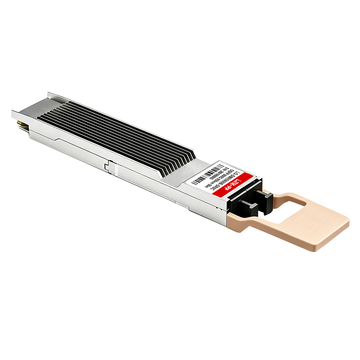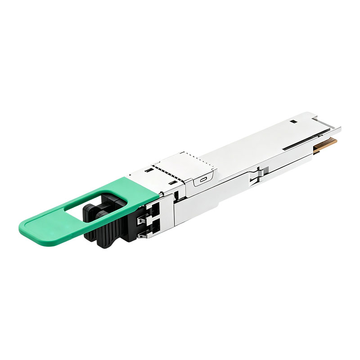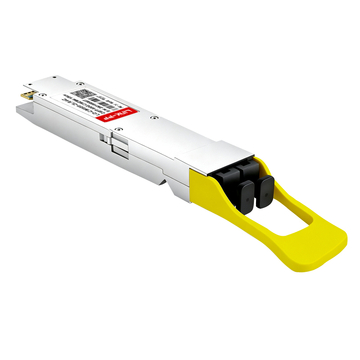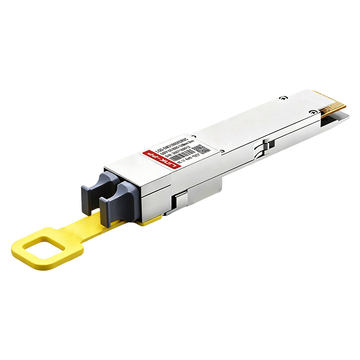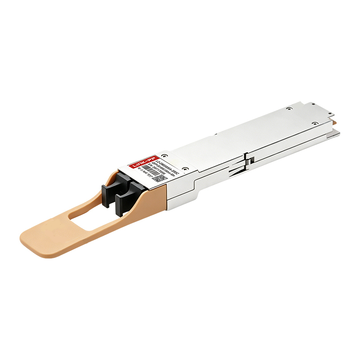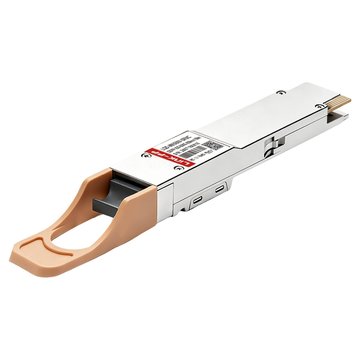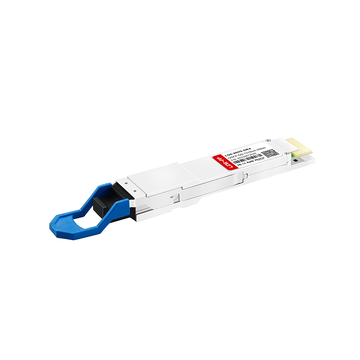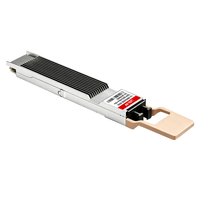
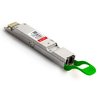
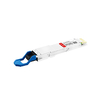
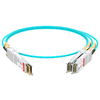
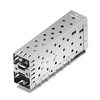
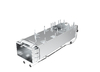
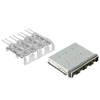

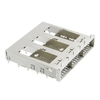

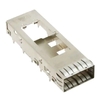
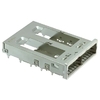
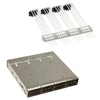
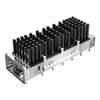




The demand for 800G Ethernet is accelerating as AI clusters, hyperscale data centers, and cloud infrastructure require higher bandwidth and faster interconnects. To support these networks, 800G optical transceivers are available in two major pluggable form factors: QSFP-DD800 and OSFP. Both deliver high-speed connectivity, but their physical designs and deployment requirements differ.
Choosing between QSFP-DD800 vs OSFP involves more than comparing transmission rates. Port density, switch compatibility, power consumption, thermal management, and existing network infrastructure all influence which form factor is more suitable. A module that supports 800Gbps may still be unsuitable for a switch if its physical interface or operating requirements do not match the host platform.
This guide compares QSFP-DD800 and OSFP from a practical network deployment perspective, covering:
-
Their physical structures, electrical interfaces, and technical differences.
-
Switch compatibility, backward compatibility, and optical performance.
-
Applications in AI clusters, hyperscale data centers, and 800G Ethernet networks.
It also introduces LINK-PP's 800G QSFP-DD and OSFP optical transceiver options to help network engineers identify suitable modules for different switch architectures.
What Are QSFP-DD800 and OSFP 800G Form Factors?
QSFP-DD800 and OSFP are two pluggable optical transceiver form factors designed to support 800G networking. Both use eight high-speed electrical lanes, but they differ in mechanical dimensions, thermal design, and host interface requirements. Understanding these differences is the first step in selecting an 800G optical module.
What Is QSFP-DD800?
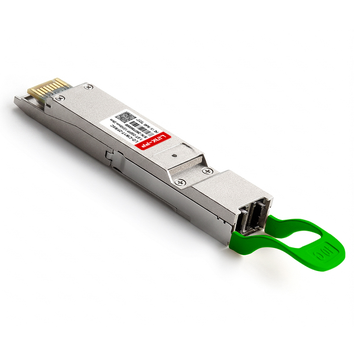
QSFP-DD800 (Quad Small Form Factor Pluggable Double Density 800) is an eight-lane pluggable transceiver form factor designed to support 800G Ethernet connectivity while retaining the compact mechanical architecture of the QSFP family.
Its main characteristics include:
-
Eight-lane electrical interface: Supports eight high-speed electrical lanes, enabling an aggregate 800G-class data rate.
-
Compact module design: Uses a relatively small footprint, making it suitable for high-density switch front panels.
-
QSFP-family compatibility: The QSFP-DD800 host interface can support selected earlier-generation QSFP modules, depending on the switch design.
-
High-speed optical connectivity: Supports optical interfaces such as SR8, DR8, and 2FR4 for different fiber types and transmission distances.
-
Data center applications: Commonly considered for high-density Ethernet switches, leaf-spine networks, and high-performance computing infrastructure.
One important advantage of QSFP-DD800 is its migration flexibility. Switch platforms designed with backward-compatible QSFP-DD ports can accommodate selected lower-speed QSFP modules, helping operators maintain existing connectivity during network upgrades.
However, backward compatibility should never be assumed across every switch or module combination. The host platform's compatibility documentation remains the final reference.
What Is OSFP 800G?
OSFP (Octal Small Form Factor Pluggable) is another eight-lane pluggable transceiver form factor developed for high-speed networking applications. Its larger physical structure provides additional design space for thermal management and high-performance optical components.
Key characteristics include:
-
Eight-lane architecture: Supports 800G-class connectivity through eight high-speed electrical lanes.
-
Larger physical dimensions: Has a larger module footprint than QSFP-DD800.
-
Thermal design flexibility: Provides additional space for heat sinks and other cooling solutions.
-
High-power module support: Its mechanical design accommodates demanding high-speed optical transceiver implementations.
-
AI and hyperscale applications: Frequently used in high-performance switches for AI clusters, GPU networking, and large-scale data center fabrics.
OSFP modules are available in different mechanical configurations, including finned-top designs. The specific heat sink and cooling arrangement must match the switch's airflow architecture.
Unlike QSFP-DD800, OSFP does not provide direct backward compatibility with QSFP-family modules through the same physical interface. An OSFP module requires an OSFP-compatible host port.
How Do QSFP-DD800 and OSFP Achieve 800G Transmission?
Both form factors use high-speed electrical signaling and PAM4 modulation to achieve 800G-class aggregate bandwidth. The module converts electrical signals from the switch into optical signals and performs the reverse conversion for incoming data.
The basic transmission architecture involves:
-
Electrical interface: Eight high-speed electrical lanes connect the host switch ASIC to the optical module.
-
PAM4 modulation: Four-level pulse amplitude modulation carries more information per symbol than traditional NRZ signaling.
-
Optical conversion: The transceiver converts electrical signals into optical signals using its internal laser and optical components.
-
FEC: Forward Error Correction helps maintain reliable data transmission over high-speed links.
-
CMIS management: Supported management interfaces provide module monitoring, configuration, and diagnostic information.
The optical lane arrangement depends on the specific 800G standard. For example, SR8 and DR8 use eight optical lanes, while 2FR4 uses a different wavelength and channel arrangement to support 800G transmission over duplex single-mode fiber.
Therefore, the 800G designation alone does not define the optical architecture. The exact Ethernet standard and module specifications must also be considered.
QSFP-DD800 vs OSFP: Key Technical Differences
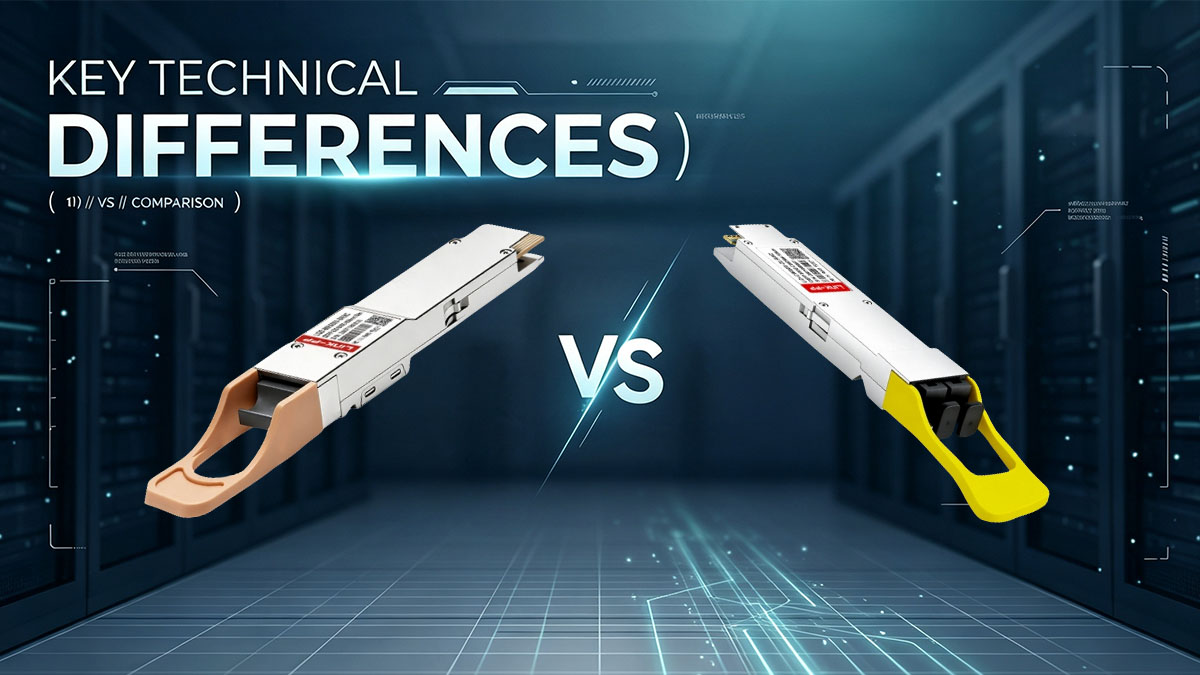
The main difference between QSFP-DD800 and OSFP lies in their physical dimensions and thermal design. QSFP-DD800 prioritizes a compact footprint and port density, while OSFP provides a larger mechanical envelope with additional room for thermal solutions. Both support 800G connectivity, but their suitability depends on the switch architecture.
Physical Dimensions and Mechanical Design
QSFP-DD800 and OSFP use different mechanical interfaces, cages, and module structures. They are not physically interchangeable, even when their optical specifications and transmission rates are identical.
Their mechanical differences include:
-
QSFP-DD800: Retains the compact QSFP-family form factor, allowing more compact front-panel arrangements.
-
OSFP: Uses a larger housing with additional space for thermal components.
-
Cage design: Each form factor requires its corresponding switch cage and electrical connector.
-
Heat sink arrangement: OSFP modules may use finned-top heat sinks, while QSFP-DD800 implementations use thermal solutions designed around their smaller module envelope.
-
Module insertion: Both support hot-pluggable operation on compatible host platforms, but their insertion mechanisms and mechanical interfaces differ.
The physical distinction is important when planning switch hardware. An 800G OSFP module cannot be inserted into a QSFP-DD800 port, and a QSFP-DD800 module cannot be installed in an OSFP cage.
These differences also affect the design of switch front panels, PCB layouts, airflow paths, and module replacement procedures.
Port Density and Front-Panel Layout
QSFP-DD800 generally offers an advantage when front-panel port density is a major design priority because of its smaller footprint. OSFP's larger housing requires more physical space per port, although actual switch density depends on the complete hardware design.
Important considerations include:
-
QSFP-DD800 port density: Its compact dimensions allow switch manufacturers to arrange a greater number of ports within a given front-panel area.
-
OSFP port layout: Its larger dimensions require more space, but provide additional flexibility for module thermal design.
-
Switch chassis size: The number of available 800G ports depends on whether the platform uses a 1U, 2U, or larger chassis.
-
PCB and connector layout: Electrical routing, cage spacing, and power distribution can limit the number of ports.
-
Airflow requirements: Dense optical installations need sufficient airflow to prevent excessive module temperatures.
A higher port count does not automatically mean a better switch. Network operators should evaluate bandwidth density alongside power distribution, cooling capacity, and serviceability.
Power Consumption and Thermal Management
OSFP's larger housing provides additional room for thermal management, while QSFP-DD800 requires more careful thermal engineering within a smaller physical envelope. However, actual module power consumption depends on the optical architecture, component selection, and implementation rather than the form factor alone.
Thermal planning should cover:
-
Module power: Check the maximum power consumption specified for the exact transceiver model.
-
Heat dissipation: Evaluate how effectively the module transfers heat into its heat sink and the surrounding airflow.
-
Airflow direction: Confirm that the module's cooling design matches the switch's front-to-back or back-to-front airflow.
-
Operating temperature: Verify the module's rated operating temperature range.
-
Thermal density: Consider the cumulative heat generated by all populated 800G ports.
OSFP can be attractive for applications using demanding optical components because its larger housing offers more room for cooling solutions. Nevertheless, a well-designed QSFP-DD800 module can also meet its specified thermal requirements.
For either form factor, the switch manufacturer's maximum supported module power and cooling specifications should guide deployment decisions.
Backward Compatibility and Upgrade Flexibility
QSFP-DD800 offers an important migration advantage through backward compatibility with selected earlier QSFP-family modules. OSFP, by comparison, uses its own mechanical interface and does not directly accept QSFP modules.
The main differences are:
-
QSFP-DD800: Compatible host ports can support selected QSFP+, QSFP28, QSFP56, and QSFP-DD modules.
-
OSFP: Requires OSFP-compatible modules and cages.
-
Mixed-speed environments: QSFP-DD800 can simplify certain transitions between 100G, 400G, and 800G generations.
-
Platform restrictions: Supported data rates, module types, and breakout configurations depend on the switch hardware and software.
-
Migration planning: Existing fiber infrastructure and optical standards must also be checked when upgrading.
Cisco's QSFP-DD800 documentation, for example, identifies backward compatibility with QSFP+, QSFP28, QSFP56, and QSFP-DD 400G modules on supported ports. This illustrates the potential flexibility of the form factor, although the actual compatibility matrix must be checked for each switch platform.
The following table summarizes the major technical differences.
|
Technical Dimension |
QSFP-DD800 |
OSFP 800G |
|---|---|---|
|
Form factor |
Compact QSFP-family design |
Larger OSFP design |
|
Transmission capacity |
800G-class |
800G-class |
|
Electrical lanes |
8 lanes |
8 lanes |
|
Signaling |
PAM4 |
PAM4 |
|
Port density potential |
Higher |
Relatively lower per port |
|
Thermal design |
Compact thermal envelope |
More room for thermal solutions |
|
Backward compatibility |
Selected QSFP-family modules |
OSFP-specific interface |
|
Physical interchangeability |
Not compatible with OSFP |
Not compatible with QSFP-DD800 |
These are general form-factor characteristics rather than guarantees for every switch. The actual module power, supported data rates, port count, and thermal limits must be verified against the relevant product documentation.
QSFP-DD800 vs OSFP: Which Form Factor Is Compatible with Your Switch?
Switch compatibility is the most important factor when selecting an 800G optical transceiver. A QSFP-DD800 or OSFP module must match the physical cage, electrical interface, supported optical standards, and firmware requirements of the host switch. Matching the transmission rate alone is not sufficient.
Switch Port and Cage Compatibility
The first step is to identify which physical transceiver interface your switch supports. QSFP-DD800 and OSFP use different cages and connectors, so they cannot be directly substituted.
Check the following before deployment:
-
QSFP-DD800 port: Requires a QSFP-DD800-compatible cage and electrical interface.
-
OSFP port: Requires an OSFP-compatible cage and electrical interface.
-
Module dimensions: Confirm that the module housing, pull tab, and heat sink fit the host port.
-
Electrical interface: Verify that the switch supports the module's required lane rate and signaling.
-
Thermal configuration: Ensure the module's cooling design matches the switch's airflow arrangement.
Even when two modules support the same 800G optical standard, their mechanical differences prevent direct insertion into the same port.
800G Switch Platforms Supporting QSFP-DD800
QSFP-DD800 is suitable for switch platforms specifically designed around the QSFP-DD800 interface. It is particularly relevant to high-density Ethernet switches and data center environments that need flexible port configurations.
When evaluating QSFP-DD800 switch platforms, consider:
-
NVIDIA networking platforms: Check the exact switch generation and supported QSFP-DD800 module specifications.
-
Cisco 800G platforms: Review the switch compatibility matrix and supported 800G transceiver models.
-
Arista switches: Confirm the supported optical interfaces, module coding, and operating requirements.
-
Juniper platforms: Verify the hardware revision, supported port speeds, and optical module compatibility.
-
H3C platforms: Check the switch's supported 800G interface and transceiver list.
Some QSFP-DD800 switches also support breakout configurations, such as 2x400G, 4x200G, or 8x100G, depending on the platform and transceiver type.
This flexibility can be useful when a data center needs to connect different generations of network equipment without redesigning the entire front-panel architecture.
800G Switch Platforms Supporting OSFP
OSFP is commonly used in high-performance switching platforms designed for AI infrastructure, GPU clusters, and large-scale data center networks.
Its larger physical design makes it attractive for switch architectures that need additional thermal management flexibility.
Important platform considerations include:
-
NVIDIA/Mellanox: Check the specific OSFP switch platform and its supported 800G optical module configurations.
-
Arista: Verify OSFP port support, optical standards, and module power limits.
-
Cisco: Consult the applicable switch hardware and transceiver compatibility documentation.
-
Juniper: Confirm supported OSFP module types and network operating system requirements.
-
H3C: Check the platform's OSFP interface and approved optical specifications.
OSFP-based switches are especially relevant when deploying high-bandwidth AI fabrics where thermal design and sustained network performance are important.
However, the presence of an OSFP port does not guarantee support for every OSFP module. Switch firmware, module coding, power limits, and optical standards must still match.
What to Check Before Deploying an 800G Transceiver
Before installing an 800G optical module, verify the complete compatibility requirements of both the switch and the optical link.
Use this checklist:
-
Switch model: Identify the exact switch model and hardware revision.
-
Form factor: Confirm whether the port supports QSFP-DD800 or OSFP.
-
Ethernet standard: Check whether the platform supports SR8, DR8, 2FR4, or another required optical interface.
-
Optical wavelength: Verify that the wavelength configuration matches the intended link.
-
Fiber type: Determine whether the connection requires multimode fiber (MMF) or single-mode fiber (SMF).
-
Connector: Check the required MPO or LC interface and fiber polarity.
-
Power and cooling: Confirm the module's maximum power consumption and thermal requirements.
-
Firmware: Verify transceiver recognition, CMIS support, and any vendor-specific restrictions.
-
Remote-end compatibility: Ensure that both ends of the optical link use compatible Ethernet standards and optical specifications.
A compatibility check should cover the entire link rather than only the local switch port. This helps prevent situations where a module is recognized by the switch but cannot establish a stable optical connection.
Optical Performance: 800G QSFP-DD vs OSFP Transceiver Options
QSFP-DD800 and OSFP do not determine optical reach or transmission performance by themselves. These characteristics depend on the specific 800G optical standard, wavelength, fiber type, connector, and transceiver implementation. Both form factors can support several optical interfaces for different data center applications.
800G SR8: Short-Reach Multimode Connectivity
800GBASE-SR8 is designed for short-reach 800G connections over multimode fiber. It uses 850nm optical signaling and is suitable for high-density data center environments where switches and servers are located relatively close to one another.
Its main characteristics include:
-
Wavelength: 850nm.
-
Fiber type: Multimode fiber, typically OM4 or OM5.
-
Typical reach: Up to 50m over OM4.
-
Optical architecture: Eight optical lanes operating at approximately 100G per lane.
-
Connector: MPO-based parallel fiber connectivity, with the specific interface depending on the module implementation.
SR8 is particularly useful for:
-
Short-reach switch-to-switch connections.
-
Rack-level and row-level data center networking.
-
High-bandwidth connections within AI computing infrastructure.
-
Applications where multimode fiber infrastructure is already available.
Because SR8 is designed for relatively short distances, it is not the appropriate choice for longer single-mode fiber links between data center buildings or network facilities.
800G DR8: Parallel Single-Mode Fiber Connectivity
800GBASE-DR8 uses eight optical lanes over single-mode fiber to deliver 800G connectivity. It is designed for longer distances than SR8 and is commonly used in data center leaf-spine networks.
Its main technical characteristics include:
-
Wavelength: 1310nm.
-
Fiber type: Single-mode fiber.
-
Typical reach: Up to 500m.
-
Optical architecture: Eight optical lanes using approximately 100G per lane.
-
Connector: MPO-16 or another supported parallel-fiber interface, depending on the module design.
DR8 offers several deployment advantages:
-
Supports longer reach than multimode SR8.
-
Uses single-mode fiber infrastructure suitable for data center scale-out networks.
-
Provides high-bandwidth parallel optical connectivity.
-
Supports connections between switches in different racks and network rows.
For data centers that already use OS2 single-mode fiber, DR8 can be a practical option for 800G network expansion.
800G 2FR4: Duplex Single-Mode Fiber Connectivity
800GBASE-2FR4 is designed to provide 800G transmission over single-mode fiber using two 400G FR4 optical channels. Each channel uses four CWDM wavelengths, making it suitable for longer data center links without requiring eight separate parallel optical fiber lanes.
Its main characteristics include:
-
Wavelength range: Approximately 1271nm, 1291nm, 1311nm, and 1331nm for each FR4 optical channel.
-
Fiber type: Single-mode fiber.
-
Typical reach: Up to 2km.
-
Optical architecture: Two 400G FR4 channels combined for 800G transmission.
-
Connector: Duplex LC interfaces, with the exact connector arrangement depending on the module implementation.
The main advantages of 2FR4 include:
-
Uses wavelength-division multiplexing to reduce the number of parallel fiber lanes.
-
Supports longer reach than SR8 and DR8.
-
Can work with existing duplex single-mode fiber infrastructure.
-
Provides a practical option for switch-to-switch links across data center areas.
For operators who prefer duplex fiber connectivity rather than MPO-based parallel fiber, 2FR4 is an important 800G option.
How to Match Optical Specifications Across Different Form Factors
QSFP-DD800 and OSFP modules can communicate with each other across an optical link if both support the same compatible Ethernet media interface and optical specifications. Their physical form factors do not need to be identical because they connect to different host switches.
For example, an 800G QSFP-DD DR8 module on one switch can potentially communicate with an 800G OSFP DR8 module on another switch when their optical interfaces, fiber connections, and operating requirements are compatible.
The following table summarizes three common 800G optical interfaces.
|
Optical Standard |
Wavelength |
Fiber Type |
Typical Maximum Reach |
Typical Connector |
|---|---|---|---|---|
|
800GBASE-SR8 |
850nm |
MMF |
50m (OM4) |
MPO-16 |
|
800GBASE-DR8 |
1310nm |
SMF |
500m |
MPO-16 |
|
800GBASE-2FR4 |
CWDM, 1271–1331nm |
SMF |
2km |
Duplex LC |
Before selecting a transceiver, check the following optical parameters:
-
Transmission standard: Both ends must support compatible Ethernet media interfaces.
-
Wavelength: The optical wavelength arrangement must match.
-
Fiber type: MMF and SMF modules cannot be treated as interchangeable.
-
Connector: MPO and LC interfaces require the corresponding fiber assemblies.
-
Transmission distance: The optical reach must cover the actual link distance.
-
Optical budget: Insertion loss and other link impairments must remain within the transceiver's specified limits.
An important distinction is that identical form factors are not required for optical interoperability, but compatible optical specifications are essential.
QSFP-DD800 vs OSFP: Which Is Better for Different Data Center Applications?
Neither QSFP-DD800 nor OSFP is universally better for every 800G deployment. QSFP-DD800 is attractive for high-density switching and flexible migration, while OSFP is well suited to platforms that prioritize thermal design flexibility and high-performance networking. The best choice depends on the application and the switch hardware.
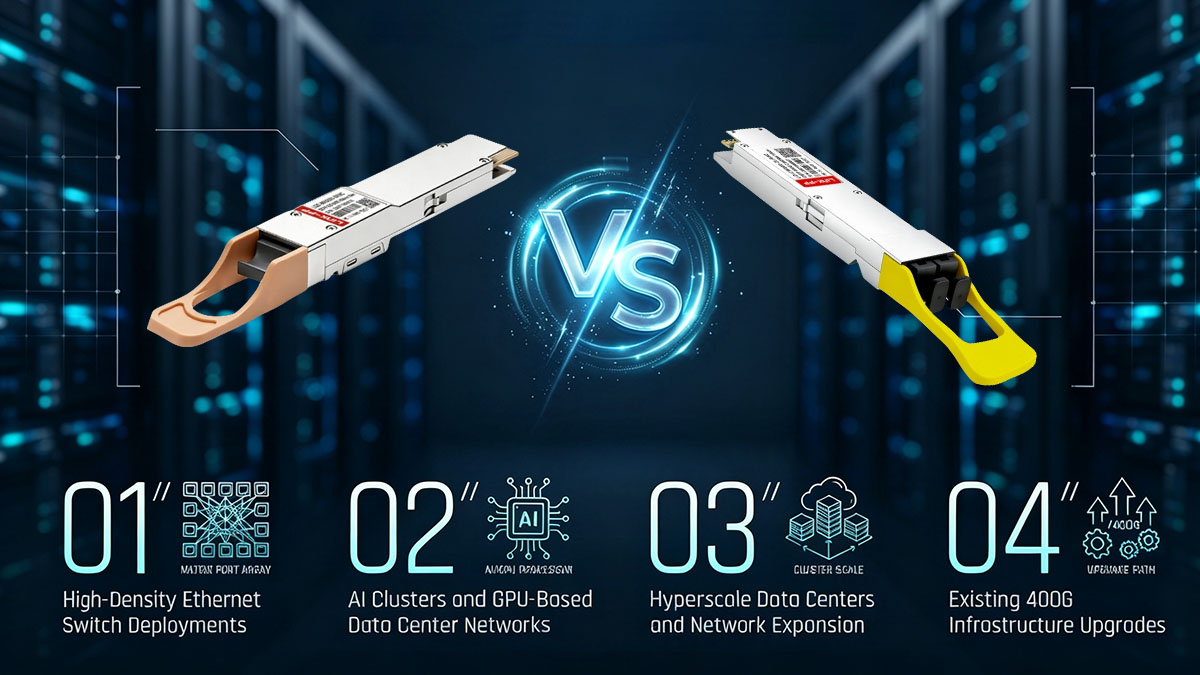
High-Density Ethernet Switch Deployments
QSFP-DD800 is often a practical choice for high-density Ethernet switch deployments because its compact footprint allows manufacturers to integrate more ports into a limited front-panel area.
Typical applications include:
-
Leaf-spine networks: High-speed connections between leaf and spine switches.
-
Top-of-rack switching: 800G uplinks in high-performance rack-level networks.
-
Data center aggregation: High-bandwidth connectivity between network layers.
-
Enterprise core networks: Capacity expansion in environments adopting 800G Ethernet.
-
Mixed-speed infrastructure: Platforms that need to accommodate selected earlier-generation QSFP modules.
For these environments, QSFP-DD800 can help operators increase network capacity while retaining flexibility across supported QSFP generations.
However, the actual number of usable ports depends on the switch's thermal and electrical design. A compact module does not eliminate the need for adequate airflow and power delivery.
AI Clusters and GPU-Based Data Center Networks
OSFP is particularly attractive for AI clusters and GPU-based networking environments where high-speed switching, thermal management, and sustained bandwidth are important.
AI infrastructure places significant demands on the network because large numbers of GPUs exchange data during distributed training and inference.
Typical OSFP deployment scenarios include:
-
GPU-to-switch connectivity: High-speed connections between GPU servers and network switches.
-
Switch-to-switch interconnects: 800G links within leaf-spine and scale-out fabrics.
-
AI training clusters: High-bandwidth connections that support distributed computing workloads.
-
High-performance computing: Networking environments that require substantial aggregate throughput.
-
Large-scale Ethernet fabrics: High-capacity network architectures designed for continuous high-speed operation.
OSFP's larger physical housing provides more room for thermal solutions, which can be advantageous in dense networking environments.
Nevertheless, thermal performance must be evaluated at the system level. The switch airflow, module power, heat sink configuration, and chassis cooling capacity all influence the final result.
Hyperscale Data Centers and Network Expansion
Hyperscale data centers need scalable network architectures that can accommodate increasing bandwidth demands without creating unnecessary infrastructure complexity.
Both QSFP-DD800 and OSFP can support this objective, but they suit different hardware strategies.
Consider the following factors:
-
Port density: QSFP-DD800 can be attractive when maximizing the number of front-panel ports is important.
-
Thermal flexibility: OSFP offers additional physical space for thermal management solutions.
-
Existing infrastructure: The currently deployed switch form factor often determines the most practical upgrade path.
-
Fiber infrastructure: Existing MMF and SMF cabling can influence the choice of SR8, DR8, or 2FR4 modules.
-
Future scalability: Consider whether the platform has a defined roadmap for higher-speed networking generations.
The best long-term decision is not necessarily the form factor with the smallest module or the largest heat sink. It is the one that aligns with the data center's overall architecture and expansion requirements.
Existing 400G Infrastructure Upgrades
When upgrading from 400G to 800G, the existing switch architecture is often more important than the theoretical advantages of either form factor.
A network already using QSFP-DD 400G switches may benefit from a QSFP-DD800 migration path, provided the new switch ports support the required 800G modules. Similarly, an OSFP-based 400G environment may have a more straightforward upgrade path within the OSFP ecosystem.
Before upgrading, evaluate:
-
Existing switch interfaces: Determine whether the current platform supports 800G or requires hardware replacement.
-
Module compatibility: Check whether the new 800G modules are supported by the upgraded switch.
-
Fiber reuse: Determine whether existing fiber assemblies can support the new optical standard.
-
Network topology: Assess whether the migration requires changes to leaf-spine connections or breakout configurations.
-
Cooling and power: Check whether the current chassis can support the new module's power and thermal requirements.
A successful 400G-to-800G migration requires more than replacing optical modules. Switch ASIC capabilities, port configurations, cabling, and network operating software must all be considered.
How to Choose the Right 800G Form Factor for Your Switch
The right 800G form factor should be selected according to the switch's supported interface, network architecture, port density, and thermal requirements. If the switch supports QSFP-DD800, choose a compatible QSFP-DD800 module; if it uses OSFP, select an OSFP module. There is no advantage in choosing a form factor that the host platform cannot accommodate.
Choose QSFP-DD800 When Port Density and Migration Flexibility Matter
QSFP-DD800 is a strong option for data center operators who prioritize compact switch designs and compatibility with selected QSFP-family modules.
Consider QSFP-DD800 when:
-
Your switch platform is specifically designed for QSFP-DD800 interfaces.
-
High front-panel port density is a major design requirement.
-
Your network already uses QSFP+, QSFP28, QSFP56, or QSFP-DD modules.
-
You want to simplify certain 100G, 400G, and 800G infrastructure transitions.
-
Your switch's power and cooling systems support the selected 800G optical modules.
-
Your network uses SR8, DR8, or 2FR4 optical connectivity supported by the platform.
For example, a data center upgrading an existing QSFP-DD-based Ethernet architecture may find QSFP-DD800 more convenient than transitioning to a completely different physical interface.
The key advantage is deployment flexibility, provided the selected switch supports the required module and operating mode.
Choose OSFP When Thermal Headroom and High-Performance Scaling Matter
OSFP is a suitable choice for platforms designed around high-performance 800G networking, particularly where thermal management is a major consideration.
Consider OSFP when:
-
Your switch has dedicated OSFP ports and cages.
-
Your network architecture is designed around OSFP-based 800G connectivity.
-
High-power optical modules require additional thermal design flexibility.
-
You are deploying AI clusters, GPU networks, or hyperscale data center fabrics.
-
Your switch cooling system supports the selected OSFP module configuration.
-
Your network expansion strategy is based on OSFP-compatible hardware.
For example, an AI data center deploying OSFP-based 800G switches may benefit from maintaining a consistent OSFP architecture across its high-speed network fabric.
OSFP is not automatically more powerful or more efficient than QSFP-DD800. Its suitability comes from the combination of its mechanical design and the capabilities of the host platform.
Use an 800G Switch Compatibility Checklist
Before finalizing an 800G transceiver configuration, confirm that every hardware and optical requirement is satisfied.
Use this checklist during network planning:
It is also important to test the complete optical link before large-scale deployment. This includes checking module recognition, DOM readings, FEC status, link stability, and error counters.
A compatibility checklist helps reduce deployment problems and prevents the selection of technically unsuitable modules.
Common Mistakes to Avoid When Selecting 800G Modules
Several common mistakes can cause compatibility issues, unstable links, or unnecessary infrastructure changes.
Avoid the following:
-
Assuming QSFP-DD800 and OSFP are interchangeable: They use different physical interfaces and cages.
-
Selecting modules based only on transmission speed: Two 800G modules may use different optical standards and fiber requirements.
-
Ignoring switch firmware: A physically compatible module may still encounter recognition or configuration problems.
-
Overlooking thermal requirements: High-density optical installations need sufficient airflow and power capacity.
-
Mismatching optical interfaces: SR8, DR8, and 2FR4 require different optical configurations.
-
Ignoring remote-end specifications: The local and remote transceivers must support compatible optical interfaces.
-
Assuming all modules from one form-factor family have identical power requirements: Power consumption varies by model and optical implementation.
The safest approach is to verify the complete switch-to-transceiver-to-fiber configuration before deployment rather than relying on the 800G label alone.
LINK-PP 800G QSFP-DD and OSFP Optical Transceiver Solutions
LINK-PP provides 800G optical transceiver options in both QSFP-DD and OSFP form factors, covering different data center connectivity requirements. Our portfolio includes short-reach multimode and longer-reach single-mode solutions, allowing network operators to select modules according to their switch interfaces and optical infrastructure.
Rather than treating QSFP-DD800 and OSFP as interchangeable products, we organize our 800G solutions around their respective form factors and optical standards.
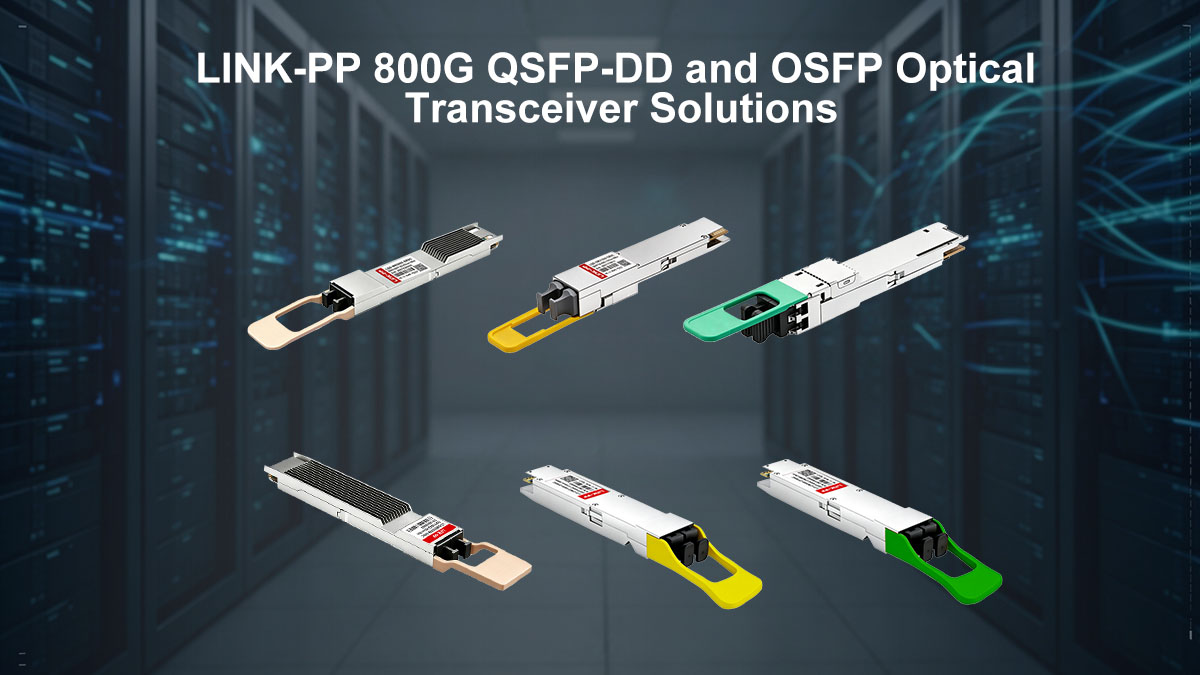
LINK-PP 800G QSFP-DD Optical Transceiver Solutions
LINK-PP's 800G QSFP-DD transceivers are designed for compatible 800G switch platforms that use the QSFP-DD interface. Different optical options address short-reach multimode connections, parallel single-mode links, and duplex single-mode fiber applications.
Representative models include:
-
LQD-M85800-SR8C: 800G QSFP-DD SR8 optical transceiver operating at 850nm, designed for short-reach multimode connectivity.
-
LQD-DM31800-DR8C: 800G QSFP-DD DR8 optical transceiver operating at 1310nm, designed for single-mode fiber connections up to 500m.
-
LQD-CW800-2FR4C: 800G QSFP-DD 2FR4 optical transceiver using CWDM technology for single-mode fiber links up to 2km.
These modules address different connectivity requirements:
-
SR8: Suitable for short-distance connections within data center racks and rows.
-
DR8: Suitable for single-mode fiber connections between switches in larger data center environments.
-
2FR4: Suitable for longer single-mode links where duplex fiber connectivity is preferred.
The correct model should be selected according to the switch's supported QSFP-DD interface, optical standard, fiber type, connector arrangement, and reach requirements. Product specifications and host compatibility should always be checked for the exact part number.
LINK-PP 800G OSFP Optical Transceiver Solutions
For switches equipped with OSFP ports, LINK-PP offers 800G OSFP optical transceiver options covering several common data center applications.
Representative models include:
-
LO-DM85800B-SR8C: 800G OSFP SR8 multimode optical transceiver operating at 850nm, with a typical reach of up to 50m over OM4 fiber.
-
LO-DM31800-DR8C: 800G OSFP DR8 single-mode optical transceiver operating at 1310nm, supporting links up to 500m.
-
LO-CW800-2FR4C: 800G OSFP 2FR4 single-mode optical transceiver designed for transmission distances up to 2km.
-
LO-CW800-2LR4C: 800G OSFP 2LR4 single-mode optical transceiver designed for transmission distances up to 10km.
These options support different network deployment scenarios:
-
SR8: Short-reach connectivity for high-density data center environments.
-
DR8: Parallel single-mode fiber connectivity for scale-out network architectures.
-
2FR4: Duplex single-mode fiber connectivity for links up to 2km.
-
2LR4: Longer-reach single-mode connectivity for inter-building and extended data center connections.
One important consideration is that OSFP mechanical configurations can vary. For example, finned-top and other module designs must match the switch's mechanical and thermal requirements. Checking the exact product specification is therefore essential.
Why Consider LINK-PP for 800G Optical Connectivity?
Selecting an 800G optical transceiver involves more than matching a part number. Network operators also need reliable product specifications, suitable form-factor options, and assistance with host compatibility.
LINK-PP's 800G optical transceiver portfolio offers several practical advantages:
-
Two major form factors: QSFP-DD and OSFP options for different 800G switch architectures.
-
Multiple optical interfaces: SR8, DR8, 2FR4, and 2LR4 options for different distances and fiber environments.
-
Multi-vendor compatibility options: Compatible transceiver solutions for platforms from NVIDIA, Cisco, Arista, Juniper, H3C, and other networking manufacturers, subject to specific model support.
-
Flexible network applications: Options for AI clusters, hyperscale data centers, Ethernet leaf-spine networks, and data center interconnects.
-
Technical assistance: Support with optical specifications, host compatibility, and transceiver selection.
-
Product availability: Access to different 800G optical module configurations through the LINK-PP Official Store.
Our focus is to help network engineers identify an appropriate optical module based on the actual switch platform and deployment requirements, rather than selecting a product based on transmission speed alone.
How to Select the Right LINK-PP 800G Module
The most efficient way to identify a suitable LINK-PP 800G transceiver is to start with the host switch and then narrow the selection according to the optical link requirements.
Follow these steps:
-
Identify your switch model: Record the manufacturer, exact model, and hardware revision.
-
Confirm the form factor: Determine whether the switch supports QSFP-DD800 or OSFP.
-
Select the optical standard: Choose SR8, DR8, 2FR4, or 2LR4 according to the required link distance and fiber infrastructure.
-
Check the fiber type: Confirm whether your deployment uses OM4/OM5 multimode fiber or OS2 single-mode fiber.
-
Verify the connector: Match the MPO or LC interface and the required fiber assembly.
-
Check compatibility: Use the LINK-PP compatibility tool to identify the appropriate compatible module.
-
Request a quotation: Provide the switch model, target module, quantity, and deployment requirements to obtain product and technical information.
If you are uncertain about a particular switch or optical standard, LINK-PP can assist with compatibility verification before you finalize your 800G network configuration.
The LINK-PP product catalog lists both QSFP-DD and OSFP 800G transceiver families, including SR8, DR8, 2FR4, and 2LR4 options. Product-specific specifications can be checked through the LINK-PP 800G QSFP-DD/OSFP product catalog.
Conclusion
When comparing QSFP-DD800 vs OSFP, the right choice ultimately depends on your switch architecture, port density requirements, thermal design, and network expansion strategy. Both form factors support 800G optical connectivity, but they serve different hardware designs and cannot be physically interchanged.
The key differences can be summarized as follows:
-
QSFP-DD800: A strong choice for high-density switch designs and environments that benefit from selected QSFP-family backward compatibility.
-
OSFP: A suitable choice for high-performance networking platforms that prioritize thermal design flexibility and demanding 800G applications.
-
Optical performance: Both support optical interfaces such as SR8, DR8, and 2FR4, depending on the specific module.
-
Switch compatibility: Always verify the host cage, optical standard, power requirements, firmware, and remote-end specifications before deployment.
For network engineers planning an 800G upgrade, choosing the correct optical transceiver is just as important as selecting the switch itself. A compatible module helps ensure reliable connectivity while avoiding unnecessary changes to existing fiber infrastructure.
At LINK-PP, we offer 800G QSFP-DD and OSFP optical transceiver solutions for different data center architectures, including AI clusters, hyperscale networks, and high-speed Ethernet applications. You can explore the LINK-PP Official Store to review product specifications, use our compatibility tool to identify suitable modules for your switch, and request a quotation from our team. For additional confidence, we provide a 15-day no-reason return/exchange policy for standard stock items. For quality-related issues, LINK-PP covers the return shipping costs.