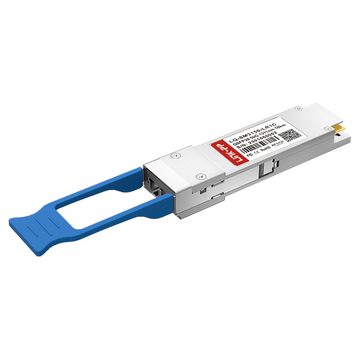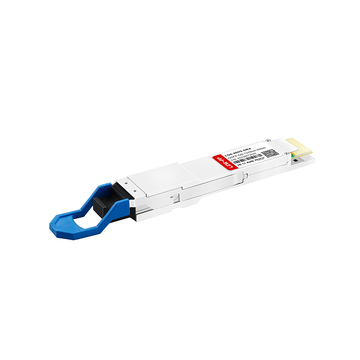
SFP 50G (technically designated as SFP56) is a small form-factor pluggable transceiver that delivers 50 Gigabit Ethernet (50GbE) over a single lane utilizing PAM4 modulation, standardized under IEEE 802.3cd. While Original Equipment Manufacturer (OEM) 50G transceivers typically range from $1,200 to over $8,000, certified third-party optics provide identical MSA-compliant hardware and guaranteed switch compatibility for $100 to $250. This allows data centers to reduce optical deployment costs by up to 90% without compromising physical layer reliability or throughput.
For modern network architects and data center managers, upgrading infrastructure is a constant balancing act between scaling bandwidth and managing rigid IT budgets. As enterprise networks, 5G front-haul deployments, and high-performance computing (HPC) environments push beyond the limitations of legacy 10G and 25G (SFP28) architectures, the SFP 50G transceiver has emerged as a critical component for next-generation connectivity.
The primary architectural advantage of SFP56 lies in its form factor. Unlike QSFP28 modules—which utilize four discrete lanes to achieve 100G—the SFP56 transceiver maintains the exact physical footprint of legacy SFP ports. By leveraging Pulse Amplitude Modulation 4-level (PAM4) signaling, it effectively doubles the throughput of previous generations over a single lane. This allows network engineers to maximize port density on Top-of-Rack (ToR) switches while seamlessly scaling bandwidth.
However, deploying a dense 50GbE network introduces a significant commercial hurdle: vendor lock-in. OEMs often utilize optical transceivers as high-margin accessories, creating a massive discrepancy between the actual manufacturing cost of the hardware and the final retail price.
In this comprehensive guide, we bypass marketing ambiguity to provide a highly technical, data-driven analysis of SFP 50G technology. Designed to support procurement and architectural decisions, this article explores:
- Physical Layer Capabilities: The precise technical thresholds of 50GBASE-SR, 50GBASE-LR, and 50G DAC (Direct Attach Copper) cabling limits.
- The OEM Pricing Reality: A transparent comparative analysis of original OEM brands (e.g., Cisco, HPE) versus Multi-Source Agreement (MSA) compliant third-party alternatives.
- Compatibility Validation: Actionable engineering protocols for verifying third-party EEPROM coding and bypassing "unsupported transceiver" switch errors safely.
✅ What is an SFP 50G (SFP56) Transceiver?
The SFP 50G, officially designated as SFP56 (Small Form-factor Pluggable 56), is a single-lane optical transceiver designed to transmit 50 Gigabits per second (Gbps). Standardized under IEEE 802.3cd, it achieves this throughput by utilizing PAM4 (Pulse Amplitude Modulation 4-level) signaling. Because it shares the exact physical dimensions of legacy 10G SFP+ and 25G SFP28 modules, the SFP56 allows data centers to double their per-port bandwidth while maintaining maximum switch faceplate density.
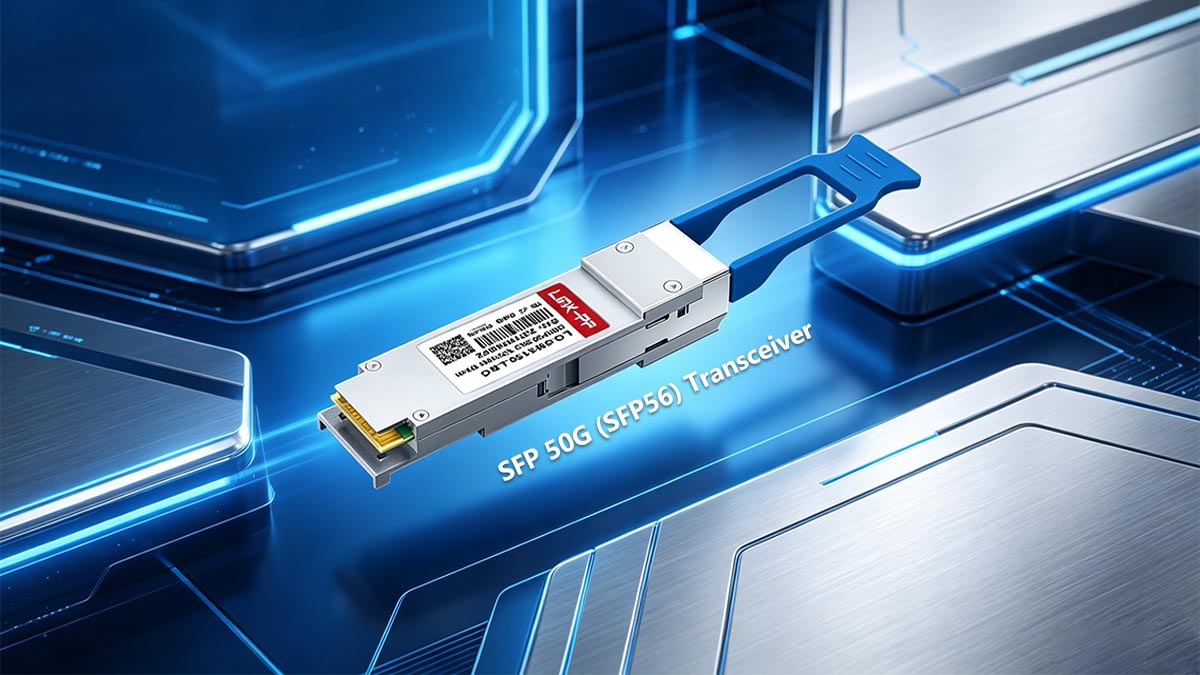
To fully understand the engineering value of the SFP56 transceiver, it is essential to look at the underlying signal modulation that makes 50GbE possible over a single electrical lane.
Previous transceiver generations, such as the 10G SFP+ and the 25G SFP28, relied on NRZ (Non-Return-to-Zero) encoding. (Micro-definition: NRZ is a binary modulation scheme that transmits one bit of data—either a 0 or a 1—per signal symbol.) Scaling NRZ to 50G on a single lane requires exponentially higher frequencies, which leads to severe signal degradation and unacceptable insertion loss over copper and fiber media.
To overcome this physical limitation, SFP56 adopts PAM4 modulation. Unlike NRZ, PAM4 utilizes four distinct voltage levels to transmit two bits of data per symbol (00, 01, 10, 11). This architectural shift effectively doubles the data rate to 50Gbps while operating at the same 25Gbaud rate as an SFP28 module, preserving signal integrity across the physical layer.
SFP56 vs. QSFP28: The Density Advantage
A frequent point of confusion during data center topology planning is distinguishing between SFP and QSFP (Quad Small Form-factor Pluggable) form factors. While a QSFP28 module achieves 100G by aggregating four parallel 25G lanes, the SFP56 delivers 50G over a single lane.
This single-lane architecture is critical for Top-of-Rack (ToR) deployment strategies. The SFP56 footprint allows network architects to populate a standard 1RU (Rack Unit) switch with up to 48 ports. This provides highly granular, dedicated 50GbE server-to-switch connectivity without the physical bulk, thermal output, or complex breakout cables associated with QSFP modules.
| Form Factor | Max Data Rate | Lane Configuration | Modulation Scheme | Primary Use Case |
|---|---|---|---|---|
| SFP28 | 25 Gbps | 1 x 25G | NRZ | Legacy server connectivity |
| SFP56 (SFP 50G) | 50 Gbps | 1 x 50G | PAM4 | Next-gen ToR & 5G front-haul |
| QSFP28 | 100 Gbps | 4 x 25G | NRZ | Spine/Core aggregation |
✅ 50GBASE Reach Types: DAC vs. SR vs. LR
Selecting the correct SFP 50G medium depends entirely on distance and link budget. For intra-rack server connections (1 to 3 meters), 50G DAC (Direct Attach Copper) provides the lowest latency and power consumption. For row-to-row data center cross-connects, 50GBASE-SR utilizes 850nm lasers over Multi-Mode Fiber (MMF) for reaches up to 100 meters. For campus or metro aggregation, 50GBASE-LR deploys 1310nm lasers over Single-Mode Fiber (SMF) to achieve distances up to 10 kilometers.
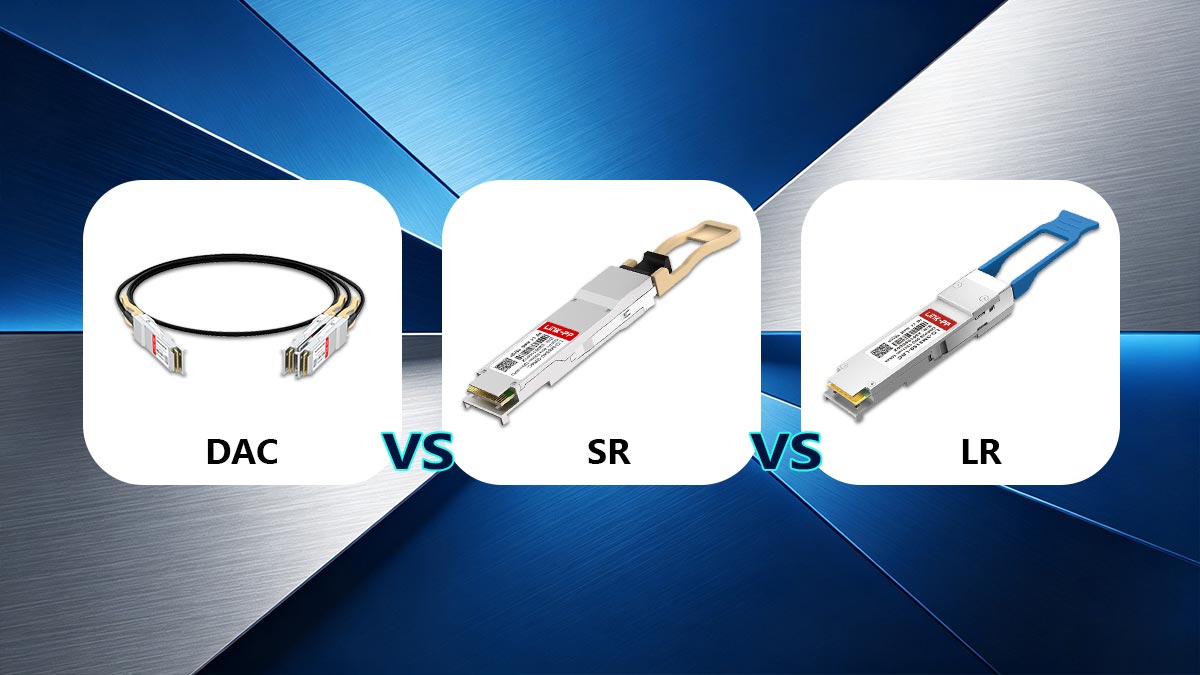
When engineering a 50GbE topology, the physical medium dictates not only the maximum transmission distance but also the thermal output and overall deployment cost. Because 50G relies on PAM4 modulation—which is highly sensitive to signal-to-noise ratio (SNR) degradation—network architects must strictly adhere to IEEE distance specifications. Below is a deep dive into the three primary SFP56 reach categories.
1. 50G DAC: Zero-Latency Intra-Rack Connectivity
Direct Attach Copper (DAC) cables consist of twinaxial copper wiring with factory-terminated SFP56 transceiver heads. They are passive components, meaning they do not consume power to convert electrical signals into optical light.
- Medium: Passive Twinax Copper (Typically 26 to 30 AWG).
- Max Distance: 1 to 3 meters.
- Latency & Power: Near-zero latency (~0.1ns) and minimal power draw (<0.1W per port).
(Pros & Cons) While DACs are the most cost-effective solution for Top-of-Rack (ToR) deployments, 50G PAM4 signaling requires thicker copper shielding than legacy 10G cables. A 3-meter 50G DAC is often built with rigid 26 AWG wire. For high-density 1U switches, managing the bend radius of dozens of thick DAC cables can restrict airflow and complicate maintenance. Recommendation: Restrict passive DAC deployments to 2 meters or less; for longer in-rack runs, consider Active Optical Cables (AOC) or SR optics.
2. 50GBASE-SR: The Data Center Workhorse
The 50GBASE-SR (Short Reach) specification is the industry standard for interconnecting switches across different racks or rows within the same facility.
- Medium: OM3, OM4, or OM5 Multi-Mode Fiber (MMF) via LC-Duplex connectors.
- Max Distance: 70 meters over OM3; 100 meters over OM4/OM5.
- Technology: Utilizes an 850nm VCSEL. (Micro-definition: A Vertical-Cavity Surface-Emitting Laser (VCSEL) is a highly efficient, low-cost semiconductor laser diode optimized for short-distance optical transmission.)
Use Case: 50GBASE-SR is ideal for End-of-Row (EoR) or Middle-of-Row (MoR) architectures where DACs cannot physically reach. If your facility is already structured with OM4 LC-duplex cabling, upgrading from 25GBASE-SR to 50GBASE-SR is a simple "plug-and-play" hardware swap.
3. 50GBASE-LR: Long-Haul and Campus Networks
For cross-campus links, metro area networks (MAN), or 5G cell tower fronthaul connections, the 50GBASE-LR (Long Reach) transceiver provides the necessary optical power to push signals across vast distances without data packet loss.
- Medium: OS2 Single-Mode Fiber (SMF) via LC-Duplex connectors.
- Max Distance: Up to 10 kilometers.
- Technology: Employs a robust 1310nm DML or EML laser. These lasers maintain signal integrity over long distances by minimizing chromatic dispersion within the fiber core.
Because manufacturing precision 1310nm lasers for PAM4 modulation is highly complex, 50GBASE-LR optics carry the highest price premium, making the OEM vs. third-party pricing debate particularly critical for long-haul deployments.
| Specification | Medium | Max Reach | Wavelength / Tech | Primary Application |
|---|---|---|---|---|
| 50G DAC | Twinax Copper | 3 meters | Passive Electrical | Server to ToR Switch (Intra-rack) |
| 50GBASE-SR | MMF (OM4/OM5) | 100 meters | 850nm VCSEL | Switch to Switch (Row-to-Row) |
| 50GBASE-LR | SMF (OS2) | 10 kilometers | 1310nm Laser | Campus / ISP / 5G Fronthaul |
✅ Third-Party SFP 50G vs OEM: What Is the Real Difference?
What is the difference between OEM and third-party SFP 50G optics?
Technically, there is zero difference in physical hardware. Both Original Equipment Manufacturers (OEMs) and third-party vendors source their bare-metal optical components from the same global foundries governed by the Multi-Source Agreement (MSA). The actual differences lie in EEPROM coding, brand markup, and supply chain models. Third-party SFP56 transceivers bypass the OEM markup, reducing CapEx by 80% to 90% while delivering identical 50Gbps PAM4 performance, provided they are properly coded for the host switch.
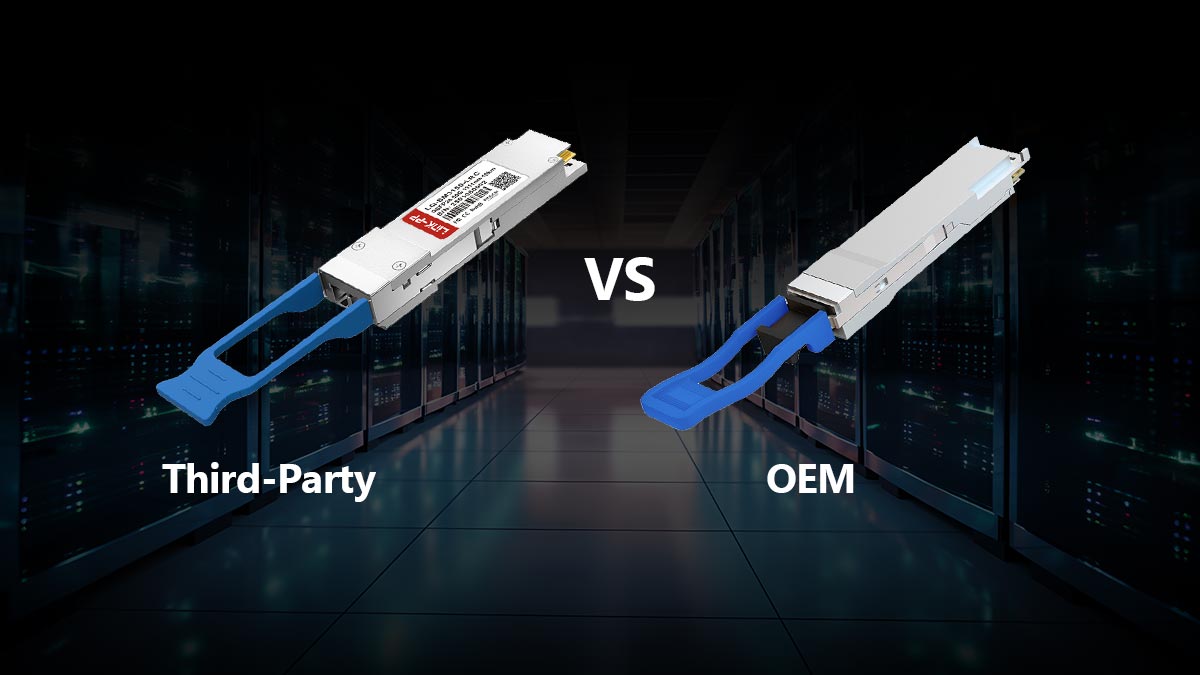
When engineering a data center upgrade, procurement teams are inevitably confronted with a massive price disparity. An official Cisco or HPE 50GBASE-SR transceiver may be quoted at over $1,200, while a third-party equivalent retails for roughly $150. To make an informed architectural decision, it is critical to evaluate cost, availability, support, and deployment risk in practical business terms.
The Role of MSA and EEPROM Validation
To understand why third-party optics are viable, network engineers must understand how transceiver modules are manufactured. (Micro-definition: The Multi-Source Agreement (MSA) is an industry consortium that strictly defines the physical dimensions, electrical interfaces, and optical parameters of transceivers.) Because of the MSA, an SFP 50G optic is a highly standardized commodity.
The mechanism OEMs use to enforce vendor lock-in is software-based. Every SFP56 module contains an EEPROM (Electrically Erasable Programmable Read-Only Memory) chip. OEMs program this chip with a proprietary cryptographic signature. When you plug an optic into a switch (e.g., a Cisco Nexus or Juniper QFX), the switch OS queries the EEPROM. If the signature is missing, it triggers an "unsupported transceiver" error.
Reputable third-party vendors bridge this gap by custom-coding the EEPROM to match the exact OEM signature. High-tier third-party suppliers maintain extensive validation labs, physically testing their 50G optics inside the actual target switches to guarantee plug-and-play interoperability without generating CLI warnings.
Evaluating the Business Impact: OEM vs. Third-Party
1. Capital Expenditure (Cost)
OEMs traditionally treat optics as high-margin accessories used to subsidize the R&D costs of the chassis and ASICs. Depending on the reach (SR vs. LR), a 50G OEM optic can cost between $1,200 and $8,000. Third-party optics reflect the true market value of the hardware, typically ranging from $100 to $250. In a high-density deployment of 48-port ToR switches, this translates to hundreds of thousands of dollars in CapEx savings per rack.
2. Supply Chain Availability
During hardware refresh cycles, lead times are a critical metric. OEMs often rely on Just-In-Time (JIT) manufacturing, which can result in 6- to 12-month lead times for specialized optics like the 50GBASE-LR. Third-party vendors operate on a localized inventory model, frequently offering next-day or same-week shipping for bulk SFP56 orders.
3. Deployment Risk and TAC Support (The "Blame Game")
The primary risk associated with third-party optics is not hardware failure, but rather vendor support friction. If a network engineer opens a Technical Assistance Center (TAC) ticket for a dropped link, the OEM support representative will often point to the third-party optic as the culprit to avoid diagnosing the core switch OS.
Risk Mitigation Strategy (Pros & Cons of the "Spares" Model):
To bypass this support friction, data center architects employ a hybrid deployment strategy.
- Pros: You deploy 95% third-party optics to maximize budget efficiency, while purchasing 5% OEM optics to keep in cold storage. If a port fails, you swap in the OEM optic, clear the logs, and then open the TAC ticket.
- Cons: It requires strict inventory management and slightly increases the time-to-resolution during a physical hardware swap.
| Decision Factor | Original OEM Optics | Third-Party Optics |
|---|---|---|
| Hardware Origin | MSA-compliant foundries | MSA-compliant foundries |
| Average Price (50GBASE-SR) | $1,200 - $3,500+ | $100 - $150 |
| Lead Times | Weeks to Months | Usually Next-Day (In Stock) |
| EEPROM Validation | Native locked signature | Custom coded per switch OS |
| TAC Support Friction | Zero friction | High (OEMs may refuse support) |
✅ Ensuring Third-Party SFP56 Compatibility in Enterprise Switches
How do you ensure third-party SFP 50G compatibility?
To ensure third-party SFP56 interoperability, network engineers must validate three core elements: host ASIC hardware support (verifying the port is true SFP56, not legacy SFP28), precise EEPROM vendor coding, and Switch OS firmware policies. By utilizing Command Line Interface (CLI) override commands—such as service unsupported-transceiver on Cisco NX-OS—and manually configuring PAM4 speed negotiation, administrators can bypass OEM software locks and establish stable 50Gbps links.
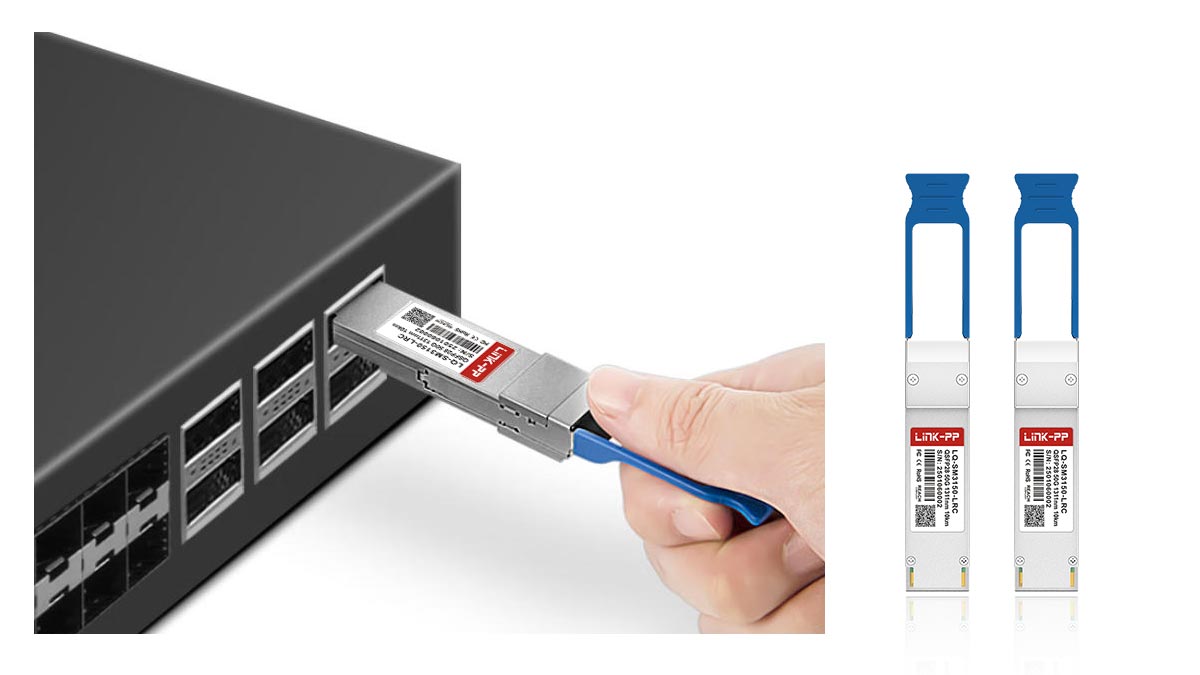
Deploying third-party optics is standard practice in enterprise data centers, but it requires strict technical validation. Because the SFP56 form factor is physically identical to older 10G (SFP+) and 25G (SFP28) modules, it is easy to encounter link-down states caused by hardware mismatches, firmware blocks, or auto-negotiation failures. Below is the engineering framework for ensuring seamless third-party SFP 50G integration.
1. Verifying True SFP56 Port Support
The most common deployment error with 50G optics is a false physical fit. An SFP56 transceiver will physically slide into any SFP+ or SFP28 port. However, if the underlying switch ASIC and SerDes (Serializer/Deserializer) are only rated for 25G NRZ signaling, the port cannot process a 50G PAM4 signal.
- Actionable Step: Consult your switch chassis datasheet to verify exact port capabilities. For example, on certain modular switches, only specific port blocks (e.g., ports 48-52) may be wired for 50GbE PAM4, while the rest remain 10/25GbE NRZ.
2. Overcoming Firmware Restrictions and EEPROM Checks
Enterprise switch operating systems (such as Cisco NX-OS, Arista EOS, or Juniper Junos) actively poll the transceiver’s EEPROM upon insertion. If the vendor OUI (Organizationally Unique Identifier) does not match the OEM's cryptographic whitelist, the switch will disable the port and flag an err-disable state.
(Micro-definition: The EEPROM is a memory chip inside the transceiver that stores identification data, including vendor name, serial number, and supported wavelengths.)
To bypass this firmware restriction safely, network administrators must input specific hidden CLI commands to force the switch to accept third-party optics:
- Cisco (IOS/NX-OS): Enter global configuration mode and type
service unsupported-transceiver, followed byno errdisable detect cause gbic-invalid. - Arista (EOS): Enter
touch /mnt/flash/enable3rdPartyTransceiversin the bash shell, or use the CLI commandtransceiver third-party acceptdepending on the EOS version. - Juniper (Junos): Junos typically displays a warning (
NON-JNPR) in the logs but will not disable the port, provided the optic's EEPROM is correctly coded to MSA standards.
3. Managing PAM4 Speed Negotiation and Link Training
At 50G speeds, relying on Auto-Negotiation (AN) and Link Training (LT) can introduce instability, especially when connecting switches from two different OEMs (e.g., a Cisco spine to an Arista leaf) using third-party optics. Because 50G utilizes PAM4 modulation, the signal-to-noise ratio margins are much tighter than older NRZ optics.
Troubleshooting Speed Negotiation (Pros & Cons of Hardcoding):
If a third-party SFP56 link fails to come up, the host port may be attempting to negotiate down to 25G NRZ.
- Pros of Hardcoding: Manually setting the port speed (e.g.,
speed 50000) and disabling auto-negotiation forces the SerDes into PAM4 mode, eliminating link-flap issues caused by protocol mismatches. - Cons of Hardcoding: Both ends of the link must be manually configured identically; otherwise, the link will remain in a down state.
| Validation Phase | Technical Check | Expected Outcome / Fix |
|---|---|---|
| Hardware Layer | Does the host switch ASIC support SFP56 / PAM4? | Avoid inserting SFP56 into legacy SFP28-only ports. |
| Software Layer | Is the switch flagging an unsupported transceiver? | Apply CLI bypass commands (e.g., service unsupported-transceiver). |
| Protocol Layer | Are Auto-Negotiation and Link Training failing? | Hardcode interface speed to 50000 (50Gbps) and disable AN/LT. |
✅ FAQ: SFP 50G Compatibility, Pricing, and Reach
The SFP 50G (SFP56) delivers 50Gbps over a single lane using PAM4 modulation. Its reach spans from 3 meters (50G DAC) to 10 kilometers (50GBASE-LR). While OEM optics command high premiums ($1,200+), MSA-compliant third-party optics offer the exact same physical performance for under $250. Compatibility is achieved via EEPROM coding and switch CLI bypass commands.
To assist network architects and procurement teams in their commercial investigations, we have compiled direct, technical answers to the most frequently asked questions regarding SFP 50G deployments.
1. What is the difference between SFP28, SFP56, and QSFP28?
The difference lies in lane architecture and modulation. SFP28 delivers 25G over a single lane using NRZ modulation. SFP56 (the technical name for SFP 50G) uses the identical single-lane physical footprint but employs PAM4 modulation to double the throughput to 50G. QSFP28 is physically larger and achieves 100G by combining four parallel 25G NRZ lanes. You cannot push 50G PAM4 traffic over a standard 25G NRZ SFP28 optic.
2. Can I put a 50G SFP into a 100G QSFP28 port?
Direct physical insertion is impossible due to the size difference between SFP and QSFP form factors. To connect an SFP56 optic into a QSFP port, you must use a QSA (Quad to Small Form-factor Pluggable Adapter). Engineering Warning: Even with an adapter, the host switch ASIC must explicitly support 50G PAM4 signaling on that specific port. Many legacy 100G QSFP28 ports only support NRZ signaling and will fail to recognize an SFP56 module.
3. Why are Cisco OEM 50G transceivers so expensive compared to third-party optics?
Original Equipment Manufacturers (OEMs) like Cisco and HPE utilize a high-margin pricing model on optical transceivers to subsidize the research and development costs of their core switch hardware. Third-party vendors bypass this brand markup. Because all transceivers are built to strict Multi-Source Agreement (MSA) hardware standards, a $150 third-party optic and a $1,500 OEM optic feature identical bare-metal lasers and receivers. The only difference is the OEM-specific software lock programmed into the EEPROM.
4. What is the maximum distance of a 50GBASE-LR transceiver?
The 50GBASE-LR specification supports a maximum transmission distance of 10 kilometers. It achieves this by transmitting a 1310nm optical signal over OS2 Single-Mode Fiber (SMF). For anything shorter than 100 meters, data centers should utilize the much more cost-effective 50GBASE-SR over OM4/OM5 Multi-Mode Fiber (MMF).
5. Should I upgrade to SFP 50G or skip straight to 100G QSFP28?
This depends on your topology. (Pros & Cons)
- Choose SFP 50G: If you need maximum Top-of-Rack (ToR) port density. SFP56 allows up to 48 single-lane 50G connections in a 1U switch, ideal for 5G fronthaul and high-density server access without messy breakout cables.
- Choose 100G QSFP28: If you are building spine-and-leaf core aggregation. The cost-per-gigabit of 100G optics has dropped significantly, making QSFP28 a better financial choice for high-bandwidth uplinks where physical density is less of a concern.
✅ How to Choose the Right SFP 50G Module for Your Use Case
Selecting the correct SFP56 module requires aligning the physical medium with your architectural distance and link budget. Use 50G DACs for 1-3m zero-latency server-to-switch uplinks. Deploy 50GBASE-SR optics over OM4 MMF for switch-to-switch cross-connects up to 100m. For campus aggregation or 5G fronthaul, utilize 50GBASE-LR over OS2 SMF for distances up to 10km. Always leverage MSA-compliant third-party optics to optimize CapEx across these deployments.
Designing a resilient 50GbE topology is not a one-size-fits-all exercise. Because PAM4 modulation is highly sensitive to insertion loss and signal degradation, network architects must strictly match the transceiver type to the specific physical environment. Below is a definitive engineering decision framework for selecting the appropriate SFP 50G module based on common data center use cases.
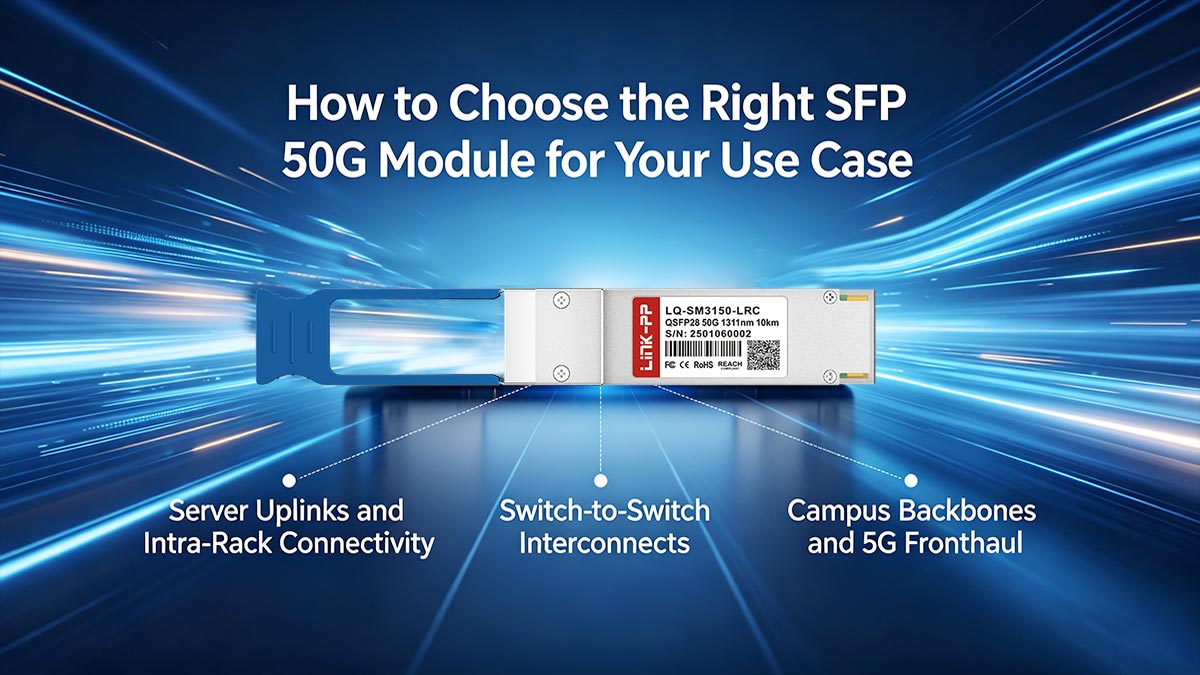
1. Server Uplinks and Intra-Rack Connectivity
Scenario: Connecting high-performance compute (HPC) servers or storage arrays directly to a Top-of-Rack (ToR) switch within the same standard 19-inch cabinet.
- Primary Recommendation: 50G DAC (Direct Attach Copper).
- Technical Rationale: DACs offer the lowest possible latency (~0.1ns) and consume practically zero power, which is critical for dense 1U switch configurations.
DAC vs. AOC (Pros & Cons):
Because 50G DACs require heavy copper shielding (often 26 AWG), they become physically rigid.
- Pros of DAC: Unbeatable cost-efficiency for runs under 2 meters.
- Cons of DAC: For 3-meter runs in dense racks, thick twinax cables obstruct airflow and complicate cable management. Solution: If your in-rack run exceeds 2.5 meters, switch to a 50G AOC (Active Optical Cable). AOCs embed the optical transceivers into a pre-terminated fiber cable, offering the flexibility of fiber with the plug-and-play simplicity of a DAC.
2. Switch-to-Switch Interconnects (Row-to-Row)
Scenario: Connecting ToR switches to End-of-Row (EoR) aggregation switches, or building out a localized spine-and-leaf fabric across adjacent data center aisles.
- Primary Recommendation: 50GBASE-SR.
- Technical Rationale: This is the workhorse of the modern data center. Operating at 850nm over LC-Duplex Multi-Mode Fiber (MMF), the SR optic reliably pushes 50Gbps up to 70 meters on OM3, or 100 meters on OM4/OM5 fiber.
(Micro-definition: Link Loss Budget is the maximum allowable signal degradation before a link fails. 50GBASE-SR over OM4 provides a highly forgiving link budget, making it ideal for environments with multiple patch panel cross-connects.)
3. Campus Backbones and 5G Fronthaul (Long-Distance)
Scenario: Interconnecting geographically separated data center buildings, tying enterprise campus networks to an ISP node, or linking 5G baseband units to remote radio heads.
- Primary Recommendation: 50GBASE-LR.
- Technical Rationale: Utilizing a powerful 1310nm laser over OS2 Single-Mode Fiber (SMF), the LR specification eliminates modal dispersion, allowing the PAM4 signal to remain intact for up to 10 kilometers.
Cost Optimization Strategy: Because 1310nm lasers are complex to manufacture, OEM 50GBASE-LR optics are notoriously expensive (frequently exceeding $3,000 per port). This specific use case is where third-party SFP 50G optics provide the highest ROI. Deploying MSA-compliant, EEPROM-validated third-party LR optics allows enterprises to build long-haul links at a fraction of the OEM CapEx.
| Architectural Use Case | Distance | Recommended SFP56 Module | Physical Medium | Cost Profile (Third-Party) |
|---|---|---|---|---|
| Intra-Rack (Server to ToR) | 1 - 3m | 50G DAC / AOC | Twinax Copper / Pre-terminated Fiber | $ ($30 - $60) |
| Inter-Rack (Switch to Switch) | Up to 100m | 50GBASE-SR | OM4/OM5 Multi-Mode Fiber (LC) | $$ ($100 - $150) |
| Campus / Metro / 5G | Up to 10km | 50GBASE-LR | OS2 Single-Mode Fiber (LC) | $$$ ($200 - $300) |
✅ Architecture Strategy: Should You Deploy SFP 50G or Jump to 100G?
The decision hinges on physical port density versus aggregate core bandwidth. Deploy SFP 50G (SFP56) for Top-of-Rack (ToR) and 5G edge networks where maximizing single-lane port density (up to 48 ports per 1U chassis) without complex breakout cables is critical. Conversely, skip to 100G (QSFP28) for spine-and-leaf core aggregation, as the plummeting cost-per-gigabit of QSFP optics currently offers superior ROI for heavy backbone traffic.
Among network engineers and system administrators, one of the most heavily debated topics during a hardware refresh cycle is whether 50GbE is merely a "stepping stone" technology. Because the market price of 100G QSFP28 optics has dropped so drastically in recent years, many architects question if deploying SFP 50G is still a viable long-term strategy.
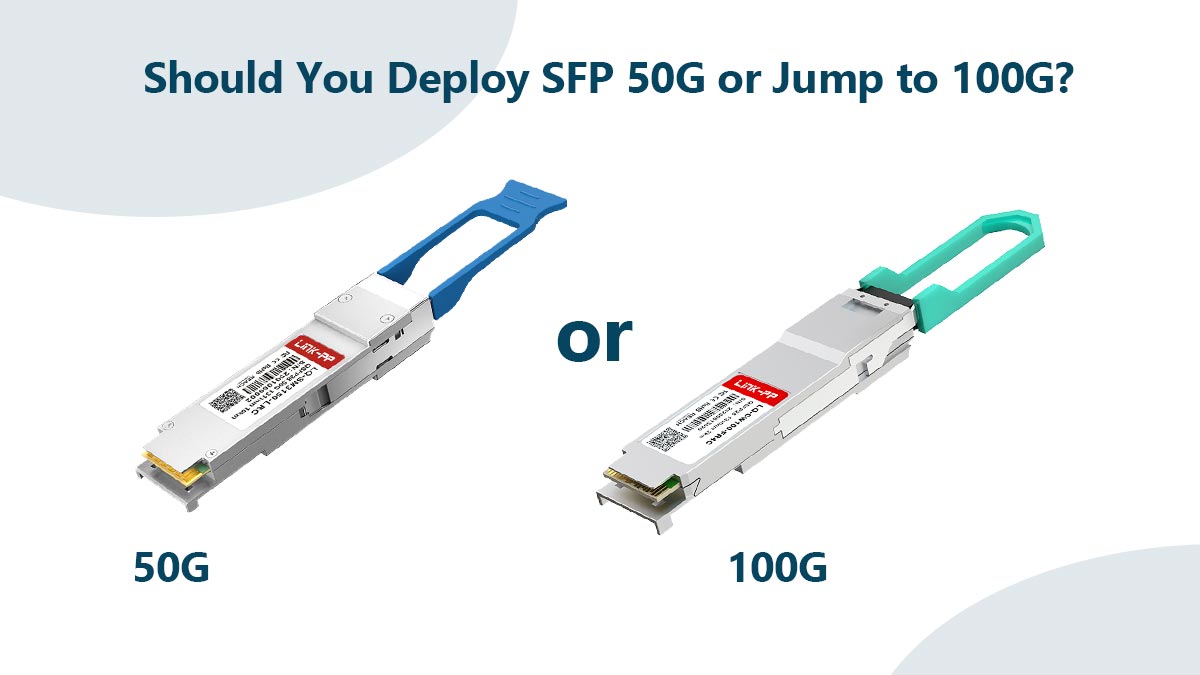
To resolve this debate, we must evaluate the physical limitations of switch faceplates, thermal outputs, and lane aggregation requirements.
The Engineering Case for SFP 50G (SFP56)
The primary advantage of the SFP56 module is not aggregate speed, but physical footprint. SFP56 delivers 50Gbps over a single electrical lane using PAM4 modulation, maintaining the exact dimensions of legacy 10G/25G ports.
Pros & Cons of the 50G Edge Strategy:
- Pros: Unmatched port density. A standard 1RU ToR switch can physically accommodate up to 48 SFP56 ports. This allows engineers to provide dedicated 50G uplinks to 48 separate servers. Furthermore, it eliminates the need for messy QSFP breakout cables. (Micro-definition: A breakout cable physically splits a high-bandwidth multi-lane port, such as a 100G QSFP28, into multiple lower-bandwidth connections, such as 2x 50G or 4x 25G, which complicates rack cable routing.)
- Cons: SFP56 ports are typically limited to edge devices. Core routing platforms prioritize QSFP form factors.
- Ideal Deployment: 5G cell tower fronthaul, high-density Storage Area Network (SAN) access layers, and hyper-converged infrastructure (HCI) nodes.
The Engineering Case for 100G (QSFP28)
If your primary objective is moving massive volumes of aggregate data between switch fabrics, the 100G QSFP28 is the industry standard. It achieves 100Gbps by aggregating four parallel 25G NRZ lanes.
Pros & Cons of the 100G Core Strategy:
- Pros: Superior economy of scale. The optical components for 100G QSFP28 have been heavily commoditized. In many scenarios, deploying a single 100G link is cheaper per-gigabit than deploying two separate 50G links.
- Cons: QSFP ports take up significantly more physical space on a switch faceplate and generate higher thermal output, limiting the total number of ports a 1U chassis can support (typically capped at 32 ports).
- Ideal Deployment: Spine-to-leaf uplinks, core data center interconnects (DCI), and heavy aggregation layers.
Executing Your Upgrade Strategy
Ultimately, a well-architected modern data center will utilize both: SFP 50G for dense, single-lane server access at the edge, and 100G/400G QSFP modules for the core backbone.
Regardless of whether your architecture dictates a high-density 50G edge or a high-throughput 100G core, managing capital expenditure without sacrificing physical layer integrity is paramount. To execute either strategy cost-effectively, network engineering teams rely on fully validated, MSA-compliant optics. You can source exact-match EEPROM transceivers, bypass OEM vendor lock-in, and secure enterprise-grade warranties directly from the LINK-PP Oficial Store.
About the Author: LINK-PP Data Center Engineering Team
This guide was compiled by senior network architects specializing in high-speed optical deployments and enterprise data center topology. With over 15 years of experience in MSA-compliant transceiver validation, our team tests and verifies physical layer interoperability across Cisco, Juniper, and Arista platforms, ensuring reliable, cost-effective scaling for modern IT infrastructure.