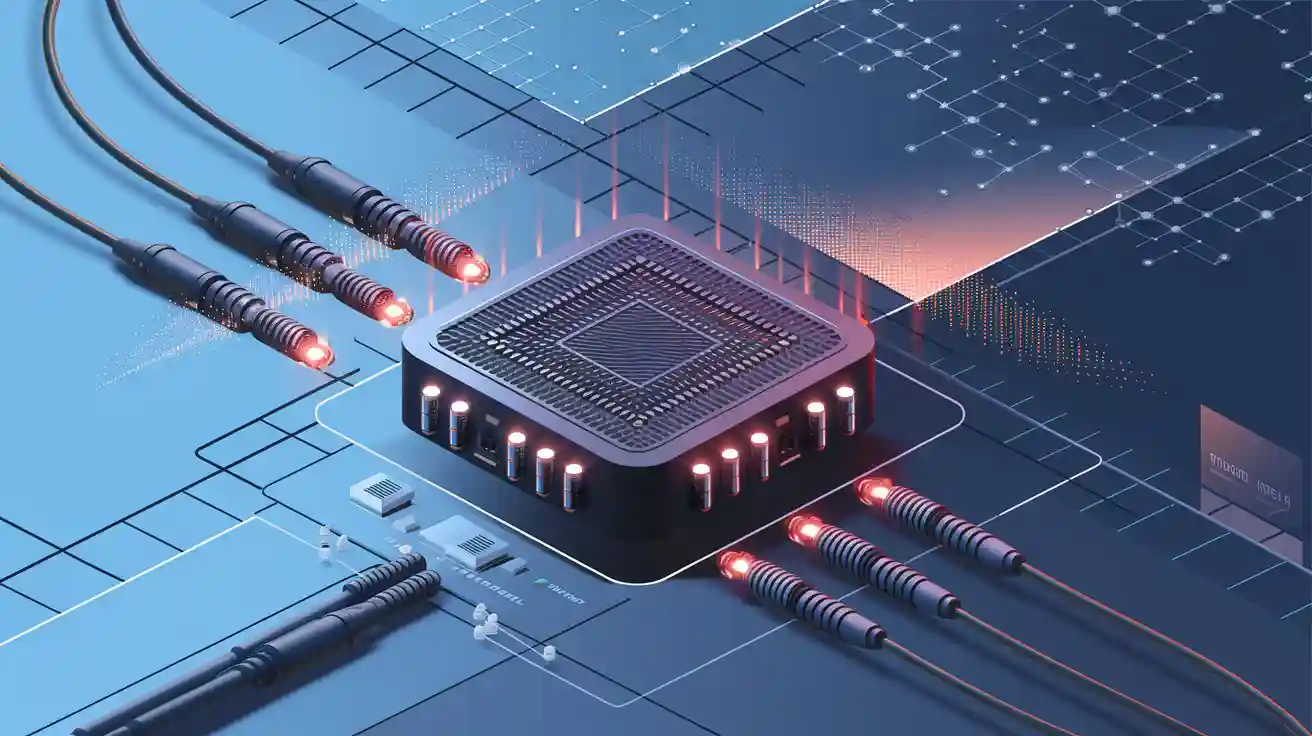
eSR4 technology is designed to solve a practical limitation in high-speed multimode optical networks: how to extend transmission distance without replacing existing fiber infrastructure. As data centers and enterprise networks continue to scale from 10G to 40G and 100G, traditional SR4 optics often reach their distance limits, especially in larger facilities where link spans exceed typical short-range thresholds. This creates a gap between performance requirements and the physical constraints of installed cabling.
Extended Short-Reach optics address this challenge by enhancing the optical budget of standard SR4 modules, enabling longer transmission distances over the same multimode fiber types such as OM3 and OM4. This makes eSR4 particularly valuable in environments where upgrading to single-mode fiber is unnecessary or cost-inefficient, yet additional reach is required to support modern network architectures.
This article explains how eSR4 technology works, its key technical characteristics, and how it compares to traditional SR4 transceivers. It also explores common deployment scenarios, cabling considerations, and the role of eSR4 in supporting 40G and 100G network evolution.
? What Is eSR4 Technology?
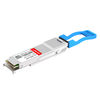
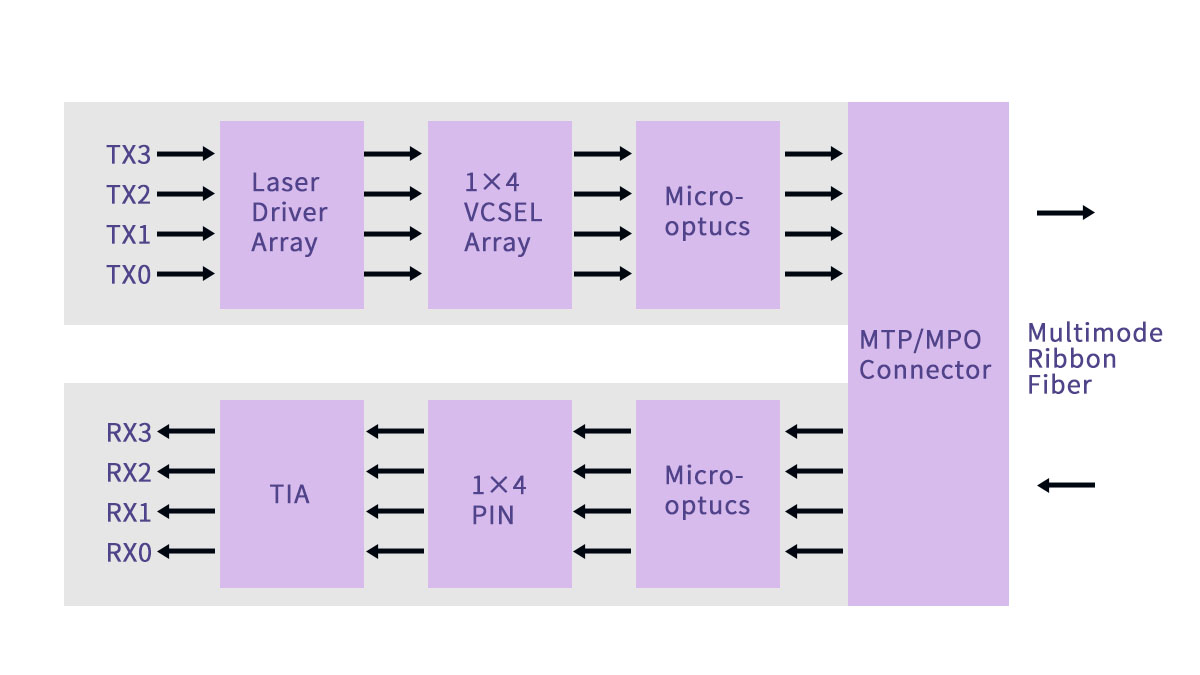
eSR4 (Extended Short Reach 4-lane) is an enhanced version of SR4 QSFP designed to extend transmission distance over multimode fiber in 40G and 100G networks. It maintains the same parallel optics architecture as standard SR4 while improving the optical budget, enabling longer link spans without requiring changes to existing cabling infrastructure.
Definition of eSR4
eSR4 describes a type of parallel multimode optical transceiver that builds on SR4 standards by increasing achievable transmission distance while preserving compatibility with established MPO-based fiber systems.
Instead of introducing a new transmission model, eSR4 optimizes the existing SR4 framework. This makes it particularly suitable for environments where the physical infrastructure is already in place but longer reach is needed.
As a result, eSR4 is commonly used in data centers where standard SR4 optical transceiver are no longer sufficient to cover growing distances.
Basic Operating Principle
eSR4 operates using a parallel optical transmission model, where multiple lanes transmit data simultaneously over separate fibers within a single connector.
The following table summarizes its core technical structure:
| Parameter |
Description |
| Transmission mode |
Parallel multimode optics |
| Lane configuration |
4 transmit + 4 receive lanes |
| Wavelength |
Typically around 850nm (VCSEL-based) |
| Connector type |
MPO/MTP (commonly 12-fiber) |
Each lane carries a portion of the total data stream, allowing high aggregate bandwidth while maintaining signal stability over multimode fiber. eSR4 extends reach by improving transmitter output and receiver sensitivity, without altering the underlying lane structure.
eSR4 in Ethernet Ecosystems
eSR4 is deployed within established SR4-based Ethernet architectures, particularly in 40G and 100G networks where parallel multimode optics are widely adopted.
Its role is to extend the usability of SR4 links in scenarios where standard reach becomes a limiting factor:
-
In 40G networks, it enhances QSFP+ SR4 links for longer intra-data-center connections
-
In 100G environments, it supports extended QSFP28 SR4 deployments
-
It enables continued use of multimode fiber in medium-scale and growing network infrastructures
Compared with single-mode module, eSR4 remains focused on short-to-intermediate distances, offering a practical balance between performance and infrastructure reuse.
? Key Technical Characteristics of eSR4 Optics
eSR4 optics are defined not only by extended transmission distance, but by how they achieve this improvement within the constraints of multimode parallel optics. Instead of changing the transmission model, eSR4 enhances signal quality, optical budget, and link tolerance, making it a performance-optimized evolution of SR4 rather than a new standard.
Parallel Lane Architecture
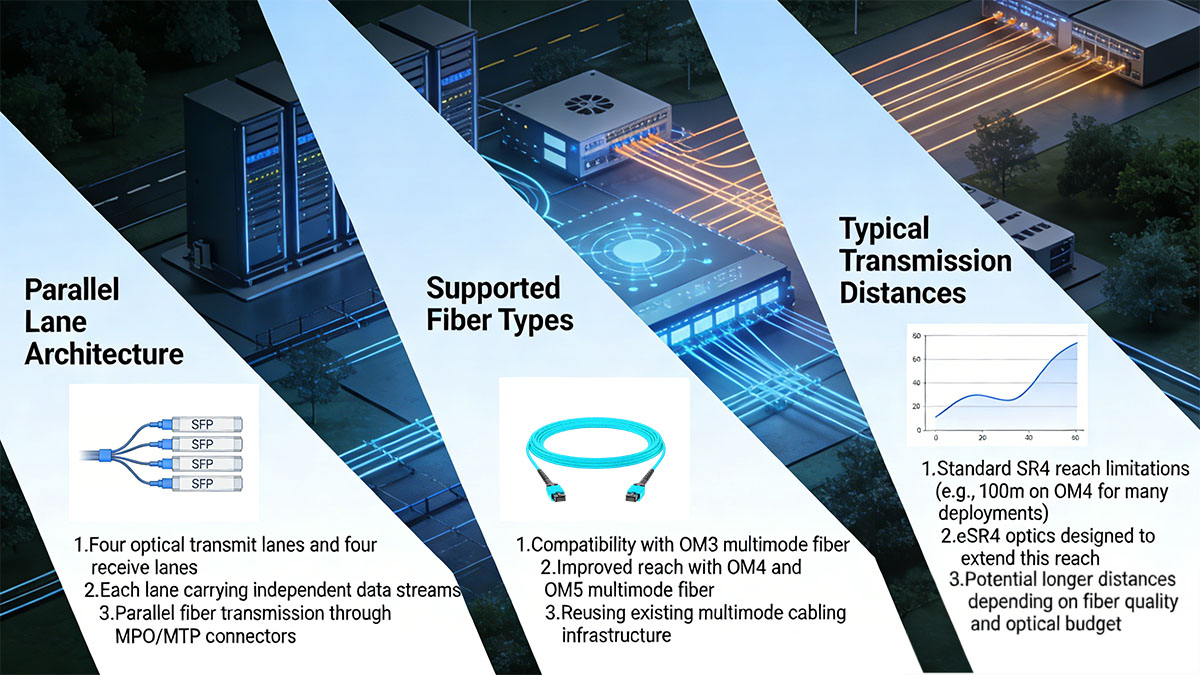
eSR4 retains the same 4-lane parallel transmission structure used in SR4, which is fundamental to its compatibility and deployment simplicity. Each lane operates independently, allowing the total data rate to be distributed across multiple optical paths.
| Parameter |
eSR4 Specification |
| Lane configuration |
4 transmit + 4 receive |
| Signaling method |
Parallel optical transmission |
| Per-lane data rate |
10G (40G) / 25G (100G) |
| Connector |
MPO/MTP (12-fiber physical) |
Because each lane carries a fraction of the total bandwidth, the system reduces the complexity of high-speed serial transmission. This design also improves tolerance to dispersion and modal noise, which are more pronounced in multimode environments.
Another important aspect is that eSR4 does not require lane aggregation or wavelength multiplexing, which keeps latency low and simplifies signal processing compared to more complex optical technologies.
Optical Budget and Signal Enhancement
The defining characteristic of eSR4 is its improved optical budget, which directly determines how far a signal can travel while maintaining acceptable performance.
| Parameter |
SR4 (Typical) |
eSR4 (Enhanced) |
| Optical budget |
Baseline |
Increased |
| Transmit power |
Standard |
Higher |
| Receiver sensitivity |
Standard |
Improved |
| Link loss tolerance |
Limited |
Higher tolerance |
A higher optical budget allows eSR4 to compensate for losses introduced by connectors, patch panels, and longer fiber runs. In real deployments, insertion loss accumulates across multiple connection points, and eSR4 is designed to handle this accumulation more effectively.
From a physical layer perspective, this improvement is achieved through optimized VCSEL performance and more sensitive photodetectors, enabling better signal integrity at longer distances.
Supported Fiber Types and Modal Performance
eSR4 is optimized for standard multimode fiber, but its performance is closely tied to modal bandwidth and attenuation characteristics of the fiber.
| Fiber Type |
Modal Bandwidth |
eSR4 Performance Impact |
| OM3 |
Moderate |
Extended but limited reach |
| OM4 |
High |
Optimal balance of reach |
| OM5 |
Enhanced |
Best-case extended scenarios |
Multimode fiber introduces modal dispersion, where different light paths travel at slightly different speeds. This effect becomes more significant as distance increases.
eSR4 mitigates these limitations by operating within improved optical margins, but fiber quality still plays a critical role. Higher-grade fibers such as OM4 and OM5 reduce dispersion and attenuation, allowing eSR4 to achieve more consistent extended distances.
Transmission Distance Characteristics
eSR4 extends the practical reach of SR4 connector by improving link margin rather than redefining distance standards. The actual achievable distance depends on fiber type, link design, and total insertion loss.
| Condition |
SR4 Behavior |
eSR4 Behavior |
| Short links |
Stable operation |
Stable with margin |
| Medium-distance links |
Near limit |
Reliable operation |
| Long multimode links |
Often unsupported |
Frequently supported |
This extended capability is particularly important in real-world deployments where theoretical maximum distances are rarely achieved due to patching, splicing, and environmental factors.
eSR4 provides additional headroom, allowing links that would otherwise fail under SR4 constraints to operate reliably.
Link Margin and Deployment Tolerance
One of the less visible but highly impactful characteristics of eSR4 is its improved link margin, which enhances overall deployment robustness.
-
Better tolerance to connector contamination and minor imperfections
-
Reduced sensitivity to insertion loss variations across patch panels
-
Improved stability in high-density cabling environments
-
Greater flexibility in link planning and routing
In large-scale data centers, links often pass through multiple interconnection points. Each point introduces small losses that accumulate across the channel. eSR4’s higher tolerance helps ensure that these cumulative effects do not degrade performance below acceptable thresholds.
This makes eSR4 particularly suitable for environments with complex cabling topologies, where maintaining strict loss budgets can be challenging.
Overall, the technical characteristics of eSR4 reflect a targeted optimization strategy: extend distance, improve tolerance, and preserve compatibility. By enhancing optical performance within the established SR4 framework, eSR4 enables more flexible and resilient multimode network designs without increasing architectural complexity.
? eSR4 vs Traditional SR4 Optics
eSR4 and traditional SR4 QSFP optics share the same fundamental architecture, but differ in transmission reach and optical performance. The primary distinction is that eSR4 is engineered to extend the usable distance of multimode links while maintaining full compatibility with existing SR4 cabling systems.
Differences in Transmission Reach
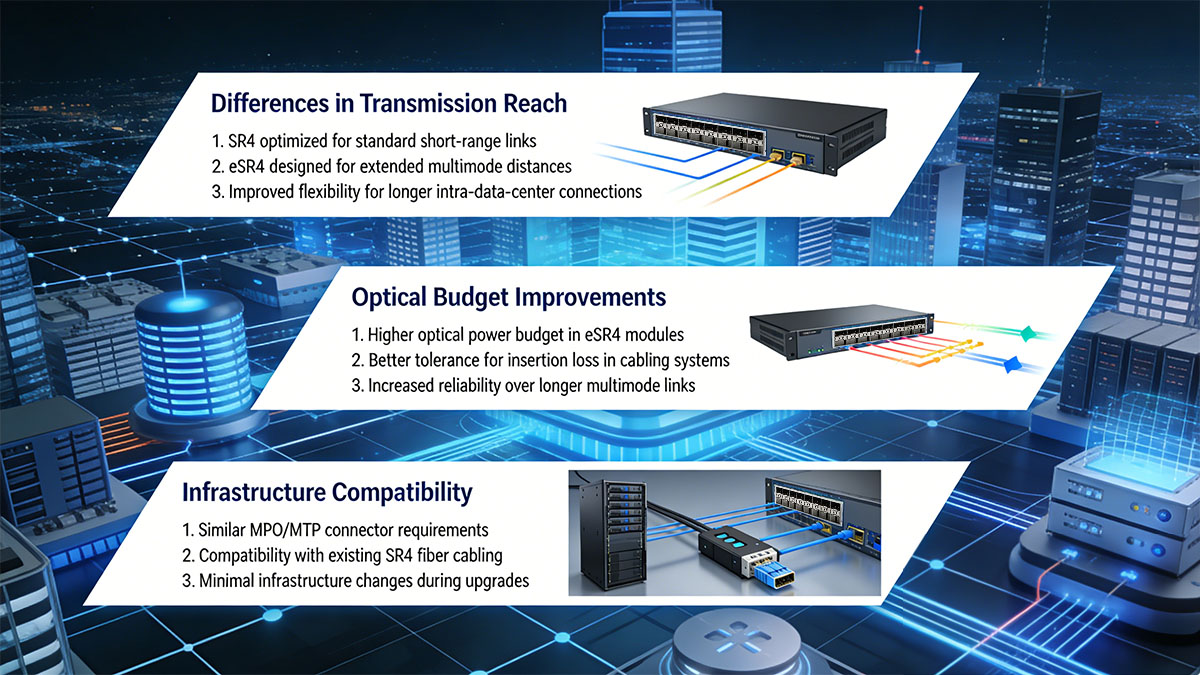
eSR4 provides longer transmission distances than standard SR4 QSFP transceiver under the same multimode fiber conditions, making it suitable for scenarios where SR4 links fall short.
| Optical Type |
Fiber Type |
Typical Reach Characteristic |
| SR4 |
OM3/OM4 |
Standard short-range reach |
| eSR4 |
OM3/OM4 |
Extended short-range reach |
This extended capability allows eSR4 to support longer intra-data-center connections without requiring changes to fiber type or connector interfaces.
In practical deployments, this means fewer constraints when designing link layouts across larger data halls or between rows.
Optical Budget and Signal Performance
eSR4 achieves its extended reach by improving the optical power budget, which directly impacts signal transmission quality over distance.
| Parameter |
SR4 Optics |
eSR4 Optics |
| Optical power budget |
Standard |
Enhanced |
| Receiver sensitivity |
Baseline |
Improved |
| Loss tolerance |
Limited |
Higher tolerance |
A higher optical budget enables eSR4 to better handle insertion loss from fiber optic connectors, patch panels, and longer fiber runs. This results in more stable link performance, especially in complex cabling environments.
Infrastructure Compatibility
eSR4 maintains full compatibility with SR4 physical infrastructure, making it easy to integrate into existing networks.
-
Uses the same MPO/MTP connector types
-
Supports the same multimode fiber standards (OM3, OM4, OM5)
-
Works within existing parallel optics architectures
Because there is no need to redesign the cabling system, upgrading from SR4 connectors to eSR4 connectors is typically a straightforward process focused on transceivers replacement.
This compatibility significantly reduces operational complexity while enabling longer link distances within the same physical network framework.
? Advantages of eSR4 Optical Technology
eSR4 optical technology provides a practical way to extend multimode network capabilities without changing the underlying infrastructure. Its main advantages come from improved reach, better utilization of existing cabling, and suitability for high-density 40G and 100G environments.
Extending the Usability of Multimode Fiber
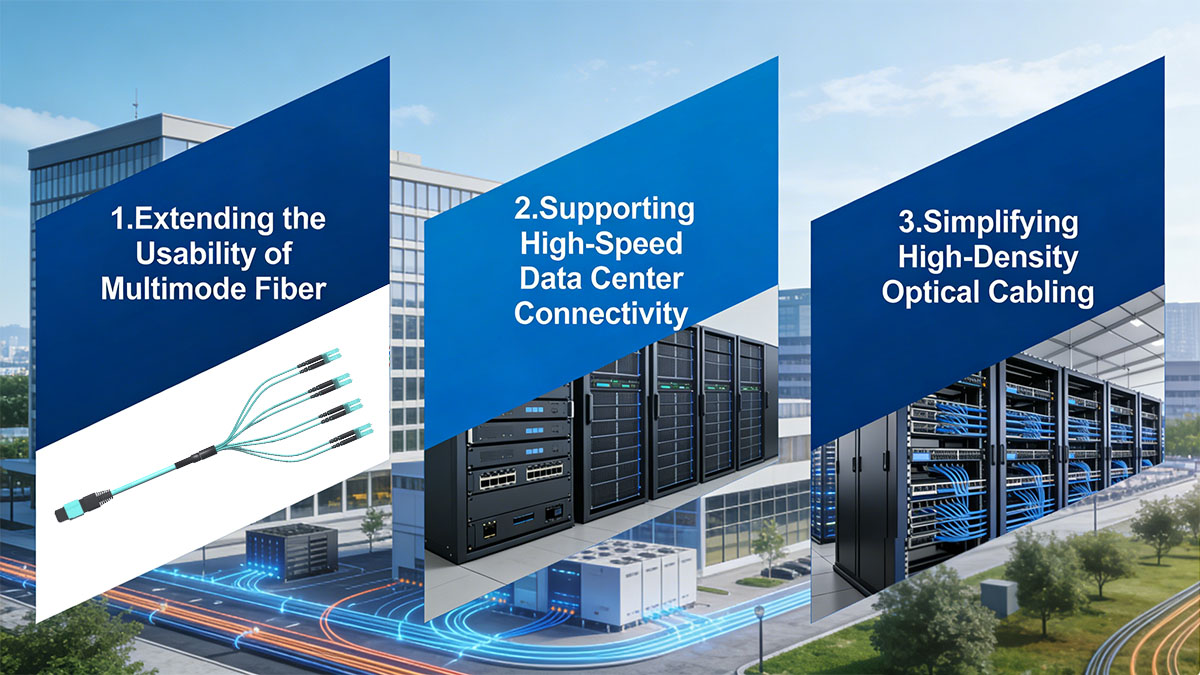
eSR4 allows existing multimode fiber systems to support longer link distances, reducing the need for immediate infrastructure upgrades.
| Aspect |
SR4 Optics |
eSR4 Optics |
| Typical reach |
Limited |
Extended |
| Fiber reuse |
Supported |
Fully optimized |
| Upgrade requirement |
Often needed |
Rarely required |
By extending the usable range of OM3 and OM4 fibers, eSR4 helps delay or avoid migration to single-mode fiber. This is especially valuable in data centers where large amounts of multimode cabling are already deployed.
In practical terms, organizations can continue leveraging their existing infrastructure while accommodating growing distance requirements.
Supporting High-Speed Data Center Connectivity
eSR4 is well suited for modern data center environments where 40G and 100G links are widely used for high-bandwidth connections.
-
Enables longer switch-to-switch links in leaf-spine architectures
-
Supports aggregation layers where distances exceed SR4 limits
-
Maintains high throughput without introducing new transmission complexity
This makes eSR4 a strong fit for environments with increasing east-west traffic, where link distances are no longer strictly confined to short ranges.
Simplifying High-Density Optical Cabling
eSR4 retains the parallel optics design of SR4, allowing it to integrate seamlessly into structured cabling systems.
| Feature |
Benefit |
| MPO/MTP interface |
Standardized high-density connectivity |
| Parallel transmission |
Efficient use of fiber strands |
| Consistent architecture |
Simplified deployment and scaling |
Because the cabling model does not change, network operators can scale port density without introducing new fiber types or connector systems.
This simplicity reduces deployment risk and helps maintain consistency across large-scale network environments, especially in data centers with high port counts and complex interconnections.
? Common Deployment Scenarios for eSR4 Optics
eSR4 optics are typically deployed in environments where standard SR4 reach is insufficient but existing multimode fiber optics must be preserved. They are especially effective in medium-distance, high-bandwidth scenarios within 40G and 100G networks.

Data Center Leaf-Spine Architectures
eSR4 is commonly used in leaf-spine topologies where link distances can exceed the limits of traditional SR4 optics.
-
Leaf-to-spine switch interconnections across rows or zones
-
Spine layer aggregation links requiring extended reach
-
East-west traffic flows that demand consistent high bandwidth
In larger data centers, the physical distance between racks and aggregation layers often grows beyond standard SR4 capabilities. eSR4 helps maintain multimode SR connectivity without redesigning the topology or introducing single-mode optics.
High-Density Switching Environments
In high-port-count switching environments, eSR4 enables flexible link design while maintaining performance and cabling consistency.
| Scenario |
SR4 Limitation |
eSR4 Advantage |
| Top-of-rack to aggregation |
Distance constrained |
Extended link coverage |
| Switch-to-switch links |
Limited flexibility |
Greater placement options |
| High-density port usage |
Tight layout limits |
More scalable connections |
By extending reach, eSR4 reduces constraints on equipment placement. This is particularly useful in modern data centers where optimizing rack layout and airflow often requires greater flexibility in link distances.
Enterprise and High-Performance Computing Networks
eSR4 is also widely applicable outside hyperscale data centers, particularly in enterprise and HPC environments where high-speed multimode links are required.
-
High-performance computing clusters with distributed nodes
-
Enterprise campus data centers with moderate link distances
-
Storage networks requiring stable, high-throughput connections
These environments often rely on multimode fiber for cost and simplicity reasons, but still require distances beyond standard SR4 limits. eSR4 provides a balanced solution by extending reach without increasing system complexity.
Across these scenarios, the key value of eSR4 lies in enabling longer multimode transceiver connections while preserving existing infrastructure, making it a practical choice for evolving 40G and 100G network designs.
? Cabling and Infrastructure Considerations
eSR4 optics are designed to work within existing multimode cabling systems, but achieving extended reach depends on proper connector selection, fiber quality, and link design. Careful evaluation of these factors ensures stable performance and maximizes the benefits of eSR4 deployment.
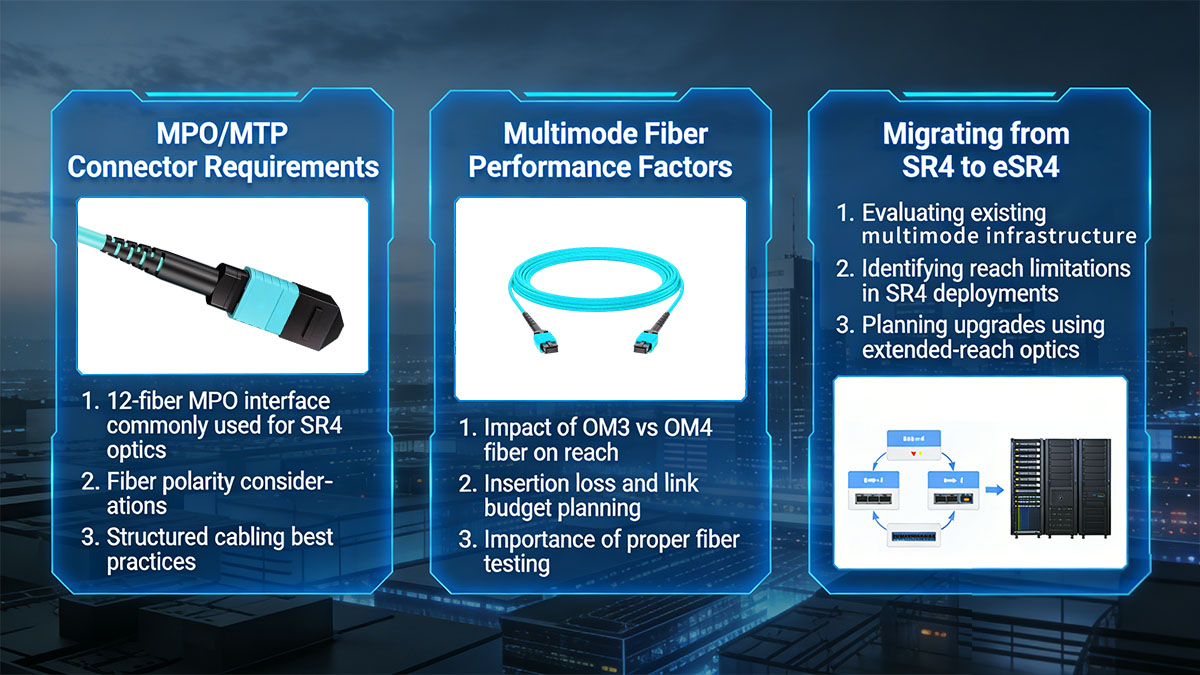
MPO/MTP Connector Requirements
eSR4 uses the same MPO/MTP-based parallel fiber interface as standard SR4, so correct connector selection and polarity management are essential for proper operation.
| Parameter |
Typical Requirement |
| Connector type |
MPO/MTP |
| Fiber count |
12-fiber (commonly used) |
| Active fibers |
8 fibers (4 Tx + 4 Rx) |
| Polarity method |
Method B or equivalent |
In most deployments, 12-fiber MPO connectors are used, even though only 8 fibers are active. Proper polarity configuration ensures that transmit and receive lanes are correctly aligned across the link.
Incorrect polarity or poor connector quality can introduce additional loss, which directly impacts the extended reach advantage of eSR4.
Multimode Fiber Performance Factors
The achievable distance of eSR4 links is strongly influenced by the quality and type of multimode fiber used.
| Factor |
Impact on Performance |
| Fiber grade (OM3/OM4/OM5) |
Higher grade enables longer reach |
| Insertion loss |
Higher loss reduces link distance |
| Connector quality |
Affects signal stability |
| Link cleanliness |
Impacts overall attenuation |
OM4 and OM5 fibers typically provide better performance due to lower attenuation and higher bandwidth, allowing eSR4 optics to reach longer distances compared to OM3.
Maintaining low insertion loss across patch panels and connectors is critical. Even small losses can accumulate and reduce the effective reach of the link.
Migrating from SR4 to eSR4
Transitioning from SR4 to eSR4 is generally straightforward because both technologies share the same physical and architectural foundation.
-
Evaluate current link distances and identify SR4 limitations
-
Measure insertion loss and verify fiber quality
-
Replace SR4 transceiver with eSR4 modules where additional reach is needed
-
Validate link performance after deployment
Because no changes to the fiber plant or connector system are required, migration focuses primarily on optical transceiver module upgrades.
This makes eSR4 a low-complexity solution for extending network reach while preserving existing multimode infrastructure investments.
? The Role of eSR4 in Short-Reach Optical Networking
eSR4 plays a transitional and optimization-focused role in short-reach optical networking by extending the practical limits of multimode fiber in 40G and 100G environments. Rather than replacing existing technologies, it enhances SR4-based deployments, allowing networks to scale in distance without increasing architectural complexity.
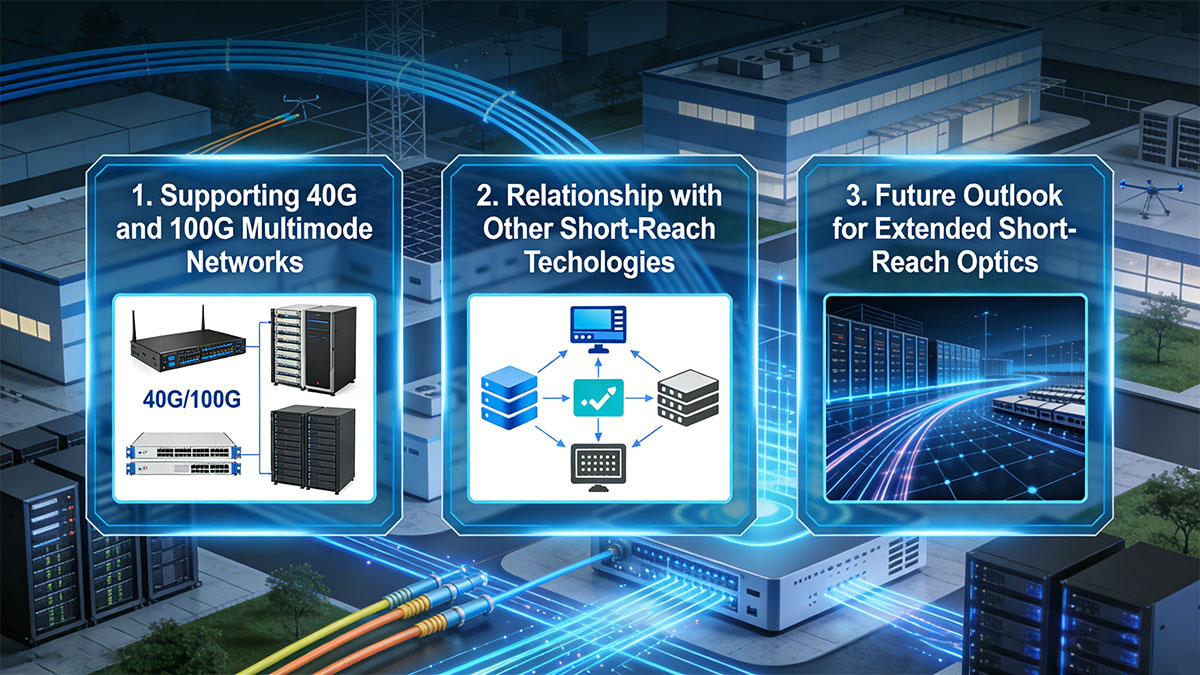
Supporting 40G and 100G Multimode Networks
eSR4 is primarily positioned to strengthen existing SR4 ecosystems by enabling longer connections within the same parallel optics framework.
| Network Type |
Typical Use Case |
eSR4 Contribution |
| 40G networks |
40G SR4 interconnections |
Extends link distance |
| 100G networks |
100G SR4 aggregation links |
Improves deployment flexibility |
| Mixed-speed environments |
Gradual network upgrades |
Maintains infrastructure continuity |
By extending reach, eSR4 allows network designers to maintain multimode architectures even as data center layouts grow larger and more distributed.
This is particularly relevant in environments where upgrading to single-mode fiber would introduce unnecessary cost and operational complexity.
Relationship with Other Short-Reach Technologies
eSR4 exists alongside other short-reach optical solutions, each designed for specific distance and infrastructure requirements.
| Technology |
Fiber Type |
Typical Positioning |
| SR4 |
Multimode fiber |
Standard short-range links |
| eSR4 |
Multimode fiber |
Extended short-range links |
| DR4 |
Single-mode fiber |
Medium-range connections |
| FR4 |
Single-mode fiber |
Longer short-to-mid range |
Compared to single-mode options such as DR4 and FR4, eSR4 focuses on maximizing the value of multimode deployments. It fills the gap between standard SR4 limitations and the need for longer but still relatively short-distance links.
This positioning allows network architects to select the most appropriate technology based on distance, cost, and existing infrastructure.
Future Outlook for Extended Short-Reach Optics
eSR4 is expected to remain relevant as long as multimode fiber continues to be widely deployed in data centers and enterprise networks.
-
Ongoing improvements in VCSEL efficiency and receiver sensitivity
-
Continued demand for cost-effective short-to-medium reach connectivity
-
Increasing need to optimize existing fiber infrastructure
While higher-speed technologies and single-mode solutions will continue to evolve, eSR4 addresses a persistent requirement: extending the life and capability of multimode networks without introducing unnecessary complexity.
In this context, eSR4 serves as a practical optimization layer within the broader evolution of short-reach optical networking.
? FAQs
What does eSR4 stand for?
eSR4 stands for Extended Short Reach 4-lane, referring to a parallel multimode optical technology designed to extend the transmission distance of standard SR4 links in 40G and 100G networks.
How is eSR4 different from standard SR4?
eSR4 uses the same parallel optics architecture as SR4 but offers a higher optical budget, allowing longer transmission distances over the same multimode fiber.
What fiber types are compatible with eSR4?
eSR4 works with OM3, OM4, and OM5 multimode fiber, with better performance and longer reach typically achieved on higher-grade fibers like OM4 and OM5.
Does eSR4 require new cabling infrastructure?
No, eSR4 is designed to operate over existing MPO/MTP-based multimode cabling systems, so infrastructure changes are usually not required.
What connector type is used in eSR4 optics?
eSR4 uses MPO/MTP connectors, typically with a 12-fiber interface where 8 fibers are actively used for transmission and reception.
Is eSR4 used in 400G networks?
No, eSR4 is mainly used in 40G and 100G SR4-based architectures. 400G networks typically use different standards such as 400G DR4, 400G FR4, or 400G SR8.
When should eSR4 be used instead of SR4?
eSR4 is suitable when link distances exceed standard SR4 limits but existing multimode fiber infrastructure needs to be preserved.
Can eSR4 replace single-mode optics?
No, eSR4 is not a replacement for SMF optics. It is designed for extended short-range applications within multimode environments, while single-mode optics are used for longer distances.
? Conclusion
eSR4 technology provides a practical solution for extending the reach of multimode optical networks in 40G and 100G environments. By enhancing the optical budget of traditional SR4 optics, it enables longer link distances while maintaining full compatibility with existing MPO-based infrastructure. This makes it especially valuable in data centers and enterprise networks where expanding coverage is necessary but replacing installed fiber is not desirable.
As network architectures continue to evolve and physical layouts grow more complex, the ability to optimize existing multimode deployments becomes increasingly important. eSR4 addresses this need by offering a balance between performance improvement and deployment simplicity, allowing organizations to scale efficiently without introducing unnecessary complexity.
For network planners seeking reliable extended-reach multimode solutions, exploring compatible eSR4 optical modules can be a practical next step. To learn more about available options and technical specifications, visit the LINK-PP Official Store for detailed product insights and deployment support.